Antimicrobial Susceptibility of Stenotrophomonas maltophilia Isolates from Korea, and the Activity of Antimicrobial
Combinations against the Isolates
The aim of this study was to determine antimicrobial susceptibility of recent clinical Stenotrophomonas maltophilia isolates from Korea, and to compare the activity levels of several combinations of antimicrobials. A total of 206 non-duplicate clinical isolates of S.
maltophilia was collected in 2010 from 11 university hospitals. Antimicrobial susceptibility testing was performed using the Clinical Laboratory Standards Institute agar dilution method. In vitro activity of antimicrobial combinations was tested using the checkerboard method. The susceptibility rates to trimethoprim-sulfamethoxazole and minocycline were 96% and 99%, respectively. The susceptibility rate to levofloxacin was 64%. All of four antimicrobial combinations showed synergy against many S. maltophilia isolates. A combination of trimethoprim-sulfamethoxazole plus ticarcillin-clavulanate was most synergistic among the combinations. None of the combinations showed antagonistic activity. Therefore, some of the combinations may be more useful than individual drugs in the treatment of S. maltophilia infection. Further clinical studies are warranted to validate our in vitro test results.
Key Words: Stenotrophomonas maltophilia; Combination Drug Therapy; Trimethoprim- Sulfamethoxazole; Ticarcillin-Clavulanate
Hae-Sun Chung,1 Seong Geun Hong,2 Young Ree Kim,3 Kyeong Seob Shin,4 Dong Hee Whang,5 Jee Young Ahn,6 Yeon-Joon Park,7 Young Uh,8 Chulhun L. Chang,9 Jong Hee Shin,10 Hye Soo Lee,11 Kyungwon Lee,1 and Yunsop Chong1
1Department of Laboratory Medicine and Research Institute of Antimicrobial Resistance, Yonsei University College of Medicine, Seoul; 2Department of Laboratory Medicine, CHA Bundang Medical Center, CHA University, Seongnam; 3Department of Laboratory Medicine, Jeju National University School of Medicine, Jeju; 4Department of Laboratory Medicine, Chungbuk National University College of Medicine, Cheongju; 5Department of Laboratory Medicine, Inje University College of Medicine, Seoul;
6Department of Laboratory Medicine,
Sooncheonhyang University College of Medicine, Gumi; 7Department of Laboratory Medicine, The Catholic University of Korea College of Medicine, Seoul; 8Department of Laboratory Medicine, Yonsei University Wonju College of Medicine, Wonju;
9Department of Laboratory Medicine, Pusan National University School of Medicine, Busan;
10Department of Laboratory Medicine, Chonnam National University Medical School, Gwangju;
11Department of Laboratory Medicine, Chonbuk National University Medical School, Jeonju, Korea Received: 24 July 2012
Accepted: 15 November 2012 Address for Correspondence:
Seong Geun Hong, MD
Department of Laboratory Medicine, CHA Bundang Medical Center, CHA University, 59 Yatap-ro, Bundang-gu, Seongnam 463-712, Korea
Tel: +82.31-780-5463, Fax: +82.31-780-5476 E-mail: [email protected]
This research was supported by the Happy Tech. Program through the National Research Foundation of Korea (NRF) funded by the Ministry of Education, Science and Technology (grant number 20110004679).
http://dx.doi.org/10.3346/jkms.2013.28.1.62 • J Korean Med Sci 2013; 28: 62-66
INTRODUCTION
Stenotrophomonas maltophilia is an environmental global emerging Gram-negative multiple-drug-resistant organism that is most commonly associated with respiratory infections (1).
Isolation of S. maltophilia from human specimens may repre-
sent colonization rather than infection. Although not highly virulent, S. maltophilia can infect immunocompromised hosts and hospitalized patients being predisposed to infection (2).
The mortality rates ranged from 14% to 69% in patients with bac- teremia by S. maltophilia (3, 4). S. maltophilia exhibits high-level intrinsic resistance to a broad spectrums of antibiotics, includ-
ing β-lactams, quinolones, aminoglycosides, tetracycline, disin- fectants, and heavy metals (5, 6). S. maltophilia can also acquire resistance through the uptake of resistance genes located inte- grons, transposons, and plasmids (7). Therefore, infections caused by S. maltophilia are particularly difficult to manage be- cause they show resistance to many classes of antimicrobial agents. The recommended therapeutic agents for S. maltophila infection is trimethoprim-sulfamethoxazole by the evidences of case reports and in vitro susceptibility studies (2). Recently, com- binations of antimicrobials have been recommended as treat- ment for S. maltophilia infection, especially in severe septic, neuropenic, debilitated or immunocompromised patients, or when trimethoprim-sulfamethoxazole cannot be used or toler- ated (2, 8, 9). However, there is no study focused on the antimi- crobial activity of the antibiotics combinations to S. maltophilia in Korea.
The aim of this study was to determine antimicrobial suscep- tibility of recent clinical S. maltophilia isolates from Korea, and to compare the activity levels of several combinations of anti- microbials.
MATERIALS AND METHODS Bacterial strains
A total of 206 non-duplicate clinical isolates of S. maltophilia were collected in 2010 from 11 university hospitals. The species were identified using conventional methods and/or the VITEK2 system (bioMerieux, Marcy l’Etoile, France). Among the 206 isolates, 30 were selected for the checkerboard method based on susceptibility: 10 isolates with resistant to trimethoprim-sul- famethoxazole, 26 with resistant to ceftazidime, 22 with nonsu- ceptible to ticarcillin-clavulanate, and 25 with nonsusceptible to levofloxacin.
Antimicrobial susceptibility test
Antimicrobial susceptibility testing was performed using the CLSI agar dilution method (10). The antimicrobial agents used were trimethoprim-sulfamethoxazole (Dong Wha, Seoul, Korea),
levofloxacin (Daiichi, Tokyo, Japan), moxifloxacin (Bayer Korea, Seoul, Korea), minocycline (SK Chemicals Life Science, Seoul, Korea), tigecycline (Wyeth Research, Pearl River, NY, USA), cef- tazidime (Sigma Chemical, St. Louis, MO, USA), ticarcillin-cla- vulanate (Dong-A, Yongin, Korea), chloramphenicol (Chong Kun Dang, Seoul, Korea), and amikacin (Sigma Chemicals). The breakpoints recommended by CLSI for S. maltophilia were ap- plied to interpret the minimum inhibitory concentrations (MICs) (10). Escherichia coli ATCC 25922 and Pseudomonas aeruginosa ATCC 27853 were used as controls.
In vitro activity of antimicrobial combinations
In vitro activity of antimicrobial combinations was tested by the checkerboard method. The antimicrobial combinations tested were trimethoprim-sulfamethoxazole + ticarcillin-clavulanate, levofloxacin + ceftazidime, ceftazidime + amikacin, and ticar- cillin-clavulanate + amikacin. Fractional inhibitory concentra- tion (FIC) index was calculated according to the following for- mula:
FICA=MIC of A in combination MIC of A alone FICB=MIC of B in combination
MIC of B alone FIC index = FICA + FICB
The FIC indices were interpreted as follows: ≤ 0.5, synergis- tic; > 0.5 to 4, indifferent; > 4, antagonistic (11).
RESULTS
Antimicrobial susceptibility test
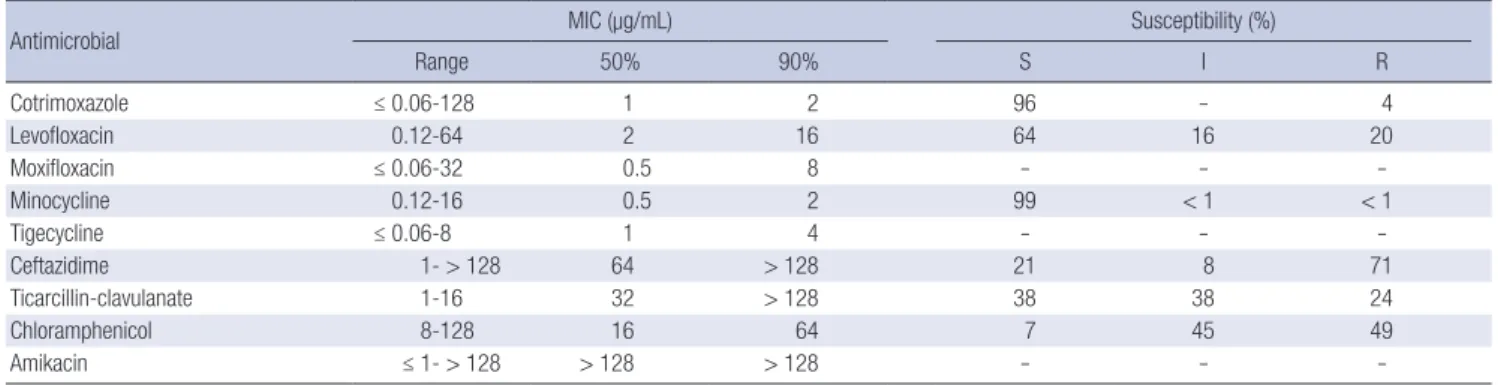
MIC ranges, MIC50s, MIC90s, and the percentages of resistant isolates for various antimicrobial agents are shown in Table 1.
The MIC of trimethoprim-sulfamethoxazole ranged from ≤ 0.06 to 128 μg/mL, and the MIC50 and MIC90 were 1 and 2 μg/mL, respectively. The susceptibility rate was 96%. The MIC of levo- floxacin ranged from 0.12 to 64 μg/mL, and the MIC50 and MIC90
Table 1. Antimicrobial activity of various antimicrobial agents against S. maltophilia by the agar dilution method
Antimicrobial MIC (µg/mL) Susceptibility (%)
Range 50% 90% S I R
Cotrimoxazole ≤ 0.06-128 1 2 96 - 4
Levofloxacin 0.12-64 2 16 64 16 20
Moxifloxacin ≤ 0.06-32 0.5 8 - - -
Minocycline 0.12-16 0.5 2 99 < 1 < 1
Tigecycline ≤ 0.06-8 1 4 - - -
Ceftazidime 1- > 128 64 > 128 21 8 71
Ticarcillin-clavulanate 1-16 32 > 128 38 38 24
Chloramphenicol 8-128 16 64 7 45 49
Amikacin ≤ 1- > 128 > 128 > 128 - - -
S, susceptible; I, intermediate; R, resistant.
were 2 and 16 μg/mL, respectively, which were higher than those of moxifloxacin (0.5 and 8 μg/mL, respectively). The resistance rate to levofloxacin was 20%. The MIC50 and MIC90 of minocy- cline were 0.5 and 2 μg/mL, respectively, and only one isolate was resistant to minocycline (the resistance rate < 1%). The MICs of tigecycline ranged from ≤ 0.06 to 8 μg/mL, and the MIC50 and MIC90 were 1 and 4 μg/mL, respectively, which were two-fold higher than those of minocycline. The MIC50 of amikacin was
> 128 μg/mL. The MIC50 of ceftazidime 64 μg/mL and the resis- tance rate was 71%. The MIC50 of ticarcillin-clavulanate was 32 μg/mL and the resistance rate was 24%. The MIC range of chlor- amphenicol was 8-128 μg/mL, the MIC50 and MIC90 were 16 and 64 μg/mL, restectively. The resistance rate to chloramphenicol was 49%.
In vitro activity of antimicrobial combinations
All of four antimicrobial combinations showed synergy against many S. maltophilia isolates. A combination of trimethoprim- sulfamethoxazole plus ticarcillin-clavulanate was most syner- gistic among the combinations. FIC index of a combination of ticarcillin-clavulanate plus amikacin was 0.38 for 50% of S. malto- philia isolates. None of the combinations showed antagonistic activity (Table 2). The FIC index for synergistic S. maltophilia ranged 0.09 to 0.5.
Antimicrobial combinations of trimethoprim-sulfamethoxa- zole plus ticarcillin-clavulanate, ceftazidime plus amikacin, and ticarcillin-clavulanate plus amikacin were synergistic for major- ity of trimethoprim-sulfamethoxazole-resistant isolates. Trime- thoprim-sulfamethoxazole plus ticarcillin-clavulanate demon- strated synergy for the four trimethoprim-sulfamethoxazole- resistant isolates with high MIC levels of trimethoprim-sulfa- methoxazole (≥ 64 μg/mL), but MIC values of trimethoprim- sulfamethoxazole did not decrease below susceptibility break- points (16-32 μg/mL ). On the other hand, synergistic FICs were not found against the two trimethoprim-sulfamethoxazole-re- sistant isolates with low MIC levels of trimethoprim-sulfamethox- azole (4 μg/mL), but MICs of trimethoprim-sulfamethoxazole in combination with ticarcillin-clavulanate were within suscep- tible range. Trimethoprim-sulfamethoxazole MICs of trime- thoprim-sulfamethoxazole-susceptible isolates for trimetho- prim-sulfamethoxazole plus ticarcillin-clavulanate became 2 to 8-fold lower than those used alone (data not shown).
DISCUSSION
Trimethoprim-sulfamethoxazole showed the lowest MIC90 (2 μg/mL) and the isolates showed a high susceptibility rate of 96%
to this agent. Trimethoprim-sulfamethoxazole is still consid- ered the treatment of choice for suspected or culture-proven S.
maltophilia infections. Resistance rates to trimethoprim-sulfa- methoxazole have been reported to vary geographically, which were generally less than 10% (2, 12, 13). In this study, all hospi- tals showed low resistance rate of 5%-10% except one hospital (26%). Some studies with isolates from cystic fibrosis patients and from some Asian countries, such as Taiwan and Turkey, showed high resistance rates (31.3%-100%) (13-25).
In this study, the resistance rate to levofloxacin was 20%, which was higher than the rates of 3% to 11% seen in previous studies (13, 20, 21, 26). Especially, three of hospitals showed high resis- tance rates over 30%. MIC90 of levofloxacin was also higher than our previous study (27). Moxifloxacin was more active than levo- floxacin considering low MICs. Moxifloxacin could be suggest- ed as an alternative to levofloxacin. Further clinical studies are necessary to evaluate the effectiveness of moxifloxacin in treat- ing S. maltophilia infections, because there is little data pub- lished on the clinical efficacy of moxifloxacin.
The tetracycline derivatives minocycline and tigecycline have shown good in vitro activity against clinical isolates of S. malto- philia, but there is little clinical data for treating S. maltophilia infections (28, 29). In this study, two isolates were intermediate and one isolate were resistant to minocycline. But, minocycline shows highest in vitro activity against S. maltophilia strains, and this data was similar to that of Taiwan, Brazil, Spain, and the USA (16, 21, 22, 30). MICs of tigecycline ranged from ≤ 0.06 to 8 μg/
mL, and MIC50 and MIC90 were 1 and 4 μg/mL, respectively. An- timicrobial susceptibilities of a worldwide collection of 1,586 S.
maltophilia tested against tigecycline, MIC50 and MIC90 of tige- cycline were 0.5 and 2 μg/mL (31). The tigecycline in vitro sur- veillance in Taiwan collected a total of 903 S. maltophilia, MIC range of tigecycline was from 0.13 to 16 μg/mL, and MIC50 and MIC90 were 2 and 4 μg/mL (32).
The rates of susceptibility to ceftazidime and ticarcillin-cla- vulanate were similar with other studies (13-25). The β-lactams and/or β-lactamase inhibitor combinations show little activity against S. maltophilia, because the organism has a high intrin-
Table 2. Activities of antimicrobial combinations against S. maltophilia
Antimicrobial combinations Syn (%) Ind (%) Ant (%) FIC*
Range 50% 90%
Cotrimoxazole + ticarcillin-clavulanate 19 (66) 10 (34) 0 (0) 0.16-1.13 0.5 0.75
Levofloxacin + Ceftazidime 10 (34) 19 (66) 0 (0) 0.09-1 0.56 0.75
Ceftazidime + amikacin 15 (52) 14 (48) 0 (0) 0.13-1 0.5 1
Ticarcillin-clavulanate + amikacin 18 (60) 12 (40) 0 (0) 0.16-0.75 0.38 0.75
*50% and 90%, FICs for 50% and 90% of the isolates, respectively. Syn, Synergistic; Ind, indifferent; Ant, antagonistic; FIC, fractional inhibitory concentration.
sic resistance to most penicillins and cephalosporins, and to all carbapenems (7). Chloramphenicol showed similar resistant rate with previous reports, but much lower susceptibility rate due to high intermediate rate (45%) (15, 19, 21, 23).
Considering of the highest MIC, amikacin demonstrated the least active drug to S. maltophilia among the tested drugs. The aminoglycosides show poor activity against S. maltophilia be- cause of high intrinsic resistance and therefore is not useful in monotherapy (7).
Because of historical evidence, case reports and high in vitro susceptibility rates, cotrimoxazole is usually considered the treat- ment of choice for S. maltophilia infection (2). However, increas- ing resistance to cotrimoxazole and the alternate antimicrobials may cause problems for the empirical treatment of S. maltophilia infections. Therefore, combination therapy may be indicated in the setting of severe sepsis, neutropenia or polymicrobial infec- tions, but clinical evidence is still lacking (2, 7). Combination therapy may be more practical when cotrimoxazole therapy is contraindicated. We assessed the activity of four antimicrobial combinations by the checkerboard method, since these combi- nations had been reported to have synergistic effects to S. malto- philia (7). Synergistic effect was demonstrated by all combina- tions (34%-66%) (Table 2). Synergy for trimethoprim-sulfame- thoxazole resistant S. maltophilia isolates were shown by trime- thoprim-sulfamethoxazole plus ticarcillin-clavulanate (4/6), ceftazidime plus amikacin (4/6), and ticarcillin-clavulanate plus amikacin (5/6).
Poulos et al. (33) demonstrated synergy between trimetho- prim-sulfamethoxazole and ticarcillin-clavulanic acid by the chequerboard method and by the time-kill assay in 19 different trimethoprim-sulfamethoxazole-resistant strains. In our study, synergistic activities by trimethoprim-sulfamethoxazole plus ticarcillin-clavulanate were shown in 67% of trimethoprim-sul- famethoxazole-resistant S. maltophilia, MIC values of trime- thoprim-sulfamethoxazole were not decreased below suscepti- ble breakpoint. Likewise, other antimicrobial combinations (cef- tazidime plus amikacin, ticarcillin-clavulanate plus amikacin) were synergistic, MIC value of each antibiotic agent sometimes was not clearly decreased (data not shown). Antibiotics for com- bination therapy should be chosen on the basis of in vitro sus- ceptibility test (7). Therefore, it is uncertain and needs to be eval- uated that combination therapy with trimethoprim-sulfame- thoxazole plus ticarcillin-clavulanate inhibit the growth in vivo of trimethoprim-sulfamethoxazole resistant S. maltophilia.
Although the choice of monotherapy or combination therapy is a controversial issue, several authors suggest combination treatment, especially in patients at risk (2, 7). Synergy testing may help determine the most appropriate combination in each special setting, but the problem is a lack of standardization of the techniques to determine synergy (34). Clinical data of in vivo combination therapy should be warranted.
ACKNOWLEDGMENTS
The microorgnisms were provided by the National Biobank of Korea - Chonbuk National University Hospital, which is sup- ported by the Ministry of Health, Welfare and Family Affairs. All materials derived from the National Biobank of Korea were ob- tained with informed consent under institutional review board- approved protocols. The authors have no conflicts of interest to disclose.
REFERENCES
1. Brooke JS. Stenotrophomonas maltophilia: an emerging global oppor- tunistic pathogen. Clin Microbiol Rev 2012; 25: 2-41.
2. Abbott IJ, Slavin MA, Turnidge JD, Thursky KA, Worth LJ. Stenotroph- omonas maltophilia: emerging disease patterns and challenges for treat- ment. Expert Rev Anti Infect Ther 2011; 9: 471-88.
3. Jang TN, Wang FD, Wang LS, Liu CY, Liu IM. Xanthomonas maltophilia bacteremia: an analysis of 32 cases. J Formos Med Assoc 1992; 91: 1170-6.
4. Victor MA, Arpi M, Bruun B, Jonsson V, Hansen MM. Xanthomonas maltophilia bacteremia in immunocompromised hematological patients.
Scand J Infect Dis 1994; 26: 163-70.
5. Zhang L, Li XZ, Poole K. Multiple antibiotic resistance in Stenotroph- omonas maltophilia: involvement of a multidrug efflux system. Antimi- crob Agents Chemother 2000; 44: 287-93.
6. Alonso A, Martinez JL. Multiple antibiotic resistance in Stenotroph- omonas maltophilia. Antimicrob Agents Chemother 1997; 41: 1140-2.
7. Looney WJ, Narita M, Muhlemann K. Stenotrophomonas maltophilia:
an emerging opportunist human pathogen. Lancet Infect Dis 2009; 9:
312-23.
8. Liaw SJ, Teng LJ, Hsueh PR, Ho SW, Luh KT. In vitro activities of anti- microbial combinations against clinical isolates of Stenotrophomonas maltophilia. J Formos Med Assoc 2002; 101: 495-501.
9. Muder RR, Harris AP, Muller S, Edmond M, Chow JW, Papadakis K, Wagener MW, Bodey GP, Steckelberg JM. Bacteremia due to Stenotro- phomonas (Xanthomonas) maltophilia: a prospective, multicenter study of 91 episodes. Clin Infect Dis 1996; 22: 508-12.
10. Clinical Laboratory and Standards Institute. Performance Standards for Antimicrobial Susceptibility Testing; Twenty-first Informational Supple- ment. Wayne, 2011.
11. Odds FC. Synergy, antagonism, and what the chequerboard puts be- tween them. J Antimicrob Chemother 2003; 52: 1.
12. Gales AC, Jones RN, Forward KR, Linares J, Sader HS, Verhoef J. Emerg- ing importance of multidrug-resistant Acinetobacter species and Steno- trophomonas maltophilia as pathogens in seriously ill patients: geograph- ic patterns, epidemiological features, and trends in the SENTRY Antimi- crobial Surveillance Program (1997-1999). Clin Infect Dis 2001; 32 Suppl 2: S104-13.
13. Sader HS, Jones RN. Antimicrobial susceptibility of uncommonly isolat- ed non-enteric Gram-negative bacilli. Int J Antimicrob Agents 2005; 25:
95-109.
14. Fedler KA, Biedenbach DJ, Jones RN. Assessment of pathogen frequency and resistance patterns among pediatric patient isolates: report from the 2004 SENTRY Antimicrobial Surveillance Program on 3 continents.
Diagn Microbiol Infect Dis 2006; 56: 427-36.
15. Laing FP, Ramotar K, Read RR, Alfieri N, Kureishi A, Henderson EA, Louie TJ. Molecular epidemiology of Xanthomonas maltophilia coloni- zation and infection in the hospital environment. J Clin Microbiol 1995;
33: 513-8.
16. Wang WS, Liu CP, Lee CM, Huang FY. Stenotrophomonas maltophilia bacteremia in adults: four years’ experience in a medical center in north- ern Taiwan. J Microbiol Immunol Infect 2004; 37: 359-65.
17. San Gabriel P, Zhou J, Tabibi S, Chen Y, Trauzzi M, Saiman L. Antimi- crobial susceptibility and synergy studies of Stenotrophomonas malto- philia isolates from patients with cystic fibrosis. Antimicrob Agents Che- mother 2004; 48: 168-71.
18. Saiman L, Chen Y, Gabriel PS, Knirsch C. Synergistic activities of macro- lide antibiotics against Pseudomonas aeruginosa, Burkholderia cepa- cia, Stenotrophomonas maltophilia, and Alcaligenes xylosoxidans iso- lated from patients with cystic fibrosis. Antimicrob Agents Chemother 2002; 46: 1105-7.
19. Betriu C, Sanchez A, Palau ML, Gomez M, Picazo JJ. Antibiotic resistance surveillance of Stenotrophomonas maltophilia, 1993-1999. J Antimicrob Chemother 2001; 48: 152-4.
20. Zhanel GG, DeCorby M, Nichol KA, Wierzbowski A, Baudry PJ, Karlowsky JA, Lagace-Wiens P, Walkty A, Mulvey MR, Hoban DJ. Antimicrobial susceptibility of 3931 organisms isolated from intensive care units in Canada: Canadian National Intensive Care Unit Study, 2005/2006. Di- agn Microbiol Infect Dis 2008; 62: 67-80.
21. Valdezate S, Vindel A, Loza E, Baquero F, Canton R. Antimicrobial sus- ceptibilities of unique Stenotrophomonas maltophilia clinical strains.
Antimicrob Agents Chemother 2001; 45: 1581-4.
22. Vartivarian S, Anaissie E, Bodey G, Sprigg H, Rolston K. A changing pat- tern of susceptibility of Xanthomonas maltophilia to antimicrobial agents:
implications for therapy. Antimicrob Agents Chemother 1994; 38: 624-7.
23. Nicodemo AC, Araujo MR, Ruiz AS, Gales AC. In vitro susceptibility of Stenotrophomonas maltophilia isolates: comparison of disc diffusion, Etest and agar dilution methods. J Antimicrob Chemother 2004; 53:
604-8.
24. Weiss K, Restieri C, De Carolis E, Laverdiere M, Guay H. Comparative activity of new quinolones against 326 clinical isolates of Stenotroph- omonas maltophilia. J Antimicrob Chemother 2000; 45: 363-5.
25. Travassos LH, Pinheiro MN, Coelho FS, Sampaio JL, Merquior VL, Marques EA. Phenotypic properties, drug susceptibility and genetic re- latedness of Stenotrophomonas maltophilia clinical strains from seven hospitals in Rio de Janeiro, Brazil. J Appl Microbiol 2004; 96: 1143-50.
26. Wu H, Wang JT, Shiau YR, Wang HY, Yang Lauderdale TL, Chang SC. A multicenter surveillance of antimicrobial resistance on Stenotrophomonas maltophilia in Taiwan. J Microbiol Immunol Infect 2012; 45: 120-6.
27. Chung HS, Hong SG, Lee Y, Kim M, Yong D, Jeong SH, Lee K, Chong Y.
Antimicrobial susceptibility of Stenotrophomonas maltophilia isolates from a Korean tertiary care hospital. Yonsei Med J 2012; 53: 439-41.
28. Belvisi V, Fabietti P, Del Borgo C, Marocco R, Di Vincenzo E, Soscia F, Mastroianni CM. Successful treatment of Stenotrophomonas maltophil- ia soft tissue infection with tigecycline: a case report. J Chemother 2009;
21: 367-8.
29. Blanquer D, De Otero J, Padilla E, Gomez F, Mayol A, Irigaray R, Espejo P, Rada MA, Makrantoni G, Perez AR. Tigecycline for treatment of nosoco- mial-acquired pneumonia possibly caused by multi-drug resistant strains of Stenotrophomonas maltophilia. J Chemother 2008; 20: 761-3.
30. Galles AC, Jones RN, Sader HS. Antimicrobial susceptibility profile of contemporary clinical strains of Stenotrophomonas maltophilia isolates:
can moxifloxacin activity be predicted by levofloxacin MIC results? J Chemother 2008; 20: 38-42.
31. Farrell DJ, Sader HS, Jones RN. Antimicrobial susceptibilities of a world- wide collection of Stenotrophomonas maltophilia isolates tested against tigecycline and agents commonly used for S. maltophilia infections. An- timicrob Agents Chemother 2010; 54: 2735-7.
32. Chen YH, Lu PL, Huang CH, Liao CH, Lu CT, Chuang YC, Tsao SM, Chen YS, Liu YC, Chen WY. Trends in the susceptibility of clinically im- portant resistant bacteria to tigecycline: results from the Tigecycline In Vitro Surveillance in Taiwan study, 2006 to 2010. Antimicrob Agents Chemother 2012; 56: 1452-7.
33. Poulos CD, Matsumura SO, Willey BM, Low DE, McGeer A. In vitro ac- tivities of antimicrobial combinations against Stenotrophomonas (Xan- thomonas) maltophilia. Antimicrob Agents Chemother 1995; 39: 2220-3.
34. Gulmez D, Cakar A, Sener B, Karakaya J, Hascelik G. Comparison of dif- ferent antimicrobial susceptibility testing methods for Stenotrophomon- as maltophilia and results of synergy testing. J Infect Chemother 2010;
16: 322-8.