• 검색 결과가 없습니다.

The Influence of Scapular-Pelvic Patterns of Proprioceptive Neuromuscular Facilitation on Hemiplegic Gait -A Case Report-

N/A
N/A
Protected

Academic year: 2021

Share "The Influence of Scapular-Pelvic Patterns of Proprioceptive Neuromuscular Facilitation on Hemiplegic Gait -A Case Report-"

Copied!
6
0
0

로드 중.... (전체 텍스트 보기)

전체 글

(1)

| Abstract |

Purpose: This study examined changes in gait speed and stride length after an intervention involving simultaneous scapular and pelvic patterns of proprioceptive neuromuscular facilitation in a hemiplegic patient.

Methods: A 58-year-old woman with left hemiplegia who had complained of slowness of gait speed and weakness of leg strength took part in an intervention involving scapular postdepression patterns on the affected side and pelvic postdepression patterns on the nonaffected side. The intervention was performed with the patient lying on her left side, in a half kneeling position, and in a standing posture. Rhythmic initiation was used for teaching the movements to the patient and improvement of kinesthesia, and a combination of isotonic was employed for increasing strength and irradiation of the scapula and pelvic movement. The intervention took place for 30 min. It was implemented twice a day, 5 days a week, for 3 weeks. After three repetitions, the average time taken to complete the 10-m walk test (10 MWT), in addition to stride length, was measured to determine gait speed.

Results: After the 3-week program, the patient’s performance in the 10 MWT improved from 21.7sec to 17.1sec, and her stride length improved from 31.4cm to 38.7cm.

Conclusion: The results showed that trunk movement exercise, especially coordinative movements of the scapula and pelvis can improve gait speed and stride length by increasing trunk stability and mobility. A combination of pelvic and scapular patterns can facilitate trunk rotation, thereby improving gait speed and stride length.

Key Words: Gait speed, Scapular- pelvic patterns, Stride length

†Corresponding Author : Jae-Won Choi ([email protected])

Case Study Open Access

PNF 어깨뼈-골반 패턴이 편마비 환자의 보행에 미치는 영향 -증례보고-

최재원

⋅황신필

11)

초이스자세교정운동센터,

1

동서한방병원 재활치료센터

The Influence of Scapular-Pelvic Patterns of

Proprioceptive Neuromuscular Facilitation on Hemiplegic Gait

-A Case Report-

Jae-Won Choi

⋅Sin-Pil Hwang

1

Choi’s postural control & motor learning Institute

1
Rehabilitation center, Donseo Hospital

Received: December 6, 2017 / Revised: February 23, 2018 / Accepted: February 23, 2018

ⓒ 2018 Journal of Korea Proprioceptive Neuromuscular Facilitation Association

This is an Open Access article distributed under the terms of the Creative Commons Attribution Non-Commercial License

(http://creativecommons.org/licenses/by-nc/3.0) which permits unrestricted non-commercial use, distribution, and reproduction

in any medium, provided the original work is properly cited.

(2)

Ⅰ. 서 론

뇌졸중(stroke)환자의 물리치료를 통한 재활에는 대 표적으로 고유수용성신경근촉진법, 브룬스트롬, 보 바스 접근법과 같은 신경근촉진법들이 사용되고 있으 며, 이러한 신경근촉진법들은 뇌손상으로 인한 편마 비 환자들의 마비측 사지의 수의적 움직임을 향상시 켜 기능을 증진하는데 중점을 두고 있다(Refshauge et al., 2005).

임상에서 사용되고 있는 신경근촉진법을 이용한 치 료 방법 중 특히 고유수용성신경근촉진법 (proprioceptive neuromuscular facilitation, PNF)은 고유수용성감각, 표재 감각 , 시각과 청각 자극을 이용하여 운동 및 기능을 증가 시키는 것이 특징이며, 근육군의 강화(촉진)와 이완(억 제 )을 위해 고유수용기를 자극하여 기능을 향상시키고 운동의 정상패턴이나 자세반응과 보행 능력의 회복 및 강화를 위해 뇌졸중환자에게 광범위하게 적용되고 있 다 (O’Sulivan & Schmize, 2001). PNF는 환자의 기능 회복 을 촉진하기 위해 마비 측 사지를 능동적으로 사용하게 하여 일상생활동작을 개선할 수 있으며 체중 이동과 체중 부하 훈련을 통해 균형과 운동 조절능력을 향상시 키며 , 보행의 속도 및 마비 측과 비 마비 측의 대칭성을 강화하는 치료를 적용하여 기능적 독립성을 향상시킬 수 있다(Eng et al., 2003).

PNF 패턴을 이용한 운동은 근육의 고유수용기를 자극하고 정상반응을 촉진하여 근 길이나 장력에 대 하여 구심성 흥분을 발산하는 근방추와 골지건기관 등 고유수용성 감각을 자극하여 근작용을 증가시킬 수 있고, 특히 발목관절 발바닥 쪽 굽힘과 무릎관절 굽힘 근 그리고 엉덩관절 굽힘근을 동시에 촉진시키 는 PNF 하지 굽힘 패턴을 적용하여 보행에서 유각기 동작이 향상되었다고 하였다(Ma et al., 2008). 또한 패턴을 결합하여 동시에 적용하였을 경우에는 더 큰 힘을 발휘시켜 근 활성도 및 안정성에 많은 영향을 준다고 하였고, 여러 가지 패턴을 통합하여 보행을 분석하고 치료하기 위해 동시에 적용할 수 있는 기법 으로 달리기(sprint)와 스케이트(skate)를 타는 사람의

패턴을 소개하였는데 이러한 패턴의 결합은 체간의 안정성과 근력 , 사지의 고유수용성감각 및 보행 능력 을 증진시킨다고 하였다(Dietz, 2008). 달리는 사람 (sprinter) 동작은 동측 상지의 굽힘 패턴과 동측 하지의 폄 패턴의 결합으로 볼 수 있는데 이를 적용하였을 경우 하지패턴만 적용한 운동보다 신체의 비대칭성 감소와 체간의 안정성을 증가시켜 균형 및 보행 향상 에 더 많은 도움을 주었다고 하였다(Choi, 2011).

뇌졸중 환자의 체간의 정렬과 안정성 증가는 균형 및 보행의 향상을 기대할 수 있다. 체간 운동은 자세반 응과 조절에서 신체의 중심역할을 하며, 균형 소실 없이 다양한 일상생활에서 체간을 조절할 수 있는 능 력은 매우 중요하다(Dean & Shepherd, 1997).

보행에서 체간의 적절한 근력과 지구력은 매우 중 요하며, 복근과 체간근은 체간하부 안정성과 관계가 있고, 체간의 움직임과 자세조절에 중요하다고 하였 다(Hodges et al., 2002). 또한 정상보행은 체중심의 수직 , 수평 혹은 측방의 위치변화를 통해 이루어지는 데 인체에 있어서 체중심은 성인을 기준으로 신체 정중선상의 발에서부터 신장의 55% 점에 위치하고 있으며, 개인차가 있으나 골반의 제2 엉치뼈(sacrum) 앞에 있다(Bae et al., 2012). 골반은 체중심의 이동을 위한 보행패턴의 조절에 큰 영향을 미치는 곳 중 하나 이므로 골반과 하지의 운동조절의 향상을 위해 골반 운동의 촉진은 보행능력을 향상 시킨다(Choi et al., 1999).

견갑골과 골반운동은 체간 근육을 강화하고 몸통, 어깨뼈, 어깨관절과 엉덩관절의 가동성을 향상시킨 다 . 인간의 보행은 몸통과 연결되는 어깨뼈과 골반이 몸통과 연결 고리가 되어 일어난다. 따라서 PNF 패턴 을 이용한 어깨뼈와 골반의 운동 동작과 몸통운동간 의 정립 , 팔과 다리와의 관련성 규명은 보행능력 향상 을 위한 훈련에 매우 중요하다(Koo et al., 2013).

이에 본 연구에서는 PNF 견갑-골반운동을 동시에

실시하는 운동프로그램을 통해 뇌졸중으로 인한 편마

비 환자의 보행에 미치는 영향을 보고자 연구를 실시

하였다.

(3)

Ⅱ. 증 례

1. 환자 소개

서울에 거주하는 58세 여자환자로 2015년 2월 16일 식사를 하던 중 위약감이 발생하여 응급실로 내원하 여 우측 뇌의 ICH로 인해 좌측편마비 진단을 받았다.

서울 D병원에서 보존적 치료 후 재활을 위해 7월 23일 본원에 입원하였다. 마비 측 감각은 정상이며 보행 시 근력약화로 보행속도가 느린 점이 가장 불편한 점 으로 호소하였다. 좌측의 상지근력은 Fair-로 특히 손 목(wrist), 손(hand)에서는 Poor의 근력을 보였다. 좌측 하지근력은 Fair-로 엉덩관절 벌림근(hip abductor)와 발목관절 등쪽 굽힘근(ankle dorsiflexor)의 근 약화로 인해 보행 시 불안함 및 속도저하를 보였다.

2. 측정방법 및 도구

1) 10m 보행 검사 (10m walkiing test, 10MWT)

10m 보행검사는 뇌졸중 환자의 임상적 추이와 전체 적 기능 상태에서 비정상의 정도를 나타내는 유용한 지표이다(Wade, 1992). 총 14m를 편안한 속도로 걷게 하였으며 가속과 감속을 감안하여 처음 2m와 마지막 2m를 측정에서 제외한 10m 구간을 이동하는데 소요 된 시간을 초시계를 이용하여 측정하였다. 처음 1회

연습 과정을 거친 후 3회 반복 측정하여 평균값을 선택 하였고, 단위는 sec이다.

2) 한 걸음 길이(stride length) 측정

한 쪽 발뒤꿈치가 땅에 닿는 초기 닿기(initial contact)부터 같은 쪽 발뒤꿈치가 땅에 닿는 시기의 동작을 한 걸음(stride) 또는 보폭이라 하고, 이 사이의 거리를 한 걸음 길이 (stride length)라고 한다. 환 측 걸 음걸이의 길이를 알아보기 위하여 한 걸음 길이(stride length)를 측정하였다.

3. 중재

중재기간은 월∼금 하루 30분씩 2회를 3주간 실시 하였다. PNF기법 중 율동적 개시(rhythmic initiation)를 통해 움직임에 대한 교육과 운동감각을 증진 시킨 후 등장성수축결합(combination of isotonic)으로 환자의 근력증진과 어깨뼈과 골반의 방산효과를 증가시키기 위해 사용하였다.

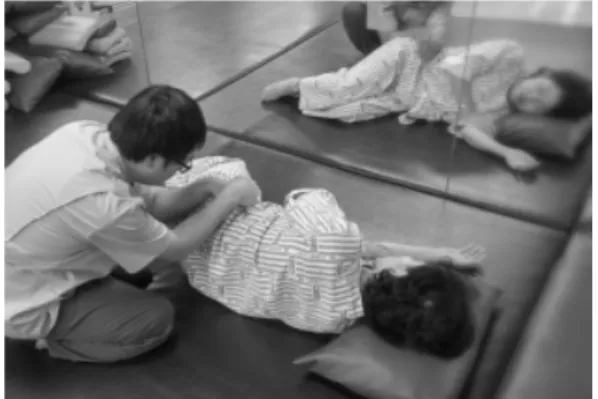
치료는 낙상에 대한 두려움을 피하고 긍정적인 치 료경험을 위해 매트에서 시작하도록 하였고, 패턴에 대한 교육을 설명하고 시각적 자극을 위해 왼쪽 벽에 거울을 사용하기 위해 옆으로 누운 자세 즉, 측와위 자세를 취하였다 . 환 측 어깨뼈의 뒤쪽 하강패턴(Post.

dep.)을 율동적 개시로 운동을 학습 시킨 후 등장성

Fig. 1. Program 1. Fig. 2. Program 1.

(4)

수축결합을 통하여 수축을 더욱 촉진하였고(Fig. 1, Program 1), 충분히 움직임에 대한 교육이 이루어 진 후 골반의 앞쪽 올림패턴(Ant. elev.)을 율동적 개시로 운동의 방향과 움직임을 학습 시킨 후 (Fig. 2, Program 1), 등장성수축결합을 통하여 방산효과를 증대시키면 서 어깨뼈패턴과 같이 적용하였다(Fig. 3, Program 1).

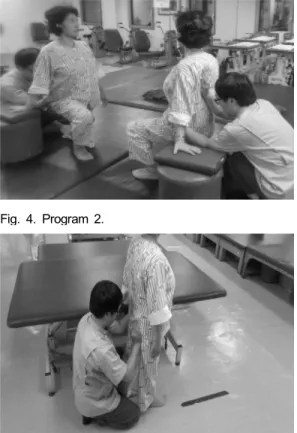
반 무릎 서기(half kneeling) 자세에서 환 측 다리를 앞으로 내어 세운 후 환 측 팔은 매트를 짚고 치료사는 뒤에서 환 측 어깨뼈의 뒤쪽 하강패턴(Post. dep.) 과 동시에 환 측 골반의 앞쪽 올림패턴 (Ant. elev.) 에 대한 움직임이 동시에 일어날 수 있도록 실시하였다(Fig.

4, Program 2). standing 자세에서 환 측 팔은 매트를 짚게 한 상태로 어깨뼈의 뒤 쪽 하강패턴(Post. dep)을 만들어 준 후(Fig. 5, Program 3), 환 측 발을 앞으로 낼 때 치료사가 건 측 골반 결절(ischial tuberosity)에 뒤쪽 하강패턴(Post. dep)과 골반의 앞쪽 올림패턴(Ant.

elev) 움직임을 동시에 할 수 있도록 저항을 주어(Fig.

6, Program 3) 환자가 자각할 수 있도록 하여 보행훈련 을 반복 실시하였다.

Posture Pattern Technique

Side lying on Lt. Scapula post. dep. RI, CI Pelvic ant. elev. RI, CI Half kneeling Lt. scapula post. dep. RI, CI Rt. pelvic post dep. RI, CI Standing Lt. scapula post. dep. RI, CI Rt. pelvic post dep. RI, CI post. dep.: posterior depression

ant. elev.: anterior elevation RI: rhythmic initiation CI: combination of isotonic

Table 1. Scapula-pelvic pattern program

Fig. 3. Program 1. Fig. 4. Program 2.

Fig. 5. Program 3. Fig. 6. Program 3.

(5)

Ⅲ. 연구 결과

1. 10MWT

실험 전 초기측정결과 21.70초를 기록했고 실험 후 17.10초로 보행 속도가 향상되었다.

Initial test Re-test

10MWT 21.70 17.10

Table 2. 10MWT (unit : sec)

2. 한걸음 길이(stride length) 측정

환 측 발뒤꿈치에서 시작하여 다시 같은 쪽 발뒤꿈 치가 닿을 때 까지 거리를 측정한 결과 초기 31.4cm에 서 실험 후 38.7cm로 보폭이 증가하였다.

Initial test Re-test

Stride length 31.4 38.7

Table 3. Stride length (unit : cm)

Ⅳ. 고 찰

고유수용성 신경근 촉진법은 특정 근육군의 강화 와 이완을 위한 고유수용기 자극으로 기능을 향상시 키는 운동치료법으로 운동의 정상패턴이나 자세반응 및 보행능력 회복을 위해 뇌졸중 환자에게 적용하는 것이 좋다고 제시하였다(O’sullivan & schmitz, 1988).

다른 여러 연구에서 특히 보행에서의 몸통의 중요성 에 대해 강조하였는데, 몸통조절은 상지와 하지의 원 활하고 분리된 동작의 기본이 되는 중심으로 작용하 며 몸통의 안정성 또한 움직임의 전제 조건이자 필수 조건이며, 몸통의 적절한 근육 활동은 우리 몸이 중력 에 대하여 균형을 유지한 상태에서 앉고, 서고, 걷는 등 일상생활 활동을 위한 준비를 위해 중요하고, 사지 를 다양하고 조화롭고 기능적인 움직임을 만들어 낸

다고 하였다 (Verheyden et al., 2007). 또한 몸통의 조절 은 앉거나 선 자세에서의 균형을 조절하고 신체의 정 렬을 맞추어 신체를 바로 세우면서 보행과 같은 항 중력 활동을 가능하게 해주는데, 이때 몸통 조절능력 은 서로 균형을 이루어 척추를 선택적이고 분절화 된 몸통 폄이 가능하도록 하여 사지의 동작을 자유롭게 움직일 수 있도록 하고, 자세조절은 균형 뿐 아니라 보행을 더 원활하게 이루어지도록 만드는 중요한 요 소 중 하나라고 하였다(Bebte, 2008). Dietz (2008)는 달리는 사람자세와 스케이트 자세를 이용한 어깨뼈과 골반의 움직임에 있어 고유수용성 신경근 촉진법 패 턴을 상호작용하도록 운동에서 상지 및 하지 움직임 까지 확대하여 일상생활동작이 원활하지 않은 환자분 의 몸통 조절능력 향상을 통한 보행의 변화를 가져왔 다 . 이것은 본 연구에서 뇌졸중으로 인한 편마비 환자 의 보행능력에 미치는 영향을 알아보기 위해 환 측 견갑골의 후방 하강 움직임과 , 환 측 골반의 전방 거상 움직임을 이용한 어깨뼈-골반 몸통운동 프로그램을 정확한 정보 자극을 주기위해 옆으로 눕기, 반 무릎 서기와 서있는 자세에서 적용하였다. 그 결과 보행 속도가 증가하였음을 알 수 있었고 한 걸음 길이도 증가하여 보폭이 증가하였다. 이는 뇌졸중 환자의 달 리는 사람자세와 스케이터자세를 이용한 고유수용성 신경근촉진법 패턴 운동을 통해 보행속도가 향상되었 다는 연구 (Lim, 2014)와 결과가 일치한다.

또한 Kim (2011)의 고유수용성신경근촉진법 연구

에서 사용한 달리는 사람자세와 스케이트자세 훈련방

법에 적용한 어깨뼈- 골반 패턴을 통해 뇌졸중 환자의

한 걸음길이가 증가되었다는 연구 결과와도 일치한

다. 따라서 본 연구결과와 앞선 연구결과를 통하여

어깨뼈-골반 운동프로그램은 체간의 협응 작용의 증

가와 체간의 안정성 조절능력의 향상으로 보행속도

및 한걸음길이의 증가에 효과적인 운동 중재법으로

사용될 수 있을 것으로 추측된다.

(6)

Ⅴ. 결 론

뇌졸중으로 인한 편마비 환자의 보행에서 체간의 중요성을 알아보기 위해 3주간의 PNF패턴을 이용한 운동을 적용하여 치료하였다. 그 결과 10MWT에서 치료 전 21.70sec에서 치료 후 17.10sec를 기록하여 4.6 초 정도의 속도가 증가하였음을 알 수 있었고 , 한 걸음 길이(stride length)측정에서는 치료 전 31.4cm에서 치 료 후 38.7cm로 보폭이 증가하였음을 알 수 있었다.

위 결과를 바탕으로 PNF의 어깨뼈- 골반 패턴을 동시에 적용하여 몸통 회전근을 촉진하고 체간의 균 형과 근력, 그리고 협응 운동을 하였을 때 뇌졸중으로 인한 편마비 환자의 보행 속도와 보폭이 모두 증가하 여 보행능력이 향상되었음을 확인 할 수 있었다. 하지 만 본 연구는 단일 사례 연구로 앞으로 더 많은 연구대 상자를 상대로 연구 할 필요성이 있음을 제시한다.

References

Bebte G. The bobath concept in adult neurolohy. New York.

Georg Thieme Verlag. 2008.

Choi WJ. The effects of PNF sprinter pattern exercise on lower limb muscle activities, balance and gait in hemiplegic stroke patients. Dong Shin University.

Dissertation of Doctorate Degree. 2011.

Choi JH, Jung BO, Kwon YS, et al. Effects of proprioceptive neuromuscular facilitation techniques on the gait for hemiplegic patients. Journal of Korean Society of Physical Therapy. 1999;11(1):121-127.

Dean CM, Shepherd RB. Task-related training improve performance of seated reaching taskd after stroke:

a randomized controlled trial. Stroke. 1998;26(4):

722-728.

Dietz B. Let’’s sprint, let’s skate: innovationen in PNF-konzept.

New York. Springer Medizin Verlag. 2009.

Eng JJ, Chu KS, Kim CM, et al. A community-based group exerrcise program for persons with chronic stroke.

Medicine & Science in Sports& Exercise. 2003;35(8):

1271-1278.

Hodges PW, Gurfinkel VS, Brumagne S, et al. Coexistence of stability and mobility inpostural control: evidence from postural compensation for respiration.

Experimental Brain Research journal. 2002;144(3):

293-302.

Kim SJ. The effect of sprinter and skater pattern training of PNF on balance and gait ability in patients with stroke.

Daegu University. Dissertation of Master’s Degree.

2011.

Kong WT, Koo BO. Kwon MJ, et al. PNF & observational gait analysis treatment training. Seoul. Daihak Pubilishing Company Group. 2012.

Koo BO, Kwon MJ, Kwon YH, et al. Neurological physiotherapy. Seoul. Daihak Pubilishing Company Group. 2013.

Lim CG, The effects of proprioceptive neuromuscular facilitation (PNF) pattern exercise using the sprinter and the skater on balance and gait function in the stroke patients. The sournal of Korean society of physical therapy, 2014;26(4) 249-256.

Ma SY, Hwang YT, Park RJ. The effect of PNF and FES on improvement of functional gait in patients with stroke. Journal of Special Education & Rehabilitation Science. 2008;47(3):283-298.

O’sullivan S. & Schmitz. Physicalrehabilitation. Philadelpia.

F.A. Davis Company. 1988

Refshauge KM, Ada L, Ellis E. Science-based rehabilitation;

theories into pratice. Oxford. Butterworth-Heinemann.

2005.

Verheyden G, Nieuwboer A, van de Winckel A, et al. Clinical tools to measure trunk performance after stroke: a systematic review of the literature. Clinical Rehabilitation journal. 2007;21(5):387-394.

Wade DT. Measurement in neurological rehabilitation. Oxford.

Oxford University Press. 1992.

수치

Fig. 1. Program 1.  Fig. 2. Program 1.
Table 1. Scapula-pelvic pattern program
Table 2. 10MWT (unit : sec)

참조

관련 문서

The purpose of this study was to evaluate surface changes and abrasion of the implant fixture and TiN coated abutment screw after repeated delivery and

The purpose of this study is to analyze the influence of dance leaders' inst ructional behavior patterns on participants' desire to participate and

In this Thesis, an empirical study on the Influence of Consumer's Preferences and Satisfaction on Purchase Intention of Korean Automobile in Vietnamese Consumers

This study examined the achievement, satisfaction and interest of an English grammar class based on flipped learning in order to find out the effect of

For the relationship between these variables, this study analyzed the influence of parental rearing attitude on juvenile subjective well-being and examined

In contrast, Chiropractic has shown better result than sports massage in the range of motion of the shoulder joint, Thoracic Scapular rhythm test, and the

In an effort to develop a new method to remove nitrogen, this study examined the effects of C/N ratio, carbon source and nitrogen concentration on

The purpose of this case study was to find comparison of sports related physical fitness and anaerobic power changes of college hockey players and