The Genetic Variations of SQSTM1 Gene are Associated with Bone Density in the Korean Population
Hyun-Seok Jin and Yong-Bin Eom
1*
Department of Medical Genetics, School of Medicine, Ajou University, Suwon 443-721, Korea
1
Department of Biomedical Laboratory Science, Korea Nazarene University, Cheonan 331-718, Korea Received September 7, 2010 /Accepted October 27, 2010
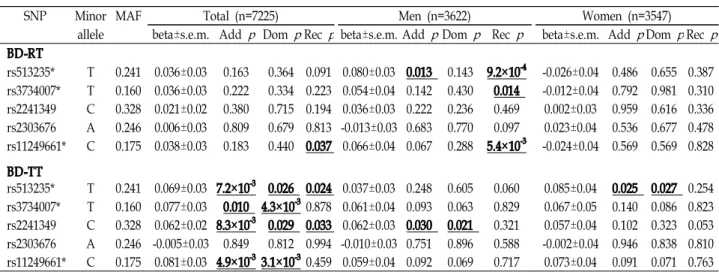
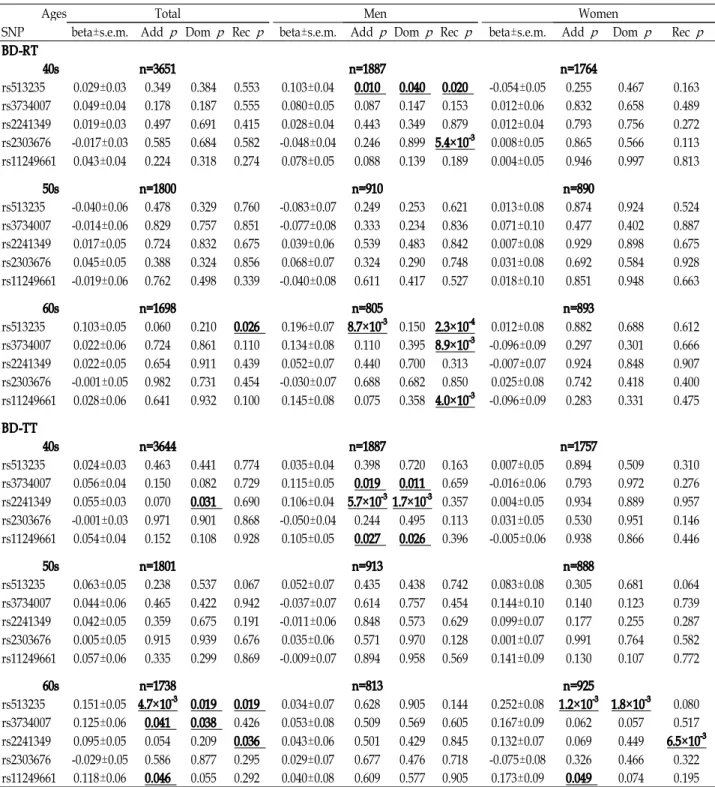
Osteoporosis is a complex systemic skeletal disease and a major public health concern worldwide. It is a heritable disorder characterized mainly by low bone density and/or low trauma osteoporotic frac- tures, both of which have strong genetic determination. However, the specific genetic variants de- termining risk for low bone density are still largely unknown. Here, we performed association analy- sis to elucidate the possible relationship between genetic polymorphisms in the SQSTM1 gene and low bone density. By examining a total of 7225 (men: 3622, women: 3603) subjects from the Korean population in the Korean Association REsource (KARE) study, we discovered that SQSTM1 gene poly- morphisms were associated with bone density. The results of the BD-RT (bone density estimated by T-score at distal radius) showed that three SNPs (rs513235, rs3734007, and rs11249661) within the SQSTM1 gene were significantly associated with bone density. The results of the BD-TT (bone density estimated by T-score at midshaft tibia) showed that four SNPs (rs513235, rs3734007, rs2241349, and rs11249661) were significantly associated with bone density. The three SNPs (rs513235, rs3734007, and rs11249661) had common significance in both BD-RT and BD-TT. In summary, we found statistically significant SNPs in the SQSTM1 gene that are associated with bone density traits. Therefore, our find- ings suggest SQSTM1 gene could be related to pathogenesis of osteoporosis.
Key words : Bone density, SQSTM1, SNP, association
*Corresponding author
*Tel:+82-41-570-4166, Fax:+82-41-570-4258
*E-mail : [email protected]
Introduction
Bone density is a medical term referring to the amount of matter per square centimeter of bones, and used in clinical medicine as an indirect indicator of osteoporosis and frac- ture risk. Bone density measurements are used to screen women for osteoporosis risk and to identify those who might benefit from measures to improve bone strength [3].
The sequestosome-1 protein is encoded by the SQSTM1 gene, which is located in chromosome 5q35 region and se- questosome-1 binds ubiquitin and regulates activation of the nuclear factor kappa-B (NF-κB) signaling pathway [7,13].
Mutations in this gene result in sporadic and familial Paget disease of bone [6,8]. Paget disease of bone (PDB) is a com- mon metabolic bone disease characterized by increased and disorganized bone turnover [11]. These abnormalities dis- rupt normal bone architecture and lead to various complica- tions such as bone pain, bone deformity, deafness, nerve compression syndromes, pathological fracture and secon- dary osteoarthritis [12]. Genetic factors play an important
role in PDB and mutations or polymorphisms have been identified in four genes that cause classical Paget’s disease and related syndrome. These include TNFRSF11A, which encodes RANK, TNFRSF11B which encodes osteoprotegerin, VCP which encodes p97, and SQSTM1 which encodes p62.
All of these genes play a role in the RANK-NFκB signaling pathway and it is likely that the mutations predispose to PDB by disrupting normal signaling, leading to osteoclast activation [11], and underscoring the critical importance of this signaling pathway in bone metabolism and bone disease.
Despite of SQSTM1 is genetic factor causing PDB, there is rarely a report about association with SQSTM1 and bone density. In this study, we examined the association with ge- netic variations in SQSTM1 and bone density in the Korean population. Notably, this study provides insight into the re- lation with SQSTM1 and bone density.
Materials and Methods Subjects and clinical characteristics
Subjects in the Korean population in the Korean
Association REsource (KARE) study were described in more
detail by other study [1]. Briefly 10,038 persons in the