• 검색 결과가 없습니다.

Variants in the Gene EBF2 Are Associated with Kawasaki Disease in a Korean Population

N/A
N/A
Protected

Academic year: 2022

Share "Variants in the Gene EBF2 Are Associated with Kawasaki Disease in a Korean Population"

Copied!
5
0
0

로드 중.... (전체 텍스트 보기)

전체 글

(1)

INTRODUCTION

Kawasaki disease (KD; MIN #611775) was first diagnosed by the pediatric doctor Tomisaku Kawasaki in 1961.

1

KD occurs most frequently in infants and children younger than five, and the most common symptom is continued fever. The diagnostic

criteria for KD are four of the following symptoms: bilateral bulbar conjunctival injection, changes in the mucosa of the oropharynx, cervical lymphadenopathy, polymorphous rash, and changes of the peripheral extremities (e.g., erythema on the palmar and plantar regions, diffuse swelling of the hands and feet, and desquamation on the tips of fingers).

2

KD is self-lim- ited: the symptoms typically increase over two weeks and then gradually resolve on their own without treatment. Neverthe- less, symptoms can be serious, presenting as a cardiac complica- tion of coronary artery aneurysm, and therefore, intravenous immunoglobulin treatment is suggested to prevent them. The cause of KD remains unknown, although medical scientists speculate that there is a genetic influence on disease suscepti- bility. KD patients are increasing in Northeast Asian popula- tions, such as Japan and Korea,

3

and Taiwan has the third high- est incidence rate of KD. The Asian incidence rate is more than 10-times higher than that in Caucasian populations in Europe.

4

Through genome-wide association studies (GWAS), an ad- vanced procedure has been designed to identify a number of novel genetic loci associated with KD.

3

Several researchers Received: November 20, 2017 Revised: February 22, 2018

Accepted: February 28, 2018

Co-corresponding authors: Dr. Yeun-Jun Chung, Integrated Research Center for Genome Polymorphism, College of Medicine, The Catholic University of Korea, 222 Banpo-daero, Seocho-gu, Seoul 06591, Korea.

Tel: 82-2-2258-7343, Fax: 82-2-537-0572, E-mail: [email protected] and Dr. Dong Soo Kim, Department of Pediatrics, Yonsei University College of Medi- cine, Severance Children’s Hospital, 50-1 Yonsei-ro, Seodaemoon-gu, Seoul 03722, Korea.

Tel: 82-2-2228-2057, Fax: 82-2-393-9118, E-mail: [email protected]

•The authors have no financial conflicts of interest.

© Copyright: Yonsei University College of Medicine 2018

This is an Open Access article distributed under the terms of the Creative Com- mons Attribution Non-Commercial License (http://creativecommons.org/licenses/

by-nc/4.0) which permits unrestricted non-commercial use, distribution, and repro- duction in any medium, provided the original work is properly cited.

Variants in the Gene EBF2 Are Associated with Kawasaki Disease in a Korean Population

Yoonsun Bae

1,2,3

, Dongjik Shin

3

, Jiho Nam

3

, Hye Rim Lee

3

, Jun Sung Kim

3

, Kyu Yeun Kim

4

, Dong Soo Kim

4

, and Yeun-Jun Chung

1,2

1

Department of Microbiology, College of Medicine, The Catholic University of Korea, Seoul;

2

Integrated Research Center for Genome Polymorphism, College of Medicine, The Catholic University of Korea, Seoul;

3

Medizen Humancare Inc., Seoul;

4
Department of Pediatrics, Yonsei University College of Medicine, Severance Children’s Hospital, Seoul, Korea.

Purpose: Kawasaki disease (KD) is a mucocutaneous lymph node syndrome. It is mainly seen in young children under the age of five. KD is a multifactorial disorder that includes genetic variants. The present study investigated the association between KD and single nucleotide polymorphisms (SNPs) in the candidate gene early B cell factor 2 (EBF2), which is associated with inflammation markers.

Materials and Methods: An SNP analysis was performed by whole exon sequencing of the EBF2 gene. Our study comprised a total of 495 subjects (295 KD patients and 200 unrelated normal controls) from a Korean population. Tag SNPs were discovered using the Haploview program. Genotyping of the EBF2 gene was performed with the TaqMan

®

assay with real-time PCR methods.

Results: Polymorphism of rs10866845 showed a significant difference in allele frequency between KD patients and controls (p=0.040). The EBF2 gene polymorphisms were significantly associated with KD on logistic regression analysis.

Conclusion: EBF2 gene variants can contribute to KD in the Korean population.

Key Words: Kawasaki disease (KD), Korean, polymorphism, EBF2 gene

pISSN: 0513-5796 · eISSN: 1976-2437 Yonsei Med J 2018 Jun;59(4):519-523

https://doi.org/10.3349/ymj.2018.59.4.519

(2)

have performed GWAS in Caucasians and Asians to confirm susceptibility loci for KD.

5

We used the Affymetrix Genome- Wide Human SNP array 5.0 to perform GWAS. As a result, we selected variants of the early B cell factor 2 [EBF2 (MIM 609934)]

gene. EBF2 is one of the candidate genes of KD in Korea that has not been reported in any other countries. The EBF2 gene is located on chromosome 8p21.2, and is a key transcriptional regulator of brown fat cell fate. The EBF2 gene is known to be associated with Kallmann syndrome (KS).

6

In this study, we investigated genetic variants of the EBF2 gene in a Korean population with KD, and examined the rela- tionship between genetic susceptibility of KD and variations in that gene.

MATERIALS AND METHODS

Study population

We recruited 295 KD patients from medical institutions in Ko- rea. The patients were diagnosed from January 2012 to Octo- ber 2015 at Severance Children’s Hospital. Incomplete KD pa- tients were excluded from this study. The controls were 200 unrelated healthy Korean children. Written informed consent from all participants was obtained. This study was approved by the Institutional Review Board of Yonsei University College of Medicine (IRB No. 2008-0055-010).

Genomic DNA extraction and sequencing

Genomic DNA was extracted from whole blood samples with the QIAmp DNA Blood Mini Kit (QIAGEN, Hilden, Germany), and quantified using an Epoch microplate spectrophotometer (BioTek, Winooski, VT, USA).

We analyzed a total of 15 pairs of primers and whole-exome sequencing results. The EBF2 gene was amplified by poly- merase chain reaction (PCR) with an exon site-specific primer designed using extracted genomic DNA as a template. Se- quencing was performed using the 3730 DNA Analyzer (Ap- plied Biosystems, Foster City, CA, USA).

Selection of tag SNPs and SNP genotyping

The 1000 Genomes database and Haploview software (version

4.2) were used to select tag single nucleotide polymorphisms (SNPs). Five tag SNPs in the EBF2 gene (rs561367201, rs10866845, rs75171102, rs573622423, and rs901176) were se- lected in our study based on an r

2

threshold of 0.8 and a minor allele frequency threshold of 0.01. Genetic variants of the EBF2 gene were genotyped using TaqMan

®

assays (Applied Biosys- tems). The accuracy of the results was confirmed by Sanger se- quencing methods (Supplementary Fig. 1, only online). Geno- typing of all samples was duplicated. The real-time PCR reaction was conducted in a final volume of 10 µL, including 15 ng of ge- nomic DNA, 5 µL of TaqMan

®

Universal PCR Master Mix, and 0.25 µL of 40× TaqMan

®

assay. Thermal cycling conditions were as follows: initial denaturing at 95°C for 10 min, 45 cycles of 95°C for 15 s, and 60°C for 1 min. Genotyping was performed on a QuantStudio

TM

6 Flex Real-Time PCR System (Applied Biosystems). The QuantStudio

TM

6 Flex Real-Time PCR soft- ware ver. 1.2 was used for allelic discrimination.

Statistical analysis

All statistical analyses were performed using R software, ver- sion 3.4.0, on a Windows 10 platform. Allele and genotype fre- quencies of polymorphisms between KD patients and controls were compared using the chi-square test. Characteristics of KD patients and controls were compared using Student’s t-test.

Odds ratio (OR) and 95% confidence interval (CI) were calculat- ed to explain the gene-gene interactions using binary logistic regression. A p value<0.05 was considered statistically significant.

RESULTS

Clinical features of the study population

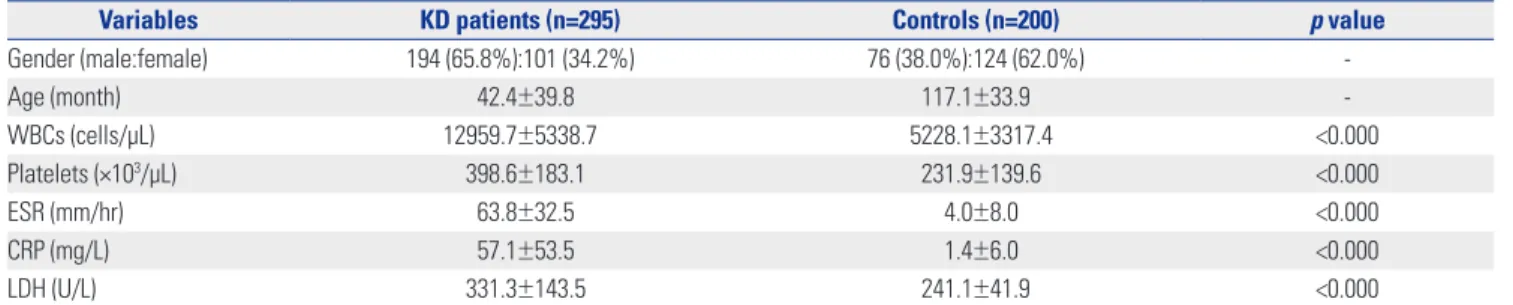
The patients with KD and healthy controls were recruited form Yonsei Medical Center in Korea. A total of 495 volunteers were enrolled in this study, including KD patients and controls (Table 1). Of the 295 patients with KD, 101 were female (34.2%), and 194 were male (65.8%). Among the control group, there were 76 males (38.0%) and 124 females (62.0%) (Table 1).

KD patients showed symptoms of fever (99.3%) and elevat- ed white blood cell (WBCs) counts in comparison with the control group. Clinical levels of C-reactive protein (CRP), eryth-

Table 1. Characteristics of the Study Subjects

Variables KD patients (n=295) Controls (n=200) p value

Gender (male:female) 194 (65.8%):101 (34.2%) 76 (38.0%):124 (62.0%) -

Age (month) 42.4±39.8 117.1±33.9 -

WBCs (cells/µL) 12959.7±5338.7 5228.1±3317.4 <0.000

Platelets (×10

3

/µL) 398.6±183.1 231.9±139.6 <0.000

ESR (mm/hr) 63.8±32.5 4.0±8.0 <0.000

CRP (mg/L) 57.1±53.5 1.4±6.0 <0.000

LDH (U/L) 331.3±143.5 241.1±41.9 <0.000

WBCs, white blood cells; ESR, erythrocyte sedimentation rate; CRP, C-reactive protein level; LDH, lactate dehydrogenase level.

p-value was calculated by chi-square test and Student’s t-test. p-value for comparison between KD patients and controls.

(3)

rocyte sedimentation rate (ESR), and lactate dehydrogenase (LDH) were increased, compared to the control subjects (Table 1). The following clinical symptoms were observed in KD pa- tients: red-eye was found in 216 of 271 patients (79.7%), rash- es in 204 of 270 patients (75.6%), and BCG injection site ery- thema in 71 of 268 patients (26.5%).

Polymorphisms of the EBF2 gene associated with clinical features of KD

As a result of preliminary exon sequencing of 48 chromosomes, we discovered 12 SNPs in the EBF2 gene. Among the discov- ered SNPs, there were no novel markers. Tagging SNPs of the EBF2 gene was selected through linkage disequilibrium (LD) analyses using the Haploview program. Therefore, five tag

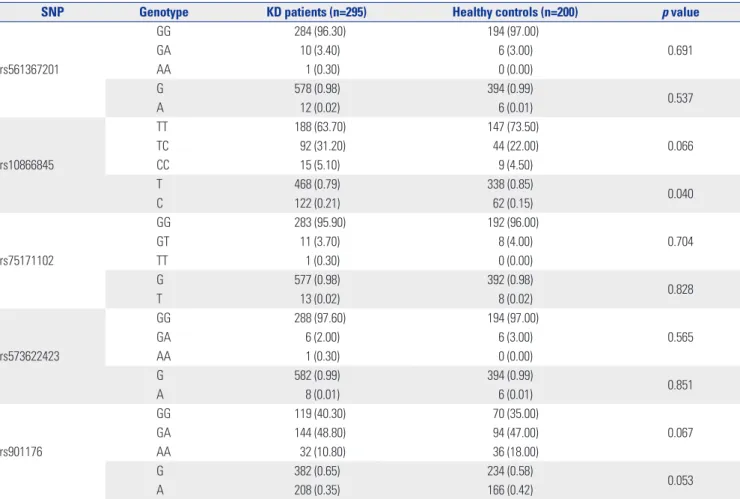
SNPs of the EBF2 gene were selected (Fig. 1). The genes were located at the chromosome 8p21.2 locus. Genotype and allele frequencies for these SNPs are listed in Table 2. There was a significant difference in allele frequency between KD patients and controls only for rs10866485 in the EBF2 gene (p=0.040), while a difference in genotype frequency was not observed any other markers.

We observed relationships between clinical data and select- ed SNPs of the EBF2 gene. The GG genotype of the rs561367201 polymorphism showed a significant association with in- creased WBC (p<0.000), ESR (p<0.000), CRP (p<0.000) level, and LDH (p<0.000) level. The rs10866845 polymorphism was associated with LDH (Table 3). Associations of the rs901176 polymorphism in the EBF2 gene with ESR and CRP level were rs901176

rs75171102

rs561367201

3'UTR

rs573622423 rs10866845 (Exon15)

Fig. 1. Overview of EBF2 gene polymorphisms. EBF2, early B cell factor 2.

Table 2. Frequency of EBF2 Gene Polymorphisms in KD Patients and Controls

SNP Genotype KD patients (n=295) Healthy controls (n=200) p value

rs561367201

GG 284 (96.30) 194 (97.00)

0.691

GA 10 (3.40) 6 (3.00)

AA 1 (0.30) 0 (0.00)

G 578 (0.98) 394 (0.99)

0.537

A 12 (0.02) 6 (0.01)

rs10866845

TT 188 (63.70) 147 (73.50)

0.066

TC 92 (31.20) 44 (22.00)

CC 15 (5.10) 9 (4.50)

T 468 (0.79) 338 (0.85)

0.040

C 122 (0.21) 62 (0.15)

rs75171102

GG 283 (95.90) 192 (96.00)

0.704

GT 11 (3.70) 8 (4.00)

TT 1 (0.30) 0 (0.00)

G 577 (0.98) 392 (0.98)

0.828

T 13 (0.02) 8 (0.02)

rs573622423

GG 288 (97.60) 194 (97.00)

0.565

GA 6 (2.00) 6 (3.00)

AA 1 (0.30) 0 (0.00)

G 582 (0.99) 394 (0.99)

0.851

A 8 (0.01) 6 (0.01)

rs901176

GG 119 (40.30) 70 (35.00)

0.067

GA 144 (48.80) 94 (47.00)

AA 32 (10.80) 36 (18.00)

G 382 (0.65) 234 (0.58)

0.053

A 208 (0.35) 166 (0.42)

EBF2, early B cell factor 2; KD, Kawasaki disease; SNP, single nucleotide polymorphism.

p-value was calculated by Cochran-Armitage trend test.

(4)

confirmed (Tables 4 and 5).

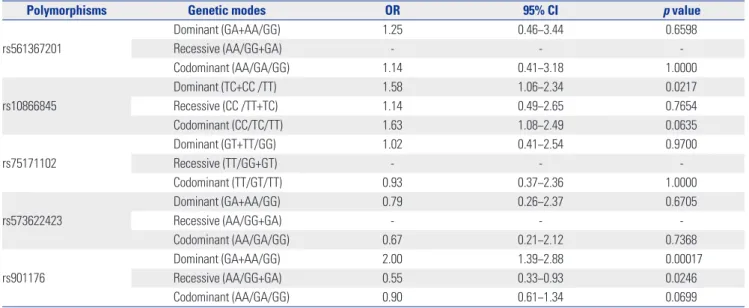
Association of genetic variants in the EBF2 gene with KD Logistic regression analysis indicated that rs10866845 and rs901176 polymorphisms were significantly associated with KD. For the rs10866845 polymorphism, the OR of C carriers (TC+CC) for the risk of KD was 1.58 (95% CI=1.06–2.34, p=

0.0217) under dominant mode inheritance. The rs901176 poly- morphism was associated with KD in a dominant model and

Table 4. Association of the rs901176 Polymorphism in the EBF2 Gene with ESR

Genotype KD patients Controls p value

GG 63.11±33.27 2.50±74 <0.000

GA 59.74±58.82 0.21±0.58 <0.000

AA 62.96±34.78 3.11±8.24 <0.000

EBF2, early B cell factor 2; ESR, erythrocyte sedimentation rate; KD, Kawasa- ki disease.

Table 5. Association of the rs901176 Polymorphism in the EBF2 Gene with CRP

Genotype KD patients Controls p value

GG 58.90±55.62 0.45±1.19 0.002

GA 59.74±53.82 0.21±0.58 <0.000

AA 37.99±39.02 4.00±10.91 <0.000

EBF2, early B cell factor 2; CRP, C-reactive protein; KD, Kawasaki disease.

Table 6. Association between KD and Genotypes of the EBF2 Gene Polymorphisms

Polymorphisms Genetic modes OR 95% CI p value

rs561367201

Dominant (GA+AA/GG) 1.25 0.46−3.44 0.6598

Recessive (AA/GG+GA) - - -

Codominant (AA/GA/GG) 1.14 0.41−3.18 1.0000

rs10866845

Dominant (TC+CC /TT) 1.58 1.06−2.34 0.0217

Recessive (CC /TT+TC) 1.14 0.49−2.65 0.7654

Codominant (CC/TC/TT) 1.63 1.08−2.49 0.0635

rs75171102

Dominant (GT+TT/GG) 1.02 0.41−2.54 0.9700

Recessive (TT/GG+GT) - - -

Codominant (TT/GT/TT) 0.93 0.37−2.36 1.0000

rs573622423

Dominant (GA+AA/GG) 0.79 0.26−2.37 0.6705

Recessive (AA/GG+GA) - - -

Codominant (AA/GA/GG) 0.67 0.21−2.12 0.7368

rs901176

Dominant (GA+AA/GG) 2.00 1.39−2.88 0.00017

Recessive (AA/GG+GA) 0.55 0.33−0.93 0.0246

Codominant (AA/GA/GG) 0.90 0.61−1.34 0.0699

EBF2, early B cell factor 2; KD, Kawasaki disease; OR, odds ratio; CI, confidence interval.

Table 3. Association of the rs10866845 Polymorphism in the EBF2 Gene with LDH

Genotype KD patients Controls p value

TT 334.68±144.41 239.71±45.58 <0.000

TC 316.98±140.44 243.37±31.22 0.026

CC 380.38±149.43 246.20±44.70 0.010

EBF2, early B cell factor 2; LDH, lactate dehydrogenase; KD, Kawasaki dis- ease.

recessive model (Table 6). The rs561367201 polymorphism was associated with red-eye symptoms (OR=0.25, 95% CI=

0.08−0.80, p=0.0320), and the rs75171102 polymorphism was significantly related to red-lips feature (OR=1.40, 95% CI=

0.33−5.95, p=0.0359) in KD patients. We did not discover any other significant ORs between KD-related clinical features and polymorphisms of the EBF2 gene (Supplementary Table 1, only online).

DISCUSSION

To date, three EBF genes have been isolated, EBF1, EBF2, and EBF3.

2

EBF has a helix-loop-helix (HLH) and highly conserved transcription factors. The EBF gene is also referred to as the Collier/Olf/EBF (COE) gene.

7-10

COE proteins are involved in nervous and immune system development.

7

EBF1 produces a family of EBF proteins expressed in B lymphocytes, osteo- blasts, and adipocytes. EBF1 is an essential gene for B-cell for- mation, as transgenic mice with a non-functioning EBF1 gene do not produce activated B cells and immunoglobulins.

11

An- other family member of the EBF gene, EBF2 is not expressed in B lymphocytes, but is expressed in osteoblasts, adipocytes, and neurons.

12-14

The EBF2 gene has been shown to contribute to neural development and function in analysis of EBF2 knock- out mice.

15

The EBF2 gene has also been shown to be related to disorders affecting the peripheral nervous system, such as Charcot-Marie-Tooth disease.

16

In a recent study, the EBF2 gene was shown to be associated

with white adipose browning through binding with an inhibitor

of differentiation 1 (Id1) known to interact with the HLH struc-

ture protein.

17

EBF2 is expressed more in brown adipocytes

than white adipocytes. By regulating Peroxisome Proliferator

activated receptor gamma (Pparγ) binding activity,

12

EBF2 helps

(5)

convert white adipocytes to brown-adipocytes that consume energy by generating heat when the body is exposed to low temperatures. In contrast, abnormal accumulation of triglyc- erides (white adipocytes) can cause cardiac diseases or diabe- tes.

17

Previous mouse studies have demonstrated that EBF2 is required for brown adipose tissue development. Brown adipo- cytes have been shown to reduce metabolic diseases and obe- sity in mice and rats, and a human study confirmed a correla- tion between weight and brown adipocytes.

18

Additionally, EBF2 is a regulator of osteoclast differentiation by controlling osteoblast-dependent differentiation. When the EBF2 gene is not functional, bone mass is reduced. These func- tions of the EBF2 gene were demonstrated in EBF2-null mouse experiments.

19

However, the EBF2 gene is not known to corre- late with KD. An association of KD with genetic variants of EBF2 was not found in any population. Through genomic re- search, we examined the association between EBF2 gene poly- morphism and KD in a Korean population.

Many inflammatory markers are generally elevated in the peripheral blood of KD patients at an acute phase. Our study confirmed that inflammatory markers, such as WBC, platelet, ESR, CRP, and LDH, were elevated in KD patients. No previous studies have reported significant associations between the EBF2 gene and inflammation markers. In our study, EBF2 gene polymorphisms were significantly associated with the inflam- mation markers ESR, CRP, and LDH (Tables 3, 4, and 5).

Among several symptoms of KD, cardiovascular complica- tions are found in less than 20% of KD patients. In an analysis of associations of coronary artery complications with EBF2 gene polymorphisms, no significant correlation was observed. Ad- ditionally, KD patients with the rs573622423 variant of the EBF2 gene showed a weak association with rash symptoms (OR=0.25, 95% CI=0.06–1.00, p=0.0630).

In this study, we observed associations between KD and EBF2 gene polymorphisms. With the rs10866845 variant, the C allele was a risk factor of KD. Also, we found the rs901176 polymorphism to be a significant risk variant of KD.

In conclusion, our study of associations between genetic variants in the EBF2 gene and KD was the first in a Korean pop- ulation. According to the results of our study, EBF2 is an inter- esting candidate gene for research on KD.

ACKNOWLEDGEMENTS

This research was supported by grants from the National Re- search Foundation of Korea (NRF-2013R1A1A2013298), the Korea Health Technology R&D Project (HI14C3417).

ORCID

Yoonsun Bae https://orcid.org/0000-0001-9521-8894 Yeun-Jun Chung https://orcid.org/0000-0002-6943-5948 Dong Soo Kim https://orcid.org/0000-0002-3270-506X

REFERENCES

1. Burns JC, Glodé MP. Kawasaki syndrome. Lancet 2004;364:533-44.

2. Kim DS. Kawasaki disease. Yonsei Med J 2006;47:759-72.

3. Kim KY, Kim DS. Recent advances in Kawasaki disease. Yonsei Med J 2016;57:15-21.

4. Ha S, Seo GH, Kim KY, Kim DS. Epidemiologic study on Kawasaki disease in Korea, 2007-2014: based on Health Insurance Review

& Assessment Service Claims. J Korean Med Sci 2016;31:1445-9.

5. Yan Y, Ma Y, Liu Y, Hu H, Shen Y, Zhang S, et al. Combined analy- sis of genome-wide-linked susceptibility loci to Kawasaki disease in Han Chinese. Hum Genet 2013;132:669-80.

6. Trarbach EB, Baptista MT, Garmes HM, Hackel C. Molecular analysis of KAL-1, GnRH-R, NELF and EBF2 genes in a series of Kallmann syndrome and normosmic hypogonadotropic hypogo- nadism patients. J Endocrinol 2005;187:361-8.

7. Hagman J, Belanger C, Travis A, Turck CW, Grosschedl R. Cloning and functional characterization of early B-cell factor, a regulator of lymphocyte-specific gene expression. Genes Dev 1993;7:760-73.

8. Dubois L, Vincent A. The COE--Collier/Olf1/EBF--transcription factors: structural conservation and diversity of developmental functions. Mech Dev 2001;108:3-12.

9. Garel S, Marín F, Mattéi MG, Vesque C, Vincent A, Charnay P.

Family of Ebf/Olf-1-related genes potentially involved in neuro- nal differentiation and regional specification in the central nervous system. Dev Dyn 1997;210:191-205.

10. Wang SS, Tsai RY, Reed RR. The characterization of the Olf-1/EBF- like HLH transcription factor family: implications in olfactory gene regulation and neuronal development. J Neurosci 1997;17:

4149-58.

11. Lin H, Grosschedl R. Failure of B-cell differentiation in mice lack- ing the transcription factor EBF. Nature 1995;376:263-7.

12. Kieslinger M, Hiechinger S, Dobreva G, Consalez GG, Grosschedl R.

Early B cell factor 2 regulates hematopoietic stem cell homeosta- sis in a cell-nonautonomous manner. Cell Stem Cell 2010;7:496-507.

13. Jimenez MA, Akerblad P, Sigvardsson M, Rosen ED. Critical role for Ebf1 and Ebf2 in the adipogenic transcriptional cascade. Mol Cell Biol 2007;27:743-57.

14. Medina KL, Pongubala JM, Reddy KL, Lancki DW, Dekoter R, Kieslinger M, et al. Assembling a gene regulatory network for speci- fication of the B cell fate. Dev Cell 2004;7:607-17.

15. Corradi A, Croci L, Broccoli V, Zecchini S, Previtali S, Wurst W, et al. Hypogonadotropic hypogonadism and peripheral neuropathy in Ebf2-null mice. Development 2003;130:401-10.

16. Giacomini C, La Padula V, Schenone A, Leandri M, Contestabile A, Moruzzo D, et al. Both Schwann cell and axonal defects cause motor peripheral neuropathy in Ebf2-/- mice. Neurobiol Dis 2011;

42:73-84.

17. Patil M, Sharma BK, Elattar S, Chang J, Kapil S, Yuan J, et al. Id1 pro- motes obesity by suppressing brown adipose thermogenesis and white adipose browning. Diabetes 2017;66:1611-25.

18. Rajakumari S, Wu J, Ishibashi J, Lim HW, Giang AH, Won KJ, et al.

EBF2 determines and maintains brown adipocyte identity. Cell Metab 2013;17:562-74.

19. Kieslinger M, Folberth S, Dobreva G, Dorn T, Croci L, Erben R, et

al. EBF2 regulates osteoblast-dependent differentiation of osteo-

clasts. Dev Cell 2005;9:757-67.

수치

Table 1. Characteristics of the Study Subjects
Table 2. Frequency of EBF2 Gene Polymorphisms in KD Patients and Controls
Table 3. Association of the rs10866845 Polymorphism in the EBF2 Gene  with LDH

참조

관련 문서

• Common polymorphism in MAO-A gene resulting in relatively low-activity enzyme, has been associated with increased risk for violent or antisocial behavior as well as for

 The cellular changes associated with dementia primarily in cortical areas.

다양한 번역 작품과 번역에 관한 책을 읽는 것은 단순히 다른 시대와 언어, 문화의 교류를 넘어 지구촌이 서로 이해하고 하나가

The index is calculated with the latest 5-year auction data of 400 selected Classic, Modern, and Contemporary Chinese painting artists from major auction houses..

SigmaNEST 펀칭 파워팩 제품 관리, 자동 다이나믹™ 배 열 및 펀칭 툴 관리를 갖춘 터렛 펀칭 프로그래밍을 위한 가장 완벽하고 최적화된

“Characteristics of Meteorological Variables in the Leeward Side associated with the Downslope Windstorm over the Yeongdong Region.” Journal of the Korean

Factors associated with hypertension control in Korean adults: The fifth Korea National Health and Nutrition Examination Survey (KNHANES V-2).. Association of stress

(Saturated zone is the zone in which the voids in the soil and rocks are filled with water at a pressure greater than atmospheric pressure).. (Unsaturated zone is the zone