Biomedical Science Letters 2015, 21(3): 144~151 http://dx.doi.org/10.15616/BSL.2015.21.3.144 eISSN : 2288-7415
Gender-specific Association of the ANO1 Genetic Variations with Hypertension
Hyun-Seok Jin and Dongju Jung†
1Department of Biomedical Laboratory Science, College of Life and Health Sciences, Hoseo University, Asan, Chungnam 31499, Korea
Development of hypertension is caused by complex contributions of genetic and environmental factors. In spite of the increased understanding of hypertension, genetic factors that contribute to hypertension largely remain elusive. ANO1 gene encoding a calcium-activated chloride channel has recently been reported to affect spontaneous hypertension in the animal model. In this report, we investigated possible association of the ANO1 gene with hypertension in human with ANO1 variants found in Korean population. Fourteen polymorphisms of ANO1 gene were analyzed to be associated with hypertension. Interestingly, the six polymorphisms that showed statistically significant association were all the male subjects. The highest significant SNP was rs7127129 (OR=1.14, CI: 1.02~1.28, additive P=0.023; OR=1.24, CI:
1.03~1.49, dominant P=0.025), and other five SNPs (rs2509153, rs11235473, rs10751200, rs10898827 and rs10899928) were also statistically associated with hypertension. Consequently, we found that the genetic variants of ANO1 present statistically significant associations with hypertension in human, especially, in male. To the best of our knowledge, this study is the first report describing association of genetic polymorphisms of ANO1 with hypertension in human.
Key Words: Hypertension, Calcium-activated chloride channel, ANO1, SNP, Association
INTRODUCTION
Hypertension is a status having consistent high blood pressure. Development of hypertension is caused by com- plex contributions of genetic and environmental factors.
According to 'the Korea National Health and Nutrition Examination Survey (KNHANES)', prevalence of hyper- tension in Korean adult population has reached to 27.3%, which is almost similar with the prevalence of Americans (Horowitz et al., 2015) and is still growing. Seriousness of hypertension is its strong relationships with other metabolic
diseases such as diabetes, obesity, dyslipidemia, and so on (Taylor et al., 2013; Kelly et al., 2014). In spite of its ser- iousness, genetic factors that are related with hypertension are still remains elusive. Hypertension studies with genetic information have been reported using KARE (Korean Asso- ciation REsource) cohorts, such as Genome-wide association study (Cho et al., 2009), nonsynonymous SNPs association study (Hong et al., 2010), replication association study (Hong et al., 2009 & Jin et al., 2012), and candidate genes study (Jin et al., 2010).
Blood pressure is determined by combination of cardiac output and resistances of peripheral blood vessels (Marc and Llorens-Cortes, 2011). Therefore, when the cardiac output is consistent, blood pressure is determined mainly by vascular contractions. Contraction of vascular smooth muscle cells are controlled by combinatorial functions of several ion channels, among which ANO1 gene (anoctamin 1), a calcium-activated chloride channel (CaCC), has been
Original Article
*Received: July 7, 2015 / Revised: August 24, 2015 Accepted: September 24, 2015
†Corresponding author: Dongju Jung. Department of Biomedical Laboratory Science, College of Life and Health Sciences, Hoseo University, Asan, Chungnam 31499, Korea.
Tel: +82-41-540-9969, Fax: +82-41-540-9997 e-mail: [email protected]
○CThe Korean Society for Biomedical Laboratory Sciences. All rights reserved.
suspected as a causal genetic factor for the development of hypertension (Large and Wang, 1996; Heinze et al., 2014).
The ANO1 gene located on human chromosome 11q13.3, and induces smooth muscle contraction by transporting chloride ion. Calcium activates ANO1 (anion channel) in plasma membrane to efflux chloride ion (Cl-) out of the cell by resulting in depolarization in the vascular smooth muscle cell. To compensate the chloride efflux, voltage- dependent Ca2+ channels lead influx of extracellular Ca2+
into the cytosol. Therefore, ANO1 overexpression could give rise to stronger arterial contraction and an increase of blood pressure. Actually, it has been reported that over- expression of ANO1 contributed to spontaneous hypertension in the spontaneously hypertensive male rats (SHRs) (Wang et al., 2015) which suggests ANO1 might be a novel genetic factor for hypertension.
We aimed to investigate whether genetic variations of ANO1 gene are associated with hypertension in humans.
For this purpose, the 14 single nucleotide polymorphisms (SNPs) of ANO1 were collected from the Korean Association REsource (KARE) and were analyzed for their relationship with hypertension. Based on the results, we suggest that ANO1 could be a susceptible gene for hypertension in human males.
MATERIALS AND METHODS Subjects and clinical characteristics
Subjects in the Korean population in the Korean Asso- ciation REsource (KARE) study were described in more detail by other study (Cho et al., 2009). Briefly 10,038 persons in the Ansung-Ansan prospective community cohorts were recruited. A two-community cohort study in South Korea was initiated beginning in 2001 as part of a major project for the Korean Health and Genome Study (KHGS) in Korea National Health and Genome Study (KNIH). Of the initial 10,038 subjects who were aged 40 to 69 years, 1196 were excluded due to poor genotyping data. In addition, to analyze accurate blood pressure traits, 330 subjects who were on drug treatments such as folk medicine that were likely to influence the blood pressure were also excluded.
The remaining 8512 subjects were finally investigated in
this study.
A case-control study was performed between hypertensive male cases (n = 910) and normotensive male controls (n = 2062). Hypertensive male cases were categorized with the systolic blood pressure (SBP) ≥ 140 mmHg and/or diastolic blood pressure (DBP) ≥ 90 mmHg in addition to the subjects who were receiving hypertension medication. Normotensive male controls were defined as SBP < 120 mmHg and DBP
< 80 mmHg. For quantitative blood pressure traits analysis, subjects who were undergoing antihypertensive treatment were excluded and the remaining 3747 males were investi- gated. Clinical characteristics of the subjects are summarized in Table 1. This study was approved by the Institutional Review Board of the Korean National Institute of Health (KNIH). Written informed consent was obtained from all subjects.
Clinical characteristic measurement
Blood sample were drawn for biochemical measurements [triglyceride, total cholesterol, high-density lipoprotein (HDL), low-density lipoprotein (LDL)]. Blood pressure measurements were taken three times in the supine position using a mercury sphygmomanometer (Baumanometer; W.
A. Baum, Copiague, NY, USA) with an appropriate cuff size by trained nurses at clinics, and the average value data was used for this study. Before the first measurement, subjects rested for 5 min, and three measurements were taken at least 2 min apart.
Genotyping and selection of SNPs
The detailed genotyping, quality control processes and quantitative traits including SBP and DBP were described in the previous report (Cho et al., 2009). Briefly, most DNA samples were isolated from the peripheral blood of partici- pants and genotyped using the Affymetrix Genome-Wide Human SNP array 5.0 (Affymetrix Inc., Santa Clara, CA, USA). The accuracy of the genotyping was calculated by Bayesian Robust Linear Modeling using the Mahalanobis Distance (BRLMM) algorithm (Rabbee and Speed, 2006).
Samples that had genotyping accuracies were lower than 98%, high missing genotype call rates (≥4%), high hetero- zygosity (>30%), or gender biases were excluded.
The 14 SNPs that we analyzed were selected from the KARE data, based on their positions within the ANO1 gene boundary (5 kb upstream and downstream of the first and last exons, respectively) (Table 2). The positions of the SNPs were validated in the NCBI human genome build 36.
For the in silico functional analysis, we used HaploReg v3 (http://www.broadinstitute.org/mammals/haploreg/haploreg_
v3.php), which is a tool for exploring annotations of the noncoding variants. The clinical information and genotype data that we used were graciously provided by the Center for Genome Science, KNIH, Korea Center for Disease Control (KCDC).
Statistical analysis
Most statistical analyses were performed using PLINK version 1.07 (http://pngu.mgh.harvard.edu/~purcell/plink) and PASW Statistics version 18.0 (SPSS Inc., Chicago, IL, USA). The 14 selected SNPs were also analyzed in hyper- tension case-control studies using logistic regression analysis, controlling for cohort, age and body mass index (BMI) as covariates. Linear regression was used to analyze for the clinical characteristics as quantitative traits in the final
3747 men, controlling for cohort, age and body mass index (BMI) as covariates. The association tests were based on an additive, dominant, and recessive genetic model, and P-values were not adjusted for multiple tests. Statistical significance was determined at a two-tailed value of P <
0.05. For the regional association plot, we had used the SNP Annotation and Proxy Search (SNAP) database (http://www.broadinstitute.org/mpg/snap/) using the CHBJPT (Chinese and Japanese) population panel originated from HapMap database for the recombination rate.
RESULTS
Association analyses between SNPs in ANO1 gene and hypertension in male
Clinical characteristics of the study subjects were listed in Table 1. Mean age of the hypertensive males (n=910), mean systolic blood pressure (SBP), and mean diastolic blood pressure (DBP) was 55.06 years, 137.56 ± 16.27, and 88.12 ± 10.37 (Table 1), respectively. Means and variances of BMI, SBP, DBP, total cholesterol, LDL, and triglyceride were statistically different between normotensive and hyper- Table 1. Basic characteristics of the male subjects in the KARE study cohort
Characteristics Quantitative trait
analysis*
Case-control analysis**
Normotensive Hypertensive P value***
Number of subjects 3747 2062 910
Age (M years ± SD) 51.27 ± 8.68 49.66 ± 8.17 55.06 ± 8.72 < 0.0001
Body mass index (BMI) (M kg/m2 ± SD) 24.14 ± 2.9 23.82 ± 2.76 24.99 ± 3.01 0.008 Systolic blood pressure (SBP)
(M mmHg ± SD) 116.5 ± 16.17 105.57 ± 8.64 137.56 ± 16.27 < 0.0001 Diastolic blood pressure (DBP)
(M mmHg ± SD) 75.76 ± 10.99 68.94 ± 7.62 88.12 ± 10.37 < 0.0001 Total cholesterol (M mg/dl ± SD) 191.33 ± 36.24 190.44 ± 34.63 193.89 ± 38.25 0.004 High density lipoprotein cholesterol
(M mg/dl ± SD) 43.79 ± 9.99 43.5 ± 9.68 43.35 ± 10.29 0.051
Low density lipoprotein cholesterol
(M mg/dl ± SD) 114.26 ± 33.40 115.76 ± 31.86 112.73 ± 35.48 0.001
Triglyceride (M mg/dl ± SD) 176.66 ± 119.48 163.73 ± 110.17 202.42 ± 127.02 < 0.0001 Abbreviations: M, mean value; SD, standard deviation. *Individuals who are not using hypertensive medications. **Controls (normotensive), SBP < 120 mmHg and DBP < 80 mmHg; Cases (hypertensive), SBP ≥ 140 mmHg and/or DBP ≥ 90 mmHg and/or antihypertensive medication. ***Significant differences in characteristics between the normotensive and hypertensive subjects were determined by the two-tailed Student's t-test.
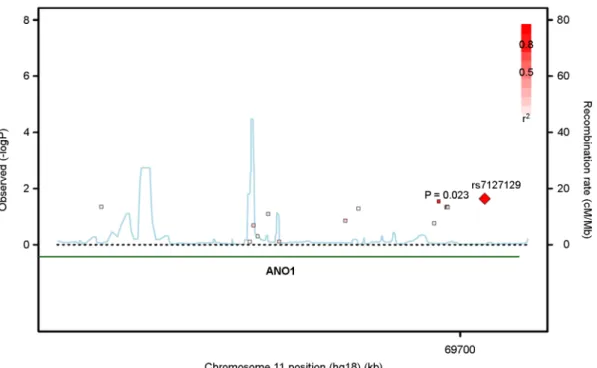
tensive groups by Student's t-test (Table 1). Minor allele, minor allele frequency, and function of ANO1 gene and its 14 SNPs were presented (Table 2). Regional association plots for the 14 SNPs in the ANO1 were presented (Fig. 1).
The six SNPs of ANO1 were associated with hypertension status. One of the six SNPs, rs7127129, had the highest significance with the hypertension (OR=1.14, CI: 1.02~
1.28, additive P=0.023, Table 2). The significance of the rs7127129 in hypertension was statistically meaningful in additive and dominant genetic models (OR=1.24, CI: 1.03~
1.49, dominant P=0.025, Table 2). The five other SNPs (rs2509153, rs11235473, rs10751200, rs10898827 and rs- 10899928) were also associated with the hypertension (Table 2). Among the six SNPs, rs10751200, rs10898827, and rs10898828 showed resistance to the hypertension (OR<1), and were composed in one LD block (r2>0.99).
Otherwise, rs11235473 and rs7127129 were susceptible to hypertension (OR>1), and had high correlation with each other (r2>0.99).
Table 2. The association analysis results of SNPs in the ANO1 gene with the hypertension in the KARE males
No. SNP Minor
allele MAF Function
Hypertension (controls 2062: cases 910) OR
(95% CI) Add P OR
(95% CI) Dom P OR
(95% CI) Rec P
1 rs2509153 T 0.288 intron 1.11
(0.98~1.27) 0.107 1.08
(0.92~1.28) 0.334 1.36
(1.01~1.83) 0.045
2 rs2515274 T 0.145 intron 0.98
(0.83~1.15) 0.781 0.98
(0.81~1.17) 0.800 0.95
(0.52~1.73) 0.858
3 rs2509166 G 0.494 intron 1.07
(0.95~1.20) 0.253 1.06
(0.88~1.28) 0.534 1.13
(0.94~1.36) 0.205
4 rs2515267 T 0.412 intron 1.02
(0.91~1.15) 0.753 1.06
(0.89~1.26) 0.499 0.97
(0.78~1.21) 0.790
5 rs2509175 T 0.095 intron 0.96
(0.79~1.16) 0.657 1.00
(0.81~1.24) 0.996 0.42
(0.16~1.11) 0.080
6 rs948173 G 0.450 intron 0.99
(0.88~1.11) 0.847 0.97
(0.82~1.16) 0.769 1.00
(0.81~1.23) 0.999
7 rs1940236 A 0.232 intron 0.90
(0.78~1.04) 0.138 0.90
(0.76~1.06) 0.194 0.81
(0.55~1.19) 0.275
8 rs10160639 A 0.195 intron 1.08
(0.94~1.25) 0.287 1.04
(0.88~1.24) 0.646 1.50
(1.00~2.24) 0.051
9 rs10793024 T 0.154 intron 0.92
(0.78~1.08) 0.309 0.88
(0.73~1.06) 0.171 1.17
(0.70~1.96) 0.546
10 rs11235473 T 0.468 intron 1.14
(1.01~1.28) 0.029 1.21
(1.00~1.45) 0.047 1.17
(0.96~1.42) 0.115
11 rs10751200 G 0.226 intron 0.87
(0.76~1.01) 0.059 0.89
(0.75~1.05) 0.166 0.66
(0.44~0.99) 0.046
12 rs10898827 A 0.225 intron 0.88
(0.76~1.01) 0.065 0.89
(0.75~1.06) 0.184 0.66
(0.44~0.99) 0.045
13 rs10898828 G 0.226 intron 0.87
(0.76~1.00) 0.057 0.89
(0.75~1.05) 0.161 0.66
(0.44~0.99) 0.046
14 rs7127129 G 0.475 intron 1.14
(1.02~1.28) 0.023 1.24
(1.03~1.49) 0.025 1.16
(0.95~1.40) 0.140 Abbreviations: SNP, sigle nucleotide polymorphism; MAF, minor allele frequency; OR, odds ratio; CI, confidence interval; Add P, additive genetic model P value; Dom P, dominant genetic model P value; Rec P, recessive genetic model P value. Controls were the subjects with SBP < 120 mmHg and DBP < 80 mmHg, and hypertension cases were the subjects with SBP ≥ 140 mmHg and/or DBP ≥ 90 mmHg and/or antihypertensive medication. Statistically significant values (P < 0.05) are indicated in bold and underline.
Association analyses between the six SNPs in ANO1 gene and the clinical characteristics
The six SNPs having association with the hypertension were further analyzed for the analysis with quantitative traits.
The male subjects' clinical characteristics were collected such as SBP, DBP, total cholesterol, HDL, LDL, and trigly-
ceride (Table 1). Linear regression analysis was used to analyze associations between the SNPs and the clinical characteristics by controlling for age, BMI, and cohort as covariates. The two SNPs (rs2509153 and rs7127129) were significantly associated with the clinical characteristics. The rs2509153 was associated with both total cholesterol (β=
2.57, dominant P=0.024) and LDL (β=2.97, dominant P=
Table 3. The association analysis results of 6 SNPs in the ANO1 gene with total cholesterol, HDL and LDL in the KARE males (n=3,747)
SNP Minor
allele MAF Function Total cholesterol HDL LDL
beta ± se Dom P beta ± se Rec P beta ± se Dom P
rs2509153 T 0.288 intron 2.57 ± 1.13 0.024 -0.11 ± 0.60 0.854 2.97 ± 1.05 4.8×10⁻³ rs11235473 T 0.468 intron 0.51 ± 1.25 0.681 -0.72 ± 0.39 0.067 0.98 ± 1.16 0.398 rs10751200 G 0.226 intron 0.08 ± 1.15 0.947 0.65 ± 0.75 0.390 -0.12 ± 1.07 0.909 rs10898827 A 0.225 intron -0.12 ± 1.16 0.921 0.66 ± 0.75 0.380 -0.29 ± 1.08 0.790 rs10898828 G 0.226 intron 0.03 ± 1.15 0.977 0.65 ± 0.75 0.390 -0.16 ± 1.07 0.884 rs7127129 G 0.475 intron 0.56 ± 1.25 0.653 -0.85 ± 0.39 0.027 0.87 ± 1.17 0.456 Abbreviations: SNP, sigle nucleotide polymorphism; MAF, minor allele frequency; beta, regression coefficient; se, standard error; HDL, high density lipoprotein cholesterol; LDL, low density lipoprotein cholesterol; Dom P, dominant genetic model P value; Rec P, recessive genetic model P value. Statistically significant values (P<0.05) are indicated in bold and underline.
Fig. 1. The regional association plots for the 14 SNPs in the ANO1 gene were generated with SNAP database (http://www.broadinstitute.org/
mpg/snap/) for the association results for gene annotations, and estimated recombination rates. The probability values were chosen among the highest values of the three genetic model.
4.8×10⁻³). On the other hand, the rs7127129 was associated with HDL (β=-0.85, recessive P=0.027). The six SNPs had no association with the characteristics indicating blood pressures such as SBP, and DBP.
Association analyses between the SNPs in ANO1 gene and the hypertension in female
Additionally, association between the genetic variations of ANO1 gene and hypertension in female was examined.
The SNPs had no significant association with the hyper-
tension except the rs2515274 (OR=1.19, CI: 1.01~1.40, additive P=0.033, Table 4). These results indicate there is gender-specific association between the SNPs in ANO1 gene and hypertension.
DISCUSSION
In this study, we investigated the association of genetic variations of ANO1 gene with hypertension in the Korean population. The six SNPs of ANO1 were associated with Table 4. The association analysis results of SNPs in the ANO1 gene with the hypertension in the KARE females
No. SNP Minor
allele MAF Function
Hypertension (controls 2390: cases 1058) OR
(95% CI) Add P OR
(95% CI) Dom P OR
(95% CI) Rec P
1 rs2509153 T 0.276 intron 0.99
(0.87~1.13) 0.917 0.96
(0.81~1.13) 0.635 1.10
(0.82~1.49) 0.529
2 rs2515274 T 0.144 intron 1.19
(1.01~1.40) 0.039 1.19
(0.99~1.44) 0.064 1.49
(0.87~2.56) 0.147
3 rs2509166 G 0.493 intron 1.03
(0.91~1.16) 0.671 0.98
(0.81~1.18) 0.830 1.10
(0.90~1.33) 0.354
4 rs2515267 T 0.421 intron 0.99
(0.88~1.11) 0.829 0.94
(0.79~1.12) 0.488 1.06
(0.85~1.31) 0.634
5 rs2509175 T 0.091 intron 0.96
(0.79~1.17) 0.680 0.93
(0.75~1.16) 0.535 1.27
(0.59~2.72) 0.547
6 rs948173 G 0.450 intron 0.99
(0.88~1.11) 0.858 0.98
(0.82~1.17) 0.785 1.00
(0.81~1.23) 0.997
7 rs1940236 A 0.240 intron 0.96
(0.84~1.10) 0.563 0.96
(0.81~1.13) 0.600 0.93
(0.64~1.34) 0.700
8 rs10160639 A 0.191 intron 0.98
(0.84~1.13) 0.758 0.95
(0.80~1.13) 0.549 1.16
(0.74~1.81) 0.526
9 rs10793024 T 0.161 intron 0.95
(0.81~1.10) 0.478 0.92
(0.77~1.10) 0.372 1.05
(0.65~1.69) 0.850
10 rs11235473 T 0.462 intron 0.99
(0.88~1.11) 0.837 1.03
(0.86~1.23) 0.791 0.94
(0.77~1.14) 0.516
11 rs10751200 G 0.234 intron 0.95
(0.83~1.09) 0.458 0.94
(0.80~1.11) 0.485 0.92
(0.64~1.33) 0.662
12 rs10898827 A 0.233 intron 0.95
(0.83~1.09) 0.464 0.94
(0.80~1.12) 0.490 0.92
(0.64~1.34) 0.666
13 rs10898828 G 0.234 intron 0.95
(0.83~1.10) 0.511 0.95
(0.80~1.12) 0.515 0.94
(0.65~1.36) 0.750
14 rs7127129 G 0.470 intron 0.99
(0.88~1.11) 0.886 1.06
(0.88~1.27) 0.559 0.91
(0.75~1.12) 0.377 Abbreviations: SNP, sigle nucleotide polymorphism; MAF, minor allele frequency; OR, odds ratio; CI, confidence interval; Add P, additive genetic model P value; Dom P, dominant genetic model P value; Rec P, recessive genetic model P value. Controls were the subjects with SBP < 120 mmHg and DBP < 80 mmHg, and hypertension cases were the subjects with SBP ≥ 140 mmHg and/or DBP ≥ 90 mmHg and/or antihypertensive medication. Statistically significant values (P<0.05) are indicated in bold and underline.
hypertension in a gender-specific manner (Table 2, Fig. 1).
Among the six SNPs, the two SNPs were also associated with total cholesterol, LDL, or HDL (Table 3). The six SNPs were analyzed in silico using HaploReg v3 which presented the motif changes in all of the six SNPs (Table S1). On the other hand, the 14 SNPs of ANO1 had no relationship with hypertension in the Korean females except one SNP (Table 4). Unlike the hypertension results, we were not able to find relationships between the genetic variations of ANO1 gene and SBP and/or DBP. Whereas, ANO1 had been shown to have a relationship with blood pressure in the experiments with SHRs (Wang et al., 2015). The dis- cordance might be caused by limited number of subjects (79 male subjects) having blood pressure above 160 mmHg and heterogeneous reasons for the hypertension. Therefore, it will be necessary to collect increased number of subjects having high blood pressure and select hypertensive subject caused by arterial resistance in the future study.
Our statistical results showed a gender-specific association of the SNPs in the ANO1 gene with hypertension in the male (Tables 2 and 4). Several gender-specific associations of the SNPs with hypertension have been reported: asso- ciation of AGT polymorphisms with hypertension in female (Dhanachandra Singh et al., 2014), association of ESR1 polymorphisms with hypertension in male (Kelly et al., 2013), and association of KNG1 polymorphisms with essential hypertension in male (Zhao et al., 2009). In a recent study, significant gender-specific differences in concentration of serum metabolites and the metabolism-related genes have been revealed (Mittelstrass et al., 2011). Nevertheless, the accurate mechanisms of these gender-specific associations of genetic polymorphisms still remain to be clarified.
We further analyzed the influence of smoking to the high prevalence of hypertension in the males. Smoking status is very different between Korean males and females. Korean females have low smoking habit (164 females, 3.52%), whereas Korean males show very high smoking habit (2,064 males, 49.34%) from KARE data. Case control analyses were conducted toward the male hypertension group having smoking habit or the non-smoking male hypertension group, separately. The results indicated that only the male hyper- tension group having smoking habit had association with
the SNPs of ANO1 gene: among the 14 SNPs of ANO1 gene, three SNPs were associated with hypertension (Table S2). These results suggest that smoking could be a reason for the gender-specific differences.
Despite a couple of reports implicating the relationship between calcium-activated chloride channel and hypertension, there has been no report for the association between ANO1 gene and hypertension in human. Even in the genetic asso- ciation databases (HuGE Navigator: http://hugenavigator.net), we were not able to find any significant association of ANO1 polymorphisms with metabolic disease. Therefore, this is the first report describing genetic polymorphisms in the ANO1 gene associated with hypertension in human.
In summary, we investigated whether the ANO1 gene associated with hypertension in Korean population. And, we found that the ANO1 polymorphisms were statistically associated with hypertension in the Korean male subjects.
Therefore, this study suggests that the ANO1 gene could be a causal genetic factor for hypertension.
Acknowledgements
This research was supported by Basic Science Research Program through the National Research Foundation of Korea (NRF) funded by the Ministry of Education (NRF- 2013R1A1A2010123).
Conflict of interest
The authors declare that they have no competing interests.
REFERENCES
Cho YS, Go MJ, Kim YJ, Heo JY, Oh JH, Ban HJ, Yoon D, Lee MH, Kim DJ, Park M, Cha SH, Kim JW, Han BG, Min H, Ahn Y, Park MS, Han HR, Jang HY, Cho EY, Lee JE, Cho NH, Shin C, Park T, Park JW, Lee JK, Cardon L, Clarke G, McCarthy MI, Lee JY, Lee JK, Oh B, Kim HL. A large-scale genome-wide association study of asian populations uncovers genetic factors influencing eight quantitative traits. Nat Genet.
2009. 41: 527-534.
Dhanachandra Singh K, Jajodia A, Kaur H, Kukreti R, Karthikeyan M. Gender specific association of RAS gene polymorphism with essential hypertension: A case-control study. Biomed Res Int. 2014. 2014: 538053.
Heinze C, Seniuk A, Sokolov MV, Huebner AK, Klementowicz AE, Szijarto IA, Schleifenbaum J, Vitzthum H, Gollasch M, Ehmke H, Schroeder BC, Hubner CA. Disruption of vascular Ca2+-activated chloride currents lowers blood pressure. J Clin Invest. 2014. 124: 675-686.
Hong KW, Jin HS, Cho YS, Lee JY, Lee JE, Cho NH, Shin C, Lee SH, Park HK, Oh B. Replication of the Wellcome Trust genome-wide association study on essential hypertension in a Korean population. Hypertens Res. 2009. 32: 570-574.
Hong KW, Jin HS, Lim JE, Cho YS, Go MJ, Jung J, Lee JE, Choi J, Shin C, Hwang SY, Lee SH, Park HK, Oh B. Non- synonymous single-nucleotide polymorphisms associated with blood pressure and hypertension. J Hum Hypertens. 2010. 24:
763-774.
Horowitz B, Miskulin D, Zager P. Epidemiology of hypertension in CKD. Adv Chronic Kidney Dis. 2015. 22: 88-95.
Huan T, Meng Q, Saleh MA, Norlander AE, Joehanes R, Zhu J, Chen BH, Zhang B, Johnson AD, Ying S, Courchesne P, Raghavachari N, Wang R, Liu P, International Consortium for Blood Pressure GWAS (ICBP), O'Donnell CJ, Vasan R, Munson PJ, Madhur MS, Harrison DG, Yang X, Levy D.
Integrative network analysis reveals molecular mechanisms of blood pressure regulation. Mol Syst Biol. 2015. 11: 799.
Jin HS, Hong KW, Lim JE, Hwang SY, Lee SH, Shin C, Park HK, Oh B. Genetic variations in the sodium balance-regulating genes ENaC, NEDD4L, NDFIP2 and USP2 influence blood pressure and hypertension. Kidney Blood Press Res. 2010. 33:
15-23.
Jin HS, Eom YB. Replicated Association between SLC4A4 gene and blood pressure traits in the Korean population. J Exp Biomed Sci. 2012. 18: 377-383.
Kaul N, Singh YP, Bhanwer AJS. The influence of ethnicity in the association of WC, WHR, hypertension and PGC-1α (Gly482Ser), UCP2 - 866 G/A and SIRT1 - 1400 T/C poly- morphisms with T2D in the population of Punjab. Gene. 2015.
563: 150-154.
Kelly CT, Mansoor J, Dohm GL, Chapman WH,3rd, Pender JR,4th, Pories WJ. Hyperinsulinemic syndrome: The metabolic syn- drome is broader than you think. Surgery. 2014. 156: 405-411.
Kelly TN, Rebholz CM, Gu D, Hixson JE, Rice TK, Cao J, Chen
J, Li J, Lu F, Ma J, Mu J, Whelton PK, He J. Analysis of sex hormone genes reveals gender differences in the genetic etiology of blood pressure salt sensitivity: The GenSalt study.
Am J Hypertens. 2013. 26: 191-200.
Large WA, Wang Q. Characteristics and physiological role of the ca(2+)-activated cl- conductance in smooth muscle. Am J Physiol. 1996. 271: C435-C454.
Marc Y, Llorens-Cortes C. The role of the brain renin-angiotensin system in hypertension: Implications for new treatment. Prog Neurobiol. 2011. 95: 89-103.
Mittelstrass K, Ried JS, Yu Z, Krumsiek J, Gieger C, Prehn C, Roemisch-Margl W, Polonikov A, Peters A, Theis FJ, Meitinger T, Kronenberg F, Weidinger S, Wichmann HE, Suhre K, Wang-Sattler R, Adamski J, Illig T. Discovery of sexual dimorphisms in metabolic and genetic biomarkers. PLoS Genet.
2011. 7: e1002215.
Pouladi N, Bime C, Garcia JG, Lussier YA. Complex genetics of pulmonary diseases: Lessons from GWAS and next-generation sequencing. Translational Research. 2015. (in press) Price PM, Hirschhorn K, Safirstein RL. Chronic kidney disease
and GWAS: "The proper study of mankind is man". Cell Metabolism. 2010. 11: 451-452.
Rabbee N, Speed TP. A genotype calling algorithm for affymetrix SNP arrays. Bioinformatics. 2006. 22: 7-12.
Rudemiller NP, Mattson DL. Candidate genes for hypertension:
Insights from the dahl S rat. Am J Physiol Renal Physiol. 2015.
(in press)
Taylor JY, Kraja AT, de Las Fuentes L, Stanfill AG, Clark A, Cashion A. An overview of the genomics of metabolic syn- drome. J Nurs Scholarsh. 2013. 45: 52-59.
Wang B, Li C, Huai R, Qu Z. Overexpression of ANO1/TMEM16A, an arterial Ca2+-activated Cl- channel, contributes to spon- taneous hypertension. J Mol Cell Cardiol. 2015. 82: 22-32.
Zhang J, Crowley SD. Role of T lymphocytes in hypertension.
Current Opinion in Pharmacology. 2015. 21: 14-19.
Zhao W, Wang Y, Wang L, Lu X, Yang W, Huang J, Chen S, Gu D.
Gender-specific association between the kininogen 1 gene variants and essential hypertension in chinese han population.
J Hypertens. 2009. 27: 484-490.