www.krspine.org
Associations of COL2A1 Gene Polymorphisms and Ankylosing Spondylitis in the Korean Population
Eun-Seok Son, M.D., Sang-Hyun Um, M.D., Moon-Yul Youn, M.D.
J Korean Soc Spine Surg 2020 Mar;27(1):1-8.
Originally published online March 31, 2020;
https://doi.org/10.4184/jkss.2020.27.1.1
Korean Society of Spine Surgery
SMG-SNU Boramae Medical Center, 20, Boramae-ro 5-gil, Dongjak-gu, Seoul 07061, Korea Tel: +82-2-831-3413 Fax: +82-2-831-3414
©Copyright 2017 Korean Society of Spine Surgery pISSN 2093-4378 eISSN 2093-4386
The online version of this article, along with updated information and services, is located on the World Wide Web at:
http://www.krspine.org/DOIx.php?id=10.4184/jkss.2020.27.1.1
This is an Open Access article distributed under the terms of the Creative Commons Attribution Non-Commercial License (http://
creativecommons.org/licenses/by-nc/4.0) which permits unrestricted non-commercial use, distribution, and reproduction in any medium, provided the original work is properly cited.
Journal of Korean Society of
Spine Surgery
Associations of COL2A1 Gene Polymorphisms and Ankylosing Spondylitis in the Korean Population
Eun-Seok Son, M.D., Sang-Hyun Um, M.D., Moon-Yul Youn, M.D.
Department of Orthopedic Surgery, College of Medicine, Keimyung University, Daegu, Korea Study Design: Case-control comparison study.
Objectives: The aim of this study was to investigate whether single nucleotide polymorphisms (SNPs) of COL2A1 affect the development of ankylosing spondylitis (AS).
Summary of Literature Review: Many factors have been reported to be involved in the etiology of AS. Human leukocyte antigen (HLA)-B27 has been established as a genetic factor involved in the development of AS; however, it has been reported in recent studies that various genetic polymorphisms may be related to the development of AS. The collagen, type II, alpha 1 gene (COL2A1) plays a role in cartilage formation and maintaining the vitreous humor in the eye. Several previous studies have investigated the associations of COL2A1 with spinal degenerative diseases, but no case-control comparative study has yet investigated the effect of COL2A1 variants on the development of AS.
Materials and Methods: The study was planned with 96 AS patients in the study group and 330 healthy individuals in the control group. We searched the gene region of the COL2A1 gene in the NCBI SNP database (http://www.ncbi.nlm.nih.gov/snp), and 3 SNPs (rs3803183, rs2070739 and rs1793949) were found using sequencing to be significantly different between the AS and control groups.
Multiple logistic regression models for genetic analysis were applied
Results: Three SNPs (rs3803183, rs2070739 and rs1793949) of COL2A1 showed significant associations with AS patients compared to control subjects (p<0.05).
Conclusions: SNPs of COL2A1 may be associated with the development of AS in the Korean population.
Key words: Ankylosing spondylitis, Collagen type II alpha 1 gene, Single nucleotide polymorphisms, AS in the Korean population
Received: November 1, 2019 Revised: December 20, 2019 Accepted: March 2, 2020 Published Online: March 31, 2020 Corresponding author: Sang-Hyun Um, M.D.
ORCID ID: Eun Seok Son: https://orcid.org/0000-0002-8831-093X Sang Hyun Um: https://orcid.org/0000-0002-2172-8768 Moon-Yul Youn: https://orcid.org/0000-0002-6259-9464 Department of Orthopedic Surgery, Dongsan Medical Center, Keimyung University School of Medicine, 1035, Dalgubeol-daero, Dalseo-gu, Daegu, 42601, South Korea
TEL: +82-53-258-4772, FAX: +82-53-258-4773 E-mail: [email protected]
Introduction
Ankylosing spondylitis (AS) is a chronic in�la��atory rh���in�la��atory rh���
�atic dis�as� and an a�toi���n� dis�as�. In AS, it has b��n consid�r�d that i���n����diat�d in�la��ation is �ajor pathophysiologic proc�ss in th� in�la��ation o� spinal and axial joint �nth�sis.
Th�r� hav� b��n pr�vio�s st�dy r�s�lts strongly s�gg�st that AS has a strong g�n�tic co�pon�nt. First, h��an l��kocyt�
antig�n (HLA)�B27 s�btyp�s hav� b��n i�plicat�d in �any st�di�s.1) HLA�B27 is �ostly positiv� in AS and r�lat�d spondyloarthropathi�s, how�v�r, 10% o� AS pati�nts do not hav� th� g�notyp�s and only 10% o� th� carri�rs d�v�lop th�
dis�as�.2)
Th� collag�n, typ� II, alpha 1 g�n� (COL2A1) is locat�d
on chro�oso�� 12q13.11.3) Typ� II collag�n is a ho�otri�Typ� II collag�n is a ho�otri�
��r consist�d o� thr�� id�ntical alpha chains. Th� tripl� h�lical do�ain o� th� α�chains contains a r�p�ating tripl�t s�q��nc�
(Gly�X�Y) with glycin� occ�pying �v�ry third position in th�
Eun-Seok Son et al Volume 27 • Number 1 • March 31 2020
www.krspine.org 2
prot�in s�q��nc� allowing th� �or�ation o� th� tripl� h�lix.4) COL2A1 is a r�sponsibl� g�n� �or typ� II collag�n, and it is
�ajor constit��nt o� joint and �nth�sis.5) Additionally, citr�l�citr�l�
linat�d typ� II collag�n is associat�d with in�la��atory d�gra� is associat�d with in�la��atory d�gra�d�gra�
dation o� collag�n, and a�toantibodi�s to th�� ar� sp�ci�ically prod�c�d and d�posit�d in th� in�la��d artic�lar synovi�� as i���n� co�pl�x, in rh���atoid arthritis pati�nts.6)
S�ch r�s�lts �ay giv� light to th� r�ason that poly�orphis�s in th� collag�n g�n�s �ay a���ct s�sc�ptibility to th�
in�la��atory arthritis. How�v�r, th�r� was no pr�vio�s st�dy o� COL2A1, which is a �ajor collag�n in joint and cartilag�, in th� asp�ct o� d�v�lop��nt or clinical ��at�r�s o� AS. Th�
p�rpos� o� this st�dy was to inv�stigat� th� association b�tw��n COL2A1 poly�orphis�s and AS in Kor�an pop�lations.
Materials and Methods
1. Study Population
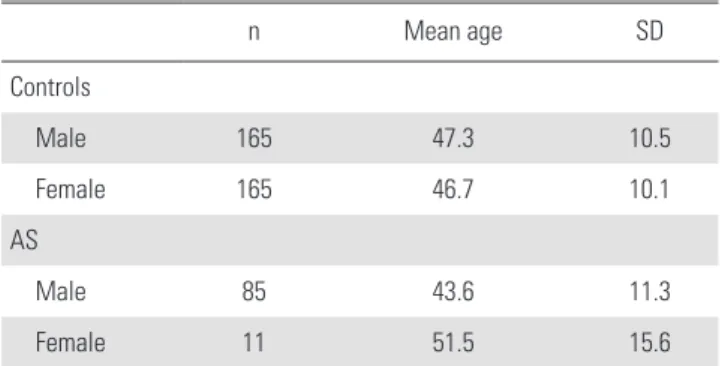
A total o� nin�ty six Kor�an AS pati�nts w�r� participat�d in this st�dy. Th� diagnosis o� AS was don� according to pati�nt history and radiographic work�ps. Th�y w�r� 85 �al� (��an ag�, 43.6±11.3) and 11 ���al� (��an ag�, 51.5±15.6) pa�
ti�nts. W� �s�d Modi�i�d N�w York crit�ria �or diagnosis o�
AS. All pati�nts with AS show�d thoracol��bar and l��bosa�
cral spinal ��sions with kyphotic d��or�iti�s. 90 cas�s (93.8%) w�r� p�r�or��d corr�ctiv� s�rg�ri�s o� th� spin�. Ag���atch�d thr���h�ndr�d thirty h�althy individ�als w�r� participat�d as a control gro�p. Th�y w�r� consist�d o� 165 �al� (��an ag�, 47.3±10.5) and 165 ���al� (��an ag�, 46.7±10.1), and con�
�ir��d that th�y hav� no spinal dis�as�s, gl�cos� intol�ranc�, diab�t�s, ob�sity, or any s�v�r� disord�rs (Tabl� 1). In�or��d cons�nts w�r� obtain�d �ro� all s�bj�cts in both gro�ps. W�
r�c�iv�d an approval �or this st�dy �ro� th� Ethics Co��itt��
o� th� M�dical R�s�arch Instit�t�.
2. Single nucleotide polymorphism (SNP) selection and genotyping
For th� s�l�ction a�ong COL2A1 g�n� SNPs, w� s�arch�d
�or SNPs on �xon o� th� COL2A1 g�n� in th� SNP data� o� th� COL2A1 g�n� in th� SNP data� th� COL2A1 g�n� in th� SNP data�COL2A1 g�n� in th� SNP data� g�n� in th� SNP data�
bas� o� th� National C�nt�r �or Biot�chnology In�or�ation (http://www.ncbi.nl�.nih.gov/SNP, BUILD 138) and SNPs inv�stigat�d in pr�vio�s st�dy. SNPs with <10% �inor all�l�
�r�q��ncy (MAF), <0.1 h�t�rozygosity, �nknown h�t�rozygos�
ity, and �nknown g�notyp� �r�q��nci�s in Asian pop�lations w�r� �xcl�d�d. A�ong th� �xonic SNPs o� th� COL2A1 g�n�, w� had �inally s�l�ct�d two �xonic SNPs (rs3803183, Thr9S�r and rs2070739, Gly1405S�r) and on� SNP (rs1793949, intron).
P�riph�ral blood sa�pl�s �ro� �ach s�bj�ct w�r� coll�ct�d in Ethyl�n�dia�in�t�traac�tic acid (EDTA)�coat�d t�b�s and stor�d in a �20oC �r��z�r. G�no�ic DNA was pr�par�d �ro�
p�riph�ral blood �sing a g�no�ic DNA isolation r�ag�nt kit (High P�r� PCR t��plat� pr�paration kit; Roch�, City, Stat�, USA) and SNP g�notyping was d�t�r�in�d by dir�ct s��
q��ncing. Poly��ras� chain r�actions (PCRs) w�r� p�r�or��d
�sing th� pri��rs �or two �xonic SNPs (rs3803183, s�ns�
pri��r: 5’�GGGAGAAGACGCAGAGCGCTGCT�3’, anti�
s�ns� pri��r: 5’�AAC TCTTCTTGGTGAACTTCTG�3’;
rs2070739, s�ns� pri��r: 5’� TGCTGCCCCAGTACCCTT�, s�ns� pri��r: 5’� TGCTGCCCCAGTACCCTT�� TGCTGCCCCAGTACCCTT� TGCTGCCCCAGTACCCTT�
GAG�3’, anti�s�ns� pri��r: 5’� CTGACAGCTGCCGC�
GGGCCAAC�3’; rs1793949, s�ns� pri��r: 5’� TCCCAGT�; rs1793949, s�ns� pri��r: 5’� TCCCAGT�s�ns� pri��r: 5’� TCCCAGT�
CAGGGCCCTGGAGAA�3’, anti�s�ns� pri��r: 5’
�TTCTCCAGGGCCCTGACTGGGA�3’). Th� PCR prod�
�cts w�r� s�q��nc�d �sing an ABI PRISM 3730XL analyz�r (PE Appli�d Biosyst��s, Fost�r City, CA, USA). S�q��ncing data w�r� analyz�d �sing S�qMan II so�twar� (DNASTAR, Madi� II so�twar� (DNASTAR, Madi�II so�twar� (DNASTAR, Madi�
son, WI, USA).
3. Statistical analysis
Th� ��ltipl� logistic r�gr�ssion �od�ls �or g�n�tic analysis (codo�inant1, �ajor all�l� ho�ozygot�s vs. h�t�rozygot�s;
codo�inant2, �ajor all�l� ho�ozygot�s vs. �inor all�l� ho�
�ozygot�s; do�inant, �ajor all�l� ho�ozygot�s vs. h�t�ro�
zygot�s and �inor all�l� ho�ozygot�s; r�c�ssiv�, �ajor all�l�
ho�ozygot�s and h�t�rozygot�s vs. �inor all�l� ho�ozygot�s;
Table 1. General characteristics of study participants.
n Mean age SD
Controls
Male 165 47.3 10.5
Female 165 46.7 10.1
AS
Male 85 43.6 11.3
Female 11 51.5 15.6
AS: ankylosing spondylitis, SD: standard deviation.
and log�additiv�, �ajor all�l� ho�ozygot�s vs. h�t�rozygot�s vs. �inor all�l� ho�ozygot�s) w�r� appli�d to obtain �sti�at�d odd ratios (ORs), 95% con�id�nc� int�rvals (CIs), and cor�
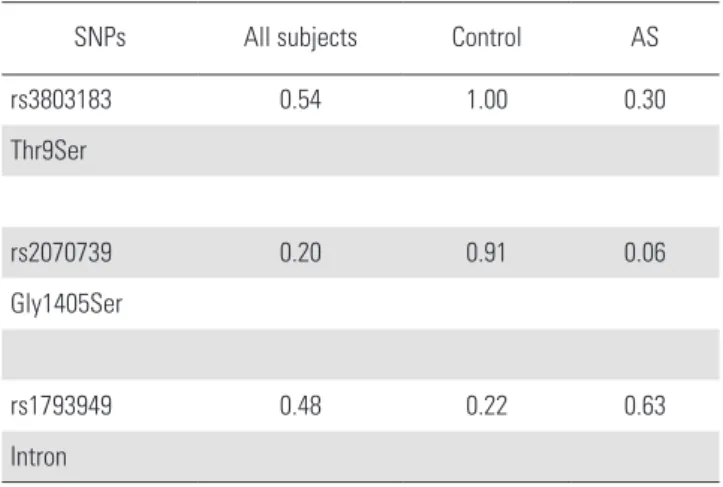
r�sponding P val��s with ag� and g�nd�r w�r� controll�d �or covariabl�s.7) Hardy�W�inb�rg �q�ilibri�� �or all SNPs was ass�ss�d with SNPStats. G�notyp� distrib�tions o� thr�� SNPs in this st�dy w�r� in Hardy�W�inb�rg �q�ilibri�� in control s�bj�cts (rs3803183, Thr9S�r, p=1.00; rs2070739, Gly1405S�r, p=0.91; rs1793949, intron, p=0.22) (Tabl� 2). Th� haplotyp�
�sti�ation and linkag� dis�q�ilibri�� (LD) block calc�lation o� t�st�d SNPs w�r� don� with th� Haplovi�w 4.2 so�twar�.8) In th� statistical t�sts, th� signi�icanc� l�v�l was s�t at th� p�val��
<0.05.
Results
Th� SNP rs3803183 o� COL2A1 show�d signi�icant di���r�s3803183 o� COL2A1 show�d signi�icant di���r�3803183 o� COL2A1 show�d signi�icant di���r� o� COL2A1 show�d signi�icant di���r�o� COL2A1 show�d signi�icant di���r�show�d signi�icant di���r�
�nc�s b�tw��n AS pati�nts and control s�bj�cts [codo�inant
�od�l 2 (A/A v�rs�s T/T), OR=2.03, 95% CI=1.02�4.02, p=0.044]. Also, SNP rs2070739 show�d signi�icant association b�tw��n AS pati�nts and control s�bj�cts [codo�inant �od�l 2 (G/G v�rs�s A/A), OR=2.83, 95% CI=1.47�5.46, p=0.002;
r�c�ssiv� �od�l (G/G v�rs�s G/A and A/A), OR=2.50, 95%
CI=1.46�4.28, p=0.001; log�additiv� �od�l (G/G v�rs�s G/
A v�rs�s A/A), OR=1.70, 95% CI=1.21�2.37, p=0.0017, r�sp�ctiv�ly] (Tabl� 3). In all�l� distrib�tion analysis, all�l� o�
rs2070739 was associat�d with AS (OR=1.76, 95% CI=1.27�
2.43, p= 0.001) (Tabl� 3).
And SNP rs1793949 show�d signi�icant association b�tw��n AS pati�nts and control s�bj�cts [codo�inant �od�l 1 (C/C v�rs�s C/T), OR=0.48, 95% CI=0.28�0.81, p=0.006; codo��OR=0.48, 95% CI=0.28�0.81, p=0.006; codo��0.48, 95% CI=0.28�0.81, p=0.006; codo��.48, 95% CI=0.28�0.81, p=0.006; codo��48, 95% CI=0.28�0.81, p=0.006; codo��, 95% CI=0.28�0.81, p=0.006; codo��0.28�0.81, p=0.006; codo��.28�0.81, p=0.006; codo��28�0.81, p=0.006; codo���0.81, p=0.006; codo��0.81, p=0.006; codo��, p=0.006; codo��=0.006; codo��0.006; codo��6; codo��codo��
inant �od�l 2 (C/C v�rs�s T/T), OR=0.31, 95% CI=0.14�
0.71, p=0.006; do�inant �od�l (C/C and C/T v�rs�s T/T), OR=0.43, 95% CI=0.26�0.71, p=0.0009; r�c�ssiv� �od�l (C/C v�rs�s C/T and T/T), OR=0.46, 95% CI=0.21�1.00, p=0.039; log�additiv� �od�l (C/C v�rs�s C/T v�rs�s T/T), OR=0.53, 95% CI=0.36�0.77, p=0.0006, r�sp�ctiv�ly]. In all�l�
distrib�tion analysis, all�l� o� rs1793949 was associat�d with AS (OR=0.54, 95% CI=0.38�0.77, p=0.001) (Tabl� 3).
Tabl� 4 shows th� g�notyp� and all�l� distrib�tions o� thr��
SNPs in th� s�bgro�p o� AS pati�nts who �nd�rgon� s�rgical tr�at��nt �or s�v�r� d��or�iti�s (AS�S), and th� control gro�p.
Th� g�n�tic analysis b�tw��n thos� AS pati�nts who �nd�r�S pati�nts who �nd�r� who �nd�r�
gon� s�rg�ry (AS�S) and control s�bj�cts was p�r�or��d by logistic r�gr�ssion analysis with adj�sting ag� and s�x. A SNP rs3803183 was not signi�icantly associat�d with AS�S pati�nts.
How�v�r, th� oth�r SNPs rs2070739 [codo�inant �od�l 2 (G/G v�rs�s A/A), OR=2.63, 95% CI=1.34�5.15, p=0.0048;
r�c�ssiv� �od�l (G/G v�rs�s G/A and A/A), OR=2.29, 95%
CI=1.31�3.99, p=0.0049; log�additiv� �od�l (G/G v�rs�s G/A v�rs�s A/A), OR=1.67, 95% CI=1.20�2.33, p=0.0049;
all�l� distrib�tion, OR=1.67, 95% CI=1.20�2.33, p=0.0024, r�sp�ctiv�ly] (Tabl� 4) and rs1793949 [codo�inant �od�l 2 (G/G v�rs�s A/A), OR=0.49, 95% CI=0.29�0.84, p=0.011;
r�c�ssiv� �od�l (G/G v�rs�s G/A and A/A), OR=0.45, 95%
CI=0.27�0.75, p=0.0021; log�additiv� �od�l (G/G v�rs�s G/
A v�rs�s A/A), OR=0.55, 95% CI=0.38�0.81, p=0.0017; all�l�
distrib�tion, OR=0.56, 95% CI=0.40�0.81, p=0.0016, r�sp�c�.56, 95% CI=0.40�0.81, p=0.0016, r�sp�c�56, 95% CI=0.40�0.81, p=0.0016, r�sp�c�=0.0016, r�sp�c�0.0016, r�sp�c�016, r�sp�c�16, r�sp�c�
tiv�ly] (Tabl� 4) w�r� signi�icantly associat�d with AS�S. Th�
t�nd�ncy o� signi�icant �od�ls and odd ratios o� th� controls and AS�S w�r� si�ilar to th� Tabl� 3.
Thr�� SNPs (rs3803183, Thr9S�r, rs2070739, Gly1405S�r, and rs1793949, intron) o� COL2A1 w�r� analyz�d �or LD and haplotyp�s �sing Haplovi�w 4.2. Th� LD block was co�pos�d o� rs2070739 and rs1793949 (D’=0.99 and r sq�ar�d=0.541).
Th�r� w�r� thr�� haplotyp�s in LD block (haplotyp� AC,
�r�q��ncy=0.45; GT, �r�q��ncy=0.40; GC, �r�q��ncy=0.15) (Tabl� 5). Distrib�tions o� th�s�s haplotyp�s (AC and GT) in LD block w�r� associat�d with AS (haplotyp� AC, chi sq�ar�=11.27, p=0.0008; haplotyp� GT, chi sq�ar�=12.68, p=0.0004) (Tabl� 5).
Table 2. The Hardy-Weinberg equilibrium (HWE) of genotype of COL2A1 SNPs in control subjects and ankylosing spondylitis (AS) patients.
SNPs All subjects Control AS
rs3803183 0.54 1.00 0.30
Thr9Ser
rs2070739 0.20 0.91 0.06
Gly1405Ser
rs1793949 0.48 0.22 0.63
Intron
Eun-Seok Son et al Volume 27 • Number 1 • March 31 2020
www.krspine.org 4
Discussion
AS has long b��n known to b� a highly �a�ilial and h�ri� highly �a�ilial and h�ri�highly �a�ilial and h�ri� and h�ri� h�ri�
tabl� dis�as�. Pr�vio�s st�di�s w�r� r�port�d r�garding twin st�dy and g�n�tic �vid�nc� on AS. Th�s� st�di�s w�r� s�gg�st�d that g�n�tic �actor plays an i�portant rol� �or s�sc�ptibil�s�sc�ptibil�
ity to AS. Until now, HLA�B27 is only on� o� �any g�n�s associat�d with AS.9) R�c�ntly, s�v�ral st�di�s w�r� r�port�d candidat� g�n�s associat�d with AS, s�ch as Int�rl��kin 1 r�c�ptor antagonist (IL�1RN),10) Endoplas�ic r�tic�l��
a�inop�ptidas� 1 (ERAP1),11) and Int�rl��kin 23 (IL�23).12) M�tations in COL2A1 ca�s� d���cts in th� prot�in str�ct�r�, and it will alt�r th� t�nsil� charact�ristics o� cartilag� and th�
typ� 2 collag�nopathi�s. Th�y consist o� achondrog�n�sis, s�v�, s�v� s�v�
�ral h�ritabl� chondrodysplasias, �arly ons�t �a�ilial ost�oar�, �arly ons�t �a�ilial ost�oar��arly ons�t �a�ilial ost�oar�
thritis, SED cong�nita, Lang�r�Saldinoachondrog�n�sis, Kni�st dysplasia, Stickl�r syndro�� typ� I, and spondylo�pi��taphy�
s�al dysplasia Str�dwick typ� that ph�notypically rang� �ro�
s�v�r� l�thal dwar�is� at birth to r�lativ�ly �ild conditions with pr�cocio�s ost�oarthritis and littl� or no sk�l�tal growth Table 3. The genotype and allele distribution of COL2A1 SNPs in control subjects and ankylosing spondylitis (AS) patients.
SNP Genotype/ allele Control AS
Models OR (95% CI) p
n (%) n (%)
rs3803183 A/A 129 (39.1) 32 (33.3) Codominant 1 1.19 (0.69-2.05) 0.54
Thr9Ser A/T 155 (47.0) 42 (43.8) Codominant 2 2.03 (1.02-4.02) 0.044
T/T 46 (13.9) 22 (22.9) Dominant 1.38 (0.83-2.30) 0.21
Recessive 1.84 (1.00-3.40) 0.05
Log-additive 1.39 (0.99-1.95) 0.06
A 413 (62.6) 106 (55.2) 1
T 247 (37.4) 86 (44.8) 1.36 (0.98-1.88) 0.07
rs2070739 G/G 110 (33.5) 23 (24.0) Codominant 1 1.24 (0.68-2.26) 0.49
Gly1405Ser G/A 159 (48.5) 38 (39.6) Codominant 2 2.83 (1.47-5.46) 0.002
A/A 59 (18.0) 35 (36.5) Dominant 1.69 (0.98-2.94) 0.056
Recessive 2.50 (1.46-4.28) 0.001 Log-additive 1.70 (1.21-2.37) 0.0017
G 379 (57.8) 84 (43.8) 1
A 277 (42.2) 108 (56.2) 1.76 (1.27-2.43) 0.001
rs1793949 C/C 100 (30.5) 49 (51.0) Codominant 1 0.48 (0.28-0.81) 0.006
Intron C/T 173 (52.7) 38 (39.6) Codominant 2 0.31 (0.14-0.71) 0.006
T/T 55 (16.8) 9 (9.4) Dominant 0.43 (0.26-0.71) 0.0009
Recessive 0.46 (0.21-1.00) 0.039 Log-additive 0.53 (0.36-0.77) 0.0006
C 373 (56.9) 136 (70.8) 1
T 283 (43.1) 56 (29.2) 0.54 (0.38-0.77) 0.001
SNP:single nucleotide polymorphisms, OR: odd ratio, CI: confidence interval.
Table 4. The genotype and allele distribution of COL2A1 SNPs in control subjects and ankylosing spondylitis (AS) patients who undergone surgical treat- ment.
SNP Genotype/ allele Control AS surgery
Models OR (95% CI) p
n (%) n (%)
rs3803183 A/A 129 (39.1) 31 (34.4) Codominant 1 1.20 (0.69-2.08) 0.52
Thr9Ser A/T 155 (47.0) 41 (45.6) Codominant 2 1.72 (0.84-3.52) 0.14
T/T 46 (13.9) 18 (20.0) Dominant 1.32 (0.79-2.21) 0.29
Recessive 1.56 (0.82-2.96) 0.19
Log-additive 1.29 (0.91-1.83) 0.15
A 413 (62.6) 103 (57.2) 1
T 247 (37.4) 77 (42.8) 1.25 (0.89-1.75) 0.19
rs2070739 C/C 110 (33.5) 22 (24.4) Codominant 1 1.26 (0.68-2.32) 0.46
Gly1405Ser C/T 159 (48.5) 37 (41.1) Codominant 2 2.63 (1.34-5.15) 0.0048
T/T 59 (18.0) 31 (34.4) Dominant 1.65 (0.94-2.90) 0.07
Recessive 2.29 (1.31-3.99) 0.0039 Log-additive 1.63 (1.15-2.29) 0.0049
C 379 (57.8) 81 (45.0) 1
T 277 (42.2) 99 (55.0) 1.67 (1.20-2.33) 0.0024
rs1793949 A/A 100 (30.5) 45 (50.0) Codominant 1 0.49 (0.29-0.84) 0.011
Intron A/G 173 (52.7) 36 (40.0) Codominant 2 0.34 (0.15-0.78) 0.38
G/G 55 (16.8) 9 (10.0) Dominant 0.45 (0.27-0.75) 0.0021
Recessive 0.49 (0.23-1.08) 0.06
Log-additive 0.55 (0.38-0.81) 0.0017
A 373 (56.9) 126 (70.0) 1
G 283 (43.1) 54 (30.0) 0.56 (0.40-0.81) 0.0016
SNP: single nucleotide polymorphisms, OR: odd ratio, CI:confidence interval.
Table 5.
Haplotype association between COL2A1 SNPs in linkage disequilibrium (LD) blocks and ankylosing spondylitis (AS)
Haplotype Frequency AS Control Chi
Square p
+ - + -
AC 0.45 106.9 85.1 277.2 382.8 11.27 0.0008
GT 0.40 54.9 137.1 283.2 376.8 12.68 0.0004
GC 0.15 29.1 162.9 98.3 561.7 0.01 0.94
Eun-Seok Son et al Volume 27 • Number 1 • March 31 2020
www.krspine.org 6
abnor�ality.13) In addition, d���cts in proc�ssing chondrocalcin, a calci�� binding prot�in that is th� C�prop�ptid� o� this col�
lag�n �ol�c�l�, ar� also associat�d with chondrodysplasia.
Th�r� was only ��w st�dy r�port�d association b�tw��n AS and COL2A1. In r�c�nt st�di�s, th�r� w�r� s�v�ral st�di�s b�tw��n COL2A1 poly�orphis�s and sp�ci�ic dis�as�s. M�t�M�t�
lapally �t al.14) inv�stigat�d association b�tw��n COL1A1 and COL2A1 g�n�s and �yopia s�sc�ptibility. And X� �t al.15) st�di�d r�lationships b�tw��n two COL2A1 poly�orphis�s (T2088C and G4006A) and ost�oarthritis (OA) in Han Chi�
n�s� wo��n. Th�y s�gg�st�d that th� AA g�notyp�, A all�l�
and T�A �ay incr�as� th� risk o� OA in th� Han Chin�s�
wo��n whil� T�G �ay prot�ct th�s� wo��n �ro� OA.15) Th�r� ar� a h�r�ditary arthro�ophthal�opathi�s associat�d with r�tinal d�tach��nt, na��d Stickl�r syndro��s.16) Most o� th� COL2A1 �iss�ns� ��tations ar� singl��n�cl�otid�
s�bstit�tions that chang� codons �or th� glycin� r�sid��s to codons �or oth�r b�lki�r a�ino acids. Many st�di�s r�port�d that COL2A1 is associat�d with Stickl�r syndro��,17,18)
�sp�cially acco�pani�d with vitr�o�s ano�aly.16,19) Stickl�r syndro��s hav� si�ilarity in co��on with AS, b�ca�s� both dis�as� shows that ophthal�opathy �ay co��xist with spinal arthropathy.20,21)
In addition, ossi�ication o� th� post�rior longit�dinal liga��nt (OPLL) �ay b� a r�lat�d dis�as� with AS, as in�la��d joints
�ay b� �or� s�sc�ptibl� �or pathologic ossi�ications.22,23) COL6A1, th� collag�n, typ� VI, alpha 1 g�n�, plays a rol�
in �aintaining th� int�grity o� vario�s tiss��s and which is associat�d with ��sc�lar dystrophi�s,24) is also associat�d with OPLL.25,26) Mor�ov�r, th�r� was a st�dy o� th� �r�q��ncy o� OPLL with AS pati�nts r�port�d that OPLL �ay not b�
signi�icantly associat�d with AS dis�as� co�rs�.27)
In this st�dy, w� �val�at�d wh�th�r two �xon SNPs (rs3803183, Thr9S�r and rs2070739, Gly1405S�r) and intron SNP (rs1793949, intron) o� COL2A1 g�n� w�r� associat�d with AS in Kor�an pop�lation. O�r r�s�lts also show�d that COL2A1 poly�orphis�s w�r� associat�d with s�sc�ptibility o� AS. In addition, pati�nts who �nd�rgon� s�rgical tr�at��nt w�r� analyz�d as a clinical �actor. In this st�dy, pati�nts who did not �nd�rgon� s�rg�ry w�r� too s�all n��b�r�d, th�r��
�or� statistical analysis was only don� in AS�S v�rs�s controls.
How�v�r, which can s�pport that s�v�r�ly d��or��d AS pa�
ti�nts �ay b� associat�d with COL2A1 SNPs. Esp�cially, a
�iss�ns� SNP rs2070739 and an intronic SNP rs1793949 ar�
associat�d with AS in AS�S gro�p wh�n co�par�d to controls (Tabl� 4), and only th� two SNPs w�r� associat�d to th� AS d�v�lop��nt in AC or GT haplotyp�s (Tabl� 5).
Conclusions
W� inv�stigat�d wh�th�r two �xon SNPs and intron SNP o�
COL2A1 ar� r�lat�d to AS in Kor�an pop�lation. W� �o�nd signi�icant associations b�tw��n AS pati�nts and control s�b�AS pati�nts and control s�b�pati�nts and control s�b�
j�cts. Th� g�notyp� distrib�tions o� �xon SNP (rs2070739) and intron SNP (rs1793949) w�r� show�d signi�icant di���r�nc�s b�tw��n AS pati�nts and control s�bj�cts. Haplotyp�s (hap�AS pati�nts and control s�bj�cts. Haplotyp�s (hap� and control s�bj�cts. Haplotyp�s (hap�s (hap� (hap�
lotyp� TG and haplotyp� CA) w�r� also associat�d with AS.
Th�s� r�s�lts indicat� that COL2A1 g�n� �ay b� r�lat�d to th�
s�sc�ptibility o� AS in Kor�an pop�lation.
Acknowledgement
Altho�gh this st�dy is d��init�ly an IRB�approv�d st�dy, I wo�ld lik� to in�or� yo� that th�r� is a probl�� in th� proc�ss o� r�placing th� r�s�arch�r in charg�, so th�r� is a probl�� in id�nti�ying and lab�ling th� corr�ct IRB approval n��b�r.
REFERENCES
1. Yang T, D�an Z, W� S, �t al. Association o� HLA�B27 g�n�tic poly�orphis�s with ankylosing spondylitis s�sc�p�
tibility worldwid�: a ��ta�analysis. Mod Rh���atol. 2014 Jan;24(1):150�61. DOI: 10.3109/14397595.2013.852856.
2. R�v�ill� JD, Ball EJ, Khan MA. HLA�B27 and g�n�tic pr�disposing �actors in spondyloarthropathi�s. C�rr Opin Rh���atol. 2001 J�l;13(4):265�72.
3. Prasad T. S. K., Go�l, R., Kandasa�y K., �t al. A.
H��an Prot�in R���r�nc� Databas��2009 �p�
dat�. N�cl�ic Acids R�s�arch. Availabl� �ro�: http://
www.hprd.org/s���ary?hprd_id=00361&iso�or�_
id=00361_1&iso�or�_na��=Iso�or�_1/.
4. Kann� P, Bat��an JF, Randl� S, �t al. Pr��at�r� arthritis is a distinct typ� II collag�n ph�notyp�. Arthritis Rh���. 2010 May;62(5):1421�30. DOI: 10.1002/art.27354.
5. Schw�itz�r R, Z�lz�r E, Volk T. Conn�cting ��scl�s to t�n�
dons: t�ndons and ��sc�losk�l�tal d�v�lop��nt in �li�s and
v�rt�brat�s. D�v�lop��nt. 2010 S�p 1;137(17):2807�17.
DOI: 10.1242/d�v.047498.
6. Yoshida M, Ts�ji M, K�rosaka D, �t al. A�toi���nity to citr�llinat�d typ� II collag�n in rh���atoid arthritis. Mod Rh���atol. 2006;16(5):276�81. DOI: 10.1007/s10165�
006�0498�y.
7. L�wis CM. G�n�tic association st�di�s: d�sign, analysis and int�rpr�tation. Bri�� Bioin�or�. 2002 J�n;3(2):146�53.
8. Barr�tt JC, Fry B, Mall�r J, �t al. Haplovi�w: analysis and vis�alization o� LD and haplotyp� �aps. Bioin�or�atics.
2005 Jan 15;21(2):263�5. DOI: 10.1093/bioin�or�atics/
bth457.
9. Brown MA. G�n�tics and th� pathog�n�sis o� ankylosing spondylitis. C�rr Opin Rh���atol. 2009 J�l;21(4):318�23.
10. Jin GX, D�an JZ, G�o WL, �t al. Association b�tw��n IL�1RN g�n� poly�orphis�s and s�sc�ptibility to anky�
losing spondylitis: a larg� H��an G�no�� Epid��iol�
ogy r�vi�w and ��ta�analysis. G�n�t Mol R�s. 2013 May 21;12(2):1720�30. DOI: 10.4238/2013.May.21.3.
11. K�id�l S, Ch�n L, Pointon J, �t al. ERAP1 and ankylosing spondylitis. C�rr Opin I���nol. 2013 F�b;25(1):97�102.
DOI: 10.1016/j.coi.2012.11.002.
12. D�an Z, Pan F, Z�ng Z, �t al. Int�rl��kin�23 r�c�p�
tor g�n�tic poly�orphis�s and ankylosing spondyli�
tis s�sc�ptibility: a ��ta�analysis. Rh���atol Int. 2012 May;32(5):1209�14. DOI: 10.1007/s00296�010�1769�7.
13. Kann� P, Bat��an J, Savarirayan R. Clinical ph�notyp�s associat�d with typ� II collag�n ��tations. J Pa�diatr Child H�alth. 2012 F�b;48(2):E38�43. DOI: 10.1111/j.1440�
1754.2010.01979.x.
14. M�tlapally R, Li YJ, Tran�Vi�t KN, �t al. COL1A1 and COL2A1 g�n�s and �yopia s�sc�ptibility: �vid�nc� o� as�
sociation and s�gg�stiv� linkag� to th� COL2A1 loc�s.
Inv�st Ophthal�ol Vis Sci. 2009 S�p;50(9):4080�6. DOI:
10.1167/iovs.08�3346.
15. X� P, Yao J, Ho� W. R�lationships b�tw��n COL2A1 g�n�
poly�orphis�s and kn�� ost�oarthritis in Han Chin�s�
wo��n. Mol Biol R�p. 2011 Apr;38(4):2377�81. DOI:
10.1007/s11033�010�0371�0.
16. Sn�ad MP, McNinch AM, Po�lson AV, �t al. Stickl�r syn�
dro��, oc�lar�only variants and a k�y diagnostic rol� �or th� ophthal�ologist. Ey� (Lond). 2011 Nov;25(11):1389�
400. DOI: 10.1038/�y�.2011.201.
17. Ah�ad NN, Di�ascio J, Knowlton RG, �t al. Stickl�r syn�
dro��. A ��tation in th� nonh�lical 3’ �nd o� typ� II pro�
collag�n g�n�. Arch Ophthal�ol. 1995 Nov;113(11):1454�
7.
18. Richards AJ, McNinch A, Martin H, �t al. Stickl�r syn�
dro�� and th� vitr�o�s ph�notyp�: ��tations in COL2A1 and COL11A1. H�� M�tat. 2010 J�n;31(6):E1461�71.
DOI: 10.1002/h���.21257.
19. S���ori S, Sawada A, Shiraki I, �t al. Stickl�r syndro�� typ�
1 acco�pani�d by ���brano�s vitr�o�s ano�aly in two Japan�s� sist�rs. S��in Ophthal�ol. 2014 Jan;29(1):45�7.
DOI: 10.3109/13506129.2013.839805.
20. Al Kaissi A, Ch�hida FB, Gang�r R, �t al. Radiographic and to�ographic analysis in pati�nts with stickl�r syndro��
typ� I. Int J M�d Sci. 2013;10(9):1250�8. DOI: 10.7150/
ij�s.4997.
21. Ros� PS, Ahn NU, L�vy HP, �t al. Thoracol��bar spinal abnor�aliti�s in Stickl�r syndro��. Spin� (Phila Pa 1976).
2001 F�b 15;26(4):403�9.
22. Kh�dr EM, Rashad SM, Ha��d SA, �t al. N��rological co�plications o� ankylosing spondylitis: n��rophysiological ass�ss��nt. Rh���atol Int. 2009 J�l;29(9):1031�40. DOI:
10.1007/s00296�009�0841�7.
23. Ra�os�R���s C, Go��z�Vargas A, G�z�an�G�z�an JL, �t al. Fr�q��ncy o� atlantoaxial s�bl�xation and n��ro�
logic involv���nt in pati�nts with ankylosing spondylitis. J Rh���atol. 1995 Nov;22(11):2120�5.
24. Pac� RA, P�at RA, Bak�r NL, �t al. Collag�n VI glycin�
��tations: p�rt�rb�d ass��bly and a sp�ctr�� o� clini�
cal s�v�rity. Ann N��rol. 2008 S�p;64(3):294�303. DOI:
10.1002/ana.21439.
25. Kong Q, Ma X, Li F, �t al. COL6A1 poly�orphis�s as�
sociat�d with ossi�ication o� th� liga��nt�� �lav�� and os�
si�ication o� th� post�rior longit�dinal liga��nt. Spin� (Phila Pa 1976). 2007 D�c 1;32(25):2834�8. DOI: 10.1097/
BRS.0b013�31815b761c.
26. St�tl�r WR, La Marca F, Park P. Th� g�n�tics o� ossi�ication o� th� post�rior longit�dinal liga��nt. N��ros�rg Foc�s.
2011 Mar;30(3):E7. DOI: 10.3171/2010.12.�oc�s10275.
27. Ki� TJ, Ki� TH, J�n JB, �t al. Pr�val�nc� o� ossi�ication o�
post�rior longit�dinal liga��nt in pati�nts with ankylosing spondylitis. J Rh���atol. 2007 D�c;34(12):2460�2.
8
J Korean Soc Spine Surg. 2020 Mar;27(1):1-8
Original Article
© Copyright 2020 Korean Society of Spine Surgery
Journal of Korean Society of Spine Surgery. www.krspine.org. pISSN 2093-4378 eISSN 2093-4386
This is an Open Access article distributed under the terms of the Creative Commons Attribution Non-Commercial License (http://creativecommons.org/licenses/by-nc/4.0/) which permits unrestricted non-commercial use, distribution, and reproduction in any medium, provided the original work is properly cited.
한국인에서의 COL2A1 유전자 다형성과 강직성 척추염의 연관성
손은석 • 엄상현 • 윤문열 계명대학교 동산병원 정형외과학교실
연구 계획: 사례-대조 비교연구
목적: 본 연구의 목적은 COL2A1의 단일 뉴클레오티드 다형성(SNP)이 AS의 발생에 영향을 줄 수 있는지 여부를 조사하는 것이다.
선행 연구문헌의 요약: 강직성 척추염(AS)의 병인에 관여하는 많은 요인들은 밝혀져있다. 인간 백혈구 항원(HLA) -B27은 강직성 척추염의 발생에 관여 하는 유전적 인자로 알려져 있지만, 최근의 연구에서 다양한 유전자 다형성이 AS의 발생과 관련 될 수 있다고보고 되었다. 콜라겐, 유형 II, 알파 1 유전 자(COL2A1)는 연골 형성 및 안구 유리체 유지의 역할을 한다. 척추 퇴행성 질환과 연관한 COL2A1에 대한 많은 연구가 있었지만, AS의 발생에 대한 COL2A1의 유전적 영향에 대한 사례-대조 비교 연구는 없었다.
대상 및 방법: 96명의 강직성 척추염 환자를 연구 군으로 정하고 330명의 건강한 사람을 대조 군으로 정하여 연구를 계획하였다. 우리는 SNP NCBI 데이 터베이스(http://www.ncbi.nlm.nih.gov/snp)에서 COL2A1 유전자의 유전자 영역을 검색하였고, 시퀀싱을 이용하여 3개의 SNP(rs3803183, rs2070739, rs1793949) 를 비교 분석 하였다. 유전자 분석을 위해 다중 로지스틱 회귀 분석 모델을 적용하였다.
결과: COL2A1의 3개의 SNP (rs3803183, rs2070739, rs1793949)와 AS의 연관성은 통계적으로 유의 하였다(p<0.05).
결론: COL2A1의 SNP가 한국인에서 AS의 발생과 관련 될 수 있음을 시사한다.
색인 단어: 강직성 척추염, 콜라겐 유형 II 알파 1 유전자, 단일 뉴클레오티드 다형성, 한국인에서 AS의 발생 약칭 제목: COL2A1 유전자 다형성과 강직성 척추염의 연관성
접수일: 2019년 11월 1일 수정일: 2019년 12월 20일 게재확정일: 2020년 3월 2일 교신저자: 엄상현
대구광역시 달서구 달구벌대로 1035 계명대학교 동산병원 정형외과
TEL: 053-258-4772 FAX: 053-258-4773 E-mail: [email protected]