157 Korean J. Pl. Taxon. (2012)
Vol. 42 No. 2, pp.157-160
Leontopodium seorakensis, a new species of Asteraceae from Korea
Yongseok Lim, Jin-O Hyun
1, Young-Dong Kim
2and Hyunchur Shin*
Department of Biology, Soonchunhyang University, Asan 336-745, Korea
1
Institute of Northeast Asian Plant, Gangnam-Gu, Seoul 135-757, Korea
2
Department of Life Science, Hallym University, Chunchon 200-702, Korea (Received 20 March 2012; Revised 19 April 2012; Accepted 19 June 2012)
한국산 신종, 설악솜다리
임용석·현진오1·김영동2·신현철*
순천향대학교 자연과학대학 생명과학과,
1동북아식물연구소,
2한림대학교 자연과학대학 생명과학과
ABSTRACT: Leontopodium seorakensis (Asteraceae), a new species from Mt. Seorak National Park in central Korea is described and illustrated. Its taxonomic history, distribution, habitats, and diagnostic characteristics are discussed and contrasted with those of the closely related L. japonicum Miquel and L. leiolepis Nakai.
Keywords: Leontopodium seorakensis, new species, Leontopodium leiolepis, Leontopodium japonicum, Korea
적 요: 설악산에 분포하는 신종, 설악솜다리를 기재하였다. 이 종은 산솜다리와 왜솜다리와 유사하나, 포 아 랫면에 털이 밀생하며, 포편의 모양과 길이가 거의 같으며, 내외포편의 위쪽에 선모가 거의 없는 점에 의해 구분된다.
주요어: 설악솜다리, 신종, 솜다리속, 국화과
Leontopodium R. Brown ex Cassini (Asteraceae, Inuleae) is a genus of perennial herbs, with small heads crowded into dense cymes surrounded by conspicuous bract-like leaves (Handel-Mazzetti, 1928; Grubov, 1990). Comprising about 35 species, the genus is distributed mainly in Eurasia and reportedly in the Andes (Mabberley, 1990). In Korea, five species of Leontopodium, most of which are quite rare, usually grow in mountainous regions.
Although various taxonomies of Leontopodium have been proposed by Beauverd (1911) and Handel-Mazzetti (1928), they are not considered wholly satisfactory (Grubov, 1990).
Therefore, recent regional monographs on the genus either did not use a taxonomic system, eg. U.S.S.R. (Grubov, 1990) and Flora of China (only manuscript available from http://hua/huh/
harvard.edu), or partially adopted Handel-Mazzetti ’ s systems, eg. Flora of Japan (Koyama, 1995).
During the revision of genus Leontopodiumin in Korea, the
taxonomic identity of two species growing in the Mt. Seorak National Park area came into question. For a long time, they have been identified as L. coreanum Nakai and L. leiolepis Nakai. However, the first species, L. coreanum, which has long been classified as an endangered endemic species by the Ministry of Environment of Korea, turned out to be conspecific with L. japonicum Miquel (Handel-Mazzetti, 1928; Lee &
Park, 2008) and thus no longer endemic to Korea. We also found that the second species is a novel taxon which is similar but clearly different from L. leiolepis in the morphological characters of its leaves and involucres. These differences seem to be sufficient to describe it as a new species.
Leontopodium seorakensis Lim, Hyun, Kim & Shin, sp.
nov. TYPE: Korea. Kangwon. Inje Gun, near the peak of Mt.
Ahn (1,396 m) area in Mt. Seorak National Park, 1,360 m alt, N 38
o08'10.2'', E 128
o20'4.2'', Jun 30 2007, Hyun 20070004 (Holotype KB; Isotype SNU). Fig. 1.
*Author for correspondence: [email protected]
한국식물분류학회지 제42권 2호
158 Yongseok Lim, Jin-O Hyun, Young-Dong Kim and Hyunchur Shin
Korean name: Seo-rak-som-da-ri
A Leontopodium leiolepis bracteolae adaxialis dense arachnoideus differt, a L. kurilense phyllaria fere glabra differt.
Perennial herbs. Rhizomes terete, cespitose, caudex, inflated, overlapping scales. Flowering stems erect, terete, purplish, 4−
14 cm tall, 1 mm diameter, hairs white arachnoid and glandular.
Leaves simple, alternate, entire, sheathing. Leaves of Fig. 1. Leontopodium seorakensis. A. habit; B. rhizome; C. capitulum; D. outer phyllary; E. inner phyllary; F. pistillate floret; G.
hermaphrodite floret; H. corolla tube of pistillate floret; I. style of pistillate floret; J. style of hermaphrodite floret; K. stamen of hermaphrodite
floret. Bar. 2 cm (A, B), 2 mm (C, D, E, F, G), 1 mm (H, I, J, K). Drawn from Hyun 2007004 (Holotype).
Korean J. Pl. Taxon, Vol. 42, No. 2
Leontopodium seorakensis, a new species of Asteraceae from Korea 159
innovation shoots oblanceolate, 1.5 −4.0 cm long, 0.3−1.0 cm, upper surfaces whitish green, sparsely arachnoid and glandular, lower surfaces white, densely arachnoid and glandular, apex acute, base attenuate, purplish, sheathing, basal margins sparsely arachnoid. Basal leaves congested, tortuous, remain during anthesis. Cauline leaves 6-14, oblanceolate, 1.3 −3.0 cm long, 3−7 mm wide, upper surfaces whitish green, thinly arachnoid and glandular, lower surfaces white, densely arachnoid and glandular, apex acute, mucronate, base attenuate, half-sheathing, lower cauline leaves, base purplish, basal margins sparsely arachnoid. Bracteal leaves 6−16, oblanceolate or narrowly elliptic, 0.5−2.2 cm long, 1−6 mm wide, upper surfaces white, densely arachnoid and glandular, lower surfaces white, densely arachnoid and glandular, apex acute, mucronate, base attenuate. Capitula 5−8, in dense corymbs, polygamous, marginal capitula 4−7, 3−5 mm across, a central capitulum largest, 6 −8 mm across. Involucre hemispheric or campanulate, phyllaries in 3 series, 4−5 mm long, phyllaries similar in size and shape, oblanceolate or narrowly elliptic, 3−5 mm long, 0.6−1.5 mm wide, apex acute, inner phyllaries sometimes acuminate, abaxial surfaces sparsely or rarely puberelent, central portion pale green to green, navicular, margins brownish scarious, incised, adaxial surfaces glabrous. Marginal disc florets pistillate, 12−23 in central capitulum, 11−20 in marginal capitula, 4 −5 mm long, corolla capillary, pale green, 2.5−3 mm long, lower portion usually inflated, 4 lobed, lobes triangular- ovate or triangular-lanceolate, ca. 0.3 mm long, abaxial surfaces sparsely puberulent, apex acute, style cylindrical, 2.5−3.5 mm long, lower portion bamboo node-like, usually inflated, tip bifid, branches 0.3−0.4 mm long, immature achenes narrowly elliptic or oblaneolate, densely pubescent, 1.3−2.0 mm long,
0.2 −0.8 mm wide. Central disc florets hermaphrodite, 25−40 in central capitulum, 7 −16 in marginal capitula, 4.0−5.5 mm long, corolla tubular, upward funnelform, pale green, 3.0−
3.5 mm long, 5 lobed, lobes triangular-ovate, 0.5−0.7 mm long, abaxial surfaces sparsely puberulent, apex acute, style cylindrical, median portion usually compressed, stigmatic portion clavate, lower portion bamboo node-like, usually inflated, stamens 5, attached at quarters of collora tube, syngenesious, 2.0 −2.5 mm long, filaments compressed, glabrous, anthers coalescent, apex acute, base sagittate, ovary oblaneolate or narrowly oblong, compressed, median to upper portion sparsely pubescent or upper portion rarely pubescent, 1.3−2.0 mm long, 0.2 −0.3 mm wide. Pappus uniseriate, bristles 21−25, white, barbed, 3.0 −3.5 mm.
Paratypes: Korea. Kangwon. Inje-Gun, around the 1,396 m peak of Mt. Ahn area in Mt. Seorak National Park, 1,360 m alt, N 38
o08'8.0'', E 128
o20'7.8'', Jun 30 2007, Hyun 20070006 (KB); around the peak of Mt. Ahn in Mt. Seorak National Park, 1,436 m alt, N 38
o08'21.8", E 128
o19'40.5", Jun 30 2007, Hyun 20070006 (SNU); the southern face of Mt. Ahn area in Mt. Seorak National Park, 1,370 m alt, N 38
o08'8.0", E 128
o20' 9.5", Jun 30 2007, Hyun 20070005 (HHU, KH); Dragon ridge in Mt. Seorak, 1,293 m alt, N 38
o08'9.5", E 128
o27'51.2", Jun 23 2007, Hyun 20070002 (KB), 1290 m alt, N 38
o08'53.2", E 128
o26'42.5", Jun 23 2007, Hyun 20070003 (KB, SNU, HHU), 1,153 alt, N 38
o08'19.6", E 128
o27'28.3", Jun 23 2007, Hyun 20070001 (KH).
Etymology: The species epithet “ seorakensis ” refers to the local name of the site where L. seorakensis was widely
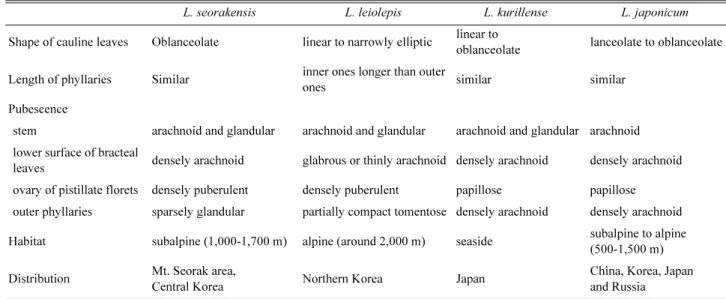
Table 1. Comparison of morphological characters among Leontopodium seorakensis and related taxa.
L. seorakensis L. leiolepis L. kurillense L. japonicum
Shape of cauline leaves Oblanceolate linear to narrowly elliptic linear to
oblanceolate lanceolate to oblanceolate Length of phyllaries Similar inner ones longer than outer
ones similar similar
Pubescence
stem arachnoid and glandular arachnoid and glandular arachnoid and glandular arachnoid lower surface of bracteal
leaves densely arachnoid glabrous or thinly arachnoid densely arachnoid densely arachnoid ovary of pistillate florets densely puberulent densely puberulent papillose papillose outer phyllaries sparsely glandular partially compact tomentose densely arachnoid densely arachnoid Habitat subalpine (1,000-1,700 m) alpine (around 2,000 m) seaside subalpine to alpine
(500-1,500 m) Distribution Mt. Seorak area,
Central Korea Northern Korea Japan China, Korea, Japan
and Russia
한국식물분류학회지 제42권 2호