• 검색 결과가 없습니다.

A new species of Huperzia (Lycopodiaceae) from Jeju Island, Korea: Huperzia jejuensis

N/A
N/A
Protected

Academic year: 2021

Share "A new species of Huperzia (Lycopodiaceae) from Jeju Island, Korea: Huperzia jejuensis"

Copied!
5
0
0

로드 중.... (전체 텍스트 보기)

전체 글

(1)

A new species of Huperzia (Lycopodiaceae) from Jeju Island, Korea:

Huperzia jejuensis Jina Lim

1

and Byung-Yun Sun*

Department of Biological Sciences, Chonbuk National University, Jeonju 561-756, Korea

1

Division of Plant Resources, National Institute of Biological Resources, Incheon 404-170, Korea (Received 28 January 2015; Accepted 21 February 2015)

한국(제주도)의 1신종: 긴다람쥐꼬리

임진아1·선병윤*

1

전북대학교 생명과학과, 국립생물자원관

ABSTRACT: A new species belonging to Lycopodiaceae Mirb. Huperzia Bernh. s.l. is described and illustrated:

Huperzia jejuensis B.-Y. Sun & J. Lim. H. jejuensis has been considered conspecific with H. integrifolia (Mat- suda) B. Øllg. ex. Z. Satou, but it is clearly distinguished by the characteristics of linear-lanceolate leaves with parallel margins from the base to the mid-part, minute dentate margins from the mid-part to the end of the leaf, and cuspidate gemma apex. Because the habitat of the new species was confined to Jeju Island, ‘jejuensis’ was chosen as the specific epithet of the scientific name of the new taxon.

Keywords: Lycopodiaceae, Huperzia, new species, H. jejuensis, H. integrifolia

적 요: 석송과 뱀톱속에 속하는 신종 긴다람쥐꼬리(H. jejuensis B.-Y. Sun & J. Lim.)를 기재하고 도해하였 다. 긴다람쥐꼬리는 현재까지 H. integrifolia (Matsuda) B. Ollg. ex Z. Satou로 취급되어 왔으나 기부(base)에 서 중간부까지 가장자리가 평행한 선상피침형의 잎, 잎의 중간부에서 상부까지 존재하는 미세한 치아상거치, 무성아의 정단은 예철두인 점에 의해 뚜렷이 구분되었다. 학명의 종소명은 신종의 생육지가 제주도인 점을 고려하여 ‘jejuensis’로 신칭하였다.

주요어: 석송과, 뱀톱속, 신종, 긴다람쥐꼬리, H. integrifolia

More than 300 species in the genus Huperzia Bernh. s.l.

belonging to Lycopodiaceae Mirb. are recognized worldwide, mostly in the tropics (Wikström and Kenrick, 1999; Sun, 2007).

Bernhardi (1801) segregated Huperzia as a distinct genus from Lycopodium L. based on sporangium born at the axil of leaves instead of producing strobilus.

Yabe (1903) first reported the distribution of Lycopodium serratum Thunb. ex Murray [= Huperzia serrata (Thunb. ex Murray) Trevis.] and L. miyoshianum Makino [= H. miyoshiana

(Makino) Ching] from Mt. Geumgang in Korea, and six species have been recognized in Korea (Sun, 2007): H. serrata, H.

integrifolia (Matsuda) B. Ø llg. ex Z. Satou, H. miyoshiana, H.

selago (L.) Bernh. ex Schrank & Mart., H. cryptomeriana (Maxim.) R. D. Dixit, and H. sieboldii (Miq.) Holub.

Of these, H. integrifolia has been regarded as an endemic species that grows naturally on Jeju Island, Korea (Nakai, 1952).

Matsuda (1911) reported a new variety, Lycopodium serratum var. integrifolium Matsuda, based on a specimen collected at Lu-shan, Kiang-si Province, China by a Japanese collector Inami (Fig. 1), mentioning that the serration of leaves of the new variety is obscure or almost absent, and many specimens of the type variety from different localities in Japan

*Author for correspondence: [email protected] http://www.pltaxa.or.kr

Copyright © 2015 the Korean Society of Plant Taxonomists

(2)

have distinct serrations. Although Latin description was not provided for this new variety, the name can be treated as valid according to ICN Art. 39.1. Subsequently, Nakai (1914) published the name L. integrifolium (Matsuda) Matsuda et Nakai with a Latin diagnosis and description, raising L.

serratum var. integrifolium to the specific level. He cited a specimen collected from Jeju Island (Mt. Halla at 700 m, Nakai 1081) and indicated the distribution range of this species as China and Korea (Jeju island). However, much earlier than Nakai, Goldie (1822) published a new species, L. integrifolium Hook. ex Goldie based on specimens collected in Montreal, Canada, describing the new species as a relative of L. clavatum L., which is apparently a different species to L. integrifolium (Matsuda) Matsuda et Nakai. Therefore, L. integrifolium (Matsuda) Matsuda et Nakai is a later homonym and hence illegitimate. Satou (1997) transferred L. integrifolium (Matsuda) Matsuda et Nakai to Huperzia as H. integrifolia.

In this study, we examined and compared the morphology of the original specimen collected by Inami in Lushan, China, and the specimens collected on Jeju Island. We found that these two taxa are fundamentally different enough to be treated as different species. Therefore we described the taxon distributed on Jeju Island as a new species, H. jejuensis B.-Y. Sun & J. Lim.

Taxonomic Treatment

Huperzia jejuensis B.-Y Sun & J. Lim, sp. nov. (Figs. 2, 3) TYPE: Korea. Jeju Island: Mt. Halla, Seongpanak hiking trail, in forests beside the trail, 33

o

22' N, 126

o

33' E, elev.

1568 m. 8 Aug. 2010. C.-H. Kim, J. Lim, N.-R. Yun and S.-S.

Choi 50803. (Holotype, KB; Isotype, KB).

Korean name: Gin-da-ram-jwi-kko-ri 긴다람쥐꼬리

Plant evergreen herb, terrestrial. Stems erect or ascending, subterranean stems decumbent, 1−2(−4) dichotomously branched, 15 −25 cm tall, together with leaves 1.2−1.9 cm wide, clustered at base without main stem; annual constrictions present. Gemmiferous branchlets present in 1−2 pseudowhorl at the end of each annual growth cycle, zygomorphic, comprising 6 lobes, with 1 large central lobe (outer), 1 small central lobe (inner), and 2 pairs small lateral lobes, each lobe linear to lanceolate, large central lobe 3−4 mm long; gemmae eliminated after maturity, obtriangular, 3−5 × 3−4 mm, zygomorphic, comprising 5 leaves, 1 central leaf, 2 large lateral leaves with

Fig. 1. Holotype of Huperzia integrifolia (Matsuda) Satou. Fig. 2. Holotype of Huperzia jejuensis B.-Y Sun & J. Lim.

(3)

apex cuspidate, 3 −5 × 3−4 mm, and 1 abaxial, 1 adaxial leaf.

Leaves monomorphic or dimorphic, attached at right angles or slightly angled downward with stem, densely spirally arranged, green, herbaceous, glabrous; vein only midrib, stomates on both sides. Trophophylls linear-lanceolate, straight in lower half or slightly narrowing from middle toward apex, 6 −8 × 0.7−

1.2 mm, apex acute, margins irregularly and minutely dentate or papillate above middle, teeth 1−10. Sporophylls linear-lanceolate, 4 −7.5 × 0.7−1.1 mm, slightly smaller than trophophyll, margins entire or irregularly and minutely dentate above middle, teeth 0 − 5, not forming distinct cones. Sporangia reniform, 0.7−1.0 × 1.1−

1.6 mm, axiallary of sporophylls, sessile, yellowish; spores trilete with truncate lobes, or irregular shape.

Additional specimens examined: Korea. Jejudo: Mt. Halla, Seongpanak hiking trail, elev. 1681 m. 8 Aug. 2010. C.-H. Kim, J. Lim, N.-R. Yun and S.-S. Choi 50850; Gwaneumsa hiking trail, elev. 1916 m. 8 Aug. 2010. C.-H. Kim, J. Lim, N.-R. Yun and S.-S. Choi 50823; Yeongsil hiking trail, elev. 1496 m. 17

June 2010. C.-H. Kim, J. Lim and N.-R. Yun 50435.

Habitat: Terrestrial in shaded conifer forests and mixed forests, moist areas covered with many mosses, above 800 m high in Mt. Halla (Fig. 4)

Distribution: Korea (Jeju Island), endemic to Korea.

Etymology: The specific epithet is derived from Jeju Island where this new species is distributed.

Note: The plant described as a new species here, Huperzia jejuensis, has been recognized as H. integrifolia (Sun, 2007).

However, our results show that, H. jejuensis should be treated as an distinct species. In comparison of leaf morphology, the two species show considerable differences that are sufficient to treat them as different species (Table 1). Specifically, H.

integrifolia has narrowly elliptic leaves with the middle part being the widest and irregularly serrate margins. In addition, gemma apex of H. integrifolia is mucronate. In contrast, H.

jejuensis has linear-lanceolate leaves with margins parallel from the base to the mid-part and a minute dentate margin restricted from the middle part to the end of the leaves. In addition,

Fig. 3. Huperzia jejuensis B.-Y Sun & J. Lim. A. Habit; B. Upper part of stem; C. Sporophyll; D. Trophophylls; E. Gemmiferous branchlets; F. Sporangia; G. Gemma.

Fig. 4. Photograph of Huperzia jejuensis B.-Y Sun & J. Lim at the

natural habitat in Mt. Halla.

(4)

gemma apex of H. jejuensis is cuspidate. Regarding the spore shape, H. integrifolia has normal triangular spores, whereas H.

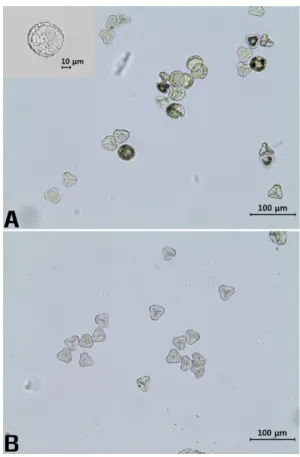
jejuensis has many spores with irregular shapes that may be indicative of hybrid origins (Fig. 5).

Regarding interspecific relationships, H. jejuensis seems to be more closely related to H. miyoshiana than H. serrata by

leaf shapes and stomate distribution patterns (Table 1). Nakai (1914) also suggested that H. integrifolia habitating in Jeju Island is more similar to H. miyoshiana than H. serrata in terms of external morphology. H. jejuensis is clearly distinguished from H. serrata which is characterized by the narrowly elliptical or oblanceolate leaves, leaves narrowed toward the base, and stomata distributed only on the lower surface of the leaves, but shares common features of linear-lanceolate leaves, stomata distributed on both sides of the leaf, and cuspidate gemma apex with H. miyoshiana.

Acknowledgements

This research was supported by a grant from the National Institute of Biological Resources (NIBR), the Ministry of Environment (MOE) of the Republic of Korea (NIBR201406101, NIBR201401208). The authors appreciate deeply anonymous reviewers to correct the initial manuscript of the paper, and TI for their loan of valuable specimen.

Literature Cited

Bernhardi, J. J. 1801. Tentamen alterum filices in genera redi- gende. Journal für die Botanik 1800: 121 − 136.

Goldie, J. 1822. Description of some new and rare plants discov- ered in Canada, in the year 1819. Edinburgh Philosophical Journal 6: 319 − 334.

Matsuda, S. 1911. A list of the plants collected by K. Inami in Hu- nan, Hu-peh, and Kiang-si. (II). Botanical Magazine 25: 116 − 126.

Nakai, T. 1914. Enumeratio specierum Filicum in insula Quelpaert Fig. 5. Spores of Huperzia jejuensis (A) and H. integrifolia (B).

Table 1. Comparison of some diagnostic characters among H. jejuensis, H. serrata, H. integrifolia and H. miyoshiana.

Character H. jejuensis H. serrata H. integrifolia H. miyoshiana

Leaf shape linear-lanceolate narrowly elliptic,

oblanceolate narrowly elliptic linear-lanceolate Broadest

part of leaf

same width except leaf tip

at or above

mid-part at mid-part

at base, narrowed from

base to apex

Leaf margin irregularly

minutely dentate

irregularly serrate, serration large

irregularly serrate,

serration small entire

Distribution of

Serration above middle part whole part whole part absent

Apex of gemmae cuspidate mucronate mucronate cuspidate

Distribution of stomata on leaf

both surfaces,

more on lower side lower surface only both surfaces, more on lower side

both surfaces, similar number on both sides Spores trilete with frequent

misshapes trilete trilete trilete

(5)

adhuc lectarum. Botanical Magazine 28: 65 − 104.

Nakai, T. 1952. Synoptical sketch of the Korean Flora. Bulletin of the National Science Museum, Tokyo 31: 1 − 15.

Satou, Z. 1997. Miscellaneous notes on ferns and fern allies (1 − 4).

Hikobia 12: 267 − 270.

Sun, B. Y. 2007. Huperzia. In The Genera of Vascular Plants of Korea. Park, C-W, (ed.), Academy Publishing. Co., Seoul.

Wikström, N. and P. Kenrick. 1999. Phylogeny of epiphytic Huperzia (Lycopodiaceae): paleotropical and neotropical clades corroborated by rbcL sequences. Nordic Journal of Bot- any 20: 165 − 171.

Yabe, Y. 1903. Fillices Koreæ Uchiyamæ. Botanical Magazine 17:

63 − 69.

수치

Fig. 1. Holotype of Huperzia integrifolia (Matsuda) Satou. Fig. 2. Holotype of Huperzia jejuensis B.-Y Sun & J
Fig. 4. Photograph of Huperzia jejuensis B.-Y Sun & J. Lim at the natural habitat in Mt
Table 1. Comparison of some diagnostic characters among H. jejuensis, H. serrata, H. integrifolia and H

참조

관련 문서

 The Dutch physicist Pieter Zeeman showed the spectral lines emitted by atoms in a magnetic field split into multiple energy levels...  With no magnetic field to align them,

In 1883, Renoir completed two paintings that look very similar, The Dance in the City and The Dance in the Country.. Both paintings show a couple who

However, the output effect from   is smaller than the same effect from  . This is the ratio of expenditure on the dirty input to the revenue from selling the output, and

• Since time is required in building up or depleting a charge distribution, the stored charge must inevitably lag behind the current in a time-dependent problem.. This is

The reservoir is also part of the largest state park in New Mexico, Elephant Butte Lake State Park!. The reservoir is part of the Rio Grande Project, a project

1 John Owen, Justification by Faith Alone, in The Works of John Owen, ed. John Bolt, trans. Scott Clark, "Do This and Live: Christ's Active Obedience as the

10.2 Two-variable diagrams: pE/pH diagrams (Pourbaix diagram).. Distribution of species in aquatic systems. 10.2 Two-variable diagrams: Methods of

• Only the single statement (simple or compound) is part of the loop.. • The statements runs from while to ; or }