Korean J. Pl. Taxon. (2010) Vol. 40 No. 2, pp.79-83
Corydalis alata: A new species of Corydalis sect. Corydalis (Fumariaceae) from Korea
Byoung-Un Oh*, Yoon-Young Kim, Seong-Jin Ji and Jae-Gil Kim
Department of Biology, Chungbuk National University, Cheongju 361-763, Korea (Received 22 March 2010 : Accepted 28 May 2010)
날개현호색: 한국에서 발견된 현호색속의 1신종
오병운*·김윤영·지성진·김재길
충북대학교 생물학과
ABSTRACT: A new species of Corydalis L. (Fumariaceae), C. alata was discovered in Pohang-si, Gyeong- sangbuk-do in Korea and is described and illustrated here. The newly described species C. alata is distinct from the closely-related species C. maculata by having tubers with whitish inner surface, sagittate base of the lower outer petals, and smaller seeds.
Keywords: Fumariaceae, Corydalis, new species, Corydalis alata
적 요: 현호색과 현호색속의 1신종인 날개현호색이 한국의 경상북도 포항시에서 발견되어 기재하고 도해하
였다. 날개현호색은 괴경의 내부 표면은 백색이고, 하측 외화판의 기부는 전저이며, 더 작은 종자를 가짐으로써, 이와 근연종인 점현호색과 뚜렷이 구별되었다.
주요어: 현호색과, 현호색속, 신종, 날개현호색
The genus Corydalis L. (Fumariaceae) is distinguishable from others by having simple or branched racemose inflorescences, zygomorphic flowers with spurred upper petals, flattened stigmata with marginal papillae, and dehiscent capsules with many carunculate seeds (Smith, 1971; Cronquist, 1981; Lidén, 1986, 1993). Over 460 species of this genus are distributed in the temperate northern hemisphere (Zhang et al., 2008). About 25 sections have been recognized within the genus Corydalis and the perennial species having a solid tuber with roots at the base are placed in sect. Corydalis (Lidén, 1986, 1993). At least 53 species in sect. Corydalis are known to be distributed in Western Europe and temperate Asia (Tebbitt et al., 2008).
The South Korean taxa of the genus Corydalis were recently revised, and 18 species representing 4 sections were recognized (Oh, 1999). Since then 4 new species and 1 unrecorded species of the sect. Corydalis have been reported in Korea (Oh and Jang, 2002; Oh et al., 2004; Oh and Choi, 2006; Kim et al., 2007;
Kim et al., 2008).
In this study, the plants, which are characterized by the sagittate base of the lower outer petals are described as a new species C. alata B.U.Oh & W.R.Lee under the Corydalis sect. Corydalis.
Taxonomic Treatment
Corydalis alata B.U. Oh & Woo Rak Lee, sp. nov. (Figs. 1, 2, 3) Differ a affinis C. maculata B.U. Oh & Y.S. Kim, petala exteriora infera basi sagittata
Holotype: KOREA. Province Gyeongsangbuk-do, Pohang- si, Jukjang-myeon, Naeyeonsan, alt. 455 m, 36
o14´30.29N, 129
o15´40.80E, 16 Apr. 2009, B.U. Oh et al, 090416-001 (CBU)
Isotypes: CBU
Herbs perennial, glabrous. Rhizome 1.0−10.0 cm long, with tuber; tuber spherical, 1.0−1.5 cm in diam., inside color of tuber
*Author for correspondence: [email protected]
white. Squamiform leaf 1, 0.7−2.0 cm long. Stems 1−5, originated from the base of squamiform leaf, brownish green, 6.0−25.0 cm long, 1.2−1.8 mm in diam. Cauline leaves 2, pale green to green, adaxial surface of leaves rarely with white spots; petioles,
1.5 −6.0 cm long; blade ternate or biternate; leaflets entire, oblong
to lanceolate, 0.9−6.5 cm long, 0.1−1.0 cm wide. Inflorescences
terminal, racemes, flowering from March to April; bracts usually
flabellate, 4.7−11.8 mm long, 2.8−10.3 mm wide, lobate or cleft
Fig. 1. Holotype of Corydalis alata B.U. Oh & W.R. Lee.
Corydalis alata: A new species of Corydalis sect. Corydalis (Fumariaceae) from Korea 81
to parted at apex; pedicels 2.7−8.3 mm long when flowering, 6.8-20.0 mm long when fruiting. Flowers 2−11, whitish blue to purple; outer petal 2, upper one 1.5−2.7 cm long, apex emarginate with mucro; spur cylindrical, slightly downcurved, 1.0 −1.7 cm long; lower one 0.8−1.5 cm long, base sagittate; inner petal 2, 7.0−9.0 mm long, obtuse at apex. Stamens 2; filaments membranous, 6.6−8.0 mm long; anthers ca. 0.8 mm long. Pistil 1; ovary fusiform, 6.5 −8.8 mm long; stigma with 14 papillae, 1.1−1.4 mm wide.
Fruits capsule, flat, fusiform, 8.5−20.0 mm long, 3.4−5.0 mm wide. Seeds black, glossy, flat, circular, 1.8−2.0 mm long, 1.4−
1.9 mm wide, with caruncle, arranged in two rows in a capsule.
Korean name: 날개현호색(Nal-gae-hyeon-ho-saek)
Corydalis alata can be included in Corydalis sect. Corydalis since
it is a perennial species with tubers. C. alata is characterized
by the sagittate base of the lower outer petals. This type of
characteristic sagittate base has previously not been reported
in the plants within sect. Corydalis occuring in Western Europe
and temperate Asia. C. alata is also distinguishable from the
closely-related species C. maculata (Kim and Oh, 1987) based
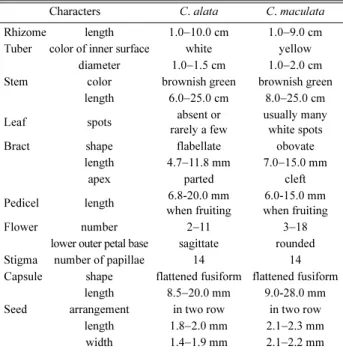
on characteristics such as the whitish inner surface of tubers,
a few or no white spots on the adaxial surface of leaves, the
Fig. 2. Illustration of Corydalis alata B.U. Oh & W.R. Lee. A. Flowers and bracts; B. Lower part of outer petal; C. Inner petals with obtuse
apex ; D. Membranous stamen; E. Ovary; F. Stigma with 14 papillae (a. Lateral view, b. Front view); G. Fusiform capsule and seed
arrangement H. Carunculate seed.
sagittate base of the lower outer petals, and smaller seeds. This species mainly grows underneath trees of the genus Quercus
in valleys of Mt. Naeyeon-san, Pohang-si in Gyeongsangbuk-do, and the soil components of their habitats contain moist leaf molds.
Fig. 3. Photographs of Corydalis alata B.U. Oh & W.R. Lee. A. Habit; B − D. Flowers (B. Dorsal view, C. Lateral view, D. Basal view) ; E:
Rhizomes; F. Fruits; G. Seeds.
Corydalis alata: A new species of Corydalis sect. Corydalis (Fumariaceae) from Korea 83
C. alata is also accompanied by other species such as Allium monanthum, Asarum sieboldii, and Corydalis remota. The five species of Corydalis sect. Corydalis can be classified using the following key.
Key to the five species of Corydalis sect. Corydalis
1. Capsules broadly linear; seeds in 1 row ··· C. ambigua 1. Capsules flattened fusiform; seeds in nearly 2 row.
2. Sepals oval, 3.0−5.0 mm long, apex rake-like ···
··· C. grandicalyx 2. Sepals aborted.
3. Stems pubescent; peduncles pubescent ···· C. hirtipes 3. Stems glabrous; peduncles glabrous.
4. Inner surface of tubers yellow; adaxial surface of leaves usually with many white spots; lower outer petals rounded at base ··· C. maculata 4. Inner surface of tubers white; adaxial surface of leaves with a few or no white spots; lower outer petals sagittate at base ··· C. alata
Acknowledgement
This work was supported by the research grant of Korea Forest Service in 2009 as the National Project of ‘The study of distribution of vascular plants in Korean peninsula’.
Literature Cited
Cronquist, A. 1981. An integrated system of classification of flow- ering plant. Columbia University Press, New York.
Kim, J. S., G. H. Lee, S. Y. Kim and J. H. Pak. 2008. Corydalis caudata (Lam.) Pers. (Fumariaceae): an unrecorded species of Corydalis in Korea. Korean J. Pl. Taxon. 38: 531-537 (in Korean).
Kim, Y. H., J. H. Jeong, D. G Jo and Z. S. Kim. 2007. Corydalis cornupetala Y.H. Kim et J.H. Jeong: a new species of Cory- dalis sect. Corydalis (Fumariaceae). Korean J. Pl. Taxon. 37:
217-224.
Kim, Y. S. and B. U. Oh. 1987. Three new species of Corydalis from Korea. Korean J. Pl. Taxon. 17: 21-28.
Lidén, M. 1986. Synopsis of Fumarioideae (Papaveraceae) with a monograph of the tribe Fumarieae. Opera Bot. 88: 1-133.
Lidén, M. 1993. Fumariaceae In The families and genera of vas- cular plants. Vol. 2. K. Kubitzki, J.R. Rohwer and V. Bittrich (eds.). Springer, Berlin.
Oh, B. U. 1999. A taxonomic review of Korean Corydalis (Fumar- iaceae). Korean J. Pl. Taxon. 29: 201-230 (in Korean).
Oh, B. U. and C. G. Jang. 2002. Corydalis hirtipes B.U. Oh et J.G.
Kim: a new species of Corydalis sect. Corydalis (Fumari- aceae) from Korea. J. Plant Biol. 45: 237-239.
Oh, B. U. and H. J. Choi. 2006. Corydalis misandra B.U. Oh et J.G. Kim: a new species of Corydalis sect. Corydalis (Fumar- iaceae) from Korea. Korean J. Pl. Taxon. 36: 137-144.
Oh, B. U., C. G. Jang and C. Y. Yoon. 2004. Corydalis namdoen- sis B.U. Oh et J.G. Kim: a new species of Corydalis sect.
Corydalis (Fumariaceae) from Korea. Korean J. Pl. Taxon. 34:
265-271.
Smith, A. C. 1971. An appraisal of the orders and families of prim- itive extant angiosperms. J. Indian Bot. Soc. 50: 216-226.
Tebbitt, M., M. Lidén and H. Zetterlund. 2008. Bleeding hearts, Corydalis, and their relatives. Timber Press, Inc., Portland.
Zhang, M., Z. Su, M. Lidén and C. Grey-Wilson. 2008. Papaver- aceae. In Flora of China. Vol. 7. Z. Y. Wu, P. H. Raven and D.
Y. Hong (eds.). Science Press and Missouri Botanical Garden Press, Beijing & St. Louis.
Table 1. Comparison of major characters between C. alata and C.
maculata.
Characters C. alata C. maculata
Rhizome length 1.0−10.0 cm 1.0−9.0 cm Tuber color of inner surface white yellow
diameter 1.0−1.5 cm 1.0−2.0 cm Stem color brownish green brownish green
length 6.0−25.0 cm 8.0−25.0 cm
Leaf spots absent or
rarely a few
usually many white spots
Bract shape flabellate obovate
length 4.7−11.8 mm 7.0−15.0 mm
apex parted cleft
Pedicel length 6.8-20.0 mm
when fruiting
6.0-15.0 mm when fruiting
Flower number 2−11 3−18
lower outer petal base sagittate rounded
Stigma number of papillae 14 14
Capsule shape flattened fusiform flattened fusiform length 8.5−20.0 mm 9.0-28.0 mm Seed arrangement in two row in two row
length 1.8−2.0 mm 2.1−2.3 mm width 1.4−1.9 mm 2.1−2.2 mm