• 검색 결과가 없습니다.

Lysimachia quelpaertensis (Primulaceae), a new species from Jeju Island, South Korea

N/A
N/A
Protected

Academic year: 2021

Share "Lysimachia quelpaertensis (Primulaceae), a new species from Jeju Island, South Korea"

Copied!
5
0
0

로드 중.... (전체 텍스트 보기)

전체 글

(1)

Lysimachia quelpaertensis (Primulaceae), a new species from Jeju Island, South Korea

Kyoung-Hwan Tae*, Jae-Hwa Tho

1

, Seunghyun Hwang, Yong Dae Park, Eun-Jae Yang and Jaeseung Lee

JEMAYU Co., Ltd. 2915 Yusuam-ri, Aewol-eup, Jeju-si, Jeju-do 695-916, Korea

1

Ecosystem Assessment Division, Ecology Research Dept. National Institute of Environmental Research, Inchon 404-708, Korea (Received 22 April 2010 : Accepted 28 May 2010)

앵초과 참좁쌀풀속 1신종, 탐라까치수염

태경환*·도재화1·황승현·박용대·양은재·이재승
㈜제마유 부설연구소,

1

국립환경과학원 생태연구부 생태평가과

ABSTRACT: Herein we describe a new species, Lysimachia quelpaertensis in Primulaceae from Jeju Island, South Korea. Lysimachia quelpaertensis differs from L. barystachys, L. fortunei, L. clethorides and L. acroadenia by having verticillate and linear-lanceolate leaves, 5 or 6 petals and 5- or 6-lobed calyx. Among the Lysimachia species, only Lysimachia quelpaertensis has verticillate leaves and white flowers.

Keywords: Lysimachia quelpaertensis, Primulaceae, verticillate, new species

적 요: 제주도에서 발견한 앵초과 참좁쌀풀속에 속하는 신종 탐라까치수염(Lysimachia quelpaertensis K.-H. Tae &

J.S. Lee) 을 기재 및 도해하였다. 탐라까치수염은 근연종인 까치수염, 진퍼리까치수염, 큰까치수염 및 섬까치수

염과는 잎이 윤생하고, 형태가 선형 또는 피침형이며, 화피와 꽃받침이 5장 또는 6장으로 구성된 차이점을 보인다. 탐라까치수염은 참좁쌀풀속 식물종 중에서 잎이 윤생하면서 동시에 백색꽃을 갖는 유일한 종이다.

주요어: 탐라까치수염, 앵초과, 윤생, 신종

The genus Lysimachia includes about 190 species of perennial and annual plants, and is one of the largest genera in the Primulaceae (Cronquist, 1981; Takhtajan, 1997). Although the distribution of the genus is centered in southwest China, it extends throughout the temperate and subtropical regions of the northern hemisphere, and into southeastern Asia, with outlying members in South America and Africa.

The first comprehensive taxonomic treatment of Lysimachia, by Klatt (1866), included 9 sections and 45 species. Significantly, Handel-Mazzetti (1928) gave taxonomic emphasis to structure of androecium and that author ’ s taxonomic treatment of 147 Chinese taxa included 5 subgenera, 19 sections and 12 subsections.

However, Chen and Hu (1979) modified and rearranged these into 6 subgenera: Idiophton, Lysimachia, Palladia, Heterostylanda,

Naumburgia and Sandwicensia.

Nakai (1911) reported 6 species and 1 variety of Korean Lysimachia and later (1952) arranged them in 7 species and 1 form: L. barystachys, L. clethroides, L. coreana, L. davurica, L. davurica f. angustifolia, L. japonica, L. leucantha and L.

pentapetala. Korean Lysimachia were also reported by Mori (1921: 9 species), Kitagawa (1939: 5 species and 1 form), Chung (1957: 8 species) and Lee (1979: 9 species and 1 variety). Taxonomic studies on the genus have concentrated on morphological studies (Chung, 1960; Chung, 1965; Pak, 1974; Kim et al., 2007), cytological study (Ko et al., 1986) and palynological study (Kim et al., 1993).

While studying the genus in Korea, we found a population of Lysimachia that does not belong to any taxon hitherto described.

The plants grow along the Donnaeko Valley of Mt. Halla on Jeju

*Author for correspondence: [email protected]

(2)

Island. The population of L. quelpaertensis in the type locality is distributed over an area of ca. 50 m

2

and consists of about 80 individuals. We herein describe and illustrate this new species of Lysimachia from Korea.

Taxonomic Treatment

Lysimachia quelpaertensis K.-H. Tae & J.S. Lee, sp. nov.

TYPE: KOREA, Jeju-do, Seogwipo-si, Sanghyo-dong, Donnaeko Valley, 450 m, 4 June 2009, K.-H. Tae & S.H. Hwang JMY 2009-00001 (Holotype: KB; isotype: KB, 1 sheet), Fig. 1.

Herba perennis usque ad 40 −60 cm alta; radice repente; caule simpici; foliis terna 4.9 −6.0 cm longa subsessilibus vel infimis brevissime determinavi-lanceolatis acutis apiculatisve; racemo exserto multifloro elongato laxiusculo erecto vel acclivis albi corolla

Fig. 1. Holotype of Lysimachia quelpaertensis K.-H. Tae & J. Lee (Primulaceae).

(3)

5 −6, 0.3−0.6 cm longa; calycis absidae 5−6, 0.2−0.3 cm longi;

Fl. Jun.−Aug.

Perennial herb; Stem erect, 40−60 cm tall, non-branching, densely covered with multicellular hairs; Leaves verticillate, linear-

lanceolate, 4.9 −6.0 cm long, 0.8−13.0 cm wide, sparsely covered with lanate multicellular hairs on both surfaces, entire; Racemes gooseneck or erect, 3.5−8.7 cm long, densely flowered, glandular and multicellular hair; Pedicel 0.5−0.7 cm long, usually slightly Fig. 2. Lysimachia quelpaertensis K.-H. Tae & J. Lee (Primulaceae) A. habit; B. inflorescence; C. corolla and stamens; D. flower and bract;

E. leaves ; F. seed; G. hair types.

(4)

shorter than bracts, glandular and multicellular hair; Calyx 0.2−

0.3 cm long, 5- or 6- lobed; Bract 0.4−0.8 cm long; Corolla white, 5 or 6, lanceolate-oblong, 0.3 −0.6 cm long; Seeds black, 0.10−

0.13 cm long. Fl. Jun−Aug.

Korean name: 탐라까치수염(Tam-ra-ga-chi-su-yeom) Distribution: Korea (Mt. Halla, Jeju-do Province), endemic Specimens examined: Warm-Temperate Forest Research Center, No. 10009274 Hyodoncheon Hyodon-dong, Seoqwipo-si, Jeju-do, Korea, Jae-Hwa Tho, Chang-min Kang, Seok-Jin Oh, Nov. 05, 2007, Col. No.:25238

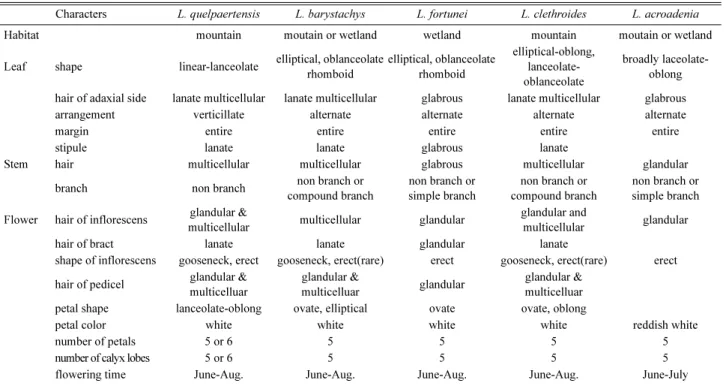
The new species (Fig. 1) appears to be closely related to Lysimachia barystachys and L. clethorides. The characteristic features and differences among related species are summarized in Table 1. The new species differs from four other species in the leaf arrangement, leaf shape, number of petal and number of calyx lobes.

Lysimachia quelpaertensis has verticillate (whorled) leaves.

Leaf shape was linear-lanceolate. Also, the new species can be distinguished from L. barystachys, L. fortunei, L. clethorides and L. acroadenia in having petal 5 or 6 and calyx 5 or 6 lobed.

The flower color of genus Lysimachia is considered important feature, being either yellow or white. The species of this genus with verticillate leaf arrangement had yellow flowers, as in L.

coreana, L. davurica, L. vulgaris and L. vulgaris var. davurica.

However, Lysimachia quelpaertensis has verticillate leaf arrangement and white flowers.

Key to five Korean Lysimachia species

1. Leaves with lanate multicellular hairs, stems multicellular hairy or glandular hairy

2. Leaves alternate

3. Flowers white ··· L. clethroides, L. barystachys 3. Flowers reddish white ··· L. acroadenia 2. Leaves verticillate ··· L. quelpaertensis 1. Leaves glabrous, stems glabrous ··· L. fortunei

Acknowledgments

This research was supported by the Ministry of Environment of the Korean Government. The authors wish to thank Dr. Kim C.-S. of Warm-Temperate Forest Research Center, Jeju-do for help with some materials.

Literature Cited

Chen, F. H. and C. M. Hu 1979. Taxonomic and phylogeographic studies on Chinese species of Lysimachia. Acta Phytptax Sinica 17: 21-53.

Chung, T. H. 1957. Korean flora II. Shinzisa Seoul pp. 487-490 (in Korean).

Table 1. Diagnostic morphological characters of the new species and closely related taxa. The morphological characters of L. quelpaertensis, L.

barystachys, L. fortunei L. clethroides and L. acroadenia are based on Kim et al. (2007) and Lee (1979).

Characters L. quelpaertensis L. barystachys L. fortunei L. clethroides L. acroadenia

Habitat mountain moutain or wetland wetland mountain moutain or wetland

Leaf shape linear-lanceolate elliptical, oblanceolate rhomboid

elliptical, oblanceolate rhomboid

elliptical-oblong, lanceolate- oblanceolate

broadly laceolate- oblong hair of adaxial side lanate multicellular lanate multicellular glabrous lanate multicellular glabrous

arrangement verticillate alternate alternate alternate alternate

margin entire entire entire entire entire

stipule lanate lanate glabrous lanate

Stem hair multicellular multicellular glabrous multicellular glandular

branch non branch non branch or

compound branch

non branch or simple branch

non branch or compound branch

non branch or simple branch Flower hair of inflorescens glandular &

multicellular multicellular glandular glandular and

multicellular glandular

hair of bract lanate lanate glandular lanate

shape of inflorescens gooseneck, erect gooseneck, erect(rare) erect gooseneck, erect(rare) erect hair of pedicel glandular &

multicelluar

glandular &

multicelluar glandular glandular &

multicelluar

petal shape lanceolate-oblong ovate, elliptical ovate ovate, oblong

petal color white white white white reddish white

number of petals 5 or 6 5 5 5 5

number of calyx lobes 5 or 6 5 5 5 5

flowering time June-Aug. June-Aug. June-Aug. June-Aug. June-July

(5)

Chung, B. S. 1960. On the Lysimachia coreana Nakai. J. Plant Biol. 2:

35-36 (in Korean).

Chung, T. H. 1965. Illustrated Encyclopedia of Fauna & Flora of Korea. Vol. 5 Tracheophyta. The Ministry of Education Seoul pp.923-927 (in Korean).

Cronquist, A. 1981. An Integrated System of Classification of Flowering Plant. Columbia Univ. Press New York NY.

Handel-Mazzetti, H. 1928. A revision of the Chinese species of Lysimachia with a new system of the whole genus. Notes RBG Edinb 16: 52-122.

Kim, J. M., K. H. Tae and J. H. Kim. 2007. A taxonmomy study of Lysimachia sect. Spicatae (Primulaceae) based on morphological characters. Korean J. Pl. Taxon 1: 61-78 (in Korean).

Kim, Y. R., K. H. Tae, J. G. Sim and S. C. Ko. 1993. A palyno- taxonomic study on the genus Lysimachia in Korea. Korean J.

Pl. Taxon 23: 43-58 (in Korean).

Kitagawa, M. 1939. Lineamenta flora Manshuricae. Inst Sci Res Manchoukuo 3 (Append.): 1-487.

Klatt, F. W. 1866. Die Gattung Lysimachia L Abh Naturw Ver Hamb 4, 4: 1-45.

Ko, S. C., I. T. Im and Y. S. Kim. 1986. A cytotaxonomic study on the genus Lysimachia in Korea. Korea J. Pl. Taxon 3: 187-197 (in Korean).

Lee, T. B. 1979. Illustrated flora of Korea. Hyangmoonsa Seoul, 606-608 (in Korean).

Mori, T. 1921. An enumeration of plants hitherto known from Corea.

Gov. Gen. Chos. Seoul pp. 282-283.

Nakai, T. 1911. Flora Koreana II. J. Coll. Sci. Imp. Univ. Tokyo 31: 81-83 (in Korean).

Nakai, T. 1952. A Synoptical Sketch of Korean Flora. Bull. Sci.

Mus. Tokyo 31: 90 (in Korean).

Pak, M. K. 1974. Keys to the Herbaceous Plants in Korea (Dicot- yledoneae). Jungumsa Seoul pp. 331-332 (in Korean).

Takhtajan, A. L. 1997. Diversity and Classification of Flowering

Plants. Columbia Univ. Press New York.

수치

Table 1. Diagnostic morphological characters of the new species and closely related taxa

참조

관련 문서

해설 교차로나 그 부근에서 긴급자동차가 접근하는 경우에는 차마와 노면전차의 운전자는 교차로를 피하여 일시정지 하여야 한다.. 27.> 모든 차와 노면전차의

이에 전남지역 중학생들 대상의 설문조사를 통해서 체벌의 실태와 중학교 교사와 학생들의 체벌에 관한 인식 및 체벌의 교육적 효과 등을 파악하여 체벌이 진정

상기 신입생 장학금 외에도 본교는 신입생장학금-재학생장학금-해외연수장학금-대학원진학장학금에 이르는 전주기 장학제도를 운영하고 있으며, 다양한 교외장학금

연구를 위해 주변 사람들로부터 표본을 추출하는 경우가 있다는 내용의 주어 진 글 다음에, 이를 기회 표본 추출이라고 하며 이런 표본은 대표성이 없다는

빈도분석을 실시하였다.또한 인구통계학적 특성이 시합 전 심리불안 해소에 대한 차검증을 위하여 일원분산분석(one-way ANOVA)을 실시하였고,유의한 차이가

Thermodynamic arguments not only suggest that point defects may be present, but actually demand their presence and imply that it is impossible to create a stable single

이재천과 김범기(1999)는 과학교사에 의해 조성되는 심리적 학습 환경이 학생들 의 과학성취도에 미치는 효과에서 학생들이 가지고 있는 교사에 대한 인식을

본 논문에서는 블루투스를 이용하여 웨어러블 컴퓨터 환경 하에서 휴대폰과 상호작용 하면서 휴대폰을 통해 서비스를 제공받는 방식을 제안한다.BAN 영역 안에서