86 Korean J. Pl. Taxon. (2009)
Vol. 39 No. 2, pp.86-88
Eranthis pungdoensis B.U. Oh: A new species of Eranthis (Ranunculaceae) from Korea
Byoung-Un Oh* and Seong-Jin JI
Department of Biology, Chungbuk National University, Cheongju 361-763, Korea
풍도바람꽃: 한국에서 발견된 너도바람꽃속의 1신종
오병운*·지성진
충북대학교 생물학과
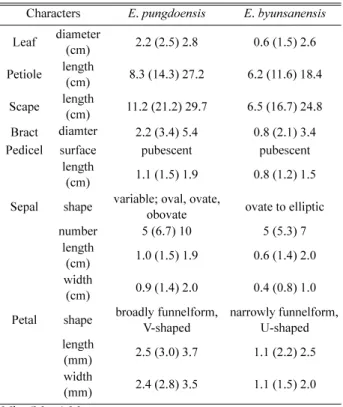
ABSTRACT: A new species of Eranthis (Ranunculaceae), E . pungdoensis B.U. Oh is described from Pung-do, Ansan-si, Gyeonggi-do in Korea. The new species is distinct from E . byunsanensis , its closely relative species, in having broad funnelform petals, 2.5-3.7 mm long, 2.4-3.5 mm wide and restricted distributional area.
Keywords: Ranunculaceae, Eranthis , new species, Eranthis pungdoensis
적 요: 미나리아재비과 너도바람꽃속의
1신종인 풍도바람꽃이 한국의 경기도 안산시 풍도에서 발견되어 기재되었다
.신종은 화판이 넓은 누두형이고
,길이
2.5-3.7 mm,너비
2.4-3.5 mm이며
,제한된 분포역을 가짐 으로써
,이와 유사한 변산바람꽃과 뚜렷이 구별되었다
.주요어: 미나리아재비과
,너도바람꽃속
,신종
,풍도바람꽃
The genus
EranthisSalisb. belongs to the tribe Helleboreae under family Ranunculaceae (Tamura, 1990), and is distinguished from other genera by having tuberous rhizomes, palmately divided simple leaves, verticillate involucre, actinomorphic and solitary flowers (Tamura, 1990; Wang
et al., 2001). About 8 species of this genus are widely distributed in temperate regions of Eurasia (Li, 1995; Wang
et al., 2001; Yuan. and Yang, 2006).
Korean species of the genus
Eranthiswere recently revised into
E.
stellataMaxim. which is known to distribute in Korea, China and Russia (Wang
et al., 2001; Park
et al., 2007), and
E.
byunsanensisB. Sun, an endemic species, in the central and southern parts of Korea (Sun, 1993; Park
et al., 2007).
In this study, one another
Eranthisspecies collected from Pung-do, Ansan-si, Gyeonggi-do, Korea is described as a new species,
E.
pungdoensisB.U.Oh.
Eranthis pungdoensis B.U.Oh, sp. nov ., Fig. 1, 2, 3.
Haec species
E.
byunsanensisB. Sun affinis, sed petala late infundibuliformis, 2.5-3.7 mm longa, 2.4-3.5 mm lata diversus.
Holotype: open fields and forests in mountainous area, Pung-do, Ansan-si, Gyeonggi-do, Korea. alt. 15-150 m, 37
o06'40"N, 126
o23'22"E, 16 Mar. 2007,
B.U.Oh 2007001(CBU)
Isotypes: CBU
Paratypes: Pung-do, Ansan-si, Gyeonggi-do, 24 Mar. 1996,
B.U.Oh 960324-001to
960324-007; Pung-do, Ansan-si, Gyeonggi- do, 20 Mar. 2005,
B.U.Oh 050320-001to
050320-005(CBU) Herbs, perennial. Roots fibrous, developed from any surface of rhizome. Rhizome globose, 1-2 cm in diam. Leaves radical, 1-4, arising from rhizome, orbicular to weakly pentagonal, deeply 3-parted, 2.2-3.8 cm wide at flower; petiole glabrous, 8.3-27.2 cm long. Inflorescence terminal, with solitary flower; scape 1 or rarely 2, glabrous, 11.2-29.7 cm long at flower; involucre 2, sessile, deeply 3-parted, 2.2-5.4 cm wide; pedicel pubescent, 1.1-1.9 cm long. Flower bisexual, actinomorphic; sepals 5-10, white or rarely greenish white, oval, ovate or obovate, 1.0-1.9 cm long, 0.9-2.0 cm wide; petals 4-11, broadly funnelform, V- shaped, pale yellow at middle and lower part, light to dark green at upper margin, emarginate apically, 2.5-3.7 mm long,
*Author for correspondence: [email protected]
Korean J. Pl. Taxon, Vol. 39, No. 2 Eranthis pungdoensis
B.U. Oh: A new species ofEranthis
(Ranunculaceae) from Korea87
Fig. 1. Holotype of Eranthis pungdoensis B.U. Oh, B.U. Oh 2007001 (CBU).
Fig. 2. Photograph of Flowers on Eranthis pungdoensis at type locality.
한국식물분류학회지 제39권 2호
88
Byoung-Un Ohand Seong-Jin JI2.4-3.5 mm wide; stamens 19-46; filaments white, filiform, 0.7- 1.0 cm long; anthers basifixed, light purple, elliptic, 1.1-1.4 mm long; pistils 3-10, 0.7-1.0 cm long; style 1 per pistil; stigma capitate. Fruits follicle, usually 5, glabrous, 1.1-1.4 cm long.
Seeds 3-5, subglobose, ca. 2.7 mm in diam.
Korean name: Pung-do-ba-ram-kkot
E
.
pungdoensisis distinguished from
E.
byunsanensis, its closely relative species, by its shapes and size of petals (Table 1.).
This species only can be observed in Is. Pung-do, which is located in adjoining western sea of the central part of Korean peninsula. Habitat of new species is open fields and lower part of the broad leaved forests in the mountainous area. Also it is often accompanied by other early flowering species such as
Hepatica asiaticaNakai,
Adonis amurensisRegel & Radde and
EuphorbiaebracteolataHayata, etc.
Acknowledgments
This work was supported by the research grant of the Chungbuk National University in 2007. Authors also thank to Jae-Gil Kim for providing the information on the habitat of new species.
Literature Cited
Li, L. Q. 1995. The geographical distribution of subfam. Hellebor- oideae (Ranunculaceae). Acta Phytotax. Sin. 33: 537-555 (in Chinese).
Park, C. W., S. H. Yeau, C. S. Chang, H. W. Lee and B. Y. Sun.
2007. Ranunculaceae.
In
The Genera of Vascular Plants of Korea. Flora of Korea Editorial Committee (eds.), Academy Publishing Co., Seoul.Sun, B. Y. 1993. A new species of
Eranthis
(Ranunculaceae) from Korea:E
.byunsanensis
. Korean J. Pl. Taxon. 23: 21-26 (in Korean).Tamura, M. 1990. A new classification of the family Ranuncu- laceae 1. Acta Phytotax. Geobot. 41: 93-101 (in Japanes).
Wang. W., D. Fu, L. Li, B. Bartholomew, A. R. Brach, B. E. Dut- ton, M. G. Gilbert, Y. Kadota, O. R. Robison, M. Tamura, M.
J. Warnock, Z. Guagnhua and S. N. Ziman. 2001. Ranuncu- laceae.
In
Flora of China. Vol. 6. Raven, P. H. and Z.-Y. Wu (eds.), Science Press and Missouri Botanical Garden Press, Beijing & St. Louis. Pp. 133-438.Yuan, Q. and Q. E. Yang. 2006. Tribal relationships of