• 검색 결과가 없습니다.

IEG 환경지질연구정보센터

N/A
N/A
Protected

Academic year: 2021

Share "IEG 환경지질연구정보센터"

Copied!
3
0
0

로드 중.... (전체 텍스트 보기)

전체 글

(1)

Vulnerability Assessment to Climate Change and Spatio-Temporal Information

Woo-Kyun LEE

*

, Hyun-Ah Choi

**

, Han-Bin Kwak

*

, Sungho Choi

*

, Guishan Cui

*

, Jae-Gyun Byun

*

, Seongjin Yoo

*

*

Department of Environmental Science and Ecological Engineering, Korea University, Seoul, 136-713, Korea

*

Department of Climatic Environment, Korea University, Seoul, 136-713, Korea [email protected]

ABSTRACT: Climate change has influenced on various sectors including ecosystem, water resource, natural hazards and health and so on. Thus, it is essential to more accurately assess climate change impact and prepare adaptation strategy. However, it is difficult to assess for climate change impact on various sectors with integrated form due to various data format by sectors. In this study, we prepared criteria and indicators for assessing climate change impact and integrated GIS. We suggest a guideline to assess vulnerability of each sectors to climate change based on integrated spatio-temporal information.

KEY WORDS: climate change, spatio-temporal information, vulnerability, adaptation

1. INTRODUCTION

The Fourth Assessment Report (AR4) of the Intergovernmental Panel on Climate Change (IPCC), states unequivocally that the global climate is warming(IPCC, 2007a, b). The impacts of climate change are not evenly distributed, in part due to the differentiated nature of hazards in different parts of the globe, but also due to differences in the ability to cope with and adapt to the negative effects and harness beneficial effects of climate shocks and stresses. The common generic conclusion is that those exposed to the most severe hazards are also those least able to cope with the associated impacts (Smit et al., 2001; AfDB et al., 2003; Adger et al., 2003).

In addition vulnerability assessment is a key concept linking research and climate change adaptation to climate change. It has been approached and interpreted in different ways, and conceptualized in particular along ecological and social lines (Adger, 2006; Chambers, 1989; O’Brien et al, 2007; Prowse, 2003). From an ecological perspective, vulnerability can be understood through the frequency and magnitude of a system’s response to an external event, such as a hazard, defined in poverty terms as a risk of inability to cope with a shock, leading to catastrophe (Hulme and Shepherd, 2003).

However, most of vulnerability assessment was based on descriptive analysis using non-spatial data. The Korean is affected by the monsoon climate and the features of complex peninsula (Im et al., 2006). It shows characterized spatial variability of temperature and precipitation. In this study, we tried to analyze vulnerability of ecosystem, forest fire, water supply, land slide and flooding with the help of spatial analysis of GIS-based spatial data. The approach for spatial vulnerability analysis suggested in this study was proven to be suitable for preparing spatially specific adaptation

strategies to climate change.

2. MATERIAL AND METHOD 2.1 Vulnerability assessment to climate change

To assess for climate change impact on various sectors, we set up the criteria. Vulnerability criteria is sensitivity, expose, adaptation (Han, 2007). And then we suggested integrated form and indicators (Figure 1).

Figure 1. Vulnerability assessment structure

2.2 Spatio-temporal information setup

Spatio temporal information data is integrated 5km x

5km raster data based on GIS (Figure 2). In addition,

vulnerability assessment approaches assessment on

current climate – 30years (1977~2006) annual average

temperature (℃) and precipitation (mm).

(2)

Figure 2. Spatio-temporal information data 2.3 Vulnerability assessment

Using indicators, vulnerability assessment can be estimated as,

Vulnerability = (Sensitivity x Expose) / Adaptation (1) The calculation represents normalize value from indicators. In this case, vulnerability has been 0-1 value in sectors. It could be integrated assessment.

Normalize value = (X-Xmin)/(Xmax-Xmin) (2)

X: indicator

Xmin: Minimum value of indicator Xmax: Maximum value of indicator

3. RESULTS AND DISCUSSIONS

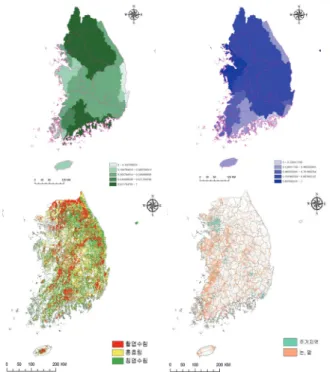
Results from vulnerability assessment indicate that water resource vulnerability output is presented flood and drought vulnerability. Yeongsan Basin estimated vulnerable to flood. Vulnerable administration unit appears to Jeollabuk-do, respectively (Figure 3a). And Drought vulnerable basin is Ahnsung, Gyeonggi-do administration unit (Figure 3b).

(a) (b)
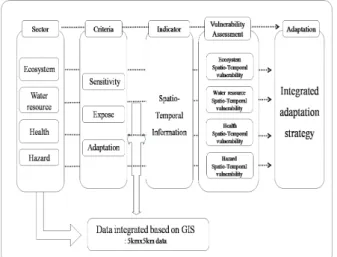
Figure 3. Result of water resource vulnerability assessment, (a) flood vulnerability, (b) drought vulnerability

Health sector is presented heat wave and air pollutant.

Megacities (Seoul, Gyeonggi and Busan) are vulnerable area to air pollutant and heat wave, respectively. Natural hazards are presented landslide and forest fire. Landslide vulnerable area is Kandwon-do around rugged Taebaek Mountains (Figure 4a). Forest fire vulnerable area is presented high population density and high density residential area as megacities (Figure 4b).

Figure 4. Result of hazard vulnerability assessment, (a) landslide vulnerability, (b) forest fire vulnerability Vulnerability of forest ecosystem by integrated assessing on vulnerability of vegetation distribution and ecosystem function. Ecosystem is mostly occupied by cool mixed forest. And southern inland area and western and eastern coastal areas were exposed to high vulnerability. Overall vulnerability of ecosystem was in moderate level (Figure 5a). However, ecosystem would be exposed to high vulnerability in southern west coastal area and southern east land area by climate change (Figure 5b).

Figure 5. Result of ecosystem vulnerability assessment, (a) ecosystem distribution vulnerability, (b) ecosystem

function vulnerability

REFERENCES

Adger, W.N., 2006. Vulnerability. Global Environmental Change, 16 (1), pp. 268-281.

Adger, W.N., Huq, S., Brown, K., Conway, D. and Hulme, M., 2003. Adaptation to climate change in the developing world. Progress in Development Studies, 3 (3), pp. 179–195.

African Development Bank; Asian Development Bank;

Department for International Development; United

Kingdom; Directorate-General for International

Cooperation: the Netherlands; Directorate General

for Development: European Commission; Federal

Ministry for Economic Cooperation and

Development: Germany; Organization for Economic

(3)

Cooperation and Development; United Nations Development Programme; United Nations Environment Programme; World Bank, 2003. Poverty and climate change: reducing the vulnerability of the poor through adaptation. Available at:

http://www.undp.org/energy/povcc.htm.

Chambers, R., 1989. Editorial introduction: vulnerability, coping and policy. Institute of Development Studies Bulletin, 20 (2), pp. 1-7.

Han, W.J., 2007. Climate Change Impact Assessment and Development of Adaptation Strategies in Korea Ⅲ.

Korea Environment Institute.

Hulme, D. and Shepherd, A., 2003. Conceptualizing Chronic Poverty. World Development, 31 (3), pp.

403-423.

Im, E. S., E. H. Park, Kwon, W. T., Giorgi, F., 2006.

Present climate simulation over Korea with a regional climate model using a one-way double-nested system.

Theoretical and Applied Climatology, 86(1), pp. 187- 200.

IPCC. 2007a. In: Solomon S, Qin D, Manning M, Chen Z, Marquis M, Averyt K B, Tignor M, Miller H L, eds., 2007. Climate change 2007: the physical science basis. Contribution of working group I to the fourth assessment report of the intergovernmental panel on climate change. Cambridge, UK:

Cambridge University Press, pp. 1032.

IPCC. 2007b. In: Parry M L, Canziani O F, Palutikof J P, Linden P J, Hanson C E, eds., Climate change 2007:

impacts, adaptation and vulnerability. Contribution of working group II to the fourth assessment report of the intergovernmental panel on climate change.

Cambridge, UK: Cambridge University Press, pp.

976.

O’Brien, K.L., S. Eriksen, L.P. Nygaard, and Schjolden, A., 2007. Why different interpretations of vulnerability matter in climate change discourses.

Climate Policy, 7 (1), pp. 73-88.

Prowse, M., 2003. Towards a clearer understanding of

‘vulnerability’ in relation to chronic poverty. Chronic Poverty Research Centre Working Paper 24.

Manchester, UK: Chronic Poverty Research Centre (CPRC).

Smit, B., Pilifosova, O., Burton, I., Challenger, B., Huq,

S., Klein, R., Yohe, G., Adger, N., Downing, T.,

Harvey, E., 2001. Adaptation to climate change in the

context of sustainable development and equity. In

McCarthy, J. J., Canziani, O., Leary, N. A.,

Dokken,D.J. and White, K.S (Eds.) Climate Change

2001: Impacts, Adaptation and Vulnerability. IPCC

Working Group II. Cambridge: Cambridge University

Press.

수치

Figure 1. Vulnerability assessment structure
Figure 2. Spatio-temporal information data  2.3 Vulnerability assessment

참조

관련 문서

It considers the energy use of the different components that are involved in the distribution and viewing of video content: data centres and content delivery networks

The term “major accident” means a sudden occurrence such as a major emission, fire or explosion in the course of an activity within a major hazard

After first field tests, we expect electric passenger drones or eVTOL aircraft (short for electric vertical take-off and landing) to start providing commercial mobility

Böcher, 2008, Integrated Rural Development Policy In Germany and its Potentials for new Modes of Forest Governance, Institute of Forest, Environmental, and

내삶을 바꾸는 숲, 숲 속의 대한민국.. KOREA FOREST

1 John Owen, Justification by Faith Alone, in The Works of John Owen, ed. John Bolt, trans. Scott Clark, "Do This and Live: Christ's Active Obedience as the

key words: forest healing, forest healing factor, forest healing program, forest for healing, urban forest.. 특히 급 격한 도시화 및 산업화에 따라 여가시간

Based on the result of such assessment, this study attempted to establish a basis for establishment of physical epidemiology research evaluation system