Behavioral reaction of common squid Todarodes pacificus to different colors of LED Light
Young Il A
N*, Hak Geun J
EONG1and Bong Man J
UNG1Dept. of marine police and Technology, Gangwon Provincial College, Gangneung 210-804, Korea
1
Building Energy Research Center, Korea Institute of Energy Research, Daejeon 305-343, Korea
To study the behavioral reaction of common squid Todarodes pacificus, to different colors of LED light, individual distribution in the dark condition without LED light stimuli, individual distribution when four colors of light stimuli were at the sections of end and middle of water tank and the changes of gathering rates as the elapse of illuminating time were examined. When it was dark, the distribution of the fish in each section of the tank was U shape regardless of the investigating time intervals, which means that Todarodes pacificus gathered at the both ends of the tank. The individual distribution when light stimuli were at the one end of the tank showed the tendency of gathering at the illuminated section and decreasing at the opposite section. There were 448 of them at the end of the tank when the light was blue, 352 when white, 302 when green and 132 when red. Thus the fish liked blue light the most, followed by white light. The variations of gathering rate at the both ends of tank as illuminating time elapsed showed the tendency of increasing at the light section (A section), however, it showed the tendency of decreasing at the darkest section (F section). The individual distribution showed the tendency of letter of gathering at the center and decreasing at the both ends mostly when the light stimuli were at the middle section of tank. The gathering rates at the lighting section were 80.4% when red, 76.4% when white, 69.6% when green and 56.7% when blue. The fishes showed the affinity for the red light mostly, followed by the white light source. The red light and blue light showed the opposite when the light stimuli were at the one end of water tank. The variations of gathering rates as the elapse of time at the lighted section showed the tendency of gradual increasing in the four light sources. The color of light source showing the highest gathering rate within 25 30 minutes of light stimuli was the white, followed by the red.
Key words : Behavioral reaction, Common squid, LED
*
Corresponding author: [email protected], Tel: 82-33-660-8201, Fax: 82-33-660-8205.
, , ,
,
(Inada and Ogura, 1988).
(Suzuki et al., 1985).
, .
100kw (Choi, 2007).
, .
,
2008 .
. LED(Light Emitting Diode,
) . LED
,
. LED
, ,
LED
.
.
Yang(1995) ,
Hamabe(1964) Imamura(1968a; b), Murata(1983), Arakawa et al.(1998)
. ,
Ogura(1972) , Arimoto(1991)
.
LED Choi(2006) LED
, Inada and Arimoto(2007) LED
. Bae et al.(2008)
, .
LED ,
LED
.
2008 7 ,
Todarodes pacificus
,
, 220 .
24.4cm(21.4 28.5cm) 1 18.7cm(16.2 21.6cm) 2 19.0cm(16.3 21.3cm) .
(80W 560L 100Hcm)
Fig. 1 , 70cm
. 6 . 1
LED , 2
. 1
, A,
B, C, D, E, F 2
A0 A1, A2, A3
. LED
(Fig. 2)
(BLS(R)16, Crown)
(Fig.2).
(DTM 920, Tektronix)
(30/10FT, YSI) ,
19.6 (19.1 20.2 ), 33.3
(33.2 33.5 ), 1 17.3 (17.3
20.1 ), 33.7 (33.3 34.2 ), 2 19.0 (17.4 20.5 ), 33.0 (31.0 34.2 ) .
4 , Fig. 3
624nm, 524nm, 460nm,
. LED
(80W 80L 20Hcm) 30cm
(Fig. 1).
50cm (T 10WL,
Minolta) 0.05lx DC
(E3617A, Agilent) .
3 10
1 3 30 , 45
Fig. 1. Experimental tank and position of LED(Light Emitting Diode) light source.
A B C D E F A2 A1 A0 A1 A2 A3
LED light
0 50 100cm
Camera Camera
0 50 100cm
LED light
Fig. 2. Schematic diagram of the experimental equipment system.
DC power supply
Storage tank Sea water
Aeration motor
Heating &
cooling unit
Storage & analysis system
Light source (LED)
Monitoring camera Fish tank
12 . 1 3 10
1 , 3 15 (45
), 2 1 ,
1 30 (30 )
.
1 30
. 4
10 .
,
, 1
A, B, C 3 2
A0, A1 3 .
LED
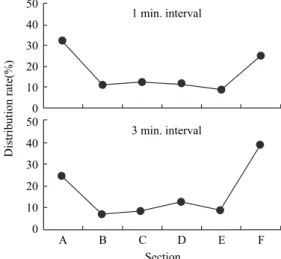
Fig. 4 . 1
A F
31.9% 25.0% ,
8.6% 12.2% .
3
A F 24.3% 38.5%,
7.0% 12.6% .
.
.
1 4 LED
Fig. 5 .
3
. Fig. 5 .
298, 225, 191, 186 .
448, 352, 302, 132
,
.
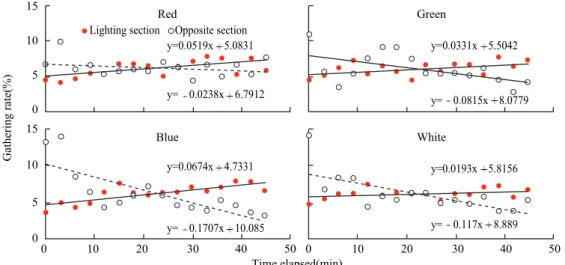
1 4 3
45 A F
Fig. 6
Fig. 3. Spectral distribution of LED lamps.Fig. 4. Distribution rate(%) of squid under dark condition.
0.9 0.8 0.7 0.6 0.5 0.4 0.3 0.2 0.1
0 400 450 500 550 600 650 700 750
Wave length(nm)
RedGreen BlueWhite
Relative radiation power
40 30 20 10 0 50 40 30 20 10
0 A B C D E F
Section 3 min. interval
Distribution rate(%)
A F
. A F
0.0757 0.1146
0.2381
0.1367 .
, .
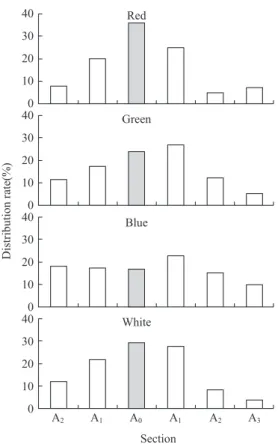
2 4 LED
Fig. 7 ,
1
.
. 35.7%, 28.0%, 24.5%, 16.4%
Fig. 5. Variation on the number of individuals in each section of the water tank after LED stimulus. Stippled columns is the lighted section.
250 150 50 -50 -150 -250 -350 350 250 150 50 -50 -150 -250 -350 350 250 150 50 -50 -150 -250 -350 350 250 150 50 -50 -150 -250 -350
Adjusted number of squid in each sections before and after stimulus
Green
Blue
White
Section
A B C D E F
A B C D E F
A B C D E F
A B C D E F
Fig. 6. Variations of gathering rate in the lighting sections(A) and the opposite sections(F) of the tank as illuminating time elapsed.
15
10
5
0 15
10
5
00 10 20 30 40 50 0 10 20 30 40 50
Time elapsed(min)
Gathering rate(%)
Red
Blue
Lighting section Opposite section y=0.0519x 5.0831
y= 0.0238x 6.7912
Green
y=0.0331x 5.5042
White
y=0.0193x 5.8156
y= 0.117x 8.889 y= 0.0815x 8.0779
y=0.0674x 4.7331
y= 0.1707x 10.085
.
80.4%, 76.4%, 69.6%,
56.7% ,
. .
2 4 1
30
Fig. 8 .
. 5
5 16 .
,
25 30 .
.
Inoue(1978)
. ,
10
210
5lx (Inoue,
1972). Choi(2007)
10
110
3lx . Choi and
Arakawa(2001) 80 360kw
3.0 10
23.4 10
4lx
. 30 70m
510nm 1.8 10
25.4
10
4µW cm
2nm
1(Arakawa et
al., 1998). ,
(Ogura, 1972; Choi, 2007),
Fig. 7. Distribution rate of squid in each section of the tank exposed to the colored LED light. Stippled columns is the lighted section.
30 20 10 400
30 20 10 400
30 20 10 400
30 20 10 0
Section Green
Blue
White
A2 A1 A0 A1 A2 A3
Distribution rate(%)
Fig. 8. Variations of gathering rate in the lighting section(A0 A1) of the tank as illuminating time elapsed.
30
20
10
00 5 10 15 20 25 30
Time elapsed(min)
Red Green Blue White
Gathering rate(%)
. 0.05lx
(Inoue, 1978) .
(Yang, 1980; 1981; 1988).
U (Fig. 4).
(Imamura, 1968a; b; Yang, 1980; 1981; Bae et al., 2008),
U
V (Kawamoto and Nagata,
1952; Yang, 1980; 1986).
, (Yang,1986; 1988).
. . ,
(Yang, 1980;
1981) (Bae et al.,
2008). 1
(Yang, 1980; 1986; 1988, Bae et al., 2008)
. ,
(Jerlov, 1976),
(470 500nm) (Seidou et al., 1990; Arimoto
LED
, , ,
Imamura(1968a; b) , , ,
. Bae et al.(2008)
.
.
1
(Fig. 5, 6) LED
, , , ,
.
(Fig. 7, 8).
(Miyazaki, 1971) (Fig. 7). ,
(Kawamura, 2000), LED
. ,
,
.
,
.
, ,
.
LED
.
4 LED
Todarodespacificus
, .
. , LED
1 , 3
U ,
.
.
.
.
.
,
, .
LED .
(2007 E CM11 P 13
0 000) ,
.
Arakawa, H., S.J. Choi, T. Arimoto and Y. Nakamura, 1998. Relationship between underwater irradiance and distribution of Janapese common squid under fishing lights of a squid jigging boat. Fisheries Science, 64, 553 557.
Arimoto, T., 1991. Fish behaviour control by use of light.
Fisheries Engineeing, 28, 71 76.
Arimoto, T. and H. Inada, 2003. The world of common squid. Seizando-shoten Publishing Co., LTD., Tokyo, pp. 217 221.
Bae, B.S., E.C. Jeong, H.H. Park, D.S. Chang and Y.S.
Yang, 2008. Behavioral characteristic of Japanese flying squid, Todarodes pacificus to LED light. J.
Kor. Soc. Fish. Tech., 44, 294 303.
Choi, S.J. and H. Arakawa, 2001. Relationship between the catch of squid, Todarodes pacificus Steenstrup, according to the jigging depth of hooks and underwater illumination in squid jigging boat. J.
Choi, S.J., 2006. Radiation and underwater transmission characteristics of a high-luminance light-emitting diode as the light source for fishing lamps. J. Kor.
Fish. Soc. 39(6), 480 486.
Choi, S.J., 2007. Rationalization of the light power output on small-size squid jigging boat. Ph.D. Thesis.
Tokyo Univ. of Fisheries., pp. 232 238, 239 252.
Hamabe, M., 1964. Study on the migration of squid(Ommastrephes Sloani Pacificus Streenstrup) with reference to the age of the moon. Bulletin of the Japanese Society of Scientific Fisheries, 30, 209 215.
Imamura, Y., 1968a. Etude de l effet du feu dans la pêche et de son opêration( ). La mer, 6, 26 44.
Imamura, Y., 1968b. Etude de l effect du feu dans la pêche et de son opêration. La mer, 6, 32 44.
Inada, H. and M. Ogura, 1988. Historical changes of fishing light and its operation in squid jigging fisheries. The report of the Tokyo university of fisheries, 24, 189 207.
Inada, H. and T. Arimoto, 2007. Trends on reseach and development of fishing light in Japan. J. Illum.
Engng. Inst. Jpn., 91(4), 199 209.
Inoue, M. 1972. Reaction of fish toward the light.
Bulletin of the Japanese Society of Scientific Fisheries, 38(8), 907 912.
Inoue, M., 1978. Fish behaviour and Fishing method.
Kouseisha-kouseikaku, Tokyo, pp. 83 100.
Jerlov, N.G. 1976. Marine optics. Elsevier Sci. Pub. Co., Amsterdam. pp. 127 150.
Kawamoto, N.Y. and S. Nagata, 1952. On the relation between light gradient and fish behavior. Report of Faculty of Fisheries, Prefectural University of Mie, 1, 152 173.
Kawamura, G., 2000. Competition for wisdom with the fish. Seizando-shoten Publishing Co., LTD., Tokyo,
Miyazaki, C., 1971. Modern fishing gear of the world 3.
Kristjonsson, H. ed. Fishing News Books LTD., London, pp. 165 167.
Murata, M., 1983. On the distribution and the behavior under fishing lamps of young Japanese common squid, Todarodes pacificus Steenstrup, in the offshore waters of northern Japan during spring and early summer. Bull. Hokkaido Reg. Fish. Res. Lab., 48, 37 52.
Ogura, M., 1972. Squid fishing and light. Bulletin of the Japanese Society of Scientific Fisheries, 38, 881 889.
Seidou, M., M. Sugahara, H. Uchiyama, K. Hiraki, T.
Hamanaka, M. Michinomae, K, Yoshihara and Y.
Kito, 1990. On the three visual pigments in the retina of the firefly squid, Watasenia scintillans. J.
Comp. Physiol, A166, 769 773.
Suzuki, T., H. Inada, K. Iida and M. Akabane, 1985.
Utilization efficiency of shades used with attraction lamps for squid fisheries. Bull. Fac. Fish. Hokkaido Univ., 36, 69 77.
Yang, Y.R., 1980. Phototaxis of filefish, conger eel and crucian carp. Bull. Korea Fish. Tech. Soc., 13, 1 13.
Yang, Y.R., 1981. Response of conger eel to the colored lights. Bull. Korea Fish. Tech. Soc., 21, 1 6.
Yang, Y.R., 1986. Response of rock trout to the white lights. Bull. Korea Fish. Tech. Soc., 22, 56 60.
Yang, Y.R., 1988. Response of striped puffer to the white lights. Bull. Korea Fish. Tech. Soc., 24, 144 149.
Yang, Y.R., 1995. Response of squid, Todarodes pacificus to the attraction lamp. Fisheries researches, 9, 25 30.