Environmental Science
Vol. 31, No. 2, pp. 126-135, May, 2015 http://dx.doi.org/10.7747/JFES.2015.31.2.126
The Ecological Characteristics of Classified Forest Cover Types in the Natural Forest of Sobaeksan
Seon-Mi Lim and Ji Hong Kim*
Department of Forest Management, Kangwon National University, Chuncheon 200-701, Republic of Korea
Abstract
This study was conducted to evaluate the ecological characteristics of forest cover types which were classified by cluster analysis in the natural forest of Sobaeksan on the basis of the vegetation data from the point-quarter sampling method.
Recognized forest cover types were 1) Mixed mesophytic forest, 2) Taxus cuspidata forest, 3) Fraxinus rhynchophylla-Quercus mongolica forest, 4) Betula ermanii forest, 5) Pinus densiflora forest, 6) Quercus mongolica mixed forest, and 7) Quercus mongolica pure forest. For those of classified types, the species composition was expressed by importance value (IV) to describe the community floristically. The species diversity was quantified using the Shannon's diversity index. The results showed that the forest cover types were characteristically different from one another in growing species and compositional rates, depending upon the type which was formed by a number of similar vegetational sample points.
Species diversity indices (H') of total and overstory both were the highest in the mixed mesophytic forest (3.530 and 2.880, respectively), and lowest in the Q. mongolica pure forest (2.122 and 0.000, respectively) with only one canopy species. The highest species diversity in the mixed mesophytic forest may due to the relatively high species richness and evenness in the forest cover types. The description on ecological characteristics were suggested to understand the formation and development of forest cover types in this study area.
Key Words: cluster analysis, forest cover type, importance value, species diversity, sobaeksan
Received: February 27, 2015. Revised: April 27, 2015. Accepted: May 10, 2015.
Corresponding author: Ji Hong Kim
Department of Forest Management, Kangwon National University, Chuncheon 200-701, Republic of Korea Tel: 82-33-250-8333, Fax: 82-33-250-5617, E-mail: [email protected]
Introduction
Given the diversity and complexity of forest ecosystems, classification is an attempt to create order from disorder, to explain the unknown, and to predict conditions in the future. Forest classification is launched to improve our abil- ity to understand every kind of information on the manage- ment of any particular forest stand. One might decide that the most useful approach to classification of forests is one that provides all possible information desired by forest re- lated stakeholders. However, Kimmins (2004) noted that
the best classification is generally a compromising between the need for simplicity and the need for sufficient detail to make the classification effective.
Vegetation classification methods generally reflect the overall ecological characteristics of a site more faithfully than are possible with other approaches such as climatic, physiographic, or edaphic classifications. The classification of vegetation approach also gives the current level of eco- logical understanding and ability to measure the environ- ment. The concepts have been on the basis of the idea of Daubenmire (1976) that the biota constitutes the best
Lim and Kim
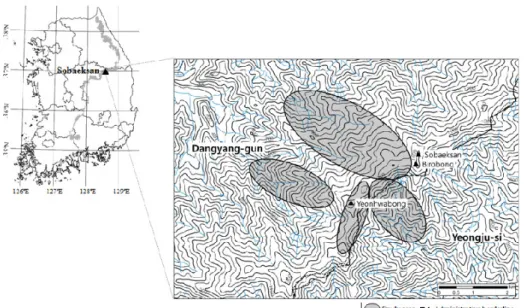
Fig. 1. The location and study boundary in Sobaeksan.
measurement and integration of the total physical and biotic environment.
Forest cover type classification is one practical applica- tion of the vegetation classification methods, defined by Eyre (1980) as "a descriptive classification of forestland based on present occupancy of an area by tree species."
Kimmins (2004) has also noted that forest cover type is a category of forest characterized by the trees presently occu- pying the area, no implication being conveyed as to whether it is temporary or permanent. Emphasis is given to compo- sition rather than development, and the classification is based on existing tree cover.
The objectives of this study was to classify the natural forests of Sobaeksan National Park area into appropriate number of forest cover types by cluster analysis and to de- scribe ecological characteristics for each forest type, includ- ing species composition and species diversity. The descrip- tions would give recognition on ecological factors influenc- ing the formation and development of forest cover types in study area.
Data and Methods
Study Area
The study was conducted in the areas of Sobaeksan, lo- cated in the course of Baekdudaegan (Fig. 1). Sobaeksan
designated as the 18th national park in Korea, 1987. It is 322,383 km2 in area and is the third largest mountainous national park in Korea next to Jirisan and Seoraksan.
Sobaeksan has many peaks beginning with Birobong which stands at 1,439 m to Gungmangbong (1,420 m), Yeonhwa- bong (1,383 m), and Dosolbong (1,314 m). The mountain ex- tends over some portion of Yeongju-si of Gyeongsangbuk-do, Danyang-gun of Chungcheongbuk-do, and Yeongwol-gun of Gangwon-do (Korea National Park Service 2014).
The vegetation data for this study were collected mainly from valley, ridge, and mid-slope where situated in Yeonhwabong and Birong of Sobaeksan (Fig. 1).
The mean annual temperature at the nearest Yeoungju weather station of study area for the last 30 years was 11.3oC, and annual precipitation was 1,290.9 mm. Mean temperature of the warmest and coldest month were 24.2oC in August and −2.9oC in January, respectively. Seventy percent of annual precipitation have occurred during the summer season, June to September (Fig. 2) (Korea Meteorological Administration 2014).
In this national park, Korean Association for Conser- vation of Nature (1995) conducted the scientific survey on geology, plants and vegetation, animals and insects, and mycoflora in 1994.
Fig. 2. Mean monthly temperature and precipitation (1981~2010).
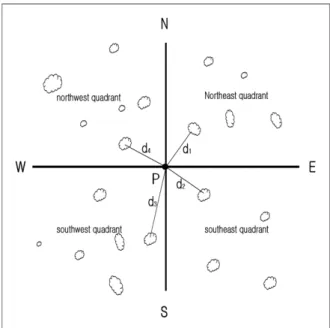
Fig. 3. The diagram of point-quarter sampling method.
Collection of data
Since the study area was rather extensive, the point-quar- ter sampling method was adopted to collect vegetation data to reduce labor and time but not to sacrifice the information and accuracy obtainable from plot or line sampling method (Brower and Zar 1977). On the randomly selected sample point P, four compass directions (N, S, E, and W) were divided into four quadrants. In each quadrant, all woody plants closest from the point were tallied by three vertical strata (overstory, midstory, and understory), identified by the species level, and measured for diameter, height, and distance from the point P (Fig. 3).
The taxonomy of woody plant species was referred to Lee (2003). The interval between points was given more than 50 m and the areas of forest plantation and gap were excluded to eliminate biased vegetation data. The total of 246 sample points temporarily established by topographic position and aspect throughout the study area.
Arrangement and analysis of data
The collected vegetation data from 246 sample points were subjected to the cluster analysis to make all points clas- sify into similar group according to the species composition in overstory. The sample points were grouped by Ward's method of hierarchical clustering. Ward's method, also known as a minimum variance clustering, has widely used by ecologists for grouping purpose (Orloci 1967; Everitt
1973; Hartigan 1975). This method has great intuitive ap- peal because it is based on the simple underlying principle that at each stage of clustering the variance within clusters is minimized with respect to the variance between clusters (Ludwig and Reynolds 1988). Also it is effective when the intent is to minimize information loss associated with any interactive step in cluster formation (Lattin et al. 2003).
The SPSS Statistics 17.0 (SPSS, Inc.) software was em- ployed to implement the analysis.
Lim and Kim
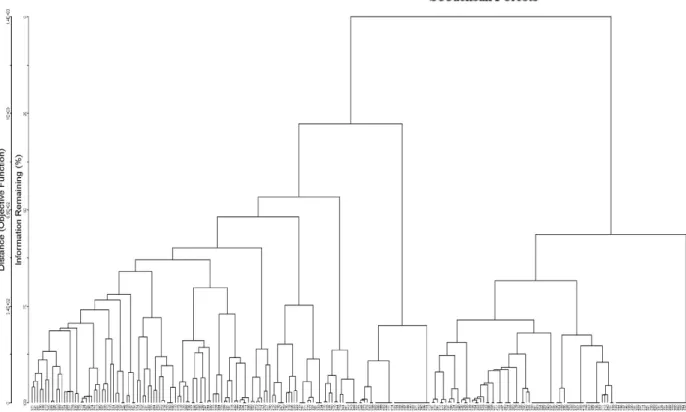
Fig. 4. Dendrogram from hierarchical cluster analysis of a species in each sample point using the Euclidean distance measure and the Ward’s method.
The species composition was expressed by importance value designed by Curtis and McIntosh (1951) to describe the community floristically. The importance value gives an overall estimate of the influence or importance of a plant species in the community (Brower and Zar 1977). The three relative measures for species i are considered as the importance value (IVi) of the species by following equation;
IV=(RD+RF+RC)/3
where RD is the relative density, RF is the relative fre- quency, and RC is the relative coverage of basal area.
Species diversity is measured by species richness (the number of species present in sample of a particular com- munity) and species evenness (the relative abundance of the different species). Shannon-Wiener diversity index would be a useful index for the community of which two or three species were dominant such as in the natural deciduous for- est of Korea (Kim et al. 2011). Shannon-Wiener diversity index is appropriate when you have a random sample of species abundances from a larger aggregation, say a random
sample of an entire community (Brower and Zar 1977).
The species diversity in each cluster were quantified us- ing (1) the Shannon's diversity index (H'), (2) the Maximum diversity (Hmax), (3) the Evenness (J'), and (4) the Dominance (1-J'). The species diversity were calculated as;
H'=(N logN−∑ni log ni)/N, Hmax=logs, J'=H'/Hmax.
where N is the total number of individuals, and ni is the number of species i in each cluster. For this calculation, we used logarithmic base e.
Results
Classification of forest cover types
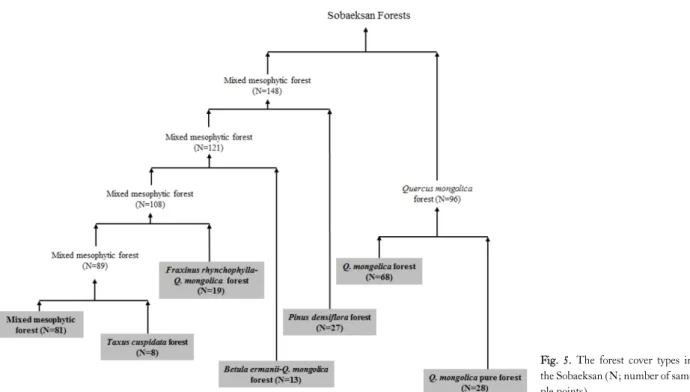
The procedure of cluster analysis of vegetation data (Fig. 4) brought 244 out of 246 sample points of which two were sampling outliers, resulted in seven distinctive forest cover types. The determination of cluster numbers and naming of forest types were referred to Lee et al. (2014). Recognized
Fig. 5. The forest cover types in the Sobaeksan (N; number of sam- ple points).
forest cover types were 1) Mixed mesophytic forest, 2) Taxus cuspidata forest, 3) Fraxinus rhynchophylla-Quercus mongolica forest, 4) Betula ermanii forest, 5) Pinus densiflora forest, 6) Quercus mongolica mixed forest, and 7) Quercus mongolica pure forest (Fig. 5).
It was noticed that the classification analysis revealed Q.
mongolica to be most abundant species in the study areas, marking dominance or co-dominance in four forest cover types. Several studies reported that the species has been most nation-widely distributed in the natural deciduous forest (Lee et al. 1990; Korea Forestry Research Institute 1996; Lee et al. 1998; Yun et al. 2011). Other research (Chung 1998; Jo et al. 2004; Lee et al. 2014) conducted in Baekdudaegan also noted that Q. mongolica was predom- inant in many forest types, occupying large areas, similar to the results of this study.
Species composition
Because types of forests are defined on a floristic basis, the species composition plays an important role to grasp fundamental ecological estimation and information for a specific forest cover type. The abundance, distribution, or dominance of species can be expressed numerically, so that different forest cover types can be compared on the basis of
species differences.
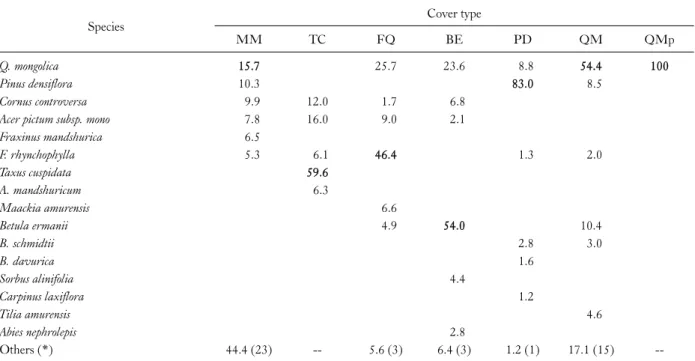
The species composition expressed by importance values of overstory tree species for 7 classified forest cover types was presented in Table 1. The results showed that growing species and compositional rates were characteristically dif- ferent from one another, depending upon the forest cover type which was formed by a number of similar vegetational sample points.
Species diversity
Species diversity is a characteristic expression of the structural attributes in a forest. A forest community is said to have a high species diversity if many equally or nearly equally abundant species are present. On the other hand, if a community is composed of a very few species, or if only a few species are abundant, species diversity is low (Brower and Zar 1977).
The species diversity can provide useful information for understanding various kinds of attributes in the forest community. High species diversity indicates a highly com- plex community because a greater variety of species allows for more variety of species interactions. Also the species di- versity could play a role in measuring the stability and ma- turity of the community. Presumably, the stability of the for-
Lim and Kim
Table 1. Species composition expressed by importance values for 7 classified forest cover types
Species Cover type
MM TC FQ BE PD QM QMp
Q. mongolica 15.7 25.7 23.6 8.8 54.4 100
Pinus densiflora 10.3 83.0 8.5
Cornus controversa 9.9 12.0 1.7 6.8
Acer pictum subsp. mono 7.8 16.0 9.0 2.1
Fraxinus mandshurica 6.5
F. rhynchophylla 5.3 6.1 46.4 1.3 2.0
Taxus cuspidata 59.6
A. mandshuricum 6.3
Maackia amurensis 6.6
Betula ermanii 4.9 54.0 10.4
B. schmidtii 2.8 3.0
B. davurica 1.6
Sorbus alinifolia 4.4
Carpinus laxiflora 1.2
Tilia amurensis 4.6
Abies nephrolepis 2.8
Others (*) 44.4 (23) -- 5.6 (3) 6.4 (3) 1.2 (1) 17.1 (15) --
*The number of the other species.
MM, Mixed mesophytic forest; TC, Taxus cuspidata forest; FQ, Fraxinus rhynchophylla-Quercus mongolica forest; BE, Betula ermanii forest;
PD, Pinus densiflora forest; QM, Quercus mongolica mixed forest; QMp, Quercus mongolica pure forest.
Table 2. Species diversity index of 7 forest cover types
MM* TC FQ BE PD QM QMP
S T 58 16 35 29 31 52 35
O 29 5 9 9 7 21 1
H` T 3.530 2.443 2.636 2.692 2.429 2.948 2.122
O 2.880 1.206 1.416 1.286 0.537 1.579 0.000
Hmax T 4.060 2.773 3.555 3.367 3.434 3.951 3.555
O 3.367 1.609 2.197 2.197 1.946 3.045 0.000
J` T 0.869 0.881 0.741 0.799 0.707 0.746 0.597
O 0.855 0.749 0.644 0.585 0.276 0.519 0.000
1-J` T 0.131 0.119 0.259 0.201 0.293 0.254 0.403
O 0.145 0.251 0.356 0.415 0.724 0.481 1.000
S, species richness; H`, species diversity; Hmax, maximum species diversity; J`, species evenness; 1-J`, species dominance; T, all tree species;
O, tree species in canopy layer.
*The abbreviations of cover types were referred to Table 1.
est community would be increased as forest succession pro- ceeds (Kim 2002).
Species diversity is one of the basic concepts of ecology that has been used to characterize forest communities and ecosystems and measured by species richness (the number
of species present in a particular community) and species evenness (the relative abundance of the different species).
In this study, Shannon-Wiener's species diversity index measures of overstory and total woody plants were calcu- lated and presented by seven forest cover types in Table 2.
Species diversity indices (H') of total and overstory both were the highest in the mixed mesophytic forest (3.530 and 2.880), and lowest in the Q. mongolica pure forest (2.122 and 0.000). Comparison of species diversity among the for- ests can not be made by using the species diversity index only. In order to have high species diversity, both of species richness and evenness should be high (Kim 1999). So spe- cies diversity should be judged by making comparison of species diversity index with maximum species diversity in- dex and evenness index.
So the species diversity indices of the communities in de- scending order were: Mixed mesophytic forest, Q. mongolica mixed forest, B. ermanii forest, F. rhynchophylla-Q. mongolica forest, T. cuspidata forest, P. densiflora forest, and Q. mongolica pure forest. The highest species diversity in the mixed mes- ophytic forest may due to the relatively high species rich- ness and evenness in that forest cover type.
Discussion: Eco-Character of Forest Cover Types
Mixed mesophytic forest
Eighty one sample points out of 244 (33.2%) came un- der the mixed mesophytic forest cover type, in which no ab- solute dominance was found, shared importance values by a number of species. Widespread dominants included Q.
mongolica, P. densiflora, C. controversa, A. pictum subsp. mono, F. mandsurica, and F. rhychophylla (Table 1). This type was the most diverse of the deciduous forest with 29 overstory tree species and 58 total, presenting highest species diver- sity index of 3.530 for all woody plant species and 2.880 in overstory among forest cover types (Table 2). In addition to this study, several recent studies (Hwang et al. 2012;
Chung and Kim 2013; Lee et al. 2014) in Korean natural forests have reported the existence of the mixed mesophytic forest, typified by diversity and complexity.
Because the composition and relative abundance of the dominants varied from place to place, this forest type con- tains the large number of dominants. This would have re- sulted in the development of apparently distinct climax forest. For instance oak species dominant forest would de- velop on some of drier sites such as upper and/or south fac- ing slopes, and maple and basswood dominant forest on wetter sites such as lower and/or north facing slopes.
Even though it was the canopy layer which primarily characterized the type, lower layers also had distinctive features. To the large number of canopy species must have been added the lower trees, which seldom or never attain can- opy position, as A. pseudo-sieboldianum, S. obassia, Morus bombycis, Magnolia sieboldii, and C. cordata. Among the shrubs, Lidera obtusiloba, Rhododendron schlippenbachii, Weigela sub- sessilis, and Staphylea bumalda were most generally present and abundant.
In such regions of narrow valleys of Appalachian Mountains in the United States where the term of this for- est type was originated, even though the species are differ- ent, trees of same genera, for example Acer, Tillia, Betula, Fraxinus, Quercus, Ulmus, and its endemic genera of Fagus, Aesculus, and Liriodendron show very similar physiognomy and ecological characteristics to those of this cover type.
This forest type has been regarded the most complex and the oldest association of the temperate deciduous forest for- mation (Braun 1950; Vankat 1979; Barbour and Billings 1988). Even in Europe (European Environment Agency 2006) it has been also recognized the mixed mesophytic forest types, suggested the characteristics of diversified spe- cies composition and structure.
Taxus cuspidata forest
T. cuspidata is characterized by cold-resistance and shade tolerance, growing in high mountainous area above 1,000 m altitude in Sobaeksan and Taebaeksan (Jang et al. 2004). In this study, the authors found and recognized T. cuspidata dominant forest at the ridge and upper slope around 1,300-1,400 m above sea level and classified as the T. cuspi- data forest cover type. The canopy layer of this cover type was dominated by T. cuspidata with 59.6% of importance value, mixed up F. rhynchophylla, C. controversa, A. man- dshuricum, and A. pictum subsp. mono. Lower stories of the forest was composed of such species as S. commixta, A. tscho- noskii var. rubripes, T. cuspidata, P. padus, A. pseudo-sieboldia- num, Euonymus sachalinensis, M. sieboldii, etc. This cover type would be ecologically so fragile that if it might be once destroyed and degraded it should be difficult to restore original features as to need conservation.
Fraxinus rhynchophylla-Quercus mongolica forest This forest cover type was mainly dominated by F. rhyn-
Lim and Kim
chophylla and Q. mongolica, occupying the forest with more than 72% of importance value (Table 1). The ash tree grows in cool and warm climate, on the moist, well-drained soil, in areas that provide enough direct sunlight. Therefore, it grows mostly in most rich soils of valleys (Choi et al. 1997;
Kim et al. 2011). Lower story of the forest was composed of such species as F. rhynchophylla, C. controversa, Q. mongolica, A. pictum var. mono, A. pseudo-sieboldianum, etc.
F. rhynchophylla has four regeneration types including seedling, stump sprout, root sprout, and layering. The spe- cies is more likely shade tolerant with a long seed dispersal distance as a samara species (Han and Sim 1989). The most frequent regeneration type was by stump sprout after disturbances (Yeo and Lee 2006). Advance regenerations often exhibit more rapid growth and can better survive competition after release than trees beginning from seeds (McGee and Loftis 1986). Therefore, F. rhynchophylla can be easily spread into the understory of natural deciduous forest. Such regeneration strategy increases the number of advanced young ash trees which could grow up and occupy the canopy (Chung 2015).
Betula ermanii-Quercus mongolica forest
This forest cover type was characteristically distributed in ridge or around mountain summit, and above 1,200 m of relatively high altitude in limited small areas of the study area. B. ermanii followed by Q. mongolica predominated.
The birch usually being more numerous and the key species in this type. Associate species were hardly varied, including C. controversa, A. pictum subsp. mono, S. alinifolia, A. neph- rolepis, and so on (Table 1). Species diversity index of woody plant species was calculated 2.692 (Table 2).
Dominant B. ermanii is known as a pioneer species, often colonizing bared areas after severe fires or soil disturbance.
The species tend to make small patch of stand with regen- erated trees. We noticed that It often preceded its associates by invading disturbed soils that had been logged or cleared by fire.
Kim and his colleagues (Kim et al. 2015) reported that, after reaching the thrifty stage as forest succession would progress with no additional major disturbances, the abun- dance of B. ermanii would be decreased and those of other hardwood species would be increased. Eventually the spe- cies would be driven out sooner than other species found in
this type and no more maintain this cover type.
Pinus densiflora forest
Even though P. densiflora and Q. mongolica together con- stituted the majority of density and volume stocking, we gave the name of this type as P. densiflora forest cover type separately from the previous type (Lee et al. 2014), due to more than 80% of importance value of the pine. In addition to the pine and oak, small number of B. schmidtii, B. davurica, C. laxiflora, and F. rhynchophylla were growing in canopy layer, presenting second lowest species diversity index of 2.429 (Table 2).
P. densiflora is shade-intolerant and commonly develops toward the even-aged stand. Once the pine stand comes to maturity and makes site condition better, the species is often replaced by the more shade-tolerant associates of deciduous trees, such as oaks, ashes, maples, and other hardwood spe- cies, which regenerate more readily in the understory of the pine stand. As years go by, pine trees are gradually de- creased in abundance and finally disappear, and other trees are increased in density and stocking through natural in- vasion of general shade-tolerant midstory and understory associates (Kim et al. 2015).
Quercus mongolica mixed forest
Q. mongolica mixed forest cover type ranked next to the mixed mesophytic forest cover type in measure of sample area with 68 sample points out of 244 (28%). This cover type extended over broad areas chiefly on topographic posi- tions from mid-slopes through upper-slopes up to ridges.
As mentioned before, when the stand of P. densiflora was cut or destroyed by fire, the oak invade vigorously and became dominant through persistent sprouting in accompany with the failure of pine trees to regenerate themselves under the stand (Kim et al. 2015).
Q. mongolica was associated with 21 tree species in the canopy (Table 1), some common to dry upland sites and others more common to moist bottomland sites, including B. ermanii, P. densiflora, T. amurensis, B. schmidtii, and so on.
Chung (2015) discussed the ecological whereabouts of this cover type. On the basis of species composition of strat- ification, he suggested three successional progress pathways. 1) Although there was a little changes in the ratio of Q. monoglica of the canopy story, the species composition
of this cover type would be continued for a while. As time goes by, 2) The influence of Q. monoglica will be gradually weaken due to growth competition of shade tolerant species in the mid-story. Consequently, 3) This cover type is likely to be changed to mixed mesophytic forest cover type by in- creasing the ratio of shade tolerant species such as C. cordata, T. amurensis, and A. pictum subsp. mono.
Quercus mongolica pure forest
Almost 12% (28 sample points) of the study area was solely composed of Q. mongolica trees in canopy (Table 1).
That was the reason we named the forest the Q. mongolica pure forest cover type. However, we found 35 woody plant species in lower strata by the sampling procedure.
Q. mongolica have some unique characteristics to form 100% pure stands. Mainly because it sprouts readily and has strong competitive ability. Great amount of the oak trees in new production stands were sprouts, either from advance reproduction or from stumps of cut trees. New sprouts from advance reproduction arose when old stems were damaged during logging or other disturbance, like fire.
Height growth of new sprouts was related to the size of the old, damaged stem. The larger the old stem, the faster the new sprout would grow (Kim 2015). In addition, the spe- cies has broad niche of topography and seldom requires good site quality Suh (1993) so as to have high competition ability against other species and to make 100% pure stand.
Q. mongolica has been well adapted to environmental con- ditions of Korean forests, but the dominant species might be replaced to other species by changes in the environ- mental factors such as global warming, climate change, and soil properties, etc. This species can also be described as a long-lived pioneer because it often requires large stand dis- turbances to regenerate successfully (Ishikawa and Ito 1989; Osawa 1992). Even though it is hard to conclude that Q. mongolica is late seral or climax species, the cover type which was dominated by Q. mongolica has high possibilities to maintain itself for a long period of time (Chung 2015).
Acknowledgement
This study was conducted with the support of 'Forest Science & Technology Projects (Project No. S211012L03 0110)' provided by Korea Forest Service.
References
Barbour MG, Billings WD. 1988. North Americal terrestrial vegetation. Cambridge University Press, pp 434.
Braun EL. 1950. Deciduous Forest of Eastern North America.
Blakiston, Philadelphia, pp 596.
Brower JE, Zar JH. 1977. Field and laboratory methods for gen- eral ecology. W. C. Brown Company Publishers, Dubuque, Iowa, USA, pp 73.
Choi SH, Song KJ, Lee KJ. 1998. The vegetation structure of Fraxinus mandshurica community in Mt. Minjuji, Youngdong- gun, Chungcheongbuk-do. Journal of Ecology and Field Biology 11: 166-176.
Chung SH, Kim JH. 2013. The classification of forest cover types by consecutive application of multivariate statistical analysis in the natural forest of western Mt. Jiri. Journal of Korean Forest Society 102: 407-414.
Chung SH. 2015. The classification of forest cover types in natural forests of the Baekdudaegan, South Korea. Ph.D Dissertation, Kangwon National University, Korea. pp 140.
Chung YS. 1998. Characteristic species distribution of the Baekdoo Great Mountain chain at Kangwon province, Korea.
Environmental Research 21: 105-112.
Curtis JT, Mclntosh RP. 1951. An upland forest continuum in the prairie-forest border region of Wisconsin. Ecology 32: 476-496.
Daubenmire RF. 1976. The use of vegetation in assessing the pro- ductivity of forest lands. Bot Rev 42: 115-143.
European Environment Agency. 2006. European forest types:
Categories and types for sustainable forest management report- ing and policy. Office for Official Publications of the European Communities, Luxembourg, pp 111.
Everitt B. 1973. Cluster analysis. John Wiley & Sons, Inc., New York.
Eyre FH. 1980. Forest cover types of the United States and Canada. Society of American Foresters, Washington DC, pp 148.
Han SS, Sim JS. 1989. Characterisitcs of photosynthesis and respi- ration in Fraxinus rhynchophylla Hance and Fraxinus mandshurica Rupr. Leaves. Journal of Korean forest Society 78: 280-286.
Hartigan JA. 1975. Clustering algorithms. John Wiley & Sons, Inc., New York.
Hwang KM, Lee JM, Kim JH. 2012. Community classification and successional trends in the natural forest of Baekdudaegan in Gangwon Province. Journal of Agriculture & Life Science 46:
41-55.
Ishikawa Y, Ito K. 1989. The regeneration process in a mixed forest in central Hokkaido, Japan. Vegetation 79: 75-84.
Jang YS, Shin CS, Jung DJ. 2004. Vegetation structure of natural taxus cuspidata forests in Mt. SouBaik. Korean J Plant Res 17:
67-74.
Jo HJ, Lee BC, Shin JH. 2004. Forest vegetation structure and species composition of the Baekdudaegan mountain range in
Lim and Kim
South Korea. The Journal of Korean Forestry Society 93:
331-338.
Kim HS, Lee SM, Song HK. 2011. Actual vegetation distribution status and ecological succession in the Deogyusan National Park. Korean Journal of Environment and Ecology 25: 37-46.
Kim JH, Jin G, Chung SH. 2015. Stand development patterns of forest cover types in the natural forests of northern Baekdudaegan in South Korea. J For Res 26: 381-390.
Kim JH. 1999. Forest ecology; attributions and analysis of forest community. HyangMoonSa, pp 208.
Kim JH. 2002. Community ecological view of the natural decid- uous forest in Korea. In: Ecology of Korea. Bumwoo Publishing Company, Seoul, Korea, pp 93-104.
Kimmins JP. 2004. Forest ecology--a foundation for sustainable forest management and environmental ethics in forestry. 3rd ed.
Printes Hall Pub. Co., Upper Saddle River, N.J, pp 611.
Korea Forestry Research Institute. 1996. Hardwood Forest Inventory Report. Research Bulletin No. 122. Forestry Research Institute, Seoul, Korea.
Korea Meterological Administration. 2014. Statistical Database.
http://www.kma.go.kr. Accessed 11 Mar 2015.
Korea National Park Service. 2014. Introductory description.
http://www.knps.or.kr. Accessed 11 Mar 2015.
Korean Association for Conservation of Nature. 1995. A report on the scientific survey of the Mt. Sobaek National Park. No. 33.
pp 259.
Lattin J, Carroll D, Green P. 2003. Analyzing multivariate data.
Thomson Brooks/Cole, Pacific Grove, California, USA. pp 556.
Lee DK, Kim JH, Cho JC, Cha DH. 1990. Studies on the devel- opment and utilization of Korean oak rsources (Ⅲ). pp 427.
Lee HJ, Bae BH Chun YM, Chung HL, Hong MP, Kim YO, Kil JH. 1998. Community structure and soil environment of Quercus mongolica forest on Mt. Chiljelbong. Journal of Basic Science 23:
83-95.
Lee JM, Hwang KM, Kim JH. 2014. The classification of forest by cluster analysis in the natural deciduous forest of the southern region of Baekdudaegan Mountains. J Korean For Soc 103:
12-22.
Lee TB. 2003. Coloured flora of Korea. Hyangmoonsa, Seoul, Korea, pp 1928.
Lee WS. 2002. Abundance and growth of naturally regenerated Pinus koraiensis wildlings in four foest types. Ph.D. Thesis.
Kangwon National University, Korea.
Ludwig JA, Reynolds JF. 1988. Statistical ecology. John Wiley &
Sons, Inc., New York, pp 125-144.
McGee CE, Loftis DL. 1986. Planted oaks perform poorly in North Carolina and Tennessee. Northern Journal of Applied Forestry 3: 114-116.
Orloci L. 1967. An agglomerative method for classification of plant communities. Journal of Ecology 55: 193-206.
Osawa A. 1992. Development of a mixed-conifer forest in Hokkaido, northern Japan, following a catastrophic windstorm:
a "parallel" model of plant succession. In: Ecology and silvi- culture of mixed-species forests (Kelty MJ, Larson BC, Oliver CD, eds). Kluwer, Dordrecht, pp 29-52.
Suh MH. 1993. Stand Structure and Regeneration Pattern of Quercus mongolica forests. Ph.D Disseration. Seoul national University, Korea.
Vankat JL. 1979. The natural vegetation of North America. John Wiley & Sons, New York, pp 261.
Yeo US, Lee DK. 2006. Early regeneration of Fraxinus rhyncho- phylla in the understorey of Larix kaempferi stands in response to thinning. Forestry 79: 167-176.
Yun CW, Kim HJ, Lee BC, Shin JH, Yang HM, Lim JH. 2011.
Characteristic community type classification of forest vegetation in South Korea. The Journal of Korean Forestry Society 100:
504-521.