INTRODUCTION
Mt. Changbai (in Korea it is called Mt. Paekdu) is located on the border between China and North Korea.
Chinese government established Mt. Changbai Nature Reserve within Chinese Territory in 1960 and North Korea government established Mt. Paekdu Nature Reserve within North Korea territory in 1959 (Fig. 1). Mt.
Changbai Nature Reserve is located in the southeast part of Jilin Province. It has a total area of 1,907 km2and the forest coverage is 87.9%. The main function of the reserve is to protect its unique forest ecosystem. It was accepted by the International Man and Biosphere Reserve Network of UNESCO in 1980, and listed as one of the 40 Class-A reserves in China by the World Wildlife Fund (WWF) in 1992.
The mixed broadleaved-Korean pine forest ecosystem in Mt. Changbai is a typical ecosystem in this area. Its
structure and function have a profound effect on the eco- system of that area. The dominant tree species, Korean pine, is very important natural resources for its great ecological and economical values. The seeds of Korean pine are the basis for the regeneration of Korean pine and
* Corresponding author: (E-mail) [email protected]
The Effects of Cone Harvesting on the Regeneration of Korean Pine and the Life of Animals in Mt. Changbai Nature Reserve
Tie Feng Piao, Ji Hong Kim*, and Sang Hoon Chung
College of Forest & Environmental Sciences, Kangwon National University, Chuncheon 200-701, Korea
ABSTRACT : Based on the former researches, this article studied the influence of cone harvesting of Korean pine on the regeneration of Korean pine trees and the life of animals in Mt. Changbai Nature Reserve. When the cone matures, scales of the cone do not open so the seeds can not be released automatically. And the seeds, if left inside, are hard to germinate and can not grow further into seedlings. The seeds of Korean pine have deep dormancy characteristics. Natural regeneration of Korean pine is very poor under mother trees. Hoarding behavior of dispersing animals not only helps animals for food shortage period but also contributes to the dispersion of seeds of Korean pine. Among those hoarding animals, squirrel and Eurasian nutcrackers are found to be the most important dispersing agents for the seeds of Korean pine. After cone harvesting, the number of those dispersers reduced a lot since the seeds of Korean pine are very important food for them. Seed quantity of Korean pine on surface layer became very few and most of them only showed single distribution. Most of the seeds were buried under litter layer and showed a single or 2-4 seeds/cluster distribution. The case of more than 4 seeds in one cluster was few. The seed quantity of Korean pine forest on steep slopes of the research area was only 0.3% of the seed quantity in 1980 for the same forest type.
If seed source of Korean pine are not protected, Korean pine forest in Mt. Changbai Nature Reserve would not maintain present feature in the future.
Keywords : Korean pine, Cone harvesting, Regeneration, Hoarding animal, Seed dispersion
Fig. 1. Map of locations of Mt. Changbai Nature Reserve and Mt. Paekdu Nature Reserve.
also are very important food for many kinds of animals.
However, since 1990s, in the fruiting season, millions of people have rushed into Mt. Changbai Nature Reserve to pick the cones of Korean pine. In 2000, the authority of Mt. Changbai Nature Reserve contracted the right of harvesting cones of Korean pines out to 38 contractors.
The total contracted area was about 500 km2 and there were about 980,000 Korean pine trees growing in that area (Feng, 2007). This article studied the influence of cone harvesting on the regeneration of Korean pine trees and animals in Mt. Changbai Nature Reserve so as to provide more scientific basis for protecting the ecosystem of Mt. Changbai Nature Reserve.
THE RELATIONSHIP BETWEEN THE REGENERATION OF KOREAN PINE AND PINE
NUT EATING ANIMALS
Many kinds of animals have a close relationship with Korean pine in the process of evolution for a long time.
In accordance with seasonal behavior rhythm, morphology and population changes, it is the result of long term co-evolution between plants and animals (Ma and Lu, 1995). Because of these complex interactions between plants and animals, the stability of the ecosystem of mixed bro- adleaved-Korean pine forest would be maintained and promoted.
Dependence of regeneration of Korean pine on animals
1. Why the regeneration of Korean pine need the help of animals?
The dependence of regeneration of Korean pine on animals is mainly because the seed dispersal of Korean pine needs the help of animals. The traditional definition of seed dispersal is the movement of seeds leaving stock trees, a key stage in plant regeneration (Pijl, 1972). Seed dispersal influences seed density, seed predation rate, pathogen aggression rate, the distance from seed to stock tree, habitat type of the seed and with whom will the future plant compete, so seed dispersal influences the sur- vival of seeds and seedlings and their future living envi-
ronment (Jordano and Fruigivory, 1992; Willson, 1992;
Schupp, 1988). The dispersion of seeds by storage animals is apparently advantageous for the survival and migration to open space of seeds.
Seeds of Korean pine are typically large and edible. Its spreading process is dependent on the burying behavior of animals. Animals usually store some of the seeds for winter. Most of the seeds are found and eaten, but also some of them are forgotten and left uneaten. These seeds become the potential seed bank of Korean pine. This process is the only way through which Korean pine regenerates (Lu, 2003).
There are three reasons for Korean pine to make the regeneration successful with the help of animals. The first reason is the mature cone of Korean pine is big, with a length of 10-15 cm, weight of about 160 g, the scales of the cone do not open, so the seeds can not release from mature cones automatically. This characteristics make the seeds of Korean pine can not be dispersed by wind or gravity (Ji et al., 2002). And because of the seed’s position in the cone, orientation of the embryo in the seeds and the structure of the cone, the seeds of Korean pine in the cone are hard to germinate and can not grow further into seedlings (Tao et al., 1995).
The second reason is that the seeds of Korean pine have deep dormancy characteristics. The mature seeds under natural condition can only massively germinate in the spring of the third year, because they have to go through the process of after-ripening. Such long period of dormancy increases the rate of being predated. Moreover, after drop down from mother trees, cones are easy to be spoiled by the attack of microorganisms and insects. So the seeds of Korean pine must get to the favorable envi- ronments before they are predated or they rot (Tao et al., 1995).
The third reason is the biological characteristics of Korean pine: Natural regeneration of Korean pine is very poor under the primary forest canopy. Two popular expres- sions of local people effectively describe the poor status of natural pine regeneration in the mixed broadleaved- Korean pine forest: “No Korean pines under their canopy”
and “Seedlings but no saplings survive” (Li and Li, 2003). Although the primary forests cover large areas of the northeast China forest lands and the Korean pine has been the dominant species in the region for thousands and millions of years, few of their saplings or young trees can be found in the forest (Li and Zhu, 1991). So the disper- sion of seeds by animals is very important for regenera- tion of Korean pine.
2. Hoarding and dispersion of Korean pine seeds by animals
2.1 Scatter-hoarding and endochory
Animals usually hoard some seeds instead of eating them. Hoarding is the strategy for the preparation of food shortage period and breeding future generations, but on the same time, it has a function of dispersing the seeds.
Hoarding can be separated into 2 modes: nest-hoarding and scatter-hoarding (Hurly and Robertson, 1987). The former one is the way of store many seeds in one or several places. Usually seeds are hard to germinate in this way. The latter one is a way of store seeds in hundreds of cache in a large scale, each cache just have few seeds in it. Many of the seeds in cashes can be rediscovered and eaten, even in winter, when the ground are covered by snow. However, some of the caches are forgotten, so the seeds in it become potential seed bank. This way of seed dispersion is called endochory (Lu and Yuan, 1997;
Lu, 2001). The seeds of Korean pine are typically big and edible, their dispersion are realized by hoarding behavior of animals. Endochory is the only way for Korean pine’s regeneration (Lu, 2003).
2.2 Dispersing animals of Korean pine seeds
All the rodents which eat seeds of Korean pine have certain kinds of hoarding behaviors. Eutamias sibiricus, Clethrionomys spp., Apodemus speciosus, Microtus fortis etc. are nest hoarders, so they do not contribute to the regeneration of Korean pine. Squirrel (Sciurus vulgaris) is the only rodent which has scatter hoarding behavior, so they are very important dispersers of seeds of Korean pine. For birds who eat seeds of Korean pine, Eurasian
nutcracker (Nucifraga caryocatactes) and Sitta europaea are seed dispersers of Korean pine, since they are scatter hoarders, other kinds are not in this class. Large mammals like Selenarctos thibetamus and Ursus arctos do not have hoarding behavior, so they are pure consumers (Lu, 2003).
Scholars of the former Soviet Union found that when wild boar searched for food, it would turn over loose litter layer like a plow. This made the seeds get in full touch with the soil, so it was good for seed germination (Brolmei and Kostenko, 1970). These scholars also thought that Sciurus vulgaris and Eurasian nutcrackers were the main dispersers of Korean pine (Brolmei and Kostenko, 1970). The research in Hokkaido made by Japanese scholars found that only squirrels contributed to seed dispersion (there were Eurasian nutcrackers distributed in the research area) (Hayashida, 1989; Watanabe, 1977). The research in Mt. Xiaoxingan showed that both squirrels and spotted nutcrackers had contributed to seed dispersion (Liu, 1988;
Lu et al., 2001), Sitta europaea also has the function of seed dispersion, but the amount was few (Hutchins et al., 1996). Different results may be caused by regional disparity.
2.3 The process of dispersion of Korean pine seeds After the squirrel gets the cone, it will turn around the cone and bites off the scales with its teeth, and then get seeds out of the cone to eat. When it is full, it will hold the cone with its mouth or put the seeds in its cheek pouch and then make cache to store the seeds for future use. Usually it will put 2-4 seeds (maximum 18 seeds) in each cache (Lu et al., 2001). In the research of Japan the hoarding amount is 3.2/cache (Hayashida, 1989). Eurasian nutcracker has sublingual pouch in its neck. It swallows the seeds in its sublingual pouch, fly to its hoarding place, disgorges the seeds and bury them under litter.
Eurasian Nuthatch has few amount of hoarding, usually store single seed under litter (Lu, 2003).
Whether the seed of Korean pine can successively ger- minate and grow to a mature tree has a great relationship with the habitat of burying place. Animals usually choose to hoard the seeds under litter layer. Since there is litter above the seeds and organic matter below them, it is good
for the germination of seeds and the root extension of seedlings. The depth of hoarding is usually 1-3 cm, suitable for the germination of seeds (Lu et al., 2001; Hayashida, 1989). Animals also have preference for forest type. For the main dispersers of Korean pine seeds, squirrels select major forest types from the order of most preference are:
natural spruce forest, primary Korean pine forest, planted Korean pine forest, mixed coniferous-broadleaved forest, planted spruce forest, secondary birch forest, mixed- coniferous forest, planted larch forest, mixed broadleaved forest and natural fir forest; Eurasian nutcrackers selected major forest types from the order of most preference are:
planted Korean pine forest, primary Korean pine forest, natural spruce forest, planted spruce forest, mixed coniferous- broadleaved forest, mixed broadleaved forest, secondary birch forest, mixed coniferous forest, planted larch forest and natural fir forest (Zong et al., 2007).
The dispersion distance of the seeds by animals is relatively long. In plantation of other species, not Korean pine, seedlings of Korean pine were found, this was due to the hoarding behavior of animals (Liu, 1986). Japanese researchers found that, the distance between the seedlings which are germinated from seeds dispersed by squirrels and mother trees can be as far as 600 m (Miyaki, 1987).
In another research, the distance even reached 1.8 km (Hayashida, 1989). The dispersion distance of Eurasian nutcracker is further, in the research of Mt. Xiaoxingan, seedlings of Korean pine are found 3 km away from their mother trees (Zhao, 1987).
The deposit quantity of animals is hard to fix. But one thing is clear: only when deposit quantity is bigger then actual required quantity that some of the seeds can enter seed bank of Korean pine. Tomback estimated that one Nucifraga Columbiana can hoard 32,000 seeds of Pinus albicaulis in one season. This may exceed the actual required amount by 45% (Tomback, 1982). From the large amount of seedlings of Korean pine in Mt. Xiaoxingan, it is estimated that squirrels and Eurasian nutcrackers hoard the quantity of seeds far more than their actual needs (Lu et al., 2001). The concrete data in this field still awaits for further research.
Dependence of seed eating animals on Korean pine
1. Rodents
In the Korean pine forest, many animals eat Korean pine seeds. Among them, rodents are very important, such as Sciurus vulgaris vulgaris, Eutamias sibiricus, Clethrio- nomys rutilus, Clethrionomys rutilus, Apodemus speciosus and Microtus fortis (Shou et al., 1958).
2. Birds
According to the research in Liangshui Forest Reserve, the Eurasian nutcracker was the most influential dispersal agent, easily acquiring seeds with its large pointed bill, carrying up to 62 seeds in one trip, and placing seeds in a variety of sites 2.5-3 cm deep in the soil (Hutchins et al., 1996). Among the examined 353 cones, there were 100 cones visited by Eurasian nutcrackers (Zhao, 1987).
Besides Eurasian nutcracker, Sitta europaea, Loxia curviro- stra, L. lercoptera, Coccothraustes coccothraustes, Picoides major, Picus canus, Dryocopus martius, Picoides leucotos, Garrulus glandarius, Eophona personata and other bird species also forage seeds of Korean pine, but the amount of predation was far less than that of Eurasian nutcrackers (Liu et al., 1999; Lu et al., 2001; Hutchins et al., 1996).
3. Other kinds of animals
Cones of Korean pine on the forest floor and seeds under litter layer can be predated by large mammals. Large mammals such as Ursus arctos, Selenarctos thibetamus, Sus scrofa, Meles meles, Cervus elaphus, Capreolus capreolus and Martis zibellina predate seeds of Korean pine (Liu et al., 1999). However, these days the population of these animals have become so few that their impacts on the seeds of Korean pine can be almost ignored.
THE EFFECTS OF CONE HARVESTING ON THE REGENERATION OF KOREAN PINE AND
THE LIFE OF ANIMALS IN MT. CHANGBAI NATURE RESERVE
The effects of cone harvesting on the regeneration of Korean pine
The regeneration of Korean pine rests with the seed source and growing condition of the seedlings. And seed source is determined by seed production ability of mother trees, the behavior of seed dispersers, and the condition of seed consumption (Li and Zhu, 1990; Xu, 2001). Natural regeneration of Korean pine is first determined by the quantity of healthy seeds under the litter layer. The change of natural regenerations under forest is in accordance with the change of seed quantity (Institute of Forestry and Pedology, 1980). And the growing condition of seedlings determines whether Korean pine trees can successively survive at last.
1. The effects of cone harvesting on the distribution of seed source
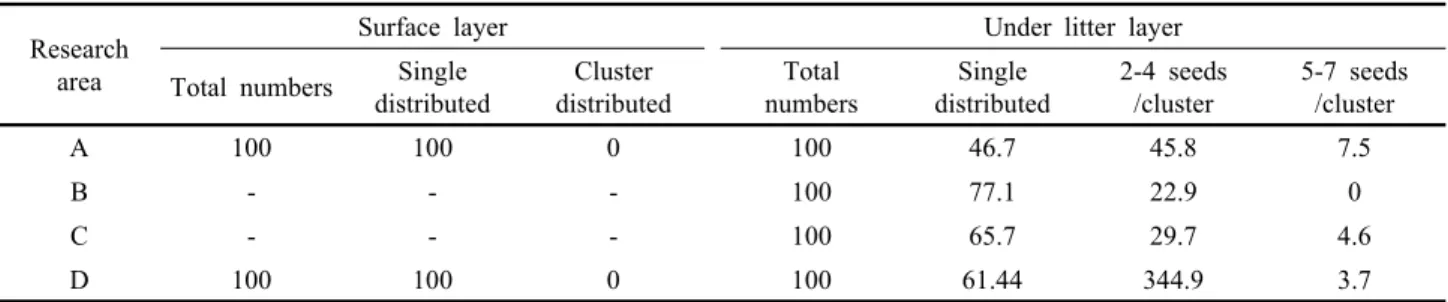
Table 1 showed that after cones were harvested by men, seed quantity of Korean pine on surface layer became very few and most of them only showed single distri- bution. Most of the seeds were buried under litter layer and showed a single or 2-4 seeds/cluster distribution. The case of more than 4 seeds in a cluster was few. This result was quite different with the past research. Liu made a research in Mt. Xiaoxiangan showed that most of the seeds under litter layer were cluster distributed, the seeds in the 2-7 seeds/cluster class account for 77% of all the
seeds buried under litter layer (Liu, 1987). Li and Zhu researched on the population dynamics of Korean pine and found that there were usually 2-8 seeds in each cluster (Li and Zhu, 1990). Chen in the research of the relation- ship between animals and Korean pine found that Eurasian nutcracker hoarded around 10 seeds in each hoarding place in litter layer (Chen and Guo, 1992). The quite different result was due to commercial cone harvesting.
After cone harvesting, seed quantity of Korean pine dropped dramatically, and since lacking of food, animals would search every corner for food. This made there were almost no seeds left on the surface of forest floor. Under litter layer, many cluster distributed seeds were eaten, with some single distributed seeds left, and many of the left seeds can not germinate.
2. The effect of cone harvesting on the seed quantity on the forest floor
Since it is hard to find historical data in one research area, comparison about changes of seed quantity of Korean pine after cone harvesting in the same research area was hard to make. There are many factors influencing the seed quantity of Korean pine on the forest floor, but the most important factors are the location of mother trees, dispersing conditions, and consuming conditions (Shi, 1982). These important factors are quite similar in the natural Korean pine forest in the same region. So we can notice how the seed quantity on the forest floor had changed by com- paring the historical data in the similar plots. The data in Table 2 was collected in 2002 and the data in Table 3 was collected in 1980. The forest type in plot A of Table 2 is called the steep slope Korean pine forest, seed
Table 1. Distribution of Korean pine seed on surface layer and under litter layer (After Liu et al., 2005).
Research area
Surface layer Under litter layer
Total numbers Single distributed
Cluster distributed
Total numbers
Single distributed
2-4 seeds /cluster
5-7 seeds /cluster
A 100 100 0 100 46.7 45.8 7.5
B - - - 100 77.1 22.9 0
C - - - 100 65.7 29.7 4.6
D 100 100 0 100 61.44 344.9 3.7
quantity in plot A was 1582/ha, this was only 0.3% of the seed quantity in 1980 for the same forest type. Plot D had the most seeds but still only accounts for 0.5% of the seed numbers in the same forest type of Table 3. Table 2 showed there were as many as 67.8%-86.2% of bad seeds on the forest floor. And since seeds of Korean pine were carried out of the forest ecosystem, animals were lack of food. Animals would further search the forest floor for seeds, this made the situation of seed bank of Korean pine worse. From Table 2 the frequency of eaten seeds showed 100% during the research period.
3. The effect of cone harvesting on spread of Korean pine
The transporting, dissemination and hoarding behavior of animals are good for the spread of Korean pine popula- tion, since the dispersion of Korean pine seeds by animals is good for the seeds’ survival and settlement in open space. This avoids the situation of high seed density under mother trees and the resulted adverse effects on germi- nation of seeds and growth of seedlings. Seeds of Korean pine are very important food for animals like squirrels and Eurasian nutcrackers. Excessive cone harvesting will lead to the population reduction of these dispersers and make the spread of Korean pine population hard to achieve (Ji et al., 2002).
The effects of cone harvesting on the life of animals
1. The effects of cone harvesting on the habitat and distribution of animals
Reduction of food seeds will lead to the changes of population structure and habitat of animals. Excessive cone harvesting of Korean pines will on one hand reduces the seed source and, on the other hand, reduce the popula- tion of seed dispersers like squirrel and Eurasian nutcracker.
So cone harvesting of Korean pine over years will in- fluence the normal succession of Korean pine forest by replacing the mixed broadleaved-Korean pine forest with mixed coniferous-broadleaved forest. By using ZELIG model, Yu and Zhao reported that without Korean pine seeds, the mixed broadleaved-Korean pine forest would change to mixed coniferous-broadleaved forest (Yu and Zhao, 1997). But since the life-span of Korean pine is long, the consequences of cone harvesting will not show immediately. The forest is seemed to be normal, but its under-forest structure has already changed radically.
Vegetation provides the nest and food for wild animals.
The change of vegetation distribution will lead to the change of animal distribution (Masters et al., 1998). Years of cone harvesting will lead to the reduction of Korean pine population, increase of broadleaved trees, change of habitat and change of animals’ competition mechanism.
Table 2. Number of seeds on the forest floor in different sample plots (Liu et al., 2005).
Site Frequency (%) Seed number /ha Percentage of bad seed (%) Frequency of eaten seed (%)
A(n=6) 7.4±0.2 1582±85 86.2±7.5 100
B(n=4) 6.7±0.5 953±42 81.1±9.2 100
C(n=4) 10.3±0.8 1889±83 76.5±5.8 100
D(n=4) 12.5±0.7 2640±69 67.8±5.3 100
Table 3. Number of seeds of Korean pine under the forest floor in natural forest (Soil Research Institute of Forestry, 1980).
Forest type Understory
vegetation Seed number/ha Healthy seed number/ha Slow slop shrub mixed broadleaved-Korean pine forest Shrub 490830 13330 Middle slope shrub mixed broadleaved-Korean pine forest Filbert 536670 12500
Steep slope Korean pine forest Least grass 888670 17500
Spruce-fir-Korean pine forest Fern 506250 6250
Finally the distribution pattern and community structure will be influenced.
2. The effect of cone harvesting on the food web of the mixed broadleaved-Korean pine forest
Small rodents of forest occupy a very important posi- tion in the food chain (Masters et al., 1998), since they usually feed on seeds and insects. And in the mean while, they are the food of large animals. Korean pine is the main food source of dispersers like squirrels and Eurasian nutcrackers. Many documents proved that there was a close relationship between the number of Korean pine seed and the number of rodents (Li, 1984; Cui, 1981; Ma, 1984; Zhou, 1985; Shu et al., 1975). Fig. 2 shows that the number of squirrels has an undulatory change along with the yield of Korean pine seed; the time lag is one year.
Because of cone harvesting, most of the seeds are taken out of the Korean pine forest. The number of primary consumers which take Korean pine seed as main food on the food chain of Korean pine forest would surely decline dramatically. This would then influence the number of animals in the upper links of the food chain. So cone harvesting will at last influence the whole food web of the Korean pine forest.
CONCLUSION
Through the evolution for a long periods of time, animals
like squirrels and Eurasian nutcracker have established a close relationship with Korean pine, in the form of mutual adaptation of performance, behavior, seasonal rhythm and population changes. This kind of relationship is called mutualism (Lanner and Nikkanen, 1990; Tomback and Linhart, 1990). The form of mutualism is the result of long periods of co-evolution. In the ecosystem of mixed broadleaved-Korean pine forest, it is the complicated interaction between animals and plant that keeps the stability of the ecosystem.
In the mixed broadleaved-Korean pine forest, excessive cone harvesting of Korean pine had made the regenera- tion of Korean pine hard to realize. Because cone har- vesting brought the cones of Korean pine out of the eco- system of Korean pine forest, it made the forest floor lack of seed source and decreased the number of dispersers. If seed source of Korean pine are not protected, Korean pine forest in Mt. Changbai Nature Reserve would not maintain present feature in the future.
In 2006, the authorities of Mt. Changbai Nature Reserve cancelled the contract cone harvesting policy of Korean pine. The cancel of this policy had vital significance to the restoration of the ecosystem of the mixed broadleaved- Korean pine forest, and in the same time, produced more opportunities for the dynamic research of the ecosystem.
In order to solve the contradictory of protection and use, on one hand, education of people for ecological protection consciousness should be enforced so that they can understand the harmfulness of cone harvesting on the
ⅠYield of cones (105 kg) ⅡNumber of squirrels (103 individuals)
ⅠYield of cones (105 kg) ⅡNumber of squirrels (103 individuals)
Fig. 2. The relationship between yield of Korean pine cones and number of squirrels from 1960-1980 in Yichun City, Heilongjiang Province (Bai, 1981).
ecosystem. On the other hand, to meet the need of seed market, specialized Korean pine plantation for seed pro- duction should be made.
Further research of the relationship between the regenera- tion of Korean pine and the animals should be made. The information of amount of seeds which is necessary to keep the health of the mixed broadleaved-Korean pine forest in Mt. Changbai should be acquired, so as to pro- vide a scientific basis for quantitative description of the mixed broadleaved-Korean pine forest and its manage- ment.
REFERENCES
Bai, J. T. 1981. Relationship between Seed Production of Korean Pine and Population Numbers of Sciurus vulgaris. Research of Natural Resource. (4): 79-82. (In Chinese).
Brolmei G. F. and Kostenko V. A. 1970. Relationship between Rodents and Korean Pine in Central and Southern Sikhoto-Alin [A]. In: Komarova, V. L. (Eds.). Small Mammals in Watershed of the Amur River and the Maritime Province of Siberia [C].
Vladivostok: Academy Nauk. 5-65. (In Russian).
Chen, D. and Guo, Y. 1992. Comment on the Relationship between Animals and Korean Pine. Wild Animals. 68(4): 10-11. (In Chinese)
Cui, S. Q. 1981. Study on Vertical Distribution of Different Kinds of Mouse at the Northern Slope of Changbai Mountain. Research of Forest Ecosystem. 2: 126-134. (In Chinese).
Feng, Y. F. 2007. China’s Empty Forests. Green Leaf. 4: 70-71. (In Chinese).
Hayashida, M. 1989. Seed Dispersal by Red Squirrels and Sub- sequent Establishment of Korean Pine [J]. For. Eco1. Manage.
28: 115-129.
Hurly, T. A. and Robetson, R. J., 1987. Scatter-hoarding by Terri- torial Red Squirrels: a Test of the Optimal Density Model.
Canadian Journal of Zoology. 65: 1247-1252. (In English).
Hutchins, H. E., Hutchins, S. A. and Liu B. W. 1996. The Role of Birds and Mammals in Korean Pine (Pinus Koraiensis) regenera- tion dynamics. Oecologia. 107: 120-130.
Institute of Forestry and Pedology, Chinese Academy of Science.
1980. Korean Pine Forest. Beijing: China Agricultural Press. (In Chinese).
Ji, L. Z., Liu, Z. G., Hao, Z. Q., Wang, Q. L., Wang, M. 2002.
Effect of Cones Picking on Mixed Broadleaved-Korean Pine Forest in Changbai Mountian. Chinese Journal of Ecology. 21(3): 39- 42. (In Chinese).
Jordano, P. Fluit and Fruigivory [A]. 1992. In: Fenner, M. (ed).
Seeds: the Ecology of Regeneration in Plant Communication [C].
Wallingford: CAB International. 105-156.
Lanner, R. M. and Nikkanen, T. 1990. Establishment of a Nucifraga-
Pinus Mutualism in Finland [J]. Ornis Fennica. 67: 24-27.
Li, J. Q. and Li, J. W. 2003. Regeneration and restoration of mixed broadleaved-Korean pine forests in Mt. Xiaoxingan of Northeast China. Chinese Journal of Ecology. 23(7): 1268-1277. (In English).
Li, J. Q. and Zhu, N. Structure and Process of Korean Pine Popula- tion in the Natural Forests. 1991. Forest Ecology and Manage- ment. 43(1): 125-135. (In Chinese).
Li, J. Q. and Zhu, N. 1990. Population Structure of Korean Pine and Its Dynamics. Chinese Journal of Ecology. 9(4): 6-10. (In Chinese).
Li, J. W. 1984. Preliminary Study on Experiment of Direct Sowing of Korean Pine Under Forest Canopy. Journal of Northeast Forestry University. Supplement: 33-37. (In Chinese).
Liu, B. W., Li, C. R. and Ni, N. Y. 1999. Animals which Eat the Seed of Coniferous Tree in Xiaoxingan Mountain [J]. Forest Science. 24(5): 26-29. (In Chinese).
Liu, Q. H. 1986. Research of Population Initiation in Larch Planta- tion. Journal of Northeast Forestry University. 14(3): 27-33. (In Chinese).
Liu, Q. H. 1987. Characteristic of Natural Regeneration of Korean Pine Population in Xiao Xing’ An Ling. Forestry Science. 23(3):
266-275. (In Chinese).
Liu, Q. H. 1988. The Dispersion of Korean Pine Seeds and the Effect on Natural Regeneration in the Mixed Broadleaved- Korean Pine Forest of Xiaoxingan Mountains. Journal of Plant Ecology. 12(2): 134-141. (In Chinese).
Liu, Z. G., Ji, L. Z. and Zhu, J. J. 2005. Impact of Cone-picking on Seed Banks and Animals. Journal of the Graduate School of the Chinese Academy of Sciences. 22(5): 596-603. (In Chinese).
Lu, C. F. 2003. Review on the Study of Relationship between Natural Regeneration of Korean Pine and Animals. Chinese Journal of Ecology. 22(1): 49-53. (In Chinese).
Lu, C. H. 2001. Effect of Rodents on Seed Dispersal. Chinese Journal of Ecology. 20(6): 56- 58. (In Chinese).
Lu, C. H., Liu, B. W. and Wu, J. P. 2001. Foraging and Dispersing of Korean Pine Seed by Animals in Broad-leaved Korean Pine Forest. Journal of Northeast Forestry University. 29(5): 96-98.
(In Chinese).
Lu, C. H. and Yuan, L. 1997. Effect of Dry-fruit Eating Birds to Seed Dispersal. Chinese Journal of Ecology. 16(5): 43-46. (In Chinese).
Lu, C. H. 2003. Review on the Study of Relationship between Natural Regeneration of Korean pine and Animals. Chinese Journal of Ecology. 22(1): 49-53.
Ma, J. Z. and Lu, C. H. 1995. A Comment on the Study of Rela- tionship between Korean Pine’s Regeneration and Birds and Mammals. Journal of Wild Animals. 1995 (1): 7-10 (In Chinese).
Ma, Y. Q. 1984. The Change Trend of Animal Resource at Yichun Region Near Thirty Years. Research of Natural Resource. (1):
44-47. (In Chinese).
Masters, G. L., Brown, V. K., Clarke, I. P. Whittaker, J. B. and Hollier, J. A. 1998. Direct and Indirect Effects of Climate Change on Insect Herbivores: Auchenorrhyncha (Honoptera). Ecological Entomology. 23: 45-52.
Miyaki, M. 1987. Seed Dispersal of Korean Pine by Red Squirrel.
Sciurus vulgaris [J]. Eco1. Res. 2: 147-157.
Pijl, Van der L. 1972. Principles of Dispersal in Higher Plants (2nd ed.) [M]. New York: Springer Verlag.
Schupp, E. W. 1988. Factors Affecting Post-dispersed Seeds, and the Dynamics of Lowland Forest in Malaysia [J]. Biotropica. 19:
326-333.
Shi, S. T. 1982. Study on the Fruiting Law of Korean Pine. Journal of Northeast Forestry University. Supplement: 62-67. (In Chinese).
Shou, Z. H., Wang, Z. and Xia, W. P. 1958. Anti-rodent research report of Direct Seeding of Korean pine [M]. Beijing: Science Press. (In Chinese).
Shu, F. M., Yang, X. X. and Guo, M. J. 1975. Calamity of Mouse and Advice of Preliminary Study. Acta Zoologica Sinica. 21(1):
9-17. (in Chinese).
Soil Research Institute of Forestry, Chinese Academy of Sciences.
1980. Forest of Korean Pine. Beijing: Agriculture Press. (In Chinese).
Tao, D. L., Zhao, D. C., Zhao, S. D. and Hao, Z. Q. 1995. Depen- dence of Natural Regeneration of Korean Pine on Animals-An Outclosure Experiment. Chinese Biodiversity. 3(2): 131-133. (In Chinese).
Tomback, D. A. and Linhart, Y. B. 1990. The Evolution of Bird- Dispersed Pines[J]. Evolutionary Ecology. (4): 185-219.
Tomback D. F., 1982. Dispersal of white bark pines seeds by Clark’s Nutcracker. Jounal of Animal Ecology. 12: 391-402.
Watanabe Y. 1977. The Red Squirrel and the Korean pine: a role for Plant Dispersion [J]. Nonezumi, 138: 11-13. (In Japanese).
Willson, M. F. 1992. The Ecology of Seed Dispersal [A]. In:
Fenner, M. (ed). Seeds: The Ecology of Regeneration in Plant Communities [C]. Walingford: CAB. International. 61-86.
Xu, H. C. 2001. Natural Forest of Korean Pine in China. Beijing:
China Forestry Press. (In Chinese).
Yu, Z. L. and Zhao, S. D. 1997. Simulation of Oak Forest Succes- sion in the Mixed Broadleaved-Korean Pine forest in Changbai Mountain. Journal of Jilin Forestry University. 13(1): 1-4. (In Chinese).
Zhao, X. R. 1987. The Relationship between Eurasian Nutcracker and Regeneration of Korean Pine. Forestry Science and Technology Communication. (9): 23-32. (In Chinese).
Zhou, L. 1985. Using a Fuzzy Clustering Method to Analyze the Relationship between Oscillations in the Population of Squirrel (Sciurus vulgaris) and the Production of Korean Pine Seed and a Prediction of the Squirrel Numbers. Acta Theriologica Sinica.
5(1): 41-55. (In Chinese).
Zong, C., Chen, T., Ma, J. Z. and Xuan, L. F. 2007. Differences on Hoarding Habitat Selection of Squirrels and Eurasian Nutcrackers.
Acta Theriologica Sinica. 27(2): 105-111. (In Chinese).