* Corresponding author: (E-mail) [email protected]
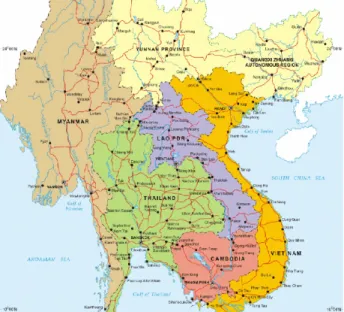
Fig. 1. Location of Lao PDR in Indochina Peninsula.
Role of NTFPs in Rural Livelihood of Lao PDR
Lamphoune Xayvongsa1*, Young-Soo Bae2, Yong-Eui Choi2, and Jae-Seon Yi2
1Faculty of Forestry, National University of Laos, P. O. Box 7322, Vientiane, Lao PDR
2College of Forest and Environmental Sciences, Kangwon National University, Chuncheon, Korea
ABSTRACT : About 83% of the total population of Lao PDR lives in rural areas. People living near forest are highly dependent on the forest resources closed to their villages. Especially non-timber forest products (NTFPs) provide a wide range of subsistence needs and are the main source of their cash income. They also make a significant contribution to the country economy. The annual export value of NTFPs is considerably high. 708 edible NTFP species (238 edible plants and 470 animals) have been recorded so far, and about 400 plants have been reported and used as medicinal plants by Lao people. One hundred NTFP species are considered as commercial forest products. The striking trend in NTFP resources is the decline of some commercial species due to increased demand on them for commercialization, and the loss of forest by rapid population growth. To sustainablely manage the NTFPs resources, a number of new management systems are under development and support in progress by the government.
Keywords : Non-timber forest products (NTFPs), Lao PDR, Medicinal plants, Edible plants, Forest income
Forest Resources and NTFPs in Laos
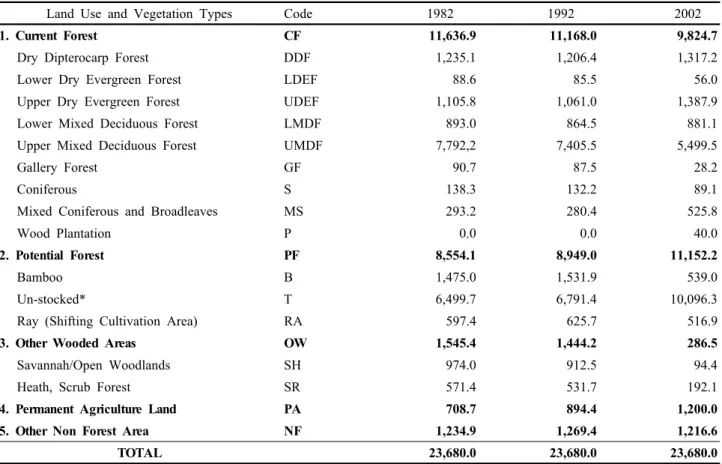
Lao PDR is rich in forest resources. Forest resources are rich in species with a high degree of endemic and biological distinctiveness. At least 8,100 plant species, 166 species of reptile and amphibian, 700 bird species, and 100 mammal species are believed to live in Lao PDR (MAF and STEA, 2003). The Lao Forest Law issued in 1996 classifies the forests into five categories; namely, Production Forest, Conservation Forests, Protection Forests, Regeneration Forests and Degraded Forests. New Lao Forest Law from 2008 classifies only three forest categories : Production Forests, Protection forest and Conseveration Forest. A comparative study on forest/vegetation cover and land use, which in Lao PDR was carried out by plot sampling of SPOT Satellite Image Maps from 1982, 1992 and 2002, suggests that the national forest cover has declined from around 70% in 1940 to 64% in the mid-sixties and then from 47% in 1989 to a current level of 41.5%. The forest cover ranges from about 65-70% in the southernmost provinces to only 25 percent in some northern provinces (Fig. 1). Mixed deciduous forest is the
predominant forest type (Table 1).
Lao PDR officially established the National Biodiversity Conservation Areas (NBCAs) in 1993 through the Prime Minister’s Decree No. 164. The total number of NBCAs are now twenty after another two were added and further- more provincial and district Protected Areas (PAs) have
Table 1. Land use and vegetation type distribution in Laos (MAF, 2005). Unit: 1,000 ha.
Land Use and Vegetation Types Code 1982 1992 2002
1. Current Forest CF 11,636.9 11,168.0 9,824.7
Dry Dipterocarp Forest DDF 1,235.1 1,206.4 1,317.2
Lower Dry Evergreen Forest LDEF 88.6 85.5 56.0
Upper Dry Evergreen Forest UDEF 1,105.8 1,061.0 1,387.9
Lower Mixed Deciduous Forest LMDF 893.0 864.5 881.1
Upper Mixed Deciduous Forest UMDF 7,792,2 7,405.5 5,499.5
Gallery Forest GF 90.7 87.5 28.2
Coniferous S 138.3 132.2 89.1
Mixed Coniferous and Broadleaves MS 293.2 280.4 525.8
Wood Plantation P 0.0 0.0 40.0
2. Potential Forest PF 8,554.1 8,949.0 11,152.2
Bamboo B 1,475.0 1,531.9 539.0
Un-stocked* T 6,499.7 6,791.4 10,096.3
Ray (Shifting Cultivation Area) RA 597.4 625.7 516.9
3. Other Wooded Areas OW 1,545.4 1,444.2 286.5
Savannah/Open Woodlands SH 974.0 912.5 94.4
Heath, Scrub Forest SR 571.4 531.7 192.1
4. Permanent Agriculture Land PA 708.7 894.4 1,200.0
5. Other Non Forest Area NF 1,234.9 1,269.4 1,216.6
TOTAL 23,680.0 23,680.0 23,680.0
been also established. Additionally the following two con- tiguous areas were created to act as corridors between three NBCAs at the end of 2000 through the Prime Mini- ster’s Decree No. 193. The total area of the NBCAs accounts for about 3.4 million ha (MAF and STEA, 2003).
The most important NTFPs in Lao PDR include food (nuts/fruits, leaves, shoots, flowers, spices, mushroom, tubers /roots), medicines (fruit/nuts, stems, tubers/roots, leaves, seeds, flowers, bark, wood), raw materials for handicraft (bamboo culm and rattan can), fibers (leaves, stem, bark, grass) and extracts (gum, gum resin, resin, oleoresin, latex, tannin, dye, essential oil, stimulants, insecticides), ornamentals (orchids, ferns, curcuma flower) and animal product (FAO, 2002; Grejmans et al., 2007). NTFPs are important for the local and national economy, as they are used as raw material for trade. The range of benefits makes NTFPs an attractive proposition not only for local and national economy but also for the private business and the conservation group. The Lao government has identified the development
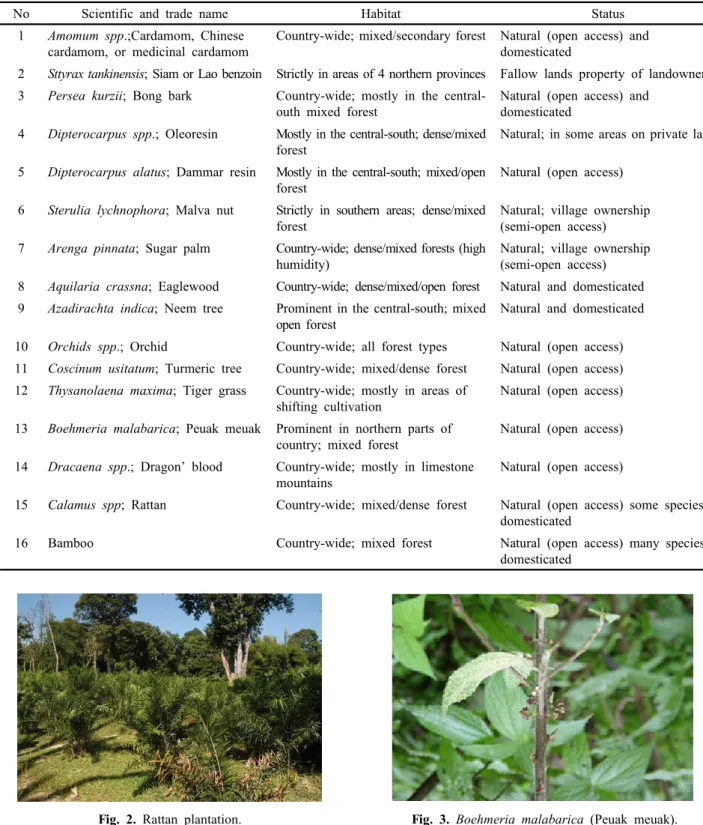
of the NTFPs sub-sector as a national priority. The dis- tribution and status of some important NTFPs have been identified by the Forest Research Center under the National Agriculture and Forestry Research Institute and are showed in table 2 (MAF and STEA, 2003).
Role of Non-Timber Forest Products Role of NTFP for Household Food Security
Rice is the staple food for the Lao people, but it is recognized that many kinds of edible stuff collected from forest are equally essential for the food security of Lao people, especially to rural dwellers. In times of rice shortage other edible products become vital and result in an in- creased demand and collection of NTFPs. Rural people with limited access to paddy field or fertile land are directly dependent on NTFPs, especially wild tubers as food. NTFPs provide a low-cost survival system or a so
Table 2. Distribution and status of selected NTFPs in Lao PDR (MAF and STEA, 2003).
No Scientific and trade name Habitat Status
1 Amomum spp.;Cardamom, Chinese cardamom, or medicinal cardamom
Country-wide; mixed/secondary forest Natural (open access) and domesticated
2 Sttyrax tankinensis; Siam or Lao benzoin Strictly in areas of 4 northern provinces Fallow lands property of landowners 3 Persea kurzii; Bong bark Country-wide; mostly in the central-
outh mixed forest
Natural (open access) and domesticated
4 Dipterocarpus spp.; Oleoresin Mostly in the central-south; dense/mixed forest
Natural; in some areas on private land
5 Dipterocarpus alatus; Dammar resin Mostly in the central-south; mixed/open forest
Natural (open access)
6 Sterulia lychnophora; Malva nut Strictly in southern areas; dense/mixed forest
Natural; village ownership (semi-open access) 7 Arenga pinnata; Sugar palm Country-wide; dense/mixed forests (high
humidity)
Natural; village ownership (semi-open access) 8 Aquilaria crassna; Eaglewood Country-wide; dense/mixed/open forest Natural and domesticated 9 Azadirachta indica; Neem tree Prominent in the central-south; mixed
open forest
Natural and domesticated
10 Orchids spp.; Orchid Country-wide; all forest types Natural (open access) 11 Coscinum usitatum; Turmeric tree Country-wide; mixed/dense forest Natural (open access) 12 Thysanolaena maxima; Tiger grass Country-wide; mostly in areas of
shifting cultivation
Natural (open access)
13 Boehmeria malabarica; Peuak meuak Prominent in northern parts of country; mixed forest
Natural (open access)
14 Dracaena spp.; Dragon’ blood Country-wide; mostly in limestone mountains
Natural (open access)
15 Calamus spp; Rattan Country-wide; mixed/dense forest Natural (open access) some species;
domesticated
16 Bamboo Country-wide; mixed forest Natural (open access) many species;
domesticated
Fig. 2. Rattan plantation. Fig. 3. Boehmeria malabarica (Peuak meuak).
-called ‘safety net’ (Grejmans et al., 2007). According to Clendon (2001), 708 edible NTFPs (238 edible plants and 470 animals) have been recorded so far (Table 3).
Collecting NTFPs are an important activity in the liveli-
hood of the Lao rural communities. On average, forest foods provide about 11% of the total food consumed in the dry season and up to 19% in rainy season. In poor households, NTFPs amount to more than 50% of all the
Table 3. Edible plants in Lao PDR (Foppes and Kethpanh, 2004).
No Category No Products Examples
1 Fruits, seeds 87 Sugar palm fruits, Irvingia nuts, etc.
2 Leaves 86 Barringtonia, Azadirachta, etc.
3 Shoots 23 Bamboo shoots, rattan shoots, etc.
4 Tubers, roots 22 Yam tubers, etc.
5 Mushrooms 16 Ear mushroom, shii-take, etc.
6 Flowers 4 Sesbania, Butea, etc.
Total 238
Fig. 4. Traditional medicine shop in Nakham village, Thapha- bath district.
food. Forest foods provide a balanced diet, with a wide range of nutrients including carbohydrates and, some mineral elements like calcium and iron, vitamin A and C (Clendon, 2001). In Salavanh province, the amount of forest foods collected per a household in a month varied from 12 kg (dry season) to 28 kg (rainy season). Forest foods were found to provide 4% energy, 20% of total protein intake, 40% of calcium, 35% of iron, 40% of Vitamin A and C (Clendon 2001).
NTFPs as Traditional Medicine
As is the case for most other countries, the geographic distribution of health care system is not even across the country, with the large cities being better served by public hospitals, private clinics and pharmacies than the rural villages. Most of the better-staffed hospitals and pharmacies are in the capital and in other large cities, while the rural areas are left with poorly qualified-staffed hospitals and pharmacies. In the more isolated district there is usually only a hospital with small number of pharmacists and nurses, who are usually poorly qualified. Many villages have neither health station nor trained pharmacist.
Almost all the rural villagers rely on medicinal plants.
Hospitals are often at considerable distance from the village and the staff of the health station or pharmacies are poorly qualified, while advice on the use of medicinal plants is given by traditional healers, relatives or neighbors, who have considerable experiences treating ailments. Also, traditional medicines are usually either free or very cheap when purchased in the villages or local markets, while chemical
drugs are often too expensive for most of rural people to purchase.
About 400 plants have been used as medicinal plants by Lao people (Vidal, 1959). Medicinal plants are primarily used to cure people and animals, and to make and keep them healthy. Most medicinal plants are for common ailment, such as fever or pain in different parts of the body. Most common plant parts used are roots followed by stems, and they are often more effective together with the bark, fruits, flowers, and leaves. Some are applied as fresh plant, while others are dried and mixed with other medicinal plants. The most common method for preparing a traditional medicine is boiling the plant in water and drinking the extract. Rural villagers often boil several parts of medicinal plants together.
Fig. 5. Bamboo house. Fig. 6. Rattan furniture.
NTFPs as Raw Material for House Construction and Handicraft
About 83% of the populations live in rural areas throughout the country. More than half of them still stay in bamboo houses. Bamboo is widely adopted for the house walls, and in some areas roofs are still made of bamboo. Also, rural people use bamboo to build huts, to make fences, and to produce farming tools, basketry and furniture. The most commonly used bamboo species are Cephalostachym virgatum, Dendrocalamus spp., Bambusa blumeana, B. nana, B. tulda, B. arudinaria and Neuhouzeana mekkhonggensia (FAO, 2002).
Rattan is also an important NTFP for the rural communities, as it is widely used by Lao people as raw material for producing handicraft and furniture (Fig. 2). Also, villagers use rattan as binding material in stead of nails. Among the rattans, Calamus javanensis and Daemonorop schmidtiana are the species used most commonly (Kethpanh, 1995) (not seen but cited in FAO, 2002).
NTFPs as Important Cash Income Resource
Many NTFPs are naturally collected and sold by rural villagers. Among commercial NTFPs, Cardamom, Damar resin, sugar palm seed, bong bark, broom grass, orchid, rattan, paper mulberry, eaglewood, bamboo shoot and culms, benzoin, meuak bark, malva nut, sisiet bark, vomica nut, berberin/kheua hem vine and sticklac are the most important items. The results of many studies indicated that NTFPs are the main source of cash income of rural households.
Morris (2002) reported that the cash income of house- holds in Nampheng village, Oudomxay province accounted for 55% of household cash income, which consists of 40%
from bitter bamboo and 15% from other NTFPs. Also, NTFPs contributed to the average 61% of cash income of households in Nale and Sing districts, Luang Namtha province (Kaufman, 1998).
The average cash income of households from selling rattan shoots from plantations amounts to 140 US$/year or 20.4% of total cash income (Xayvongsa, 2007). A tradi- tional healer in Pakthuai village, Borikhamxay province earns on average 200 US$ per year. Handicraft made from bamboo and rattans are an important source of household income, too.
Domestication of NTFPs in Lao PDR
The Lao government has identified the development of the NTFPs sub-sector as a national priority. It encourages rural villagers to use sustainablely as well as to domesticate NTFPs, to meet the household demand for market to generate income. The NTFPs species planted by the villagers are bamboo, cardamom, rattan, paper mulberry, Eaglewood and bong. Currently, many villages have specialized in the domes- tication of NTFPs.
The KM 25 village in Pakxe, Champasack province specializes in bamboo production. Three bamboo species, Bambusa nana, B. blumeana and Dendrocalamus spp. are planted by villagers. Bambusa nana is planted in large
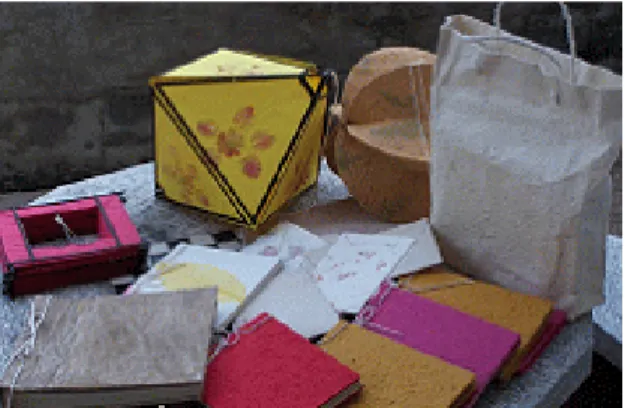
Fig. 7. Mulberry paper handicraft.
number. It is mainly planted for the production of bamboo shoots for household consumption and for market sale.
Bambusa blumeana and Dendrocalamus spp. are planted for using as material for construction (Foppes and Kethpanh, 2000).
Cardamom is grown in gardens that can be grown more than 60 years old under the high secondary forest. Cultivation is widespread in the Bachieng, Pakxong and Laongam districts. In the Khouangsi village, 200 households have cardamom gardens. The main reason why the villagers cul- tivate cardamom is to provide cash income to buy rice paddy because their areas are hilly and not suitable for growing rice. An average household of 5-6 persons has 1-2 ha of cardamom gardens. The average yield is 120 kg/ha dry seed (Foppes and Kethpanh, 2000). Aubertin (2004a) reported that the average yield of cardamom planted on the Boliven Plateau, Champasack province, accounts for 30 kg/ha/year.
Rattan is widely planted in the country. In Champhone district, Savannekhet province villagers have been planting rattan in their fruit gardens since the year 1970. 69% of households of Lao Huai Kham village have rattan plan- tation with an area of at least 0.1 ha. On average, a house- hold owns rattan plantation of 0.39 ha. The main reason for planting rattan is to produce rattan shoots for income generation (Xayvongsa, 2007).
Mulberry paper provides a good example of successful domestication of a forest product. In Xayaboury province villagers cultivate paper mulberry as a cash crop. For one hectare yielding one tone of bark, the theoretical labour
requirement amounts to 120 days. In Xayaboury province, each household harvest on average 100 kg of bark per year. Few households own large area and most of them have less than 0.5 ha. It is estimated that one third of households in Kenthao and Paklay districts harvest paper mulberry (Pelliard, 2000).
Trends in NTFPs Resources in Lao PDR
During the last two decades the NTFPs in the natural forest resources throughout the country have rapidly declined.
The main reasons for this decline are increased market pressure, loss of forests due to commercial logging and conversion to agricultural area, and rapid population growth.
However, new management systems for NTFPs production are under development, e.g. domestication of NTFPs in agro-forestry system and community-based NTFPs manage- ment. NTFPs domestication is increasingly expanded through- out the country. Examples are the domestication of carda- mom, rattan, Eaglewood and bong bark, and community /village forest management regulations. Presently, NTFPs also become a considerably interesting topic for the researchers, and sustainable managements of NTFPs are supported by the Lao government, NGOs and international organizations.
REFERENCES
Aubertin, C. 2004a. Cardamon (Amomum sp.) in Lao PDR: The Hazardous Future of an Agro-forest System Product. In: Koen Krusters and Brian Belcher: Forest Products, Livelihoods and Conservation. Volume 1. Case Studies of Non-Timber Forest Product System, pp. 43-60.
Aubertin, C. 2004b. Paper Mulberry (Broussonetia papyrifera) in Lao PDR: A Successful Example of Forest Product Domesti- cation. In: Koen Krusters and Brian Belcher: Forest Products, Livelihoods and Conservation. Volume 1. Case Studies of Non- Timber Forest Product System, pp. 43-60.
Clendon, K. 2001. The Role of Forest Food Resources in Village Livelihood Systems: A study of three Villages in Salavan Pro- vince, Lao PDR, IUCN, Vientiane, Lao PDR.
FAO. 2002. Non Wood Forest Products in 15 Countries of Tropical Asia – An Overview. pp. 89-103.
Foppes, J. and Ketphanh, S. 2004. NTFP use and household food security in Lao PDR. Paper prepared for the NAFRI/FAO EM -1093 symposium on “Biodiversity for Food Security”. 14 pp.
Foppes, J., and S. Ketphanh, 2000. Draft: Forest extraction or
cultivation? Local solutions from Lao PDR”. Paper for the work- shop on the Evolution and Sustainability of “intermediate systems”
of forest management, FOREASIA, 28 June-1 July 2000, Lofoten, Norway.
Grejmans, M., Sounthone, K., Vichith, L. and Khamphone. S. 2007.
Non-Timber Forest Product in Lao PDR – A Manual of 100 Commercial and Traditional Products. Netherland Development Organization (SNV), Vientiane, Lao PDR. 421 pp.
Kaufmann, S. 1998. Nutrition survey Muang Sing and Nalae, Luang Namtha Province. GTZ Integrated Food-Security Programme Muang Sing. Luan Namtha, Laos P.D.R.
Ministry of Agriculture and Forestry (MAF). 2005. Report on Assessment of Forest Cover and Land Use during 1982-1992- 2002. 19 pp.
Ministry of Agriculture and Forestry (MAF) and Science, Tech- nology and Environment Agency (STEA). 2003. Biodiversity
Country Report. 169 pp.
Morris, J. 2002. Bitter bamboo and sweet living: Impacts of NTFP conservation activities on poverty alleviation and sustainable live- lihoods. 35 pp.
Pelliard, D., and Ducourtieux, O. 2000. Modélisation des effets économiques à terme du projet de développement reral du dis- trict de Phongsaly. Comité de Coopération acec le Laos, Cientiane.
127 pp.
Vidal, J. 1959. Noms Vernaculaires de Plantes (Lao, Mèo, Kha) en Usage au Laos. Extrait du Bulletin de l'Ecole Francaise d'Etrême -Orient, Tome XLIX, fascicule 2, Paris.
Xayvongsa, L. 2007. Smallholder Rattan Plantation in Champhone District, Savannakhat Province, Lao PDR. (Lao Language). In:
ASAFAS 2007: Local Knowledge in the Past, Present and Future, pp. 65-81.
(Received December 21, 2008; Accepted August 7, 2009)