J Lung Cancer 2007;6(2):74-77
74
Mutational Analysis of Pro-apoptotic BNIP3 Gene in Non- Small Cell Lung Cancers
Purpose: Cell death deregulation is a hallmark of human cancers. BNIP3, which was initially identified as a pro-apoptotic member of the Bcl-2 family, plays an important role in apoptosis, necrosis and autophagy. This study was conducted to explore whether mutation of the BNIP3 gene is a characteristic of human non-small cell lung cancers (NSCLC). Materials and Methods: In the current study, we used polymerase chain reaction (PCR), single-strand conformation polymorphism (SSCP), and DNA sequencing to detect somatic mutations in the DNA sequences encoding the BH3 (Bcl-2 homology3) and TM (transmembrane) domains that are important to the cell death function of BNIP3 in 48 NSCLCs.
Results: SSCP analysis revealed no evidence of somatic mutation in the DNA sequences encoding the BH3 and TM domains of the human BNIP3 gene in the 48 NSCLCs evaluated in this study. Conclusion: The data presented here indicate that the pro-apoptotic BNIP3 gene may not be somatically mutated in human NSCLCs, which suggests that mutational events of the BNIP3 gene may not be involved in the mechanisms by which NSCLCs evade cell death. (J Lung Cancer 2007;6(2):74 77)
Key Words: Non-small cell lung cancer, BNIP3, Cell death, Mutation
Sung Hak Lee, M.D. and Sug Hyung Lee, M.D.
Department of Pathology, College of Medicine, The Catholic University of Korea, Seoul, Korea
Received: October 31, 2007 Accepted: December 12, 2007 Address for correspondence Sug Hyung Lee, M.D.
Department of Pathology, College of Medicine, The Catholic University of Korea, 505, Banpo-dong, Seocho-gu, Seoul 137-701, Korea
Tel: 82-2-590-1188 Fax: 82-2-537-6586
E-mail: [email protected] This work was supported by the funds from Korea Research Founda- tion (E00224).
서 론
세포자멸사(apoptosis)는 세포사멸(cell death)의 주된 발생 기전으로 조직의 항상성, 세포분화 및 발생에 중요한 역할 을 하며, 세포자멸사 조절 이상은 퇴행성 질환, 종양, 에이 즈 등 여러 질병을 유발한다(1∼3). 정상세포에 비하여 암 세포는 일반적으로 생리적 자극에 대해 사멸이 잘 유발되 지 않는 특성이 있으며, 이런 특성은 종양의 발생, 종양의 성장 및 전이에도 중요한 역할을 한다(3).
세포사멸을 유발하는 경로는 많지만, 내인성 경로와 외 인성 경로로 나누는 것이 가장 흔한 분류법이다(1). 외인성 경로는 Fas, tumor necrosis factor-related apoptosis-inducing ligand (TRAIL) receptor 같은 death receptor family에 의해서 유발되고, 내인성 경로는 성장인자의 소실, 저산소증, 방사 선 조사, 항암제 등에 의해서 유발된다(1∼3). 내인성 경로 는 bcl-2 family에 의해서 주로 조절되는데, bcl-2 family는 크게 세포자멸사 유발성과 세포자멸사 길항성으로 나뉜다 (1). 이들 bcl-2 family 구성원은 서로 결합하여 homodimer 및 heterodimer로서 복잡한 조절 체계를 구성하며, bcl-2
family 단백질의 상대적 비율은 세포자멸사의 반응정도를 결정하는 중요한 인자이다(1).
포유동물의 bcl-2 family 단백질은 약 20종류가 밝혀져 있 고, 이들 모두에는 한 종류 이상의 bcl-2 homology (BH) domain이 있다(1). BH domain 중 BH3 domain은 세포사멸을 유발하는 데 필요 충분한 domain이다. Proapoptotic bcl-2 family 단백질에는 BAD, PUMA, Hrk, bcl-G, Noxa, BIM, bcl-rambo, BAX, BIK, BAX, BID, BMF 등이 있으며, 이들은 모두에는 BH3 domain이 있고 대부분의 경우 세포사멸 유발 을 BH3 domain의 존재에 의존한다(4∼9). Bcl-2/adenovirus E1B-19kDa-interacting protein3 (BNIP3)는 세포자멸사 유발 성 bcl-2 family에 속하며 BH3 domain과 transmembrane (TM) domain을 갖는다(10∼13). TM domain은 BNIP3가 mitochon- dria에 결합하는데 중요하며, BNIP3의 세포사 유발에도 필 요한 domain이다(10∼13). BNIP3는 hypoxia에 의해서 발현 이 증가되며, 세포자멸사 뿐 아니라 괴사 및 autophagy에 이 르는 다양한 종류의 세포사에 관여한다고 알려져 있다(12
∼14).
세포사멸 기전에 관여하는 유전자의 이상이 발암과정에
BNIP3 in Lung Cancer 75
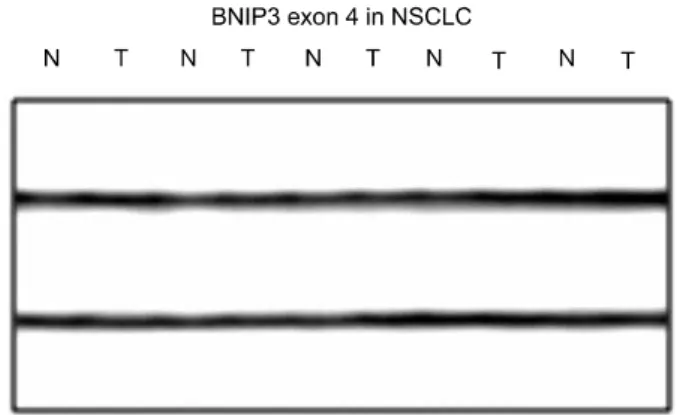
Fig. 1. Representative SSCP of BNIP3 gene in the non-small cell lung cancers. The exon 4 of the BNIP3 gene was amplified by PCR using a specific primer set. The PCR products from the representative cases of non-small cell lung cancers were visualized on SSCP. SSCP of DNA from the non-small cell lung cancers (T) shows no aberrant bands as compared to SSCPs from the normal tissues (N).
중요한 역할을 한다는 증거들이 제시되고 있다. 예를 들면 caspase-3, Fas 등의 돌연변이가 비소세포폐암을 비롯한 여 러 암에서 보고된 바 있다(15∼21). BNIP3가 세포사멸에서 중요한 기능을 담당하지만, 현재까지 이 유전자의 돌연변 이에 관한 연구는 보고된 바 없다. 이에 저자들은 본 연구에 서 BNIP3 유전자의 돌연변이가 비소세포성폐암의 세포사 멸 이상에 관여하는지를 알아보기 위해, 비소세포성폐암 조직을 대상으로 돌연변이 발굴연구를 시행하였다.
대상 및 방법 1) 연구 대상
1999년 이후 근치적 폐 절제술을 받고 진단된 48명의 비 소세포성폐암 환자의 폐조직을 대상으로 하였다. 폐암 환자 의 파라핀 포매 조직을 5μm 두께로 박절하여 hematoxylin
& eosin 염색을 실시한 후 2명의 진단병리 의사가 독립적으 로 WHO 분류에 따라 분류하였으며, 이들은 편평상피암 25 예, 선암 23예였다. 36∼79세의 연령분포를 보였으며 평균 연령은 57세였다.
2) 돌연변이 조사
Hematoxylin & eosin 염색된 조직에서 미세절제술(micro- dissection)을 이용하여 암세포 및 정상세포를 각각 분리 수 집한 후, proteinase K를 처리하여 DNA를 얻었다. BNIP3 유 전자를 이루고 있는 exon 중 세포사에 중요한 역할을 한다 고 알려진 BH3 domain을 코딩하는 exon 4와 TM domain을 coding하는 exon 5를 증폭할 수 있는 시발체(primer) 2쌍을 제작하였고, DNA sequence는 exon 4 (5'-atctgcctttaacattgact- 3' 및 5'-cgtgacactgagaacacact-3'), exon 5 (5'-cacgtttcttcccgcctca- 3' 및 5'-tgccatgacaggagtcacacag-3')였다. 방사성 동위원소인 ([32P]dCTP)를 중합효소연쇄반응에 포함시켜서 자기방사법 (autoradiogram)으로 중합효소연쇄반응 산물을 분석할 수 있 게 하였다. 중합효소연쇄반응은 혼합액을 94oC에서 10분간 변성시킨 후 94oC에서 30초, 53∼62oC에서 40초와 72oC에 서 40초씩 각각 35회 반복하였으며 72oC에서 5분간 연장반 응을 실시하였다. 중합효소연쇄반응 산물을 single-strand conformation polymorphism (SSCP) 분석을 위해 non-dena- turing gel에 running 후 gel을 건조하고 관찰하여, 정상 DNA 에서 관찰되는 wild-type band 이외의 band가 나타난 경우, 2회 이상 반복하여 확인하고, aberrant band를 잘라서 cyclic sequencing으로 DNA 염기서열을 분석하였다. SSCP, DNA 염기서열분석에 관한 내용은 이전의 논문에 자세히 기술되 어 있다(15∼21).
결 과
미세절제를 통해서 암 및 정상세포를 비소세포성폐암 조 직에서 선택적으로 분리할 수 있었고, 추출된 DNA를 이용하 여 BNIP3 BH3와 TM을 coding하는 exon 4와 exon 5를 증폭하 여 SSCP로 분석하였다. 중합효소연쇄반응 산물은 SSCP에서 잘 관찰되어서, 미세절제를 통한 DNA의 획득 및 중합효소 연쇄반응에 이상이 없음을 알 수 있었다(Fig. 1). SSCP를 분 석한 결과 중합효소연쇄반응의 결과물은 정상조직의 DNA 와 같이 wild-type의 band로만 나타났으며, 돌연변이에서 보 이는 abnormal band는 관찰 할 수 없었다(Fig. 1). 또한, 이들 은 염기서열 분석 결과 돌연변이가 없는 정상 염기서열을 가지고 있었다(data not shown). 따라서, SSCP 결과는 BNIP3 유전자의 돌연변이가 분석한 48예의 폐암에서 나타나지 않 음을 의미했다. 이 실험은 미세절제, 중합효소연쇄반응, SSCP 및 염기서열분석을 2회 반복하였으며, 결과는 2회 모 두 일치하였다.
고안 및 결론
세포사와 연관된 단백질을 코딩하는 유전자에 흔히 돌연 변이가 발생하고 기능적으로 세포사멸 기능을 저하시키는 경우가 흔하다는 선행연구(15∼21)를 따라 세포사멸 유발 기능은 확인이 되었지만 돌연변이 연구가 이루어지지 않은 BNIP3 유전자의 돌연변이 연구를 시행하였다. 따라서, 본
76 J Lung Cancer 2007;6(2):74-77
연구의 목적은 두 가지였다. 첫째는 세포사멸 조절에 중요 한 역할을 하는 BNIP3가 비소세포폐암 조직에서 돌연변이 되는 지 여부를 판명하는 것이었고, 둘째는 돌연변이가 있 다면 그 기능적 변화를 암발생과 연관 시키는 것이었다. 하 지만 BNIP3 유전자가 48예의 비소세포폐암 조직에서 돌연 변이가 되지 않았다는 것을 확인하였고, 이를 통해서 비소 세포폐암의 병발생 기전에서 이 유전자의 돌연변이가 작용 하지 않으리라는 것을 예측할 수 있었다.
비소세포폐암에서 세포사멸 관련 유전자의 돌연변이 연 구는 이미 많은 유전자를 대상으로 이루어졌다. Death re- ceptor인 Fas의 돌연변이는 7.7%의 비소세포폐암에서 나타 났으며, 이중 대부분은 세포사멸에 중요한 death domain에 서 발견되었다(16). 또한, 다른 death receptor인 TRAIL receptor1 및 2의 돌연변이는 6.8%의 비소세포폐암에서 나 타났다(17). Death receptor를 기시부로 하는 외인성 세포사 멸 경로상의 유전자들을 검색한 결과 Fas, FADD, caspase- 10의 돌연변이가 13.8%라는 높은 빈도로 나타났고, 림프절 로 전이한 폐암의 경우는 그 돌연변이 정도가 전이하지 않 은 폐암에 비해 의미 있게 높은 것을 관찰되었다(18). 내인 성 세포사멸경로를 이루는 Bcl-2계열의 돌연변이는 BAD 등 을 검색하였으나 발견할 수 없었다(19). Caspase는 caspase- 3, 7, 8, 9, 10에 대해서 돌연변이 연구가 이루어졌으며, cas- pase-10과 caspase-3만이 돌연변이가 발견되었다(15,18,20,21).
하지만, 이 경우도 caspase-3는 2.2%, caspase-10은 5%로 나 타나서 caspase-10을 제외한 대부분의 caspase-유전자는 돌 연변이로 인해 세포사멸 기능을 폐암에서 소실하지는 않는 다는 것을 알 수 있었다(15,18). 정리하면 비소포폐암에서 세포사멸 관련 유전자의 돌연변이는 주로 death receptor 경 로상의 유전자에 집중적으로 나타나는 것을 알 수 있으며, 본 연구의 결과로 BNIP3의 돌연변이가 비소세포폐암에서 발견되지 않았던 것도 이에 상응하는 결과라고 생각한다.
암세포의 사멸을 방해하는 기전은 여러 가지가 있으며, 돌연변이는 이 중 한 가지 기전이다(1∼3). 돌연변이 이외 에 DNA 메틸화, 단백질의 세포내 위치 변경, 단백질 발현 감소, 길항물질의 생성 증가, 인산화 등이 세포사멸을 유도 하는 단백질의 기능을 불활성화 시키는 방법이다(1∼3).
Bim 단백질은 세포 골격기관인 미세관과 결합하면 불활성 화 되고, bad 단백질은 인산화되면 기능을 소실한다(1). 또 한, bcl-2 단백질의 발현 증가는 암세포의 사멸을 항암제 등 의 세포사 유발기전으로부터 보호한다(1). 본 연구 결과는 BNIP3 유전자가 비소세포폐암에서 돌연변이 되지 않는다 는 사실을 제시하며, 비소세포폐암에서 암세포의 세포사멸 억제기전의 이해를 위해서는 BNIP3 유전자의 불활성화가
돌연변이 이외에 다른 어떤 방법으로 일어나는지를 규명할 필요가 있다고 생각한다. BNIP3 단백질의 발현은 장기에 따라서 다양한 형태로 나타난다. 정상 대장상피는 BNIP3를 발현하지만 많은 대장암에서는 이 단백질의 발현이 소실되 며 이는 메칠화에 의한 것으로 알려져 있다(22). 반면에, 유 방의 정상상피는 BNIP3를 발현하지 않지만 유방암의 전암 병변과 유방암은 이 단백질을 강하게 발현하는 것이 알려져 있어서(23), 단백질의 발현이 암세포를 selection하는 기전으 로 작용할 가능성이 있음을 제시한다. 폐암에서는 BNIP3의 발현에 대한 연구가 알려진 바가 없다. 따라서, BNIP3에 대 한 발현연구를 통해서 이 단백질이 어떤 경로로 폐암발생 에 영향을 주는지를 알 수 있을 것이다.
많은 연구가 비소세포폐암을 대상으로 시행되었지만 많 은 비소세포폐암 환자들이 매년 사망하고 있다. 따라서 비 소세포폐암의 조기 발견 및 진행을 예측하는 방법의 개발 이 절실하다. 최근, 치료적 관점에서 세포사멸 유방성 반백 질을 소형분자약제와 결합시켜서 종양의 세포자멸사를 유 도하는 방법도 연구되고 있다(24). 이와 같은 임상연구를 위해서는 진단 및 치료타겟 발굴연구가 환자의 암조직을 이용해서 이루어져야 한다고 생각되며, 앞으로도 이를 위 해 많은 세포사멸 관련 유전자 및 산물의 이상에 관한 연구 가 이루어져야 한다고 생각된다.
REFERENCES
1. Reed JC. Mechanisms of apoptosis. Am J Pathol 2000;39:
1415-1430.
2. Nagata S. Apoptosis by death factor. Cell 1997;88:355-365.
3. Hanahan D, Weinberg RA. The hallmarks of cancer. Cell 2000;100:57-70.
4. Datta SR, Katsov A, Hu L, et al. 14-3-3 proteins and survival kinases cooperate to inactivate BAD by BH3 domain phosphorylation. Mol Cell 2000;6:41-51.
5. O'Connor L, Strasser A, O'Reilly LA, et al. Bim: a novel member of the Bcl-2 family that promotes apoptosis. EMBO J 1998;17:384-395
6. Inohara N, Ding L, Chen S, Nunez G. harakiri, a novel re- gulator of cell death, encodes a protein that activates apoptosis and interacts selectively with survival-promoting proteins Bcl-2 and Bcl-X(L). EMBO J 1997;16:1686-1694.
7. Guo B, Godzik A, Reed JC. Bcl-G, a novel pro-apoptotic member of the Bcl-2 family. J Biol Chem 2001;276:2780-2785.
8. Oda E, Ohki R, Murasawa H, et al. Noxa, a BH3-only member of the Bcl-2 family and candidate mediator of p53-induced apoptosis. Science 2000;288:1053-1058.
9. Nakano K, Vousden KH. PUMA, a novel proapoptotic gene, is induced by p53. Mol Cell 2001;7:683-694.
10. Chen G, Cizeau J, Vande Velde C, et al. Nix and Nip3 form
BNIP3 in Lung Cancer 77
a subfamily of pro-apoptotic mitochondrial proteins. J Biol Chem 1999;274:7-10.
11. Ray R, Chen G, Vande Velde C, et al. BNIP3 heterodimerizes with Bcl-2/Bcl-X(L) and induces cell death independent of a Bcl-2 homology 3 (BH3) domain at both mitochondrial and nonmitochondrial sites. J Biol Chem 2000;275:1439-1448.
12. Vande Velde C, Cizeau J, Dubik D, et al. BNIP3 and genetic control of necrosis-like cell death through the mitochondrial permeability transition pore. Mol Cell Biol 2000;20:5454-5468.
13. Yasuda M, Theodorakis P, Subramanian T, Chinnadurai G.
Adenovirus E1B-19K/BCL-2 interacting protein BNIP3 con- tains a BH3 domain and a mitochondrial targeting sequence.
J Biol Chem 1998;273:12415-12421.
14. Daido S, Kanzawa T, Yamamoto A, Takeuchi H, Kondo Y, Kondo S. Pivotal role of the cell death factor BNIP3 in ceramide-induced autophagic cell death in malignant glioma cells. Cancer Res 2004;64:4286-4293.
15. Soung YH, Lee JW, Kim HS, et al. Somatic mutations of CASP3 gene in human cancers. Hum Genet 2004;115:112-115.
16. Lee SH, Shin MS, Park WS, et al. Alterations of Fas (Apo- 1/CD95) gene in non-small cell lung cancer. Oncogene 1999;
18:3754-3760.
17. Lee SH, Shin MS, Kim HS, et al. Alterations of the DR5/
TRAIL receptor 2 gene in non-small cell lung cancers. Cancer
Res 1999;59:5683-5686.
18. Shin MS, Kim HS, Lee SH, et al. Alterations of Fas-pathway genes associated with nodal metastasis in non-small cell lung cancer. Oncogene 2002;21:4129-4136.
19. Lee JW, Soung YH, Nam SW, Lee JY, Yoo NJ, Lee SH.
Mutational analysis of pro-apoptotic BAD gene in non-small cell lung cancer. J Lung Cancer 2006;5:35-38.
20. Soung YH, Lee UW, Moon SW, et al. Mutational analysis of caspase-7 and 8 genes in non-small cell lung cancer. J Lung Cancer 2005;4:38-41.
21. Soung YH, Lee JW, Kim SY, et al. Mutational analysis of pro-apoptotic caspase-9 gene in common human carcinomas.
APMIS 2006;114:292-297.
22. Bacon AL, Fox S, Turley H, Harris AL. Selective silencing of the hypoxia-inducible factor 1 target gene BNIP3 by histone deacetylation and methylation in colorectal cancer. Oncogene 2007;26:132-141.
23. Tan EY, Campo L, Han C, et al. BNIP3 as a progression marker in primary human breast cancer; opposing functions in in situ versus invasive cancer. Clin Cancer Res 2007;13:467- 474.
24. Reed JC. Apoptosis-targeted therapies for cancer. Cancer Cell 2003;3:17-22.