Diagnostic Performance of High-Sensitivity Troponin T, Myeloperoxidase, and Pregnancy-Associated Plasma Protein A Assays for Triage of Patients with Acute Myocardial Infarction
Dilshad Ahmed Khan, Ph.D., Mariam S Sharif, M.Phil., and Farooq Ahmad Khan, Ph.D.
Department of Pathology, Army Medical College National University of Sciences and Technology, Islamabad, Pakistan
Background: Early diagnosis is the cornerstone of management of acute myocardial infarction (AMI). We aimed to compare the di- agnostic accuracy of high-sensitivity troponin T (hs-cTnT) with myeloperoxidase (MPO) and pregnancy-associated plasma protein A (PAPP-A) for early diagnosis of AMI in patients at the time of presentation to the emergency department (ED).
Methods: We enrolled 289 patients who presented at the ED of the National Institute of Heart Disease (NIHD) Rawalpindi, Pakistan, within 4 hr of onset of chest pain. Clinical assessment, electrocardiography (ECG), and angiography were carried out. Blood sam- ples were collected at 0, 3, 6, and 12 hr. Analyses of plasma hs-cTnT, MPO, and PAPP-A were carried out using commercial kits.
Results: Out of 289 subjects who presented to the ED, we diagnosed 180 patients with coronary heart disease as having AMI (N=
61) and 119 as without AMI (stable coronary artery disease, N=61; unstable angina, N=58). Compared to non-AMI patients, the patients with AMI had significantly higher levels (represented here as median [inter quartile range]) of plasma hs-cTnT (136 [39-370]
vs. 12 [7-21] ng/L), MPO (906 [564-1,631] vs. 786 [351-1,299] pmol/L) and PAPP-A (5.78 [2.67-13.4] vs. 2.8 [1.8-4.9] mIU/L). Receiver operator characteristic curves (95% CI) for hs-cTnT (0.952 [0.909-0.978]) were significantly higher (P<0.001) than those for MPO (0.886 [0.830-0.929]) and PAPP-A (0.797 [0.730-0.854]), with AMI sensitivity and specificity percentages of 87% and 98% (hs-cTnT), 82% and 84% (MPO), and 65% and 87% (PAPP-A), respectively.
Conclusions: The diagnostic performance of hs-cTnT was superior to that of MPO and PAPP-A for early triage and diagnosis of AMI among patients of coronary heart disease presenting with chest pain to the ED.
Key Words: Acute myocardial infarction, Diagnostic accuracy, High-sensitivity troponin T, Myeloperoxidase, Pregnancy-associated plasma protein A
Received: December 17, 2010 Manuscript No: KJLM-10-171 Revision received: March 2, 2011
Accepted: May 11, 2011
Corresponding author: Dilshad Ahmad Khan, Ph.D.
Department of Pathology, Army Medical College, Abid Majeed Road, Rawalpindi 46000, Pakistan
Tel: +92-03005147938, Fax +92-51-9271247, E-mail: [email protected] ISSN 1598-6535 © The Korean Society for Laboratory Medicine.
This is an Open Access article distributed under the terms of the Creative Commons Attribution Non-Commercial License (http://creativecommons.org/licenses/by-nc/3.0) which permits unrestricted non-commercial use, distribution, and reproduction in any medium, provided the original work is properly cited.
INTRODUCTION
Coronary heart disease (CHD) is primarily the hallmark of gradual atherosclerosis, comprising stable coronary ar- tery disease (SCAD), unstable angina (UA), and acute myo- cardial infarction (AMI) due to impaired myocardial blood supply [1]. Myocardial necrosis is detected on the basis of
elevated cardiac troponin levels and changes in electrocar- diography (ECG) patterns in patients presenting with chest pain [1]. However, ECG and conventional cardiac biomark- ers are not sensitive enough for the early diagnosis of AMI patients in the emergency department (ED) of hospitals [2].
A delay in the diagnosis of AMI increases the risk of com- plications and reduces the benefit of reperfusion treatment [3]. Therefore, early and specific diagnosis of AMI is the cornerstone of management of these patients in the coro- nary care unit and helps avoid unnecessary admissions.
According to current guidelines, patients can be diag- nosed as having AMI if they have a history of chest pain, abnormal ECG changes, and a cardiac troponin value ex- ceeding the 99th percentile in the reference population [1].
However, conventional cardiac troponin assays have low sensitivity during the initial few hours after the onset of chest pain; as a result, the diagnosis of AMI in the ED is challenging. High-sensitivity cardiac troponin T (hs-cTnT)
assays with lower limits of detection have been recently in- troduced to overcome this problem in clinical practice.
Their improved sensitivity may facilitate earlier diagnosis of AMI among patients presenting with chest pain [4].
Myeloperoxidase (MPO) is an enzyme released from neutrophils in response to acute inflammatory changes fol- lowing myocardial injury. It has been suggested to be an early diagnostic marker for acute coronary syndrome [5].
Patients with AMI presenting within 2 hr of onset of chest pain have been reported to have significantly higher levels of MPO than healthy controls. It has therefore been sugges- ted that measurement of MPO may be useful for the early diagnosis of AMI [6].
Pregnancy-associated plasma protein A (PAPP-A) has been found to be a useful biomarker for predicting the rup- ture of unstable atherosclerotic plaques [7, 8]. However, stu- dies investigating its usefulness in the diagnosis of AMI are scant. Iversen and co-workers have recently reported that PAPP-A is a more sensitive marker for the diagnosis of AMI than troponin T and the creatine kinase isotype CK-MB [9].
Multiple cardiac biomarkers, including MPO, PAPP-A, and cardiac troponin, have been used for AMI diagnosis in the ED setting. However, the sensitivity of cardiac troponin for the diagnosis of AMI was observed to be lower within 4 hr of chest pain (55%) than at ≥12 hr (97%) after presentation at the ED [10].
The performance of new high-sensitivity cardiac biomar- kers of different pathophysiological pathways needs to be evaluated for early triage and diagnosis of AMI among pa- tients presenting with chest pain. We aimed to compare the diagnostic accuracy of newly developed hs-cTnT with that of MPO and PAPP-A assays, for the early diagnosis of AMI among CHD patients who presented at the ED of the Na- tional Institute of Heart Disease (NIHD) Rawalpindi, Paki- stan, with recent onset of chest pain.
MATERIALS AND METHODS
The comparative study was carried out at the Chemical Pathology Department, Army Medical College (AM Col- lege), Rawalpindi, in collaboration with NIHD, Rawalpindi, Pakistan. The research protocol was approved by the ethics committee of the AM College, National University of Sci- ence and Technology (NUST) Islamabad, Pakistan, and complies with the Declaration of Helsinki.
1. Patients
We enrolled 289 consecutive adult male and female pa tients aged 35 to 80 yr, who presented to the ED of NIHD
within 4 hr of onset of chest pain between September 2009 and March 2010. All patients underwent an initial clinical assessment by a cardiologist, which included recording of clinical history, physical examination, 12-lead ECG, contin- uous monitoring, and serial hs-cTnT testing at presentation and 0, 3, 6, and 12 hr after onset of chest pain. Coronary ar- tery angiography was carried out at NIHD.
Data were reviewed by 2 independent cardiologists for a final diagnosis at the time of discharge from the institute.
We diagnosed 180 CHD patients on the basis of clinical findings, ECG, hs-cTnT, and angiography results; these in- cluded 61 patients with AMI, 58 patients with UA, and 61 patients with SCAD. AMI was diagnosed, on the basis of current guidelines, if the hs-cTnT level was at least one value above the 99th percentile with a coefficient of varia- tion (CV) of 9.2%; if there was a >50% increase or decrease in hs-cTnT levels in 2 consecutive samples along with ECG changes were indicative of ST segment elevation/depression or development of new pathologic Q waves on serial mea- surements (1). UA was diagnosed in patients with chest pain lasting more than 20 min at rest, without elevation in hs-cTnT levels and with or without changes in ECG pat- terns. SCAD was diagnosed if angiography results revealed
>70% stenosis in one of the main coronary arteries, with a history of no significant change in frequency or duration of angina on minimal exertion or at rest for at least 60 days, and if there was no evidence of recent myocardial damage.
We excluded 109 patients, including those who presented with other cardiac diseases (cardiomyopathies, myocarditis, heart failure, AMI with concomitant renal failure), present- ed with pulmonary or psychiatric problems, died in the ED, or were unwilling to participate in the study.
2. Biochemical analysis
Blood samples were collected in EDTA tubes from all pa- tients before the administration of heparin. The samples were transported immediately to the clinical pathology lab- oratory of AM College, Rawalpindi, where plasma was sep- arated by centrifugation at 2,000×g for 15 min. Assays for hs-cTnT and MPO were performed immediately after sam- ple collection, and the remaining samples were stored at -80˚C. Analysis of PAPP-A and lipid profile was carried out in batches at end of the study.
Biochemical analysis was carried out by qualified labora- tory technologists according to the validated manufacturer’s procedures in the clinical pathology laboratory of AM Col- lege, Rawalpindi, Pakistan. Total cholesterol, plasma glu- cose, and serum creatinine were measured on a Selectra E Chemistry Analyzer (Vital Scientific NV, DIERN, The Neth-
erlands) using kits provided by Pioneer Diagnostics (Pio- neer, New York, NY, USA).
Assay for hs-cTnT was performed using plasma with an electrochemiluminescence-based kit (Elecsys Cobas e 411 analyzer; Roche Diagnostics, Basel, Switzerland). The lower limit of detection for the hs-cTnT assay was 1 ng/L. The as- say employs 2 monoclonal antibodies specifically directed against human cardiac troponin T. The antibodies recog- nize 2 epitopes (amino acid positions 125-131 and 136-147) located in the central part of the cardiac troponin T protein.
The procedure comprised 2 incubations, the first of which involved the sample, a biotinylated monoclonal anti-cardiac troponin T antibody, and a monoclonal anti-cardiac tropo- nin T antibody labelled with a ruthenium complex, which together formed a sandwich complex. The reaction mixture was aspirated into the measuring cell, where the micropar- ticles were magnetically captured onto the surface of the electrode. Application of a voltage to the electrode then in- duced chemiluminescent emission, which was measured by a photomultiplier, and the values were determined using a calibration curve. The CV at 14 ng/L, i.e., 99th percentile for the assay was 9.2%.
Plasma MPO was analyzed on the ARCHITECT ci4100 immunoassay analyzer (Abbott Diagnostic, Chicago, IL, USA) by using the chemiluminescent microparticle immu- noassay kit of the same manufacturer, which has a measur- ing range of 20-10,000 pmol/L and a CV of 4.7%. The plasma MPO levels in the healthy controls were 285 to 540 pmol/L.
Serum PAPP-A levels were measured by an ultrasensitive ELISA kit (IBL International GmbH, Hamburg, Germany) using the Evolis automated ELISA processor (Bio-Rad Labo- ratories, Hercules, CA, USA). This kit has specifically been designed for this cardiac biomarker and has a measuring range of 0-100 mIU/L. The serum PAPP-A levels in the healthy controls were 1.74-5.91 mIU/L, and the CV of the assay was 5.1%.
3. Statistical analysis
Statistical analysis was performed using SPSS 16 (SPSS Inc., Chicago) and MedCalc software version 9.6.4.0. The baseline characteristics are reported as percentage for cate- gorical variables, mean (SD) for continuous normal distrib- uted variables, and median and interquartile range (IQR) for variables with a skewed distribution. The distribution of serum hs-cTnT, PAPP-A, and plasma MPO levels were not normal; therefore, the Mann-Whitney test was applied. The area under the receiver operator characteristic curves (AUC) of the serum levels of hs-cTnT, PAPP-A, and MPO were cal- culated, and the C-statistic was applied. The ROC curves
from these 3 assays were compared by the method of De- Long (11). We set the cutoff value as that at which the dis- crimination between the cases with positive and negative diagnosis is optimal. The diagnostic accuracies of hs-cTnT, PAPP-A, and MPO were assessed on the basis of the sensi- tivity (SN), specificity (SP), likelihood ratio (LR), and diag- nostic odds ratio (DOR) of the tests. A P value of <0.05 was considered significant.
RESULTS
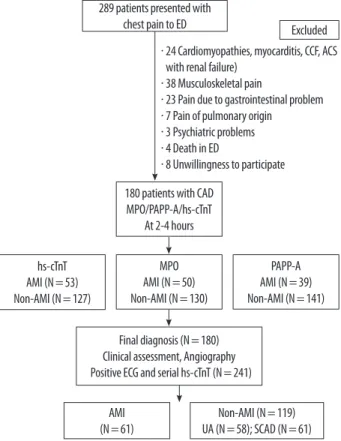
During the study period, 289 patients presented at the ED of NIHD within 4 hr of onset of chest pain. One hun- dred and nine patients were excluded because they had non-cardiac and cardiac diseases like cardiomyopathies, myocarditis, congestive cardiac failure, and acute coronary syndrome (ACS) with renal failure. These patients also in- cluded 4 who died in the ED and 8 who were not willing to participate in the study (Fig. 1). A total of 180 patients (age,
Excluded
180 patients with CAD MPO/PAPP-A/hs-cTnT
At 2-4 hours
Final diagnosis (N=180) Clinical assessment, Angiography Positive ECG and serial hs-cTnT (N=241) hs-cTnT
AMI (N=53) Non-AMI (N=127)
MPO AMI (N=50) Non-AMI (N=130)
AMI (N=61)
Non-AMI (N=119) UA (N=58); SCAD (N=61)
PAPP-A AMI (N=39) Non-AMI (N=141) 289 patients presented with
chest pain to ED
Fig. 1. Schematic diagram showing the methodology for classification of patients.
Abbreviations: AMI, acute myocardial infarction; CAD, coronary artery dis- ease; UA, unstable angina; SCAD, stable coronary artery disease; hs-cTnT, high-sensitivity cardiac troponin T; MPO, Myeloperoxidase; PAPP-A pregnan- cy-associated plasma protein A.
∙ 24 Cardiomyopathies, myocarditis, CCF, ACS with renal failure)
∙ 38 Musculoskeletal pain
∙ 23 Pain due to gastrointestinal problem
∙ 7 Pain of pulmonary origin
∙ 3 Psychiatric problems
∙ 4 Death in ED
∙ 8 Unwillingness to participate
35 to 80 yr) with AMI (N=61) and non-AMI (N=119) di- agnoses therefore constituted the final study population.
The baseline characteristics of the patients are shown in Ta- ble 1. Retrosternal chest pain (98%) and sweating (61%) were the commonest presenting symptoms of patients with AMI, followed by nausea (39%), vomiting (36%), anxiety (13%), and shortness of breath (8%).
1. Diagnostic performance of cardiac biomarkers
Patients with AMI had significantly higher (P <0.001) median (IQR) levels of biomarkers than non-AMI patients:
hs-cTnT, 136 (39-370) ng/L vs. 12 (7-21) ng/L; MPO, 906 (564-1,631) pmol/L vs. 786 (351-1,299) pmol/L; and PAPP- A, 5.78 (2.67-13.4) mIU/L vs. 2.8 (1.8-4.9) mIU/L (Fig. 2).
Patients with AMI had significantly higher AUC for hs- cTnT (95% CI, 0.952 [0.909-0.978]) than for MPO (0.886 [0.830-0.929]; P =0.028), or PAPP-A (0.797 [0.730-0.854];
P <0.001) at the time of presenting to the ED, as shown in Fig. 3. The AUC for MPO was also significantly higher than that for PAPP-A (P =0.015).
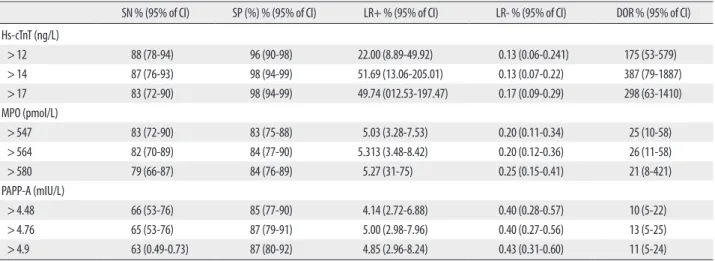
The sensitivity, specificity, positive LR, negative LR, and DOR of hs-cTnT, MPO, and PAPP-A at different cutoff levels were calculated (Table 2). The best cutoff value for hs-cTnT was 14 ng/L, with a sensitivity and specificity of 87% and 98%, respectively, for diagnosing AMI. The best cutoff values for MPO and PAPP-A were 564 pmol/L and 4.7 mIU/L re- spectively, with a sensitivity and specificity of 82% and 84%
for MPO, and 65% and 87% for PAPP-A. On the basis of sensitivity, the number of patients with AMI correctly diag- nosed at admission were 53 (87%), 50 (82%), and 39 (65%), by the hs-cTnT, MPO, and PAPP-A assays, respectively.
Therefore, hs-cTnT had the highest sensitivity for the diag- nosis of AMI in the ED within 4 hr of onset of chest pain.
DISCUSSION
The early triage of AMI patients who present with clinical symptoms suggestive of CHD is a challenging task for doc- tors. However, the development of the new high-sensitivity fifth-generation generation cardiac troponin assay, with its very low detection limits, has greatly improved the early di- agnosis of minor cardiac injury. Admission of patients on provisional diagnosis of AMI without proper investigation with cardiac biomarkers, often leads to overcrowding and is associated with excessive hospital costs.
One potential advantage of a multi-marker approach is the rapid diagnosis or exclusion of AMI. cTn measurements are essential for the diagnosis of AMI in all patients who present with chest pain in the ED. Sampling of conventional cTn is necessary at presentation and at intervals of 6, 9, 12, and 24 hr. However, our main aim was to diagnose AMI pa- tients early by using hs-cTnT; therefore, we collected sam- ples at intervals of 0, 3, 6, and 9 hr. We also compared the
Table 1. Baseline characteristics of patients diagnosed with and without acute myocardial infarction
Characteristic Non-AMI
N=119 AMI
N=61 P value
Age (yr) 57.62 (9.8) 58.34 (8.9) 0.121
Male sex n (%) 99 (83) 51 (84) 0.110
BMI (kg/m2) 26.89 (4.20) 25.66 (2.57) 0.078
Total cholesterol (mmol/L) 5.30 (0.87) 5.56 (0.94) 0.021
Triglyceride (mmol/L) 1.80 (0.80) 2.13 (0.81) 0.034
Creatinine (µmol/L) 84.83 (2.80) 90.34 (1.74) 0.067
Family history of CHD n (%) 26 (21) 14 (23) 0.071
Diabetes mellitus n (%) 43 (36) 45 (74) 0.005
Hypertension n (%) 73 (61) 37 (60) 0.067
Hyperlipidemia n (%) 51 (42) 36 (59) 0.003
*Data are shown as mean (SD) for continuous variables and number (percentage) for categorical variables.
Abbreviations: AMI, Acute myocardial infarction; BMI, Body Mass Index.
Fig. 2. Comparison of high-sensitivity cardiac troponin, myeloperoxidase and pregnancy-associated plasma protein A levels between patients with AMI (N=61) and without AMI at admission (N=119).
Abbreviations: AMI, acute myocardial infarction; MPO, Myeloperoxidase;
PAPP-A, pregnancy-associated plasma protein A.
800
600
400
200
0
hs cTnT (ng/L)
Groups
Non-AMI AMI P <0.001
4,000.0
3,000.0
2,000.0
1,000.0
0.0
Myeloperoxidase (pmol/L)
Groups Non-AMI AMI
P <0.001 25.0
20.0 15.0 10.0 5.0 0.0
PAPP-A (mlU/L)
Groups Non-AMI AMI
P <0.001
diagnostic usefulness of newer-generation hs-cTnT with MPO and PAPP-A assays for the early detection of AMI in patients of CHD presenting with chest pain. The AUC val- ues showed that the hs-cTnT assay has excellent diagnostic ability for patients presenting at the ED within 4 hr of onset of chest pain. The number of patients correctly classified at 4 hr was also the highest when plasma hs-cTnT levels were used. This demonstrates that the diagnostic performance of hs-cTnT is superior to that of the MPO and PAPP-A assays.
The AUC values for hs-cTnT noted in our AMI patients at the time of admission to ED were similar to those reported by Reichlin et al. [4]. The sensitivity and specificity of the hs- cTnT assay was excellent for early diagnosis of AMI, with a cutoff value greater than 14 ng/L at the 99th percentile. Keller et al. [12] also reported a higher AUC value with a high-sen- sitivity troponin I assay than with the conventional troponin T assay Standard troponin assays have several limitations.
When measured 4 hr after the onset of chest pain, their sen- sitivity and specificity are 35% and 96% respectively [13].
Further, they are incapable of determining concentrations in a healthy population. Another study demonstrated that use of the 99th percentile cutoff for the hs-cTnT assay allows ear- lier diagnosis of non-ST-elevation myocardial infarction (NSTEMI) [14]. Our study supports the previous finding that cardiac troponin is more clinically accurate for the early diagnosis of AMI [15]. An ideal biochemical marker would therefore be one that has high sensitivity and specificity and appears early after an AMI.
The levels of MPO observed in our study were similar to those observed by Khan et al. [16] and Mocatta et al. [17].
Ndrepepa et al. [18] also found higher circulating levels of MPO in patients of AMI than in patients with angina and healthy individuals. Elevated levels of PAPP-A in AMI pa- tients were previously reported by Iversen et al. [9]. Our findings differ from those of Brennan et al. with respect to the usefulness of MPO in the diagnosis of ACS in patients who were consistently negative for Troponin T [6]. They used the stan-dard troponin T assay, which has reduced sen- sitivity at low concentrations. However, the results of our study are consistent with the observations of Esporcatte et al.
SN % (95% of Cl) SP (%) % (95% of Cl) LR+ % (95% of Cl) LR- % (95% of Cl) DOR % (95% of Cl) Hs-cTnT (ng/L)
>12 88 (78-94) 96 (90-98) 22.00 (8.89-49.92) 0.13 (0.06-0.241) 175 (53-579)
>14 87 (76-93) 98 (94-99) 51.69 (13.06-205.01) 0.13 (0.07-0.22) 387 (79-1887)
>17 83 (72-90) 98 (94-99) 49.74 (012.53-197.47) 0.17 (0.09-0.29) 298 (63-1410)
MPO (pmol/L)
>547 83 (72-90) 83 (75-88) 5.03 (3.28-7.53) 0.20 (0.11-0.34) 25 (10-58)
>564 82 (70-89) 84 (77-90) 5.313 (3.48-8.42) 0.20 (0.12-0.36) 26 (11-58)
>580 79 (66-87) 84 (76-89) 5.27 (31-75) 0.25 (0.15-0.41) 21 (8-421)
PAPP-A (mIU/L)
>4.48 66 (53-76) 85 (77-90) 4.14 (2.72-6.88) 0.40 (0.28-0.57) 10 (5-22)
>4.76 65 (53-76) 87 (79-91) 5.00 (2.98-7.96) 0.40 (0.27-0.56) 13 (5-25)
>4.9 63 (0.49-0.73) 87 (80-92) 4.85 (2.96-8.24) 0.43 (0.31-0.60) 11 (5-24)
Abbreviations: SN, Sensitivity; SP, Specificity; LR+, Positive likelihood ratio; LR-, Negative likelihood ratio; DOR, Diagnostic odds ratio; MPO, myeloperoxidase; PAPP-A, pregnancy- associated plasma protein A; hs-cTnT, high-sensitivity cardiac troponin T.
100
80
60
40
20
0
Sensitivity
100-Specificity
0 20 40 60 80 100
Fig. 3. Comparison of area under receiver operator characteristic curves for high-sensitivity cardiac troponin (hs-cTnT), myeloperoxidase (MPO), and pregnancy-associated plasma protein A (PAPP-A) between patients with and without AMI at presentation in the ED. P value of hs-cTnT is <0.01 when compared to MPO and PAPP-A.
AUC (95 CI)
hs-cTnT 0.952 (0.909-0.978)*
MPO 0.886 (0.830-0.929) PAPP-A 0.797 (0.730-0.854)
[19], who reported a diagnostic sensitivity of 92% and speci- ficity of 40% for identifying AMI patients with acute chest pain. Elesber et al. also assessed the levels of PAPP-A in pa- tients presenting to the ED with acute chest pain suggestive of ACS, and reported that PAPP-A levels were predictive of a final diagnosis of ACS [20]. Evidence shows that myocardial injury not only is related to platelet activation but also in- volves leukocyte accumulation and activation in the athero- sclerotic plaque. These leukocytes undergo degranulation in the coronary circulation in patients with ACS, which leads to the release of MPO and thus accounts for the elevated lev- els of MPO seen in ACS. More recently, PAPP-A was as- sessed as a marker of vulnerable plaque in patients with ACS, and the number of patients with high-risk ACS (63%) reported to have detectable PAPP-A was significantly greater than that of patients with low-risk ACS (39%; P <0.001). We observed a strong and positive correlation between MPO and PAPP-A, which reflects a heightened state of inflamma- tion in ACS. However, the diagnostic performance of the hs- cTnT assay used in our study was significantly higher than that of both MPO and PAPP-A assays. Research is underway to identify a biomarker that can detect ACS before the mani- festation of full-blown AMI (e.g., MPO and PAPP-A), but none have shown potential for use in standard practice for diagnosis of AMI because of deficiencies in their diagnostic performance. Merits of this study is that we determined the cutoff values, sensitivity, specificity, and DOR of biomarkers by using newly validated hs-cTnT assays for early diagnosis of AMI in patients with CHD in the ED. Our study supports the recommendation for the use of hs-cTnT as a single car- diac biomarker along with ECG for early diagnosis of AMI in the emergency setup. We acknowledge the potential limi- tations of our study, namely, a relatively small sample size and lack of evaluation in a typical clinical setting because of our strict inclusion criteria of CHD patients only.
CONCLUSIONS
We conclude that high-sensitivity troponin enables a more rapid and accurate diagnosis of myocardial injury than con- ventional cardiac biomarkers. The diagnostic performance of hs-cTnT is superior to MPO and PAPP-A for early triage of AMI among CHD patients presenting with chest pain in an emergency medical care setting.
Authors’ Disclosures of Potential Conflicts of Interest No potential conflict of interest relevant to this article was reported.
REFERENCES
1. Thygesen K, Alpert JS, White HD. Universal definition of myo- cardial infarction. J Am Coll Cardiol 2007;50:2173-95.
2. Menown IB, Mackenzie G, Adgey AA. Optimizing the initial 12- lead electrocardiographic diagnosis of acute myocardial infarction.
Eur Heart J 2000;21:275-83.
3. Bassand JP, Hamm CW, Ardissino D, Boersma E, Budaj A, Fern- ández-Aviléz F, et al. Guidelines for the diagnosis and treatment of non-ST-segment elevation acute coronary syndromes. Eur Heart J 2007;28:1598-660.
4. Reichlin T, Hochholzer W, Bassetti S, Steuer S, Stelzig C, Hartwiger S, et al. Early diagnosis of myocardial infarction with sensitive car- diac troponin assays. N Engl J Med 2009;361:858-67.
5. Gururajan P, Gurumurthy P, Nayar P, Babu S, Sarasabharati A, Vic- tor D, et al. Serum myeloperoxidase: a novel biomarker for evalua- tion of patients with acute coronary syndrome. Heart Asia 2009;
1:41-6.
6. Brennan ML, Penn MS, Van Lente F, Nambi V, Shishehbor MH, Aviles RJ, et al. Prognostic value of myeloperoxidase in patients with chest pain. N Engl J Med 2003;349:1595-1604.
7. Bayes-Genis A, Conover CA, Overgaard MT, Bailey KR, Chris- tiansen M, Holmes DR Jr, et al. Pregnancy-associated plasma pro- tein A as a marker of acute coronary syndromes. N Engl J Med 2001;345:1022-9.
8. Lund J, Qin QP, Ilva T, Pettersson K, Viopio-Pulkki LM, Porela P, et al. Circulating pregnancy-associated plasma protein-A predicts outcome in patients with acute coronary syndrome but no Tropo- nin-I elevation. Circulation 2003;108:1924-6.
9. Iversen KK, Teisner AS, Teisner B, Kliem A, Thanning P, Grande P, et al. Pregnancy associated plasma protein A, a novel, quick, and sensitive marker in ST-elevation myocardial infarction. Am J Car- diol 2008;101:1389-94.
10. McCann CJ, Glover BM, Menown IB, Moore MJ, McEneny J, Ow- ens CG, et al. Novel biomarkers in early diagnosis of acute myo- cardial infarction compared with cardiac troponin T. Eur Heart J 2008;29:2843-50.
11. DeLong ER, DeLong DM, Clarke-Pearson DL. Comparing the ar- eas under two or more correlated receiver operating characteristic curves: a nonparametric approach. Biometrics 1988;44:837-45.
12. Keller T, Zeller T, Peetz D, Tzikas S, Roth A, Czyz E, et al. Sensitive troponin I assay in early diagnosis of acute myocardial infarction.
N Engl J Med 2009;361:868-77.
13. Achar AS, Kundu S, Norcross WA. Diagnosis of acute coronary syndrome. Am Fam Physician 2005;72:119-26.
14. Giannitsis E, Becker M, Kurz K, Hess G, Zdunek D, Katus HA.
High-sensitive cardiac troponin T for early prediction of evolving non-ST- segment elevation myocardial infarction in patients with suspected acute coronary syndrome and negative troponin results on admission. Clin Chem 2010;56:642-50.
15. Apple FS, Smith SW, Pearce LA, Murakami MM. Assessment of the multiple- biomarker approach for diagnosis of myocardial in- farction in patients presenting with symptoms suggestive of acute coronary syndrome. Clin Chem 2009;55:93-100.
16. Khan SQ, Kelly D, Quinn P, Davies JE, Ng LL. Myeloperoxidase aids prognostication together with N-terminal pro-B-type natri- uretic peptide in high-risk patients with acute ST elevation myo-
17. Mocatta TJ, Pilbrow AP, Cameron VA, Senthilmohan R, Frampton CM, Richards AM, et al. Plasma concentrations of myeloperoxi- dase predict mortality after myocardial infarction. J Am Coll Car- diol 2007;49:1993-2000.
18. Ndrepepa G, Braun S, Mehilli J, von Beckerath N, Schomig A, Kas- trati A. Myeloperoxidase level in patients with stable coronary ar- tery disease and acute coronary syndrome. Eur J Clin Invest 2008;
19. Esporcatte R, Rey HCV, Rocha RM, Bittencourt MI, Salgado CS, Garcia MI, et al. Impact of myeloperoxidase dosage in acute coro- nary syndrome. Crit Care 2005;9(S2):S30.
20. Elesber AA, Lerman A, Denktas AE, Resch ZT, Jared Bunch T, Schwartz RS, et al. Pregnancy associated plasma protein-A and risk stratification of patients presenting with chest pain in the emergen- cy department. Int J. Cardiol 2007;117:365-9.