Brief Report
Vol. 28, No. 4, 2016 529
Received September 24, 2015, Revised January 14, 2016, Accepted for publication January 18, 2016
Corresponding author: Sung Ku Ahn, Department of Dermatology, Yonsei University Wonju College of Medicine, 20 Ilsan-ro, Wonju 26426, Korea. Tel:
82-33-741-0621, Fax: 82-33-748-2650, E-mail: [email protected]
This is an Open Access article distributed under the terms of the Creative Commons Attribution Non-Commercial License (http://creativecommons.org/
licenses/by-nc/4.0) which permits unrestricted non-commercial use, distribution, and reproduction in any medium, provided the original work is properly cited.
Copyright © The Korean Dermatological Association and The Korean Society for Investigative Dermatology
Antibiotic susceptibility differs among Citrobacter sub- types3 and treatment has been based on individual anti- microbial profiles. One study of 22 cases of C. freundii showed 100% resistance to erythromycin, ampicillin, and methicillin5. As was demonstrated in our case study, mac- rolides including erythromycin and roxithyromycin (often indicated for gram positive/negative cocci infections) were ineffective treatments for C. braakii, a gram-negative bacillus.
While oral amoxicillin and pivoxyl sulbactam were pre- scribed after incision and drainage (I&D) in our study, the Citrobacter isolate was resistant to amoxicillin. Therefore, the I&D procedure was primarily responsible for patient improvement.
To our knowledge, this is the first reported case of C. braa- kii-induced periungual abscess in a patient with chronic paronychia. Additional data on Citrobacter infections are needed to improve comprehension of risk factors, etiol- ogy, clinical features, and management of these infections.
REFERENCES
1. Nayar R, Shukla I, Sultan A. Epidemiology, prevalence and identification of Citrobacter species in clinical specimens in a tertiary care hospital in India. Int J Sci Res Publ 2014;4:1-6.
2. Tosti A, Piraccini BM, Ghetti E, Colombo MD. Topical steroids versus systemic antifungals in the treatment of chronic paronychia: an open, randomized double-blind and double dummy study. J Am Acad Dermatol 2002;47:73-76.
3. Samonis G, Karageorgopoulos DE, Kofteridis DP, Matthaiou DK, Sidiropoulou V, Maraki S, et al. Citrobacter infections in a general hospital: characteristics and outcomes. Eur J Clin Microbiol Infect Dis 2009;28:61-68.
4. Whalen JG, Mully TW, English JC 3rd. Spontaneous Citrobacter freundii infection in an immunocompetent patient. Arch Dermatol 2007;143:124-125.
5. Abo-State MA, Mahdy HM, Ezzat SM, El Shakour EHA, El-Bahnasawy MA. Antimicrobial resistance profiles of Enterobacteriaceae isolated from rosetta branch of river Nile, Egypt. World Appl Sci J 2012;19:1234-1243.
http://dx.doi.org/10.5021/ad.2016.28.4.529
A Rare Cutaneous Adverse Reaction after Intra-Articular Injection of Hyaluronic Acid
Hee-Chul Chung, Hana Bak, Jin Wook Lee, Sung Ku Ahn
Department of Dermatology, Yonsei University Wonju College of Medicine, Wonju, Korea
Dear Editor:
Hyaluronic acid (HA) is a high-molecular-weight poly- saccharide found throughout the extracellular matrix and is one of the major components of articular joints. Intra-ar- ticular injection of HA is often performed for the treatment of symptomatic osteoarthritis. The efficacy of HA injection
in relieving pain and improving function in patients with osteoarthritis has been reported previously. Adverse re- actions are usually limited to local reactions at the in- oculation site, including transient local tenderness1. Although HA has been acknowledged as safe, there have been many reports related to a variety of adverse effects to
Brief Report
530 Ann Dermatol
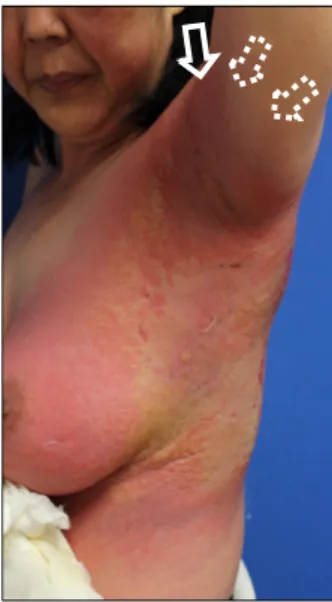
Fig. 1. Diffuse edematous erythema, vesicles and bullae with localized erosion on the patient’s left arm and trunk. Arrows present injection sites and courses; dotted arrows mean that injection site is on her scapula of the back area.
Fig. 2. Severe papillary dermal edema and superficial perivenular mixed inflammatory cell infiltrates with an increased number of eosinophils (H&E, ×100; inset, ×400).
injectable HA2-4.
A 59-year-old female presented with diffuse skin eruption with pruritus on the left arm and trunk. She had osteo- arthritis and intra-articular injection of HA was performed on her left shoulder in order to relieve left shoulder pain 5 days prior. This was the first time for the patient to be in- jected by HA. There was no relevant contact history and no history of dermatologic disease. Physical examination revealed diffuse edematous erythema, vesicles and bullae with localized erosion on her left arm and trunk (Fig. 1).
Blood sampling showed mild leukocytosis (9,890/μl), but all other results were within normal limits. Histopathologi- cally, severe papillary dermal edema and superficial peri- venular mixed inflammatory cell infiltrates were observed with an increased number of eosinophils (Fig. 2). The pa- tient was diagnosed with an acute allergic reaction accom- panying cellulitis. Within 1 week of short-term systemic corticosteroid and antibiotic therapy, the cutaneous le- sions resolved.
Intra-articular HA injection is a universal, safe non-surgical therapy indicated for patients with osteoarthritis. Adverse events following intra-articular injection of HA are unusual. Most reactions are transient, local erythematous responses including pain, tenderness, edema and heat sensation1.
There have been some previous reports related to the der- matologic side effects of injectable HA. A 70-year-old fe- male patient manifested a generalized target-like rash with confluent edema after intra-articular HA injection and ex- hibited a positive reaction on an intradermal test for HA2.
She was diagnosed with erythema multiforme due to HA.
Another patient, a 68-year-old woman, had a history of knee osteoarthritis and demonstrated knee swelling, pain- ful erythema and bullae with desquamation after in- tra-articular HA injection4. Histologic findings showed subcorneal cleavage, she was positive for exfoliative toxin B and bacterial culture grew methicillin-sensitive Staphy- lococcus aureus, supporting a diagnosis of staphylococcal scaled skin syndrome. There was also a report describing a delayed granulomatous response after injection of HA used as a soft tissue filler3. This patient developed a sub- epidermal blister with histopathologic features that varied from those above.
HA has no known immunogenic side effects, but it is pos- sible to develop anti-HA antibodies5. An allergic reaction can develop resulting in clinically severe erythema, blis- ters and histopathologic subepidermal cleavage with peri- vascular lymphocytes and eosinophils in the patient.
Unfortunately, the assay for antibodies against HA was not performed in this case. In addition, we did not perform the patch test because of the patient’s refusal and worry about systemic adverse reaction. The lack of these tests could not fully explain the allergic reaction. There is also a pos- sibility of allergic reaction for antiseptic agent such as potadine. The pathomechanism is still unknown although the foreign body or hypersensitivity reaction may be hypothesized. Further elucidation is needed.
We introduce a case of severe cutaneous adverse reaction triggered by HA intra-articular injection; serious side ef- fects of this procedure are rare with only a few reported cases. This report indicates that a relatively common ther- apeutic procedure with low immunogenicity can trigger severe systemic allergic reactions.
Brief Report
Vol. 28, No. 4, 2016 531
REFERENCES
1. Petrella RJ, Petrella M. A prospective, randomized, double- blind, placebo controlled study to evaluate the efficacy of intraarticular hyaluronic acid for osteoarthritis of the knee. J Rheumatol 2006;33:951-956.
2. Calvo M, Tornero P, De Barrio M, Mínquez G, Infante S, Herrero T, et al. Erytema multiform due to hyaluronic acid (go-on). J Investig Allergol Clin Immunol 2007;17:127-128.
3. Kim JH, Choi JS, Yun JH, Kang HK, Baek JO, Roh JY, et al.
Foreign body reaction to injectable hyaluronic acid: late granuloma formation. Ann Dermatol 2015;27:224-225.
4. Kunugiza Y, Tani M, Tomita T, Yoshikawa H. Staphylococcal scalded skin syndrome after intra-articular injection of hyaluronic acid. Mod Rheumatol 2011;21:316-319.
5. Micheels P. Human anti-hyaluronic acid antibodies: is it possible? Dermatol Surg 2001;27:185-191.