Review Article
강직성 척추염의 침 치료에 대한 최근 연구동향 분석 : China National Knowledge Infrastructure 검색을 중심으로
유재은
⋅권용수
⋅김효준
⋅박주언
⋅김국범
⋅이희원
⋅배준효
대전자생한방병원 한방재활의학과
Acupuncture Treatment for Ankylosing Spondylitis Using China National Knowledge Infrastructure: A Literature Review
Jae-eun Yu, K.M.D., Yong-Su Kwon, K.M.D., Hyo-Jun Kim, K.M.D., Joon Park, K.M.D., Gook-Beom Kim, K.M.D., Hee-Won Lee, K.M.D., Jun-Hyo Bae, K.M.D.
Department of Rehabilitation Medicine of Korean Medicine, Daejeon Jaseng Hospital of Korean Medicine
RECEIVED September 9, 2020 REVISED October 6, 2020 ACCEPTED October 10, 2020 CORRESPONDING TO Jae-eun Yu, Department of Rehabilitation Medicine of Korean Medicine, Daejeon Jaseng Hospital of Korean Medicine, 58 Munjeong-ro 48beon-gil, Seo-gu, Daejeon 35262, Korea
TEL (042) 1577-0007 FAX (042) 610-0415 E-mail [email protected] Copyright © 2020 The Society of Korean Medicine Rehabilitation
Objectives This study was performed to research the trends of Chinese acupuncture treatment for ankylosing spondylitis (AS).
Methods We searched clinical studies about Chinese acupuncture treatment for AS through China National Knowledge Infrastructure. We analyzed the characteristics of selected studies according to research design, sample size, publication year, treat- ment methods, evaluation criteria and adverse events.
Results 16 studies published from 2015 to 2020 were selected. They consisted of 11 randomized controlled trials and 5 case reports. In these studies, several types of acu- puncture treatments were performed and especially there were many treatments that applied thermal stimulation of needles. The most commonly used evaluation criteria was effective rate.
Conclusions This study showed that acupuncture treatment could be effective for AS.
It suggested that various studies should be conducted to provide reliable evidence about acupuncture treatment for AS in Korea. (J Korean Med Rehabil 2020;30(4):79-88) Key words Acupuncture, Ankylosing spondylitis, Review
서론 »»»
척추관절염은 척추 및 천장관절의 염증과 주로 하지에 비대칭적으로 침범하는 말초관절염, 부착부염(enthesitis) 과 같은 관절 증상과 포도막염(uveitis), 건선(psoriasis), 염증성 장 질환과 같은 관절외 증상 등 특징적인 임상 소견과 유전적 연관성을 공유하는 일련의 질환군이다1). 강직성 척추염은 대표적인 혈청음성 척추관절염으로 주로 추체(axial skeleton)를 침범하는 원인 미상의 만성
염증성 질환이다. 주로 10~20대에서 발병하고 남성과 여성의 발생빈도는 약 2~3:1 정도이다. HLA-B27 항원 과 밀접한 관련이 있으며 유병률은 0.2~1.2%로 알려져 있는데 대개 이 항원의 양성률에 비례한다2,3).
진단기준은 없으나 다양한 분류기준이 진단에 도움 이 될 수 있으며4), 강직성 척추염과 관련된 최초의 분류 기준은 Rome criteria (1961년)이다. 이후 방사선학적 천 장관절염을 포함시키는 등 한계점을 보완하여 New York criteria (1966년), modified New York criteria (1984년)
로 발전하였다5).
현재 널리 사용되는 modified New York criteria에 의 하면 염증성 요통, 요추의 운동 제한, 흉부 확장능의 감 소 중 한 가지 항목을 만족하고 grade 2 이상의 양측 천 장관절염 또는 grade 3 이상의 편측 천장관절염이 있는 경우 강직성 척추염으로 진단이 가능하다. 이는 축형 증상에 한정되어 있으며 방사선학적 천장관절염이 확 인되기 이전의 조기 질환은 배제한다는 한계점이 있다.
2000년대 이후 magnetic resonance imaging (MRI)를 통해 방사선학적 손상이 나타나기 전 급성 염증 병변을 확인할 수 있게 되었고, tumor necrosis factor-α (TNF-α) 저해제의 효과가 보고되면서 새로운 분류기준의 필요성 이 대두되었다. 이에 국제척추관절염평가학회(Assessment of SpondyloArthritis international Society, ASAS)에서는 주요 증상에 따라 축형(axial)과 말초형(peripheral) 척추 관절염으로 구분하여 다양한 임상양상을 포괄하고 천 장관절의 MRI 소견, HLA-B27 결과 등을 기준에 포함 하여 조기진단, 조기치료의 중요성을 내포한 새로운 분 류기준을 제안하였다6).
건강보험심사평가원의 질병 소분류 통계에 따르면
‘강직척추염(M45)’ 상병에 해당하는 환자는 2015년도 38,469명, 2016년도 40,007명, 2017년도 41,797명, 2018 년 43,686명, 2019년 47,197명으로 매년 증가하는 추세 이다7).
강직성 척추염의 침 치료와 관련된 국내 임상연구는 Lee와 In8)의 봉약침 치료 연구, Seo 등9)의 약침치료 연 구, Jin 등10)의 침, 한약, 운동요법 병행치료 연구, Lee와 Hong11)의 침, 한약 병행치료 연구, Kim 등12)의 침, 한약, 양약 통합치료 연구 등이 있으며 관련 연구가 많지 않 고 대부분의 연구가 1~2예의 증례보고에 그치는 실정 이다.
이에 본 연구는 최근 중국 내 강직성 척추염의 침 치 료에 대한 연구동향을 파악하여 향후 이를 바탕으로 국 내 임상 및 연구에 대한 기초 자료를 마련하고자 하였다.
대상 및 방법 »»»
1. 문헌 검색
中國智識基礎設施工程(China National Knowledge Infrastructure, CNKI)의 advanced search를 사용하여 “强 直性脊柱炎” 혹은 “强直性脊椎炎”과 “針”을 조합하여 검 색하였으며 최근 연구동향을 확인하기 위하여 발표연 도는 2015년도 1월 1일부터 검색일(2020년 7월 3일) 이 전까지로 제한하였다.
검색된 논문 중 근거 수준에 제한을 두지 않고 침 치 료가 주 치료 중재로 사용된 임상 논문을 연구 대상으 로 포함하였으며 문헌연구, 침 치료가 주 치료 중재가 아닌 연구, 침 치료와 관련이 없는 연구 등은 제외하였 다. 침 치료의 연구대상은 전통적인 침 치료 이외에 전 침, 도침, 부침(浮针) 등의 신침 요법을 포괄하였으며 침 치료의 단독 효과를 확인하기 위해 약물 치료 등 다 른 치료를 병행한 연구는 제외하였다.
2. 문헌 선택 및 분류
발행 연도를 2015년 1월 1일 이후로 제한한 다음 검 색을 통해 총 113편의 논문이 검색되었으며 문헌연구, 침 치료가 주 치료중재가 아닌 연구 등 선정 기준에 맞 지 않는 92편의 논문을 제외하였다. 이 가운데 원문을 확인할 수 없는 5편을 제외하고 16편의 논문을 최종 연 구대상으로 선정하였다(Fig. 1).
선정된 16편의 논문을 연구 디자인, 연구 대상자 수, 발행연도, 치료방법, 평가도구, 부작용 등으로 분석하 였다.
결과 »»»
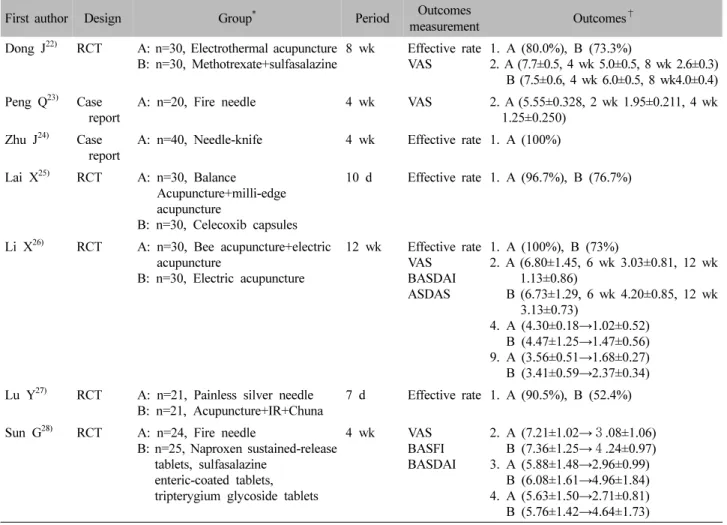
포함된 연구의 주요 정보는 Table Ⅰ에 요약되어 있다13-28).
1. 연구 디자인 분석
총 16편의 연구 중 무작위 배정연구는 11편(68.75%), 증례보고는 5편(31.25%)이었다.
First author Design Group* Period Outcomes
measurement Outcomes†
Wang J13) RCT A: n=31, Internal warm acupuncture B: n=31, Conventional acupuncture
treatment
8 wk VAS
BASFI BASDAI
2. A (7.31±1.03→1.89±0.95) B (7.05±1.20→3.64±1.05) 3. A (7.49±0.82→3.06±0.47) B (7.61±0.79→4.73±0.51) 4. A (7.62±0.73→3.27±0.31) B (7.14±0.80→5.03±0.65) Zhang Y14) Case
report A: n=1, Panlong acupuncture+warm
acupuncture 30 d - Improved
Zhang Y15) Case
report A: n=1, Heshi fire needle+milli-fire
needle 24 wk - Improved
Zhu F16) RCT A: n=30, Acupotomy
B: n=30, Acupuncture 12 wk Effective rate VASBASFI
1. A (6 wk 86.67%, 12 wk 93.30%) B (6 wk 33.33%, 12 wk 73.33%) 2. A (8.30±1.39, 6 wk 4.03±0.8, 12 wk
2.07±0.83)
B (8.17±1.12, 6 wk 5.03±1.5, 12 wk 2.90±1.88)
3. A (6.74±1.19, 6 wk 5.07±0.84, 12 wk 3.16±1.12)
B (7.39±1.51, 6 wk 5.68±1.11, 12 wk 4.45±0.98)
Zhang Z17) RCT Group 1: n=20, Internal heat needle (42℃)
Group 2: n=20, Internal heat needle (45℃)
Group 3: n=20, Internal heat needle (50℃)
4 wk Effective rate
VAS 1. Group 1 (70.0%), Group 2 (90.0%), Group 3 (80.0%)
2. Group 1 (6.28±1.32→3.73±0.63) Group 2 (6.14±1.26→2.70±0.48) Group 3 (5.95±1.25→3.28±0.74) He L18) Case
report A: n=48, Fire Needle 30 d Effective rate 1. A (81.25%) Huang X19) RCT A: n=30, Internal thermal
acupuncture
B: n=30, Milli-acupuncture
8 wk Effective rate VASBASFI BASDAI ASAS20 response
1. A (86.67%), B (73.33%) 2. A (6.5 (5~8)→2 (2~3))
B (7 (5.75~8)→4 (3~4)) 3. A (7.4 (6.95~8.2)→3 (3~3.55))
B (7.6 (7~8.2)→4.6 (4~5)) 4. A (7.6 (6.55~8)→3.2 (3~4))
B (7 (6.2~8)→5 (4.6~5.65)) 6. A (76.67%), B (50.00%) Mo J20) RCT A: n=25, Silver needle
B: n=24, Sulfasalazine pyridine tablets
3 wk Effective rate BASFI BASDAI BASMI TCM syndrome
score
1. A (96.00%), B (87.50%) 2. A (7.59±0.69→4.51±0.52)
B (7.64±0.83→5.71±0.65) 3. A (7.75±0.72→3.35±0.58) B (7.83±0.62→5.47±0.51) 5. A (7.54±1.24→3.67±0.64) B (7.32±1.03→4.93±0.73) 7. A (33.1±8.6→14.7±5.6)
B (34.5±7.2→26.1±6.8) Wang Y21) RCT A: n=38, Superficial needling
B: n=36, Celecoxib capsules, methotrexate tablets, sulfasalazine enteric-coated tablets
24 wk BASFI BASDAI TCM syndrome
score Lumbago
3. A (4.10±0.15→1.30±0.20) B (4.00±0.16→2.60±0.22) 4. A (4.30±1.42→1.81±1.47) B (4.40±1.60→3.00±1.53) 7. A (29.10±1.56→11.30±1.78)
B (28.50±1.69→16.45±1.63) 8. A (8.30±0.53→2.20±0.39)
B (8.25±0.55→4.29±0.49) Table Ⅰ. Key Data of Selected Studies
First author Design Group* Period Outcomes
measurement Outcomes†
Dong J22) RCT A: n=30, Electrothermal acupuncture
B: n=30, Methotrexate+sulfasalazine 8 wk Effective rate
VAS 1. A (80.0%), B (73.3%)
2. A (7.7±0.5, 4 wk 5.0±0.5, 8 wk 2.6±0.3) B (7.5±0.6, 4 wk 6.0±0.5, 8 wk4.0±0.4) Peng Q23) Case
report A: n=20, Fire needle 4 wk VAS 2. A (5.55±0.328, 2 wk 1.95±0.211, 4 wk 1.25±0.250)
Zhu J24) Case
report A: n=40, Needle-knife 4 wk Effective rate 1. A (100%) Lai X25) RCT A: n=30, Balance
Acupuncture+milli-edge acupuncture
B: n=30, Celecoxib capsules
10 d Effective rate 1. A (96.7%), B (76.7%)
Li X26) RCT A: n=30, Bee acupuncture+electric acupuncture
B: n=30, Electric acupuncture
12 wk Effective rate VASBASDAI ASDAS
1. A (100%), B (73%)
2. A (6.80±1.45, 6 wk 3.03±0.81, 12 wk 1.13±0.86)
B (6.73±1.29, 6 wk 4.20±0.85, 12 wk 3.13±0.73)
4. A (4.30±0.18→1.02±0.52) B (4.47±1.25→1.47±0.56) 9. A (3.56±0.51→1.68±0.27) B (3.41±0.59→2.37±0.34) Lu Y27) RCT A: n=21, Painless silver needle
B: n=21, Acupuncture+IR+Chuna 7 d Effective rate 1. A (90.5%), B (52.4%) Sun G28) RCT A: n=24, Fire needle
B: n=25, Naproxen sustained-release tablets, sulfasalazine
enteric-coated tablets, tripterygium glycoside tablets
4 wk VAS
BASFI BASDAI
2. A (7.21±1.02→3.08±1.06) B (7.36±1.25→4.24±0.97) 3. A (5.88±1.48→2.96±0.99)
B (6.08±1.61→4.96±1.84) 4. A (5.63±1.50→2.71±0.81) B (5.76±1.42→4.64±1.73)
*A: Control group, B: Observation group.
†1: effective rate, 2: VAS, 3: BASFI, 4: BASDAI, 5: BASMI, 6: ASAS20 response, 7: TCM syndrome score, 8: Lumbago, 9: ASDAS.
RCT: randomized controlled trial, wk: week, VAS: visual analog scale, BASFI: Bath ankylosing spondylitis functional index, IR:
infrared, BASDAI: Bath ankylosing spondylitis disease activity index, d: day, BASMI: Bath ankylosing spondylitis metrology index, ASAS: Assessment of SpondyloArthritis International Society, TCM: traditional Chinese medicine, ASDAS: ankylosing spondylitis disease activity s core.
Table Ⅰ. Continued
Fig. 1. Flow chart of publication selection process.
2. 연구 대상자 분석
실험군, 대조군을 모두 포함하여 단독 침 치료를 받 은 연구 대상자를 분석한 결과 20명 미만 2편(12.50%), 20명 이상 40명 미만 7편(43.75%), 40명 이상 60명 미 만 2편(12.50%), 60명 이상 80명 미만이 5편(31.25%)이 었다(Table Ⅱ).
3. 발행 연도 분석
논문의 발행 연도를 분석한 결과 2020년 2편(12.50%), 2019년 1편(6.25%), 2018년 4편(25.00%), 2017년 4편
Sample size Number of study (%)
Less than 20 2 (12.50)
20~39 7 (43.75)
40~59 2 (12.50)
60~79 5 (31.25)
Table Ⅱ. Sample Size
Published year Number of study (%)
2020 2 (12.50)
2019 1 ( 6.25)
2018 4 (25.00)
2017 4 (25.00)
2016 2 (12.50)
2015 3 (18.75)
Table Ⅲ. Published Year of the Study
Frequency Acupoints
8 Jiaji xue
4 GV3 (Yaoyangguan), GV14 (Dazhui) 3 GV12 (Shenzhu), GV9 (Zhiyang), GV4
(Mingmen), GB30 (Huantiao), BL23 (Shenshu) 2 GV8 (Jinsuo), GV11 (Shendao), GV6 (Jizhong),
BL31-34 (Baliao), BL25 (Dachangshu), BL54 (Zhibian)
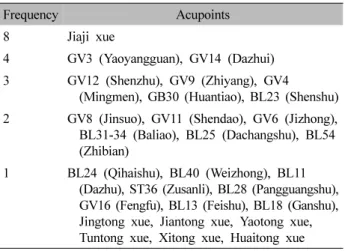
1 BL24 (Qihaishu), BL40 (Weizhong), BL11 (Dazhu), ST36 (Zusanli), BL28 (Pangguangshu), GV16 (Fengfu), BL13 (Feishu), BL18 (Ganshu), Jingtong xue, Jiantong xue, Yaotong xue, Tuntong xue, Xitong xue, Huaitong xue Table Ⅳ. Frequency of Acupoints
Treatment period Number of study (%)
Less than 20 days 2 (12.5)
20~29 days6 (37.5) 30~39 days2 (12.5) 40~59 days2 (12.5) More than 60 days4 (25.0) Table Ⅴ. Treatment Period
(25.00%), 2016년 2편(12.50%), 2015년 3편(18.75%) 이었다(Table Ⅲ).
4. 치료 방법 분석
주요 자극방법에 따라 분류한 결과 화침 4편, 도침 3 편, 내열침(内热针) 3편, 은질침(银质针) 2편, 온침 1편, 특수 제작한 침구를 피하에 자입하여 소산시키는 치료 법인 부침(浮针) 1편, 전열침(电热针) 1편, 봉침 1편이 었다.
실험군, 대조군 관계없이 침 치료가 주 치료 중재인 경우는 모두 22건이었으며 이 가운데 경혈점을 사용한 경우 10건, 비경혈점을 사용한 경우 11건, 경혈점과 비 경혈점 모두 사용한 경우는 평형침요법과 도침치료를 결합한 치료군 1건이었다.
사용된 경혈점은 夾脊穴이 8회로 가장 많았고, 腰陽 關(GV3), 大椎(GV14) 4회, 身柱(GV12), 至陽(GV9), 命 門(GV4), 環跳(GB30), 腎俞(BL23) 3회, 筋缩(GV8), 神 道(GV11), 脊中(GV6), 八髎穴(BL31-34), 大腸俞(BL25), 秩邊(BL54) 2회, 氣海俞(BL24), 委中(BL40), 大杼(BL11), 足三里(ST36), 膀胱俞(BL28), 風府(GV16), 肺俞(BL13), 肝俞(BL18) 각각 1회였으며 그 외 평형침요법의 頸痛 穴, 肩痛穴, 腰痛穴, 臀痛穴, 膝痛穴, 踝痛穴 등도 있었다.
경맥으로는 주로 督脈과 足太陽膀胱經이 사용되었고 1
편의 논문에서 任脈과 足陽明胃經도 언급하였다. 비경 혈점을 사용한 경우에는 아시혈과 해부학적 병변부위 에 근거하여 치료부위를 선택하였다(Table Ⅳ).
평균 유침 시간은 24.68±4.98분으로 도침, 화침 등 유 침을 하지 않은 경우 5건을 제외하고 20분 8건, 25분 1 건, 30분 7건이었으며, 나머지 1건은 유침 시간을 구체 적으로 명시하지 않았다(Table Ⅰ). 치료기간은 7일에서 부터 최대 24주까지 편차가 다소 큰 편이었고 20일 이 상 30일 미만인 경우가 6편으로 가장 많았다(Table Ⅴ).
5. 평가척도
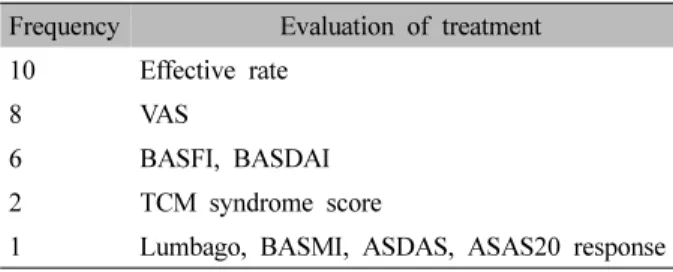
중복을 허용하여 평가척도를 분석하였을 때 4개 등 급(临床缓解 显效 有效 无效)의 유효율을 사용한 논문 6편, 3개 등급(显效 有效 无效)의 유효율로 평가한 논문 4편, visual analog scale 8편, 강직성 척추염 기능지수인 Bath ankylosing spondylitis functional index, 강직성 척 추염 활성도지수인 Bath ankylosing spondylitis disease activity index 각각 6편, 중의변증점수 2편이 있었다. 그
Frequency Evaluation of treatment 10 Effective rate
8 VAS
6 BASFI, BASDAI
2 TCM syndrome score
1 Lumbago, BASMI, ASDAS, ASAS20 response VAS: visual analog scale, BASFI: Bath ankylosing spondylitis functional index, BASDAI: Bath ankylosing spondylitis disease activity index, TCM: traditional Chinese medicine, BASMI:
Bath ankylosing spondylitis metrology index, ASDAS: ankylosing spondylitis disease activity score, ASAS: Assessment of SpondyloArthritis International Society.
Table Ⅵ. Evaluation of Treatment
외 요통지수, 강직성 척추염 계측지표인 Bath ankylos- ing spondylitis metrology index, 강직성 척추염 증상 활 성도 평가지수인 ankylosing spondylitis disease activity score, 강직성 척추염 증상이 20% 이상 개선되었음을 나타내는 국제 지표인 ASAS20 달성도를 사용한 논문 이 각각 1편 있었으며 별도의 평가척도를 사용하지 않 은 연구는 2편이었다(Table Ⅵ).
6. 부작용
부작용 및 이상반응을 언급한 논문은 4편이었다. 2편 의 연구에서는 내열침(内热针) 치료군에서 1건의 심계 항진, 일반침 치료군에서 2건의 체침(滯鍼)이 있었으며 1편의 연구에서는 도침 치료군 7명이 5분 정도의 불편 한 반응을 보였으나 휴식 후 호전되었고 일반침 치료군 에서 3명이 현기증 및 심계항진을 보였다고 밝혔다. 1 편의 연구에서는 전신적인 부작용은 없었다고 보고하 였다.
고찰 »»»
강직성 척추염은 환자 상당수에서 장애를 초래하는 척추 변형을 유발하여 가장 중증의 척추관절염 형태라 할 수 있다. 명확하게 규명되지 않았으나 HLA-B27과 관련된 유전적 인자가 가장 중요한 병인으로 알려져 있 으며 강직성 척추염 환자의 HLA-B27 양성률은 일반 인구에 비해 유의하게 높다3).
임상양상은 크게 관절 증상과 관절외 증상으로 나누 어지는데 척추관절염 환자의 75%에서 첫 증상이 염증 성 요통으로 나타나며 요추나 요천추부에서 시작된다29). 질병이 진행됨에 따라 인대 골증식이 발생하여 척추체 간 융합이 일어나 단순 방사선 검사 결과 대나무 형태 (bamboo spine)를 보이며 운동 제한과 기능 장애가 발 생한다. 말초관절염은 주로 하지 관절에서 비대칭적으 로 발생하며 무릎과 발목을 쉽게 침범한다. 건, 인대, 근막이 뼈와 부착되는 부위에 염증이 발생하는 부착부 염 또한 주요 특징이다4). 피부, 눈, 장 점막 등 장기에 이환되어 관절외 증상을 나타내기도 하며 이중 전방 포 도막염이 가장 흔하다30).
우리나라 보험급여기준에 따르면 현재 강직성 척추염 환자에게 적용되는 약물군은 nonsteroidal anti-inflammatory drugs (NSAIDs), disease-modifying antirheumatic drugs (DMARDs), TNF-α 저해제 3가지이다. NSAIDs가 일차 적인 약물 치료제로서 비교적 좋은 반응을 보이며 장기 간 사용 시 강직 예방 효과를 기대할 수 있다. 이후 치 료 효과가 적을 경우 TNF-α 저해제가 권고되고 있으며 국제척추관절염평가학회-유럽류마티스학회 가이드라인 에 따르면 DMARDs는 TNF-α 저해제를 투여하기 전 반드 시 투여해야 하는 약물은 아니다31). TNF-α 저해제는 조 조강직, 통증 등의 임상소견과 C-reactive protein, eryth- rocyte sedimentation rate를 포함하는 염증지표의 개선 이 보고되었으나 피부 이상반응 및 결핵, 감염 등의 우 려가 있다. 치료에 불응하는 극심한 통증과 구조적인 손 상이 있는 고관절염, 척추의 심한 변형으로 인한 장애 등이 있는 경우 수술적 치료가 고려될 수 있다32).
강직성 척추염은 대개 40대 미만의 청장년기에 발병 하여 서서히 진행되는 만성적인 경과를 보이므로 조기 에 진단하여 환자의 증상과 염증을 치료하고, 비가역적 인 척추 변형을 예방하여 기능적으로 독립적인 생활을 유지할 수 있도록 하는 것이 중요하다. 따라서 약물치 료 뿐 아니라 규칙적인 운동, 재활치료와 같은 비약물 치료가 병행되어야 한다33).
한의학적 관점에서 강직성 척추염은 관절 증상을 중 심으로 脊强, 骨痿, 附骨疽 등에 해당한다고 볼 수 있으 며, 병인병기와 관련하여 뺷東醫寶鑑뺸의 「外形⋅背⋅脊 强」에서 ‘督脈之別, 名曰長强, 其病實, 則脊强’, ‘足太陽 之脈病, 腰脊强痛’이라 하여 督脈과 足太陽脈의 병으로 보
Fig. 2. Three parts of Fu’s subcutaneous needling (Reprinted from Fu et al. Evid Based Complement Alternat Med 2012;
2012:1-8)35). 았음을 알 수 있으며, 骨痿는 腎氣의 熱證으로, 附骨疽
는 寒濕의 침입에 의한 氣鬱을 원인으로 인식하였다34). 본 연구에서 선정한 16편의 연구 중 무작위 배정연구 가 11편, 증례보고가 5편이었으며 연구대상자는 20명 이상 40명 미만인 경우가 7편으로 가장 많았다.
치료자극에 따라 분류하였을 때 화침 4편, 도침 3편, 내열침(内热针) 3편, 은질침(银质针) 2편, 온침 1편, 부 침(浮针) 1편, 전열침(电热针) 1편, 봉침 1편으로 온열 자극을 가하는 치료가 가장 많았고, 전통적인 침치료 이외에 전침, 도침, 부침(浮針) 등 신침과 관련된 연구 도 활발하게 이루어지고 있었다.
온열자극을 가하는 치료로는 화침의 경우 가열 방법 을 언급하지 않은 1편의 논문을 제외하고 침체를 직접 가열한 뒤 자입하는 방식이 사용되었으며, 내열침(内热 针)과 전열침(电热针)은 자침 후 내열식 치료기를 이용 하여 일정시간 항온 가열하는 치료법으로 화침 및 온침 과 달리 온도 조절이 가능하고 조작이 간편하며 화상의 위험이 적다는 장점이 있었다. 열 전도율이 높은 은질 침(银质针)의 경우 온침과 같이 쑥뜸을 태우는 방식과 온도 조절기기를 이용하는 방식 모두 사용되었다.
Wang 등13)과 Huang19)은 중말기 강직성 척추염 환자 에 대하여 일반침 치료군에 비해 내열침(内热针) 치료 군이 우수한 효과를 보였고 Lu27)는 침, 추나, 적외선을 결합한 군과 비교하여 은질침(银质针) 치료군에서 현저 하게 우수한 치료효과를 얻었다고 밝혔다. Sun과 Wang28) 은 화침 치료군과 NSAIDs, sulfasalazine, tripterygium glucosides를 투여한 군을 비교하였을 때 유의하게 우수 하다고 보고하였다. Zhang 등17)은 내열침(内热针) 치료 군을 저온(42℃), 중온(45℃), 고온(50℃) 군으로 나누 어 20분간 동일하게 처치하였을 때 45℃가 가장 최적 의 온도라 보고하였다.
Dong 등22)은 전열침(电热针) 치료군과 methotrexate 와 sulfasalazine 투여군에 대하여 치료 4주 및 치료 8주 후 흉부 확장도, 천장관절 압통, 관절 압통 개수, 조조 강직, Schober test 및 interleukin (IL)-1, IL-6 수준을 비 교하였다. 두 군 모두 치료 전과 비교하여 개선되었으 나 두 군간 유의한 차이는 없었다고 밝혀 추가적인 연 구가 필요할 것으로 생각된다.
Zhu16)는 도침치료와 拔針疗法(needle dialing thrapy) 을 병용하여 근막 또는 근섬유의 조삭(条索)이 나타나
는 부위를 층별로 절개한 뒤 360도 회전 조작하여 연부 조직의 유착을 박리함으로써 일반 침 치료군에 비해 우 수한 효과를 거두었다고 밝혔고, Lai와 Lin25)은 도침치 료와 평형침법을 결합한 군이 일반 침 치료와 경구 cel- ecoxib 캡슐 결합한 군에 비하여 높은 치료율을 보였음 을 보고하였다.
Li26)는 단독 전침 치료와 비교하여 봉침과 전침을 병 용한 결합치료에서 강직성 척추염 관련 지표가 우수하 게 개선이 되었음을 보고하였다.
그 외 Wang과 Qiu21)는 부침요법(浮針療法)이 cele- coxib 캡슐, sulfasalazine, methotrexate과 비교해 강직 완화 및 척추관절의 기능개선에 효과적이었다고 보고 하였다. 부침요법(浮針療法)이란 1996년 符仲华 박사가 개발한 신침 요법으로 針芯, 軟套管, 保护套管으로 이루 어진 복합관침을 사용한다. 針芯은 스테인리스 스틸로 제작되어 신체에 진입하는 부분이며 軟套管은 부침의 주요구조로 針芯을 감싸며 충분한 유연성을 갖추어 장 시간 유관이 가능하다(Fig. 2)35).
Mo20)는 중의변증 상 寒湿痹阻证으로 분류된 강직성 척추염 환자에게 은질침(银质针) 치료를 시행하여 sul- fasalazine을 투여한 군에 비해 유의한 치료결과를 얻었 는데, Xu와 Feng36)의 연구에 따르면 강직성 척추염은 병인과 증상이 복잡하여 寒熱錯雜, 痰瘀互結 등 다양한 혼합 증후군이 나타날 수 있으므로 진단과 치료는 기존 의 표준 변증에 국한될 수 없다고 주장하며 통일된 변
증 분류의 필요성을 언급하였다.
한방재활의학과 교과서에 따르면 강직성 척추염을 骨痺證에 해당하는 질환으로 분류하고 있으나 병인, 증 상 등 질환의 특성이 반영된 변증을 제시하고 있지는
않은데3,34) 통일되지 않은 변증 기준의 사용은 진단 및
치료 기준을 복잡하게 만들고 신뢰할 수 있는 연구 결 과를 얻기 어렵기 때문에 향후 추가적인 연구가 필요하 다고 생각된다.
치료부위에 따라 분석하였을 때 경혈점 10건, 비경혈 점 11건으로 차이가 없었으나 경맥으로는 督脈과 足太 陽膀胱經이 주로 사용되어 대부분 척추 관절 증상에 대 하여 요배부에 침 치료를 진행하였음을 알 수 있었다.
치료효과에 대한 평가척도는 3단계 또는 4단계로 나 눈 유효율(effective rate)이 총 10편으로 가장 많이 사용 되었으나 그 기준이 명확하지 않고 객관성이 확보되지 않아 신뢰도와 타당도가 낮은 것으로 생각된다. 강직성 척추염의 평가와 관련하여 ASAS에서는 core sets를 제 안하였으며37), 추후 연구에서도 검증된 평가척도를 사 용하는 것이 중요하다고 생각된다. 또한 호전과 악화를 반복하며 진행되는 질환이나 장기적인 추적 관찰이 이 루어진 연구가 없었다는 점에서 한계가 있었다.
Standards for Reporting Interventions in Clinical Trials of Acupuncture (STRICTA)에 따르면 침 치료의 임상 시험 중재를 보고할 경우 침 치료에 대한 논거, 자침에 대한 상세한 내용, 처치 내용, 치료의 다른 구성요소, 시술자의 배경, 대조군 및 비교군 중재 항목에 대하여 점검해야 한다. 본 논문에서 선정된 연구는 대부분 일 회 치료 시 환자 당 자침 수, 침의 형태, 자침 깊이 등 자침에 대한 상세 내용 가운데 일부가 누락되었거나, 시술자의 배경에 대하여 서술하지 않아 STRICTA에 부 합하지 않았다. 연구의 투명성과 재현성을 높이고 과정 및 결과에 대한 명확한 이해가 가능하도록 향후 표준에 부합하는 연구가 진행되어야 할 필요가 있다.
본 연구는 논문의 근거 수준에 제한을 두지 않고 강 직성 척추염 환자의 침 치료에 대한 임상 연구를 모두 포함하였으며 2015년도 이후 발표된 논문으로 한정하 여 분석한 점에서 결과 해석이 제한적일 수 있다는 한 계가 있으나 최근 중국 내 연구동향을 살펴봄으로써 임 상 및 연구에 도움이 될 만한 기초 자료를 마련하고자 하였다. 향후 국내에서도 높은 근거 수준의 다양한 연
구를 진행하여 강직성 척추염의 치료에 대한 객관적인 근거를 마련해야 할 것으로 생각한다.
결론 »»»
CNKI를 중심으로 강직성 척추염의 침 치료에 관한 임상연구 논문 16편을 분석한 결과 다음과 같은 결론을 얻을 수 있었다.
1. 선정한 16편의 연구 중 무작위 배정연구가 11편, 증례보고가 5편이었으며 연구대상자는 20명 이상 40명 미만인 경우가 가장 많았다.
2. 주요 자극방법에 따라 분류한 결과 화침과 같이 온열자극을 가하는 치료가 가장 많았고, 전통적인 침 치료 이외에 전침, 도침, 부침(浮針) 등의 신침요 법도 사용되었다.
3. 치료 부위는 경혈점과 비경혈점 간 차이는 없었다.
주로 督脈과 足太陽膀胱經의 혈위와 夾脊穴이 사 용되었고, 비경혈점은 아시혈과 해부학적 병변부 위에 근거하여 선택되었다.
4. 강직성 척추염에 침 치료가 좋은 효과를 보인다는 근거를 확인할 수 있었으나, 신뢰할 수 있는 과학 적 근거 자료를 마련하기 위해서는 향후 표준에 부합하는 높은 수준의 연구가 진행되어야 한다.
References »»»
1. Dougados M, Baeten D. Spondyloarthritis. Lancet.
2011;377(9783):2127-37.
2. Longo DL, Fauci AS, Kasper DL, Hauser SL, Jameson JL, Loscalzo J. Harrison's principles of internal medicine.
17th ed. New York:McGraw-Hill. 2010:2537-41.
3. The Society of Korea Medicine Rehabilitation. Korea rehabilitation medicine. 4th ed. Paju:Koonja Publishing.
2015:82, 132-3.
4. Seo MR, Baek HJ. The concept and overview of spondyloarthritis. Korean Journal of Medicine. 2013;
85(3):229-39.
5. Van der Linden S, Valkenburg HA, Cats A. Evaluation of diagnostic criteria for ankylosing spondylitis: a pro- posal for modification of the New York criteria. Arthritis and Rheum. 1984;27(4):361-8.
6. Rudwaleit M, van der Heijde D, Landewé R, Listing J, Akkoc N, Brandt J, Braun J, Chou CT, Collantes- Estevez E, Dougados M, Huang F, Gu J, Khan MA, Kirazli Y, Maksymowych WP, Mielants H, Sørensen IJ, Ozgocmen S, Roussou E, Valle-Oñate R, Weber U, Wei J, Sieper J. The development of Assessment of SpondyloArthritis International Society classification criteria for axial spondyloarthritis (part II): validation and final selection. Ann Rheum Dis. 2009;68:777-83.
7. Healthcare Bigdata Hub. Statistics of classification of disease (3-stage of disease codes) [Internet] Health Insurance Review & Assessment Service; 2020 [cited 2020 Sep 7]. Available from: http://opendata.hira.or.kr/o p/opc/olap3thDsInfo.do#none.
8. Lee SG, In CS. A case report of bee acupuncture ther- apy on ankylosing spondylitis. Journal of Korean Pharmacopuncture Institute. 1999;2(1):39-49.
9. Seo DM, Lee SH, Lee JD. Effect of herbal acupuncture on ankylosing spondylitis and its evaluation of func- tional scale. The Journal of Korean Acupuncture &
Moxibustion Society. 2002;19(6):234-46.
10. Jin KS, Chang BS, Hwang WJ, Lyu CS, Park SJ. A clinical study on the case of ankylosing spondylitis treat- ed by oriental therapy. The Journal of the Korea Institute of Oriental Medical Informatics. 2002;8(2):1-10.
11. Lee JM, Hong KE. Clinical study of patient with anky- losing spondylitis. Journal of Korean Pharmacopuncture Institute. 2006;9(2):135-40.
12. Kim HJ, Bae SE, Lee SG, Jung YH. A clinical report on the case of bilateral sacroilitis with synovitis in Rt.
hip joint caused by ankylosing spondylitis, treated by conservative Korean medical treatment including hip joint MST (motion style treatment). The Journal of Korea CHUNA Manual Medicine for Spine & Nerves.
2014;9(2):125-32.
13. Wang J, Ou G, Yuan P, Dong B, Yao J, Wang G, Xiao B. Therapeutic effects of internal warm acupuncture on middle- and late- stage ankylosing spondylitis. Journal of Beijing University of Traditional Chinese Medicine.
2020;43(3):242-7.
14. Zhang Y, Li L. Treatment of ankylosing spondylitis with Panlong acupuncture Jiaji point combined with warm acupuncture. Chinese Journal of Ethnomedicine and Ethnopharmacy. 2020;29(4):78-9.
15. Zhang Y, Zhou Z. One case of ankylosing spondylitis with He's fire needle. Chinese Journal of Ethnomedicine and Ethnopharmacy. 2019;28(23):69-70.
16. Zhu F. Clinical observation on treatment of ankylosing spondylitis with acupotomy combined with scaple-nee- dle [dissertation]. Nanjing:Nanjing University of Chinese Medicine. 2018.
17. Zhang Z, Wu Q, Cai Y. Clinical observation on internal hot needle therapy for ankylosing spondylitis at differ- ent temperatures. Journal of Hubei University of Chinese Medicine. 2018;20(4):70-2.
18. He L. 48 cases of ankylosing spondylitis treated by fire needle. Journal of External Therapy of Traditional Chinese Medicine. 2018;27(02):34-5.
19. Huang X. Explore the clinical effect of internal heat needle therapy for advanced ankylosing spondylitis [dissertation]. Shaanxi:Shaanxi University of Chinese Medicine. 2018.
20. Mo J. Clinical study on silver needle in treating ankylos- ing spondylitis with cold-dampness obstruction syndrome.
Journal of Minimally Invasive Medicine. 2017;12(06):
811-2, 855.
21. Wang Y, Qiu W. Observations on the efficacy of super- ficial needling therapy for early ankylosing spondylitis.
Shanghai Journal of Acupuncture and Moxibustion.
2017;36:1088-91.
22. Dong J, Li Y, Cai Y. Observations on the therapeutic effect of electrothermal acupuncture on ankylosing spondylitis and its impact on IL-1 and IL-6. Shanghai Journal of Acupuncture and Moxibustion. 2017;36(09):
444-8.
23. Peng Q, Xiang K. Fire needle treatment the clinical ef- fect of the treatment of 20 patients with ankylosing spondylitis. Asia-Pacific Traditional Medicine. 2017;
13(1):136-7.
24. Zhu J, Hu Y. 40 cases of horizontal needling with needle kife for ankylosing spondylitis. Chinese Journal of Woman and Child Health Research. 2016;27(S2):538.
25. Lai X, Lin J. Observation on 60 cases of ankylosing spondylitis treated with balance needle and milli-edge needle. Journal of Practical Traditional Chinese Medicine.
2016;32(06):588-9.
26. Li X. Clinical observation of bee acupuncture combined with electric acupuncture for patients with ankylosing spondylitis [dissertation]. Guangzhou:Guangzhou University of Chinese Medicine. 2015.
27. Lu Y. Effect of painless silver needle on ankylosing spondylitis. People's Military Surgeon. 2015;58(04):
419-20.
28. Sun G, Wang L. Clinical observation of fire needle and conventional therapy for ankylosing spondylitis. China's Naturopathy. 2015;23(02):30-2.
29. Braun J, Sieper J. Ankylosing spondylitis. Lancet. 2007;
369:1379-90.
30. Rosenbaum JT. Characterization of uveitis associated with spondyloarthritis. J Rheumatol. 1989;16:792-6.
31. van der Heijde D, Ramiro S, Landewé R, Baraliakos X, Van den Bosch F, Sepriano A, Regel A, Ciurea A,
Dagfinrud H, Dougados M, van Gaalen F, Géher P, van der Horst-Bruinsma I, Inman RD, Jongkees M, Kiltz U, Kvien TK, Machado PM, Marzo-Ortega H, Molto A, Navarro-Compàn V, Ozgocmen S, Pimentel-Santos FM, Reveille J, Rudwaleit M, Sieper J, Sampaio-Barros P, Wiek D, Braun J. 2016 update of the ASAS-EULAR management recommendations for axial spondyloarthritis.
Ann Rheum Dis. 2017;76:978-91.
32. Kim TH. Updates of spondyloarthrothy treatment.
Korean Journal of Medicine. 2013;85(3):256-9.
33. Park EH, Lee EY. Diagnosis and management of spondlyoarthritis. The Journal of Korean Association of Pain Medicine. 2016;15(1):1-8.
34. Kim JH, Yoon EK, Baik YS, Jeong CH, Jang WC, Lyu JA. A study on ankylosing spodylitis in traditional Korean medical perspective. The Journal of Korean
Medical Classics. 2012;25(3):23-38.
35. Fu Z, Hsieh YL, Hong CZ, Kao MJ, Lin JG, Chou LW. Remote subcutaneous needling to suppress the irri- tability of myofascial trigger spots: an experimental study in rabbits. Evid Based Complement Alternat Med.
2012;2012:1-8.
36. Xu F, Feng X. Research progress on TCM syndrome classification of ankylosing spondylitis. Chinese Journal of Information on Traditional Chinese Medicine.
2008;15(08):104-5.
37. van der Heijde D, Calin A, Dougados M, Khan MA, van der Linden S, Bellamy N. Selection of instruments in the core set for DC-ART, SMARD, physical therapy, and clinical record keeping in ankylosing spondylitis.
Progress report of the ASAS working group. Assessments in ankylosing spondylitis. J Rheumatol. 1999;26:951-4.