Received:December 28, 2020, Revised:March 13, 2021, Accepted:March 25, 2021 Corresponding to:İsa Cüce http://orcid.org/0000-0002-1290-9540
Department of Physical Medicine and Rehabilitation, Faculty of Medicine, Erciyes University, Köşk Mah. Dede Efendi Sok. P.K.
38030 Melikgazi, Kayseri, Turkey. E-mail:[email protected] Copyright ⓒ 2021 by The Korean College of Rheumatology. All rights reserved.
This is an Open Access article, which permits unrestricted non-commerical use, distribution, and reproduction in any medium, provided the original work is properly cited.
Neuropathic Pain and its Relationship With Fibromyalgia, Vitamin D Status and Medication Use in Patients With Ankylosing Spondylitis
Sema Mızrak, M.D.1, Mehmet Kırnap, M.D.2, İsa Cüce, M.D.2
1Şebinkarahisar State Hospital, Department of Physical Medicine and Rehabilitation, Giresun, 2Department of Physical Medicine and Rehabilitation, Faculty of Medicine, Erciyes University, Kayseri, Turkey
Objective. To determine the frequency of neuropathic pain (NeP) and potentially related new factors including fibromyalgia, vitamin D and medication use in ankylosing spondylitis (AS) patients. Methods. In total, 102 patients with AS were pro- spectively enrolled in this study and evaluated for pain severity (visual analog scale, VAS), disease activity (the Bath Ankylosing Spondylitis Disease Activity Index, BASDAI), fibromyalgia and current medication use. The presence of NeP was also assessed using the painDETECT questionnaire. Blood samples were taken from all patients to analyze serum 25-hydroxyvitamin D and inflammatory marker levels. Results. NeP component 32 (21 [20.6%]; clearly NeP and 11 [10.8%]; mixed NeP) was present in patients with AS. Compared to those without NeP, they had significantly higher VAS and BASDAI scores (p=0.022 and 0.003, respectively). In addition, there was a highly significant difference of frequency of fibromyalgia between patients with and with- out NeP (50.0% vs. 5.7%, p<0.001). Vitamin D status and medication use were comparable for patients with and without NeP.
Logistic regression analysis revealed that only fibromyalgia was a significant predictor of NeP. Conclusion. This study con- firmed that about one-third of AS patients have the NeP component. In addition, NeP was found to be associated with the fre- quency of fibromyalgia. However, no relation was found between NeP and vitamin D status and medication use in AS. (J Rheum Dis 2021;28:126-132)
Key Words. Ankylosing spondylitis, Neuropathic pain, Vitamin D, Fibromyalgia
INTRODUCTION
Ankylosing spondylitis (AS) is a prevalent form of axial spondyloarthritis (axSpA), with a remarkable link with HLA-B27 [1]. Axial inflammation and new bone for- mation are two major issues in the pathogenesis of AS.
These two ongoing processes are often responsible for chronic back pain and loss of mobility and function in pa- tients with AS. Other common findings related to pain are asymmetric oligoarthritis and enthesitis [2].
Although the pain in AS has an inflammatory nature, re- cent studies have suggested that neuropathic pain (NeP) component exists in 25%∼35.4% of patients [3-5]. A
structural magnetic resonance study also revealed the oc- currence of additional structural brain abnormalities, which are compatible with neural correlations of NeP, in patients with AS, thereby supporting the existence of a central pain process [6]. NeP is thought to be caused by the immune response due to chronic stimulation of the joints and entheses, leading to neural plasticity in the pe- ripheral and central nervous systems [7]. Current treat- ments of AS, including the use of biological agents, pri- marily focus on suppressing inflammation; however, they do not always provide satisfactory pain relief in all patients. One of the reasons for this is that comorbidities associated with accompanying pain in these patients fur-
ther complicate neuro-immune interactions and affect the character of the current pain [8,9].
Previous studies have reported that NeP in AS is asso- ciated with demographic, disease-related (i.e., disease ac- tivity or enthesitis) and emotional factors [3-5]. However, other factors affecting pain in AS patients, which are com- mon and potentially associated with NeP, have not been adequately investigated. First, vitamin D deficiency is fre- quent among patients with AS and potentially related to pain, whereas the impact of vitamin D status on AS-re- lated NeP is unknown [10]. The correlation of the pres- ence and severity of neuropathy with a poor vitamin D status in painful neuropathic diseases has been demon- strated in recent studies [11,12]. Second, in a recent sys- temic review of axSpA, concomitant fibromyalgia has re- ported in 13.8% of patients with AS [13]. Studies indicate that patients with axSpA with concomitant fibromyalgia have higher disease burden with higher pain severity and lower quality of life than those without [14,15]. Although pain in fibromyalgia is not included in the NeP classi- fication, recent studies containing primary data on patho- physiology have highlighted the neuropathic component of pain in fibromyalgia, and even the new category as
"centralized pain" is proposed [16-18]. Moreover, the ef- fect of concomitant fibromyalgia on NeP in patients with axSpA or other inflammatory arthritis is not clear.
Therefore, the purpose of this study is to investigate the frequency of NeP in AS and its relationship with some new potential primary data added.
MATERIALS AND METHODS
This cross-sectional study was conducted between November 2018 and October 2019 at our department’s outpatient clinic. The study protocol received ethics ap- proval from the local ethics committee (reference num- ber: 2018/542). All the patients received detailed in- formation about the study protocol and provided signed consent. According to the modified New York criteria, pa- tients 18 years and older diagnosed with AS were consec- utively enrolled during their medical appointments. The exclusion criteria were as follows: (i) the presence of ac- companying systemic or neurological disorders that can cause NeP, e.g., diabetes mellitus, chronic renal impair- ment, or polyneuropathy; (ii) the presence of metabolic bone diseases; (iii) the presence of psychiatric disorders;
(iv) the use of medications affecting NeP or vitamin D lev- els, e.g., antidepressants, antiepileptics, or calcium and
vitamin D or B12 supplements; (v) chronic alcohol or drug misuse; (vi) a previous diagnosis of vitamin B12 de- ficiency; and (vii) refusal to participate in the study.
A standardized form was used to gather demographic and disease related data, including age, gender, body length and body weight, educational status, presence of systemic diseases, disease duration, and current medi- cation and duration of use. The patients were questioned for the presence of concomitant fibromyalgia, and noted.
The American College of Rheumatology (ACR) 2010 classification criteria were used to diagnose fibromyalgia.
The overall pain intensity of the patients within the last week was evaluated using a horizontal visual analog scale (VAS) scoring system. The disease activity was tested us- ing the Bath Ankylosing Spondylitis Disease Activity Index (BASDAI), which is a simple and valid instrument that includes five main disease parameters, namely fa- tigue/tiredness, back/hip pain, peripheral joint pain/swel- ling, localized tenderness, and morning stiffness [19].
The total scores range from 0 to 10, with higher scores showing increased disease activity.
The neuropathic component of the pain was assessed with the painDETECT questionnaire (PD-Q). In adults, the PD-Q questionnaire used to detect NeP components in chronic painful conditions, developed by Freynhagen et al. [20]. The survey contains seven items relevant to the nature and intensity of specific NeP symptoms. The total score ranges from −1 to 38, with <13, 13∼18, and ≥19 points representing “unlikely,” “mixed” and “very likely”
NeP component, respectively. The PD-Q can be easily ad- ministered and validated in Turkish [21].
A total of 5 mL of fasting peripheral blood was collected early in the morning. Serum 25-hydroxyvitamin D (25(OH)D) levels were quantitatively determined using liquid chromatography/tandem mass spectrometry method. The vitamin D status was considered sufficient, insufficient, and deficient for patients with serum 25(OH)D levels ≥30 ng/mL, between 21 and 29 ng/mL, and ≤20 ng/mL, respectively [22]. Additional laboratory tests were carried out, including erythrocyte sed- imentation rate (ESR) and C-reactive protein (CRP).
Statistical analysis
Data analyses were performed using SPSS 26.0 stat- istical software (IBM Co., Armonk, NY, USA). The basic characteristics of the patients were evaluated using de- scriptive statistics. The Kolmogorov–Smirnov test and graphical methods were used to check the normal dis-
Table 1. Demographic and clinical variables in patients with AS (n=102) based on PD-Q score
Variable NePN group (n=70) NePP group (n=32) Total (n=102) p-value
Age (yr) 40.33±11.20 40.81±10.34 40.5±10.9 0.836
Sex
Male 35 (50.0) 19 (59.4) 54 (52.9) 0.379
Female 35 (50.0) 13 (40.6) 48 (47.1)
BMI (kg/m2)
<25 29 (41.4) 12 (37.5) 41 (40.2) 0.707
≥25 41 (58.6) 20 (62.5) 61 (59.8)
Disease duration (yr) 9.55±8.87 7.94±6.39 9.04±8.18 0.358
AS medication
NSAID 17 (24.3) 7 (21.9) 24 (23.5) 0.326
DMARD (alone or combination) 4 (5.7) 5 (15.6) 9 (8.8)
TNF inhibitor 43 (61.4) 19 (59.4) 62 (60.8)
None 6 (8.6) 1 (3.1) 7 (6.9)
Duration of TNF inhibitors, months 45.1±27.1 32.1±28.2 41.1±27.9 0.089
VAS pain 3.84±2.42 5.03±2.32 4.22±2.44 0.022
BASDAI 3.19±2.28 4.66±2.29 3.64±2.37 0.003
ESR (mm/h) 11.56±9.68 12.09±10.43 11.7±9.9 0.800
CRP (mg/dL) 9.30±13.06 7.06±7.71 8.6±11.7 0.371
25(OH)D (ng/mL) 19.36±7.06 17.78±8.37 18.9±7.5 0.329
Vitamin D status
≤20 ng/mL 40 (57.1) 19 (59.4) 59 (57.8) 0.973
21∼29 ng/mL 25 (35.7) 11 (34.4) 36 (35.3)
≥30 ng/mL 5 (7.1) 2 (6.3) 7 (6.9)
Fibromyalgia 4 (5.7) 16 (50.0) 20 (19.6) <0.001
Data were expressed as mean±standard deviation or frequency (%). AS: ankylosing spondylitis, PD-Q: painDETECT questionnaire, NePN: neuropathic pain-negative, NePP: neuropathic pain-positive, BMI: body mass index, NSAID: nonsteroidal antiinflammatory drug, DMARD: disease-modifying antirheumatic drug, VAS: visual analog scale, BASDAI: Bath Ankylosing Spondylitis Disease Activity Index, ESR: erythrocyte sedimentation rate, CRP: C-reactive protein, 25(OH)D: 25-hydroxyvitamin D.
tribution of quantitative data. Based on the total PD-Q score, the patients divided into NeP-negative (NePN,
<13 points) and NeP-positive groups (NePP, ≥13 points). For comparison of continuous variables between NePP and NePN groups, Student's t-test or Mann–
Whitney U-test (if t-test assumptions were not met) was used. Univariate and multivariate analyses were per- formed to define NEP-related independent predictors for AS. The significance level was accepted at p<0.05.
RESULTS
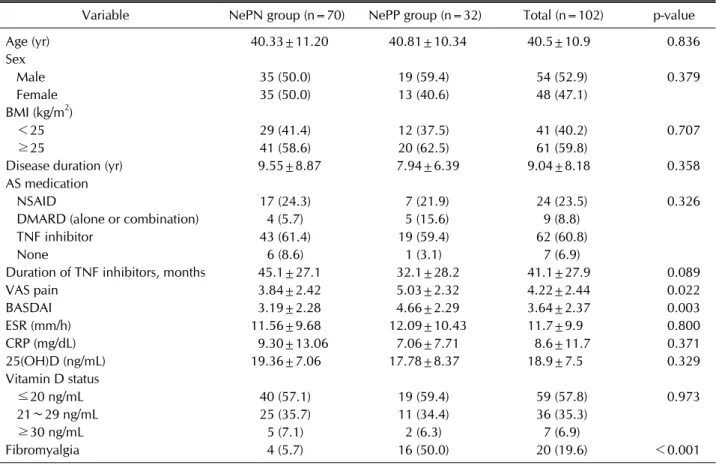
During the study period, 125 patients diagnosed with AS were enrolled; and eventually, 102 patients met eligi- bility criteria. Of 102 patients, 54 (52.4%) were males and 48 (46.6%) were females. The mean age of patients was 40.5±10.9 years. The demographic and clinical data of the AS patients are shown in Table 1.
Based on their PD-Q score, 31.4% of patients had the
NeP component (21 [20.6%]; clearly NeP and 11 [10.8%]; mixed NeP); 68.6% had no NeP component.
The clinical data for patients with and without NeP are presented in Table 1. In comparing the NePP and NEPN groups, there were no significant differences in age, gen- der and disease duration. However, VAS and BASDAI scores were significantly higher in the NePP group than in the NePN group (p=0.022 and 0.003, respectively). The serum 25(OH)D levels were low in both the groups, and the between-group difference did not reach statistical sig- nificance (p=0.329). The two groups were also com- parable in terms of vitamin D status (p=0.973). The fre- quency of fibromyalgia was 50.0% and 5.7%, respectively, in NePP and NePN groups, and this difference was highly significant (p<0.001).
Correlation analysis showed that PD-Q scores was pos- itively correlated with VAS and BASDAI (p<0.001, r=0.658 and p<0.001, r=0.633, respectively), and neg- atively correlated with duration of tumor necrosis factor
Table 2. Factors associated with NeP by univariate and multivariate logistic regression analysis
Variable Univariate analysis Multivariate analysis
OR 95% CI p-value OR 95% CI p-value
Age 1.004 0.966∼1.044 0.834
Sex 1.462 0.627∼3.409 0.380
BMI 1.179 0.499∼2.784 0.707
CRP 0.981 0.940∼1.024 0.375
Disease duration 0.974 0.922∼1.030 0.356
AS medication 1.114 0.736∼1.686 0.609
Fibromyalgia 16.500 4.851∼56.126 <0.001 16.500 4.851∼56.126 <0.001
25(OH)D 0.971 0.917∼1.029 0.326
BASDAI 1.315 1.087∼1.591 0.005
VAS 1.233 1.027∼1.481 0.025
NeP: neuropathic pain, OR: odds ratio, CI: confidence interval, BMI: body mass index, CRP: C-reactive protein, 25(OH)D:
25-hydroxyvitamin D, BASDAI: Bath Ankylosing Spondylitis Disease Activity Index, VAS: visual analog scale.
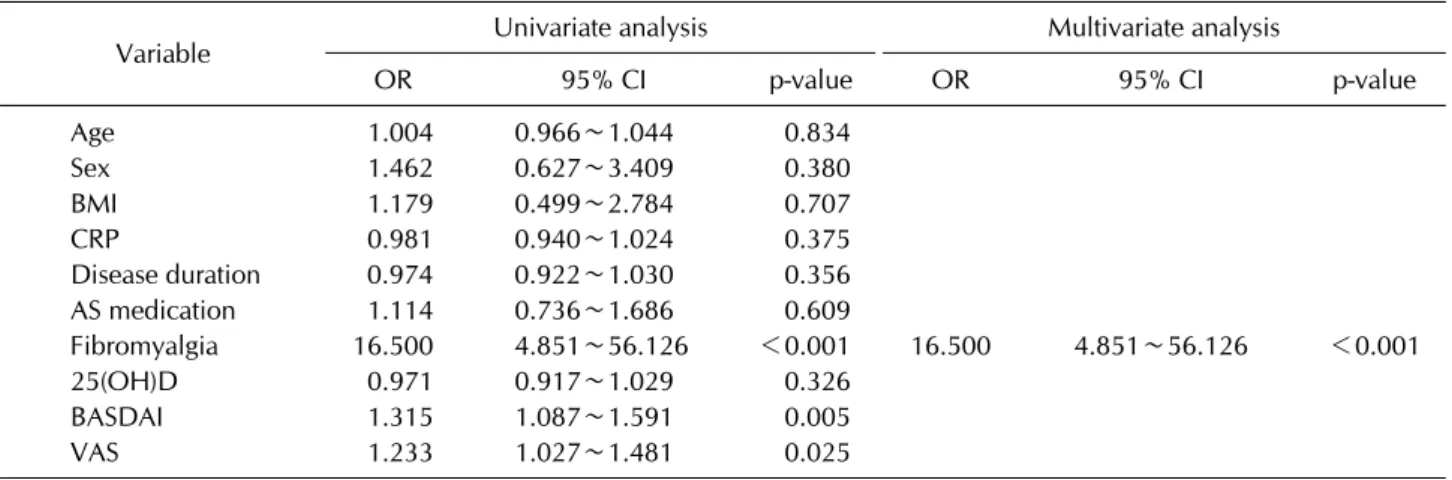
(TNF) inhibitors (p=0.039, r=–0.262). However, PD-Q scores were not significantly correlated with age (p=0.767), disease duration (p=0.085) and 25(OH)D levels (p=0.489). In logistic regression, only fibromyalgia was found to be statistically significant as a predictor of NeP (odds ratio [OR], 16.500; 95% confidence interval, 4.851∼56.126) (Table 2).
DISCUSSION
Our study provides new insights into the growing liter- ature suggesting that the NeP component is present in patients with axSpA. Of the 102 patients with AS in- cluded in the study, 21 (20.6%) clearly (very likely) had the NeP component (PD-Q score ≥19 points). Furthermore, the possible NeP component (PD-Q scores between 13 and 18 points), i.e., mixed pain, was present in 10.8% of the patients. Similar results were obtained in previous studies investigating the prevalence of NeP in patients with AS using the PD-Q [3-5]. These studies revealed the presence of the NeP component in 25%, 32.8%, and 35.2% of patients with AS, respectively. In addition, using the PD-Q, Wu et al. [6], detected the NeP component in 11 out of 17 AS patients with active disease and back pain.
A recently published meta-analysis showed that AS pa- tients with NeP had higher pain intensity, higher disease activity, and poorer quality of life than those without NeP.
In addition, NeP was higher in females than in males.
Moreover, HLA-B27 was present in significantly more pa- tients with NeP, compared to those without NeP. In con- trast, age, body mass index, symptom duration, and levels of systemic markers of inflammation (i.e., ESR and CRP
level) did not differ between patients with and without NeP [23]. The findings in our study were consistent, ex- cept for the gender ratio.
Fibromyalgia was considerably more frequent in pa- tients with NeP, and it was revealed to be an independent predictor of NeP by logistic regression analysis. Considering the current research on NeP in AS patients, it seems con- fusing whether the presence of fibromyalgia in these pa- tients can be excluded. Choi et al. [5] reported that con- comitant fibromyalgia in AS patients with NeP was sub- stantially higher, but it was not an independent predictor of NeP. Gok et al. [4] found similar frequency of fi- bromyalgia in patients with the NeP component com- pared to patients without it. On the other hand, in the study conducted by Geler-Külcü et al. [3], patients with AS with concomitant fibromyalgia, despite having similar methodology, were excluded. In our study, 19.6% of pa- tients had fibromyalgia according to the ACR 2010 fi- bromyalgia criteria, and more than half of them had a NeP component. The total number of female patients included in the study was relatively high, but 12 of the 20 patients with concomitant fibromyalgia were females. Depending on the criteria used, the frequency of concomitant fi- bromyalgia was found to be between 4% and 25% in pa- tients with AS [24]. However, in another study, interest- ingly, the frequency of fibromyalgia was found to be 19%–
29% by applying the ACR 1990 and 2010 FM criteria to the same AS cohort [25]. Using the PD-Q, a recent study revealed that 52.5% of the patients with fibromyalgia had a NeP component [18]. On the other hand, the PD-Q has been found to have low sensitivity and specificity in dis- tinguishing NeP in patients with fibromyalgia [26].
Understanding the complex relationship between fi- bromyalgia and NeP is challenging because of their clin- ical and neurobiological similarities [27]. A study using patient reported questionnaires in patients with diabetic polyneuropathy and fibromyalgia showed that both groups of patients experienced very similar sensory symptoms and that sensory profiles were overlapping in 20%∼35% of patients [28]. The presence of NeP in in- flammatory arthritis is quite new to diabetic poly- neuropathy, and self-assessment questionnaires have generally been used in current research; however, our knowledge of their uses and validity is very limited.
Therefore, in cross-sectional studies, it may be not possi- ble to determine whether the NeP component in patients with AS is related to the disease itself or to fibromyalgia and whether fibromyalgia or AS contributes to the pa- tients’ current NeP using self-administered questionnaires, such as the PD-Q.
We found no substantial difference in the vitamin D lev- els or status (sufficiency, insufficiency, and deficiency) between AS patients with and without NeP. Most re- search has primarily addressed the relationships between diabetic peripheral neuropathy and vitamin D. The re- sults of a recent meta-analysis showed that there is a close relationship between vitamin D and diabetic peripheral neuropathy, and vitamin D deficiency is one of the risk factors for neuropathy [29]. Moreover, some previous studies have reported that vitamin D replacement treat- ment has beneficial effects on neuropathic signs/symp- toms in patients with diabetic NeP and vitamin D defi- ciency [30,31]. However, in a recently published study, possible NeP was detected in 26.8% of 236 diabetic pa- tients using the PD-Q; no significant relationship was ob- served when comparing the vitamin D status of patients with and without NeP. The authors interpreted in- compatibility with previous studies as a result of the lim- ited sample size and the use of a different neuropathy as- sessment tool (i.e., the PD-Q) [32]. Yesil et al. [33] de- tected NeP in 33.3% of 93 patients with rheumatoid ar- thritis (RA) using the Leeds Assessment of Neuropathic Symptoms and Signs (LANSS) pain scale. In their study, the mean serum 25(OH)D level was lower than 20 ng/mL in patients with NeP and higher than 20 ng/mL in pa- tients without NeP, and there was a significant difference between the two groups. Furthermore, the prevalence of NeP was about six times greater in patients with vitamin D deficiency than in those with sufficient levels of vitamin D. In contrast to RA, the lack of a reasonable association
between NeP and vitamin D deficiency in patients with AS could be attributed to the relatively small number of patients with NeP as well as the methodological differ- ences in our study.
In our study, we found no significant difference in medi- cation use between AS patients with and without NeP.
The frequency of those using NSAIDs or TNF inhibitors was similar in both groups. There was only a weak neg- ative correlation with the PD-Q scores and the duration of TNF inhibitors. Approximately two-thirds of all patients in our study had been using TNF inhibitors for a long pe- riod (at least 6 months). Wu et al. [34] demonstrated that TNF inhibitors could reduce NeP severity in a small pro- portion of AS patients with NeP. Similarly, in our study, the severity of pain and PD-Q scores of the patients using TNF inhibitors were lower in the NeP group compared to those who did not (data not shown). In a recently pub- lished study, almost all 58 AS patients were taking NSAIDs, while 22 patients were taking TNF inhibitors. In this study, NeP was detected in 50% of the patients [35].
Thus, although anti-inflammatory agents appear to alle- viate NeP severity in patients with AS, this findings con- firm that they are not sufficient for NeP treatment.
Several limitations of the present study need to be noted. We used a self-assessment screening (and not di- agnostic) questionnaire to evaluate the NeP component of patients. Therefore, it cannot replace the clinical his- tory and examination, which also assess the functions of the somatosensory system. In addition, the fact that only 32 patients had NeP component may have weakened the strength of logistic regression to evaluate variables. As far as we know, our study is the first to explore the relation- ship between NeP and vitamin D status in patients with AS. However, our results should be viewed with caution because of the cross-sectional study design. Longitudinal studies are required in patients with AS to validate poten- tial causal relationships between NeP and vitamin D sta- tus or medication use.
CONCLUSION
This study confirmed that This study confirmed that about one-third of AS patients have the NeP component.
In addition, NeP was found to be associated with the fre- quency of fibromyalgia. However, no relation was found between NeP and vitamin D status and medication use in AS. Furthermore, the pain severity and disease activity were higher in patients with NeP than in those without
NeP. Further research is necessary to confirm our findings and related mechanisms.
ACKNOWLEDGMENTS
This research was supported by Erciyes University Research Foundation (Project Number TTU-2019-9511).
CONFLICT OF INTEREST
No potential conflict of interest relevant to this article was reported.
AUTHOR CONTRIBUTIONS
Conceptualization: S.M. and M.K. Data acquisition:
S.M., M.K., and İ.C. Formal analysis: S.M and İ.C.
Funding: Erciyes University. Supervision: M.K. Writing—
original draft: S.M. and İ.C. Writing—review & editing:
İ.C. and M.K.
REFERENCES
1. Carli L, Calabresi E, Governato G, Braun J. One year in re- view 2018: axial spondyloarthritis. Clin Exp Rheumatol 2019;37:889-98.
2. Kiltz U, Baraliakos X, Regel A, Bühring B, Braun J. Causes of pain in patients with axial spondyloarthritis. Clin Exp Rheumatol 2017;35 Suppl 107:102-7.
3. Geler-Külcü D, Batıbay S, Öztürk G, Mesci N. The associa- tion of neuropathic pain and disease activity, functional lev- el, and quality of life in patients with ankylosing spondylitis:
a cross-sectional study. Turk J Med Sci 2018;48:257-65.
4. Gok K, Cengiz G, Erol K, Ozgocmen S. Neuropathic pain component in axial spondyloarthritis and the influence on disease burden. J Clin Rheumatol 2018;24:324-7.
5. Choi JH, Lee SH, Kim HR, Lee KA. Association of neuro- pathic-like pain characteristics with clinical and radio- graphic features in patients with ankylosing spondylitis.
Clin Rheumatol 2018;37:3077-86.
6. Wu Q, Inman RD, Davis KD. Neuropathic pain in ankylos- ing spondylitis: a psychophysics and brain imaging study.
Arthritis Rheum 2013;65:1494-503.
7. Lampa J. Pain without inflammation in rheumatic diseases.
Best Pract Res Clin Rheumatol 2019;33:101439.
8. Bidad K, Gracey E, Hemington KS, Mapplebeck JCS, Davis KD, Inman RD. Pain in ankylosing spondylitis: a neuro-im- mune collaboration. Nat Rev Rheumatol 2017;13:410-20.
9. Pathan EMI, Inman RD. Pain in spondyloarthritis: a neu- ro-immune interaction. Best Pract Res Clin Rheumatol 2017;31:830-45.
10. Zhao S, Duffield SJ, Moots RJ, Goodson NJ. Systematic re- view of association between vitamin D levels and suscepti- bility and disease activity of ankylosing spondylitis. Rheumatology
(Oxford) 2014;53:1595-603.
11. Celikbilek A, Gocmen AY, Tanik N, Borekci E, Adam M, Celikbilek M, et al. Decreased serum vitamin D levels are as- sociated with diabetic peripheral neuropathy in a rural area of Turkey. Acta Neurol Belg 2015;115:47-52.
12. Chao CT, Chiang CK, Huang JW, Hung KY. Vitamin D is closely linked to the clinical courses of herpes zoster: from pathogenesis to complications. Med Hypotheses 2015;85:
452-7.
13. Jones GT, Mallawaarachchi B, Shim J, Lock J, Macfarlane GJ.
The prevalence of fibromyalgia in axial spondyloarthritis.
Rheumatol Int 2020;40:1581-91.
14. Sayın S, Yurdakul FG, Sivas F, Bodur H. Is fibromyalgia fre- quency increasing in axial spondyloarthritis? Association with fibromyalgia and biological therapies. Rheumatol Int 2020;40:1835-41.
15. Duffield SJ, Miller N, Zhao S, Goodson NJ. Concomitant fi- bromyalgia complicating chronic inflammatory arthritis: a systematic review and meta-analysis. Rheumatology (Oxford) 2018;57:1453-60.
16. Cheng CW, Wong CS, Hui GK, Chung EK, Wong SH.
Fibromyalgia: is it a neuropathic pain? Pain Manag 2018;8:
377-88.
17. Ueda H. Systems pathology of neuropathic pain and fibromyalgia. Biol Pharm Bull 2019;42:1773-82.
18. Kösehasanoğullari M, Erdinç Gündüz N, Akalin E. Is fi- bromyalgia syndrome a neuropathic pain syndrome? Arch Rheumatol 2018;34:196-203.
19. Zochling J. Measures of symptoms and disease status in an- kylosing spondylitis: Ankylosing Spondylitis Disease Activity Score (ASDAS), Ankylosing Spondylitis Quality of Life Scale (ASQoL), Bath Ankylosing Spondylitis Disease Activity Index (BASDAI), Bath Ankylosing Spondylitis Functional Index (BASFI), Bath Ankylosing Spondylitis Global Score (BAS-G), Bath Ankylosing Spondylitis Metrology Index (BASMI), Dougados Functional Index (DFI), and Health Assessment Questionnaire for the Spondylarthropa- thies (HAQ-S). Arthritis Care Res (Hoboken) 2011;63 Suppl 11:S47-58.
20. Freynhagen R, Baron R, Gockel U, Tölle TR. painDETECT:
a new screening questionnaire to identify neuropathic com- ponents in patients with back pain. Curr Med Res Opin 2006;22:1911-20.
21. Alkan H, Ardic F, Erdogan C, Sahin F, Sarsan A, Findikoglu G. Turkish version of the painDETECT questionnaire in the assessment of neuropathic pain: a validity and reliability study. Pain Med 2013;14:1933-43.
22. Wacker M, Holick MF. Vitamin D - effects on skeletal and extraskeletal health and the need for supplementation.
Nutrients 2013;5:111-48.
23. Kim TW, Son SM, Lee JS. Neuropathic pain in ankylosing spondylitis: a meta-analysis. Z Rheumatol 2020;79:95-102.
24. Zhao SS, Duffield SJ, Goodson NJ. The prevalence and im- pact of comorbid fibromyalgia in inflammatory arthritis.
Best Pract Res Clin Rheumatol 2019;33:101423.
25. Baraliakos X, Regel A, Kiltz U, Menne HJ, Dybowski F, Igelmann M, et al. Patients with fibromyalgia rarely fulfil classification criteria for axial spondyloarthritis. Rheumatology (Oxford) 2018;57:1541-7.
26. Gauffin J, Hankama T, Kautiainen H, Hannonen P, Haanpää M. Neuropathic pain and use of PainDETECT in patients
with fibromyalgia: a cohort study. BMC Neurol 2013;13:21.
27. Maletic V, Raison CL. Neurobiology of depression, fi- bromyalgia and neuropathic pain. Front Biosci (Landmark Ed) 2009;14:5291-338.
28. Koroschetz J, Rehm SE, Gockel U, Brosz M, Freynhagen R, Tölle TR, et al. Fibromyalgia and neuropathic pain--differ- ences and similarities. A comparison of 3057 patients with diabetic painful neuropathy and fibromyalgia. BMC Neurol 2011;11:55.
29. Zhang B, Zhao W, Tu J, Wang X, Hao Y, Wang H, et al. The relationship between serum 25-hydroxyvitamin D concen- tration and type 2 diabetic peripheral neuropathy: a system- atic review and a meta-analysis. Medicine (Baltimore) 2019;98:e18118.
30. Sari A, Akdoğan Altun Z, Arifoglu Karaman C, Bilir Kaya B, Durmus B. Does vitamin D affect diabetic neuropathic pain and balance? J Pain Res 2020;13:171-9.
31. Lee P, Chen R. Vitamin D as an analgesic for patients with
type 2 diabetes and neuropathic pain. Arch Intern Med 2008;168:771-2.
32. Alkhatatbeh M, Abdul-Razzak KK. Neuropathic pain is not associated with serum vitamin D but is associated with fe- male gender in patients with type 2 diabetes mellitus. BMJ Open Diabetes Res Care 2019;7:e000690.
33. Yesil H, Sungur U, Akdeniz S, Gurer G, Yalcın B, Dundar U.
Association between serum vitamin D levels and neuro- pathic pain in rheumatoid arthritis patients: a cross-sec- tional study. Int J Rheum Dis 2018;21:431-9.
34. Wu Q, Inman RD, Davis KD. Tumor necrosis factor in- hibitor therapy in ankylosing spondylitis: differential effects on pain and fatigue and brain correlates. Pain 2015;156:
297-304.
35. Borman P, Kaygisiz F, Yaman A. Neuropathic component of low back pain in patients with ankylosing spondylitis. Mod Rheumatol 2021;31:462-7.