- 7-
알레르기비염에서의 유전적 역할
원광대학교 의과대학 이비인후-두경부외과학교실
이 재 훈·고 승 현 Genetic Role in Allergic Rhinitis
Jae Hoon Lee, MD and Seung Hyun Koh, MD
Department of Otolaryngology-Head and Neck Surgery, Institute of Wonkwang Medical Science, College of Medicine, Wonkwang University, Iksan, Korea
ABSTRACT
Allergic rhinitis is an inflammatory disease of the nasal mucosa, induced by an IgE-mediated reaction following exposure to an allergen. Allergic rhinitis is a global health problem, with a prevalence of between 9-42% among the general population.
While it is known that allergic rhinitis does not exhibit a Mendelian hereditary pattern, the disease does have a hereditary component. The development of allergic rhinitis entails a complex interaction between genetic predisposition and environ- mental exposure to different factors, of which the most important is the implicated allergen. Genetic studies about several atopic diseases, including allergic rhinitis, are now actively in progress, but most of the studies focus on asthma and adverse drug reactions. Current genetic studies of allergic rhinitis include family and twin studies, genome-wide linkage analyses, and candidate gene association studies. Also ongoing are studies to identify susceptibility genes and to understand factors influencing gene expression.
KEY WORDS:Allergic rhinitis·Genetic·Multifactorial.
서 론
알레르기비염은 알레르겐에 노출 되었을 때 IgE 매개반 응에 의해 유발되어지는 비강점막의 염증성 질환이다. 전 세 계 인구의 9~42%가 이환되어 있으며, 비록 심각한 질환은 아니지만, 삶의 질에 상당한 영향을 끼치고, 학교와 직장 생활에 영향을 주며, 사회생활의 변화를 가져올 수 있다.1) 또한 알레르기비염은 천식의 위험 인자로 알려져 있다.2)
알레르기 질환은 유전적 소인을 가진다. 알레르기 질환의 가족력이 있는 경우, 현저히 그 유병률이 높다. 양쪽 부모 중 어느 한쪽이 알레르기 질환을 지닌 경우 약 50%에서, 부모가 모두 알레르기 질환을 지닌 경우 약 75%에서 자식 에게 알레르기 질환이 나타날 확률이 보고되고 있다. 부모 모두 알레르기 질환이 없는 경우 10~15% 정도에서 자식에
게 알레르기질환이 나타난다고 알려져 있다.3)
알레르기 질환의 발생은 유전적 성향이 강하지만, 단독 유 전자좌(single gene locus)에 국한된 전형적인 멘델유전방 식(Mendelian hereditary pattern)을 보이지는 않으며, 다 양한 유전자들의 상호작용과 환경적인 요인들의 복합적인 과정에 의해 발생한다.4-7) 하지만, 알레르기에 대한 유전성 이 있는 사람 중 얼마나 많은 사람이 알레르기 환자가 되는 지는 확실하지 않다.8) 아토피성 알레르기 질환의 가족 내 발 현이 높은 점, 일란성 쌍생아에서 이란성 쌍생아보다 질환의 합치율이 높은 점 등은 유전적 배경을 암시하고 있지만, 일 란성 쌍생아의 일치율도 50%를 넘지 않아, 환경적인 요인 도 이와 동등한 정도의 연관이 있을 수 있음을 의미하기 때 문에 유전자간의 상호작용과 환경인자와의 관련성을 이해 해야 한다.5-7)
알레르기비염을 비롯한 여러 아토피성 질환에 대한 유전 적 연구는 현재 활발히 진행되고 있지만, 대부분 천식과 약 물이상반응 연구에 집중되어 있다.9) 알레르기비염에 있어 서의 유전 연구는 가족과 쌍생아 연구, 면역학적 연구 즉, 논문접수일:2010년 3월 17일
교신저자:이재훈, 570-749 전북 익산시 신용동 344-2 원광대학교 의과대학 이비인후-두경부외과학교실 전화:(063) 859-1441·전송:(063) 841-6556 E-mail:[email protected]
전체 게놈 연계분석(genome-wide linkage analysis)과 후 보 유전자 연관성 연구(candidate gene association study) 등이 있으며, 이와 더불어 감수성 있는 유전자(susceptibility gene)와 유전자의 발현에 영향을 미치는 요인들에 대한 연 구가 진행되고 있다.
알레르기 질환이 증가 하는 원인
최근 수십 년간 알레르기 질환은 특히 산업화된 국가에 서 급속히 증가 하고 있으며, 이러한 현상은 생활 여건의 향 상과 백신의 효과 및 세균감염의 기회 감소 등 환경적인 변 화에 기인한다는 위생가설(hygiene hypothesis)로 설명하는 학자들이 있다.10) 그러나 알레르기 질환이 증가하는 이유를 위생가설 등으로 모두 설명하기는 어려우며, Bousquat 등 은 추정되는 요인으로 생활습관의 변화 즉, 알레르겐, 대 기 오염 및 연기나 가스 같은 자극물에 대한 노출증가, 모 유수유의 감소, 육류 및 인스턴스 식품위주의 식생활 변화, 예방접종과 의학의 발달 등으로 세균 등 미생물에 노출될 기회가 감소하여 인체 내 면역체계가 자극 받을 수 있는 기 회의 감소, 스트레스 등이라고 하였다.11) 그 외에도 외국과 의 교류가 많아지면서 새로운 알레르기 원인 물질이 들어
와 노출될 기회가 증가한 것도 원인이 될 수 있다.
알레르기비염의 유전형태
유전적 요인에 의해 발생되는 질병들은 3가지 주요 유형으 로 나눌 수 있다. 단일 유전인자 질환(single gene disorders) 은 개개의 유전인자의 돌연변이에 의해 발생되는 것이다. 단 일 유전인자 질환은 대개 확실하고 특징적인 가계도의 특 성을 보인다.
염색체 질환(chromosome disorders)은 하나의 오류가 아 니라 염색체 전체 혹은 염색체 일부에 존재하는 유전인자 가 많아지거나 적어진 것에 기인한다. 예를 들어 21번 염색 체가 하나 더 있는 경우 개개의 유전인자에는 아무 이상이 없을지라도 다운증후군을 나타낸다.
다인자성 유전(multifactorial disorders)은 선천성 기형을 일으키는 발생과정의 질병과 많은 종류의 성인 질환의 유전 양식이다. 알레르기비염도 다인자성 유전에 해당된다. 여러 유전인자들의 작은 변이들이 함께 작용하여 심각한 결손을 일으키거나 일으킬 소지(predisposition)를 갖게 되는데, 주 로 환경적인 요인도 함께 작용하게 된다. 즉, 알레르기 질 환은 하나 이상의 유전자좌들에 존재하는 유전형(genotype)
Fig. 1. Risk factor of allergic rhinitis (adopted from Risk factors of allergic rhinitis:genetics or environmental? Ther Clin Risk Manag 2005;1:115-23).
과 이러한 질환의 진행을 유발하고 증진시키고 악화시키는 다양한 환경에 노출되는 것을 포함하는 병에 걸리기 쉽게 하 는 요소들사이의 복잡한 상호작용들에 의해 발생하게 된다 (Fig. 1).12) 다인자성 질환은 가족 내에서 재발되는 경향을 보이지만 단일 유전인자 질환에서처럼 특징적인 가계도 양 상을 나타내지는 않는다.
다인자성 유전은 다음과 같은 4가지의 특징을 갖는다.13) 1) 복합 유전질환들은 단일 유전인자 질환은 아니며 단 순히 멘델의 유전법칙을 따르지 않는다.
2) 복합 유전질환의 경우 가계집성 현상(familial aggre- gation)을 보이게 되는데 이는 질환자의 친척들이 관련이 없 는 사람들보다는 질환자와 공유하는 질환에 걸리기 쉬운 대 립유전인자들을 더 가질 가능성이 높기 때문이다.
3) 관련된 유전자좌들에서 질환에 걸리기 쉬운 유전인자 형을 공유하는 다수의 친척들은 표현형이 꼭 일치하지 않 을 수 있는데(발현의 결여) 이는 질병유발에 있어 비유전적 요소들이 결정적인 역할 때문이다. 동일한 유전인자형을 보 임에도 불구하고 가장 극단적인 발현의 결여를 보이는 예로 서 불합치하는 일란성 쌍생아가 있다.
4) 질환은 발단자와 가까운 친척들 사이에서 더 호발하며, 이와 멀수록 덜 발생한다. 질환의 더 큰 합치는 일란성 쌍생 아 대 이란성 쌍생아들 사이에서 기대된다.
알레르기 질환의 유전적 기초 연구
가족 연구(Family studies)
알레르기비염과 같이 복합유전(complex inheritance)의 양상을 보이는 질환들의 주요 특징은 질병에 이환된 사람들 이 무리 지어 나타난다는 것이다(가계집성 현상). 가계집성 현상이 우연히도 같이 일어난 일인지 아니면 그 가계 구성 원들에게 공통적인 요소들의 영향으로 인한 결과인지를 결 정하는 것이며, 그러한 공통요소들이 유전적인 것과 환경 적인 것의 정도가 어느 정도 되는지를 가늠하는 것이다.
궁극적으로 여기에 관여된 특정 유전자좌와 대립유전인자 들을 파악하는 유전인자지도 연구(gene mapping study)를 하게 되면 다인자성 질환에 대한 유전적 기여를 확실하게 증명할 수 있다.
쌍생아 연구(Twin studies)
다인자성 질환에서 환경적인 효과로부터 유전적 영향의 기여도를 파악하고자 하는 방법으로 발단자와 다소 밀접하 게 관련되어 있는 친척들 가운데서 질환합치(disease con- cordance)를 비교하는 방법이 있다. 유전인자들이 그 질환
에 대해 중요한 기여 인자라고 할 때 질환합치의 빈도는 관 련성의 강도가 증가할수록 증가하게 된다. 공통적으로 대 립유전인자들을 가지게 되는 가장 극단적인 예가 모든 위 치에서 같은 대립유전인자를 갖는 일란성 쌍생아이다. 그 다음으로 밀접한 연관을 갖는 사람들은 부모와 자식, 이란 성 쌍생아를 포함한 형제이다. 부모-자식 사이에서 자식은 모든 유전자좌에서 각 부모와 공통된 한 개의 대립유전인 자를 가지고 있게 되는데 이것은 그 대립유전인자가 부모 로부터 유전된 것을 뜻한다. 형제간에는(이란성 쌍생아를 포함해서) 그 사정이 조금 다르다. 형제들은 한 유전자좌에 서 양쪽 대립유전인자가 같은 경우가 25%, 한쪽 대립유전 인자만 같은 경우가 50%, 양쪽대립유전인자가 다 다른 경 우가 25%이다.13)
알레르기에서 쌍생아 연구는 1971년 Edfors-Luds 등에 의해서 처음으로 연구 되었으며, 7,000쌍의 쌍생아 연구에 서 알레르기비염이 유전적인 성격을 보여준다고 하였다.14) 또한 연구에서는 일란성 쌍생아의 경우 알레르기비염이 45~
60%의 합치율이 관찰되고, 이란성 쌍생아에서는 25%의 합 치율이 있다고 보고하였다. 이 연구를 기반으로 하여 알레르 기비염이 0.33~0.75의 유전율(inheritability)을 나타낸다고 예상하였다.6)7)
유전자 연구
전체 게놈 연구(Genome-wide search)
질병을 일으키는 유전자를 밝혀내는 한 가지 접근법으로 전체 게놈 연구가 있다. 전체 게놈 연구는 가계도를 통해 질 환 및 중간 표현형과 연결된 염색체 내의 유전자좌를 확인 하는 것으로, 정밀 맵핑(fine-mapping;염색체에 있는 유 전자의 위치를 정확하게 결정하는 것)과 위치적 클로닝(pos- itional cloning)에 의한 유전 연구들이 가장 신뢰성 있는 접 근으로 여겨진다. 알레르기비염의 경우 많은 유전자 연구가 행해졌다(Table 1).7)15-20)
2001년 Haagerup은 446개의 microsatellite maker를 이 용하여 적어도 두 명의 형제에서 알레르기가 진단된 33개의 가족에 대한 연구를 수행하였다. 염색체 4q24~q27에서 하 나의 일차적인 후보을 밝혀내었고, 8개의 2차적 후보를 밝 혀냈다.15) 또한 Yokouchi 등은 오리새(Dactylis glomerata) 에 의한 알레르기비염을 가진 48개의 일본가족에 대한 유 전 연관 연구에서 알레르기비염이 염색체 1p26.2, 4q13.3, 9q34.3에 연관이 있음을 밝혀냈고, 염색체 5q33.1에 약한 연관이 있음을 밝혀 냈다.16) 하지만, 전반적인 게놈 스크리 닝을 이해하기 어렵고, 복잡한 질환의 유전을 분석하는 좋
은 방법이 없어 후보 유전자 연구를 하게 되었으며, 후보 유전자에서 유전자 다형성(polymorphism)을 밝혀 내는데 최 근 더 큰 관심을 가지고 있다.21)22)
단일 염기 다형성
(Single Nucleotide Polymorphism;SNP)
인구의 1% 이상에서 나타나는 DNA 염기 서열의 변이를
유전자 다형성이라고 부르고 그 중 하나의 염기 변화에 의 한 것을 SNP라고 한다. 이것은 이차적으로 유전자의 기능 적 변화를 초래하고 환경적 요인에 대한 감수성에 영향을 주게 된다. 복잡한 유전 질환에 기여하는 대부분의 유전적 변이는 SNP의 변화로써 발현 된다고 여겨지고 있다. SNP 는 인간 유전자 DNA에서 대략 1,000분의 1 정도의 염기쌍 에서 나타난다. 즉 인간 게놈에는 4억 2천만 염기들이 있으 므로 적어도 400백만 SNP가 키, 몸무게, 인격, 눈 색깔, 머
Table 1. Genomic searches conducted in allergic rhinitis
Population Sample Associated chromosomal regions Reference
Danish 424 individuals from 100 families, of which selection was made of 33 families with at least 2 siblings diagnosed with AR
Principal association:4q24-q27
Other candidate regions:2q12-q33, 3q13, 4p5-q12, 5q13-q15, 6p24-p23, 12p13, 22q13, y Xp21
(15)
Japanese 48 Japanese families (188 members) with at least 2 siblings with AR due to Dactilys glomerata
1p36.2, 4q13.3 y 9q34.3 Weak linkage to 5q33.1 (16)
Danish 424 individuals from 100 families Region 4q32.2 (17)
French 295 families with at least one asthmatic 2q32, 3p24-p14, 9p22 and 9q22-q34 with RA 1p31 p with asthma and AR
(18) Swedish 250 families initially included in an atopic
dermatitis linkage study
Most intense association:3q13, 4q34-35 y 18q12 Weakest association:
6p22-24, 9p11-q12, 9q33.2-34.3 y 17q11.2
(19)
Danish Three independent populations with a total of 236 families, including 125 sibling couples with rhinitis
3q13.31 (20)
adopted from Genetic aspects of allergic rhinitis. J Investig Allergol Clin Immunol 2009;19:25-31
Table 2. Polymorphisms for which a positive association to allergic rhinitis has been described
Genes Chromosome Population Associated polymorphisms and gene Reference
3p21.3 Japanese A111G, Arg127Cys, Arg252G1n CCXCR1
T885C CCR1
Val64I1e y T780C CCR2 T51C CCR3
Arg223G1n CCR5
(36)
4q21 Japanese SNP in haplotypic block SDAD1, CXCL9, CXCL10
and CXCL11
(37)
17q11 Korean -430A y-28G RANTES (38)
Chemokines or their receptors
7q11.22 Korean +2497T>G Eotaxin-3 (39)
11q22 Czech -607 IL-18 (AR due to Alternaria) (40)
1p36.11 Korean and Chinese G>A IL-28RA (41)
11q22 Korean IL-18/-607 (42)
5q31 Korean G2044A IL-13 (43)
Interleukins or their receptors
5q31 (IL 13) 10p 15 (GATA 3)
Isle of Wight (UK) Combinations of polymorphisms of IL-13 and GATA3
(43)
17q23 Japanese Pro358Leu EPO (44)
Eosinophils
17q23 Japanese 202Arg in exon 6 y 358Leu in exon 7 EPO (45)
Leukotrienes 5q35 Turkish A-444C LTC4S (46)
5q31.1 Korean C-159T CD14 (47)
20p13 Japanese 7575G/A, 9073G/A, 12540C/T
10918G/C,12433T/C, 12462C/T
(48) 17q22 Korean g.-460C>T, g.1805G>T, g.3375G>C
FOXJI
(49) Other genes
1q21 Turkish 131R FcγRIIA (50)
adopted from Genetic aspects of allergic rhinitis. J Investig Allergol Clin Immunol 2009;19:25-31
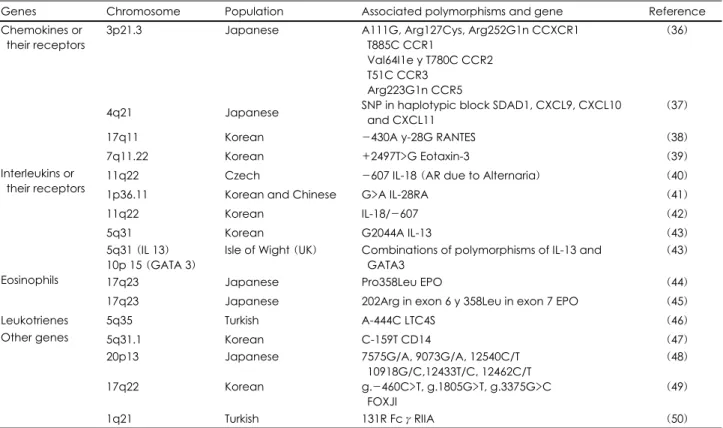
리색깔, 기타 등등 모든 개개인의 특성에 기여하게 된다.7)11)21) 일단, 전체 게놈 연구나 관련 연구를 통해서 위치가 밝혀지 면, 특정 유전자 다형성의 역할이 어떤 기능을 하는지, 어떤 표현형으로 나타나는지 알아내는 기능적 연구를 수행한다.
후보 유전자(Candidate Gene) 연구
후보 유전자란 특정 유전자가 질병에 영향을 미칠 가능성 이 큰 경우를 말한다. 현재 인간 유전체 연구에서 많은 후 보 유전자들을 찾아 냈다(Table 2).7) 전체 게놈 연구에서 염 색체의 14쌍이상의 표지자(chromosome 1, 2, 3, 5, 6, 7, 9, 11, 12, 14, 16, 19 etc)와 알레르기 질환의 특정한 표현형 사 이의 연관성을 확인 할 수 있었다. 이 유전자중 일부는 특이 면역 반응(HLA-D, TCR, CD14, toll-like receptor, STAT6) 과 Th1/Th2 세포 분화를 포함하고 있고, 일부 유전자들 은 Ig E 반응 또는 Ig E 수용체의 기능(IL-4, IL-4R, TcεRI β, FcεRI)과 염증과정(TNF-γ, IFN-γ, IL-3)을 포함한
다.13)23-31) 현재 대부분의 유전체 연구는 이와 같은 후보유전
자의 유전자 다형성과 알레르기 증상 발현의 연관성을 관찰 하는 연구로 진행되고 있지만, 아직은 혼동되는 결과를 나타 내고 있으며, 여러 문헌에서 각 인종마다 상이한 결과32-35)를 보이고 있어 이에 대한 재현성 여부와 임상적 유용성에 대 한 검토가 필요하다.
결 론
지난 수십 년간 알레르기비염에서 유전적 영향 및 알레르 기비염에 관여하는 다양한 유전자들 그리고 유전자들의 기 능에 대해 많은 부분을 밝혀내었다. 하지만 알레르기비염의 유전학적 연구는 앞으로 나아갈 길이 멀다. 알레르기비염을 일으키는 위험요소와 그 위험요소를 발현하게 만드는 감수 성 유전자를 밝혀내야 하며, 좀 더 나아간다면 유전자 정보 에 근거한 진단법을 알아 낼 수 있겠으며, 이에 대한 예방 및 치료에 있어서도 유전학적인 자료를 바탕으로 한 단계 진보한 방법을 찾을 수 있겠다. 현재 여러 유전인자에 대한 지식, 다양한 대립유전인자의 특성 및 이러한 변형된 대립유 전인자가 질환을 일으키는 기전에 대해 활발히 연구되고 있으 며, 계속적인 새로운 사실이 밝혀지고 있다. Human genome project에서 얻어진 정보들이 복합 유전하는 질환들에 적용 되어 임상의와 유전 학자가 멀지 않은 미래에 알레르기 질환 들에 대해 정확한 분자 유전학적인 진단에 필요한 정보를 얻 을 수 있기를 기대한다.
중심 단어:알레르기비염·유전·다인자.
REFERENCES
1) Settipane RA, Charnock DR. Epidemiology of rhinitis: allergic and nonallergic. Alin Allergy Immunol 2007;19:23-34.
2) Mullol J, Valero A, Alobid I, Bartra J, Navarro AM, Chivato T, et al. Allergic Rhinitis and its Impact on Asthma update (ARIA 2008) The perspective from Spain. J Investig Allergol Clin Immunol 2008;
18:327-34.
3) McKee WD. The incidence and familial occurrence of allergy. J Allergy 1966;38:226-9.
4) Sadanaga Y, Uno M, Kitao Y, Ishikawa T. Investigation of genetic regulation in allergic rhinitis. Auris Nasus Larynx 1990;17:23-32.
5) 대한 천식 및 알레르기 학회. 4천만의 알레르기: 의학문학사;
2005. p.9-21.
6) Feijen M, Gerritsen J, Postma DS. Genetics of allergic disease. Br Med Bull 2000;56:894-907.
7) Davila I, Mullol J, Ferrer M, Bartra J, Cuvillo AD, Montoro J, et al.
Genetic aspects of allergic rhinitis. J Investig Allergol Clin Im- munol 2009;19:25-31.
8) Lynch NR, Medouze L, Di Prisco-Fuenmayor MC, Verde O, López RI, Malave C. Incidence of atopic disease in a tropical environment:
Partial independence from intestinal helminthiasis. J Allergy Clin Immunol 1984;73:229-32.
9) Kim SH, Park HS. Genetic studies of allergic disease and their cli- nical implications. Korean J Med 2009;76:416-24.
10) Strachan DP. Hay fever, hygiene and household size. BMJ 1989;
299:1259-60.
11) Bousquet J, Van Cauwenberg P, Khaltaev N. Allergic rhinitis and its impact on asthma. J Allergy Clin Immunol 2001;108:S147-334.
12) Wang DY. Risk factors of allergic rhinitis: genetics or enviromental?
Ther Clin Risk Manag 2005;1:115-23.
13) 의학 유전학 편찬 위원회. Thompson & Thompson 의학 유전 학: 정담;2002. p.289-311.
14) Edfors-Lubs ML. Allergy in 7000 twin pairs. Acta Allergol 1971;
26:249-85.
15) Haagerup A, Bjerke T, Schøitz PO, Binderup HG, Dahl R, Kruse TA. Allergic rhinitis - a total genome-scan for susceptibility genes suggests a locus on chromosome 4q24-q27. Eur J Hum Genet 2001;
9:945-52.
16) Yokouchi Y, Shibasaki M, Noguchi E, Nakayama J, Ohtsuki T, Kamioka M, et al. A genome-wide linkage analysis of orchard grass-sensitive childhood seasonal allergic rhinitis in Japanese fa- milies. Genes Immun 2002;3:9-13.
17) Haagerup A, Børglum AD, Binderup HG, Kruse TA. Fine-scale mappingof type I allergy candidate loci suggests central susceptibility geneson chromosomes 3q, 4q and Xp. Allergy 2004;59:88-94.
18) Dizier MH, Bouzigon E, Guilloud-Bataille M, Genin E, Oryszczyn MP, Annesi-Maesano I, et al. Genome screen in the French EGEA study: detection of linked regions shared or not shared by allergic rhinitis and asthma. Genes Immun 2005;6:95-102.
19) Bu LM, Bradley M, Soderhall C, Wahlgren CF, Kockum I, Nor- denskjold M. Genome-wide linkage analysis of allergic rhinocon- junctivitis in a Swedish population. Clin Exp Allergy 2006;36:204-10.
20) Brasch-Andersen C, Haagerup A, Børglum AD, Vestbo J, Kruse TA. Highly significant linkage to chromosome 3q13.31 for rhinitis and related allergic diseases. J Med Genet 2006;43:e10.
21) John WS, Larry B. Genetics of allergic disease. Med Clin N Am 2006;90:1-15.
22) Hoh J, Ott J. Genetic dissection of disease: design and methods. Curr opin Genet dev 2004;14:229-32.
23) Cookson WO, Sharp PA, Faux JA, Hopkin JM. Linkage between immunoglobulin E responses underlying asthma and rhinitis and chromosome 11q. Lancet 1989;1:1292-5.
24) Barnes KC, Neely JD, Duffy DL, Freidhoff LR, Breazeale DR, Schou C, et al. Linkage of asthma and total serum IgE concentra- tion to markers on chromosome 12q: evidence from Afro-Caribbean and Caucasian populations. Genomics 1996;37:41-50.
25) Baldini M, Lohman IC, Halonen M, Erickson RP, Holt PG, Martinez FD. A polymorphism in the 5’ flanking region of the CD14 gene is associated with circulating soluble CD14 levels and with total serum immunoglobulin E. Am J Respir Cell Mol Biol 1999;20:976-83.
26) Deichmann KA, Starke B, Schlenther S, Heinzmann A, Sparholt SH, Forster J, et al. Linkage and association studies of atopy and the chromosome 11q13 region. J Med Genet 1999;36:379-82.
27) Shek LP, Tay AH, Chew FT, Goh DL, Lee BW. Genetic suscepti- bility to asthma and atopy among Chinese in Singapore - linkage to markers on chromosome 5q31-33. Allergy 2001;56:749-53.
28) Nishiyama C, Akizawa Y, Nishiyama M, Tokura T, Kawada H, Mitsuishi K, et al. Polymorphisms in the Fc epsilon RI beta promoter region affecting transcription activity: a possible promoter-depen- dent mechanism for association between Fc epsilon RI beta and atopy. J Immunol 2004;173:6458-64.
29) Park BL, Kim LH, Choi YH, Lee JH, Rhim T, Lee YM, et al. In- terleukin 3 (IL3) polymorphisms associated with decreased risk of asthma and atopy. J Hum Genet 2004;49:517-27.
30) Pykäläinen M, Kinos R, Valkonen S, Rydman P, Kilpeläinen M, Laitinen LA, et al. Association analysis of common variants of STAT6, GATA3, and STAT4 to asthma and high serum IgE phenotypes. J Allergy Clin Immunol 2005;115:80-7.
31) Weidinger S, Klopp N, Wagenpfeil S, Rümmler L, Schedel M, Kabesch M, et al. Association of a STAT 6 haplotype with elevated serum IgE levels in a population based cohort of white adults. J Med Genet 2004;41:658-63.
32) Tan EC, Lee BW, Tay AWN. Interleukin-4 receptor varient Q576R:
Ethnic differences and association with atopy. Clin Genet 1999;56:
333-4.
33) Noguchi E, Shibasaki M, Arinami T, Takeda K, Maki T, Miyamoto T, et al. Evidence for linkage between asthma/atopy in childhood and chromosome 5q31-q33 in a Japanese population. Am J Respir Crit Care Med 1997;156:1390-3.
34) Hershey GKK, Friedrich MF, Esswein LA, Thomas ML, Chatila TA.
The association of atopy with a gain-of-function mutation in the α subunit of the IL-4 receptor. N Engl J Med 1997;337:1720-5.
35) Kawashima T, Noguchi E, Arinami T, Yamakawa-Kobayashi K, Nakagawa H, Otsuka F, et al. Linkage and association if an in- terleukin 4 gene polymorphism with atopic dermatitis in Japanese Families. J Med Genet 1998;35:502-4.
36) Nakamura H, Higashikawa F, Nobukuni Y, Miyagawa K, Endo T, Imai T, et al. Genotypes and haplotypes of CCR2 and CCR3 genes
in Japanese cedar pollinosis. Int Arch Allergy Immunol 2007;142:
329-34.
37) Zhang J, Noguchi E, Migita O, Yokouchi Y, Nakayama J, Shi- basaki M, et al. Association of a haplotype block spanning SDAD1 gene and CXC chemokine genes with allergic rhinitis. J Allergy Clin Immunol 2005;115:548-54.
38) Kim JJ, Lee JH, Jang CH Kim YS, Chae SC, Chung HT, et al.
Chemokine RANTES promoter polymorphisms in allergic rhinitis.
Laryngoscope 2004;114:666-9.
39) Chae SC, Park YR, Oh GJ, Lee JH, Chung HT. The suggestive as- sociation of eotaxin-2 and eotaxin-3 gene polymorphisms in Korean population with allergic rhinitis. Immunogenetics 2005;56:760-4.
40) Sebelova S, Izakovicova-Holla L, Stejskalova A, Schuller M, Znojil V, Vasku A. Interleukin-18 and its three gene polymorphisms re- lating to allergic rhinitis. J Hum Genet 2007;52:152-8.
41) Chae SC, Park YR, Li CS, Lee JH, Yang YS, Zhang Q, et al. An- alysis of the variations in IL-28RA gene and their association with allergic rhinitis. Exp Mol Med 2006;38:302-9.
42) Lee HM, Park SA, Chung SW, Woo JS, Chae SW, Lee SH, et al.
Interleukin-18/-607 gene polymorphism in allergic rhinitis. Int J Pediatr Otorhinolaryngol 2006;70:1085-8.
43) Kim JJ, Min JY, Lee JH. Polymorphisms in the IL-13 and IL-4 receptor alpha genes and allergic rhinitis. Eur Arch Otorhinolaryngol 2007;264:395-9.
44) Nakamura H, Miyagawa K, Ogino K, Endo T, Imai T, Ozasa K, et al. High contribution contrast between the genes of eosinophil per- oxidase and IL-4 receptor alpha-chain in Japanese cedarpollinosis.
J Allergy Clin Immunol 2003;112:1127-31.
45) Nakamura H, Higashikawa F, Miyagawa K, Nobukuni Y, Endo T, Imai T, et al. Association of single nucleotide polymorphisms in the eosinophil peroxidase gene with Japanese cedar pollinosis. Int Arch Allergy Immunol 2004;135:40-3.
46) Eskandari HG, Unal M, Ozturk OG, Vayisoglu Y, Muslu N. Leuko- triene C4 synthase A-444C gene polymorphism in patients with allergic rhinitis. Otolaryngol Head Neck Surg 2006;134:997-1000.
47) Kang HJ, Choi YM, Chae SW, Woo JS, Hwang SJ, Lee HM. Poly- morphism of the CD14 gene in perennial allergic rhinitis. Int J Pe- diatr Otorhinolaryngol 2006;70:2081-5.
48) Cheng L, Enomoto T, Hirota T, Shimizu M, Takahashi N, Akahoshi M, et al. Polymorphisms in ADAM33 are associated with allergic rhinitis due to Japanese cedar pollen. Clin Exp Allergy 2004;34:1192- 201.
49) Li CS, Chae SC, Lee JH, Zhang Q, Chung HT. Identification of single nucleotide polymorphisms in FOXJ1 and their association with al- lergic rhinitis. J Hum Genet 2006;51:292-7.
50) Gulen F, Tanac R, Altinoz S, Berdeli A, Zeyrek D, Koksoy H, et al.
The Fc gamma RIIa polymorphism in Turkish children with asthma bronchial and allergic rhinitis. Clin Biochem 2007;40:392-6.