- 123 -
Electronic Structure of Superconducting NaFeAs
K.-W. Lee *
Department of Display and Semiconductor Physics, Korea University, Jochiwon ,Chungnam-do, Korea (Received 9 March 2009; revised 1 April 2009; accepted 8 April 2009)
초전도 NaFeAs의 전자 구조
이관우 *
Abstract
NaFeAs recently observed superconductivity with the maximum T
c≈25 K is investigated using first principles approach. We will address briefly the electronic structure and contrast other superconducting pnictides. This system shows strong two-dimensionality and reduction of flatness in the Fermi surfaces undermines tendencies of magnetic or charge instabilities. As observed in other superconducting pnictides,
) 0 , , ( π π
M
=
Q antiferromagnetic ordering, which has not been observed clearly yet in this compound, is energetically favored. However, contrast to other superconducting pnictides, the density of states in this ordering shows considerable electron-hole asymmetry, implying efficiency of hole-doping than electron-doping to enhance T
c.
Keywords : Electronic structure, Fe-pnictides
I. 서론
2008년도 초에, Hosono와 동료 연구자들이 iron -pnictide에서 임계 온도 T
c=27 K를 갖는 초전도 현상을 발견한 이후에 [1], 희토류 금속의 도핑에 의해서 그 임계 온도는 급속하게 상승하여 현재 56 K까지 도달하였다 [2, 3]. 이 임계 온도는 cuprate 다음으로 높은 것으로 모든 물리학자들을 흥분시키고 있다.
Hosono와 동료들의 최초 발견 이후에, 많은 종
류의 관련된 초전도 물질들이 발견되었는데, 현재 까지 25 K이 넘는 임계 온도를 갖고 있는 물질들 은 크게 네 종류로 구분할 수 있다. 첫째로
“1111”이라 불리는 ROFeAs(R=rare earth atom)이 다 [3, 4]. 1111 그룹은 전자나 양공의 도핑에 의 해서 자기장을 억제하고 초전도 현상이 발현된다.
둘째로, “122”라 불리는 MFe
2As
2(M=earth alkali metal)로, 도핑을 하지 않고도 압력에 의해서 자 기 상태에서 초전도 상태로의 변화가 발생한다 [5-8]. 셋째는“111”으로 표기되는 AFeAs(A=Li, Na)이며 [9-11], 넷째는 Se 빈자리나 압력을 가함 에 의해서 초전도체가 되는 FeSe
1-x이다 [12-14].
무엇보다도 흥미로운 점은, 고온 T
ccuprate에서
*Corresponding author. Fax : +82 41 865 0939
e-mail : [email protected]
1-x
x에 무관하게 18 K의 임계온도를 보인다 [23]. 하
지만, 최근에 Chen과 동료들은 x≈0.3에서 10 K의 임계온도를 보고하였다 [26]. 또한, Pratt와 동료들 의 transverse-field muon-spin 측정에 의해서 이 물질이 자기적 불안정 상태에 근접해 있다고 결 론을 내렸지만[25], 아직까지 스핀밀도파 상태나 결정 구조 찌그러짐의 증거는 관찰되지 않고 있 다 [9, 23, 24]. Parker와 동료들에 [10] 의해서 합 성된 NaFeAs는 강하게 샘플에 의존하는 9-25 K 의 임계온도를 보이고 있다 [11]. 최근에 Chen과 동료들의 자기 감수율과 광학적 측정에 의해서 화학당량 근처에서 자기 정렬을 암시하는 현상을 관측하였다 [26]. Jishi와 Alyahyaei의 포논 계산은 전자-포논 결합의 크기가 매우 작아서 위와 같이 높은 임계온도를 설명할 수 없음을 보인다 [27].
이 논문에서는 상대적으로 아직까지 연구가 덜 된 111 그룹 중에서 NaFeAs에 초점을 둘 것이다.
여기서, 우리는 간략하게 전자 구조와 페르미 면 의 특성 및 자기 정렬 상태에 대해서 기술하고자 한다.
II. 계산 방법
NaFeAs(space group: P4/nmm)에서, As 이온과 사면체배위를 형성하는 Fe 이온은 2a(3/4,1/4,0), As 이온과 Na 이온은 2c(1/4,1/4,z) 자리에 위치해 있다. 우리의 계산은 실험으로 저온에서 얻은 격 자 매개변수 a=3.9474 , c=6.9911 Å Å을 이용하였 다. 내부 매개변수 z는 Na와 As 이온에 대해서 각각 0.6467과 0.2023의 값이 이용되었다 [25].
Fig. 1. Total and atom-projected densities of states (DOSs) per both spins per formula unit, in nonmagnetic NaFeAs.
The total density of states N(E
F) at the Fermi level E
Fis 0.98 (states per eV per spin per formula unit).
이웃하는 모든 Fe 이온들의 스핀이 서로 반평 행으로 정렬한 단순한 반자성 상태(
Q )와 1111과 0122 그룹에서 관찰되는
QM= ( π , π , 0 ) 2 × 2 의 반자성 정렬을 모두 고려하였다.
이 계산들은 all-electron full-potential 프로그램 인 FPLO-7에 구현되어 있는 local spin density approximation (LSDA)을 이용하였다 [28].
III. 결과
먼저, 상자성 상태에 대해서 알아보고자 한다.
Fig. 1에 주어진 상태밀도(DOS)에서 보여지는 것 처럼, As p 상태는 -5 ~ -2 eV에 걸쳐서 분포되어 있고, Fe d 상태는 -2 ~ 2.5 eV 범위에서 넓게 분포 한다. 또한, 다른 초전도 pnictide에 비해서 강한 p-d hybridization에 의해서, -2 eV 바로 밑에서 0.1 eV 정도의 틈이 보인다. hybridization의 크기는 As p 영역에 있는 Fe d 상태의 양, 또는 역으로 Fe d 상태 영역에 있는 As p 상태의 양으로 어림 할 수 있다. 페르미 에너지에서 DOS N(E
F)=0.94 는 대부분 Fe d 밴드에 의해서 기인한 것으로, 다 른 pnictides에 비해서 작은 값을 보인다.
페르미 에너지 근처에서 상자성 상태에서의 에
너지띠 구조는 Fig. 2에 주어져 있다. 전체적으로,
Fig. 2. Enlarged bandstucture of nonmagnetic NaFeAs, near E
F, set to zero. The symmetry points are given in Fig.
3. The Z-point is a zone-boundary along the <001>
direction.
Fig. 3. Fermi surfaces (FSs) of nonmagnetic NaFeAs. As measured in the bandstructure given in Fig. 2, two Γ-centered hole pockets are nearly identical, so one of them is given in (a). Additionally, there are one small Γ-centered hole ellipse, which is not shown here, and two M-centered electron pockets (b, c).
이 구조는 같은 결정 구조(isostructure)와 같은 원 자가(isovalent)를 갖는 LiFeAs와 비슷하다 [29].
LiFeAs와 비교해서 두드러진 차이점은 Γ-Z 방향 을 따라서 페르미 에너지 바로 위에 위치한 거의 평평한 세 개의 에너지띠에서 보인다. 대략 10 % 정도 큰 c 격자 매개변수에서 예측할 수 있는 것처 럼, NaFeAs의 전자 구조는 강한 이차원적 특성을 보인다. 이와 같은 특성은 Fig. 3에 주어진 페르
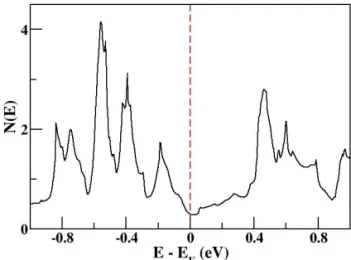
Fig. 4. Total density of states per both spins per formula unit in Q
Mordered NaFeAs. Compared with other superconducting pnictides, this shows considerable hole- electron asymmetry.
미 면에 반영되어 있다. 이 띠들은 이중 축퇴(two -fold degenerate)된 d
xz,
d 와 단일상태 yz dx2−y2로 구성되어 있다. 강한 이차원적 특성에도 불구하고, LiFeAs와 비슷한 임계온도를 보인다는 사실은“낮 은 차원이 고온 초전도 현상의 선결 조건이 아니 라는 것”을 암시해 준다 [30].
Singh에 의해서 LiFeAs에서 얻은 것처럼 [29], NaFeAs 또한 다섯 개의 페르미 면으로 구성되어 있다. 세 개의 Γ를 중심으로 한 양공 주머니는 작 은 타원체와 거의 비슷한 모양의 두 원통으로 구 성되어 있다. 이 원통은 이심률이 거의 영에 가까 운 Fig. 3(a)에 주어진 모양을 갖고 있으며, 반지름 은 0 . 3 ( ) π a 이다. 전체적으로 다른 초전도 pnicitides 에 비해서, NaFeAs의 페르미 면에서는 평평한 부 분들이 많이 적다. 이는 nesting 효과를 감소시켜 자기나 전하에 대한 불안정성을 약화시킬 것으로 예상된다.
자기적 경향을 알아보기 위해서, 강자성 상태와
Q , 0Q
M의 두 반강자성 상태를 비교하였다. 다른
초전도 pnictides에서 관측된 것처럼 [20], 강자성
상태는 상자성 상태와 거의 축퇴되어 있다. 강자
성 상태에서 자기 모멘트 0.35 μ
B/Fe-pair(Fe 국
소 모멘트: 0.2 μ
B)이다. 두 반자성 상태는 에너지
적으로 상자성이나 강자성보다 선호되는 정렬이다.
임계온도가 좌우 대칭인 것과 일치한다. 하지만, NaFeAs는 이와 같은 전자-양공의 대칭성이 확연 히 깨지는 것을 관찰할 수 있다. 따라서, NaFeAs 가
Q 의 스핀 정렬을 한다면, 전자 도핑보다는 M양공의 도핑에 의해서 임계 온도를 올릴 수 있다 는 것을 암시하고 있다.
IV. 토의 및 결론
111 그룹에 대한 두 연구그룹의 Sommerfeld 계 수에 대한 보고가 있는데, Chen과 동료들은 NaFeAs에서 5 mJ/mol.K
2를 관찰한 반면 [26], Chu와 동료들은 LiFeAs에서 22.5 mJ/mol.K
2의 큰 값을 얻었다 [11]. NaFeAs와 LiFeAs의 페르미 에 너지에서의 DOS의 차이가 크지 않다는 것을 고 려한다면, LiFeAs의 실험값은 강한 상관 효과를 암시한다. 이는 상이한 임계 온도와 더불어 두 물 질에서 Li과 Na 이온의 역할이 상당히 다를 수 있음을 암시한다. 그러나, pnictides에서는 같은 물 질에서 조차 Sommerfeld 계수에 대한 상이한 보 고들이 있다 [31]. 이와 같은 차이는 강한 스핀 요동에 의해서 기인했을 것으로 추측되고 있다.
초전도 pnictides에서 강한 스핀 요동 현상은 자기 모멘트의 이론 값이 실험값의 두 배가 넘는다는 사실에도 암시되어 있다. 따라서, 111 그룹에서 Sommerfeld 계수의 차이점이 단순한 샘플에 따른 결과인지 아니면, NaFeAs와 LiFeAs의 고유한 특 성인지 여부가 규명되어야 할 것이다.
우리는 최고 25 K의 임계온도를 보이는 초전도 NaFeAs의 전자구조에 대해서 알아보았다. 다른
Acknowledgments
We acknowledge W. E. Pickett for useful discussion on these materials. This work was financially supported by Korea University.
References