Current Research on Agriculture and Life Science (2014) 32(2): 63−66 http://dx.doi.org/10.14518/crals.2014.32.2.009
Online ISSN 2288-0356 Print ISSN 2287-271x
Original Article
Effects of Flower Thinning Formulation on Activities of Digestive Enzymes and Acetylcholine Esterase in Honey bee Apis mellifera
S. M. Hemayet Jahan
1, Jae-Kyoung Shim
1, Tae-Gwon Son
3, Jaedoo Jo
3, Cheul Choi
2, and Kyeong-Yeoll Lee
1,4*
1
School of Biosciences, College of Agriculture and Life Sciences, Kyungpook National University, Daegu 702-701, Korea
2
Department of Horticultural Science, College of Agriculture and Life Sciences, Kyungpook National University, Daegu 702-701, Korea
3
Apple, Kyungpook National University, Daegu 702-701, Korea
4
Institute of Plant Medicine, Kyungpook National University, Daegu 702-701, Korea
Received: April 24 2014 / Accepted: May 28 2014
Abstract The effects of a newly developed flower thinning formulation (FTF) on the vitality of the honey bee Apis mellifera were examined by measuring the activities of various digestive enzymes in adult worker bees. First, direct spraying of the FTF solution did not cause any behavioral changes or lethal effects for the honey bees based on 24 h observation. Second, oral ingestion of a sugar solution containing the FTF did not produce any significant change in the activities of amylase, proteinases, lipase, or acetylcholine esterase (AChE) in the worker bees 6 h or 24 h after treatment. Meanwhile, a commercial formulation containing sulfur compounds showed slightly reduced activities for several digestive enzymes and AChE, although no behavioral disturbance.
Thus, the results of the present study suggest that the FTF is not toxic for honey bees, in terms of contact and ingestion. Therefore, this newly developed FTF can be used for flower thinning without any detrimental effects on pollinating insects.
Keywords: amylase, insecticidal activity, pollinating insects, proteases
Introduction
Flower or fruit thinning of crop trees is a critical process performed to increase the yield of high-quality fruits. While conventionally conducted manually, various chemical and mechanical thinning methods have also recently been developed (Williams, 1994). For example, ammonium thiosulfate (ATS) has been effectively applied to apple orchards in North America and Europe (Dennis, 2000), and carbaryl (1-naphthyl-N- methylcarbamate) is a highly effective carbamate pesticide for fruit thinning (Batjer and Westwood, 1960; Williams, 1993). Plus, other efficient and reliable thinning agents include naphthalene acetic acid (NAA) and benzyladenine (BA) (Batjer and Billingsley, 1964; Stopar et al., 2009), and the derivative sulfcarbamide has been used as a blossom thinning agent for apples in the United States (Williams, 1993). However, the use of carbaryl has been reduced due to its harmful effects on pollinating insects, along with the integrated flower or fruit production program, the main purpose of which is to reduce the application of chemical pesticides (Dennis, 2000). Thus, there is a need to develop alternative thinning agents that are safe for fruit trees and the environment.
Accordingly, the present study examined the effects of a newly developed flower thinning formulation (FTF) on the European honey bee Apis mellifera by monitoring the activities of the digestive enzymes and acetylcholine esterase in adult worker bees. The results showed that this novel organic thinning agent is not harmful to honey bees and can be applied to orchard cultivation in an environment-friendly way.
*Corresponding author: Kyeong-Yeoll Lee Tel: 82-53-950-5759; Fax: 82-53-950-6758 E-mail: [email protected]
This is an Open Access article distributed under the terms of the Creative Commons Attribution Non-Commercial License (http://creativecommons.
org/licenses/by-nc/3.0/) which permits unrestricted non-commercial use, distribution, and reproduction in any medium, provided the original work is properly cited.
© 2014 Institute of Agricultural Science and Technology, Kyungpook National University
64 Jahan et al.
Curr Res Agric Life Sci (2014) 32(2): 63−66
Materials and Methods
Treatment with plant extracts and sulfur compounds A colony of A. mellifera was collected from Sangju, Korea. The FTF was diluted with a 20% sugar solution to generate solution concentrations of 0%, 0.1%, and 1%. A formulation containing a sulfur compound was also diluted in a 20% sugar solution to prepare a 1% solution. Cotton balls were soaked in each diluted solution. Adult worker honey bees (n=10) were then placed in a plastic box (10×10×5 cm
3) and allowed to feed on the sugar solution-soaked cotton balls for 24 h at 25
oC.
Preparation of Gut samples
The guts (n=5) of the worker honey bees were dissected, immersed in a sterile saline solution, and homogenized using a plastic pestle in a microcentrifuge tube containing 200 μL of a homogenization buffer (20 mM Tris-HCl, pH 8.6). The samples were centrifuged for 15 min at 12,000 rpm and 4
oC and the supernatants transferred to new tubes. The protein concentrations in the samples were determined using a Bradford assay (Bradford, 1976) with bovine serum albumin fraction V (Sigma, USA) as the standard.
Digestive enzyme activity assay
The activities of various enzymes were determined using the following substrates: N-benzoyl-
L-arginine p-nitroanilide (L- BApNA) for trypsin, N-succinyl-Ala-Ala-Pro-Phe p-nitroanilide (SA
2PFpNA) for chymotrypsin, N-succinyl-Ala-Ala-Pro-Leu p- nitroanilide (SA
2PLpNA) for chymotrypsin and type 2 elastase,
L- Leu p-nitroanilide (LpNA) for aminopeptidase, 4-nitrophenyl acetate (p-NPAc) for esterase, and p-nitrophenyl phosphate (pNPP) for alkaline phosphatase. The substrates for trypsin, chymotrypsin, esterase, and aminopeptidase were prepared at a final concentration of 2 mM in 50 mM Tris-HCl at pH 8.6 (Erlanger et al., 1961). The substrate for ALP was prepared at a 5 mM concentration in the same buffer with 5 mM MgCl
2. The substrate for esterase was prepared at a 2 mM concentration in a 0.1 M phosphate buffer (pH 7.0). All the substrates for the proteases were obtained from Sigma (St. Louis, MO). The protease assays were all carried out by adding 5 μL of the enzyme solution to 395 μL of each substrate. The reaction rate was monitored for 10 min at 25
oC and the enzyme activity determined by measuring the OD values at a wavelength of 405 nm at 30-sec intervals using a Tecan Sunrise microplate reader (Tecan, San Jose, CA).
The amylase activity was determined using a QuantiChrom
TMα-Amylase assay kit (BioAssay systems, Hayward, CA). Briefly, the assays were performed by adding 10 μL of the enzyme solution to 190 μL of the corresponding substrate, 3% amylose
azure. The reaction rate was then monitored for 5 min at 25
oC and the enzyme activity determined by measuring the OD values at 595 nm. The lipase activity was determined using a QuantiChrom
TMLipase assay kit (BioAssay systems, Hayward, CA). Here, the assays were conducted by adding 10 μL of the enzyme solution to 140 ìL of the corresponding substrate, 0.1% 2,3-dimercapto-1-propanol tributyrate. The reaction rate was then monitored for 5 min at 25
oC and the enzyme activity determined by measuring the OD values at 412 nm. The acetylcholine esterase (AChE) activity was measured according to the method of Ellman et al., (1961) with minor modifications. The reaction mixture contained 100 mM Tris-HCl (pH 7.8), 0.4 mM 5,5-dithio-bis 2-nitrobenzoic acid (DTNB), 5 mM acetylcholine iodide, and 10 μL of the enzyme solution.
One unit (U) of enzyme activity was defined as the hydrolysis of 1 μmol of substrate per min under the assay conditions. The enzyme activity is presented as the slope of the reaction rate created by the increase in absorbance over time.
Statistical analysis
The statistical analysis of the data was conducted using the SPSS 12.0 program (SPSS Inc., 2004) for Windows. The data was analyzed using a one-way ANOVA or student’s t-test. The data that were not normally distributed were analyzed using Tukey’s method (P<0.05).
Results and Discussion
The toxicity of the new FTF was investigated using A. mellifera bees, which are one of the major pollinating insects of ornamental crop trees. First, the contact toxicity was determined based on observing behavioral changes in the honey bees after treatment.
The honey bees in the cages were sprayed with water, a 0.1% or 1% FTA solution, or a 1% sulfur formulation. While hundreds of honey bees were sprayed with the different solutions, none exhibited any unusual behavioral changes during 24 h post- treatment. In addition, no dead honey bees were observed in any of the treatments groups. In apple orchards, a 0.5% FTF spray is sufficient for effective flower thinning. Thus, the present results suggest that the application of FTF at the specified concentrations did not produce any contact toxicity for the honey bees (data not shown).
Second, the oral toxicity was examined by allowing the honey
bees to ingest a sugar solution containing 1% FTF or a sulfur
formulation for 24 h. Again, none of the honey bees exhibited any
behavioral changes and no mortalities were observed with either
treatment. In addition, the activities of various digestive enzymes
were examined in the treated and untreated honey bees. While
the activities of five proteolytic enzymes, including trypsin,
Effects of Flower Thinning Formulation on Honey bee 65
Curr Res Agric Life Sci (2014) 32(2): 63−66
chymotrypsin, esterase, alkaline phosphatase, and aminopeptidase,
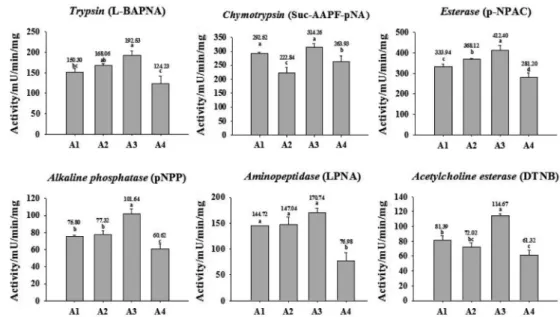
did not differ significantly between the treated and untreated honey bees (Figure 2), the activities of these enzymes were slightly higher in the 1% FTF-treated honey bees than in the 0.1% FTF-treated individuals and slightly lower in the honey bees treated with the sulfur formulation. Furthermore, the AChE activity in the honey bees increased after treatment with the 1% FTF formulation, yet decreased after treatment with the sulfur formulation (Figure 1).
The amylase and lipase activities in the digestive tract of the honey bees were also examined. While the amylase activities did not change significantly after ingestion of the FTF or sulfur formulations, the lipase activity was higher after ingestion of the
1% FTF formulation, yet remained the same after ingestion of the 0.1% FTF and sulfur formulations (Figure 2).
The digestive enzyme activities of honey bees are influenced by both internal and external factors (Moritz and Crailsheim, 1987).
The major ingredients of the new FTF formulation include boron and zinc at concentrations of 0.1%, as well as organic compounds such as carbohydrates and amino acids (Table 1). Boron and zinc are both essential minerals for survival, yet become toxic at concentrations higher than those required for normal physiological functioning (Woods, 1994; Rainey et al., 1999). For example, boron is used as a wood preservative to prevent attack by decay fungi and certain insects, including termites and wood-boring beetles. Boron is also used in insecticide formulations against urban insects, such as cockroaches and fleas. Different boron formulations have been shown to alter the behavioral and physiological responses of the termite Coptotermes formosanus (Gentz and Grace, 2006). For example, termite damage is lower in borate-treated lumber than in untreated wood (Grace et al., 2006;
Figure 1. Effects of flower thinning formulation (FTF) and sulfur formulation on activities of proteolytic enzymes in midgut and acetylcholine esterase in A. mellifera adult workers. The FTF was diluted to 0.1% (A2) and 1% (A3) concentrations, and the sulfur formulation diluted to a 1% solution (A4).
Water was used as the control (A1). Each solution was sprayed into the honey bee colony cage, and the midguts (n=5) collected 24 h post-treatment.
The entire abdomen of the adult workers was used for the acetylcholine esterase activity analysis. One unit (U) of enzyme activity was defined as the hydrolysis of 1µmol of substrate per min under the assay conditions.
Figure 2. Effects of flower thinning formulation (FTF) and sulfur formulation on activities of amylase and lipase in A. mellifera adult workers. The FTF was diluted to 0.1% (A2) and 1% (A3) concentrations, and the sulfur formulation diluted to a 1% (A4) solution. Water was used as a control (A1). Each solution was sprayed into the honey bee colony cage, and the midguts (n=5) collected 6 h post-treatment. One unit (U) of enzyme activity was defined as the hydrolysis of 1µmol of substrate per min under the assay conditions.
Table 1. Major compounds in flower thinning formulation
Contents Amounts
Water soluble Boron <0.1%
Water soluble Zinc <0.1%
Glucose 140 mg/L
Mannitol 50 mg/L
Glycine 1.5 mg/L
Glutamic acid 1.2 mg/L
66 Jahan et al.
Curr Res Agric Life Sci (2014) 32(2): 63−66
Tsuboda et al., 2006). However, boron toxicity has not yet been determined in honey bees. Thus, the present results indicated that the minimal amounts of boron and zinc in the FTF formulation were not detrimental to honey bees.
Sulfur is non-toxic to bees (Farm Chemical Handbook, 1994).
Therefore, sulfur formulations such as 98% dust and 92%
wettable powders are low in contact and oral toxicity for honey bees (USEPA, 1991). However, in the present study, the formulation containing a sulfur compound did inhibit the midgut proteolytic enzyme activities and AChE activity, although it did not disturb the behavior of the honey bees. Therefore, this finding suggests that the sulfur formulation may be toxic to honey bees at the biochemical level.
In conclusion, this study found that ingestion of the FTF formulation did not alter the activities of most of the digestive enzymes in the honey bees. Therefore, these results provide information for the practical use of an organic thinning formulation that is not toxic to pollinating insects, such as honey bees.
Acknowledgments
The authors are grateful to Changhoon Shin, Sangjoo, Korea for providing the honey bee colonies. This work was supported by a research grant from the Agricultural Research and Development Promotion Center of Korea.
References
Batjer LP, Billingsley HD (1964) Apple thinning with chemical sprays.
Washington State Expt Sta Blu 636: 651-659.
Batjer LP, Westwood MN (1960) 1-Naphthyl N-methylcarbamate, a new
chemical for thinning apples. Proc Amer Soc Hort Sci 75: 1-4.
Bradford MM (1976) A rapid and sensitive method for the quantitation of microgram quantities of protein utilizing the principle of protein dye binding. Analyt Biochem 72: 248-254.
Dennis FG (2000) The history of fruit thinning. Plant Growth Regul 31:
1-16.
Deshmukh C, Mohite A, Shinde J (2009) Effects of carbaryl and gamma- BHC on the histology of midgut and digestive enzyme profiles in the third instar larvae of fruit-sucking moth, Othreis materna (Linn.) (Lepidoptera: Noctuidae). Turkish J Zool 33: 207-213.
Ellman GL, Courtney DK, Andres V, Featherstone RM (1961) A new and rapid colorimetric determination of acetylcholinesterase activity.
Biochem Pharmacol 7: 88-95.
Farm Chemicals Handbook (1994) Meister Publishing Co. Willoughby, OH.
Gentz MC, Grace JK (2006) A review of boron toxicity in insects with an emphasis on termites. J Agric Urban Entomol 23: 201-227.
Grace JK, Byrne A, Morris PI, Tsunoda K (2006) Performance of borate- treated lumber after 8 years in an above-ground termite field test in Hawaii. International Research Group on Wood Preservation.
Stockholm, Sweden. IRG/WP 06-30390, p. 8.
Moritz B, Crailsheim K (1987) Physiology of protein digestion in the midgut of the honey bee (Apis mellifera L.). J Insect Physiol 33: 923-931.
Rainey CJ, Nyquist LA, Christensen RE, Strong PL, Culver D, Coughlin JR (1999) Daily boron intake from the American diet. J Am Diet Assoc 99: 335-340.
Stopar M, Leskosek G, Simoncic A (2009) 1-Naphthaleneacetic acid and 6- benzyladenine thinning of a common slender spindle ‘Jonagold’/M.9 apple orchard. II: Partial tree spraying J Hort Sci Biotechnol ISAFRUIT Special Issue pp. 127-130.
Tsunoda K, Byrne A, Morris PI, Grace JK (2006) Performance of borate- treated lumber after 10 years in a protected, above-ground field test in Japan (mal report). IRGIWP 06-30395. International Research Group on Wood Preservation. Stockholm, Sweden, p. 8.
U.S. Environmental Protection Agency(1991) Reregistration Eligibility Document (RED): Sulfur. US EPA, Office of Pesticide Programs, May. Washington, DC.
Williams MW (1993) Sulfcarbamide, a blossom-thinning agent for apples.
Hort Technology 3: 322-324.
Williams MW (1994) Factors influencing chemical thinning and update on new chemical thinning agents. Compact Fruit Tree 27: 115-122.
Woods WG (1994) An introduction to boron: history, sources, uses, and chemistry. Environ Health Perspect 102: 5-11.