Printed in the Republic of Korea
http://dx.doi.org/10.5012/jkcs.2013.57.2.252
DABCO-Catalyzed Green Synthesis of 2-Hydroxy-1,4-diones via Direct Aldol Reaction of Arylglyoxals in Water
Mahnaz Saraei*, Bagher Eftekhari-Sis†,*, and Sakineh Mozaffarnia† Department of Chemistry, Payame Noor University, P. O. Box. 19395-3697, Tehran, Iran.
*E-mail: [email protected]
†Department of Chemistry, University of Maragheh, P. O. Box. 55181-83111, Maragheh, Iran.
*E-mail: [email protected]
(Received November 27, 2012; Accepted March 13, 2013)
ABSTRACT. A green and simple method to synthesize of 1,4-diketones via aldol reaction of arylglyoxals and ketones such as 1-(4-methoxyphenyl)-2-propanone, deoxybenzoin and substituted acetophenones in the presence of a catalytic amount of DABCO in water at room temperature has been reported. Corresponding 2-hydroxy-1,4-diones were obtained in moderate to high yields with simple separation of obtained solid from reaction mixture and recrystallization.
Key words: 1,4-Diketones, Aldol reaction, Arylglyoxals, DABCO, Green chemistry
INTRODUCTION
Because of water is one of the most abundant and cheap solvents, and also makes the reactions environmentally amenable, much safer and easier to handle,1 the organic reactions in aqueous media have attracted much attention in synthetic organic chemistry.2 Also, reactions in water exhibit interesting reactivity and selectivity, which are dif- ferent from conventional organic solvents.
The routes for formation of C−C bonds are the most important topics in synthetic organic chemistry. The aldol reaction is one of the most powerful C−C bond-forming reactions in organic synthesis,3 leading to the β-hydrox- ycarbonyl structural units, which are found in several bio- logically active compounds, such as macrolide antibiotics and anti-cancer drugs,4 and also are important building blocks in the synthesis of polyfunctional compounds and natural products.3d,5
Additionally, 1,4-dicarbonyl compounds are versatile precursors for the synthesis of substituted cyclopenten- ones,6 such as jasmones,6g−i cuparenones,6c and prostag- landins,6j−l and also various heterocyclic compounds, for example, furan, thiophene, pyrrole, and pyridazine deriv- atives.7 Thus the development of the synthetic methods of the 1,4-diketones have a significant impact on organic chemistry. A number of methods have already been reported for the preparation of 1,4-diketone derivatives,8 and among them, most widely used approach is the Michael addition to α,β-unsaturated ketones of either unmasked acyl anions such as acyllithium,9 and acyl-transition metal complexes,10
or masked acyl anions and their equivalents.11 Also, the preparation of 1,4-dicarbonyl compounds were carried out by the classic utilization of α-halo ketones,12 by appli- cation of the Stetter reagent,13 thiazolium salts in the pres- ence of a tertiary amine,14 or 1,3-dithiane derivatives.15
Recently, we have reviewed the application of arylgly- oxals (aromatic α-ketoaldehyds) in synthesis of hetero- cyclic compounds,16 that encouraged us to work on aldol reaction of arylglyoxals to prepare 1,4-dicarbonyl com- pounds.
However, aldol reaction with some α-dicarbonyl com- pounds such as benzil, isatin and ethyl phenylglyoxalate17 to synthesize of 1,4-dicarbonyl compounds were previ- ously reported,18 as the best of our knowledge, there is one report on aldol reaction of arylglyoxals in the literature using expensive chiral ligand with limited scope of prod- ucts, in which trimethylsilyl enols of ketones were used in CH2Cl2.19
Herein, we wish to report the direct aldol reaction of dif- ferent ketones such as 1-(4-methoxyphenyl)-2-propanone, deoxybenzoin and substituted acetophenones with arylg- lyoxals in water to produce 2-hydroxy-1,4-diketones in the presence of a catalytic amount of DABCO.
RESULTS AND DISCUSSION
We first studied the aldol reaction of 1-(4-methoxyphe- nyl)propan-2-one 1a with phenylglyoxal hydrate 2a, which were prepared by oxidation of acetophenone using SeO2,20 in water in the presence of different tertiary amines such
as Et3N, DMAP and DABCO, and also NaOH at room temperature to give 2-hydroxy-3-(4-methoxyphenyl)-1- phenylpentane-1,4-dione 3a (Scheme 1). When DABCO was used, 2-hydroxy-1,4-dione 3a was obtained in 95%
yield as only syn isomer, determined using 1H NMR spec- troscopy. The crystal structure of the compound 3a (Fig.
1),21 which was synthesized by the similar procedure,22 was reported by K. Harms,23 which is consistent with syn isomer.
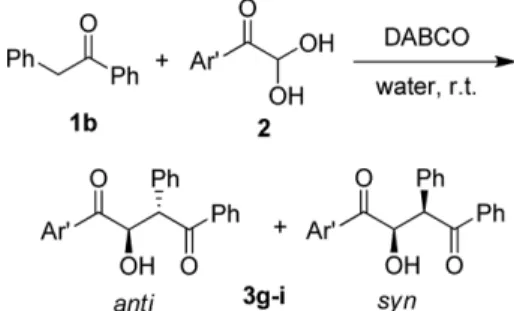
Aldol reactions of 1a with different substituted phe- nylglyoxal hydrates 2b−f were also investigated. The reactions were carried out by addition of DABCO to a mixture of 1a (0.5 mmol) and 2 (0.05 mmol) in water and stirred at room temperature for appropriate time. The cor- responding 2-hydroxy-1,4-diones 3b−f were obtained in good to high yields. Also the aldol reaction of deoxyben- zoin 1b was conducted with different arylglyoxals 2 under the same conditions, and the corresponding 2-hydroxy- 1,4-diones 3g−i were obtained in good to high yields (Scheme 2). The results are summarized in Table 1. The products were characterized using FT-IR, 1H NMR and
13C NMR spectroscopy.
As shown in Table 1, electron-withdrawing substituted phenylglyoxals such as 4-Cl and 4-Br worked as well as electron-donating substituted phenylglyoxals such as 3- MeO, 4-MeO and 3,4-(MeO)2 in DABCO-catalyzed aldol reaction in water. Phenyl-, 4-Clphenyl- and 4-Br-phenylg- lyoxals underwent aldol reaction with excellent diastere- oselectivity (3a−c and 3g,h), while electron-donating substituted phenylglyoxals afforded corresponding 2-hydroxy-1,4- diketones 3d−f and 3i as a mixture of two stereoisomers.
As shown in Fig. 2, the syn/anti ratio was determined by
1H NMR, using the intensity of the Ha for two isomers.
The coupling constant (3JHa,Hb) for signal of the anti-iso- mer is higher than that of the syn-isomer. According to the
1H NMR spectrum, the Ha signal for the syn-isomer has a higher δ value than that for the anti-isomer. For instance, in the 1H NMR spectra of 2-hydroxy-1,3-bis(4-methox- yphenyl)pentane-1,4-dione (3d), the signal at δ = 5.78 ppm (3JHa,Hb = 4.4 Hz) is contributed by the syn-isomer, while the one at 5.28 ppm (3JHa,Hb = 5.6 Hz) is contributed by the anti-isomer.
Scheme 1. Reaction of 1a with phenylglyoxal hydrate 2a in water.
Fig. 1. ORTEP representation of 3a with 45% ellipsoid proba- bility.21
Scheme 2. Reaction of 1b with arylglyoxal hydrates in water in the presence of DABCO.
Table 1. Aldol reaction of 1a and 1b with arylglyoxal hydrates 2 in the presence of DABCO in water.a
Ketone
[1] Ar' [2] Product
[3]
Yield
(%)b syn/antic
1a Ph [2a] 3a 95 >99/1
1a 4-ClC6H4 [2b] 3b 77 >99/1
1a 4-BrC6H4 [2c] 3c 84 >99/1
1a 4-MeOC6H4 [2d] 3d 82 67/33
1a 3-MeOC6H4 [2e] 3e 74 67/33
1a 3,4-(MeO)2C6H3 [2f] 3f 72 64/36
1b 4-ClC6H4 [2b] 3g 70 >99/1
1b 4-BrC6H4 [2c] 3h 82 >99/1
1b 4-MeOC6H4 [2d] 3i 80 65/35
aReaction time was 24 h, except in the case of 3i which was 48 h.
bYields refer to isolated products by simple filtration of the reaction mixture.
cAnti/syn ratio was determined using 1H NMR spectroscopic analy- sis of the crude reaction mixture.
Another characteristic feature of the present protocol is the high chemoselectivity of the aldol reaction toward phenylglyoxal, in preference to benzaldehyde as shown in Scheme 3. When aldol reaction of phenylglyoxal with 1a in the presence of 1 equiv. of benzaldehyde was carried out under same conditions, only 3a was isolated and ben- zaldehyde was recovered without changes.
The results encouraged us to work on the aldol reaction of acetophenone derivatives 4 with arylglyoxal hydrates 2 (Scheme 4). The reactions were conducted by stirring of a mixture of acetophenones and arylglyoxal hydrates in water at room temperature in the presence of catalytic
amount of DABCO. The reaction mixture was solidified after appropriate time. The obtained solid was filtered off and washed with hot water to remove arylglyoxal and ace- tophenone residue. The results are summarized in Table 2.
As shown in Table 2, different 4 were subjected to DABCO- catalyzed aldol reaction with 2 to give corresponding 2- hydroxy-1,4-diones 5 in 25−88% yields. Also, heterocy- clic methyl ketones such as 2-furyl and 2-thienyl methyl ketones underwent aldol reaction in water at room tem- perature to afford corresponding 1,4-diones 5g,l in good yields. The structure of products were established using FT-IR, 1H NMR and 13C NMR.
Attempts to aldol reaction of arylglyoxals with ali- phatic ketones such as acetone and cyclohexanone under the same conditions were failed and a mixture of products was obtained.
CONCLUSION
In conclusion, a new green and simple methodology for construction of 1,4-diketone along with 2- and 3-hydroxy structural motifs was developed. Reactions were carried out in water at room temperature using DABCO as cat- alyst. Ketones such as 1a,b worked well in aldol reaction in water and afforded corresponding 2-hydroxy-1,4-diones in good to high yields. Electron-withdrawing substituted phenylgyloxals afforded the 1,4-diones with excellent syn selectivity, while arylglyoxals with electron-donating substit- uents gave corresponding 1,4-diones as a two diastereoi- somers with ratio of about 2/1 of syn/anti. Also, acetophenone Fig. 2. Identification of anti and syn isomer by 1H NMR.
Scheme 3. Chemoselectivity of the aldol reaction of 1a toward phenylglyoxal, in preference to benzaldehyde.
Scheme 4. DABCO-catalyzed aldol reaction of acetophenones 4 with 2 in water at room temperature.
Table 2. Aldol reaction of acetophenones 4 with arylglyoxal hydrates 2 in the presence of DABCO in water at room temper- ature (See also Scheme 4)
Ar' [2] Ar [4] Product (5) Time (h) Yield (%)a
2a 4-ClC6H4 5a 28 59
2a 4-BrC6H4 5b 15 25
2a 4-NO2C6H4 5c 24 47
2b Ph 5d 30 67
2b 4-ClC6H4 5e 48 56
2b 4-BrC6H4 5f 58 53
2b 2-thienyl 5g 24 64
2c Ph 5h 48 59
2c 4-ClC6H4 5i 48 60
2c 4-BrC6H4 5j 192 55
2c 4-NO2C6H4 5k 18 88
2c 2-furyl 5l 33 68
aYields refer to isolated products by simple filtration of the reaction mixture and washing with warm water and cold EtOH to remove unreacted arylglyoxals and acetophenones, respectively.
deivatives worked well in aldol reaction with arylglyox- als in water.
EXPERIMENTAL
All chemicals were purchased and used without any fur- ther purification. NMR spectra were recorded at 400 MHz for proton and at 100 MHz for carbon nuclei in CDCl3 or DMSO-d6. Most of compounds were new and characterized by their spectroscopic data (FT-IR, NMR and elemental analysis).
General Procedure of the Aldol Reaction
To a mixture of arylglyoxal 2 (0.55 mmol) and ketone 1 or 4 (0.5 mmol) in 3−5 mL water, was added 0.02 g DABCO and stirred at room temperature. The progress of the reac- tion was monitored by TLC (n-hexane/ethyl acetate; 7/3).
After completion of the reaction, the products were iso- lated as solid from reaction mixture, which was filtered off and washed with hot water and cold EtOH to remove unre- acted arylglyoxals and ketones, respectively. All obtained products are almost pure, but further purification for ele- mental analysis were carried out by recrystallization from EtOH.
2-Hydroxy-3-(4-methoxyphenyl)-1-phenylpentane-1,4- dione (3a)
White solid, m.p. 95−95.3oC. FT-IR (KBr) ν = 3316 (O−H), 3068, 2891 (C−H), 1712, 1674 (C=O), 1645 (C=C), 1245 (C−O) cm−1. 1H NMR (500 MHz, CDCl3): δ
= 7.90 (dd, 3JH,H = 7.9 Hz, 4JH,H = 0.8 Hz, 2H, CHAr), 7.66 (m, 1H, CHAr), 7.53 (t, 3JH,H = 7.9 Hz, 2H, CHAr), 7.01 (d,
3JH,H = 9.5 Hz, 2H, CHAr), 6.86 (d, 3JH,H = 9.6 Hz, 2H, CHAr), 5.85 (d, 3JH,H = 4.0 Hz, 1H, CH−O), 4.03 (d, 3JH,H = 4.1 Hz, 1H, CH), 3.82 (s, 3H, OCH3), 3.26 (s, br., 1H, OH, Exchange with D2O), 2.14 (s, 3H, CH3) ppm. 13C NMR (125 MHz, CDCl3): δ = 206.8 (C=O), 200.4 (C=O), 159.9, 134.8, 134.2, 131.5, 129.3, 129.0, 125.4, 114.6, 73.3, 62.1, 55.6, 29.5 ppm. Anal. Calcd for C18H18O4 (298.33): C 72.47, H 6.08; Found: C 72.51, H 6.10%.
1-(4-Chlorophenyl)-2-hydroxy-3-(4-methoxyphenyl) pentane-1,4-dione (3b)
White solid, m.p. 119−123oC. FT-IR (KBr) ν = 3355 (br., O−H), 3071, 2943 (C−H), 1716, 1685 (C=O), 1583 (C=C), 1244 (C−O), 601 (C−Cl) cm−1. 1H NMR (400 MHz, CDCl3) δ = 7.82 (d, 3JH,H = 8.8 Hz, 2H, CHAr), 7.37 (d, 3JH,H = 8.4 Hz, 2H, CHAr), 7.20 (d, 3JH,H = 8.8 Hz, 2H, CHAr), 6.84 (d, 3JH,H = 8.8 Hz, 2H, CHAr), 5.23 (d, 3JH,H = 5.2 Hz, 1H, CH−O), 4.20 (d, 3JH,H = 5.2 Hz, 1H, CH), 3.80 (s, 3H, OCH3), 2.20 (s, 3H, CH3) ppm. 13C NMR (100
MHz, CDCl3) δ = 209.6, 199.0 (C=O), 159.5, 139.9, 133.4, 130.5, 130.3, 128.7, 126.1, 114.5, 76.1, 59.8, 55.3, 30.2 ppm. Anal. Calcd for C18H17ClO4 (332.78): C 64.97, H 5.15; Found: C 64.90, H 5.30%.
1-(4-Bromophenyl)-2-hydroxy-3-(4-methoxyphenyl) pentane-1,4-dione (3c)
White solid, m.p. 118.5−120.1oC. FT-IR (KBr) ν = 3335 (br., O−H), 3069, 2941 (C−H), 1695 (C=O), 1578 (C=C), 1244 (C−O), 579 (C−Br) cm−1. 1H NMR (400 MHz, CDCl3) δ
= 7.72−7.75 (m, 2H, CHAr), 7.53−7.56 (m, 2H, CHAr), 7.19− 7.22 (m, 2H, CHAr), 6.83−6.86 (m, 2H, CHAr), 5.22−5.28 (m, 1H, CH−O) 4.33 (m, br., 1H, OH), 4.20 (d, 3JH,H = 5.6 Hz, 1H, CH), 3.80 (s, 3H, OCH3), 2.20 (s, 3H, CH3) ppm.
13C NMR (100 MHz, CDCl3) δ = 209.6, 199.3 (C=O), 159.5, 133.8, 131.7, 130.6, 130.3, 128.6, 126.1, 114.5, 76.1, 59.8, 55.3, 30.1 ppm. Anal. Calcd for C18H17BrO4 (377.23): C 57.31, H 4.54; Found: C 56.76, H 4.27%.
2-Hydroxy-1,3-bis(4-methoxyphenyl)pentane-1,4- dione (3d)
Syn/anti = 67/33. Yellow oil, FT-IR (KBr) ν = 3442 (br., O−H), 3040, 2943 (C−H), 1706, 1670 (C=O), 1602 (C=C), 1255 (C−O) cm−1. 1H NMR (400 MHz, CDCl3) δ = 7.82−
7.92 (2×m, 2H, CHAr), 6.79−7.21 (3×m, 6H, CHAr), 5.78 (d, 3JH,H = 4.4 Hz, 0.67H, CH−O, anti), 5.28 (d, 3JH,H = 5.6 Hz, 0.33H, CH−O, syn), 4.16 (d, 3JH,H = 5.6 Hz, 0.33H, CH, syn), 4.02 (d, 3JH,H = 4.4 Hz, 0.67H, CH, anti), 3.84- 3.90 [2×S: (3.90, ~2H, anti; 3.84, ~1H, syn), 3H, OCH3], 3.76-3.79 [2×S: (3.79, ~2H, anti; 3.76, ~1H, syn), 3H, OCH3], 2.12−2.17 [2×S: (2.17, ~1H, syn; 2.12, ~2H, anti), 3H, CH3] ppm. 13C NMR (100 MHz, CDCl3) δ = 209.3, 206.6, 198.4, 198.2 (C=O), 164.1, 163.8, 159.4, 159.3, 132.2, 131.4, 131.1, 130.3, 127.8, 127.0, 126.5, 125.2, 114.4, 114.17, 114.16, 113.7, 75.5, 72.5, 61.9, 60.3, 55.6, 55.5, 55.3, 55.2, 30.4, 29.2 ppm. Anal. Calcd for C19H20O5
(328.36): C 69.50, H 6.14; Found: C 69.83, H 6.21%.
2-Hydroxy-1-(3-methoxyphenyl)-3-(4-methoxyphe- nyl)pentane-1,4-dione (3e)
Syn/anti = 67/33. Yellow oil, FT-IR (KBr) ν = 3504 (br., O−H), 3098, 2947 (C−H), 1693 (br., C=O), 1596 (C=C), 1253 (C−O) cm−1. 1H NMR (400 MHz, CDCl3) δ = 6.78−
7.50 (9×m, 8H, CHAr), 5.82 (d, 3JH,H = 4.0 Hz, 0.67H, CH−O, anti), 5.30 (d, 3JH,H = 5.6 Hz, 0.33H, CH−O, syn), 4.19 (d, 3JH,H = 5.6 Hz, 0.33H, CH, syn), 4.04 (d, 3JH,H = 4.0 Hz, 0.67H, CH, anti), 3.83−3.87 [2×S: (3.87, ~2H, anti; 3.83, ~1H, syn), 3H, OCH3], 3.78−3.81 [2×S: (3.81,
~2H, anti; 3.78, ~1H, syn), 3H, OCH3], 2.13−2.17 [2×S:
(2.17, ~1H, syn; 2.13, ~2H, anti), 3H, CH3] ppm. 13C NMR (100 MHz, CDCl3) δ = 209.3, 206.4, 200.0, 199.8 (C=O), 160.0, 159.6, 159.5, 159.4, 136.3, 135.6, 131.1, 130.3,
130.0, 129.4, 126.4, 125.0, 121.6, 121.1, 120.3, 120.2, 114.4, 114.2, 113.0, 112.9, 75.9, 72.9, 61.7, 60.3, 55.5, 55.4, 55.3, 55.2, 30.2, 29.1 ppm. Anal. Calcd for C19H20O5
(328.36): C 69.50, H 6.14; Found: C 68.89, H 5.78%.
1-(3,4-Dimetoxyphenyl)-2-hydroxy-3-(4-metoxyphe- nyl)pentane-1,4-dione (3f)
Syn/anti = 64/36. Yellow oil, FT-IR (KBr) ν = 3511 (br., O−H), 3093, 2941 (C−H), 1712, 1672 (C=O), 1598 (C=C), 1265 (C−O) cm−1. 1H NMR (400 MHz, CDCl3) δ = 7.51- 7.61 [2×dd: 7.59 (dd, 3JH,H = 8.4 Hz, 4JH,H = 2.0 Hz), 7.50 (dd, 3JH,H = 8.4 Hz, 4JH,H = 2.0 Hz) 1H, CHAr], 7.39-7.41 (m, 1H, CHAr), 7.12−7.20 [2×d: 7.20 (d, 3JH,H = 8.8 Hz), 7.12 (d, 3JH,H = 8.8 Hz), 1H, CHAr], 6.93−7.02 [2×d: 7.02 (d, 3JH,H = 8.8 Hz), 6.93 (d, 3JH,H = 8.4 Hz), 2H, CHAr], 6.79−6.85 (m, 2H, CHAr), 5.78 (d, 3JH,H = 4.4 Hz, 0.64H, CH−O, anti), 5.29 (d, 3JH,H = 5.6 Hz, 0.36H, CH−O, syn), 4.18 (d, 3JH,H = 5.6 Hz, 0.36H, CH, syn), 4.04 (d, 3JH,H = 4.4 Hz, 0.64H, CH, anti), 3.88−3.97 (3×s, 6H, OCH3), 3.73−3.79 [2×S: (3.79, ~1.9H, anti; 3.73, ~1.1H, syn), 3H, OCH3], 2.12−2.17 [2×S: (2.17, ~1.1H, syn; 2.12, ~1.9H, anti), 3H, CH3] ppm. 13C NMR (100 MHz, CDCl3) δ = 209.5, 206.7, 198.4, 198.2 (C=O), 159.4, 159.36, 153.9, 153.6, 149.3, 148.8, 131.1, 130.4, 127.9, 127.2, 126.4, 125.3, 124.1, 123.4, 114.4, 114.2, 110.9, 110.7, 110.3, 109.9, 75.5, 72.5, 62.1, 60.3, 56.2, 56.1, 55.9, 55.3, 55.2, 50.1, 30.3, 29.2 ppm. Anal. Calcd for C20H22O6 (358.39): C 67.03, H 6.19; Found: C 66.51, H 6.28%.
1-(4-Chlorophenyl)-2-hydroxy-3,4-diphenylbutane- 1,4-dione (3g)
White solid, m.p. 176.8−179.6oC. FT-IR (KBr) ν = 3367 (br., O−H), 3060, 2893 (C−H), 1670 (C=O), 1583 (C=C), 1199 (C−O), 694 (C−Cl) cm−1. 1H NMR (400 MHz, CDCl3) δ = 7.97 (d, 3JH,H = 8.0 Hz, 2H, CHAr), 7.85 (d, 3JH,H = 8.8 Hz, 2H, CHAr), 7.52−7.56 (m, 1H, CHAr), 7.41−7.44 (m, 2H, CHAr), 7.19−7.36 (m, 7H, CHAr), 5.44−5.48 (dd, 3JH,H
= 5.6, 9.2 Hz, 1H, CH−O), 5.13 (d, 3JH,H = 5.6 Hz, 1H, CH), 4.53 (d, 3JH,H = 9.2 Hz, 1H, OH) ppm. 13C NMR (100 MHz, CDCl3) δ = 200.4, 199.3 (C=O), 139.9, 136.2, 134.5, 133.6, 133.5, 130.7, 129.2, 129.0, 128.9, 128.7, 128.0, 59.5, 55.7, 31.3 ppm. Anal. Calcd for C22H17ClO3 (364.82): C 72.43, H 4.70; Found: C 72.50, H 4.80%.
1-(4-Bromophenyl)-2-hydroxy-3,4-diphenylbutane- 1,4-dione (3h)
White solid, m.p. 180−184.5oC. FT-IR (KBr) ν = 3361 (br., O−H), 3059, 2914 (C−H), 1666 (C=O), 1577 (C=C), 1199 (C−O), 702 (C−Br) cm−1. 1H NMR (400 MHz, CDCl3) δ = 7.97 (d, 3JH,H = 7.6 Hz, 2H, CHAr), 7.77 (d, 3JH,H = 7.6 Hz, 2H, CHAr), 7.51−7.56 (m, 3H, CHAr), 7.41−7.44 (m, 2H, CHAr), 7.19−7.33 (m, 5H, CHAr), 5.45 (m, 1H, CH−O),
5.13 (d, 3JH,H = 6.0 Hz, 1H, CH), 4.53 (d, 3JH,H = 7.6 Hz, 1H, OH) ppm. 1H NMR (400 MHz, CDCl3+drops of D2O) δ = 7.97 (d, 3JH,H = 8.8 Hz, 2H, CHAr), 7.77 (d, 3JH,H = 8.8 Hz, 2H, CHAr), 7.51−7.56 (m, 3H, CHAr), 7.41−7.44 (m, 2H, CHAr), 7.19−7.33 (m, 5H, CHAr), 5.43 (d, 3JH,H = 5.6 Hz, 1H, CHO), 5.13 (d, 3JH,H = 5.6 Hz, 1H, CH) ppm. 13C NMR (100 MHz, CDCl3) δ = 200.5, 199.5 (C=O), 136.2, 134.5, 133.9, 133.6, 131.7, 130.7, 129.2, 129.0, 128.9, 128.7, 128.6, 128.0, 58.4, 55.6, 31.0 ppm. Anal. Calcd for C22H17BrO3 (409.27): C 64.56, H 4.19; Found: C 64.01, H 4.72%.
2-Hydroxy-1-(4-methoxyphenyl)-3,4-diphenylbutane- 1,4-dione (3i)
Syn/anti = 65/35. White solid. FT-IR (KBr) ν = 3471 (O−
H), 3064, 2952 (C−H), 1670 (C=O), 1591 (C=C), 1267 (C−O) cm−1. 1H NMR (400 MHz, CDCl3) δ = 7.96−7.99 (m, 2H, CHAr), 7.86−7.90 (m, 2H, CHAr), 7.16−7.55 (7×m, 8H, CHAr), 6.83−6.98 [2×d: (6.98, 3JH,H = 9.2 Hz;
6.83, 3JH,H = 8.8 Hz), 2H, CHAr), 5.84 (m, br., 0.65H, CH− O, anti), 5.53 (m, br., 0.35H, CH−O, syn), 5.09 (d, 3JH,H = 6.4 Hz, 0.35H, CH, syn), 5.05 (d, 3JH,H = 5.2 Hz, 0.65H, CH, anti), 4.45 (m, br., 0.35H, OH, syn), 3.86−3.92 [2×S:
(3.92, ~2H, anti; 3.86, ~1H, syn), 3H, OCH3], 3.03 (s, br., 0.65H, OH, anti) ppm. 13C NMR (100 MHz, CDCl3) δ = 200.0, 198.7, 198.0, 197.9 (C=O), 164.1, 163.8, 136.5, 136.0, 134.1, 133.4, 133.1, 131.6, 131.4, 129.7, 129.1, 129.0, 128.97, 128.9, 128.6, 128.5, 127.9, 127.8, 127.5, 114.1, 113.6, 76.3, 73.6, 57.5, 56.2, 55.6, 55.5 ppm. Anal. Calcd for C23H20O4
(360.40): C 76.65, H 5.59; Found: C 76.09, H 5.72%.
4-(4-Chlorophenyl)-2-hydroxy-1-phenylbutane-1,4- dione (5a)
White solid, m.p. 132.5−136oC. FT-IR (KBr) ν = 3743 (O−H), 3061 (C−H), 1681 (C=O), 1552 (C=C), 1195 (C−O), 651 (CCl) cm−1. 1H NMR (400 MHz, CDCl3) δ = 8.01 (d,
3JH,H = 8.4 Hz, 2H, CHAr), 7.91 (d, 3JH,H = 8.4 Hz, 2H, CHAr), 7.66 (t, 3JH,H = 7.2 Hz, 1H, CHAr), 7.54 (t, 3JH,H = 7.6 Hz, 2H, CHAr), 7.46 (d, 3JH,H = 8.8 Hz, 2H, CHAr), 5.69 (s, br., 1H, OH), 4.05 (m, 1H, CH−O), 3.33−3.45 (m, 2H, CH2) ppm. 1H NMR (400 MHz, DMSO-d6) δ = 8.03 (d,
3JH,H = 7.2 Hz, 2H, CHAr), 8.00 (d, 3JH,H = 8.4 Hz, 2H, CHAr), 7.67 (t, 3JH,H = 7.2 Hz, 1H, CHAr), 7.62 (d, 3JH,H = 8.4 Hz, 2H, CHAr), 7.56 (t, 3JH,H = 7.6 Hz, 2H, CHAr), 5.85 (d, 3JH,H = 7.6 Hz, 1H, OH), 5.43−5.48 (m, 1H, CH−O), 3.35−3.59 [2×dd: 3.54−3.59 (dd, 3JH,H = 6.8, 17.2 Hz, 1H, CH2), 3.35−3.41 (dd, 3JH,H = 6.4, 17.2 Hz, 1H, CH2)] ppm.
13C NMR (100 MHz, DMSO-d6) δ = 199.5, 197.5 (C=O), 138.8, 135.7, 135.5, 133.7, 130.5, 129.3, 129.2, 129.17, 69.1, 42.6 ppm. Anal. Calcd for C16H13ClO3 (288.73): C 66.56, H 4.54; Found: C 66.49, H 4.51%.
4-(4-Bromophenyl)-2-hydroxy-1-phenylbutane-1,4- dione (5b)
White solid, m.p. 145.8−149.6oC. FT-IR (KBr) ν = 3448 (br., O−H), 3058, 2964 (C−H), 1676 (C=O), 1583 (C=C), 1191 (C−O), 696 (C−Br) cm−1. 1H NMR (400 MHz, CDCl3) δ = 8.01 (d, 3JH,H = 7.6 Hz, 2H, CHAr), 7.83 (d, 3JH,H = 8.4 Hz, 2H, CHAr), 7.61−7.67 (m, 3H, CHAr), 7.54 (t, 3JH,H = 7.6 Hz, 2H, CHAr), 5.68 (m, 1H, CH−O), 4.04 (d, 3JH,H = 6.0 Hz, 1H, OH), 3.33−3.44 (m, 2H, CH2) ppm. 13C NMR (100 MHz, CDCl3) δ = 200.6, 196.3 (C=O), 135.4, 134.1, 133.5, 132.0, 129.9, 129.0, 128.9, 128.7, 70.1, 43.5 ppm.
Anal. Calcd for C16H13BrO3 (333.18): C 57.68, H 3.93;
Found: C 57.50, H 4.00%.
2-Hydroxy-4-(4-nitrophenyl)-1-phenylbutane-1,4- dione (5c)
Yellow solid, m.p. 128−132oC. FT-IR (KBr) ν = 3450 (O−H), 3076 (C−H), 1670 (C=O), 1593 (C=C), 1521, 1315 (NO2), 1195 (C−O) cm-1. 1H NMR (400MHz, CDCl3) δ = 8.34 (d, 3JH,H = 8.8 Hz, 2H, CHAr), 8.13 (d, 3JH,H = 8.8 Hz, 2H, CHAr), 8.02 (d, 3JH,H = 7.6 Hz, 2H, CHAr), 7.67 (t,
3JH,H = 7.6 Hz, 1H, CHAr), 7.54−7.58 (m, 2H, CHAr), 5.68− 5.72 (m, 1H, CH−O), 4.05 (d, 3JH,H = 6.0 Hz, 1H, OH), 3.41− 3.47 (m, 2H, CH2) ppm. 13C NMR (100 MHz, CDCl3) δ = 200.2, 195.9 (C=O), 150.6, 141.1, 134.3, 133.3, 129.4, 129.1, 128.7, 123.9, 70.0, 44.1 ppm. Anal. Calcd for C16H13NO5
(299.28): C 64.21, H 4.38, N 4.68; Found: C 64.18, H 4.31, N 4.55%.
1-(4-Chlorophenyl)-2-hydroxy-4-phenylbutane-1,4- dione (5d)
White solid, m.p. 151−155oC. FT-IR (KBr) ν = 3440 (O−
H), 3080 (C−H), 1679 (C=O), 1554 (C=C), 1190 (C−O), 750 (C−Cl) cm−1. 1H NMR (400 MHz, CDCl3) δ = 7.96−
8.00 (m, 4H, CHAr), 7.62 (t, 3JH,H = 7.6 Hz, 1H, CHAr), 7.48−7.52 (m, 4H, CHAr), 5.59−5.63 (m, 1H, CH−O), 4.02 (d, 3JH,H = 6.4 Hz, 1H, OH), 3.38−3.52 [2×dd: 3.46−3.52 (dd, 3JH,H = 6.8, 17.2 Hz, 1H, CH2), 3.38−3.44 (dd, 3JH,H = 3.6, 17.2 Hz, 1H, CH2)] ppm. 13C NMR (100 MHz, CDCl3) δ = 199.5, 197.5 (C=O), 140.4, 136.5, 133.8, 132.1, 130.3, 129.3, 128.8, 128.3, 70.4, 43.2 ppm. Anal. Calcd for C16H13ClO3 (288.73): C 66.56, H 4.54; Found: C 66.50, H 4.50%.
1,4-Bis(4-chlorophenyl)-2-hydroxybutane-1,4-dione (5e) White solid, m.p. 159−162oC. FT-IR (KBr) ν = 3427 (O−H), 3071 (C−H), 1673 (C=O), 1588 (C=C), 1200 (C−
O), 745 (C−Cl) cm−1. 1H NMR (400 MHz, CDCl3) δ = 7.98 (d, 3JH,H = 8.8 Hz, 2H, CHAr), 7.91 (d, 3JH,H = 8.8 Hz, 2H, CHAr), 7.51 (d, 3JH,H = 8.8 Hz, 2H, CHAr), 7.47 (d,
3JH,H = 8.4 Hz, 2H, CHAr), 5.57−5.61 (m, 1H, CH−O), 4.01 (d, 3JH,H = 6.4 Hz, 1H, OH), 3.34−3.47 [2×dd: 3.41−
3.47 (dd, 3JH,H = 7.2, 17.2 Hz, 1H, CH2), 3.34−3.39 (dd,
3JH,H = 3.6, 17.2 Hz, 1H, CH2)] ppm. 13C NMR (100 MHz, CDCl3) δ = 199.3, 196.3 (C=O), 140.6, 140.3, 134.8, 132.0, 130.2, 129.8, 129.3, 129.1, 70.3, 43.1 ppm. Anal. Calcd for C16H12Cl2O3 (323.17): C 59.46, H 3.74; Found: C 59.40, H 3.74%.
4-(4-Bromophenyl)-1-(4-chlorophenyl)-2-hydroxyb- utane-1,4-dione (5f)
White solid, m.p. 172−177oC. FT-IR (KBr) ν = 3450 (O−H), 3080 (C−H), 1674 (C=O), 1581 (C=C), 1197 (C−
O), 771 (C−Cl), 574 (C−Br) cm−1. 1H NMR (400 MHz, CDCl3) δ = 7.98 (d, 3JH,H = 8.4 Hz, 2H, CHAr), 7.83 (d,
3JH,H = 8.4 Hz, 2H, CHAr), 7.64 (d, 3JH,H = 8.4 Hz, 2H, CHAr), 7.51 (d, 3JH,H = 8.4 Hz, 2H, CHAr), 5.59-5.61 (m, 1H, CH−O), 4.01 (d, 3JH,H = 6.4 Hz, 1H, OH), 3.33−3.47 [2×dd: 3.41−3.47 (dd, 3JH,H = 6.8, 17.2 Hz, 1H, CH2), 3.33−3.39 (dd, 3JH,H = 3.2, 17.2 Hz, 1H, CH2)] ppm. 13C NMR (100 MHz, CDCl3) δ = 199.3, 196.6 (C=O), 140.6, 135.2, 132.1, 131.9, 130.2, 129.8, 129.3, 129.1, 70.3, 43.1 ppm. Anal. Calcd for C16H12BrClO3 (367.62): C 52.27, H 3.29; Found: C 52.30, H 3.22%.
1-(4-Chlorophenyl)-2-hydroxy-4-(thiophen-2-yl)butane- 1,4-dione (5g)
Cream solid, m.p. 131.6−135.1oC. FT-IR (KBr) ν = 3450 (O−H), 3085, 2943 (C−H), 1695 (C=O), 1649 (C=C), 1203 (C−O), 721 (C−Cl) cm−1. 1H NMR (400 MHz, DMSO-d6) δ = 8.02−8.11 (m, 4H, CHAr), 7.63 (d, 3JH,H = 8.4 Hz, 2H, CHAr), 7.26−7.28 (m, 1H, CHAr), 5.92 (d, 3JH,H
= 7.6 Hz, 1H, OH), 5.38−5.43 (m, 1H, CH−O), 3.35−3.51 (m, 2H, CH2) ppm. 13C NMR (100 MHz, CDCl3) δ = 199.2, 190.1, 143.7, 140.5, 134.9, 133.0, 131.9, 130.3, 129.3, 128.3, 70.4, 43.9 ppm. Anal. Calcd for C14H11ClO3S (294.75): C 57.05, H 3.76; Found: C 56.60, H 3.49%.
1-(4-Bromophenyl)-2-hydroxy-4-phenylbutane-1,4- dione (5h)
White solid, m.p. 154.5−157.0oC. FT-IR (KBr) ν = 3438 (O−H), 3086 (C−H), 1676 (C=O), 1573 (C=C), 1190 (C−
O), 654 (C−Br) cm−1. 1H NMR (400 MHz, DMSO-d6) δ = 7.95−8.04 (m, 4H, CHAr), 7.78 (d, 3JH,H = 8.4 Hz, 2H, CHAr), 7.67 (t, 3JH,H = 7.6 Hz, 1H, CHAr), 7.53−7.57 (m, 2H, CHAr), 5.89 (d, 3JH,H = 7.6 Hz, 1H, OH), 5.38−5.44 (m, 1H, CH−O), 3.31−3.62 (m, 2H, CH2) ppm. 13C NMR (100 MHz, DMSO-d6) δ = 198.9, 198.3 (C=O), 136.9, 134.6, 133.9, 132.2, 131.3, 129.2, 128.5, 127.7, 69.2, 42.5 ppm.
Anal. Calcd for C16H13BrO3 (333.18): C 57.68, H 3.93;
Found: C 57.66, H 3.93%.
1-(4-Bromophenyl)-4-(4-chlorophenyl)-2-hydrox- ybutane-1,4-dione (5i)
Cream solid, m.p. 168−173oC. FT-IR (KBr) ν = 3440 (O−
H), 3074 (C−H), 1676 (C=O), 1558 (C=C), 1197 (C−O), 771 (C−Cl), 690 (C−Br) cm−1. 1H NMR (400 MHz, CDCl3) δ = 7.89−7.92 (m, 4H, CHAr), 7.68 (d, 3JH,H = 7.6 Hz, 2H, CHAr), 7.47 (d, 3JH,H = 8.4 Hz, 2H, CHAr), 5.57−5.59 (m, 1H, CH−O), 4.01 (s, br., 1H, OH), 3.34−3.47 [2×dd: 3.41−
3.47 (dd, 3JH,H = 7.2, 17.2 Hz, 1H, CH2), 3.34−3.39 (dd,
3JH,H = 3.6, 17.2 Hz, 1H, CH2)] ppm. 13C NMR (100 MHz, CDCl3) δ = 199.6, 196.3 (C=O), 140.3, 134.8, 132.4, 132.3, 130.3, 129.8, 129.3, 129.1, 70.3, 43.1 ppm. Anal. Calcd for C16H12BrClO3 (367.62): C 52.27, H 3.29; Found: C 52.60, H 3.41%.
1,4-Bis(4-bromophenyl)-2-hydroxybutane-1,4-dione (5j) White solid, m.p. 185−189oC. FT-IR (KBr) ν = 3441 (O−H), 3081 (C−H), 1674 (C=O), 1575 (C=C), 1199 (C−
O), 675 (C−Br) cm−1. 1H NMR (400 MHz, CDCl3) δ = 7.90 (d, 3JH,H = 8.4 Hz, 2H, CHAr), 7.83 (d, 3JH,H = 8.0 Hz, 2H, CHAr), 7.68 (d, 3JH,H = 8.4 Hz, 2H, CHAr), 7.64 (d,
3JH,H = 8.4 Hz, 2H, CHAr), 5.57−5.59 (m, 1H, CH−O), 4.00 (d, 3JH,H = 6.0 Hz, 1H, OH), 3.39−3.47 [2×dd: 3.41−
3.47 (dd, 3JH,H = 6.8, 17.2 Hz, 1H, CH2), 3.39−3.42 (dd,
3JH,H = 3.6, 17.2 Hz, 1H, CH2)] ppm. 13C NMR (100 MHz, CDCl3) δ = 199.5, 196.5 (C=O), 135.2, 134.4, 132.3, 132.1, 130.3, 129.8, 129.3, 129.1, 70.3, 43.1 ppm. Anal.
Calcd for C16H12Br2O3 (412.07): C 46.64, H 2.94; Found:
C 46.54, H 2.89%.
1-(4-Bromophenyl)-2-hydroxy-4-(4-nitrophenyl)butane- 1,4-dione (5k)
Yellow solid, m.p. 146−150oC. FT-IR (KBr) ν = 3429 (br., O−H), 3097 (C−H), 1677 (C=O), 1581 (C=C), 1519, 1328 (NO2), 1195 (C−O), 688 (C−Br) cm−1. 1H NMR (400 MHz, DMSO-d6) δ = 8.36 (d, 3JH,H = 8.8 Hz, 2H, CHAr), 8.22 (d, 3JH,H = 8.8 Hz, 2H, CHAr), 7.98 (d, 3JH,H = 8.4 Hz, 2H, CHAr), 7.78 (d, 3JH,H = 8.4 Hz, 2H, CHAr), 6.00 (d,
3JH,H = 7.6 Hz, 1H, OH), 5.41−5.46 (m, 1H, CH−O), 3.44−3.69 [2×dd: 3.62−3.69 (dd, 3JH,H = 6.4, 17.2 Hz, 1H, CH2), 3.44−3.49 (dd, 3JH,H = 6.0, 17.2 Hz, 1H, CH2)] ppm.
13C NMR (100 MHz, DMSO-d6) δ = 199.2, 196.2 (C=O), 151.1, 140.9, 139.6, 132.4, 130.3, 129.5, 129.4, 124.0, 70.3, 43.6 ppm. Anal. Calcd for C16H12BrNO5 (378.17): C 50.82, H 3.20, N 3.70; Found: C 50.80, H 3.21, N 3.89%.
1-(4-Bromophenyl)-4-(furan-2-yl)-2-hydroxybutane- 1,4-dione (5l)
Cream solid, m.p. 168.0−173.0oC. FT-IR (KBr) ν = 3620 (O−H), 1679 (C−O), 1550 (C=C), 1198 (C=O), 675 (C−Br) cm−1. 1H NMR (400 MHz, DMSO-d6) δ = 7.96 (d, 3JH,H = 8.4 Hz, 2H, CHAr), 7.92 (d, 3JH,H = 8.4 Hz, 2H, CHAr), 7.75−7.79 (m, 3H, CHAr), 5.91 (d, 3JH,H = 7.6 Hz, 1H, OH), 5.37−5.42 (m, 1H, CH−O), 3.33−3.59 (m, 2H, CH2) ppm.
13C NMR (100 MHz, DMSO-d6) δ = 198.8, 197.6 (C=O),
135.9, 134.6, 132.3, 132.2, 131.3, 130.6, 127.9, 127.8, 69.4, 42.5 ppm. Anal. Calcd for C14H11BrO4 (323.14): C 52.04, H 3.43; Found: C 52.20, H 3.40%.
Acknowledgments. This work was supported by the research council of the PNU and UM. B. E. S. gratefully acknowledges Mr. Biglari (IASBS) for taking NMR spectra.
And the publication cost of this paper was supported by the Korean Chemical Society.
REFERENCES
1. (a) Anastas, P.; Williamson, T. Green Chemistry, Frontiers in Benign Chemical Synthesis and Procedures; Oxford Science Publications: New York, 1998. (b) Hayashi, T.; Yamasaki, K.
Chem. Rev. 2003, 103, 2829.
2. (a) Grieco, P. A. Organic Synthesis in Water; Blackie Academic and Professional: London, 1998. (b) Li, C.-J.
Chem. Rev. 2005, 105, 3095. (c) Li, C.-J.; Chan, T.-H.
Organic Reactions in Aqueous Media; Wiley: New York, 1997. (d) Zuo, H.; Li, Z.-B.; Zhao, B.-X.; Miao, J.-Y.;
Meng, L.-J.; Jang, K.; Ahn, C.; Lee, D.-H.; Shin, D.-S.
Bull. Korean Chem. Soc. 2011, 32, 2965. (e) Islam, M.;
Hossain, D.; Mondal, P.; Roy, A. S.; Mondal, S.; Mobarak, M. Bull. Korean Chem. Soc. 2010, 31, 3765. (f) Dhokte, A. O.; Khillare, S. L.; Lande, M. K.; Arbad, B. R. J.
Korean Chem. Soc. 2011, 55, 430.
3. (a) Marhwald, R. Modern Aldol Reactions; Weinheim Wiley-VCH: 2004. (b) Trost, B. M. Science 1991, 254, 1471. (c) Trost, B. M. Angew. Chem., Int. Ed. 1995, 34, 259. (d) Li, J.-Z.; Cui, B.-C.; Wang, J. J.; Shim, Y. K.
Bull. Korean Chem. Soc. 2011, 32, 2465. (e) Basaif, S. A.;
Sobahi, T. R.; Khalil, A. K.; Hassan, M. A. Bull. Korean Chem. Soc. 2005, 26, 1677. (f) Jeong, T. M.; Park, K. H.
J. Korean Chem. Soc. 1989, 33, 426.
4. (a) Scheidt, K. A.; Bannister, T. D.; Tasaka, A.; Wendt, M. D.; Savall, B. M.; Fegley, G. J.; Roush, W. R. J. Am.
Chem. Soc. 2002, 124, 6981. (b) White, J. D.; Blakemore, P. R.; Green, N. J.; Hauser, E. B.; Holoboski, M. A.;
Keown, L. E.; Kolz, C. S. N.; Phillips, B. W. J. Org.
Chem. 2002, 67, 7750. (c) Gerber-Lemaire, S.; Vogel, P.
Eur. J. Org. Chem. 2003, 2959. (d) Casiraghi, G.; Zanardi, F.; Appendino, G.; Rassu, G. Chem. Rev. 2000, 100, 1929.
5. (a) Nicolaou, K. C.; Vourloumis, D.; Wissinger, N.; Baran, P.
S. Angew. Chem., Int. Ed. 2000, 39, 44. (b) Evans, D. A.;
Ratz, A. M.; Huff, B. E.; Sheppard, G. S. J. Am. Chem.
Soc. 1995, 117, 3448. (c) Keck, G. E.; Wager, C. A.; Sell, T.; Wager, T. T. J. Org. Chem. 1999, 64, 2172.
6. (a) Stetter, H.; Kulhmann, H. Synthesis 1975, 379. (b) Mussatto, M. C.; Savoia, D.; Trombini, C.; Umani-Ronchi, A. J. Org. Chem. 1980, 45, 4002. (c) Wenkert, E.; Green- berg, R. S.; Ragu, M. S. J. Org. Chem. 1985, 50, 4681. (d) Takahashi, K.; Aihara, T.; Ogura, K. Chem. Lett. 1987, 2359.
(e) Curran, D. P. Tetrahedron 1994, 58, 1181. (f) Banik,
B. K.; Banik, I.; Renteria, M.; Dasgupta, S. K. Tetrahe- dron Lett. 2005, 46, 2643. (g) Ho, T.-L. Synth. Commun.
1974, 4, 265. (h) Ballini, R.; Petrini, M. Synth. Commun.
1989, 19, 575. (i) Yamashita, M.; Tashika, H.; Uchida, M.
Bull. Chem. Soc. Jpn. 1992, 65, 1257. (j) Bentley, P. H.
Chem. Soc. Rev. 1974, 29. (k) Mitra, A. The Synthesis of Prostaglandins; Wiley: New York, 1977. (l) Bindra, J. S.;
Bindra, R. Prostaglandin Synthesis; Academic Press:
New York, 1977.
7. (a) Gribble, G. W. In Comprehensive Heterocyclic Chem- istry; Katrizky, A. R., Rees, C. W., Scriven, E. F., Eds.;
Pergamon: Oxford, 1996; Vol. 2, p. 207. (b) Benassi, R.
In Comprehensive Heterocyclic Chemistry; Katrizky, A.
R., Rees, C. W., Scriven, E. F., Eds.; Pergamon: New York, 1996; Vol. 2, p. 259. (c) Hirano, K.; Biju, A. T.; Piel, I.;
Glorius, F. J. Am. Chem. Soc. 2009, 131, 14190. (d) Biju, A.
T.; Glorius, F. Angew. Chem., Int. Ed. 2010, 49, 9761. (e) Mortensen, D. S.; Rodriguez, A. L.; Carlson, K. E.; Sun, J.; Katzenellenbogen, B. S.; Katzenellenbogen, J. A. J.
Med. Chem. 2001, 44, 3838. (f) El-Haji, T.; Martin, J. C.;
Descotes, G. J. J. Heterocycl. Chem. 1983, 20, 233. (g) Perrine, D. M.; Kagan, J.; Huang, D. B.; Zeng, K.; Theo, B. K. J. Org. Chem. 1987, 52, 2213. (h) Bellina, F.; Rossi, R. Tetrahedron 2006, 62, 7213. (i) Lipshutz, B. H. Chem.
Rev. 1986, 86, 795. (j) Rao, H. S. P.; Jothilingam, S. J.
Org. Chem. 2003, 68, 5392.
8. (a) Katritzky, A. R.; Zhang, G. F.; Jiang, J. L. J. Org. Chem.
1995, 60, 7605. (b) Lu, X. Y.; Ji, J. G.; Ma, D. W.; Shen, W. J. Org. Chem. 1991, 56, 5774. (c) Yasuda, M.; Tsuji, S.; Shigeyoshi, Y.; Baba, A. J. Am. Chem. Soc. 2002, 124, 7440. (d) Yuguchi, M.; Tokuda, M.; Orito, K. J. Org. Chem.
2004, 69, 908. (e) Xue, A. S.; Li, L.; Liu, Y.; Guo, Q. J.
Org. Chem. 2006, 71, 215. (f) Matsubara, R.; Doko, T.;
Uetake, R.; Kobayashi, S. Angew. Chem., Int. Ed. 2007, 46, 3047.
9. Seyferth, D.; Hui, R. C. J. Am. Chem. Soc. 1985, 107, 4551.
10. (a) Cooke, M. P., Jr.; Parlman, R. M. J. Am. Chem. Soc.
1977, 99, 5222. (b) Hegedus, L. S.; Perry, R. J. J. Org.
Chem. 1985, 50, 4955. (c) Hermanson, J. R.; Hershberger, J.
W.; Pinhas, A. R. Organometallics 1995, 14, 5426. (d) Lipshutz, B. H.; Elworthy, T. R. Tetrahedron Lett. 1990, 31, 477.
11. (a) Hassner, A.; Lokanatha Rai, K. M. In Comprehensive Organic Synthesis; Trost, B. M., Fleming, I., Eds.; Per- gamon: Oxford, 1991; Vol. 2, p 541. (b) Stetter, H.; Kuhl- mann, H. Org. React. 1991, 40, 407. (c) Mattson, A. E.;
Bharadwaj, A. R.; Scheidt, K. A. J. Am. Chem. Soc. 2004, 126, 2314. (d) Johnson, J. S. Angew. Chem., Int. Ed. 2004, 43, 1326. (e) Myers, M. C.; Bharadwaj, A. R.; Milgram, B.
C.; Scheidt, K. A. J. Am. Chem. Soc. 2005, 127, 14675.
12. Calter, M. A.; Zhu, C. Org. Lett. 2002, 4, 205.
13. Enders, D.; Balensiefer, T. Acc. Chem. Res. 2004, 37, 534.
14. (a) Stetter, H.; Kuhlmann, H. Synthesis 1975, 379. (b) Yadav, J. S.; Anuradha, K.; Reddy, B. V. S.; Eeshwaraiah, B. Tetrahedron Lett. 2003, 44, 8959. (c) Amarnath, V.;
Anthony, D. C.; Amarnath, K.; Valentine, W. M.; Wet- terau, L. A.; Graham, D. G. J. Org. Chem. 1991, 56, 6924.
(d) Kerr, M. S.; Read de Alaniz, J.; Rovis, T. J. Org. Chem.
2005, 70, 5725.
15. Smith, A. B., III; Adams, C. M. Acc. Chem. Res. 2004, 37, 365.
16. Eftekhari-Sis, B.; Zirak, M.; Akbari, A. Chem. Rev. 2013, doi: 10.1021/cr300176g.
17. Tokuda, O.; Kano, T.; Gao, W.-G.; Ikemoto, T.; Maruoka, K. Org. Lett. 2005, 7, 5103.
18. (a) Allen, C. F. H. Can. J. Res. 1931, 4, 264. (b) Allen, C. F. H.; Van Allan, J. A. J. Org. Chem. 1951, 16, 716.
(c) Hara, N.; Nakamura, S.; Shibata, N.; Toru, T. Adv.
Synth. Catal. 2010, 352, 1621. (d) Samanta, S.; Zhao, C.-G.
Tetrahedron Lett. 2006, 47, 3383. (e) Langer, P.; Köhler, V. Org. Lett. 2000, 2, 1597.
19. Zhao, J.; Zheng, K.; Yang, Y.; Shi, J.; Lin, L.; Liu, X.;
Feng, X. Synlett 2011, 903.
20. Riley, H. A.; Gray, A. R. Organic Syntheses, Wiley &
Sons: New York, 1943, collect; Vol. II, p. 509.
21. By permission of Allgood, T. Scientific Account Manager CCDC; Macrae, C. F.; Edgington, P. R.; McCabe, P.; Pid- cock, E.; Shields, G. P.; Taylor, R.; Towler, M.; van de Streek, J. J. Appl. Cryst. 2006, 39, 453.
22. Eftekhari-Sis, B.; Akbari, A.; Amirabedi, M. Chem. Hetero- cycl. Comp. 2011, 46, 1330.
23. Harms, K. Private communication to the Cambridge Struc- tural Database. deposition number CCDC 784184.