• 검색 결과가 없습니다.

A Double-blind, Randomized, Placebo-controlled Intervention Study of the Efficacy and Safety of 'Atomento solution & cream' in patients with Atopic Dermatitis

N/A
N/A
Protected

Academic year: 2021

Share "A Double-blind, Randomized, Placebo-controlled Intervention Study of the Efficacy and Safety of 'Atomento solution & cream' in patients with Atopic Dermatitis"

Copied!
15
0
0

로드 중.... (전체 텍스트 보기)

전체 글

(1)

교신저자 : 김희택, 충북 제천시 신월동 산21-11번지 세명대학교 부속 제천한방병원 한방안이비인후피부과 (Tel : 043-649-1817, E-mail : [email protected])

접수 2009/07/13 수정 2009/08/07 채택 2009/08/12 Otolaryngology & Dermatology 2009;22(2) : 223-237

A Double-blind, Randomized, Placebo-controlled Intervention Study of the Efficacy and Safety of ‘Atomento solution &

cream’ in patients with Atopic Dermatitis

Sun-Bok Hwang

1

·Sung-Min Park

2

·Min-Jee Oh

3

·Hee-Taek Kim

3

1

Joongbu university Industry-Academic Cooperation Foundation

2

R&D Center, CoSeedBioPharm Corporation

3

Department of Ophthalmology & Otolaryngology & Dermatology, College of Oriental Medicine, Semyung University

아토피 피부염 환자에 대한 위약 대조 시험법에 의한 ‘Atomento solution &

cream’의 유효성 및 안전성을 평가하기 위한 단일기관, 무작위배정, 이중맹검, 위약대조, 비교 임상연구
황선복·박성민·오민지·김희택

본 임상연구는 임상연구 모집 공고를 통하여 모집된 대상자 중 Atopic Dermatitis Research Group (2005) 한국 인 아토피 피부염 진단기준에 따라 아토피 피부염으로 판정되고 현재 약물(한약, 양약)치료나 외용제 치료를 하고 있 지 않은 만 5~50세의 아토피 피부염 환자를 대상으로 하였다. 피험자들을 이중맹검, 블록무작위배정하여 시험군과 대 조군으로 나누어 6주간의 시험기간 동안 육안적 평가, 혈액학적 검사, 피부측정 장비를 통한 기기적 평가를 시험 전 후에 실시하여, 시험군에 사용된 제품이 대조군 사용된 제품에 비하여 얼마나 효과적으로 아토피 피부염으로 손상된 피부 장벽을 회복하는지 관찰하였다.

본 임상시험을 통해 ‘Atomento solution & cream’이 손상된 피부장벽을 회복시키고 피부 보습력을 증가시켜 아토피 피부염에 효과적이었으며, 인체에 이상반응이나 부작용 없이 안전하게 사용될 수 있음을 확인하였다.

Key words : Atopic Dermatitis, TEWL, skin hydration, skin pH, SCORAD Index, Total IgE

(2)

Introduction

The industrialization derived from the advances in science has had a huge influence on the drastic environmental changes and adversely affected the health of human beings.

As a result, the number of chronic and intractable diseases has been skyrocketing.

Among the diseases mentioned above, environmental diseases such as atopic dermatitis, allergic rhinitis and asthma are the top three1-2). According to the recent statistics from the NHIC (National Health Insurance Corporation), in 2007, out of 7.14 million patients from environmental diseases (atopic dermatitis, allergic rhinitis and asthma), those of atopic dermatitis account for 15.6% (1.12 mil.); children under the age of 9 who are sensitive to the environment constitute 53.4%

(0.6 mil.)

Atopic dermatitis is both the chronic, recurring eczematous disease and the inflammatory, itchy dermatologic disease3). So far it has been thought to occur from a few complicated factors like the environment, the damages of skin barriers and the malfunction of the immune system4-7). However, there have been no definite diagnostic methods to date therefore, almost all the diagnoses are being made from the clinical manifestation of major and minor features suggested by Hanifin and Rajka in 1980s8).

With the increasing number of atopic dermatitis patients recently, a wide range of moisturizers, especially those using private herbal medicinal stuff or herbal medicine are

being marketed. To this trend, cosmetic companies around the world are developing and launching numerous products for atopic dermatitis9-12). The companies originally developed the products for only the damaged skins; however, the products are advanced for higher and diverse effects to suit the customers’needs.

The clinical research here was done to atopic dermatitis patients from 5 to 50 years of age who were diagnosed as having the disease by the Atopic Dermatitis Research Group in 2005 and who have no histories of medicinal treatments or external preparation13).

The subjects are tested through double blinding, block randomization and then divided into the experimental group and the control group. For six weeks of test period, gross examination, hematological examination and instrumentation through skin-ANBT equipment were made before and after the experiments to see how well the products for experimental group act against the disease compared with those for control group in recovering the damaged skin barriers by atopic dermatitis.

Subjects and Methods 1. Subjects

After a series of prior notices for the

clinical research, the subjects of this study

were selected from the patients who have

been diagnosed as having atopic dermatitis by

(3)

OMDs in Dept. of Oriental Medical Ophthalmology & Otolaryngology & Dermatology of Semyung Jecheon Oriental Medical Hospital, Korea. The age of the subjects ranges from 5 to 50 and they were diagnosed by the standards set by the Korean Atopic Dermatitis Association in 2005. This study only featured those under inclusion criteria and was conducted from Feb. 4 to Apr. 24 in 2009.

Before the clinical research, we distributed information sheets and fully explained to all the subjects as to the objectives and methods of the research; only those who signed the Informed Consent were included. Among the 36 patients, 6 were excluded due to withdrawal, lack of conformity, violation of agreements, etc. This clinical research was approved on Jan. 26, 2009 by IRB (Institution Review Board) and followings are the inclusion and exclusion criteria.

2. Inclusion Criteria

All the subjects are subject to the following criteria.

1) The subjects must show more than 2 major features and 4 minor features by the atopic dermatitis diagnostic standards.

2) Symptoms are not severe enough to receive medical treatments.

3) The subjects should voluntarily participate in the research and sign the agreement.

4) The subjects should not be included in the exclusion criteria.

3. Exclusion Criteria

Followings are never to be included in the clinical research.

1) The subjects getting drug treatments for severe atopic dermatitis: antihistamine, adrenocortical hormone, herb medicine, etc.

2) The subjects using certain remedies that affect the immune system

3) The subjects taking health supplementary foods that might affect the research

4) The subjects using steroid ointment

5) The subjects who are pregnant, breast- feeding or those in child-bearing age who don’t use proper contraceptive methods 6) The subjects whose qualifications don’t meet

the requirements set by the researchers

4. Methods

The experimental and control group were supplied using the same instruments in LOHAS Life science laboratory and managed by the pharmacist of Semyung Jecheon Oriental Medical Hospital, Korea

1) The experimental product

① Product name : Atomento solution(50㎖)

& cream(50g) ② Type : cream, toner

③ Storing process : Avoid the direct light, follows in general cosmetics custody method

④ Subjects : 16 (4 male, 12 female)

(4)

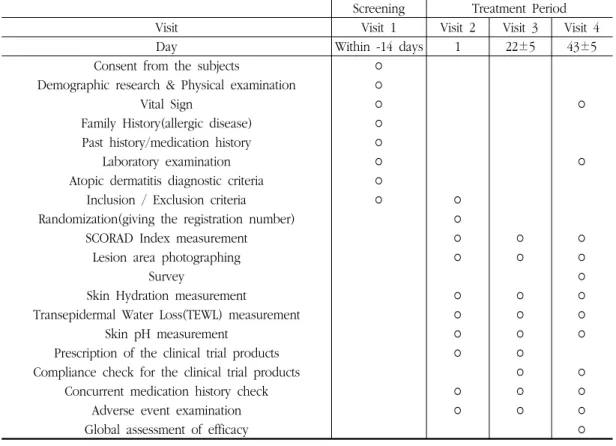
Table 1. Study Flow Chart

Screening Treatment Period

Visit Visit 1 Visit 2 Visit 3 Visit 4

Day Within -14 days 1 22±5 43±5

Consent from the subjects ○

Demographic research & Physical examination ○

Vital Sign ○ ○

Family History(allergic disease) ○ Past history/medication history ○

Laboratory examination ○ ○

Atopic dermatitis diagnostic criteria ○

Inclusion / Exclusion criteria ○ ○

Randomization(giving the registration number) ○

SCORAD Index measurement ○ ○ ○

Lesion area photographing ○ ○ ○

Survey ○

Skin Hydration measurement ○ ○ ○

Transepidermal Water Loss(TEWL) measurement ○ ○ ○

Skin pH measurement ○ ○ ○

Prescription of the clinical trial products ○ ○

Compliance check for the clinical trial products ○ ○

Concurrent medication history check ○ ○ ○

Adverse event examination ○ ○ ○

Global assessment of efficacy ○

2) The control product

① Product name : The products which draws out the principal ingredient of Atomento solution(50㎖) & cream(50g) ② Type : cream, toner

③ Storing process : Avoid the direct light, follows in general cosmetics custody method

④ Subjects : 14 (4 male, 10 female)

3) Application period, quantity and method ① Period

Six weeks

② Application quantity and method

The experimental and control group were

supplied for three weeks quantity(each for one) at the first time and after three weeks supplied in addition. To the case which will be insufficient, LOHAS Life science laboratory supplied the same products. The products were given to subjects to be applicated for two to three times a day, using the toner first, in order to apply the cream

5. Clinical efficacy

1) Primary endpoint ① SCORAD Index

Aim of this studies used the SCORAD

Index with first effectiveness evaluation using

(5)

in the subjects ‘Atomento solution & cream’

for evaluates the condition improvement of the atopic dermatitis.

② Image analysis of lesion

Image analysis of lesion of subjects used screening image system by DCS-104T (SOMETECH CO., Ltd. Korea).

2) Secondary endpoint

The Secondary endpoint evaluation index the machinery evaluation which leads a skin measurement equipment and Total IgE, Eosinophil count measurements. The machinery evaluation measured the measurement equipment of C+K companies (Courage+

Khazaka electronic GmbH and Germany) under conditions of room 20~25℃ of temperature, 40~60% of the humidity 40~60%.

Skin change of before and after of evaluation tested in order to evaluate measured in skin moisture content, Transepidermal Water Loss(TEWL) of the important joint region and skin pH. Blood of objects measured Total IgE and Eosinophil count.

Total IgE measured in serum by CENTUAR(USA), Reagent kit measured CLIA(Chemi Luminescence Immuno Assay).

Eosinophil count measured in peripheral blood by XE-2100(Sysmax, Japan). Reagent kit measured by STROMATOLASER-4DS.

① Change of moisture content

Skin change of before and after of evaluation tested in order to evaluate measured in skin moisture content by using Corneometer CM825(Courage+Khazaka electronic GmbH, Germany).

② Change of TEWL

Skin change of before and after of evaluation tested in order to evaluate measured in Transepidermal Water Loss(TEWL) by using Tewameter TM300(Courage+Khazaka electronic GmbH, Germany)

③ Change of Skin pH

Skin change of before and after of evaluation tested in order to evaluate measured in skin pH by using Skin-pH-Meter PH905 (Courage+Khazaka electronic GmbH, Germany)

6. Safety test

In order to examine the effect where the product which it uses on the human body conduct an experiment with the blood analysis(WBC, RBC, MCV, MCH, MCHC, MPV, Hemoglobin, Hematocrit and Platelets count) and biochemical analysis (Total Bilirubin, Glucose, AST, ALT, ALP, Albumin, BUN, Total Protein, Creatinine, Na, K, Cl and Total Cholesterol and ESR).

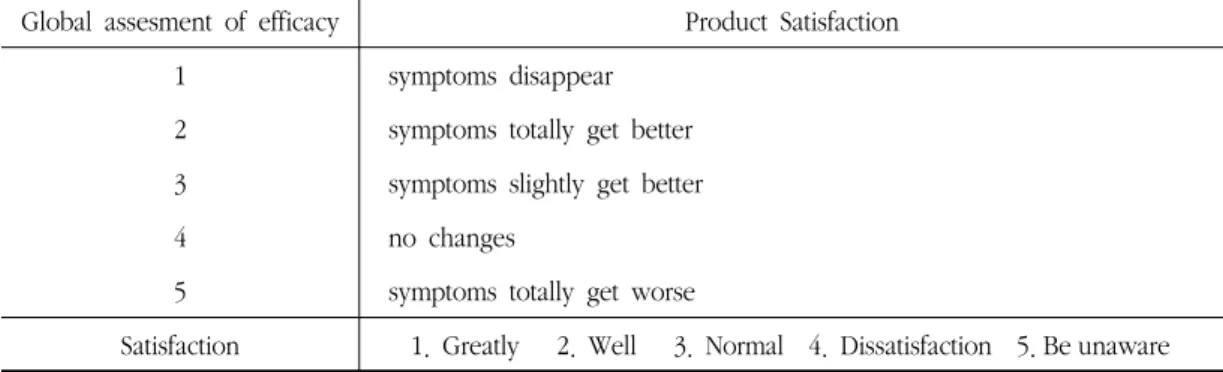
7. Global assesment of efficacy

After six weeks, the subjects and the research investigator evaluate an improvement degree and also the subjects evaluate a satisfactory degree divided at 5 phases(Table 2).

8. The other survey index

Before the clinical trial, Distribution on Age,

Height, Weight, Sex, family history(Allergic

(6)

Global assesment of efficacy Product Satisfaction 1 symptoms disappear

2 symptoms totally get better 3 symptoms slightly get better

4 no changes

5 symptoms totally get worse

Satisfaction 1. Greatly 2. Well 3. Normal 4. Dissatisfaction 5. Be unaware Table 2. Global Assesment of Efficacy & Product Satisfaction

disease), past history and measurement of vital sign were practiced, after the trial, measurement of vital sign was practiced once more. And every time the subjects visiting, Adverse event examination was practiced.

9. Statistical analysis

Data is presented as the mean of Excel program, SPSS Windows version 10.1. Comparison between two groups were analyzed using Student's t-test. P values less than 0.05 considered be statistically significant. Independent sample T verification method and Confrontation sample T official approval method were used by Statistical analysis method. the baseline characteristics was analyzed by frequency analysis and descriptive analysis

Results

1. Common characteristic of subjects

1) Sex distribution

Table 3. Sex Distribution

ITT analysis No. of Cases Male Female Total Control group

Experimental group 4 4

10 12

14 16

Total 8 22 30

2. Distribution on Age, Height, Weight

Table 4. Mean on Age, Height, Weight

Control group (N=14)

Experimenta l group

(N=16)

Total (N=30) Mean±S.D Mean±S.D Mean±S.D Age(yrs) 16.7±12.0 17.2±11.1 17.1±11.1 Height(㎝) 145.8±19.9 146.1±19.0 146.0±19.1 Weight(㎏) 45.1±18.4 48.6±21.4 46.9±19.8

Table 5. Distribution on Age Part

Age &

Sex

Experimental

group Control group Total Male Female Male Female 5-9

10-14 15-19 over

3 0 0 1

3 1 2 6

3 1 0 0

3 1 1 5

12 3 3 12

Total 4 12 4 10

16 14 30

(7)

3. Diagnosis of Atopic Dermatitis

Diagnosis of atopic dermatitis were compared with major and minor features of experimental and control group on standard diagnosis of Atopic Dermatitis Research Group (2005).

Fig. 1. Minor features of experimental and control group (Blue bar; experimental group, Red bar; control group, 1;Xerosis, 2;Pityriasis alba, 3;Periorbital eczema or orbital darkening, 4;Periauricular eczema, 5;Cheilitis, 6;Tendency towards non-specific hand or foot dermatitis, 7;Scalp scale, 8;Perifollicular accentuation, 9;Nipple eczema, 10;Itch when sweating).

The experimental and control group had a shape and the region of the characteristic dermatitis on major features. The individual and the family characteristic of atopy (asthma, allergic splenitis, atopic dermatitis) appeared highly the experimental group compare with control group.

Xerosis of minor features appeared highly experimental and control group. Experimental group appeared highly in order of tendency towards non-specific hand or foot dermatitis, scalp scale, and periorbital eczema or orbital

darkening etc. Control group appeared highly in order of scalp scale, tendency towards non-specific hand or foot dermatitis, and periorbital eczema or orbital darkening etc.

Major features 1. Pruritus

2. Typical morphology and distribution 1) Under the age of 2 years : face, trunk

and extensor involvement

2) Over the age of 2 years : face, neck and flexural involvement

3. Personal or family history (atopic dermatitis, asthma, allergic rhinitis)

Minor features 1. Xerosis

2. Pityriasis alba

3. Periorbital eczema or orbital darkening 4. Periauricular eczema

5. Cheilitis

6. Tendency towards non-specific hand or foot dermatitis

7. Scalp scale

8. Perifollicular accentuation 9. Nipple eczema

10. Itch when sweating 11. White dermographism 12. Skin prick test reactivity 13. Elevated serum IgE

14. Tendency towards cutaneous infections Table 6. Atopic Dermatitis Research Group

(2005): diagnostic criteria in Korean (at

least two of 4 major features and four

of 14 minor features)

(8)

2. Clinical efficacy

1) Primary endpoint ① SCORAD Index

Aim of this studies used the SCORAD Index with first effectiveness evaluation using in the subjects ‘Atomento solution & cream’

for evaluates the condition improvement of the atopic dermatitis.

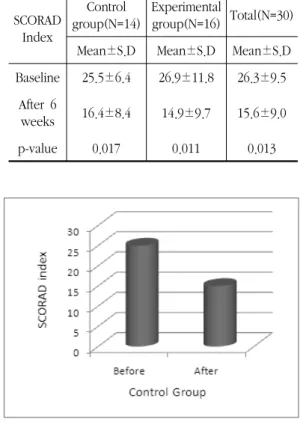
SCORAD Index changes of control group decreased with before of evaluation 25.5±6.4 points, after of evaluation 6 weeks decreased with 16.4±8.4 points. SCORAD Index changes of experimental group decreased with before of evaluation 26.9±11.8 points, after of evaluation 6 weeks decreased with 14.9±9.7 points. This results the experimental group compared in the control group the consideration characteristic appeared highly.

Fig. 2. Change of SCORAD Index between before and after 6 weeks on experimental group.

SCORAD Index

Control group(N=14)

Experimental

group(N=16) Total(N=30) Mean±S.D Mean±S.D Mean±S.D Baseline 25.5±6.4 26.9±11.8 26.3±9.5

After 6

weeks 16.4±8.4 14.9±9.7 15.6±9.0

p-value 0.017 0.011 0.013

Table 7. Change of SCORAD Index between Baseline and After 6 Weeks

Fig. 3. Change of SCORAD Index between before and after 6 weeks on control group.

② Image analysis of lesion

Image analysis of lesion of subjects used screening image system by DCS-104T (SOMETECH CO., Ltd. Korea). This results reported in the CRF.

2) Secondary endpoint

The Secondary endpoint evaluation index the

machinery evaluation which leads a skin

measurement equipment and Total IgE,

Eosinophil count measurements. The machinery

evaluation measured the measurement

equipment of C+K companies (Courage+

(9)

Khazaka electronic GmbH and Germany) under conditions of room 20~25℃ of temperature, 40~60% of the humidity 40~60%.

Skin change of before and after of evaluation tested in order to evaluate measured in skin moisture content, Transepidermal Water Loss(TEWL) of the important joint region and skin pH. Blood of objects measured Total IgE and Eosinophil count.

Total IgE measured in serum by CENTUAR(USA), Reagent kit measured CLIA(Chemi Luminescence Immuno Assay).

Eosinophil count measured in peripheral blood by XE-2100(Sysmax, Japan). Reagent kit measured by STROMATOLASER-4DS.

① Change of moisture content

Atopic dermatitis was become known low moisture content of skin not only inflammatory

Table 8. Change of Skin Hydration

Hydration Control group (N=14) Experimental group (N=16) Total(N=30)

Mean±S.D Mean±S.D Mean±S.D

Baseline 39.4±14.7 36.6±10.0 37.9±12.3

After 6 Weeks 40.9±9.3 44.0±10.3 42.5±9.8

p-value 0.019 0.008 0.011

* Reference table *

pH-value <3.5 3.8 4.0 4.3 4.5 5.0 5.3 5.5 5.7 5.9 6.2 6.5 >6.5

woman + acidic range - normal + alkaline range -

men + acidic range - normal + alkaline range -

Measurement area Type

Forehead, T-zone, Scalp, Cheek, Eyelid, Temple, Corner of the Mouth, Upper body parts, Back, Neck

Arms, Hands, Legs, Elbows

Very Dry < 30 < 15

Dry 30-49 15-29

Moisturized 50-59 30-39

Sufficiently Moisturized > 60 > 40

but also normal skins. As a results, experimental group was increased visible the skin moisture content. ‘Atomento solution &

cream’ was evaluated providing moisture contents in dermatitis.

Fig. 4. Change of Skin Hydration after 6 weeks (Blue bar; experimental group, Red bar;

control group)

(10)

② Change of TEWL

The experimental group was decreased TEWL but control group was increased TEWL.

As a results, ‘Atomento solution & cream’

were repaired skin barrier function on atopic dermatitis.

Fig. 5. Change of TEWL after 6 weeks (Blue bar;

experimental group, Red bar; control group).

TEWL Control group (N=14) Experimental group (N=16) Total(N=30)

Mean±S.D Mean±S.D Mean±S.D

Baseline 16.3±5.6 16.7±5.1 16.5±5.2

After 6 Weeks 17.3±6.3 15.4±8.7 16.3±7.6

p-value 0.023 0.019 0.025

Table 9. Change of Transepidermal Water Loss(TEWL)

* standard value *

Interpretation help TEWL VALUE(g/h/m²)

Very healthy condition 0~9

Healthy condition 10~14

Normal condition 15~24

Strained condition 25~29

Critical condition above 30

③ Change of Skin pH

Before and after of evaluation tested cannot improve skin pH from test of 6 weeks.

Fig. 6. Change of pH after 6 weeks (Blue bar;

experimental group, Red bar; control group).

④ Change of Total IgE

The result of change of total IgE was

statistical analysis in 26 subject of experimental

(11)

Table 10. Change of Skin pH

Skin pH Control group (N=14) Experimental group (N=16) Total(N=30)

Mean±S.D Mean±S.D Mean±S.D

Baseline 5.5±0.5 5.4±0.5 5.4±0.5

After 6 Weeks 5.7±0.6 5.6±0.5 5.6±0.5

p-value 0.001 0.001 0.002

* Reference table *

pH-value <3.5 3.8 4.0 4.3 4.5 5.0 5.3 5.5 5.7 5.9 6.2 6.5 >6.5

woman + acidic range - normal + alkaline range -

men + acidic range - normal + alkaline range -

Table 11. Change of Total IgE

Total IgE Control group (N=12) Experimental group (N=14) Total(N=26)

Mean±S.D Mean±S.D Mean±S.D

Baseline 93.0±109.4 641.9±1294.6 388.6±977.1

After 6 Weeks 72.7±72.7 565.8±1076.8 338.2±817.4

p-value 0.056 0.074 0.067

Fig. 7. Change of tatal IgE after 6 weeks (Blue bar; experimental group, Red bar; control group).

and control group. Total IgE of the experimental and control group was decreased after 6 weeks.

⑤ Change of Eosinophil count

Eosinophil is increase by allergic diseases, atopic dermatitis, hypersensitivity reactions and

Fig. 8. Change of Eosinophil count after 6 weeks (Blue bar; experimental group, Red bar;

control group).

parasitization. Eosinophil count changes were

visible the decrease in the experimental group

compare with control group during 6 weeks.

(12)

Table 12. Change of Eosinophil count

Eosinophil count Control group (N=13) Experimental group (N=15) Total(N=28)

Mean±S.D Mean±S.D Mean±S.D

Baseline 183.1±121.4 246.7±203.5 217.1±170.5

After 6 Weeks 174.7±108.0 203.3±130.7 190.0±119.4

p-value 0.046 0.035 0.038

Table 13. Global assesment of efficacy

Control group (N=14) Experimental group (N=16) Total(N=30)

Mean±S.D Mean±S.D Mean±S.D

Subjects 2.6±1.0 2.6±0.8 2.6±0.9

Study monitor 2.7±0.6 2.5±0.8 2.6±0.7

Table 14. Product Satisfaction

Control group (N=14) Experimental group (N=16) Total(N=30)

Mean±S.D Mean±S.D Mean±S.D

Product satisfaction 2.3±1.0 2.1±0.8 2.2±0.9

3. Global assesment of efficacy

Global assesment of efficacy of experimental group was highly comparing control group than.

Fig. 9. Global assesment of efficacy after 6 weeks (Blue bar; subjects, Red bar; study monitor).

4. Product Satisfaction

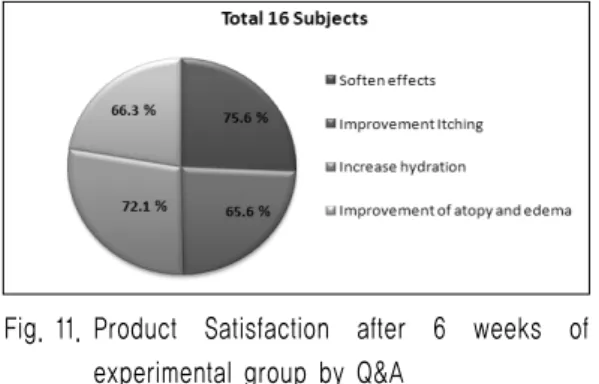
After the test of 6 weeks, it investigated the satisfactory degree against the use product in subjects. As a results, experimental group show product satisfaction where it is excellent control group than.

Fig 10. Product Satisfaction after 6 weeks (Blue

bar; experimental group, Red bar; congrol

group).

(13)

Fig. 11. Product Satisfaction after 6 weeks of experimental group by Q&A

5. Safety test

In order to examine the effect where the product which it uses on the human body conduct an experiment with the blood analysis (WBC, RBC, MCV, MCH, MCHC, MPV, Hemoglobin, Hematocrit and Platelets count) and biochemical analysis (Total Bilirubin, Glucose, AST, ALT, ALP, Albumin, BUN, Total Protein, Creatinine, Na, K, Cl and Total Cholesterol and ESR). It did show no irritation the test result of control and experimental group of 6 weeks in the human body.

Conclusion

1. The total number of subjects was 30: in the experimental group, 4 were males and 12 were females in the control group, 4 were males and 10 were females.

2. Age/height/weight ranges: 12 persons (under the age of 10), 6 persons (from the age of 10 to 20), 12 persons (over 20years of age); average age (17.1±11.1years), average height (146.0±19.1㎝) and average weight (46.9±19.8㎏)

3. In the atopic dermatitis diagnostic criteria, both the control group and the experimental group have more than two major features and four minor features. In minor features of the experimental group and the control group, xerosis was the most common symptom followed by the tendency towards non-specific hand or foot dermatitis, scalp scale, periorbital eczema or orbital darkening etc.

4. In the primary endpoint, SCORAD Index showed a statistically significant (reliable) decline in both the control group and the experimental group. However, the experimental group showed greater statistical significance (reliability) than the control group.

5. In the secondary endpoint index of skin hydration, both the control group and the experimental group showed a statistically significant (reliable) increase. However, the degree of skin hydration in the experimental group is greater than in the control group.

6. In the secondary endpoint index of Transepidermal Water Loss (TEWL), the statistical significance (reliability) of the control group was acknowledged but TEWL increased; TEWL of the experimental group showed a statistically significant (reliable) decline.

7. In the secondary endpoint index of skin pH, both the control group and the experimental group are located on the edges of subacid and alkalescent states.

After six weeks, the skin pH in the

(14)

control group was higher than in the experimental group, showing no statistical significance (reliability).

8. In the secondary endpoint index of Total IgE, compared to the previous level, the average after the clinical research became lower in both the control group and experimental group, showing statistical significance (reliability).

9. In the secondary endpoint index of Eosinophil count, compared to the previous level, both the control group and the experimental group showed a statistically significant (reliable) decline it was higher in the experimental group than in the control group.

10. To evaluate the safety of the products for the human body, hematological examination and hematological biochemical examination were conducted; both the control group and the experimental group showed no abnormallevel. Therefore, the safety of the products, if used for so long a time, proved to be safe for the human body.

11. In global assessment of efficacy, it was higher in the experimental group than in the control group for both the subjects and the researchers.

12. Product satisfaction was higher in the experimental group than in the control group.

Throughout the clinical research for six weeks, ‘Atomento solution & cream’ proved their efficacy on the damaged skin barriers

and also verified the high moisturizing effects for atopic dermatitis. Moreover, the prolonged use of ‘Atomento solution & cream’ guarantees the safety without absolutely no abnormal reactions or side effects.

Acknowledgement

본 연구는 중소기업기술혁신개발사업(과제번호 S1038768)의 지원에 의한 결과이며, 이에 감사드 립니다.

Reference

1. Oh, J.W., Kim, K.E., Pyun, B.Y.

Nationwide study for epidemiological changes of atopic dermatitis in school aged children between 1995 and 2000 and kindergarten aged children in 2003 in Korea. Pediatr Allergy Resir Dis.

2003;13(4):227-37.

2. 박용민. 아토피피부염 병태생리에 대한 최신지 견. 소아알레르기 및 호흡기학회지. 2006;16 (3):189-96.

3. Leung DYM Atopic dermatitis: new insights and opportunities for therapeutic intervention. J Allergy Clin Immunol.

2000;105:860-76.

4. 이유신. 임상피부과학. 서울:여문각. 1998:22-7.

5. Bos JD, Wierenga EA, Sillevis JH, Heijden FL, Kapsenberg ML. Immuune dysregulation in atopic eczema. Arch Dermatol. 1992;128:1509-12.

6. Bohme, M., Svenson, A., Kull, I.,

Nordvall, S.L., Wahlgren, C.F. Clinical

(15)

features of atopic dermatitis at two years of age. A prospective, population-based case-control study. Acta Derm Venerol.

2001;81:193-7.

7. Taieb A. Hypothesis: from epidermal barrier dysfunction to atopic disorders.

Contact Dermatitis. 1999;41:177-80.

8. Hanifin JM, Rajka RG. Diagnostic features of atopic dermatitis. Acta Derm Venereol 1980;92(suppl. 144):44-7.

9. 김창훈, 김정태, 정현아, 노석선. 아토피 피부 염 환자에서 한방 추출물이 포함된 외용 제품 에 대한 임상효과. 한방안이비인후피부과학회 지. 2007;20(2):187-98.

10. 황순이, 황보민, 지선영, 김소연, 권영규, 서정 철. 아토피 피부염 환자에서 七葉膽을 함유한

화장품의 임상적 연구. 한방안이비인후피부과 학회지. 2007;20(3):212-21.

11. 김성호, 윤대철, 김희택, 호동수, 윤경섭. 連翹 升麻湯이 함유된 한방화장품이 아토피 피부염 에 미치는 임상 연구. 한방안이비인후피부과학 회지. 2008;21(2):126-41.

12. 윤대철, 김희택, 김이화, 호동수. 아토피 피부 염 환자에서 黃連解毒湯이 함유된 한방화장품 에 대한 임상 연구. 동의생리병리학회지.

2008;22(6):1611-20.

13. 박영립, 김형동, 김규한, 김명남, 김진우, 노영 석, 박천욱, 이광훈, 이애영, 조상현, 최지호.

아토피피부염 학회 보고서: 한국인 아토피피부

염의 진단기준에 대한 연구. 대한피부과학회

지. 2006;44(6):659-63.

수치

Table 1. Study Flow Chart
Table 3. Sex Distribution
Fig.  1.  Minor  features  of  experimental  and  control  group  (Blue  bar;  experimental  group,  Red  bar;  control  group,  1;Xerosis,  2;Pityriasis  alba,  3;Periorbital  eczema  or  orbital  darkening, 4;Periauricular eczema, 5;Cheilitis,  6;Tendenc
Fig.  2.  Change  of  SCORAD  Index  between  before  and after 6 weeks on experimental group.
+6

참조

관련 문서

Sedation, analgesia, and cardiorespiratory function in colonoscopy using midazolam combined with fentanyl or propofol.. A randomized, double-blind, phase 3 study

This study examined the sensibility about the fundamental value of ‘safety’ of police officer who are responsible for the public security to establish

Despite this trend in addition to numerous studies examining the crime prevention effects of CCTV, a research that studies the difference between the effects

The study conducted a study of literature and research, and in literature, the study of cosmetic behavior, nail behavior, self esteem, and

The differences found in these concepts of human resources and HRD originate from their diverse subjects and objectives. In the narrow definition of the concept, the subjects of

Objective: The purpose of this study was to analyze recent trend in incidence of basal cell carcinoma and squamous cell carcinoma in patients from the Gwangju City

The purpose of study are analyzing the effects of dance majors' self-management on dance performance ability, self-efficacy and concentration, In the future,

These days, the shipping companies and shipyards are required a optimization hull form design according to improved fuel efficiency and application of EEDI.. In the present