I. Introduction
Female in their early 20s typically show keen interest in their appearances as they are stepping into a totally new phase of life such as university or career. They get to develope individual characteristics and personal tastes on fashion in this period, when they go through
Corresponding author: Choi Heisun, Tel. +82-2-3277-3075, Fax. +82-2-3277-3079 E-mail: [email protected]
dramatic changes physically, mentally, and socially. They also tend to be more or less emotionally unstable and are strongly influenced by what they feel about their clothes and appearances (Lee & Han, 2007; Su & Song, 2004). Female university students are found to be quite unfavorable and unsatisfied with some of their body parts (Rhee & Lim, 2001). Such
Preference and Fitness of Jackets by Body Shape:
Focused on the Female University Students
Jeong Jinah · Choi Heisun · Choi Jeongwook¹⁺ Dept. of Clothing & Textiles, Ewha Womans University Dept. of Textile & Clothing Design, Kyunghee University¹
Abstract
This study investigated the jacket preferences and actual fit according to body image perception of female university students in their early twenties, using a survey questionnaire method to analyze areas of dissatisfaction and improvements based on wearing experience.
On the relationship between jacket and body image perception, female students with poor body image expressed the highest rate of "not satisfied" with purchase, which was significant. On buying preferences, the "Internet" was the primary place of purchase and
"design" of jacket had highest consideration on the decision to buy. "Princess with a cinched - in waist" was the most preferred silhouette, and the most preferred length was
"below the hip line." The most preferred cut was "basic," a jacket with a "tailored-collar of notched lapel shape," and "2-buttons." On discomfort and improvement of jacket fitness, students were most dissatisfied with "arm hole." The studies of production of a jacket which fitness and activities is both considered for female university students in their early twenties who use clothes to make them look more like their ideal body image.
Key words : body image perception, female university students, fitness, jacket
physical discontentment affects their physical satisfaction and the behaviors of putting efforts to improve their appearances. And it leads them to try to change what they don't like about their body by going on a diet and at the same time try to complement their body shapes by choosing proper clothes for them.
The biggest complaint about their clothes is that the clothes do not exactly match their bodies (Su & Song, 2004). The fitness can be defined as how the clothes fit wearer's body enough to ensure natural and comfortable movements. However, It gives a great pleasure to young women to find that their body just fits some of the clothes taken off the hottest shelf.
So, fitness should be considered as one of the most critical aspects that contribute to the contentment of the consumers after purchase of apparel. The way people find that clothes fit them will be influenced by a lot of factors such as gender, age, body shape, and individual preference on diverse fashion elements (Row &
Park, 2011). Thus, we are in great need of more extensive studies and surveys on the preference of the target consumers including such diverse factors that affect their purchase decisions.
There is a study by Samsung Fashion Laboratory on the factors influencing purchase decision when Korean women buy off-the-shelf clothing, in which office wear received the highest points 4.46 out of 5.0 full marks in fitness test.
Another study by Seok and Kim (2003) on the preference survey over the fitness of ready made clothing for ladies according to different age groups shows that women in their 20s have special preference over jackets with small ease at shoulders, waist, and sleeve breadths. The jacket has strongly appealed to female in their 20s who prefer fitness compared with other age groups.
This is the core item that is composed of
asymmetric designs on the shoulder and waist ("2009 Hot & new fashion", 2009).
The way young women feel about clothes and the way they choose jackets must have been changing a lot. Accordingly, it seems necessary that there should be endeavors to find out and analyze such changes to develop clothes for young women, who are looking for clothes both stylish and comfortably fitting, by the manufacturers whose main targets are female university students in their early twenties.
As a matter of fact, we haven’t had enough number of practical studies on the jackets for female university students in early 20s so far. A study by Y. Kim (2001), rather than detailed analysis on jackets, made a survey and the comparison on the clothes fitness according to different kinds of clothes between male and female university students. A study by I. Kim and Kim (2009) aimed at the fitness of blouses among different kinds of brands. A study by Cha and Sohn (2010) only focussed on the Brassieres not jackets.
Female university students in early twenties are very important consumers in fashion industry. This study is, therefore, intended to be served as a basic resource for developing practical, comfortable and beautiful jackets when it analyzed major factors influencing purchase. And the general preference in silhouette, color, material also including analysis on the problems and complaints in fitness of off the shelf jackets.
II. Methods
1. Survey of Subjects
The subjects were randomly selected out of female university students living in Seoul or
Gyeonggi area in their early twenties aged from 20 to 24. There was a survey on 330 female university students in their early 20s from Sep.
30, 2013 to Dec. 15, 2013.
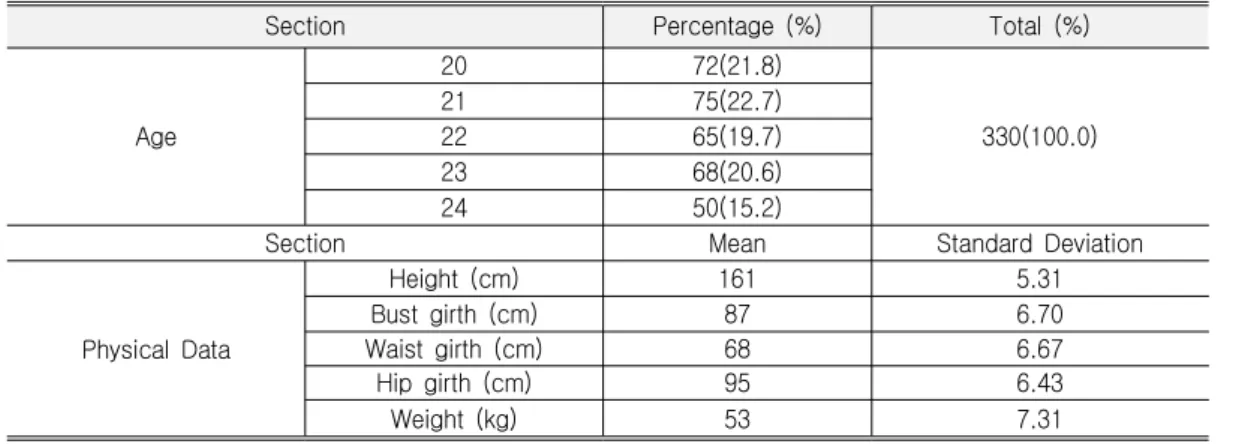
Methods of the study are actual measuring and questionnaire. Table 1 shows the general data of subjects' age and physical measurements (height, bust girth, waist girth, hip girth, weight).
2. Making the Questionnaire
The questionnaire used for the study comprises all 37 questions asking about general physical data of the subjects (2 questions), the relations between their understanding of their own body shapes and the way they choose jackets (8 questions), how they purchase and how they wear (10 questions), the preference of designs (6 questions), fitness (9 questions), any comment or suggestions on developing jackets for them (1 question).
3. Method of Analysis
Descriptive statistics was executed by SPSS WIN 21.0 program to analyze the collected data.
Table 1. General Data of Subjects
Section Percentage (%) Total (%)
Age
20 72(21.8)
330(100.0)
21 75(22.7)
22 65(19.7)
23 68(20.6)
24 50(15.2)
Section Mean Standard Deviation
Physical Data
Height (cm) 161 5.31
Bust girth (cm) 87 6.70
Waist girth (cm) 68 6.67
Hip girth (cm) 95 6.43
Weight (kg) 53 7.31
Problems or complaints of fitting or mending related questions were treated in 5 points Likert scale. Comments or suggestions on developing jackets were asked to remark in short answers, and later we checked the frequency of identical answers before we statistically treated them.
. Results
Ⅲ
1. Self Body Image Perception
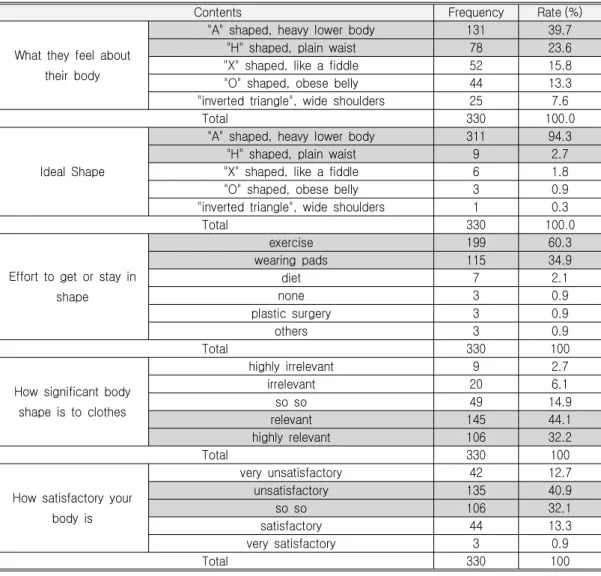
Table 2 indicates the results of the survey on how female university students in their early twenties appraise their own body shape, as well as their ideal body shape, what they did to be more like such ideal body shape, how they feel about their body shape, and how much they value body shape when choosing clothes. Most proportion of the subjects (131 people, 39.7%) answered that they had "A" shaped body with well-build lower body, second to which 78 people (23.6%) answered that they had "H"
shaped body with plain waist thinking of themselves far from being like a fiddle. However, their ideal body shape, "X" shaped body with
slim waist, was almost invariably identical, which was answered by 311 subjects (94.3%).
In an effort to be like such ideal shape, they mostly answered they work out (199 people, 60.3%), and 115 subjects (34.9%) answered they wear pads on their breast or hips. It seems that most women work out to get shaped and later resort to complementary materials. The influence of body shape on purchase decision was like "significant" 145 people (44.1%) "highly
Table 2. Self Body Image Perception
Contents Frequency Rate (%)
What they feel about their body
"A" shaped, heavy lower body 131 39.7
"H" shaped, plain waist 78 23.6
"X" shaped, like a fiddle 52 15.8
"O" shaped, obese belly 44 13.3
"inverted triangle", wide shoulders 25 7.6
Total 330 100.0
Ideal Shape
"A" shaped, heavy lower body 311 94.3
"H" shaped, plain waist 9 2.7
"X" shaped, like a fiddle 6 1.8
"O" shaped, obese belly 3 0.9
"inverted triangle", wide shoulders 1 0.3
Total 330 100.0
Effort to get or stay in shape
exercise 199 60.3
wearing pads 115 34.9
diet 7 2.1
none 3 0.9
plastic surgery 3 0.9
others 3 0.9
Total 330 100
How significant body shape is to clothes
highly irrelevant 9 2.7
irrelevant 20 6.1
so so 49 14.9
relevant 145 44.1
highly relevant 106 32.2
Total 330 100
How satisfactory your body is
very unsatisfactory 42 12.7
unsatisfactory 135 40.9
so so 106 32.1
satisfactory 44 13.3
very satisfactory 3 0.9
Total 330 100
significant" 106 people (32.3%), which means the majority of female university students consider body shape as a very important factor when they buy clothes.
To the question that if they are satisfied with their own body shape, 135 people (40.9%) answered 'unsatisfactory', and 106 (32.1%) answered 'tolerable'. A lot of subjects were found to be unsatisfied with their own body shapes.
2. Choice of the Jacket Size
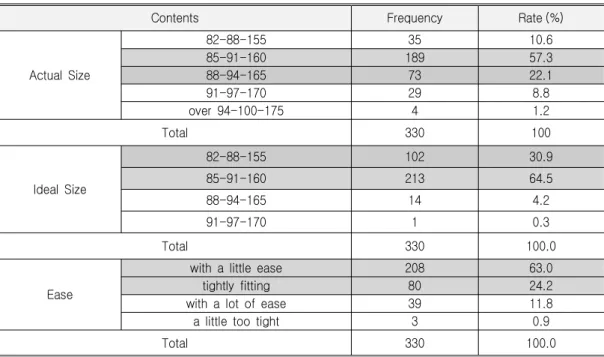
Table 3 shows the results of the survey on ideal size of a jacket and what size they choose for them considering their own body shape. The most popular jacket size proved to be '85-91-160' that accounts for 189 (57.3%).
Most of female university students in their early twenties seem to wear '85-91-160'.
In answering to the preferred amount of ease, more than half of the subjects replied to like 'a little slack clothes' (63.0%). Young women are considered to like jackets with a little ease.
3. Purchasing and wearing of the jacket
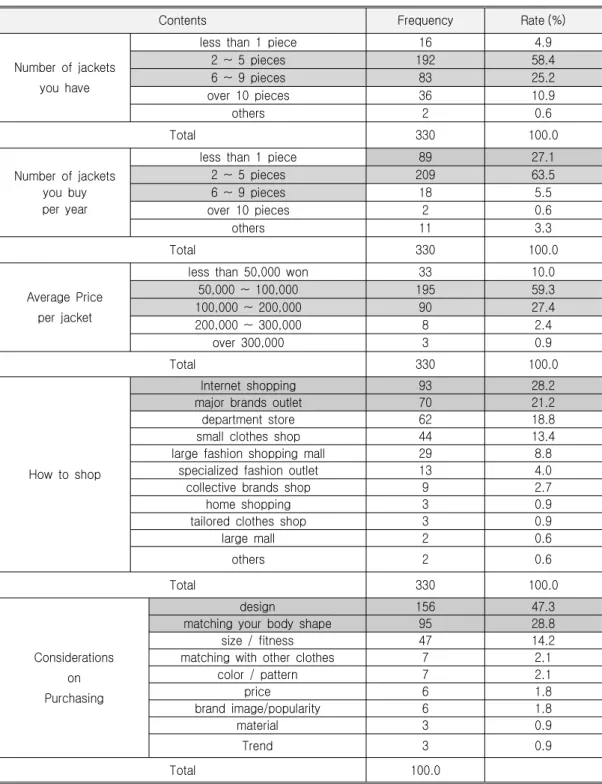
The number of jackets that female university students in early 20s possess, how many jacket they buy per year, the average price per jacket, where they usually shop for jackets are shown in
Table 3. Choice of Jacket Size
Contents Frequency Rate (%)
Actual Size
82-88-155 35 10.6
85-91-160 189 57.3
88-94-165 73 22.1
91-97-170 29 8.8
over 94-100-175 4 1.2
Total 330 100
Ideal Size
82-88-155 102 30.9
85-91-160 213 64.5
88-94-165 14 4.2
91-97-170 1 0.3
Total 330 100.0
Ease
with a little ease 208 63.0
tightly fitting 80 24.2
with a lot of ease 39 11.8
a little too tight 3 0.9
Total 330 100.0
Table 4. Most of the subjects (192 people, 58.4%) replied they have '2~5 pieces', 83 people (25.2%) said they have '6~9 pieces'. The number of jackets they purchase per year is mostly '2~5 pieces' answered by 209 people (63.5%) followed by '1 piece' 89 people (27.1%) said.
More than half 195 (59.3%) replied that the average money they spend for a jacket is '50,000 ~ 100,000 won' followed by the group of 90 (27.4%) who said they spend '100,000 ~ 200,000 won'.
The way they buy their jackets are 'internet shopping' by 93 (28.2%), 'major brand outlets’
by 70 (21.2%), 'department store' by 62 (18.8%). Lots of young women seem to prefer internet shopping.
The most important factor they consider is 'design' by 156 (47.3%), 'matching my shape' by 95 (28.8%), 'fitness and size' by 47 (14.2%).
Table 4. Facts on Purchasing Jackets
Contents Frequency Rate (%)
Number of jackets you have
less than 1 piece 16 4.9
2 ~ 5 pieces 192 58.4
6 ~ 9 pieces 83 25.2
over 10 pieces 36 10.9
others 2 0.6
Total 330 100.0
Number of jackets you buy per year
less than 1 piece 89 27.1
2 ~ 5 pieces 209 63.5
6 ~ 9 pieces 18 5.5
over 10 pieces 2 0.6
others 11 3.3
Total 330 100.0
Average Price per jacket
less than 50,000 won 33 10.0
50,000 ~ 100,000 195 59.3
100,000 ~ 200,000 90 27.4
200,000 ~ 300,000 8 2.4
over 300,000 3 0.9
Total 330 100.0
How to shop
Internet shopping 93 28.2
major brands outlet 70 21.2
department store 62 18.8
small clothes shop 44 13.4
large fashion shopping mall 29 8.8
specialized fashion outlet 13 4.0
collective brands shop 9 2.7
home shopping 3 0.9
tailored clothes shop 3 0.9
large mall 2 0.6
others 2 0.6
Total 330 100.0
Considerations on Purchasing
design 156 47.3
matching your body shape 95 28.8
size / fitness 47 14.2
matching with other clothes 7 2.1
color / pattern 7 2.1
price 6 1.8
brand image/popularity 6 1.8
material 3 0.9
Trend 3 0.9
Total 100.0
It is confirmed that design is the most important factor influencing their purchase decisions.
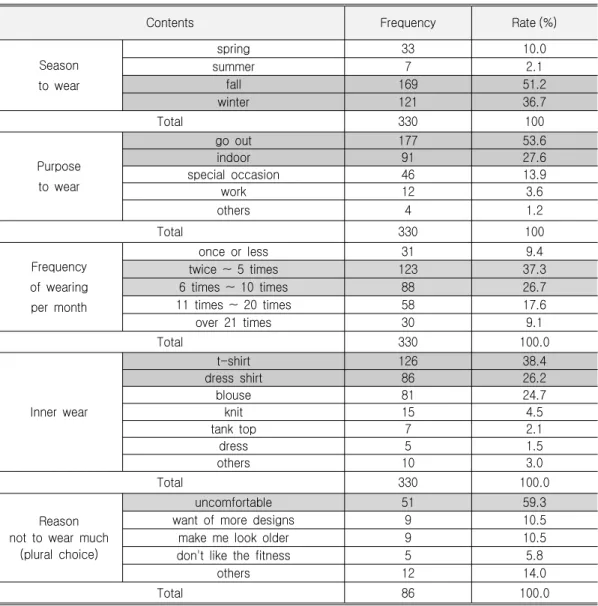
Table 5 shows that the season when they wear the jackets, the purpose of the wear, how often they wear jackets per month, what to wear to go with the jacket, and if they wear jackets once of never why they don't use jackets much.
Major season that they wear jackets is 'fall' by
Table 5. Facts on Wearing Jackets
Contents Frequency Rate (%)
Season to wear
spring 33 10.0
summer 7 2.1
fall 169 51.2
winter 121 36.7
Total 330 100
Purpose to wear
go out 177 53.6
indoor 91 27.6
special occasion 46 13.9
work 12 3.6
others 4 1.2
Total 330 100
Frequency of wearing per month
once or less 31 9.4
twice ~ 5 times 123 37.3
6 times ~ 10 times 88 26.7
11 times ~ 20 times 58 17.6
over 21 times 30 9.1
Total 330 100.0
Inner wear
t-shirt 126 38.4
dress shirt 86 26.2
blouse 81 24.7
knit 15 4.5
tank top 7 2.1
dress 5 1.5
others 10 3.0
Total 330 100.0
Reason not to wear much
(plural choice)
uncomfortable 51 59.3
want of more designs 9 10.5
make me look older 9 10.5
don't like the fitness 5 5.8
others 12 14.0
Total 86 100.0
169 (51.2%), 'winter' by 121(36.7%), 'spring' by 33 (10.0%). The purpose of wearing was 'going out' by 177(53.6%) and 'indoor' by 91 (27.6%).
The number of using jackets per month was 'twice ~ 5 times' by 123 (37.3%), and '6 times
~ 10 times' by 88 (26.7%).
To go with the jacket, they choose to wear 'T-shirt' by 126 (38.4%), 'dress shirt' by 86
(26.2%), and 'blouse' by 81 (24.7%). Lots of the subjects preferred gender neutral and active shirts to feminine blouse. When they rarely use jackets, they answered they don't use jackets because it is uncomfortable.
4. Preference of Design
Table 6. Preferred Design
Contents Frequency Rate (%)
Silhouette
princess line with slim waist 159 48.2
boxy style with lots of ease 108 32.7
H line, straight legs 55 16.7
tent-shaped, wider descendingly 7 2.1
others 1 0.3
Total 330 100
Length
lower than hip girth line 169 51.2
hip girth line 92 27.9
mid hip girth line 52 15.8
waist line 17 5.2
Total 330 100
Lapel design
tailored collar + nudged lapel 171 51.8
tailored collar + picked color lapel 75 22.7
flat collar 35 10.6
high neck collar 26 7.9
collarless 23 7.0
Total 330 100.0
Number of buttons
1-button jacket 36 10.9
2-button jacket 123 37.3
3-button jacket 103 31.2
double button jacket 68 20.6
Total 330 100.0
Material
wool 162 49.1
synthetic fabric 146 42.4
cotton 15 6.7
others 5 1.5
Total 330 100.0
Color
achromatic colors 295 89.7
primary colors 20 6.1
pastel colors 10 3.0
others 4 1.2
Total 330 100.0
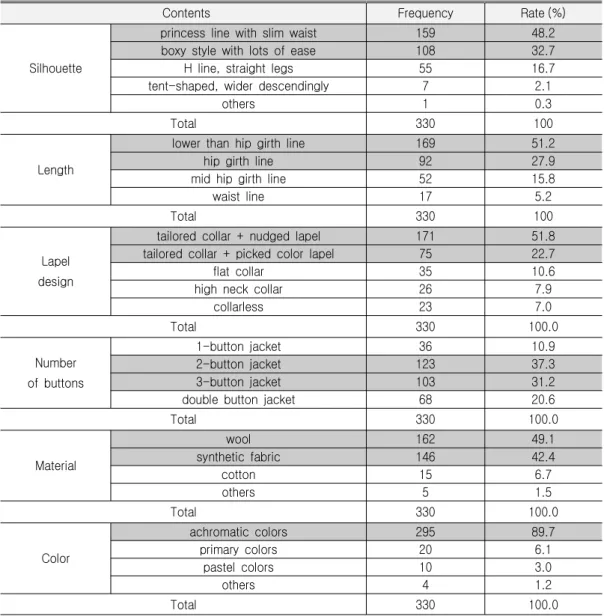
The preference of jacket design by female university students in their early twenties is shown in Table 6. Their most preferred silhouette was found to be 'princess line with slim waist' replied by 159 (48.2%) followed by 'boxy style with a spacious ease' by 108 (32.7%). It seems to be the recent fad of
skinny jeans and leggings that encouraged them to select boxy style upper wear with a lot of ease to match those tight pants.
The preferred length of the jacket was 'a little lower than the hip girth line' by 169 (51.2%) and 'hip girth line' by 92 (27.9%).
The preferred collar and lapel design was 'nudged lapel' which is the basic tailored collar by 171 (51.8%) and tailored 'picked lapel' by 75 (22.7%). The preferred number of buttons is 'two-button jacket' by 123 (37.3%), 'three-button jacket' by 103 (31.2%).
The most preferred material was 'wool'
Table 7. Fit of Jackets
Contents Frequency Rate (%)
Items that fitness is important (plural choice)
Upper Clothes
jacket 45 13.6
coat 34 10.3
blouse / shirt 32 9.7
t-shirt 14 4.2
Lower Clothes
slacks 100 30.3
skirt 20 6.1
dress 85 25.8
Total
Parts where fitness is
important
shoulder 118 35.8
length of jacket 78 23.6
waist 61 18.5
breast 29 8.8
sleeves 29 8.8
others 9 2.7
collar and lapel 5 1.5
Total 330 100
Fitness of Ready made clothes
well fitting to all brands 212 64.2
not fitting to some of brands 56 17.0
not fitting to most of brands 41 12.4
others 21 6.4
Total 330 100
answered by 162 (49.1%), which seemed to be influenced by the season that surveyed, followed by 'synthetic fabric' by 146 (42.4%). The most preferred colors were by and large achromatic colors such as white, gray, and black by 295 (89.7%), which shows they prefer a formal style.
5. Fitness of the Jacket
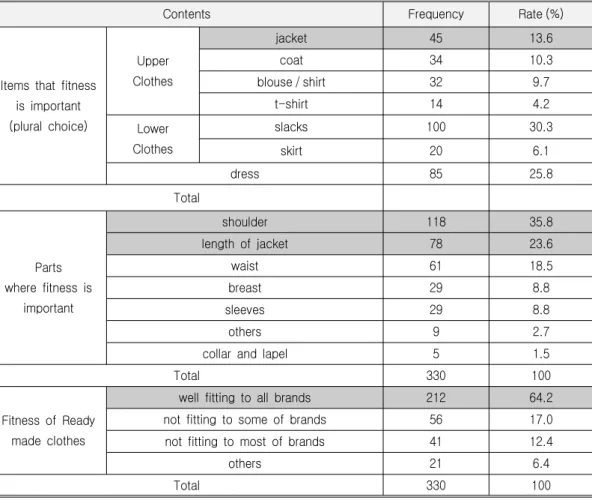
The items they consider fitness most, the part of jacket they think fitness is important, and how they feel about fitness of ready made jackets are shown in Table 7.
They think fitness most important in purchasing 'slacks' said by 100 (30.3%), 'dress' by 85 (25.8%), 'jacket' by 42 (12.7%). We see that slacks are important in lower clothes, and jackets in upper clothes.
The part of jacket where fitness is important are 'shoulders' by 118 (35.8%), 'length' by 78 (23.6%) and 'waist' by 6 (18.5%).
The survey on the fitness of ready made clothes showed that most of the subject (212, 64.2%) said they feel well fit in most brands.
Table 8. Uncomfortable Areas
Contents
Frequency (%)
Total Mean (S.D) extremely
uncomfortable
generally
uncomfortable tolerable generally comfortable
extremely comfortable
P A R T S
shoulder
length 6(1.8) 60(18.2) 157(47.6) 89(27.0) 14(4.2) 3.13(0.82)
sleeve length 9(2.7) 66(20.0) 134(40.6) 98(29.7) 17(5.2) 3.14(0.89) jacket length 1(0.3) 20(6.1) 157(47.6) 127(38.5) 19(5.8) 3.44(0.71) front intersyce
length 4(1.2) 45(13.6) 136(41.2) 116(35.2) 21(6.4) 3.32(0.84)
back intersyce
length 5(1.5) 49(14.8) 142(43.0) 113(34.2) 15(4.5) 3.25(0.82)
bust girth 10(3.0) 59(17.9) 126(38.2) 110(33.3) 17(5.2) 3.20(0.90) waist girth 4(1.2) 25(7.6) 141(42.7) 131(39.7) 23(7.0) 3.44(0.78) hip girth 8(2.4) 42(12.7) 130(39.4) 121(36.7) 23(7.0) 3.33(0.88)
arm hole 13(3.9) 71(21.5) 140(42.4) 87(26.4) 13(3.9) 3.04(0.89)
upper arm
circumference 9(2.7) 66(20.0) 147(44.5) 87(26.4) 10(3.0) 3.07(0.84) sleeve breadth 6(1.8) 48(14.5) 137(41.5) 114(34.5) 18(5.5) 3.27(0.85)
sleeve hem
width 1(0.3) 18(5.5) 146(44.2) 128(38.8) 26(7.9) 3.50(0.73)
collar & lapel 2(0.6) 13(3.9) 125(37.9) 143(43.3) 40(12.1) 3.63(0.77) general ease 4(1.2) 20(6.1) 150(45.5) 129(39.1) 18(5.5) 3.42(0.74) (1 : extremely bad, 2 : bad, 3 : tolerable, 4 : satisfactory, 5 : very satisfactory, ascendingly positive)
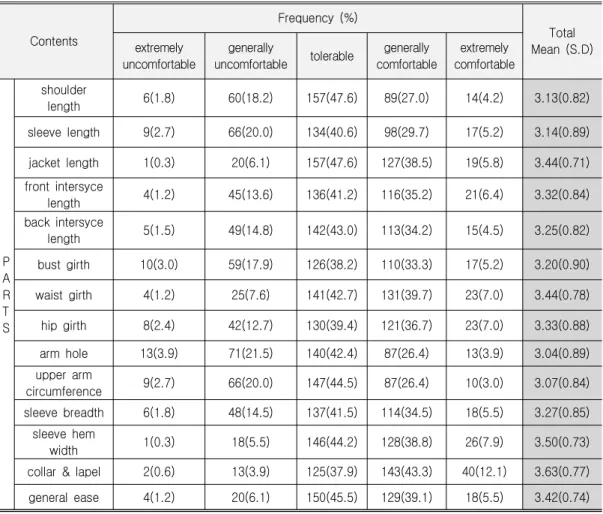
Females in early 20s wouldn't have much problems fitting ready made jackets.
The parts of jacket where they feel uncomfortable were checked in 5 points scale. The nearer to 5, the more positive. Table 8 has the results. All parts of jacket were marked over 3 points, which showed the ready made jackets were generally comfortable. 'Arm hole' got the lowest points, 3.04 followed by 'top arm hole', 3.07.
The parts of jacket where they do amendments after purchase and the amount of the adjustments are in Table 9. 'Sleeve length' was the least satisfactory part of jacket, where they adjusted the length of sleeves (lengthening: 12, shortening: 2) most often. The frequency of
Table 9. Area and Amount of Alterations
Contents
Frequency (%)
Total
Mean(S.D) Repair Frequ- extremely ency
unfitting
more or less unfitting
so so fitting highly fitting
U N C O M F O R A B L E P A R T S
shoulder
length 1(0.3) 19(5.8) 61(18.5) 35(10.6) 17(5.2) 3.36(0.90) lengthening 20 shortening 40 sleeve
length 2(0.6) 35(10.6) 53(16.1) 36(10.9) 10(3.0) 3.12(0.93) lengthening 12 shortening 2 jacket
length 9(2.7) 66(20.0) 46(13.9) 11(3.3) 3.44(0.74) lengthening 14 shortening 8 front
intersyce length
2(0.6) 7(2.1) 58(17.6) 56(17.0) 9(2.7) 3.47(0.76)
lengthening 15 shortening 21 back
intersyce length
1(0.3) 7(2.1) 64(19.4) 49(14.8) 9(2.7) 3.44(0.73)
lengthening 5 shortening 20 bust
girth 1(0.3) 12(3.6) 66(20.0) 42(12.7) 9(2.7) 3.35(0.77) lengthening 4 shortening 5 waist
girth 8(2.4) 62(18.8) 51(15.5) 10(3.0) 3.48(0.72) lengthening 5 shortening 4 hip girth 7(2.1) 73(22.1) 46(13.9) 8(2.4) 3.41(0.68) lengthening 6 shortening 7 arm
hole 2(0.6) 9(2.7) 70(21.2) 46(13.9) 7(2.1) 3.35(0.74) lengthening 9 shortening 21 upper
arm circumfe
rence
2(0.6) 8(2.4) 65(19.7) 49(14.8) 7(2.1) 3.38(0.75)
lengthening 3 shortening 10 sleeve
breadth 12(3.6) 65(19.7) 47(14.2) 8(2.4) 3.38(0.73) lengthening 1 shortening 1 sleeve
hem width
8(2.4) 60(18.2) 51(15.5) 9(2.7) 3.47(0.72)
lengthening 8 shortening 9 collar &
lapel 1(0.3) 2(0.6) 67(20.3) 52(15.8) 9(2.7) 3.50(0.68) lengthening 6 shortening 21 general
ease 7(2.1) 62(18.8) 53(16.1) 8(2.4) 3.47(0.69) lengthening 4
shortening 3 (1: extremely bad, 2: bad, 3: tolerable, 4: satisfactory, 5: very satisfactory, ascendingly positive)
amendments (40) were the highest in 'shoulder length'. 'Front intersyce length' (21), 'arm hole' (21), and 'collar and lapel' (21) were found to be quite satisfactory yet had high frequency of amendments. 'shoulder length' (20) and 'rear ease' (20) followed.
. Conclusion and Suggestion
Ⅳ
The purpose of the study is to analyze 1) the jacket preference and the wearing fitness according to the body image perception of female university students in their early twenties, 2) preferred design such as silhouette, color, and fitness, and 3) the dissatisfaction factors and the improvements from the experience of wearing a jacket. The findings and the discussion of the studies are as followed.
First, in the result of investigating the relationship between jacket and the body image perception of the female university students in her early twenties, "well-build lower body A shaped figure" was responded highest as their current body image, and 'trunk-waist H shaped figure' were followed. Many people considered their body type as lower body obesity or a rectangular body figure with no curves, whereas
"X figure with slim waist," or an hourglass figure responded most as their ideal body image. As for satisfaction of their body image, most chose
"not satisfied", showing their dissatisfaction of their figure. For the response to the effort that was made to make an ideal body, "Exercise"
responded the highest and "putting on pad on the breast and hip" the second.
The result of investigating the effect of one's body image on the purchase, people responded 'related' and 'very related' orderly, showing that perception of their own body image is critical factor of their purchase.
The result has shown that "size 55" is the ideas as well as the actual clothes size for the female university students in their early twenties and most of them preferred "a cloth that has little room".
Secondly, in results on the purchase and wearing conditions, one's possession of jackets
and an annual purchase of a jacket have both responded highest in "2~5 pieces." The average purchase cost per answered highest in "50,000~
100,000 won", and "Internet shopping" was their place of purchase. The survey also shows that the "design" of jacket was the most considered in purchasing a jacket.
"Fall season" is when people mostly wear jacket, and they do as outer wear. The study shows that 'T-shirt' is the most preferred inner-wear when wearing a jacket. The number of wearing a jacket per a month had highest respond in "2~5 times", yet they answered that they only wear a jacket "once a month". The reason was because the inconvenience of movement which shows that women in early twenties are not comfortable when wearing a jacket.
Third result is on the desirable design of jacket. The most preferred silhouette is
"Princess-silhouette with a cinched in waistline"
and a length "below the hip line". As for style, people preferred the basic which is the one with
"2-buttons" and "tailored-collar of notched lapel". Moreover, "wool" resulted to be the preferred clothe material and "achromatic color series" for the colors.
Fourth is the result of investigating the inconveniences and improvements accordingly.
"Fitness" is most considered factor especially for jacket compared to other upper garments. When purchasing a jacket, people especially showed the most concern the most in shoulder fitness.
In the list of items related to the inconvenient part in wearing a jacket, "arm hole" responded the highest as dissatisfied. After the purchase,
"sleeve length" rated the lowest, and
"shoulder-length" responded the highest in the degree of mending.
In the free respond and short-answer section
for dissatisfaction and improvements of jacket.
Twenty people stated their demand as "need of sleeve breadth fit to the size" recording to be the highest demand and showing their complaints in their sleeves. Next, thirteen people suggested, “want of a better movement around armpit area” which showed they feel uncomfortable when they move arms. For length,
“would like it if sleeves were shorter” was a conspicuous suggestion. For shapes, larger sizes such as "bigger bosom or hips" and more diverse sizes are desired to be developed. This shows the need of developments in jackets considering the activity of the female university students in their early twenties.
Likewise, this research states that it is necessary to manufacture jacket pattern that female university students in early twenties put on for their fitness and activities. Also, this study will be used as primary data for imaging body shape of women in early twenties who place a high value on its design and fitness.
However, the sample of this research is limited to the part of Seoul and Gyeonggi region.
Therefore there is a danger in applying this results to all Korean women in their early twenties.
References
Cha, S., & Sohn, H. (2010). The conditions for wearing and purchasing brassieres by Korean women: Based on the female college students in their Early 20's. Journal of the Korean Society of Clothing and Textiles, 34(2), 303-317.
Kim, I., & Kim, S. (2009). A study of ready-made clothes (RMC) of women in their early twenties: Their body posture and RMC
fitting. Korean Journal of Human Ecology, 18(2), 451-463.
Kim, Y. (2001). Fitness and problems of ready-to-wear garment in collegians. Korean Journal of Human Ecology, 10(1), 93-100 Lee, J., & Han, G. (2007). The Effects of
University Woman Students' Recognition on their image and satisfaction of their physical bodies. Journal of Fashion business, 11(2), 145-154.
Rhee, Y., & Lim, S. (2001). The relationship between weight control behavior and satisfaction with fit of apparel. Journal of the Korean Society of Clothing and Textiles, 25(1), 13-24.
Row, Y., & Park, J. (2011). Study of clothing purchase behavior and fit of middle and elderly women. The Research Journal of the Costume Culture, 19(1), 214-229.
Seok, H., & Kim, I. (2003). A study on the fit preference tendency for ready-to-wear by the age and obesity level of adult women. Journal of the Korean Home Economics Association, 41(9), 17-29.
Su, H., & Song, J. (2004). A study on body cathexis, satisfaction with apparel fit and appearance: Management behaviors according to physical figure. Fashion & Textile Research Journal, 6(3), 329-335
2009 Hot & new fashion trends. (2009, August 10). Fashion Biz. Retrieved March 15, 2014, from http://www.fashionbiz.co.kr
Received (June 9, 2014)
Revised (July 8, 2014; July 15, 2014) Accepted (July 18, 2014)