. Introduction
Ⅰ
With advancements in medical technology, the human lifespan has increased, leading to changes
†
Corresponding author: MiYoung Lee, Tel. +82-32-360-8137, Fax:+82-32-865-8130 E-mail: [email protected]
This work was supported by INHA UNIVERSITY Research Grant.
in perceptions toward the elderly. The proportion of the elderly is expected to rise to 15.7% by 2020 and 32.3% by 2040 in the entire population, driven by the surge in the senior population, which
New Seniors’ Information Sources, Store Selection Criteria, and Sales Associates' Attributes for Clothing:
Based on Their Clothing Involvement
Jeong-Hyun Ghal MiYoung Lee ․
†Dept. of Beauty Art, Myongji College Dept. of Fashion Design & Textiles, Inha University
†Abstract
This study examines female new seniors’ clothing consumption behaviors, such as their information sources, clothing store selection criteria, and perceived importance of sales associates’ attributes, based on their level of clothing involvement. A face-to-face survey was conducted through a market research firm. The subjects of this study were female adults in their 50s and 60s residing in the Seoul metro area (N=197). Significant differences were found in the clothing consuming behaviors of new seniors depending on their clothing involvement(CI). High-CI new seniors tended to place more importance on both personal and non-personal information sources than low-CI new seniors. High-CI new seniors place importance both "merchandise assortment and store atmosphere" and
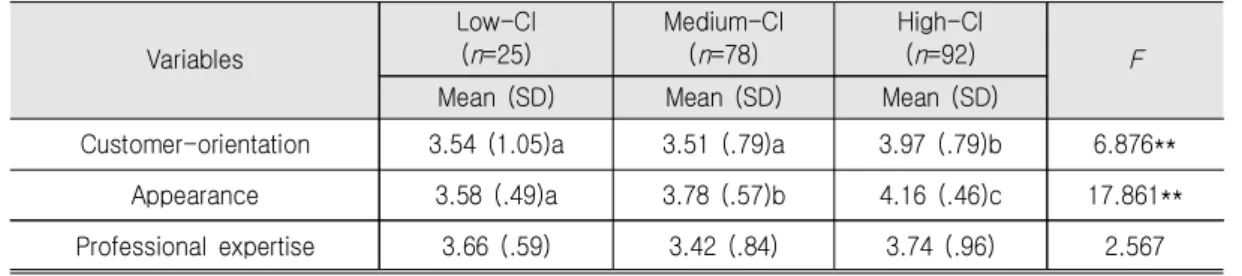
"sales associates and service" when they select stores for clothing than low-CI new seniors. In terms of sales associates’ attributes, high-CI new seniors tend to place more importance on customer-orientation than medium- and low-CI groups. Medium- and high-CI new seniors tend to place more importance on appearance than low-CI groups.
However, there were no significant statistical differences for professional expertise among the three different CI groups.
Keywords : new senior, clothing, store selection, information source, clothing involvement
suggests that Korean society is making a rapid transition to an aged society (Statistics Korea, 2013). These days, senior citizens perceive themselves as being younger than they actually are, pursuing youthful lifestyles. This is in stark contrast to the past, when biological age, based on date of birth, was used as the basis for defining aging. They are dubbed the 'new silver' (Kang, 2011), 'active seniors' (Kim, 2013), or 'new senior' (Ahn, 2011) to distinguish them from the traditional elderly generation. As mentioned above, "new seniors" (or active seniors) refer to the elderly in their 50s to 60s who are very interested in health and outward appearance. They are actively engaged in self-development without having internalized the stereotypical image of the elderly as having a passive and inactive lifestyle (Kim, 2013).
These elderly called the “new seniors” are economically well off and actively engaged in cultural activities and consumption, unlike previous elderly generations who have been stereotypically considered passive and inactive.
The new seniors are those in their 50s to 60s who cultivate themselves and lead active lives, characterized by an inclination to seek a younger look. They are attracted to nostalgia and vigorous involvement in creative and social activities. As the new seniors pursue youth, both physically and psychologically, the cosmetology and beauty industries, along with the miscellaneous goods/fashion industries, have witnessed new trends of anti-aging and down-aging, which aim to prevent aging and stimulate rejuvenation, respectively (Ahn, 2011, Kim, 2013).
Senior consumers have received growing attention in marketing research in Korea. One of the reasons could be that older consumers are going to be the most important group in terms
of retail spend (Myers & Lumbers, 2008). The senior-friendly product market, which targets senior citizens, is expected to grow rapidly from KRW 33 trillion in 2010 to KRW 125 trillion by 2020, as economically secure baby boomers (born in the period spanning from 1955 to 1963) are retiring (Korea Health Industry Development Institute, 2012). The retired elderly who have financial stability and purchasing power are very likely to form an important consumption market in the period ahead. Yet, limited research has been conducted on older consumer behaviors in the fashion market in Korea.
The fashion industry has also moved beyond the marketing that used to target primarily young consumers and has begun to tap into the senior segment that has emerged as a major consumer segment while launching new products and marketing campaigns that target the new seniors. Senior consumers, who are keen to keep pace with the latest trends and who have strong purchasing power, are spread across segments including young casual brands, imported contemporary items, and global SPA brands. Department stores have seen a surge in sales of young casual clothing for those in their 40s to 60s, surpassing the sales of clothing for those in their 20s and 30s, which is driven by the trend to select clothes that give mature individuals a younger look (Moon, 2011). Robust growth in sales has been achieved by fashion brands that exude youthfulness (e.g., LeBeige) and that are significantly differentiated from existing women’s clothing (Chung, 2009; Lee, 2014).
As new seniors have been thrust into the
limelight as a major consumer group in the
Korean market, it is necessary for marketers to
monitor this demographic group’s needs and
consumption patterns in mapping out their
marketing strategies. Research has suggested that the mature market is not homogeneous (Carrigan, 1998). Mathur et al. (1998) found that these new-elderly consumers have different value orientations compared with other mature consumers, possess younger cognitive ages and greater self-confidence, and are more receptive to change and willing to try new products and experiences. Likewise, retailers need to determine which store selection criteria and sales associate attributes are more important to their target customers to meet customers’
expectations and to develop appropriate marketing plans. In addition, they need to know what types of information sources new seniors use to develop effective advertising and promotional plans.
Thus, this study examines new seniors’
clothing consumption behaviors, such as their information sources, clothing store selection criteria, and perceived importance of sales associates, based on their level of clothing involvement. This study can help increase our understanding of the new senior consumers and provide basic data for mapping out effective marketing strategies that incorporate the knowledge of these new seniors’ clothing consumption behaviors.
. Literature Review
Ⅱ
1. Characteristics of the “New Seniors”
The threshold of old age is defined differently according to different laws and scholars in Korea. The “National Pensions Act” defines the elderly population as those aged 60 years or older, while the “Act on Prohibition of Age Discrimination in Employment and Aged
Employment Promotion” lowers the threshold to the age of 55. Previous studies on seniors have sometimes defined “seniors” as those aged 50 years or older (Chung, 2009). Moreover, such studies have defined the “new silver” as those aged 55 years or older (Kim & Lee, 2008) or have specified that those in their early 50s and early 60s are “active seniors” (Lee & Lee, 2008).
The “new seniors” refer to the elderly in their 50s to early 60s who are economically well off and who are engaged in cultural activities and consumption, actively cultivating themselves and leading active lives without any stereotyped image of leading a passive or inactive lifestyle (Ahn, 2011, Kim, 2013). Particularly, new seniors are characterized by an inclination to look younger, an attraction to nostalgia, and vigorous involvement in creative and social activities. As the new seniors pursue youth, both physically and psychologically, the fashion industry has witnessed that anti-aging and down-aging––
which aim to prevent aging and stimulate rejuvenation, respectively have emerged as ––
major trends (Ahn, 2011, Jang, 2011).
Previous findings in the literature have suggested that older consumers tend to patronize reputable/traditional stores (Lumpkin et al., 1985; Moschis, 2003) and spend more on luxury products and services than younger consumers (Gardyn, 2002; Moschis, 2008;
Moschis, 2003; Sawchuck, 1995). Previous
research in the US found that senior consumers
tend to choose products based on quality and
brand name (Burt & Gabbott, 1995; Moschis,
2003) and are less price conscious and deal
prone than younger consumers (Lumpkin et al.,
1985; Moschis, 2003). However, Korean senior
consumers tend to be more price conscious
than other aged consumer groups due to their
limited income (Bae, Oh, & Hwang, 2016).
2. Clothing Involvement
Involvement refers to the extent to which individuals perceive the importance of specific objects or relevance under specific situations (Ahn, Hwang, & Jung, 2012). Thus, clothing involvement implies the relevance and importance perceived by individuals with respect to clothing. According to a study examining the clothing involvement of aging women, clothing involvement increased in proportion to age and education level. Furthermore, participants used more information sources when clothing involvement was higher (Lee, 1996). Regarding the evaluation of sales associates’ service, it was found that the professionalism and attitude of sales associates were considered important (Hong & Jung, 2004). Moreover, the group with higher clothing involvement was found to assign greater importance to the effects of merchandise display, comfort, indoor decoration, and convenience in connection with preferred store atmosphere compared to the group with lower clothing involvement (Hong, 1996). This implies that clothing involvement may be an important variable influencing the clothing purchasing behavior or consumer behavior of seniors.
3. Information Sources
Consumers acquire information to reduce uncertainty and risk in purchasing decisions.
Information sources are the sources of information to be collected and used by consumers in the course of a purchase.
Consumers are in search of a great deal of information that is vital for them to figure out their need for purchasing and make decisions
on purchases. Information searches refer to the activities that individuals engage in to collect and process information, both physically and psychologically, to facilitate their decision-making on purchases (Hong, 1998).
Such information search activities are carried out via many different information sources, and the collected information influences the purchase decision-making processes of consumers (Ahn, Hwang, & Jung, 2012). Researchers have used several different ways to categorize information sources. Cox (1967) categorized information sources as market-dominated sources (e.g., newspaper ads, television/radio commercials, salespeople), neutral sources (e.g., magazines and consumer reports), and personal sources (e.g., family and friends). Engel et al. (1995) classified information sources as personal (e.g., conversations with family members, friends, and salespeople) and impersonal (e.g., mass media, advertisements).
Previous studies that have investigated information sources related to the clothing of the elderly suggest that personal information sources, such as family, friends, neighbors, and sales associates, have been the primary source of information for the elderly (Kim & Lee, 2008;
Whee & Sohn, 2000). According to these studies, family is considered the most important information source as an individual’s age increases, followed by print media advertisements and store window displays (Lee
& Kim, 1999). Kim and Lee (2008) classified
perceptual age into feel-age, see-age, do-age,
and interest-age and investigated the effect of
such perceptual age on the utilization of
information sources. In relation to interest-age,
a greater perception of old age led to a higher
use of personal information obtained from
friends, family, neighbors, and sales associates
but resulted in less utilization of information obtained through visual means. These previous studies suggest that seniors exercise greater use of personal information obtained from intimate sources, such as family and acquaintances, rather than non-personal information sources.
4. Store Selection Criteria
Store selection refers to the specific shops that consumers select for the purpose of shopping and making purchases. Store selection criteria, or the characteristics that appeal to consumers and draw them into the store (Ko, 1995), are important attributes that consumers use in deciding where to shop (Scott, 1985).
Store selection criteria include various aspects, such as product lineup, product quality, location, store atmosphere, sales associates’ customer service, and price. Based on these criteria, consumers judge various store alternatives and determine which store best meets their needs.
Hong and Koh (2002) studied the importance that Korean married women placed on clothing store attributes, and they found that price and merchandise variety were important store selection criteria for Korean female consumers followed by customer service and convenience.
In terms of the store selection criteria of senior consumers, Kim (2005) found that elderly women assigned the highest importance to product quality, followed by after-sales service, price, and the kindness of sales associates.
Meanwhile, Nam and Kim (1998) found that elderly women placed a high emphasis on convenience when selecting stores.
5. Sales Associates’ Attributes
Sales associates refer to those who provide
product-related knowledge and information, along with follow-up management service, for greater customer satisfaction to induce customers to purchase products. In other words, personal sales associates are in direct contact with both fixed and potential customers, and they provide them convincing information to help spur demand for products in order to induce the purchase of products or services (Ahn et al., 2012). Personal selling through sales associates has the advantage of flexible responses suited to the circumstances or customers’
requirements, increasing efficiency, and it is often leveraged to turn potential customers into actual buyers through direct contact with customers, unlike advertisements or promotions (Ahn et al., 2012). Especially for senior consumers, characterized by a decline in sensory and cognitive ability, additional assistance from sales associates when they purchase clothing may play an important role.
On the other hand, for senior consumers who are less involved in social activities, sales associates play a key part in helping them connect with society. As this personal interaction can help meet the emotional and psychological needs of aged consumers, sales associates are a decisive factor influencing the shopping behavior of senior citizens. Sales associate attributes are divided into specific factors, such as appearance, professionalism, similarity, ethicality, and customer-orientation.
Previous studies investigating senior consumers’ perceived importance of sales associates’ attributes have suggested that senior consumers tend to rely more on personal information sources for product information; in particular, they tend to obtain clothing information from sales associates (Lumpkin &
Festervand, 1987). In addition, they found that
older consumers prefer stores where they can interact with kind sales associates and can expect respectful treatment, a warmhearted tone of voice, and a decent attitude from sales associates (Kang & Hillery, 1998). Customers of advanced age in the United States were found to prefer sales associates who were of a similar age or older than themselves (Kang & Hillery, 1998), while customers of advanced age in Korea were found to prefer sales associates dressed in clothing that made them look young or formal (Jeon, 1999).
. Methods
Ⅲ
1. Research Questions
This study aimed to examine new seniors’ use of information sources, perceived importance of sales associates, and criteria for selecting clothing stores based on their level of clothing involvement. Research questions include;
1) To investigate female new seniors' clothing consumer behaviors, including type of store used for clothing shopping, and type of company chosen when they shop for clothing, 2) To investigate female new seniors' perceived importance of information sources, criteria for selecting clothing stores, and sales associates' attributes in general, and
3) To investigate new seniors' perceived importance of information sources, criteria for selecting clothing stores, and sales associates' attributes based on their clothing involvement.
2. Measurement
The questionnaire was developed based on previous work. The questions addressed the
following issues: active seniors’ 1) sources of information for purchasing clothing products, 2) clothing store sales associates’ attributes, and 3) clothing store selection criteria. Sources of information were measured with five items adopted from both Kim (2006) and Part et al.
(2006). Store selection criteria were measured with nine items adopted from Kim (2007) and Park et al. (2004). Salespersons’ attributes were measured with nine items adopted from Shin et al. (2002), Kim and Lee (2001), and Hong (2008). Level of clothing involvement was measured with five items (Kim, 1999). All measurement items were measured with 5-point scales. Questions on demographics (e.g., age, educational background, occupation, household income) were also asked.
3. Sampling and Data Analysis
The face-to-face survey was conducted over a period of 10 days through an online market research firm. The subjects of this study were adults in their 50s and 60s residing in the Seoul metro area in February 2014. Taking subjects’
age into consideration, we concluded that the face-to-face survey was most appropriate for this study. A total of 197 usable questionnaires were collected. Descriptive analysis, series of factor analyses, K-means cluster analysis, and MANOVA were applied as statistical methods.
4. Respondents’ Characteristics
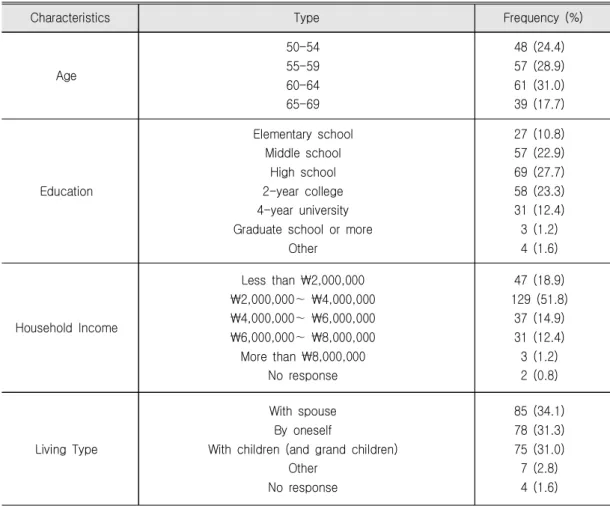
Of the 197 respondents, 53.3% were in their
50s, and 35.1% had education levels of
two-year college or more. Of all respondents,
34% indicated that they were living with their
spouse, while 31.3% indicated that they were
living alone, and 53.8% indicated that they had
Table 1. Respondents’ Characteristics (N=197)
Characteristics Type Frequency (%)
Age
50-54 55-59 60-64 65-69
48 (24.4) 57 (28.9) 61 (31.0) 39 (17.7)
Education
Elementary school Middle school
High school 2-year college 4-year university Graduate school or more
Other
27 (10.8) 57 (22.9) 69 (27.7) 58 (23.3) 31 (12.4) 3 (1.2) 4 (1.6)
Household Income
Less than 2,000,000 ₩ 2,000,000 4,000,000
₩ ∼ ₩
4,000,000 6,000,000
₩ ∼ ₩
6,000,000 8,000,000
₩ ∼ ₩
More than 8,000,000 ₩ No response
47 (18.9) 129 (51.8)
37 (14.9) 31 (12.4) 3 (1.2) 2 (0.8)
Living Type
With spouse By oneself
With children (and grand children) Other
No response
85 (34.1) 78 (31.3) 75 (31.0) 7 (2.8) 4 (1.6)
a monthly income between 2 and 4 million KRW.
Detailed information on the respondents’
characteristics is shown in Table 1.
. Results
Ⅳ
1. New Senior's Clothing Shopping Characteristics
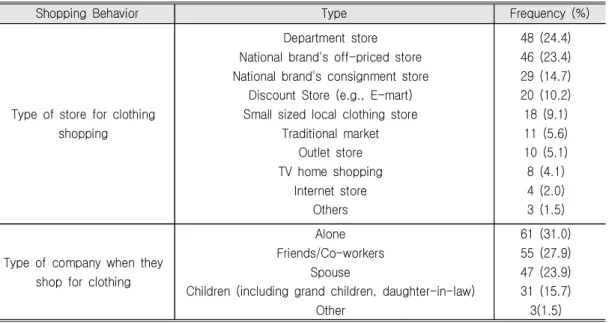
Respondents indicated that their major chosen shopping store type for clothing were department
stores (24.4%) and national brands’ off-priced
stores (23.4%). Only two percent (n=4) indicated
that they use online shopping for clothing,
indicating that most female new seniors in Korea
use off-line stores for clothing. New seniors
tend to shop alone (31%) for clothing, followed
by shopping with friends/co-workers (27.9%)
and shopping with a spouse (23.9%). Detailed
information on the respondents’ shopping
behavior is shown in Table 2.
Table 2. Clothing Shopping Characteristics (N=197)
Shopping Behavior Type Frequency (%)
Type of store for clothing shopping
Department store National brand's off-priced store National brand's consignment store
Discount Store (e.g., E-mart) Small sized local clothing store
Traditional market Outlet store TV home shopping
Internet store Others
48 (24.4) 46 (23.4) 29 (14.7) 20 (10.2) 18 (9.1) 11 (5.6) 10 (5.1) 8 (4.1) 4 (2.0) 3 (1.5)
Type of company when they shop for clothing
Alone Friends/Co-workers
Spouse
Children (including grand children, daughter-in-law) Other
61 (31.0) 55 (27.9) 47 (23.9) 31 (15.7) 3(1.5) Table 3. The Results of Factor Analysis on Information Sources (N=197)
Factor Name Item Factor
Loading Eigen value
Variance Explained %
(Cumulative variance %)
Cronbach’s α Personal
information sources
Advice from friends, family, and neighbors 0.79
1.92 38.31 .84
Advice from the sales associates of stores 0.81
Non-personal information
sources’
Show windows, displays in stores, clothes
displayed in stores 0.71
1.81 36.12
(74.43) .73
Advertisements on TV, magazines, newspapers, fashion catalogs, snail mail, subway or bus. 0.79 Advertisements via the Internet, SNS, or mobile
platforms. 0.71
2. Factor Analyses and Measurement Reliability
Measurement reliabilities for all of the measurement items were first evaluated. A factor analysis with all items was performed to determine whether the measures had good discriminant validity. First, a factor analysis
(principal component analysis (PCA)) with
Varimax rotation of active seniors’ sources of
information resulted in two factors: “personal
information sources” (% of variance = 38.31,
Cronbach’s α = .84) and “non-personal
information sources” (% of variance = 36.12,
Cronbach’s α = .73) (see Table 3).
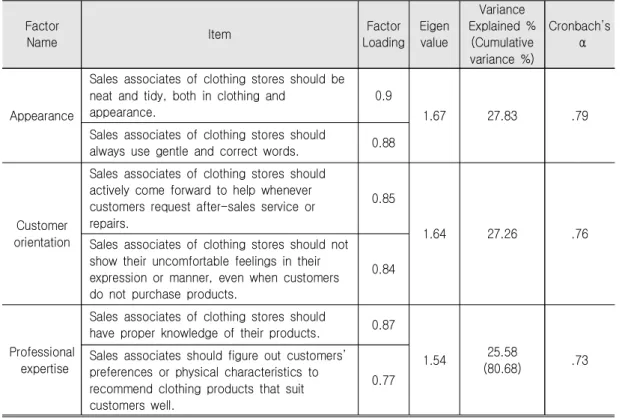
A factor analysis with Varimax rotation of active seniors’ criteria of sales associates’
attributes resulted in three factors: “appearance”
(% of variance = 27.83, Cronbach’s α = .79),
“customer orientation” (% of variance = 27.26, Cronbach’s α = .76), and “professional expertise” (% of variance = 25.58, Cronbach’s α
= .73) (see Table 4).
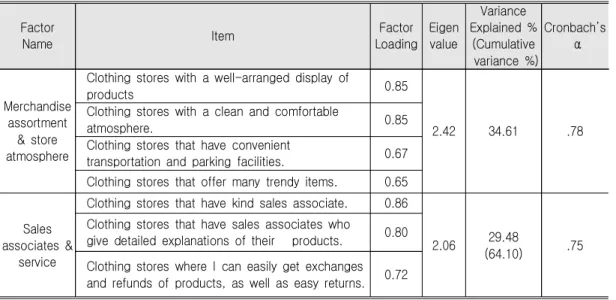
A factor analysis with Varimax rotation of active seniors’ store selection criteria resulted in two factors: “merchandise assortment and store atmosphere” (% of variance = 34.61, Cronbach’s
= .78) and “sales associates and service” (%
α
of variance = 29.48, Cronbach’s α = .75) (see Table 5). All measurement inter-item reliabilities were good (Cronbach’s α >.70) and were averaged to single scores for further analyses.
Table 4. The Results of Factor Analysis on Sales Associates’ Attributes
Factor
Name Item Factor
Loading
Eigen value
Variance Explained %
(Cumulative variance %)
Cronbach’s α
Appearance
Sales associates of clothing stores should be neat and tidy, both in clothing and
appearance.
0.9
1.67 27.83 .79
Sales associates of clothing stores should
always use gentle and correct words. 0.88
Customer orientation
Sales associates of clothing stores should actively come forward to help whenever customers request after-sales service or repairs.
0.85
1.64 27.26 .76
Sales associates of clothing stores should not show their uncomfortable feelings in their expression or manner, even when customers do not purchase products.
0.84
Professional expertise
Sales associates of clothing stores should
have proper knowledge of their products. 0.87
1.54 25.58
(80.68) .73
Sales associates should figure out customers’
preferences or physical characteristics to recommend clothing products that suit customers well.
0.77
3. New Seniors' Perceived Importance of Information Sources, Sales Associates' Attributes, and Criteria for Selecting Clothing Stores in General
In general, respondents (N=197) indicated that they placed importance both "sales associates and service" (M=3.80) and "merchandise assortment" (M=3.73) when they select clothing retail stores. For sales associates’ attributes, respondents indicated that place more importance on clothing sales associates’
appearance (M=3.93), followed by customer
orientation (M=3.74) and professional expertise
(see Table 6)
Table 5. The Results of Factor Analysis on Store Selection Criteria
Factor
Name Item Factor
Loading
Eigen value
Variance Explained %
(Cumulative variance %)
Cronbach’s α
Merchandise assortment
& store atmosphere
Clothing stores with a well-arranged display of
products 0.85
2.42 34.61 .78
Clothing stores with a clean and comfortable
atmosphere. 0.85
Clothing stores that have convenient
transportation and parking facilities. 0.67 Clothing stores that offer many trendy items. 0.65
Sales associates &
service
Clothing stores that have kind sales associate. 0.86
2.06 29.48
(64.10) .75
Clothing stores that have sales associates who
give detailed explanations of their products. 0.80 Clothing stores where I can easily get exchanges and refunds of products, as well as easy returns. 0.72
Table 6. New Senior's Clothing Consumer Behavior in General (N=197)
Variables Mean (SD)
Information sources Personal 3.17 (.96)
Non-Personal 3.03 (.79)
Store selection criteria Merchandise assortment & store atmosphere 3.73 (.64) Sales associates & service 3.80 (.72)
Sales associate’s attributes
Customer-orientation 3.74 (.86)
Appearance 3.93 (.57)
Professional expertise 3.61 (.89)
4. New Seniors' Perceived Importance of Information Sources, Sales Associates' Attributes, and Criteria for Selecting Clothing Stores Based on Clothing Involvement
K-means cluster analysis was conducted with five fashion involvement items. Respondents were classified into three groups (Table 7).
Respondents with the lowest clothing involvement were classified as the low-CI group
(n=25), and they were the oldest of the three groups at 60.7 years. Respondents with the highest clothing involvement were classified as the high-CI group (n=92), and they were the youngest of the three groups at 57.8 years.
Additionally, respondents with a clothing
involvement score that fell between low-CI and
high-CI were classified as the medium-CI group
(n=78), and this group was the middle of the
three groups in age, with an average age of
58.9 years.
Table 7. Clusters of Senior Consumers with Clothing Involvement Variables
Low-CI ( n =25)
Medium-CI ( n =78)
High-CI
( n =92) F
Mean (SD) Mean (SD) Mean (SD)
Clothing involvement 2.47 (.41)a 3.45 (.18)b 3.96 (.32)c 267.63***
Table 8. Comparison of CI Clusters for Clothing Information Sources Variables
Low-CI ( n =25)
Medium-CI ( n =78)
High-CI
( n =92) F
Mean (SD) Mean (SD) Mean (SD)
Personal
information sources 2.68 (.84)a 3.05 (.91)ab 3.39 (.98)b 6.251**
Non-Personal
information sources 2.42 (.82)a 2.84(.76)b 3.30 (.68)c 14.405***
**p<.01, ***p<.001 1) Information Sources
MANOVA was conducted with different level of CI groups as a independent variable and personal and non-personal information sources as the dependent variables. There was a statistically significant difference in the perceived importance of information sources based on a respondents' level of CI , F(4, 376) = 7.11, p <
.000; Wilk's Λ = 0.864, partial 2 = .70. Further η univariate test results were evaluated. Clothing involvement had a significant effect on both personal (F(2, 189)=6.251, p=.002, partial η
2