Optimization of Glycosyl Aesculin Synthesis by Thermotoga neapolitana β-Glucosidase Using Response-surface Methodology
Hyunsu Park1, Young-Don Park1 and Jaeho Cha1,2*
1Department of Microbiology, College of Natural Sciences, Pusan National University, Busan 46241, Korea
2Genetic Engineering Institute, Pusan National University, Busan 46241, Korea
Received August 3, 2016 /Revised September 19, 2016 /Accepted September 26, 2016
Glycosyl aesculin, a potent anti-inflammatory agent, was synthesized by transglycosylation reaction, catalyzed by Thermotoga neapolitana β-glucosidase, with aesculin as an acceptor. The key reaction pa- rameters were optimized using response-surface methodology (RSM) and 2 μg of the enzyme. As shown by a statistical analysis, a second-order polynomial model fitted well to the data (p<0.05). The response surface curve for the interaction between aesculin and other parameters revealed that the aesculin concentration and reaction time were the primary factors that affected the yield of glycosyl aesculin. Among the tested factors, the optimum values for glycosyl aesculin production were as fol- lows: aesculin concentration of 9.5 g/l, temperature of 84℃, reaction time of 81 min, and pH of 8.2.
Under these conditions, 61.7% of glycosyl aesculin was obtained, with a predicted yield of 5.86 g/l.
The maximum amount of glycosyl aesculin was 6.02 g/l. Good agreement between the predicted and experimental results confirmed the validity of the RSM. The optimization of reaction conditions by RSM resulted in a 1.6-fold increase in the production of glycosyl aesculin as compared to the yield before optimization. These results indicate that RSM can be effectively used for process optimization in the synthesis of a variety of biologically active glycosides using bacterial glycosidases.
Key words : Aesculin, β-glucosidase, response surface methodology, Thermotoga neapolitana, trans- glycosylation
*Corresponding author
*Tel : +82-51-510-2196, Fax : +82-51-514-1778
*E-mail : [email protected]
This is an Open-Access article distributed under the terms of the Creative Commons Attribution Non-Commercial License (http://creativecommons.org/licenses/by-nc/3.0) which permits unrestricted non-commercial use, distribution, and reproduction in any medium, provided the original work is properly cited.
Journal of Life Science 2017 Vol. 27. No. 1. 38~43 DOI : https://doi.org/10.5352/JLS.2017.27.1.38
Introduction
Aesculin, a 6, 7-dihydroxycoumarin-6-O-D-β-glucopyr- anoside, is a coumarin glucoside naturally found in stem barks of Fraxinus rhynchophyllycosidea and widely used for the treatment of diarrhea, leukorrhea, and inflammatory dis- eases such as arthritis and gout [14, 18, 19]. The anti-in- flammatory activity of aesculin is attributed to activating nu- clear factor-E2-related factor 2 (Nrf2) as well as inhibiting NF-κB [5, 15]. Although aesculin has been reported to show an anti-inflammatory effect, it marginally activates Nrf2 [5].
Glycosylation is one of important tailoring reactions in the synthesis or modification of biologically active compounds.
Addition of a sugar moiety to the biologically active com- pounds by glycosylation can improve their biological activ- ities as well as the low water solubility and low absorption
rate in small intestine [6, 7, 9, 20]. The β-glucosidase from hyperthermophilic bacterium Thermotoga neapolitana has been successfully used to attach the sugar moiety to the vari- ous biologically active compounds and the resultant glycosy- lated compounds enhanced solubility and biological half-life [4, 8, 16]. The glycosylated aesculin was also synthesized us- ing aesculin as an acceptor by this enzyme and its chemical structure was identified as 3-O-β-D-glycosyl aesculin by mass spectrometry and 2-dimensional NMR analysis [5].
Although the glycosylation did not give a benefit to aesculin in terms of solubility and stability, the aesculin conferred the ability to activate Nrf2 after glycosylation, enhancing the anti-inflammatory function [5].
Process optimization has been used to increase the yield and productivities of many bioprocesses. Optimization of the process parameters by classical methods, which requires the change of one variable at a time, is extremely time-con- suming because a large number of variables are usually considered. It is also difficult to obtain the valuable in- formation about the combined effect of various factors. In order to solve these difficulties and analyze the interactions between the variables, response surface methodology (RSM) based on factorial central composite design has been em-
ployed for optimization of the process parameters [3, 12, 13].
Hence in this study, optimization of critical factors for enzy- matic synthesis of glycosyl aesculin by the β-glucosidase mutant from T. neapolitana was carried out by using RSM.
The yield of the glycosylated product was continuously monitored by TLC during the optimization process of re- action conditions.
Materials and Methods
Chemicals, bacterial strain, and growth conditions Aesculin, cellobiose, maltose, and maltotriose were pur- chased from Sigma-Aldrich (St. Louis, MO, USA). E. coli MC1061 cells, which were used as host for enzyme ex- pression study, were grown in Luria-Bertani medium sup- plemented with ampicillin (100 μg/ml).
Purification of mutant enzyme
The β-glucosidase mutant (N291T) from T. neapolitana (BglA) was obtained as previously [2]. E. coli cells harboring the p6xHis119 vector containing a mutated bglA gene from Thermotoga neapolitana was cultured at 37°C in a shaking in- cubator for 18 h and then harvested by centrifugation at 10,000× g for 30 min at 4°C. The cell pellet was resuspended in 100 mM Tris-HCl buffer (pH 7.5) and disrupted by soni- cation (Sonifier 450, Branson, Danbury, CT, USA; output 4, 6 times for 30 s, constant duty) on an ice bath. The cell lysate was centrifuged at 16,000× g for 30 min at 4°C to remove the cellular debris. The supernatant was incubated at 80°C for 30 min, and heat-labile proteins of E. coli were removed by centrifugation at 16,000× g for 30 min at 4°C. The super- natant was filtered through a 0.4 μm pore-sized filter and then passed through a nickel-NTA resin (Qiagen). The col- umn was washed twice with two volumes of washing buffer [100 mM Tris-HCl buffer (pH 7.5), 10 mM imidazole], and the mutant BglA was eluted with the same buffer containing 250 mM imidazole. Proteins from the eluted fractions were pooled and dialyzed against Tris-HCl buffer (pH 7.5) to re- move the excess imidazole, and then concentrated using a Vivaspin 2 concentrator (Sigma-Aldrich).
Transglycosylation reaction
In all experiments, the reaction mixture contained 2 μg of BglA (N291T) enzyme in a 100 mM each buffer, unless otherwise indicated. The aesculin concentration (1.7-15.3 g/l), reaction temperature (70-90oC), reaction pH (5-9), and
reaction time (0-120 min) were varied in accordance to the experimental plan. The reaction was quenched by boiling for 10 min. The glycosyl aesculin produced in the reaction mixture was analyzed by TLC. TLC was performed on Whatman K5F silica gel plates using n-butanol/ethanol/ wa- ter (5:3:2, v/v/v) as the solvent, and the spots were vi- sualized by immersion in a solution containing 0.3% (w/v) N-(1-naphtyl)-ethylenediamine and 5% (v/v) H2SO4 in meth- anol followed by heating at 110°C for 10 min. The quantifica- tion of the aesculin and the glycosyl aesculin was evaluated by the density of each spot using ImageJ program (Wayne Rasband, Research Services Branch, National Institute of Mental Health, Bethesda, MD, USA).
Experimental design and data analysis
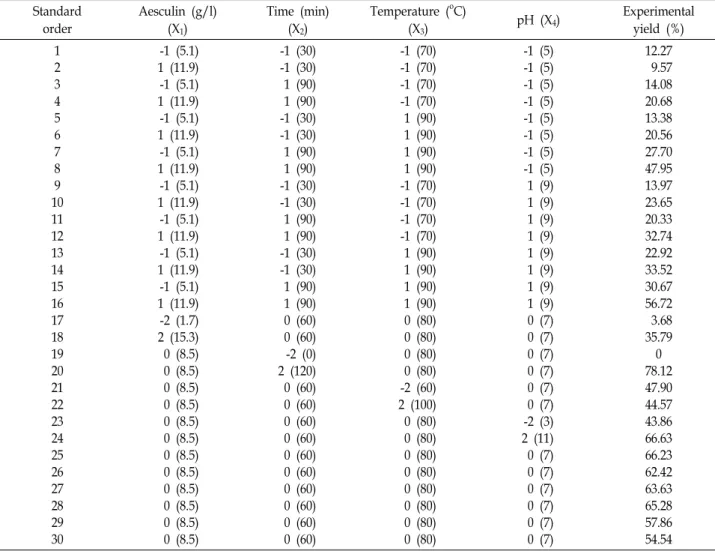
To optimize the conditions for transglycosylation reaction of aesculin by BglA (N291T) enzyme, Design-Expert 9.0 soft- ware (Stat-Ease, Minneapolis, MN, USA) was used in the experimental design and data analysis. Experiments were conducted using a central composite design (CCD) with 30 experimental points, that helps in investigating linear, quad- ratic, and cross product effects of four factors, each varied at five levels [10, 17]. The assay conditions for reaction pa- rameters were taken at zero level (center point), level one (+1 and -1) and level two (+2 and -2). The design of the experiments employed is presented in Table 1, with both, actual and coded values of factors. For the data evaluation RSM was used, and the experimental data was fitted via the following second-order polynomial equation:
Yi = βo +
where Yi is the predictive response, XiXj the independent variables, β0, βi, βii, βij are regression coefficient of the ap- plied equation. The independent variables were coded as X1, X2, X3, and X4. Analysis of variance (ANOVA) was used to estimate the statistical parameters. The significance of the model equation and model terms was evaluated by Fisher’s test [1]. The fitted polynomial equation was expressed as three-dimensional response surface curves showing the ef- fect of interactions between the responses and the ex- perimental levels of each variable used in this study.
Results and Discussion
The β-glucosidase mutant (N291T) from T. neapolitana has been previously reported as an efficient catalyst in trans-
Table 1. Experimental design with experimental yields of glycosyl aesculin production Standard
order
Aesculin (g/l) (X1)
Time (min) (X2)
Temperature (oC)
(X3) pH (X4) Experimental
yield (%) 1
2 3 4 5 6 7 8 9 10 11 12 13 14 15 16 17 18 19 20 21 22 23 24 25 26 27 28 29 30
-1 (5.1) 1 (11.9) -1 (5.1) 1 (11.9) -1 (5.1) 1 (11.9) -1 (5.1) 1 (11.9) -1 (5.1) 1 (11.9) -1 (5.1) 1 (11.9) -1 (5.1) 1 (11.9) -1 (5.1) 1 (11.9) -2 (1.7) 2 (15.3) 0 (8.5) 0 (8.5) 0 (8.5) 0 (8.5) 0 (8.5) 0 (8.5) 0 (8.5) 0 (8.5) 0 (8.5) 0 (8.5) 0 (8.5) 0 (8.5)
-1 (30) -1 (30) 1 (90) 1 (90) -1 (30) -1 (30) 1 (90) 1 (90) -1 (30) -1 (30) 1 (90) 1 (90) -1 (30) -1 (30) 1 (90) 1 (90) 0 (60) 0 (60) -2 (0) 2 (120) 0 (60) 0 (60) 0 (60) 0 (60) 0 (60) 0 (60) 0 (60) 0 (60) 0 (60) 0 (60)
-1 (70) -1 (70) -1 (70) -1 (70) 1 (90) 1 (90) 1 (90) 1 (90) -1 (70) -1 (70) -1 (70) -1 (70) 1 (90) 1 (90) 1 (90) 1 (90) 0 (80) 0 (80) 0 (80) 0 (80) -2 (60) 2 (100) 0 (80) 0 (80) 0 (80) 0 (80) 0 (80) 0 (80) 0 (80) 0 (80)
-1 (5) -1 (5) -1 (5) -1 (5) -1 (5) -1 (5) -1 (5) -1 (5) 1 (9) 1 (9) 1 (9) 1 (9) 1 (9) 1 (9) 1 (9) 1 (9) 0 (7) 0 (7) 0 (7) 0 (7) 0 (7) 0 (7) -2 (3) 2 (11) 0 (7) 0 (7) 0 (7) 0 (7) 0 (7) 0 (7)
12.27 9.57 14.08 20.68 13.38 20.56 27.70 47.95 13.97 23.65 20.33 32.74 22.92 33.52 30.67 56.72 3.68 35.79 0 78.12 47.90 44.57 43.86 66.63 66.23 62.42 63.63 65.28 57.86 54.54
Table 2. ANOVA for the fitted quadratic polynomial model of glycosyl aesculin production
Source Sum of squares Degree of freedom Mean square F value p-value
Model Residual Lack of fit Pure error Cor totalb
11230.49 2616.84 2513.26 103.58 13847.33
14 15 10 5 29
802.18 174.46 251.33 20.72
4.60
12.13
0.0029a
0.0065a
ap<0.05 Significant
bCor total: corrected total
glycosylation reaction [2]. Previously, the glycosyl aesculin was enzymatically synthesized using aesculin and cellobiose as an acceptor and a donor, respectively [5]. The reaction was carried out at the condition of 20 g/l aesculin, 10 g/l cellobiose and 1.8 μg of enzyme in the presence of 100 mM sodium phosphate buffer (pH 7.0) at 80oC. After 1 hr re- action, the reaction product was examined using TLC. Only one major product, glycosyl aesculin, was identified and pu- rified from the reaction mixture by recycling prep HPLC,
whose yield was approximately 15% according to the densi- tometric analysis.
For optimization process, cellobiose supposed to be a do- nor for transglycosylation reaction was not added in the re- action because glycosyl aesculin was still synthesized with- out cellobiose. It has been known that cellobiose has an in- hibitory effect on most microbial β-glucosidase [11, 21]. In this respect, the use of β-glucosidase without adding cello- biose will have a significant advantage for the enzymatic
A
B
C
Fig. 1. Three-dimensional response surface curves showing the effect of interactions of (A) aesculin and time, (B) aescu- lin and temperature, and (C) aesculin and pH for glyco- syl aesculin production.
A B
Fig. 2. TLC chromatogram (A) and yield (B) of the glycosyl aes- culin by the transglycosylation reaction using the β -glucosidase mutant. Arrow indicates a glycosyl aesculin.
1, before optimization, 2, after optimization with RSM.
G1, glucose; G2, maltose; G3, maltotriose.
conversion of aesculin to glycosyl aesculin. It was confirmed that the glucose moiety released from the aesculin by hydro- lytic reaction of BglA was transferred to the aesculin to pro- duce the glycosyl aesculin.
Therefore, in order to maximize the yield of the product, the reaction conditions including aesculin concentration (X1), reaction time (X2), temperature (X3), and pH (X4) were investigated. CCD was used to assess the interactions be- tween factors within a range of -2 to +2 for synthesis of glu-
cosyl aesculin. A total of 30 experiments was conducted uti- lizing different combinations of four factors (Table 1). RSM was adopted because it determines the optimum values of key experimental factors, as well as explains the relation- ships between factors. Statistical analysis showed that the proposed second-order polynomial model was adequate for fitting experimental results at the applied significance value (p<0.05). The final empirical model in terms of four factors in coded units was as follows:
Y = 61.66 + 6.43X1 + 10.72X2 + 4.14X3 + 4.74X4 + 2.53X1X2
+ 2.38X1X3 + 1.71X1X4 + 2.77X2X3 - 0.51X2X4 + 0.009X3X4 - 12.99X12
- 8.15X22
- 6.36X32
- 4.11X42
where X1 is aesculin, X2 is reaction time, X3 is temperature, and X4 is pH. From ANOVA, p-value (Prob > F) less than 0.05 indicated that the model terms were significant. In this case, X1, X2, X12
, X22
, and X32
were significant model terms.
The model F-value was 4.60 and the F-value for lack of fit was 12.13(Table 2). The coefficient of determination (R2) of 0.8110 (a value > 0.75 indicates fitness of the model) showed reasonably a good agreement with the adjusted R2 of 0.6346.
The “adequate precision” measures the single to noise ratio.
In this model, a ratio was found to be 7.294(a ratio greater than 4 is desirable), which indicated a satisfactory outcome.
The response surface curve for the interaction between aesculin and other parameters are shown in Fig. 1. The ex- perimental yield of glycosyl aesculin varied with changes in X2, X3, and X4. The yield of glycosyl aesculin was de- creased at longer reaction time and lower aesculin concen-
tration (Fig. 1A). The synthesis of glycosyl aesculin was dras- tically affected by slight changes in the values of these two factors. The coefficient value from second-order polynomial model also indicated that the aesculin concentration and the reaction time seem to be the influential factors, since the cor- responding linear and quadratic coefficients have the high values. Other factors exhibited moderate effects in the prod- uct yield. The optimum values were X1 = 9.5 g/l, X2 = 81.2 min, X3 = 84oC, and X4 = pH 8.16. At these conditions, the yield of maximum glycosyl aesculin was 61.7% with a pre- dicted yield of 5.86 g/l. The actual yield obtained was 6.02 g/l. The 1.6% deviation from the predicted value was ob- served between the experimental and predicted values, which validate the model. The glycosyl aesculin production before optimization was 3.76 g/l at 1 hr. Thus the opti- mization of reaction conditions resulted in 1.6-fold increase in the production of glycosyl aesculin over the yield before optimization (Fig. 2). In conclusion, RSM might be effec- tively applied to the process optimization for the synthesis of a variety of biologically active glycosides using bacterial glycosidases.
Acknowledgment
This work was supported by a 2-Year Research Grant of Pusan National University.
References
1. Box, G. E. P. and Wilson, K. B. 1951. On the experimental attainment of optimum conditions (with discussion). J. R.
Aust. Hist. Soc. Series B 13, 1-45.
2. Choi, K. W., Park, K. M., Jun, S. Y., Park, C. S., Park, K.
H. and Cha, J. 2008. Modulation of the regioselectivity of a Thermotoga neapolitana β-glucosidase by site-directed mutagenesis. J. Microbiol. Biotechnol. 18, 901-907.
3. Gurme, S. T., Surwase, S. N., Patil, S. A., Jadhav, S. B. and Jadhav, J. P. 2013. Optimization of biotransformation of l-ty- rosine to l-DOPA by Yarrowia lipolytica-NCIM 3472 using response surface methodology. Ind. J. Microbiol. 53, 194-198.
4. Jun, S. Y., Park, K. M., Choi, K. W., Jang, M. K., Kang, H.
Y., Lee, S. H., Park, K. H. and Cha, J. 2008. Inhibitory effects of arbutin-β-glycosides synthesized from enzymatic trans- glycosylation for melanogenesis. Biotechnol. Lett. 30, 743-748.
5. Kim, K. H., Park, H., Park, H. J., Choi, K. H., Sadikot, R.
T., Cha, J. and Joo, M. 2016. Glycosylation enables aesculin to activate Nrf2. Sci. Rep. 6, 29956.
6. Kim, K. H., Park, Y. D., Park. H., Moon, K. O., Ha, K. T., Baek, N. I., Park, C. S., Joo, M. and Cha, J. 2014. Synthesis and biological evaluation of a novel baicalein glycoside as
an anti-inflammatory agent. Eur. J. Pharmacol. 744, 147-156.
7. Ko, J. A., Ryu, Y. B., Park, T. S., Jeong, H. J., Kim, J. H., Park, S. J., Kim, J. S., Kim, D., Kim, Y. M. and Lee, W. S.
2012. Enzymatic synthesis of puerarin glucosides using Leuconostoc dextransucrase. J. Microbiol. Biotechnol. 22, 1224- 1229.
8. Park, T. H., Choi, K. W., Park, C. S., Lee, S. B., Kang, H.
Y., Shon, K. J., Park, J. S. and Cha, J. 2005. Substrate specific- ity and transglycosylation catalyzed by a thermostable β- glucosidase from marine hyperthermophile Thermotoga neapolitana. Appl. Microbiol. Biotechnol. 69, 411-422.
9. Raab, T., Barron, D., Vera, F. A., Crespy, V., Oliveira, M.
and Williamson, G. 2010. Catechin glucosides: occurrence, synthesis, and stability. J. Agric. Food Chem. 58, 2138-2149.
10. Rodriguez-Nogales, J. M., Roura, E. and Contreras, E. 2005.
Biosynthesis of ethyl butyrate using immobilized lipase: a statistical approach. Process Biochem. 40, 63-68.
11. Schmid, G. and Wandrey, C. 1987. Purification and partial characterization of a cellodextrin glucohydrolase (β-glucosi- dase) from Trichoderma reesei strain QM 9414. Biotechnol.
Bioeng. 30, 571-585.
12. Tanyildizi, M., Ozer, D. and Elibol, M. 2005. Optimization of α-amylase production by Bacillus sp. using response sur- face methodology. Process Biochem. 40, 2291-2296.
13. Thangavel, P., Balaraman, M. and Soundra, D. 2009. A re- sponse surface methodological study on prediction of gluco- sylation yields of thiamin using immobilized β-glucosidase.
Process Biochem. 44, 251-255.
14. Thuong, P. T., Pokharel, Y. R., Lee, M. Y., Kim, S. K., Bae, K., Su, N. D., Oh, W. K. and Kang, K. W. 2009. Dual anti-oxi- dative effects of fraxetin isolated from Fraxinus rhinchophylla.
Biol Pharm Bull. 32, 1527-1532.
15. Tianzhu, Z. and Shumin, W. 2015. Esculin inhibits the in- flammation of LPS-induced acute lung injury in mice via regulation of TLR/NF-κB pathways. Inflammation 38, 1529- 1536.
16. Turner, P., Svensson, D., Adlercreutz, P. and Karlsson, E.
N. 2007. A novel variant of Thermotoga neapolitana β-glucosi- dase B is an efficient catalyst for the synthesis of alkyl gluco- sides by transglycosylation. J. Biotechnol. 130, 67-74.
17. Veličković, D., Dimitrijević, A., Bihelović, F., Bezbradica, D., Jankov, R. and Milosavić, N. 2011. A highly efficient diaster- eoselective synthesis of α-isosalicin by maltase from Sacchar- omyces cerevisiae. Process Biochem. 46, 1698-1702.
18. Witaicenis, A., Seito, L. N., da Silveira Chagas, A., de Almeida, L. D. Jr, Luchini, A. C., Rodrigues-Orsi, P., Cestari, S. H. and Di Stasi, L. C. 2014. Antioxidant and intestinal anti-inflammatory effects of plant-derived coumarin de- rivatives. Phytomedicine 21, 240-246.
19. Witaicenis, A., Seito, L. N. and Di Stasi, L. C. 2010. Intestinal anti-inflammatory activity of esculetin and 4-methyl- esculetin in the trinitrobenzenesulphonic acid model of rat colitis. Chem. Biol. Interact. 186, 211-218.
20. Woo, H. J., Kang, H. K., Nguyen, T. T., Kim, G. E., Kim, Y. M., Park, J. S., Kim, D., Cha, J., Moon, Y. H., Nam, S.
H., Xia, Y. M., Kimura, A. and Kim, D. 2012. Synthesis and
초록:반응표면분석법을 이용한
Thermotoga neapolitana
β-glucosidase의 당전이 활성을 통한 glycosyl aesculin 합성 최적화박현수․박영돈․차재호*
(부산대학교 미생물학과)
강한 항 염증 활성을 갖는 glycosyl aesculin이 Thermotoga neapolitana β-glucosidase의 당전이 활성을 통하여 aesculin을 수용체로 이용하여 합성되었다. 약 2 μg의 효소를 이용하여 반응표면분석법을 통한 주요 반응 매개변 수들의 최적화가 시도되었다. 각 반응 변수들의 통계분석 결과 2차 다항식모델이 적용된 유의값(p<0.05)에 잘 맞 았다. Aesculin과 다른 매개변수사이의 상호관계를 의미하는 반응표면곡선 그래프는 glycosyl aesculin의 수율이 주로 aesculin의 농도와 반응시간에 영향을 받음을 나타내었다. Glycosyl aesculin의 생산을 위한 반응최적조건은 aesculin의 농도 9.5 g/l, 온도 84oC, 반응시간 81분, 그리고 pH 8.2로 나타났으며, 이러한 조건하에서 효소반응 시 61.7%의 전환율로 5.86 g/l 의 수율이 예상되었다. 실험을 통한 실질적인 수율은 6.02 g/l으로 나타났다. 실질적 인 수율과 가까운 값을 예측 가능하다는 것을 통하여 반응표면분석법이 효소반응의 전환율을 최적화하는데 타당 하다는 것이 입증되었다. 본 연구에서는 반응표면분석법을 활용하여 최적화 이전에 비하여 약 1.6배의 glycosyl aesculin을 얻을 수 있었다. 이러한 결과들은 반응표면분석법이 미생물유래 당화효소를 이용한 생물학적 활성을 갖는 배당체 합성의 생산 최적화에 효과적으로 활용할 수 있다는 것을 보여준다.
characterization of ampelopsin glucosides using dex- transucrase from Leuconostoc mesenteroides B-1299CB4: gluco- sylation enhancing physicochemical properties. Enzyme Microb. Technol. 51, 311-318.
21. Woodward, J. and Wiseman, A. 1982. Fungal and other β- glucosidases-their properties and applications. Enzyme Microb.
Technol. 4, 73-79.