• 검색 결과가 없습니다.

Optimization of Alkali Pretreatment from Steam Exploded Barley Husk to Enhance Glucose Fraction Using Response Surface Methodology

N/A
N/A
Protected

Academic year: 2021

Share "Optimization of Alkali Pretreatment from Steam Exploded Barley Husk to Enhance Glucose Fraction Using Response Surface Methodology"

Copied!
13
0
0

로드 중.... (전체 텍스트 보기)

전체 글

(1)

1. INTRODUCTION

Lignocellulosic biomass (complex polymer made up from three carbohydrates: cellulose and hemicellulose) is considered an attractive feedstock for the production of fuel ethanol due to its availability in large quantities at low cost and for reducing competition with food (Cardona and Sanchez, 2007; Cheng et al., 2008, Mandade et al., 2016; Zhang et al., 2016) Second generation biofuels (e.g. lignocellulosic

bioethanol), based on lignocellulosic biomass, are becoming a viable alternative. Low-cost ag- ricultural residues such as corn stover, sugar cane bagasse, barley husk and wheat straw are potential materials for lignocellulosic ethanol production (Sanchez and Cardona, 2008).

Barley (Hordeum vulgare) is one of the com- mon cereal grains, which serves as a major health food, animal feed crop and, more re- cently, a large amount is being used for malting to produce alcoholic drinks such as beer and

Original Article

Optimization of Alkali Pretreatment from Steam Exploded Barley Husk to Enhance Glucose Fraction Using Response Surface Methodology 1

Ji Young Jung

2

⋅Si Young Ha

2

⋅Jai Hyun Park

2

⋅Jae-Kyung Yang

2,†

ABSTRACT

The optimum alkali pretreatment parameters (reaction time, reaction temperature and potassium hydroxide concentration) for facilitate the conversion into fermentable sugar (glucose) from steam exploded (severity log Ro 2.45) barley husk were determined using Response Surface Methodology (RSM) based on a factorial Central Composite Design (CCD). The prediction of the response was carried out by a second-order polynomial model and regression analysis revealed that more than 88% of the variation can be explained by the models.

The optimum conditions for maximum cellulose content were determined to be 201 min reaction time, 124 ℃ reaction temperature and 0.9% potassium hydroxide concentration. This data shows that the actual value obtained was similar to the predicted value calculated from the model. The pretreated barley husk using acid hydrolysis resulted in a glucose conversion of 94.6%. This research of steam explosion and alkali pretreatment was a promising method to improve cellulose-rich residue for lignocellulosic biomass.

Keywords : barley husk, steam explosion, alkali pretreatment, response surface methodology

1

Date Received January 19, 2017, Date Accepted March 1, 2017

2

Division of Environmental Forest Science and Institute of Agriculture & Life Science, Gyeongsang National University, Jinju, 52828, Republic of Korea

Corresponding author: Jae-Kyung Yang (e-mail: [email protected])

(2)

whisky. Barley husk is lignocellulosic agro waste, which is about 20% of the barley plant.

A small portion of the barley husk is used as cattle food and fertilizer. Conversion of cellu- lose and hemicellulose from this waste barley husk to sugars provides a feedstock for the production of fuel ethanol and will substantially reduce the amount of waste.

Pretreatment is necessary to alter the structure of the cellulosic biomass and minimize energy demands, but it is also needed to limit the for- mation of degradation products that can inhibit the growth of fermentative microorganism (Hamelinck et al., 2005; Hendriks and Zeeman, 2009; Wyman et al., 2005; Mosier et al., 2005a; Mosier et al., 2005b). Pretreatment dis- rupts the plant cell wall and improves micro- organism access to the polysaccharides. Studies have shown a direct correlation between the re- moval of lignin and hemicellulose and the di- gestibility of cellulose (Wyman et al., 2005;

Kim and Holtzapple, 2006). The steam ex- plosion treatment (explosive autohydrolysis) has been extensively studied as a promising pre- treatment process (Duff and Murray, 1996;

Vlasenko et al., 1997) to separate main compo- nents of lignocellulosic biomass (cellulose, hemicellulose and lignin). Steam explosion con- sists of placing the material into a reactor, ex- posing it to steam in the range of 16 - 34 kgf/cm

2

at temperatures in the range of 200 - 240 ℃ for 30 s to 20 min, and opening a valve rapidly to explosively decompress the material to atmospheric pressure. During the steam ex- plosion, the hemicellulose is partially hydro-

lyzed and the lignin is depolymerized, giving rise to sugars and phenolic compounds that are soluble in water. At the end of the process, the cellulose is depolymerized and defibrillated, while the de-etherified lignin is decomposed, repolymerized, and melted, becoming soluble in alkali solution and in certain organic solvents.

The process is generally followed by a fractio- nation step to separate the main components (Donaldson et al., 1988; Heitz et al., 1991;

Beltrame et al., 1992). One of the problems with the steam explosion process is that it does not significantly delignify the lignocellulosic bi- omass; most of the lignin remains in the result- ing cellulosic substrate. Alkaline treatment and chlorine treatment have been successfully devel- oped for lignocellulose pretreatment, and the agents are effective for hemicellulose and lignin removal (Carrilo et al., 2005; Zhu et al., 2006).

The alkaline pretreatment has received more at- tention because it is relatively inexpensive, less energy intensive, and effective on many feed- stocks such as forage and agricultural residues (Belkacemi et al., 1998; Chang et al., 2001;

Chen et al., 2007; Xu et al., 2010). The appli- cation of alkaline solutions leads to removal of the lignin barrier, disruption of structural link- ages, reduction of cellulose crystallinity, and a decrease in the polymerization degree of carbo- hydrates (Mosier et al., 2005b; Sun and Cheng, 2002).

Optimization of pretreatment conditions for

lignocellulosic biomass is one of the most im-

portant stages in the development of an effi-

cient and economical pretreatment method.

(3)

Response surface methodology (RSM) is a col- lection of statistical techniques for designing experiments, building models, evaluating the effects of factors (Yue et al., 2008), which ex- tracts the maximum amount of information with a minimal number of runs. Recently, RSM has been successfully applied to biomass pretreat- ment by many researchers (Jeong and Lee, 2016; Canettieri et al., 2007; Kim and Mazza, 2008, Lu et al., 2007; Neureiter et al., 2002).

There are three major hydrolysis processes for lignocellulosic biomass to produce a variety of capable sugars of making ethanol: dilute acid, concentrated acid, and enzymatic hydrol- ysis (Broder et al., 1995). Hemicellulose is readily hydrolyzed by dilute acids under moder- ate conditions, but much more extreme con- ditions are needed for hydrolysis of cellulose.

The main advantages of the concentrated acid hydrolysis process are low operating temper- atures and pressures and higher ethanol yields than the dilute acid hydrolysis process (Broder et al., 1995; Parisi, 1989; Sivers and Zacchi, 1995).

The objective of this study was to improve the glucose conversion of steam exploded bar- ley husk by optimizing alkaline treatment. The response surface methodology with a central composite design was adopted to optimize the alkaline treatment parameters (reaction time, re- action temperature and potassium hydroxide concentration) to obtain a maximum cellulose content from steam exploded barley husk. The glucose conversion by acid hydrolysis of the cellulose fraction into glucose of the pretreated

materials was evaluated.

2. MATERIALS and METHODS 2.1. Raw material

The barley husk was air-dried, hammer-milled to a particle size of 20 - 80 mesh and then stored in sealed plastic bags at 4 ℃.

2.2. Two-stage pretreatment

2.2.1. The first stage: steam explosion pre- treatment

The barley husk was pretreated with steam explosion at bench scale equipment with a 1 L reactor fitted with a quick-opening aerodynamic valve in the following procedure: barley husk was steamed at 10 kgf/cm

2

for 25 min. The

“severity parameter (Ro)” was used to map the destruction, desegregation, and depolymerization of barley husk. Ro was calculated using the fol- lowing equation, Eq.(1) (Fernadez-Bolanos et al., 1999):

Ro = {t*exp[(T-100)/14.5]} ··· (1)

Where T is the temperature ( ℃) and t is the

time (min). The steam exploded material was

recovered in a cyclone and, after cooling to

about 40 ℃, filtered for solid recovery. The sol-

id fraction was distilled water washed then was

dried in the air until the moisture content of

samples reached less than 10% (drying con-

ditions: ambient temperature and 72 h of drying

time) and stored in the refrigerator for the sec-

(4)

ond stage of alkali treatment.

2.2.2. The second stage: alkali pretreatment Barley husk was treated using steam ex- plosion method in the first stage and dried in the convection air as described previous section.

After drying process, 10 g of dry steam ex- ploded samples was re-pretreated with four dif- ferent types of alkali chemicals: 1% potassium hydroxide, 1% sodium hydroxide, 1% sodium hypochlorite and 1% sodium chlorite, respectively. The second stage reaction was treated with dilute solutions (substrate: liquid ratio = 1:20) in Erlenmeyer flasks at room tem- perature and stirred at 100 rpm for 3 h. After the pretreatment, the sample was washed with distilled water several times, and used for anal- ysis of chemical composition.

2.3. Design of response surface methodology

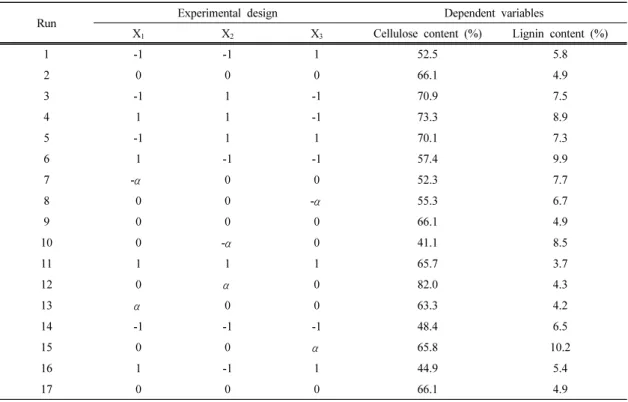
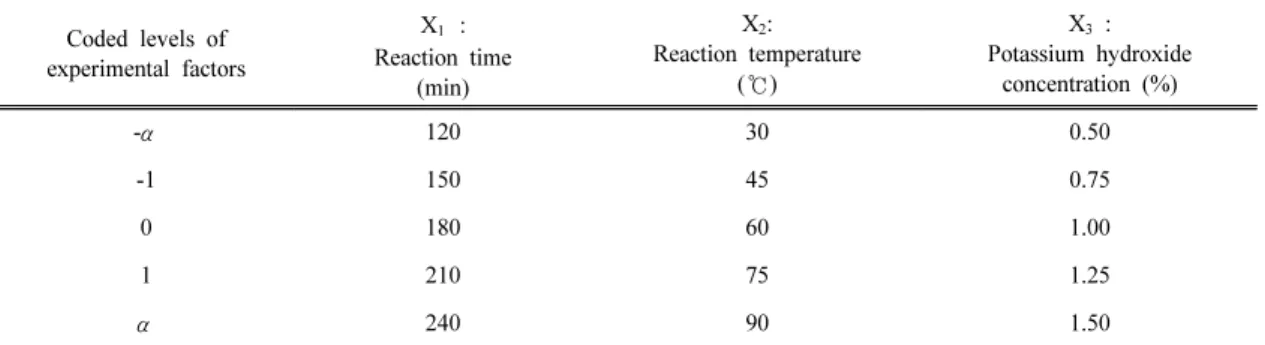
The experimental factors and corresponding values were presented in Table 1, whereas the central composite design was presented in Table 2. All experimental design runs were performed

in duplicate. Response surface methodology (RSM) was used to design the experiment. A central composite design (CCD) was used to study the impact of three factors: reaction time, reaction temperature and potassium hydroxide concentration on responses such as cellulose content and lignin content. The experimental re- gion included eight factorial design points, eight axial points ( α = 1.41) and three replicates of center points. The 17 experiments were run in random order to minimize the effects of un- expected variability in observed responses due to extraneous factors. Response surfaces, as rep- resented by 3D plot, were drawn by using the RSREG (SAS: statistical analysis system, SAS institute U.S.A).

2.4. Analytical methods

The chemical composition of barley husk and pretreated barley husk were analyzed quantita- tively according to analytical procedures of NREL laboratory: NREL/TP-510-42618 (Sluiter et al., 2008) for Structural carbohydrates, TP-510-42623 (Sluiter et al., 2006) for Sugars.

The glucose content in residues in residues was

Coded levels of experimental factors

X

1

: Reaction time

(min)

X

2

: Reaction temperature

( ℃)

X

3

: Potassium hydroxide

concentration (%)

- α 120 30 0.50

-1 150 45 0.75

0 180 60 1.00

1 210 75 1.25

α 240 90 1.50

Table 1. Experimental design factors and corresponding values

(5)

determined using high performance liquid chro- matography (HPLC). The HPLC (Agilent, USA) system was equipped with an Aminex HPX-87P column (Bio-Rad, Hercules, CA), a guard col- umn, an automated sampler, a gradient pump, and a refractive index detector. The mobile phase was deionized water at a flow rate of 0.6 mL min

-1

at 85 ℃. Prior to HPLC injection, all samples were neutralized with calcium carbo- nate, and filtered through 0.2 µm syringe filters.

3. RESULTS and DISCUSSION 3.1. Chemical composition of barley husk

The chemical composition of barley husk

used in this study, is presented in Table 3. The cellulose was the most abundant fraction (32.9%), followed by xylan (19.3%) and lignin (11.9%). The carbohydrate content was within the previously reported range. However, ex- tractives, lignin, ash, and protein content were much lower than previously reported (Ares-Pe et al., 2011). The different chemical composi- tion may be due to the differences in the kind of barley, the cultivation climate and the har- vest season (Han et al., 2011). The agriculture residue such as barley husk was a promising option as feedstock for glucose production, es- pecially in terms of their abundant availability, low cost and yield.

Run Experimental design Dependent variables

X

1

X

2

X

3

Cellulose content (%) Lignin content (%)

1 -1 -1 1 52.5 5.8

2 0 0 0 66.1 4.9

3 -1 1 -1 70.9 7.5

4 1 1 -1 73.3 8.9

5 -1 1 1 70.1 7.3

6 1 -1 -1 57.4 9.9

7 - α 0 0 52.3 7.7

8 0 0 - α 55.3 6.7

9 0 0 0 66.1 4.9

10 0 - α 0 41.1 8.5

11 1 1 1 65.7 3.7

12 0 α 0 82.0 4.3

13 α 0 0 63.3 4.2

14 -1 -1 -1 48.4 6.5

15 0 0 α 65.8 10.2

16 1 -1 1 44.9 5.4

17 0 0 0 66.1 4.9

X

1

, Coded value of time; X

2

, Coded value of reaction temperature; X

3

, Coded value of reaction potassium hydroxide concentration

Table 2. The central composite design for the response surface methodology

(6)

3.2. Effect of pretreatment on chemical composition

The purpose of this pretreatment was to re- move the hemicellulose and lignin in raw mate- rial, which then can be detoxified of the in- hibitor compound derived from hemicellulose and lignin. The inhibitor compound include fur- fural and hydroxymethyl furfural (degradation products of hemicellulose), phenolic and other aromatic compounds (degradation products of lignin), acetic acid (liberated from some hemi- celluloses) (Tran and Chambers, 1985; Watson et al., 1984).

The solid recovery and chemical composition change of barley husk were important indices for the effectiveness of its pretreatment. The solid recovery and chemical composition of bar- ley husk after each treatment stage for steam explosion (physical pretreatment), steam ex- plosion-alkaline and steam explosion-chlorine pretreatment processes were presented in Fig. 1

and Fig. 2. The solid recovery is significantly decreased by the steam explosion from 100% of raw material to 83% of the steam exploded material. This is mainly attributed to the de- crease of hemicellulosic fraction; as can be seen in Fig. 2. The hemicelluloses degrade at temperatures from 160 ℃ to around 260℃ (Pei et al., 2011). The solid loss occurred through the escape of volatiles with the steam and through the degradation of sugars into furfural and 5-hydroxymethyl furfural, both of which are volatile compounds (Jeoh, 1998). The high severity of steam explosion improves sugar sol-

Composition % Dry weight

Extractives 17.4 ± 0.9

Glucan 32.9 ± 0.2

Xylan 19.3 ± 0.4

Acid insoluble lignin 11.4 ± 0.5 Acid soluble lignin 0.5 ± 0.0

Ash 4.7 ± 0.3

Protein 11.3 ± 0.5

The others 2.5 ± 0.0

Total 100

Table 3. Average chemical composition of barley husk (results expressed as % dry solid basis)

Fig. 1. Recovery of solid in different experimental conditions (* SE: steam explosion).

Fig. 2. Recovery of cellulose, hemicellulose and acid

insoluble lignin in different experimental conditions

(* SE: steam explosion).

(7)

ubility and sugar conversion, but sugar degrada- tion can also be increased. Steam explosion conditions (log Ro 2.45) were optimized to re- move hemicellulose (data not shown). Lignin is removed only to a limited extent during the steam explosion but is redistributed on the fiber surfaces as a result of melting and depolymeri- zation- repolymerization reactions (Kabel et al., 2007; Li et al., 2007). A two-stage process which combines the steam explosion for a treatment for delignification was also suggested for further improvement of hydrolysis (Fernandez-Bolanos et al., 1999; Montane et al., 1998; Sun et al., 2005). After steam ex- plosion pretreatment, alkaline and chlorine were included by combination stages (KOH, NaOH, NaClO and NaClO

2

). The percentage of steam explosion - chemical pretreated solid recovery ranged between 41.7 and 72.7% (Fig. 1). As expected, a decrease of total gravimetric recov- ery was detected. The lignin of the steam ex- ploded material, referred to as raw material, showed a slight decrease (23.7%) (Fig. 2). On

the other hand, the lignin of the KOH treated residue, showed a large decrease (50.4%).

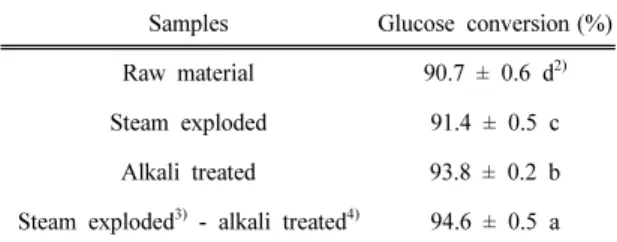
The recovery of glucan fraction after two-stage pretreatment was presented in Table 4. It could be found that the glucose conversion efficiency was increased to 94.6% through two-stage pretreatment of barley husk. This im- plies that alkali pretreatment has significantly reduced lignin content compared to the raw material.

3.3. Statistical modeling

The conditions of the system were optimized using the CCD based on the obtained model and the input criteria. The optimal delignifica- tion was carried out based on the three varia- bles (reaction time, reaction temperature and potassium hydroxide concentration) which were in the range of experimental runs.

Response surface methodology (RSM) is an efficient tool to establish the relationship of the interesting variables (at least two variables) with the obtained responses (Canettieri et al., 2007; Kim and Mazza, 2008; Lu et al., 2007;

Neureiter et al., 2002). The data analysis was developed by fitting the experimental data in a smooth curve, which was plotted by calculation of the specific predicted response. The ex- perimental conditions and corresponding re- sponses of the dependent variables (cellulose content and lignin content) were listed in Table 2. The results of 17 experiments in- dicated that cellulose content from the steam exploded - KOH treated barley husk ranged

Samples Glucose conversion (%) Raw material 90.7 ± 0.6 d

2)

Steam exploded 91.4 ± 0.5 c

Alkali treated 93.8 ± 0.2 b Steam exploded

3)

- alkali treated

4)

94.6 ± 0.5 a

1)

The pretreated barley husk (300 mg) was acid hydrolyzed 3 m ℓ of 72% sulfuric acid at 30℃ for 60 min (primary hydrolysis) and secondary hydrolysis at 121℃, with 4% sulfuric acid for 90 min

2)

The statistical significance of the results was assessed by Duncan’s t - test (p ≦ 0.05)

3)

Steam exploded, severity log Ro 2.45

4)
Alkali treated, potassium hydroxide concentration: 0.9%

Table 4. Glucose conversion of different pretreated

barley husk subjected to acid hydrolysis

1)

(8)

from 41.1 to 82.0% and the lignin content ranged from 3.7 to 10.2%.

Among the 17 experiments, experiment 12 (reaction time 180 min, reaction temperature 90 ℃ and potassium hydroxide concentration 1.00%) has the greatest cellulose content (82.0%) and experiment 11 (reaction time 210 min, reaction temperature 75 ℃ and potassium hydroxide concentration 1.25%) has the smallest lignin content (3.7%).

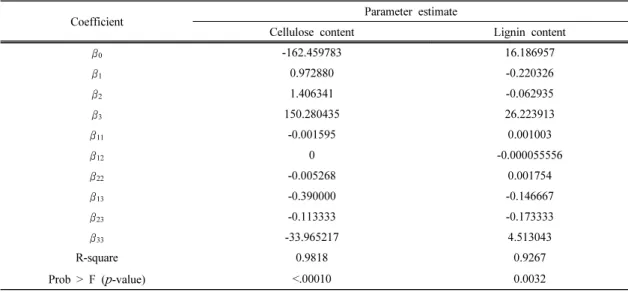
To test the significance of the developed model, analysis of variance (ANOVA) was per- formed and the results were presented in Table 5. For both responses of cellulose content and lignin content, the quadratic model was se- lected, as suggested by the used software. The final empirical models in terms of coded pa- rameters and actual parameters were given by Eq. (2), Eq. (3) and Eq. (4) where Y represents

one of the two considered responses: Where X

1

, X

2

and X

3

were the reaction time, reaction temperature and potassium hydroxide

Y = β

0

+ β

1

X(1) + β

2

X(2) + β

3

X(3) ···

+ β

11

X(1)

2

+ β

12

X(1)X(2) + β

22

X(2)

2

+ β

13

X(1)X(3) + β

23

X(2)X(3) + β

33

X(3)

2

(2)

Cellulose content =

– 162.459783 + 0.972880 × X

1 ···

+ 1.406341× X

2

+ 150.280435

× X

3

– 0.001595 × X

12

+ 0 × X

1

× X

2

– 0.005268 × X

22

– 0.390000

× X

1

× X

3

- 0.113333 × X

2

× X

3

– 33.965217 × X

32

(3)

Lignin content =

+ 16.186957 – 0.220326 × X

1 ···

– 0.062935× X

2

+ 26.223913 × X

3

+ 0.001003 × X

12

– 0.000055556

× X

1

× X

2

+ 0.001754 × X

22

– 0.146667 × X

1

× X

3

– 0.173333

× X

2

× X

3

+ 4.513043 × X

32

(4)

Coefficient Parameter estimate

Cellulose content Lignin content

β

0

-162.459783 16.186957

β

1

0.972880 -0.220326

β

2

1.406341 -0.062935

β

3

150.280435 26.223913

β

11

-0.001595 0.001003

β

12

0 -0.000055556

β

22

-0.005268 0.001754

β

13

-0.390000 -0.146667

β

23

-0.113333 -0.173333

β

33

-33.965217 4.513043

R-square 0.9818 0.9267

Prob > F ( p -value) <.00010 0.0032

Table 5. Regression coefficients for the response surface and p-values

(9)

concentration, respectively. The coefficients β

i

, are displayed in Table 5. A positive sign in front of the terms indicates a synergetic effect, whereas a negative sign indicates an antago- nistic effect. The quality of the developed mod- els was evaluated based on the correlation co- efficient R

2

, and also the standard deviation values. The R

2

for the two obtained model were found to be 0.9818 and 0.9267 for cellulose content and lignin content, respectively. This in- dicates that 98.2% and 92.7% of the total varia- tion in cellulose content and lignin content were attributed to the experimental variables studied.

The high R

2

value specifies that the model ob- tained will be able to give a good estimate of the response of the system within the studied range (an R-square value > 0.75 indicates a suitable model) (Haaland, 1989). A model was significantly considered if its p-value (also known as the ‘Prob > F’ value) is lower than 0.05, indicating only a 5% chance that a

‘Model F-value’ could occur because of noise.

The “Prob > F” values were also used to

evaluate the significance of the effects of each linear, quadratic and interaction term on the response.

3.4. Optimization of alkali pretreatment

The relationship between the response factors and controlled variables was visualized using the response surface or contour plots. Graphic repre- sentation of the response surface, shown in Fig.

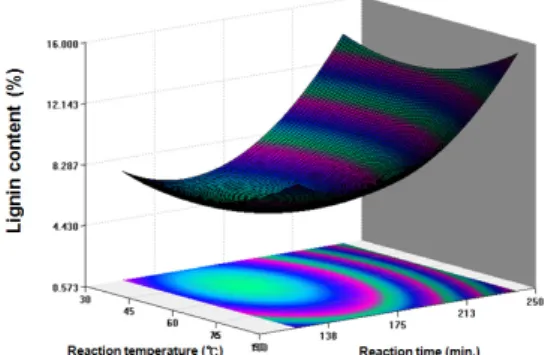
3, helps visualize the effects of reaction temper- ature and potassium hydroxide concentration. For these plots, the reaction time was fixed at 201 min. The relationship between reaction temper- ature and potassium hydroxide concentration al- so appears to be quite simple (Fig. 3), where reaction temperature was most influential and potassium hydroxide concentration only had a minor effect. The highest reaction temperature appeared to have achieved the best results with a high potassium hydroxide concentration (0.9%). Fig. 4 represents the three-dimensional response surface plot of lignin content at a po- Fig. 4. Three-dimensional response surface plot of lignin content: effect of reaction time and reaction temperature at a potassium hydroxide concentration of 0.6%.

Fig. 3. Three-dimensional response surface plot of

cellulose content: effect of reaction temperature and

potassium hydroxide concentration at a reaction time

201 min.

(10)

tassium hydroxide concentration of 0.6% to in- vestigate the interactive effect of reaction time and reaction temperature. At different reaction times, the lignin content reaches a minimum value at approximate 50 ℃ and slightly in- creases above that value. This study has re- vealed that potassium hydroxide pretreatment at a moderate temperature around 50 ℃ minimizes the lignin content within the range 45 - 60 ℃ and reaction time from 138 to 175 min. The optimal working conditions to attain high levels of cellulose content and lignin content were de- fined: (a) cellulose content - 201 min reaction time, 124 ℃ reaction temperature and 0.9% po- tassium hydroxide concentration (b) lignin con- tent - 157 min reaction time, 52 ℃ reaction temperature and 0.6% potassium hydroxide concentration. In these conditions, the model predicted cellulose content of 86.6% and lignin content of 5.6% in the confidence range of 95%. To confirm these results, experimental runs were conducted under these optimized con- ditions and a cellulose content of 83.0% with a lignin content of 6.0% was attained. These re- sults showed that the model fits well with the experimental data and thus accurately described the studied region.

4. CONCLUSION

The results obtained in this study suggested that the steam explosion pretreatment of barley husk followed by alkali treatment is a promis- ing pretreatment that results in a higher cellu- lose content. The conditions for alkali treatment

of steam exploded (severity log Ro 2.45) barley husk were optimized by using CCD and RSM.

The optimal conditions were found as follows:

(a) cellulose content - 201 min reaction time, 124 ℃ reaction temperature and 0.9% potassium hydroxide concentration (b) lignin content - 157 min reaction time, 52 ℃ reaction temperature and 0.6% potassium hydroxide concentration. In these conditions, the predicted value of cellu- lose content (86.6%) and lignin content (5.6%) is close to that observed value (83.0% and 6.0%, respectively). The acid hydrolysis, steam explosion/potassium hydroxide pretreatment re- sults in a higher glucose conversion (94.6%) than the raw material. The work indicates that the use of barley husk may be a feasible option as a feedstock for the production of sugars for biofuel synthesis, due to its low cost and high sugar yields.

ACKNOWLEDGEMENT

This work was supported by Development Fund Foundation, Gyeongsang National University, 2015.

REFERENCES

Ares-Pe, ón, I.A., Vila, C., Garrote, G., Paraj, ó, J.C.

2011. Enzymatic hydrolysis of autohydrolyzed barley husks. J Chem Technol Biotechnol 86:

251 ∼260.

Belkacemi, K., Turcotte, G., de, Halleux, D., Savoie, P. 1998. Ethanol production from AFEX-treated forages and agricultural residues. Applied Biochemistry and Biotechnology 70-72: 441 ∼462.

Beltrame, P.L., Carniti, P., Visciglio, A., Foche, B.,

Marzetti, A. 1992. Fractionation and bio-

(11)

conversion of steam-exploded wheat straw.

Bioresource Technology 39: 165 ∼171.

Broder, J.D., Barrier, J.W., Lee, K.P., Bulls, M.M.

1995. Biofuels system economics. World Resources Review 7(4): 560 ∼569.

Canettieri, E.V., Rocha, G.J.M., Carvalho, J.A., Silva, J.B.A. 2007. Optimization of acid hydrol- ysis from the hemicellulosic fraction of Eucalyptus grandis residue using response sur- face methodology. Bioresource Technology 98(2): 422 ∼428.

Cardona, C.A., Sánchez, O.J. 2007. Fuel ethanol pro- duction: process design trends and integration opportunities. Bioresource Technology 98: 2415

∼2457.

Carrillo, F., Lis, M.J., Colom, X., Lopez-Mesas, M., Valldeperas, J. 2005. Effect of alkali pretreat- ment on cellulase hydrolysis of wheat straw: ki- netic study. Process Biochemistry 40: 3360 ∼ 3364.

Chang, V.S., Nagwani, M., Kim, C.H., Holtzapple, M.T. 2001. Oxidative lime pretreatment of high-lignin biomass: poplar wood and newspaper. Applied Biochemistry Biotechnology 94: 1 ∼28.

Chen, Y., Sharma-Shivappa, R.R., Keshwani, D., Chen, C. 2007. Potential of agricultural residues and hay for bioethanol production. Applied Biochemstry Biotechnology 142: 276 ∼290.

Cheng, K.K., Cai, B.Y., Zhang, J.A., Ling, H.Z., Zhou, Y.J., Ge, J.P., Xu, J.M. 2008. Sugarcane bagasse hemicellulose hydrolysate for ethanol production by acid recovery process.

Biochemical Engineering Journal 38: 105 ∼109.

Donaldson, L.A., Wong, K.K.Y., Mackie, K.L. 1988.

Ultrastructure of steam-exploded wood. Wood Science and Technology 22(2): 103 ∼114.

Duff, S.J.B., Murray, W.D. 1996. Bioconversion of forest products industry waste cellulosics to fuel

ethanol: a review. Bioresource Technology 55:

1 ∼33.

Fernandez-Bolanos, J., Felizon, B., Heredia, A., Guillen, R., Jimenez, A. 1999. Characterization of the lignin obtained by alkaline delignification and of the cellulose residue from steam-exploded olive stones. Bioresource Technology 68: 121 ∼ 132.

Haaland, P.D., Design in Biotechnology, Marcel Dekker, Inc., New York 1989.

Hamelinck, C.N., van, Hooijdonk, G, Faaij, A.PC.

2005. Ethanol from lignocellulosic biomass:

techno-economic performance in short- middle- and long-term. Biomass and Bioenergy 28: 384

∼410.

Han, M.H, Kim, Y., Kim, S.W., Choi, G.W. 2011.

High efficiency bioethanol production from OPEFB using pilot pretreatment reactor. Journal of Chemical Technology and Biotechnology 86:

1527 ∼1534.

Heitz, M., Capek-Mdnard, E., Koeberle, P., Gagnd, J., Chornet, E. 1991. Fractionation of Populus tremuloides at the pilot plant scale: optimization of steam pretreatment conditions using the stake II technology. Bioresource Technology 35: 23 ∼32.

Hendriks, A.T.W.M., Zeeman. 2009. Pretreatments to enhance the digestibility of lignocellulosic biomass. Bioresource Technology 100: 10 ∼18.

Jeoh, T., Master’s thesis, Virginia Tech. University, VA 1998.

Jeong, S.Y., Lee, J.W. 2016. Optimization of pre- treatment condition for ethanol production from oxalic acid pretreated biomass by response sur- face methodology. Industrial Crops and Products 79: 1 ∼6.

Kabel, M.A., Bos, G., Zeevalking, J., Voragen,

A.G.J., Schols, H.A. 2007. Effect of pretreatment

severity on xylan solubility and enzymatic

(12)

breakdown of the remaining cellulose from wheat straw. Bioresource Technology 98:

2034 ∼2042.

Kim, J.W., Mazza, G. 2008. Optimization of phos- phoric acid catalyzed fractionation and enzymatic digestibility of flax shives. Industrial Crop and Products 28(3): 346 ∼355.

Kim, S.H., Holtzapple, M.T. 2006. Effect of struc- tural features on enzyme digestibility of corn stover. Bioresource Technology 97: 583 ∼591.

Li, J., Henriksson, G., Gellerstedt, G. 2007. Lignin depolymerization/repolymerization and its crit- ical role for delignification of aspen wood by steam explosion. Bioresource Technology 98(16): 3061 ∼3068.

Lu, X.B., Zhang, Y.M., Yang, J., Liang, Y. 2007.

Enzymatic hydrolysis of corn stover after pre- treatment with dilute sulfuric acid. Chemical Engineering and Technology 30(7): 938 ∼944.

Mandade, P., Bakshi, B.R., Yadav, G.D. 2016.

Ethanol from Indian agro-industrial lignocellulo- sic biomass: an emergy evaluation. Clean Technologies and Environmental Policy 18(8):

2625 ∼2634.

Montane, D., Farriol, X., Salvado, J., Jollez, P., Chornet, E. 1998. Fractionation of wheat straw by steam-explosion pretreatment and alkali delignification. Journal of Wood Chemistry and Technology 18(2): 171 ∼191.

Mosier, N., Hendrickson, R., Ho, N., Sedlak, M., Ladisch, M.R. 2005a. Optimization of pH controlled liquid hot water pretreatment of corn stover. Bioresource Technology 96(18):

1986 ∼1993.

Mosier, N., Wyman, C., Dale, B., Elander, R., Lee, Y.Y., Holtzapple, M., Ladisch, M. 2005b.

Features of promising technologies for pretreat- ment of lignocellulosic biomass. Bioresource Technology 96(6): 673 ∼686.

Neureiter, M., Danner, H., Thomasser, C., Saidi, B., Braun, R. 2002. Dilute acid hydrolysis of sugar- cane bagasse at varying conditions. Applied Biochemistry and Biotechnology 98-100: 49 ∼58.

Parisi, F. 1989. Advances in lignocellulosics hydrolysis and in the utilization of the hydrolysates. Advanced in Biochemical Engineering/Biotechnology 38:

53 ∼87.

Pei, H., Sun, J., Liu, L., Hu, J., Zhang, X., Zhang, J.

2011. Pretreatment of corn stover by acidic elec- trolyzed water for enhancing hemicellulose degradation. Journal of Biobased Materials and Bioenergy 5(3): 403 ∼408.

Sanchez, O.J., Cardona, C.A. 2008. Trends in bio- technological production of fuel ethanol from different feedstocks. Bioresource Technology 99(13): 5270 ∼5295.

Sivers, M.V., Zacchi, G. 1995. A techno-econom- icalcomparison of three processes for the pro- duction of ethanol from pine. Bioresource Technology 51(1): 43 ∼52.

Sluiter, A., Hame, B., Ruiz, R., Scarlata, C., Sluiter, J., Templeton, D., Croker, D. 2006.

Determination of Structural Carbohydrates and Lignin in Biomass. NREL Laboratory Analytical Procedure. National Renewable Energy Laboratory Golden, CO:TP-510-42623: 1 ∼14.

Sluiter, A., Hame, B., Ruiz, R., Scarlata, C., Sluiter, J., Templeton, D., Croker, D. 2008.

Determination of Structural Carbohydrates and Lignin in Biomass. NREL Laboratory Analytical Procedure. National Renewable Energy Laboratory Golden, CO: TP-510-42618.

Sun, X.F., Xu, F., Sun, R.C., Fowler, P., Baird, M.S.

2005. Characteristics of degraded cellulose ob- tained from steam-exploded wheat straw.

Carbohydrate Research 340(1): 97 ∼106.

Sun, Y., Cheng, J. 2002. Hydrolysis of lignocellulo-

sic materials for ethanol production: a review.

(13)

Bioresource Technology 83(1): 1 ∼11.

Tran, A.V., Chambers, R.P. 1985. Red oak wood de- rived inhibitors in the ethanol fermentation of xylose by Pichia stipitis CBS 5776.

Biotechnology Letters 7(11): 841 ∼845.

Vlasenko, E.Y., Ding, H., Labavitch, J.M., Shoemaker, S.P. 1997. Enzymatic hydrolysis of pretreated rice straw. Bioresource Technology 59: 109 ∼119.

Watson, N.E., Prior, B.A., Lategan, P.M. 1984.

Factors in acid treated bagasse inhibiting ethanol production from d-xylose by Pachysolen tannophilus. Enzyme and Microbial Technology 6(10): 451 ∼456.

Wyman, C.E., Dale, B.E., Elander, R.T., Holtzapple, M., Ladisch, M.R., Lee, Y.Y. 2005. Coordinated development of leading biomass pretreatment technologies. Bioresource Technology 96(18):

1959 ∼1966.

Xu, J., Cheng, J.J., Sharma-Shivappa, R.R., Burns, J.C. 2010. Lime pretreatment of switchgrass at mild temperatures for ethanol production.

Bioresource Technology 101(8): 2900 ∼2903.

Yue, Z.B., Yu, H.Q., Hu, Z.H., Harada, H., Li, Y.Y.

2008. Surfactant-enhanced anaerobic acidogenesis of Canna indica L. by rumen cultures.

Bioresource Technology 99(9): 3418 ∼3423.

Zhang, K., Pei, Z., Wang, D. 2016. Organic solvent pretreatment of lignocellulosic biomass for bio- fuels and biochemicals: A review. Bioresource Technology 199: 21 ∼33.

Zhu, S., Wu, Y., Yu, Z., Zhang, X., Wang, C., Yu, F. 2006. Production of ethanol from micro- wave-assisted alkali pretreated wheat straw.

Process Biochemistry 41(4): 869 ∼873.

수치

Table 1. Experimental design factors and corresponding values
Table 2. The central composite design for the response surface methodology
Fig. 2. Recovery of cellulose, hemicellulose and acid  insoluble lignin in different experimental conditions  (* SE: steam explosion).
Table 4. Glucose conversion of different pretreated  barley husk subjected to acid hydrolysis 1)
+3

참조

관련 문서

SEM photographing of smart paints made with curing process using temperature and time parameters (10000X).. The resistance history by curing time and

Fructose ester and Glycerol carbonate were synthesized using free-lipase and immobilized lipase under batch reaction condition enzyme.. The conversion of

표면 불순물층 중부인 dark gray 상 (Zr-rich zone) 의 안쪽 부위까지는 Si 침투가 이뤄지지 않음. • Uranium은 중부 dark gray

AUC: Area under the plasma concentration-time curve from time zero to time infinity, C max, Peak concentration, T max : The time to reach peak plasma concentration, t 1/2 :

- The standard enthalpy of an overall reaction is the sum of the standard enthalpies of the individual reactions into which a reaction may be divided - - The individual steps

Change of the dissolution rate of the complex of loess according to the reaction time(400℃ firing temperature)

PI3K inhibition decreased antioxidants/GD-induced apoptosis in A549 cells, and PI3K inhibitor LY294002 had inhibitory effect on antioxidants/GD-induced caspase-3

Arsenic acquisition concentration the reaction time under various As concentration conditions