반응표면분석법을 이용한 우엉식초 발효조건 최적화
김이슬․김성호 대구대학교 식품공학과
Optimization of Fermentation Conditions for Burdock Vinegar Using Response Surface Methodology
Yi-Seul Kim and Seong-Ho Kim Department of Food Engineering, Daegu University
ABSTRACT In this study, we optimized fermentation conditions for burdock vinegar by response surface methodology.
We confirmed the fermentation characteristics and major components of burdock vinegar. Alcohol fermentation of burdock extract added with 15% apple concentrates for vinegar production was performed. Consequently, 6.4% alcohol was produced after 5 days of fermentation. Central composite design was applied to investigate the effects of two independent variables, fermentation time (5∼17 days; X1) and fermentation temperature (26∼34°C; X2), on fermenta- tion of burdock vinegar. Fermentation conditions were optimized using characteristics of fermentation broth as a depend- ent variable. Acetic acid contents of dependent variables were 3.85∼4.73% during acetic acid fermentation. The correla- tion coefficient (R2) of the derived equation from the response surface regression for acetic acid contents was 0.9850 with significance level of 1%. Arctiin contents of all fermentation samples were 0.37∼0.50 mg/100 mL, with an R2 value of 0.8380 and significance level of 5%. We elicited a regression equation for each variable and superimposed the optimum area of fermentation conditions for characteristics and effective constituent contents of the fermentation broth. The predicted values for the optimum fermentation conditions for burdock vinegar were at 31°C and 16 days.
Key words: Arctium lappa L., burdock, vinegar fermentation, response surface methodology
Received 28 April 2017; Accepted 31 July 2017
Corresponding author: Seong-Ho Kim, Department of Food Engi- neering, Daegu University, Gyeongsan, Gyeongbuk 38453, Korea E-mail: [email protected], Phone: +82-53-850-6536
서 론
우엉(Arctium lappa L., burdock)은 국화과의 두해살이 풀로 길이는 50~150 cm이며 윗부분의 지름은 2~4 cm의 긴방추상으로 주로 잎과 씨 및 뿌리를 식용한다(1). 뿌리는 바깥면이 흑갈색이나 속은 황백색이며 맛은 쓰고 점성이 있 다. 원산지는 지중해 연안에서 서아시아 일대이며, 국내에서 는 영남지방을 중심으로 낙동강 유역 배수가 좋은 사질토 지역에서 많이 재배되고 있다(2,3).
우엉에 존재하는 arctiin은 장내 효소에 의하여 가수분해 되어 arctigenin으로 변환되는데 이런 성분들의 약리작용으 로는 요로결석 예방 효과(4), 혈관염증 완화(5), 항알레르기 작용(6), 피부 항노화 작용(7), 고지혈증에 미치는 영향(8)에 대한 연구 결과가 보고되어 있다. 우엉의 주성분인 chloro- genic acid는 감자나 사과, 커피 등의 식품에도 다량 함유되 어 있으며(9), 또한 in vitro 상에서 free radical 소거 활성, 메탈이온의 착화합화, radical 및 과산화물 형성에 관여하는
효소를 억제할 뿐만 아니라 생체 내에서는 산화적 손상으로 유발되는 암이나 심혈관계 질병의 예방 및 건강 증진의 효과 를 가진다고 보고되었다(1,10-12).
국내 식초 산업은 1970년대 빙초산을 희석하여 만든 합 성식초가 주를 이루었으며 80년대에는 주정을 희석하여 과 즙, 무기염을 첨가한 양조식초의 소비가 증가하였다. 이후 90년대부터는 첨가물을 사용하지 않고 100% 과실을 원료 로 하는 천연 양조식초의 생산이 시작되어 최근에는 단기간 에 대량 생산이 가능한 2단계 발효 및 병행 발효법을 통해 참다래(13), 사과(14), 양파(15) 등을 이용한 다양한 식초 개발이 진행되고 있다(16). 발효식초는 주성분인 초산, 소량 의 기타 유기산, 유리당, 아미노산 및 에스테르류 등을 함유 한 발효식품으로 음식을 조리할 때 신맛을 내게 하는 조미료 로 사용될 뿐만 아니라 짠맛, 단맛 등의 음식 맛을 부드럽게 하고 특유의 방향을 가지며 강한 산성 때문에 식품 내 유해 미생물의 생육을 억제하는 효과가 있다(17,18). 발효식초 제조의 원료에 따라서는 다양한 영양물질과 기능물질 등이 함유되어 있어 소화액 분비 촉진, 피로회복, 비만 방지, 혈압 상승 방지, 노화 방지 및 항종양 효과, 항당뇨 및 항산화 활성 (19-23) 등 다양한 생리활성이 보고되고 있다. 특히 발효식 초들은 발효과정을 통한 화학적 변화에 의해서 원료에는 함
Table 1. Experimental design of fermentation conditions for burdock
Fermentation conditions -2 -1 0 1 2 X1 time (day)
X2 temperature (°C)
5 26
8 28
11 30
14 32
17 34 유되어 있지 않은 다수의 물질들과 생리활성을 지닌 물질들
을 함유하게 될 가능성이 높아진다는 보고도 있다(24). 현재 곡류, 과실류 이외에 오이(25), 다시마(26), 함초(27), 죽순 (28) 등 다양한 원료를 이용한 식초 제조 연구가 있으며, 우엉과 같은 근채류를 이용한 식초로는 천마(29), 생강(30) 식초 등이 있으나 아직 우엉식초에 대한 연구는 미미하다.
따라서 본 연구에서는 다양한 생리활성의 효능을 지닌 우 엉뿌리를 이용한 식초의 제조가능성을 검토하기 위하여 반 응표면분석법을 통하여 우엉식초의 발효조건에 대하여 모 니터링하고 최적화하였다. 또한, 우엉식초의 이용성과 효능 연구를 위하여 제조된 우엉 발효식초의 유효성분을 확인하 였다.
재료 및 방법
실험 재료
본 연구에서 사용된 우엉은 경북 안동에서 재배되어 2015 년 9월에 채취한 우엉을 농업회사법인 (주)들산초(Gyeong- san, Korea)로부터 제공받아 5°C에서 냉장 저장하여 사용 하였다.
효모 및 초산균
우엉식초 발효를 위하여 알코올 발효용 효모 및 초산균은 각종 과실 및 발효식품에서 순수 분리한 후, 우엉 추출물이 함유된 배양배지에서 순양하여 알코올 발효력이 뛰어난 효 모 및 초산 생성능이 뛰어난 초산균을 최종 선별하였고, 이 후 동정하여 균주보존기관에 기탁된 Saccharomyces cer- evisiae KSH-Y141029(기탁번호 KCTC 12702BP) 및 Acetobacter tropicalis DUIS-1701(기탁번호 13181BP) 을 사용하였다.
우엉의 전처리 및 추출
실험원료 우엉은 수세한 후 일정한 두께(0.5 cm)로 세절 하여 건조기(OF22GW, Jeio Tech Co., Ltd., Daejeon, Korea)에서 50°C, 22시간 동안 건조처리를 한 우엉을 볶음 기(JIS e04, Jeil-Tech Co., Ltd., Seoul, Korea)에서 220
°C에서 3분간 볶음처리하고 볶음이 완료되면 즉시 실온에 서 냉각하여 전처리하였다. 전처리된 우엉시료에 20배의 증 류수를 넣고 항온수조(BW-20G, Jeio Tech Co., Ltd.)를 이용하여 90°C에서 3시간 동안 추출하였으며 추출액은 부 직포를 사용하여 여과 후 실험에 사용하였다.
알코올 발효 및 초산 발효 전배양액의 제조
알코올 발효를 위하여 Saccharomyces cerevisiae KSH- Y141029를 YM 액체배지(Merck Co., Darmstadt, Ger- many)에 접종하여 30°C에서 48시간 배양하여 알코올 발효 전배양액으로 사용하였으며, 초산 발효는 초산균 배양배지 (D-glucose 1%, glycerol 1%, polypeptone 0.2%, yeast
extract 0.2 %, potato extract 10 mg%, acetic acid 1%, ethanol 4%, pH 4.0)에 Acetobacter tropicalis DUIS- 1701을 접종하여 30°C에서 200 rpm으로 120시간 진탕 배 양(LSl-5149R, Daihan Labtech Co., Ltd., Namyangju, Korea)하여 초산 발효 전배양액으로 사용하였다.
우엉 추출물의 알코올 발효조건 검토
우엉 추출물에 당원으로서 부원료의 첨가 효과를 검토하 기 위하여 사과 농축액(65°Brix, Sanjung Food, Eum- seong, Korea)을 농도별로 우엉 추출물에 첨가한 것을 90
°C에서 30분간 멸균시킨 후, 효모 전배양액 3%(v/v)를 접종 하여 30°C에서 5일간 정치 배양시키면서 알코올 발효 중의 당도, 알코올 함량 등을 측정하여 발효 경과를 비교하였다.
당도 및 알코올 함량 측정
원료 및 발효물의 당도는 digital refractometer(PR- 101, ATAGO Co., Tokyo, Japan)를 사용하여 측정하였으 며, 알코올 함량은 배양액을 원심분리기(VS-24SMTi, Vision Co., Ltd., Daejeon, Korea)에서 7,989×g로 원심분리 한 후, 그 상등액을 증류하여 15°C에서 주정계(211-DK-12, Daekwang, Seoul, Korea)로 측정하여 Gay Lussac 표에 대비하여 산출하였다(31).
우엉 식초의 제조를 위한 발효조건 최적화
사과 농축액을 첨가한 우엉 추출물의 알코올 발효 후, 식 초 발효를 위하여 중심합성 계획법(central composite de- sign)(32)에 따라 Table 1과 같은 발효시간(X1)과 발효온도 (X2)를 독립변수로 설정하고, 반응표면분석(repose sur- face methodology, RSM)(33)에 의하여 설정한 13가지의 발효조건으로 우엉식초를 발효하였다. 각 종속변수에 대한 회귀 방정식을 얻어 발효조건에서 독립변수의 상호영향 및 최적 발효조건을 구하였다. 발효조건의 회귀식에 의한 예측 은 Statistical Analysis System(SAS) program(34)을 사 용하였다. 중심합성계획에서 독립변수(Xn)는 발효시간(5~
17 day, X1) 및 발효온도(26~34°C, X1)이며 실험계획은 -2, -1, 0, 1, 2 다섯 단계로 부호화하여 실험값을 나타내었 다. 최적 발효조건과 관련된 종속변수(Yn)로는 초산 발효액 의 이화학적 특성(pH, 산도, 총당)과 유효성분(acetic acid, arctiin 및 chlorogenic acid 함량)으로 각각 나타내었다.
이때 두 가지의 발효조건에 따른 2차 회귀모형식은 Y=b0+ b1X1+b2X2+b12X1X2+b11X12+b22X22과 같다. 이때 Y는 초산 발효 종속변수, X1은 발효시간 및 X2는 발효온도, b0는 회귀 계수이다.
Table 2. Physicochemical properties of alcohol ferments added with apple concentrates Apple concentrates
(65°Brix) Initial conc.
(°Brix) Final conc.
(°Brix) Alcohol content
(%) Yeast viable cell
count (CFU/mL) Alcohol ferments
acidity (%) Acetic acid ferments acidity (%) 10%
15%
20%
25%
10.6 13.8 17.3 20.9
5.8 7.0 8.3 12.3
4.6 6.4 8.8 8.6
9.25×10⁷ 5.50×10⁷ 7.00×10⁷ 3.50×10⁷
0.32±0.01 0.47±0.01 0.59±0.01 0.75±0.01
2.11±0.03 4.45±0.01 5.13±0.08 1.63±0.06 pH 및 산도 측정
우엉 추출물, 알코올 및 초산 발효액 시료의 pH는 pH me- ter(Mettler-Toledo AG 8603, Schwerzenbach, Switz- erland)를 사용하여 측정하였으며, 적정산도는 시료를 0.1 N NaOH로 pH 8.3으로 적정한 후, 적정에 소비되는 0.1 N NaOH 용액의 소비량을 초산 함량으로 환산하여 총산 함 량(%, v/v)으로 표시하였다.
총당 함량 분석
우엉 추출물, 알코올 및 초산 발효액의 총당 함량은 phe- nol-sulfuric acid법(35)으로 측정하였다. 즉 시료용액 1 mL에 5%(v/v) 페놀용액 1 mL와 95% 황산 5 mL를 가하여 발열시킨 후 30분 동안 상온에서 방치하였으며, 분광광도계 (UVmini-1240, Shimadzu, Kyoto, Japan)를 이용하여 470 nm에서 흡광도를 측정하였다.
Arctiin 및 chlorogenic acid 함량 분석
우엉 추출물, 알코올 및 초산 발효액의 arctiin, arctige- nin 및 chlorogenic acid(Sigma-Aldrich Co.)의 함량 분석 을 위해 시료를 0.45 μm membrane filter로 여과하여 HPLC(2695 Alliance HPLC, Waters, Milford, MA, USA) 로 분석하였다. 칼럼은 X-bridge C18(150×4.6 mm, 3.5 μm, Waters)을 사용하였으며, 이동상으로는 acetonitrile(A)과 0.1% phosphoric acid(B)를 사용하였다. 이동상의 비율은 5:95(0 min)에서 25:75(35 min), 35:65(65 min), 95:5(70 min)로 순차적으로 변화시켰으며, 유속은 1 mL/min의 조건 으로 photo diode array(PDA) 280 nm에서 측정하였다 (36).
Acetic acid 함량 분석
식초 발효액 중의 acetic acid 함량 분석은 HPLC를 이용 하여 분석하였다. 시료를 0.45 μm membrane filter로 여과 하여 HPLC로 분석하였다. HPLC 분석조건은 AminexⓇ HPX-87H(7.5×300 mm, 9 μm, BIO-RAD Laboratories, Hercules, CA, USA)를 사용하여 5 mM sulfuric acid를 유속 0.6 mL/min의 조건으로 PDA 214 nm에서 분석하였 다. 모든 표준물질은 Sigma-Aldrich Co. 제품으로 사용하 였다(37).
최적 발효조건의 예측 및 실증 시험
우엉 추출물의 초산 발효 최적화를 위하여 초산 발효액의
중요한 품질인자로 고려되는 초산 생성량을 최대로, pH를 최저로 설정하여 반응표면을 superimposing 하여 최적 추 출조건 범위를 예측하였다. 또한, 예측된 범위에서 임의의 점을 설정하여 회귀식에 대입한 후 그 예측된 값들에 대하여 동일조건에서 실제 실험을 통하여 얻은 실험치를 비교하고 SAS program(34)의 Student’s t-test로서 P<0.05수준에 서 유의성을 검증하였다.
결과 및 고찰
우엉 추출물의 알코올 발효조건 검토
본 실험에서 추출한 우엉 추출물(2.5°Brix)의 경우 당원 이 부족하여 그 자체로서는 알코올 발효 및 초산 발효를 유 도하는 데 한계가 있다. 따라서 우엉 추출물에 당원으로써 발효력과 맛 등을 고려하여 사과 농축액을 농도별로 첨가하 여 알코올 발효를 시행한 결과는 Table 2와 같다. 사과 농축 액 10%를 첨가하였을 때 알코올 함량이 4.6%였고, 첨가량 이 많아질수록 알코올 함량이 높아지다가 25% 첨가하였을 때 알코올 함량이 감소하는 것으로 나타났다. 효모 생균수는 사과 농축액 첨가량이 많아질수록 오히려 감소하는 것을 알 수 있었다. 사과 농축액을 농도별로 첨가하여 알코올 발효 후 초산 발효를 행한 결과 초산 발효 전보다 발효 후 산도는 증가하였고 pH는 발효 전보다 감소하는 것으로 나타나 초산 발효가 일어남을 알 수 있었다(Table 2). 사과 농축액 15%
를 첨가한 우엉 추출물의 알코올 함량이 6.4%였고 초산 발 효 후 산도 4.45%로 식초 제품 규격 산도 4% 이상에 도달하 는 것으로 나타나, 이후 실험에서는 사과 농축액 15%를 첨 가 후 알코올 발효와 초산 발효실험을 진행하였다. Seo 등 (38)은 농축 사과주스를 이용한 식초 발효 연구에서 72
°brix 사과 농축액을 이용하여 15°brix로 조절한 배양액을 6일간 100 rpm으로 발효하였을 때 알코올 함량이 7.3%로 보고하여 본 실험의 사과 농축액을 활용한 우엉식초 발효와 유사한 결과를 보이는 것으로 나타났다.
우엉식초의 제조를 위한 발효조건 최적화
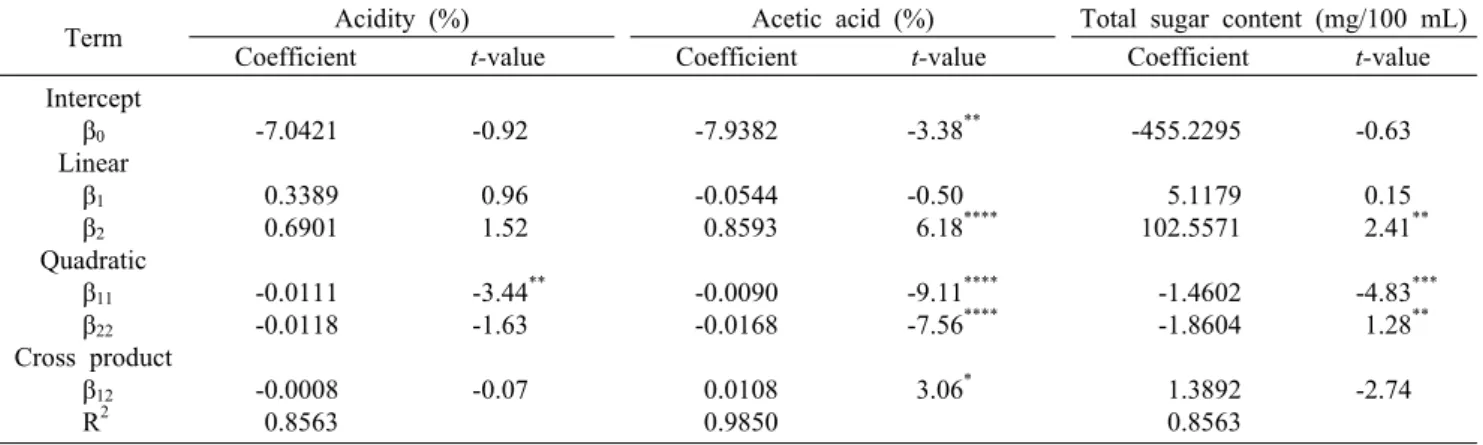
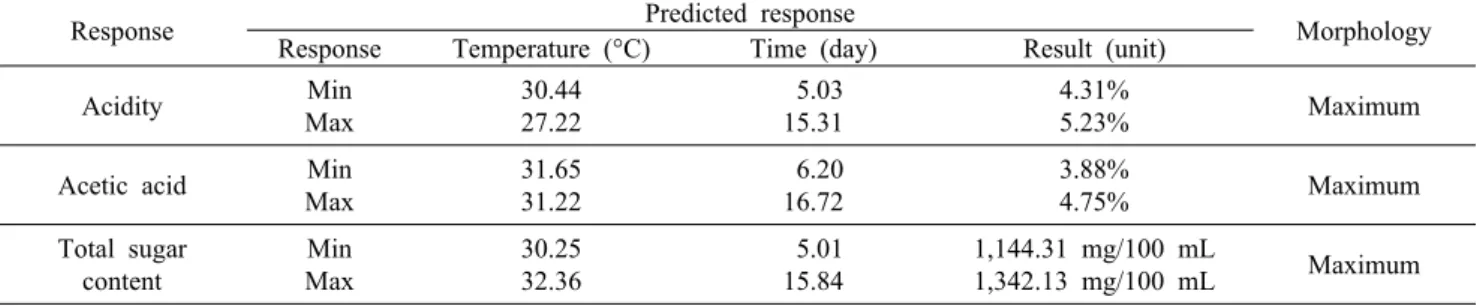
우엉 추출액에 사과 농축액(65°Brix) 15%를 첨가하여 알 코올 발효 후 반응표면분석법의 반응조건에 따라 우엉식초 발효조건에 따른 반응변수 값을 조사한 결과는 Table 3과 같다. 발효 후 산도는 4.15~5.25%의 범위로 나타났으며, 이를 바탕으로 한 회귀식은 Table 4와 같다. 산도에 대한 R2값은 0.8563으로 높은 신뢰도를 보였으며, P-value는
Table 3. Experimental data on acidity, acetic acid content, and total sugar content of burdock vinegar ferments added with apple concentrates under different fermentation conditions based on central composite design by response surface analysis
Exp.
No.
Fermentation condition Physicochemical properties
Time (day) Temperature (°C) Acidity (%) Acetic acid content (%) Total sugar content (mg/100 mL) 1
2 3 4 5 6 7 8 9 10 11 12 13
14 (1) 14 (1) 8 (-1) 8 (-1) 11 (0) 11 (0) 11 (0) 11 (0) 11 (0) 17 (2) 5 (-2) 11 (0) 11 (0)
32 (1) 28 (-1) 32 (1) 28 (-1) 30 (0) 30 (0) 30 (0) 30 (0) 30 (0) 30 (0) 30 (0) 34 (2) 26 (-2)
5.10±0.04 5.17±0.02 4.95±0.02 5.00±0.02 5.11±0.01 5.09±0.09 5.11±0.08 5.08±0.03 5.14±0.02 5.25±0.03 4.15±0.02 4.77±0.03 5.05±0.02
4.70 4.73 4.12 4.41 4.64 4.55 4.59 4.60 4.65 4.71 3.85 4.24 4.43
1,314.74±13.93 1,267.37±9.12 1,228.77±3.04 1,214.74±9.12 1,295.44±3.04 1,288.42±9.12 1,284.91±10.96 1,295.44±3.04 1,277.89±5.26 1,334.04±6.08 1,139.30±3.04 1,281.40±13.25 1,237.54±10.96
Control1) 0.62±0.02 0.39 2,196.67±12.00
1)Alcohol ferments was performed for 5 days at 30°C with the burdock extract containing 15% apple concentrates.
Table 4. Regression coefficient and t-value of the predicted quadratic polynomial models on acidity, acetic acid content, and total sugar content of burdock vinegar added with apple concentrates
Term Acidity (%) Acetic acid (%) Total sugar content (mg/100 mL) Coefficient t-value Coefficient t-value Coefficient t-value Intercept
β0
Linear β1
β2
Quadratic β11
β22
Cross product β12
R2
-7.0421 0.3389 0.6901 -0.0111 -0.0118 -0.0008 0.8563
-0.92 0.96 1.52 -3.44**
-1.63 -0.07
-7.9382 -0.0544 0.8593 -0.0090 -0.0168 0.0108 0.9850
-3.38**
-0.50 6.18****
-9.11****
-7.56****
3.06*
-455.2295 5.1179 102.5571 -1.4602 -1.8604 1.3892 0.8563
-0.63 0.15 2.41**
-4.83***
1.28**
-2.74 Significant at *P<0.1, **P<0.05, ***P<0.01, and ****P<0.001, respectively.
Table 5. ANOVA values of the factors for the response surface model on acidity, acetic acid content, and total sugar content of burdock vinegar added with apple concentrates
Independent
variables1) Degree of
freedom Sum of squares Means squares F-value P-value
Acidity X1
X2
3 3
0.7574 0.0899
0.2525 0.0300
13.08 1.55
0.0030 0.2839 Acetic acid X1
X2
3 3
0.7390 0.1611
0.2463 0.0537
136.28 29.71
<0.0001 0.0002 Total sugar
content
X1
X2
3 3
27474.0000 3399.8611
9158.0551 1133.2870
54.10 6.69
<0.0001 0.0183
1)X1, fermentation time; X2, fermentation temperature.
5% 이내 유의수준을 보였다. 발효조건에 대한 영향에서 산 도의 경우 발효온도보다 발효시간이 큰 영향을 미치는 것으 로 확인된다(Table 5). Lee 등(39)은 감자식초의 발효에서 총산에 대한 초산 발효조건의 영향은 발효시간이 주로 영향 을 미치고 있었다는 보고와 본 결과가 유사하였다. 한편
lack of fit(적합결여검정) 값은 model의 적합도를 검정하는 통계량으로 P값이 0.05보다 작을 때 model의 적합성에 문 제가 있으며, 이보다 클 때 model이 적합하다고 판단하는 통계값이다(34). 산도값 model에 대한 lack of fit의 P-val- ue는 0.0005로 나타나 model이 적합하지 않은 것으로 나타
Table 6. Analysis of variance for response of dependent variables on acidity, acetic acid content, and total sugar content of burdock vinegar added with apple concentrates
Responses Sources Degree of
freedom Sum of squares Means squares F-value P-value
Acidity
Model Linear Quadratic Cross-product Residual Lack of fit Pure error
5 2 2 1 7 3 4
0.8049 0.5677 0.2371 0.0001 0.1351 0.1330 0.0021
0.1610 0.2839 0.1186 0.0001 0.0193 0.0443 0.0005
8.34 14.71 6.14 0.01
- 473.12
-
0.0073 0.0031 0.0288 0.9446 - 0.0005
-
Total 12 0.9973 0.0831 - -
Acetic acid
Model Linear Quadratic Cross-product Residual Lack of fit Pure error
5 2 2 1 7 3 4
0.8285 0.6129 0.1987 0.0169 0.0127 0.0061 0.0065
0.1657 0.3065 0.0994 0.0169 0.0018 0.0020 0.0016
91.67 169.53 54.98 9.35
- 1.25
-
<0.0001
<0.0001
<0.0001 0.018 - 0.402 -
Total 12 0.8412 0.0701 - -
Total sugar content
Model Linear Quadratic Cross-product Residual Lack of fit Pure error
5 2 2 1 7 3 4
29670.0000 25092.0000 4300.2911 277.8889 1185.0392 963.2774 221.7618
5934.0000 12546.0000 2150.1456 277.8889 169.2913 321.0925 55.4405
35.05 74.11 12.70 1.64
- 5.79
-
<0.0001
<0.0001 0.0047 0.2409 - 0.0614
-
Total 12 30855.0392 2571.2533 - -
Table 7. Predicted levels of optimum acetic acid fermentation conditions for the maximum responses by the ridge analysis on acidity, acetic acid content, and total sugar content of burdock vinegar added with apple concentrates
Response Predicted response
Morphology Response Temperature (°C) Time (day) Result (unit)
Acidity Min Max
30.44 27.22
5.03 15.31
4.31%
5.23% Maximum
Acetic acid Min Max
31.65 31.22
6.20 16.72
3.88%
4.75% Maximum
Total sugar content
Min Max
30.25 32.36
5.01 15.84
1,144.31 mg/100 mL
1,342.13 mg/100 mL Maximum 났다(Table 6). 발효조건에 따라 반응표면모델로 예측된 회
귀분석 결과 정상점이 최대점으로 나타났으며, 최적점을 산 출한 결과 산도의 최대값은 5.23%이고 이때의 발효조건은 27.22°C, 15.31일로 나타났다(Table 7). 이들 산도값에 대 한 반응표면은 Fig. 1과 같다.
발효조건에 따른 사과 농축액을 첨가한 우엉식초의 ace- tic acid 함량은 3.85~4.73%의 범위로 나타났으며(Table 3), 이를 바탕으로 한 회귀식은 Table 4와 같다. R2값은 0.9850으로 회귀방정식에 대한 적합도가 높았으며, P-val- ue는 1% 이내 유의 수준을 보였다. 발효온도와 발효시간 모두 acetic acid 함량에 큰 영향을 미치는 것으로 확인되었 고(Table 5), acetic acid 함량값을 위한 발효조건 model에 대한 lack of fit의 P-value는 0.402로 나타나 model이 적
합한 것으로 나타났다(Table 6). 발효조건에 따라 반응표면 모델로 예측된 회귀분석 결과 정상점이 최대점으로 나타났 다. 최적점을 산출한 결과 acetic acid의 최대값은 4.75%이 며, 이때의 발효조건은 31.22°C, 16.72일로 나타났다(Table 7). 이들 acetic acid 함량값에 대한 반응표면은 Fig. 2와 같다. Seo 등(38)의 농축 사과주스를 이용한 식초 발효연구 에서 사과식초는 초산 발효 중 acetic acid 함량이 8일째 6,517.66 mg%였다고 보고하여 본 연구와는 값의 차이가 있으나, 이는 시료의 종류, 상태 및 교반속도 등의 변수의 차이라 생각된다.
사과 농축액을 첨가한 우엉식초의 발효조건에 따른 총당 함량의 변화는 1,139.30~1,334.04 mg/100 mL의 범위로 나타났으며(Table 3), 이를 바탕으로 한 회귀식은 Table 4
Fig. 1. Contour and response plots showing the influence of fermentation time and fermentation temperature on acidity from burdock vinegar added with apple concentrates.
Fig. 2. Contour and response plots showing the influence of fermentation time and fermentation temperature on acetic acid content from burdock vinegar added with apple concentrates.
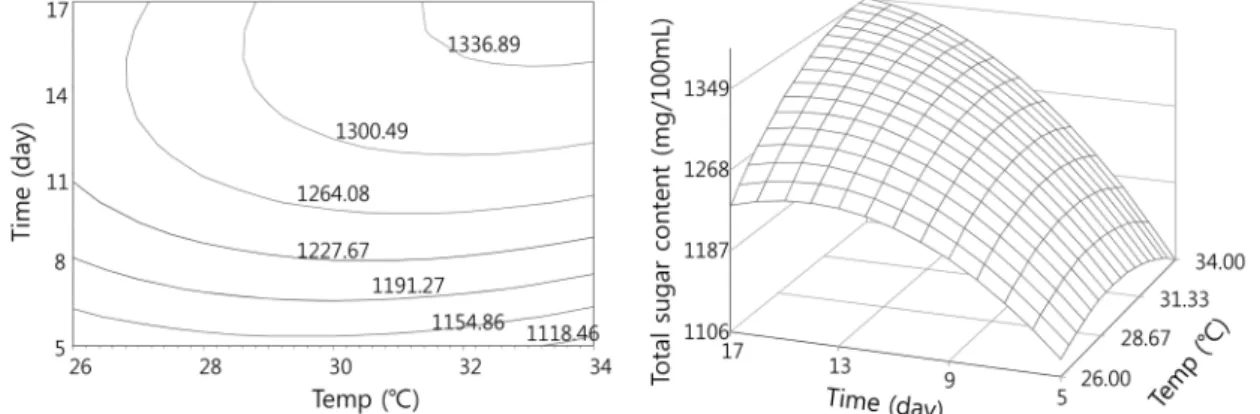
Fig. 3. Contour and response plots showing the influence of fermentation time and fermentation temperature on total sugar content from burdock vinegar added with apple concentrates.
와 같다. 총당 함량에 대한 회귀식의 R2값은 0.8563으로 높 은 신뢰도를 보였으며, P-value는 5% 이내 유의수준을 보 였다. 우엉식초의 총당값 model에 대한 lack of fit의 P- value는 0.0614로 나타나 적합성이 있는 것으로 나타났다 (Table 6). 발효조건에 대한 영향은 발효온도보다 발효시간 이 큰 영향을 미치는 것으로 확인된다(Table 5). 발효조건에 따라 반응표면모델로 예측된 회귀분석 결과 정상점이 최대 점으로 나타났으며, 최적점을 산출한 결과 총당의 최대값은
1,342.13 mg/100 mL이며, 이때의 발효조건은 32.36°C, 15.84일로 나타났다(Table 7). 우엉식초의 총당 함량값에 대한 발효조건별 반응표면의 변화는 Fig. 3과 같다. 초산 발효과정 중 우엉식초의 총당 함량은 감소하였는데 이는 발 효과정 중 당의 소모에 따른 결과로써 으름열매식초(40), 복분자식초(41), 오디식초(42) 등에서 발효 후 총당이 감소 하였다는 결과와 유사하였다.
발효조건에 따른 사과 농축액을 첨가한 우엉식초의 arc-
Table 8. Experimental data on arctiin and chlorogenic acid content of burdock vinegar added with apple concentrates under different fermentation conditions based on central composite design by response surface analysis
Exp. No. Fermentation condition Arctiin content (mg/100 mL)
Chlorogenic acid content (mg/100 mL) Time (day) Temp (°C)
1 2 3 4 5 6 7 8 9 10 11 12 13
14 (1) 14 (1) 8 (-1) 8 (-1) 11 (0) 11 (0) 11 (0) 11 (0) 11 (0) 17 (2) 5 (-2) 11 (0) 11 (0)
32 (1) 28 (-1) 32 (1) 28 (-1) 30 (0) 30 (0) 30 (0) 30 (0) 30 (0) 30 (0) 30 (0) 34 (2) 26 (-2)
0.50 0.45 0.38 0.37 0.45 0.44 0.42 0.41 0.45 0.48 0.37 0.45 0.43
10.43 10.89 8.34 8.47 10.47 10.76 10.33 10.90 10.60 10.44 8.76 11.26 12.07
Control1) - 5.28
1)Alcohol ferments was performed for 5 days at 30°C with the burdock extract containing 15% apple concentrates.
Table 9. Regression coefficient and t-value of the predicted quadratic polynomial models on arctiin and chlorogenic acid content of burdock vinegar added with apple concentrates
Term Arctiin content Chlorogenic acid content
Coefficient t-value Coefficient t-value
Intercept β0
Linear β1
β2
Quadratic β11
β22
Cross product β12
R2
1.0017 -0.0325 -0.0345 -0.0003 0.0003 0.0017 0.8380
0.86 -0.60 -0.50 -0.54 0.31 0.95
58.0025 1.508
-3.5754 -0.0165 -0.0606 -0.014 0.6959
1.26 0.49 -1.32 -0.86 1.39 -0.20 Significant at *P<0.1, **P<0.05, ***P<0.01, and ****P<0.001, respectively.
Table 10. ANOVA values of the factors for the response surface model on arctiin and chlorogenic acid content of burdock vinegar added with apple concentrates
Independent
variables1) Degree of
freedom Sum of squares Means squares F-value P-value Arctiin content X1
X2
3 3
0.0152 0.0013
0.0051 0.0004
11.37 0.95
0.0044 0.4657 Chlorogenic acid content X1
X2
3 3
8.6536 1.7795
2.8845 0.5932
4.17 0.86
0.0546 0.5059
1)X1, fermentation time; X2, fermentation temperature.
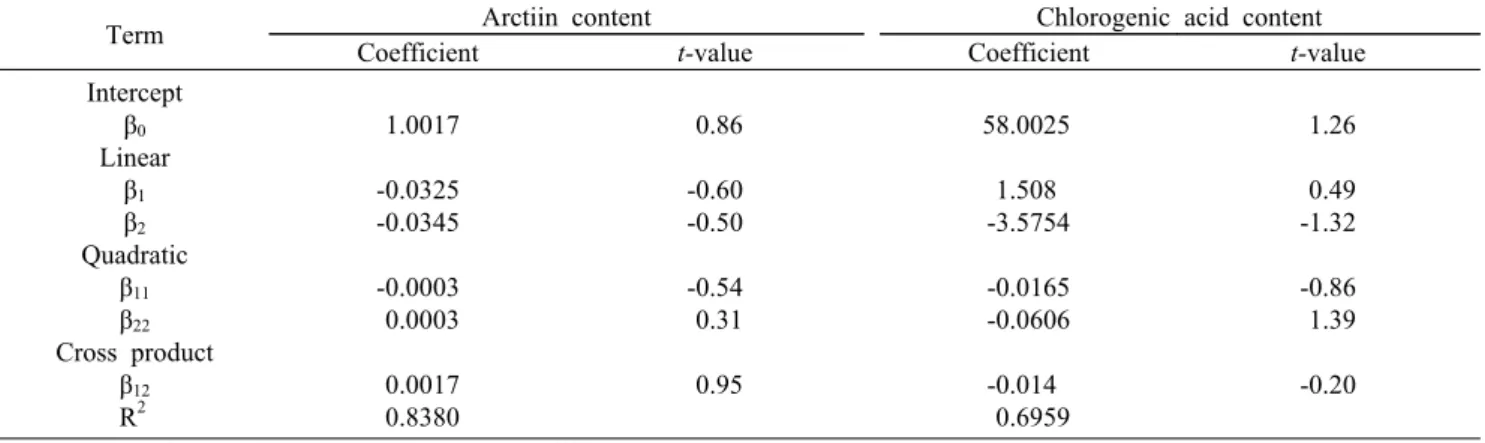
tiin 함량은 0.37~0.50 mg/100 mL의 범위로 나타났으며 (Table 8), 이를 바탕으로 한 회귀식은 Table 9와 같다.
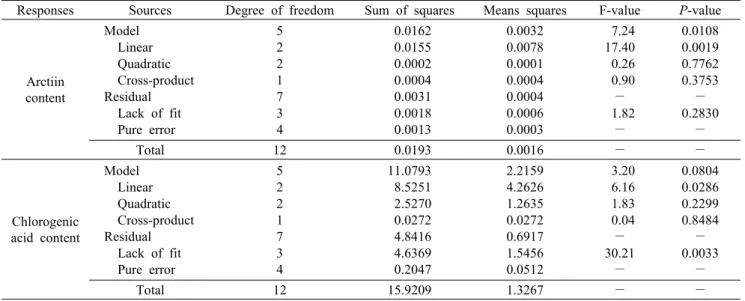
Arctiin 함량의 R2값은 0.8380으로 회귀방정식에 대한 적합 성이 높았으며, P-value는 5% 이내 유의수준을 보였으나 회귀식 매개변수(parameter)들의 유의수준은 10% 이상으 로 나타났다(Table 9). 발효조건에 대한 영향은 발효온도보 다 발효시간이 큰 영향을 미치는 것으로 확인되었다(Table 10). 우엉식초의 arctiin 함량값 model에 대한 lack of fit의
P-value는 0.2830으로 나타나 model이 적합하였다(Table 11). 발효조건에 따라 반응표면모델로 예측된 회귀분석 결 과 정상점이 최대점이 아닌 안장점으로 나타나 능선분석으 로 하여 최대점을 산출한 결과, arctiin 함량의 최대값은 0.51 mg/100 mL이며, 이때의 발효조건은 32.33°C, 15.88 일로 나타났다(Table 12). 사과농축액 첨가 우엉발효식초의 arctiin 함량값에 대한 발효조건별 반응표면의 변화는 Fig.
4와 같다. 한편 우엉의 지표성분인 arctiin의 aglycon 형태
Table 11. Analysis of variance for response of dependent variables on arctiin and chlorogenic acid content of apple concentrates addition burdock vinegar
Responses Sources Degree of freedom Sum of squares Means squares F-value P-value
Arctiin content
Model Linear Quadratic Cross-product Residual Lack of fit Pure error
5 2 2 1 7 3 4
0.0162 0.0155 0.0002 0.0004 0.0031 0.0018 0.0013
0.0032 0.0078 0.0001 0.0004 0.0004 0.0006 0.0003
7.24 17.40 0.26 0.90
- 1.82
-
0.0108 0.0019 0.7762 0.3753
- 0.2830
-
Total 12 0.0193 0.0016 - -
Chlorogenic acid content
Model Linear Quadratic Cross-product Residual Lack of fit Pure error
5 2 2 1 7 3 4
11.0793 8.5251 2.5270 0.0272 4.8416 4.6369 0.2047
2.2159 4.2626 1.2635 0.0272 0.6917 1.5456 0.0512
3.20 6.16 1.83 0.04
- 30.21
-
0.0804 0.0286 0.2299 0.8484
- 0.0033
-
Total 12 15.9209 1.3267 - -
Table 12. Predicted levels of optimum acetic acid fermentation conditions for the maximum responses of the ridge analysis on arctiin and chlorogenic acid content of burdock vinegar added with apple concentrates
Response Predicted response
Morphology Response Temperature (°C) Time (day) Result (mg/100 mL)
Arctiin content Min Max
30.82 32.33
5.13 15.88
0.35
0.51 Saddle point Chlorogenic acid content Min
Max
30.03 26.57
5.00 14.08
8.04
12.14 Saddle point
Fig. 4. Contour and response plots showing the influence of fermentation time and fermentation temperature on arctiin content from burdock vinegar added with apple concentrates.
의 분해물로 알려진 arctigenin은 본 발효식초 과정에서는 함량값이 측정되지 않아 본 식초 발효과정에서는 분해에 관 여하지 않는 것으로 나타났다. Liu 등(43)은 우엉 잎에서 약 3 mg/100 g의 arctiin 함량이 분석되었다고 보고하였다.
이는 우엉 사용 부위와 본 연구에서는 시료를 추출하여 사용 하였으므로 함량 차이가 있는 것으로 생각된다.
사과 농축액을 첨가한 우엉발효식초의 발효조건에 따른 chlorogenic acid 함량은 8.34~12.07 mg/100 mL의 범위
로 나타났으며(Table 8), 이에 따른 회귀식은 Table 9와 같다. R2값은 0.6959였으며, P-value는 10% 이내 유의수 준을 보였으나, arctiin과 마찬가지로 회귀식 매개변수들의 유의수준은 10% 이상이었다(Table 9). 발효조건에 대한 영 향은 발효온도보다 발효시간이 큰 영향을 미치는 것으로 확 인되었다(Table 10). 우엉식초의 chlorogenic acid 함량값 model에 대한 lack of fit의 P-value는 0.0033으로 나타나 model의 적합성이 떨어지는 것으로 나타났다(Table 11).
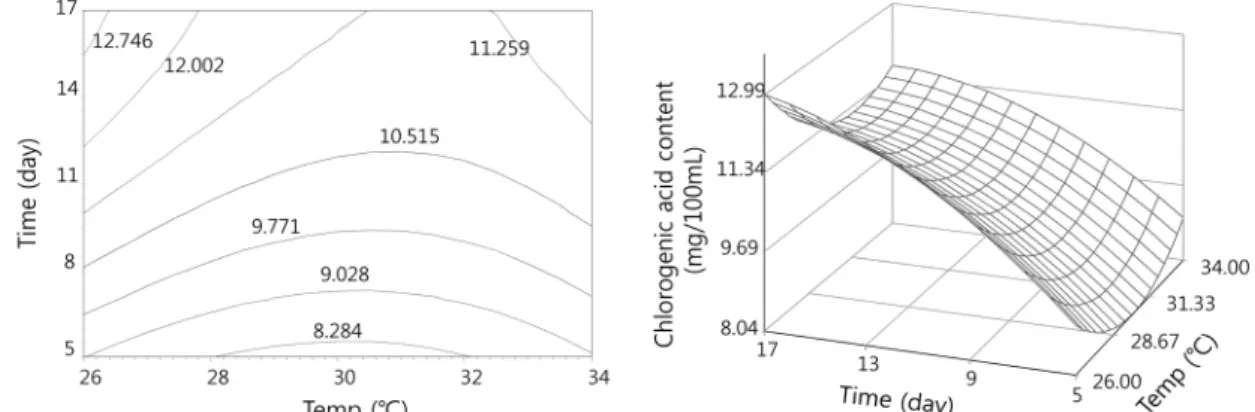
Fig. 5. Contour and response plots showing the influence of fermentation time and fermentation temperature on chlorogenic acid content from burdock vinegar added with apple concentrates.
Fig. 6. Superimposed response surface for optimization of total sugar, arctiin, chloro- genic acid, and acetic acid content as a func- tion of fermentation temperature and time.
Overlapped dark area was predicted as a range of optimal fermentation condition.
발효조건에 따라 반응표면모델로 예측된 회귀분석 결과 정 상점이 최대점이 아닌 안장점으로 나타났으며, 능선분석을 하여 최대점을 산출한 결과 chlorogenic acid 함량의 최댓 값은 12.14 mg/100 mL며, 이때의 발효조건은 26.57°C, 14.08일로 나타났다(Table 12). 사과 농축액 첨가 우엉발 효식초의 chlorogenic acid 함량값에 대한 발효조건별 반응 표면의 변화는 Fig. 5와 같다. Park(1)의 연구에서 생우엉의 chlorogenic acid는 123.75±3.82 mg/100 g으로 본 연구 의 우엉 알코올 발효액보다는 약 20배, 우엉식초보다는 약 10배 많은 함량이었으나, 본 연구는 우엉 추출액을 사용한 결과로써 생우엉과 직접 비교할 수 없으나 추출 시 가해진 물의 양을 고려하면 거의 유사한 결과라 생각된다.
최적 발효조건의 예측
우엉식초의 최적 발효조건을 설정하기 위하여 각 성분의 반응표면을 superimposing 하여 Fig. 6에 나타내었다. 각 항목의 최적 발효조건으로 도출된 최대 또는 최적값의 반응 표면을 한 도면에 합한 결과 total sugar, chlorogenic acid, arctiin 및 acetic acid 함량 등 5항목의 반응표면의 그림이
완전 또는 부분적으로 적합하였고 그 일치하는 부분을 각 독립변수의 범위를 읽어 최적 추출조건의 범위로 설정하였 다. 이 반응표면으로부터 설정될 수 있는 최적 조건 범위는 Fig. 6의 짙은 부분으로 우엉식초의 최적 발효조건은 발효온 도 30°C, 발효시간 16일을 최적 발효조건으로 예측되었다.
최적 발효조건의 실증 시험
각 성분의 반응표면을 superimposing 하여 예측된 최적 발효조건(발효온도 30°C, 발효시간 16일)에서 실제 발효 및 실험을 수행하여 예측치와 실제 실험치의 비교를 통하여 모 델의 정확도를 검증하였다(Table 13). 그 결과, 최적 발효조 건에서의 arctiin 함량값은 예측된 조건에서의 값보다 실측 된 값에서 그 함량이 높게 나타났고, 총당 함량과 chloro- genic acid 함량값은 실측값이 예측보다 다소 낮은 값을 나 타내었다. 그 외의 측정된 함량값은 예측값과 실제 실험치를 비교하였을 때 대부분 유사한 수준으로 나타나 본 실험의 최적 발효조건 모델의 적합도가 적절하였으나 예측치와 실 험치 간의 유의성(P<0.05)은 떨어지는 것으로 나타났다.
Table 13. Comparison between predicted and observed values of response variables within the range of the optimum condition Apple concentrate addition burdock vinegar
Predict value (A) Experimental value (B) B/A×100 (%) Acidity (%)
Acetic acid content (%)
Total sugar content (mg/100 mL) Arctiin content (mg/100 mL)
Chlorogenic acid content (mg/100 mL)
5.22a1) 4.51a 1,849.34a 0.43b 12.18a
5.12±0.02b 4.46±0.00b 1,568.34±5.46b 0.57±0.00a 10.44±0.37b
98.02 98.96 84.81 133.65 85.68 All values are mean±SD.
1)Different letters (a,b) in the same row are significantly different by t-test at P<0.05.
요 약
본 연구에서는 우엉을 이용한 식초의 제조 가능성을 검토하 였으며, 반응표면분석법을 통하여 우엉식초의 발효조건에 대한 영향을 모니터링하여 발효조건을 최적화하였다. 그리 고 제조된 우엉 발효식초의 기능성 성분과 유효성분을 확인 하였다. 식초 제조를 위해 우엉 추출액에 사과 농축액을 15%
첨가하여 알코올 발효시킨 결과, 5일 후 6.4%의 알코올이 생성되었다. 초산 발효조건을 확립하기 위해 중심합성계획 법에 따라 발효시간, 발효온도를 독립변수로 하여 실험을 계획하였고, 발효액의 특성을 반응변수로 하여 실험한 후 발효조건을 최적화하였다. 17일간의 초산 발효 후 13개 실험 구의 acetic acid 함량은 3.85~4.73%였으며, R2값은 0.9850 으로 1% 이내 유의수준에서 유의성이 인정되었다. Arctiin 함량의 범위는 0.37~0.50 mg%였으며, R2값은 0.8380으로 5% 이내 유의수준에서 유의성이 인정되었다. 각 변수에 대 한 회귀식을 도출하여 우엉식초 제조를 위한 최적 발효조건 을 superimposing 한 결과 발효시간은 16일, 발효온도는 30°C로 예측되었다.
감사의 글
이 논문은 2013학년도 대구대학교 학술연구비(과제번호 20130486) 지원에 의한 논문임.
REFERENCES
1. Park YO. 2015. Antioxidant activities and phenolic com- pounds analysis of burdock root (Arctium lappa L.) accord- ing to cooking conditions. MS Thesis. Soonchunhyang Uni- versity, Asan, Korea.
2. Lim JH, Jeong MC, Moon KD. 2005. Purification and char- acterization of polyphenol oxidase from burdock (Arctium lappa L.). Korean J Food Preserv 12: 489-495.
3. Hong II. 2013. Quality and sensory characteristics of bur- dock gruels with various amount of burdock. MS Thesis.
Kyung Hee University, Seoul, Korea.
4. Hong EY. 2014. Inhibitory effects of Arctii fructus water extract on lipogenesis in 3T3-L1 cell. MS Thesis. Won- kwang University, Iksan, Korea.
5. Lee YJ, Choi DH, Cho GH, Kim JS, Kang DG, Lee HS.
2012. Arctium lappa ameliorates endothelial dysfunction in
rats fed with high fat/cholesterol diets. BMC Complement Altern Med 12: 116.
6. Nam JY, Kim DG, Lee JY. 2006. Effects of Woobangja on anti-allergic inflammation. J Korean Oriental Pediatrics 20: 241-255.
7. Kim JH. 2014. Analysis of photoprotective and anti-skin aging activities of Fructus arctii extracts fermented with Grifola frondosa. PhD Dissertation. Chungbuk National University, Cheongju, Korea.
8. Yang KS, Sim JM. 1997. Effect of Arctii fructus on low density lipoprotein oxidation. Kor J Pharmacogn 28: 275- 279.
9. Kono Y, Shibata H, Kodama Y, Sawa Y. 1995. The sup- pression of the N-nitrosating reaction by chlorogenic acid.
Biochem J 312: 947-953.
10. Clifford MN. 2000. Chlorogenic acids and other cinnamates- nature, occurrence, dietary burden, absorption and metabo- lism. J Sci Food Agric 80: 1033-1043.
11. Chen JH, Ho CT. 1997. Antioxidant activities of caffeic acid and its related hydroxy cinnamic acid compounds. J Agric Food Chem 45: 2374-2378.
12. Rice-Evans CA, Miller NJ, Paganga G. 1996. Structure-anti- oxidant activity relationships of flavonoids and phenolic acids. Free Radic Biol Med 20: 933-956.
13. Woo SM, Kim OM, Choi JW, Kim YS, Choi HD, Jeong YJ. 2007. Condition of acetic acid fermentation and effect of oligosaccharide addition on kiwi vinegar. Korean J Food Preserv 14: 100-104.
14. Seo JH, Lee GD, Jeong YJ. 2001. Optimization of the vine- gar fermentation using concentrated apple juice. J Korean Soc Food Sci Nutr 30: 460-465.
15. Jeong YJ, Seo JH, Jung SH, Shin SR, Kim KS. 1998. The quality comparison of uncleaned rice vinegar by two stages fermentation with commercial uncleaned rice vinegar. Kore- an J Postharvest Sci Technol 5: 374-379.
16. Jo YL. 2013. Manufacturing of green tea-treated maggeolli and vinegar. MS Thesis. Chonnam National University, Gwangju, Korea.
17. Mo HW, Jung YH, Jeong JS, Choi KH, Choi SW, Park CS, Choi MA, Kim ML, Kim MS. 2013. Quality characteristics of vinegar fermented using omija. J Korean Soc Food Sci Nutr 42: 441-449.
18. Kwon SH, Jeong EJ, Lee GD, Jeong YJ. 2000. Preparation method of fruit vinegars by two stage fermentation and bev- erages including vinegar. Food Industry and Nutrition 5(1):
18-24.
19. Lee YC, Lee JH. 2000. A manufacturing process of high strength vinegar. Food Industry and Nutrition 5(1): 13-17.
20. Choi HS, Kim MK, Park HS, Shin DH. 2005. Changes in physicochemical characteristics of Bokbunja (Rubus cor- eanus Miq.) wine during fermentation. Korean J Food Sci
Technol 37: 574-578.
21. Lee WJ, Kim SS. 1998. Preparation of Sikhe with brown rice. Korean J Food Sci Technol 30: 146-150.
22. Seok H, Lee JY, Park EM, Park SE, Lee JH, Lim S, Lee BW, Kang ES, Lee HC, Cha BS. 2012. Balsamic vinegar improves high fat-induced beta cell dysfunction via beta cell ABCA1. Diabetes Metab J 36: 275-279.
23. Sakanaka S, Ishihara Y. 2008. Comparison of antioxidant properties of persimmon vinegar and some other commer- cial vinegars in radical-scavenging assays and on lipid oxi- dation in tuna homogenates. Food Chem 107: 739-744.
24. Na HS, Choi GC, Yang SI, Lee JH, Cho JY, Ma SJ, Kim JY. 2013. Comparison of characteristics in commercial fer- mented vinegars made with different ingredients. Korean J Food Preserv 20: 482-487.
25. Hong SM, Moon HS, Lee JH, Lee HI, Jeong JH, Lee MK, Seo KI. 2012. Development of functional vinegar by using cucumbers. J Korean Soc Food Sci Nutr 41: 927-935.
26. Kim KE, Choi OS, Lee YJ, Kim HS, Bae TJ. 2001. Process- ing of vinegar using the sea tangle (Laminaria japonica) extract. Korean J Life Sci 11: 211-217.
27. Kim HS. 2011. Development of vinegar using saltwort (Sal- icornia herbacea L.) and its antioxidant effect. MS Thesis.
Sunchon National University, Suncheon, Korea.
28. Jang H, Lee E, Shim YS, Seo D, Hwang J, Lee S. 2013.
Chemical characteristics and flavors of bamboo-shoot vine- gar. Korean J Food Sci Technol 45: 675-681.
29. Lee ES. 2008. Study on the chemical compositions and anti- oxidant activities of the vinegar drinks from naturally fer- mented Gastrodia elata Blume. MS Thesis. Daegu Haany University, Gyeongsan, Korea.
30. Lee S, Min SG. 2012. Functional drink including ginger vin- egar and method thereof. Korea Patent 10-1280664-0000.
31. Oh SL, Kim SS, Min BY, Chung DY. 1990. Composition of free sugars, free amino acids, non-volatile organic acids and tannins in the extracts of L. chinensis M., A. acutiloba K., S. chinensis B. and A. sessiliflorum S.. Korean J Food Sci Technol 22: 76-81.
32. Wanasundara PKJPD, Shahidi F. 1996. Optimization of hex- ametaphosphate-assisted extraction of flaxseed proteins us-
ing response surface methodology. J Food Sci 61: 604-607.
33. Myers RH. 1971. Response surface methodology. Allyn and Bacon, Inc., Boston, MA, USA. p 126.
34. SAS Institute. 2005. SAS/STAT User’s Guide (Version 9.1.3).
SAS Institute, Inc., Cary, NC, USA.
35. DuBois M, Gilles KA, Hamilton JK, Rebers PA, Smith F.
1956. Colorimetric method for determination of sugars and related substances. Anal Chem 28: 350-356.
36. Liu QD, Qin KM, Shen BJ, Cai H, Cai BC. 2015. Optimiza- tion of the processing technology of Fructus Arctii by re- sponse surface methodology. Chin J Nat Med 13: 222-231.
37. Kim KO, Kim SM, Kim SM, Kim DY, Jo D, Yeo SH, Jeong YJ, Kwon JH. 2013. Physicochemical properties of com- mercial fruit vinegars with different fermentation methods.
J Korean Soc Food Sci Nutr 42: 736-742.
38. Seo JH, Lee GD, Jeong YJ. 2001. Optimization of the vine- gar fermentation using concentrated apple juice. J Korean Soc Food Sci Nutr 30: 460-465.
39. Lee GD, Jeong YJ, Seo JH, Lee JM. 2000. Monitoring on alcohol and acetic acid fermentation of potatoes using re- sponse surface methodology. J Korean Soc Food Sci Nutr 29: 1062-1067.
40. Lee EK, Kwon WY, Lee JW, Yoon JA, Chung KH, Song BC, An JH. 2014. Quality characteristics and antioxidant activity of vinegar supplemented added with Akebia quinata fruit during fermentation. J Korean Soc Food Sci Nutr 43:
1217-1227.
41. Park SY, Chae KS, Son RH, Jung JH, Im YR, Kwon JW.
2012. Quality characteristics and antioxidant activity of bok- bunja (black raspberry) vinegars. Food Eng Prog 16: 340- 346.
42. Choi SY. 2010. Studies on biological activity and beverage development of extracts from mulberry. MS Thesis. Daegu Haany University, Gyeongsan, Korea.
43. Liu S, Chen K, Schliemann W, Strack D. 2005. Isolation and identification of arctiin and arctigenin in leaves of bur- dock (Arctium lappa L.) by polyamide column chromatog- raphy in combination with HPLC-ESI/MS. Phytochem Anal 16: 86-89.