http://bxdoi.org/10.7783/KJMCS.2012.20.6.447
재배 황기의 Phenolic Compounds 함량의 변이
전윤미*·김은혜*·임주진*·김성협*·김승현*·임정대**·최대성***·최유순***·유창연****·정일민*†
*건국대학교 생명환경과학대학 응용생물과학과, **강원대학교 한방보건복지대학 생약자원개발학과,
***강원도 정선군 농업기술센터, ****강원대학교 농업생명과학대학
Variation of Phenolic Compounds Contents in Cultivated Astragalus membranaceus
Yoon Mi Jun*, Eun Hye Kim*, Ju Jin Lim*, Sung Hyop Kim*, Seung Hyun Kim*,
Jung Dae Lim**, Dae Sung Cheoi***, Yu Soon Cheoi***,Chang Yeon Yu**** and Ill Min Chung*§
*Department of Applied Bioscience, College of Life and Environmental Science, Konkuk University, Seoul 143-701, Korea.
**Department of Herbal Medicine Resource, Kangwon National University, Samcheok 200-701, Korea.
***Jeongseon Agricultural Technology and Extension Center, Jeongseon 233-852, Korea.
****Department of Applied Plant Sciences, College of Agriculture and Life Science, Kangwon National University, Chuncheon 200-701, Korea.
ABSTRACT : This study was conducted to determine the contents of phenolic compounds and astragalosides in Astragalus membranaceus. Between the phenolic compound groups, flavonoids compounds (51.13%) had higher average concentra- tions than the phenolic acids groups. Among the 30 phenolic compounds, quercetin (353.11㎍ g-1) provided the highest con- centrations. According to different cultivation year, 3-year-cultivated Astragalus (2612.57㎍ g-1) showed the highest concentrations of phenolic compounds. According to different harvest days, 6/5 harvesting Astragalus (2615.80㎍ g-1) showed the highest concentrations of phenolic acids. Comparison between the top and subterranean parts of harvested Astragalus plants cultivated for 2 years, 3 years, and 5 years showed big difference of total phenolic compounds in concen- trations. Further, the top part had higher amounts of the total phenolic compounds than the subterranean part among all Astragalus. This tendency was similar to those of the top root and lateral root. The concentration of the phenolic compounds in the top root was higher than that of the lateral root.
Key Words : Astragaluds membrabaceus, Phenolic Compounds, Variation
INTRODUCTION
Astragalus is considered to be one of the largest genera, containing about 2,500-3,000 species (annual, perennials, and shrubs) distributed throughout the northern temperate zones (Podlech, 1986). The greatest number of Astragalus species is found in the arid, continental regions of western North America (400 species) and central Asia (2,000 - 2,500 species).
An additional 150 species are present in temperate South Africa (Liston and Wheeler, 1994).
Especially, the roots of A. membranaceus, called Huangqi, which is a herb native to northern China and the elevated regions of the Chinese provinces, Yunnan and Sichuan, are commonly used in traditional Chinese medicine (TCM). This
drug has been used in the treatment of night sweats, deficiency of qi (e.g., fatigue, weakness, and loss of appetite) and diarrhea (Foster and Yue, 1992). A.
membranaceus is often harvested in autumn and dried use in decorations, powder, and tinctures. It also possesses hepatoprotective, antioxidative, antiviral, antihypertensive, and immuno-stimulant properties (Rios and Waterman, 1997). A.
membranaceus roots have been reported to contain triterpene saponins, phenolic compounds, and polysaccharides (Hirotami et al., 1994; Subarnas et al., 1991).
A. membranaceus is an important ingredient in many traditional Chinese formulas. It is treatment of cold sensitivity, poor circulation, and low energy as well as with Atractylodes macrocephala and Ledebouriella seseloides for
†Corresponding author: (Phone) +82-2-450-3730 (E-mail) [email protected]
Received 2012 October 27 / 1st Revised 2012 November 2 / 2nd Revised 2012 November 14 / Accepted 2012 November 19
treatment of allergies, frequentcolds, diabetes, kidney problems, prolapsed organs, anemia, and slow-healing skin eruptions. It also improves recovery and longevity in cancer patients undergoing chemotherapy or radiation treatment.
Phenolic compounds are widely distributed in plant constituents. They have traditionally thought to play an important role in plant-herbivore interaction (Feeny, 1976;
Swain, 1979). Indeed, phenolic compounds play a role in virtually any interaction that a plant has with its environment, either biotic or abiotic (Niknam and Ebrahimzadeh, 2002). It is well-known that diets rich in fruits and vegetables offer protective effects against cardiovascular disease, certain forms of cancer, and perhaps other diseases as well.
These protective effects have been attributed, in large part, to the presence of antioxidants, including vitamin C and β-carotene, but also carotenoids and plant phenolics such as flavonoids and phenylpropanoids (Catherine et al., 1995). Flavonoids constitute a large class of ubiquitous compounds in plants, and they contain a number of phenolic hydroxyl groups attached to their ring structure, conferring antioxidant activity (Harborne et al., 1986).
Flavonoids and other plant phenolics have been reported to have multiple biological activities (Ho et al., 1992;
Kinsella et al., 1993) in addition to their free radical scavenging activities (Kandaswami and Middleton, 1994), including vasodilatory (Duarte et al., 1993), anticarcinogenic, antiinflammatory, antibacterial, immuno-stimulating, antiallergic, antiviral, and estrogenic effects, as well as being inhibitors of phospholipase A2, cyclooxygenase, and lipoxygenase (Brown, 1980).
As mentioned above, herbal medicines possess biologically functional substances. For this reason, more research is needed to determine whether or not Astragalus is safe and has few side effects. Therefore, this study focused on the concen- trations of phenolic compounds in Astragalus plants raised for different time periods and harvested at different dates.
MATERIALS AND METHODS
1. Plant materials
Twenty-seven astragalus (Astragalus membranaceus) plants were obtained from the Department of Herbal Medicine Resource, Kangwon National University (Dogye Campus, Hwangjori 3, Dogye-up, Samcheok, Kangwon-Do, Korea) and Jeongseon Agricultural Technology and Extension
Center (Jeongseongun, Kangwon-Do, Korea) in 2010. They were divided based on sample types as shown in Table 1.
2. Analysis of phenolic compounds by HPLC 1) Sample preparetion
Each of the Astragalus were stored in a vacuum drier and then ground. The extraction of Astragalus samples were followed a method of Kim et al. (2006). The ground samples (2 g) were extracted in 10㎖ of acetonitrile and 2㎖ of 0.1 N hydrochloric acid, and stirred for 2 h at room temperature. The extract was filtered through No. 42 Whatman filter paper and concentrated by a vacuum evaporator. The residues were redissolved with 10㎖ of aqueous methanol (HPLC grade, J. T. Baker, USA), and filtered through a 0.2㎛ syringe filter (TITAN, Nylon) and analyzed by HPLC equipment.
2) Analysis of Phenolic compounds
The high performance liquid chromatography (HPLC) analysis was conducted using an Agilent 1100 (Palo Alto, CA, USA) series system with photodiode array (PDA) detector (Agilent, Germany). Separation was primarily achieved by a YMC-Pack ODS AM-303 (5㎛, 250 ㎜ × 4.6 ㎜ I.D.) column. The absorbance was measured at 280 nm. The mobile phase was 0.1% glacial acetic acid in distilled water (solvent A) and 0.1% glacial acetic acid in acetonitrile (solvent B). The injection volume was 20㎕ and the gradient was followed: 0 min, 92% A: 8% B; 0~2 min 90% A: 10% B; 2 ~ 27 min, 70% A: 30% B; 27 ~ 50 min, 10% A: 90% B; 50 ~ 51 min, 0% A: 100% B; 51 ~ 60 min, 0% A: 100% B; 60 ~ 63 min, 92% A: 8% B. Run time was 63 min and flow rate was 1㎖ min-1. The 30 kinds of phenolic compounds standards were bought from Sigma- Aldrich (USA), and used to establish calibration curves. All of the solvents were used as HPLC grade (J. T. Baker, USA). The standard stock solutions were made with dimethyl sulfoxide (DMSO). Phenolic compounds in Astragalus were determined based on their retention times of standards and the plotting standard concentration was obtained at three concentrations, 1, 50, 100 ppm also, a high linearity of r2> 0.996 was obtained from each curve.
3. Statistical analysis
Statistical analyses were conducted by the general linear model procedure (GLM) of the statistical analysis program
(SAS, 2000). The experimental design was a completely randomized design with three replications. The least significant different (LSD) test was based on a 0.05 probability level.
RESULTS AND DISCUSSION
1. Distribution of phenolic compounds concentrations in Astragalus
Among 30 phenolic compounds, quercetin (353.11㎍ g-1) showed the highest average concentrations while, gallic acid (0.30㎍ g-1) revealed the lowest average concentrations.
Pyrogallol, gentisic acid, chlorogenic acid, rutin and ferulic acid showed 181.00㎍ g-1, 100.47㎍ g-1, 145.50㎍ g-1, 112.95㎍ g-1 and 151.25㎍ g-1, respectively (Table 2).
Phenolic compounds can be divided into three groups.
There are phenolic acids, flavonoids, and a miscellaneous group. First, the phenolic acids present were gallic acid, protocatechuic acid, gentisic acid, chlorogenic acid, ρ-
hydroxybenzoic acid, β-resorcylic acid, vanillic acid, caffeic acid, syringic acid, ρ-coumaric acid, ferulic acid, veratric acid, m-coumaric acid, o-coumaric acid, and t-cinnamic acid. Second, the flavonoids consisted of (+)catechin, rutin, naringin, hesperedin, myricetin, quercetin, naringenin, kaempferol, hesperetin, formononetin, and biochanin A. Third, the other compounds included pyrogallol, homogentisic acid, vanillin, and resveratrol.
In the present study, due to the diversity and complexity of the natural mixture of phenolic compounds in the Astragalus extracts, it was difficult to characterize every compound and assess or compare their antioxidant activities.
Each Astragalus sample generally contained different phenolic compounds, and each of these compounds possessed different degrees of antioxidant activity. Thus, in this experiment, we can assume that the phenolic compounds in Astragalus, as shown in the figure, had antioxidant activity. Based on a report by Zheng and Shiow (2001), there was a positive Table 1. List of Astragalus used in this study.
Sample No. Cultivated location Harvest Date Cultivation year Plant part Classification
1 Taebaeg 6/5 2 top part improved variety
2 Taebaeg 6/5 2 subterranean part - main root improved variety
3 Taebaeg 6/5 2 subterranean part - lateral root improved variety
4 Taebaeg 6/5 3 top part improved variety
5 Taebaeg 6/5 3 subterranean part - main root improved variety
6 Taebaeg 6/5 3 subterranean part - lateral root improved variety
7 Taebaeg 6/5 5 top part improved variety
8 Taebaeg 6/5 5 subterranean part - main root improved variety
9 Taebaeg 6/5 5 subterranean part - lateral root improved variety
10 Taebaeg 7/8 2 top part improved variety
11 Taebaeg 7/8 2 subterranean part - main root improved variety
12 Taebaeg 7/8 2 subterranean part - lateral root improved variety
13 Taebaeg 7/8 3 top part improved variety
14 Taebaeg 7/8 3 subterranean part - main root improved variety
15 Taebaeg 7/8 3 subterranean part - lateral root improved variety
16 Taebaeg 7/8 5 top part improved variety
17 Taebaeg 7/8 5 subterranean part - main root improved variety
18 Taebaeg 7/8 5 subterranean part - lateral root improved variety
19 Taebaeg 9/21 2 top part improved variety
20 Taebaeg 9/21 2 subterranean part - main root improved variety
21 Taebaeg 9/21 2 subterranean part - lateral root improved variety
22 Taebaeg 9/21 3 top part improved variety
23 Taebaeg 9/21 3 subterranean part - main root improved variety
24 Taebaeg 9/21 3 subterranean part - lateral root improved variety
25 Taebaeg 9/21 5 top part improved variety
26 Taebaeg 9/21 5 subterranean part - main root improved variety
27 Taebaeg 9/21 5 subterranean part - lateral root improved variety
linear correlation between the phenolic contents and antioxidant capacities of herbs.
Based on the data, significant variation in the phenolic content of a specific Astragalus was observed. Studies on the distribution of phenolic content in Astragalus showed that the flavonoids (51.13%) had a higher concentration compared to the phenolic acids and other groups (Fig. 1). The average value of total phenolic compounds was 75.93㎍ g-1.
Typical phenolics that possess antioxidant activity are mainly phenolic acids or flavonoids (Khknen et al., 1999).
Phenolic acids had been repeatedly implicated as natural antioxidants in fruits, vegetables, and other plants. For example, vanillic acid, caffeic acid, and ferulic acid are widely distributed in plants. Caffeic acid has high antioxidant activity comparable to that of quercetin (Larson, 1988).
Ferulic acid has been shown to inhibit the photoperoxidation of linoleic acid at somewhat high concentrations of 10-3M (Larson, 1988). The most widespread and diverse phenolic compounds are flavonoids that share the same C15 (C6-C3-C6) skeleton and possess antioxidant activities toward a variety of Table 2. Comparison of 30 phenolic compounds in Astragalus.
No. Phenolic compounds name Average concentrations (㎍ g-1) CV (%) LSD (0.05)
1 gallic acid 0.30 32.63 0.20
2 pyrogallol 181.00 4.97 18.49
3 homogentisic acid 67.50 1.74 2.42
4 protocatechuic acid 14.55 57.68 17.25
5 gentisic acid 100.47 19.99 41.29
6 chlorogenic acid 145.50 64.90 194.10
7 (+)catechin 72.28 49.42 73.42
8 ρ-hydroxybenzoic acid 28.45 27.27 15.95
9 β-resorcylic acid 26.52 19.31 10.53
10 vanillic acid 27.96 22.27 12.80
11 caffeic acid 66.91 24.13 33.19
12 syringic acid 14.06 32.09 9.27
13 vanillin 21.67 8.47 3.77
14 ρ-coumaric acid 24.64 12.52 6.34
15 rutin 112.95 1.52 3.54
16 ferulic acid 151.25 112.81 350.73
17 veratric acid 29.68 33.40 20.38
18 m-coumaric acid 4.42 118.98 10.82
19 naringin 140.71 29.84 86.32
20 hesperedin 143.73 4.97 14.68
21 o-coumaric acid 20.72 10.04 4.28
22 myricetin 136.09 49.35 138.06
23 resveratrol 155.76 16.54 52.95
24 quercetin 353.11 16.46 119.49
25 t-cinnamic acid 31.95 28.54 18.74
26 naringenin 49.00 20.45 20.60
27 kaempferol 46.51 8.94 8.55
28 hesperetin 38.17 81.86 64.23
29 formononetin 51.53 2.57 2.72
30 biochanin A 20.49 8.53 3.59
*phenolic acids 687.38 14.25 201.35
**flavonoids 1164.57 11.13 266.31
***others compounds 425.93 6.01 52.59
total 2277.89 9.13 427.42
***Phenolic acids; gallic acid, protocatechuic acid, gentisic acid, chlorogenic acid, ρ-hydroxybenzoic acid, β-resorcylic acid, vanillic acid, caffeic acid, syringic acid, ρ-coumaric acid, ferulic acid, veratric acid, m-coumaric acid o-coumaric acid and t-cinnamic acid,
***Flavonoids; (+)catechin, rutin, naringin, hesperedin, myricetin, quercetin, naringenin, kaempferol, hesperetin, formononetin and biochanin A,
***other compounds; pyrogallol, homogentisic acid, vanillin and resveratrol.
oxidizable compounds (Robards et al., 1999). In many herbs, the main flavonoid constituents are flavonol aglycones such as quercetin, mycicetin, kaempferol, and their glycosides (Khknen et al., 1999). In general, flavonoids containing multiple hydroxy groups have high antioxidant activities against peroxylradicals than do phenolic acids. However, flavonoid glycosides, including rutin, naringin, and hesperidin, usually have low oxygen radical absorbance capacity (ORAC) values (Robards et al., 1999).
In conclusion, Astragalus contains a high concentration of phenolic compounds and thus might have good effects as a medical plant.
2. Distribution of phenolic contents in Astragalus according to harvest time and cultivation year
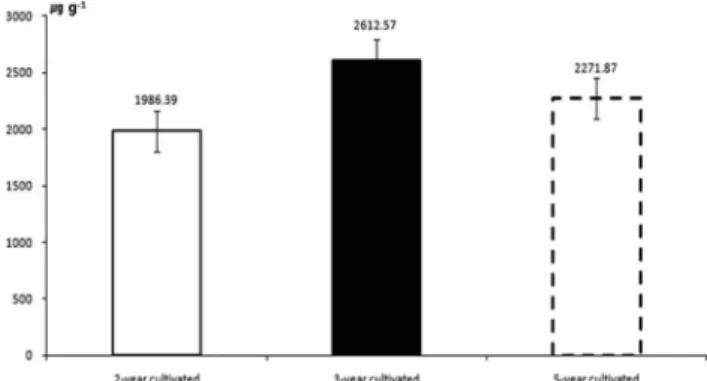
According to different harvest time, total phenolic concentrations in Astragalus ranged from 2052.01㎍ g-1 to 2615.80㎍ g-1. 6/5 harvesting Astragalus had the highest contents of total phenolic compounds (2615.80㎍ g-1). In contrast, 9/24 harvesting Astragalus had the lowest total concentrations of phenolics (2052.01㎍ g-1). Thus, it can be inferred that we predict a good harvest. The harvest season of Astragalus, June is the appropriated time of harvest in Taebaeg area. In this study, we compared phenolic compounds concentrations between different cultivation years. The total phenolic compounds according to cultivation year ranged from 1986.39㎍ g-1 to 2612.57㎍ g-1 in Astragalus. 3 years-cultivated Astragalus had the highest content (2612.57㎍ g-1) among the Astragalus plants
cultivated for different years. By contrast, 2-year-cultivated Astragalus had the lowest concentration (1986.39㎍ g-1).
The average value of total phenolic concentrations was 2290.28㎍ g-1 (Fig. 2). There was a significant pattern in the contents of phenolic compounds among the variously cultivated Astragalus plants. From the 2nd to 3rd year, the phenolic compound contents increased, whereas from the 3rd to 5th year, the phenolic compounds contents decreased. Thus, it can be inferred that 3-year-cultivated Astragalus may be of no commercial value.
Based on this data, significant variation in the contents of phenolics among specific varieties of Astragalus plants cultivated for different time periods was observed. The Astragalus cultivated for different time periods were significantly influenced by the surrounding environment.
Variation in the content of secondary metabolites was due to many factors, for example a genetic component (Bowers and Stamp, 1992). However, the genotype can be modified by a variety of biotic and abiotic features. For example, seasonal changes in biochemistry were caused by shifting patterns of resource allocation, which reflect the different physiological demands associated with growth, defense, and reproduction. At the same time, environmental stresses contribute to spatial variation within and among populations (Waterman and Mole, 1994; Dudt and Shure, 1994). In order to determine factors that contribute to variations in phenolic contents between species, field or greenhouse experiments are necessary.
3. Comparison of total phenolic contents between the top and subterranean parts of Astragalus according to harvest time and cultivation year
Comparison of the total phenolic contents between the Fig. 1. The percent contents of phenolic compounds in the
Astragalus.
Fig. 2. The total average value of total phenolic compounds according to cultivated-year in Astragalus.
top and subterranean parts of 2-, 3- and 5-year-cultivated Astragalus is shown in Fig. 3. The total phenolic contents in 2 years-cultivated Astragalus ranged from 1521.53㎍ g-1 to 2122.25㎍ g-1, and this value reflected the phenolic content in the top part minus that in the subterranean part.
7/8 harvesting Astragalus cultivated for 2 years had the difference of total phenolic concentrations (2122.25㎍ g-1) between the top part and subterranean part. In contrast, 6/5 harvesting Astragalus cultivated for 2 years had the smallest gap in total phenolic content (1521.53㎍ g-1) between the top part and subterranean part.
The total phenolic contents in the 3-year-cultivated Astragalus ranged from 1569.40㎍ g-1 to 2068.49㎍ g-1. 7/8 harvesting Astragalus cultivated for 3 years showed big difference of total phenolic concentrations (2068.49㎍ g-1) between the top part and subterranean part. In contrast, 9/
21 harvesting Astragalus cultivated for 3 years revealed little difference of total phenolic content (1569.40㎍ g-1)
between the top part and subterranean part. The total phenolic compounds contents in the 5-years-cultivated Astragalus ranged from 563.35㎍ g-1 to 1951.97㎍ g-1. 7/8 harvesting Astragalus cultivated for 5 years had the largest gap in total phenolic content (1951.97㎍ g-1) between the top part and subterranean part. On the other hand, 6/5 harvesting Astragalus cultivated for 3 years showed small difference in total phenolic concentrations (563.35㎍ g-1) between the top part and subterranean part.
Significantly, the total phenolic content of the top part minus that of the subterranean part was a positive number in Astragalus. The higher amount of phenolics in the top part might have been attributed to the presence or absence of light. There is a well established positive relationship between the intensity of solar radiation and the quantity of phenolics produced by plants. Generally, there is a rise in total phenolic content in plants grown in sunny environments relative to those grown in shady ones. This can be seen at the intra-individual level by comparing plants exposed to different amounts of light (Mole et al., 1988). An adaptive interpretation of this response in terms of plant physiological needs is that phenolics are produced as a way of reducing the photo destruction of exposed tissues. This is seen as being particularly likely whenever UV light is absorbed (Del, 1972).
4. Comparison of phenolic contents between the top and lateral roots of Astragalus
Comparison between the total phenolic contents of the top and lateral roots of 2, 3- and 5-year-cultivated Astragalus (Fig. 4). Total phenolic content in 2 year- cultivated Astragalus was -102.47㎍ g-1, and this value Fig. 3. The comparison of phenolic compounds contents
between top part and subterranean part according to the cultivated 5-year and different harvesting-time in the Astragalus. A; cultivated 2-year, B; cultivated 3-year, C; cultivated 5-year.
Fig. 4. The comparison of phenolic compounds contents between top root and lateral root according to the cultivated-year in the Astragalus.
was the phenolic content of the top root minus that of the lateral root. Total phenolic content in 3 year-cultivated Astragalus was -666.51㎍ g-1, and this value was the phenolic content of the top root minus that of the lateral root. Total phenolic content in 5 year-cultivated Astragalus was 88.03㎍ g-1, and this value was the phenolic content of the top root minus that of the lateral root.
So, it could infer a result from a above-mentioned shown data. Total phenolic content in lateral root of Astragalus plants increased upon cultivation from 2 years to 3 years.
On the contrary, that of the lateral root decreased upon cultivation from 3 years to 5 years. In conclusion, total phenolic content of lateral root decreased from 3 years of cultivation.
ACKNOWLEDGEMENTS
This work was carried out with the support of Cooperative Research Program for Agricultural Science &
Technology Development (Project No. PJ007877), Rural Development Administration, Republic of Korea.
LITERATURE CITED
Bowers MD and Stamp NE. (1992). Chemical variation within and between individuals of Plantago lanceolata(Plantaginaceae).
Journal of Chemical Ecology. 18:985-995.
Brown JP. (1980). A review of the genetic effects of naturally occurring flavonoids, anthroquinones and related compounds.
Mutation Reviews. 75:243-277.
Catherine A, Rice E, Miller NJ and Paganga G. (1996). Review article - Structure-antioxidant activity relationships of flavonoids and phenolic acids. Free Radical Biology & Medicine. 20:933-956.
Del MR. (1972). On the variability of chlorogenic concentration.
Oecologia. 9:289-300.
Duarte J, Vizcainnom FP, Utrilla P, Jimenez J, Tanargo J and Zarzuelo A. (1993). Vasodilatory effects of flavonoids in rat aortic smooth muscle, structure-activity relationships. General Pharmacology. 24:857-862.
Dudt JF and Shure DJ. (1994). The influence of light and nutrient on foliar phenolics and insect herbivory. Ecology. 75:86-98.
Feeny P. (1976). Plant apparency and chemical defense. Recent Advances in Phytochemistry. 10:1-40.
Foster S and Yue CX. (1992). Herbal emissaries: Bringing Chinese herbs to the west. Healing Art Press. Rochester. New York, USA. p.27-33.
Harborne JB. (1986). Nature, distribution and function of plant flavonoids- Plant flavonoids in biology and medicine. Alan R.
Liss Inc. New York. New York, USA. 213:15-24.
Hirotami M, Zhou Y, Liu H and Furuya T. (1994). Cycloartane
triterpene glycosides from the hairyroot cultures of Astragalus membranaceus. Phytochemistry. 37:1403-1407.
Ho CT, Chen Q, Shi H, Zhang KQ and Rosen RT. (1992).
Antioxidative effect of polyphenol extract prepared from various chinese tea. Preventive Medicine. 21:520-525.
Khknen MP, Hopia AI, Vuorela HJ, Rauha JP, Pihlaja K, Kujala TS and Heinonen M. (1999). Antioxidant activity of plant extracts containing phenolic compounds. Journal of Agricultural and Food Chemistry. 47:3954-3962.
Kandaswami C and Middleton E. (1994). Free radical scavenging and antioxidant activity of plant flavonoids. Advances in Experimental Medicine and Biology. 366:351-376.
Kim EH, Kim SH, Chung JI, Chi HY, Kim JA and Chung IM.
(2006). Analysis of phenolic compounds and isoflvones in soybean seeds(Glycine max (L.) Merill) and sprouts grown under different conditions. European Food Research and Technology. 222:201-208.
Kinsella JE, Frankel E, Geerman B and Kanner J. (1993).
Possible mechanisms for the protective role of antioxidants in wine and plant foods. Food Technology. 47:85-88.
Larson RA. (1988). The antioxidants of higher plants. Phytochemistry.
27:969-978.
Liston A and Wheeler JA. (1994). The phylogenetic position of the genus Astragalus(Fabaceae): Evidence from the chloroplast gene rpoC1 and C2. Biochemical Systematics and Ecology.
22:377-388.
Mole SJ, Ross AM and Waterman PG. (1988). Light-induced variation in phenolic levels in foliage of rain forest plants. I.
Chemical change. Journal of Chemical Ecology. 14:1-21.
Niknam V and Ebrahimzadeh H. (2002). Phenolics content in Astragalus species. Pakistan Journal of Botany. 34:283-289.
Podlech D. (1986). Taxonomic and phytogeographical problems in Astragalus of the old world and southwest Asia. Proceedings of the Royal Society of Edinburgh. 89:37-43.
Rios JL and Waterman PG. (1997). A review of the pharmacology and toxicology of Astragalus. Phytotherapy Research. 11:411-418.
Robards K, Prenzler PF, Tucker G, Swatsitang P and Glover W. (1999). Phenolic compounds and their role in oxidative processes in fruits. Food Chemistry. 66:401-436.
SAS Institute. 2000. SAS User’s Guide: Basics (5th ed). SAS Institute. Cary. North Carolina, USA.
Shahidi F and Wanasundra PK. (1992). Phenolic antioxidants.
Critical Reviews in Food Science and Nutrition. 32: 67-103.
Subarnas A, Ashima Y and Hikino H. (1991). Isoflavone and a pterocarpan from Astragalus mongholicus. Phytochemistry.
30:2777-2780.
Swain T. (1979). Tannins and lignins - Herbivores: Their interaction with secondary plant metabolites. Academic Press. San Diego.
California, USA. p.657-682.
Waterman PG and Mole S. (1994). Analysis of phenolic plant metabolites. Blackwell Scientific Publication. Oxford, England.
p.1-238.
Zheng W and Shiow YW. (2001). Antioxidant activity and phenolic compounds in selected herbs. Journal of Agricultural and Food Chemistry. 49:5165-5170.