http://www.medicinalcrop.org http://dx.doi.org/10.7783/KJMCS.2013.21.5.380
축분퇴비 시용 수준에 따른 논전환밭 인삼의 생육특성 및 생리장해 분석
장인배·현동윤†·이성우·김영창· 김장욱·박기춘·방경환·김기홍
*농촌진흥청 국립원예특작과학원 인삼특작부
Analysis of Growth Characteristics and Physiological Disorder of Korean Ginseng Affected by Application of Manure in Paddy-Converted Field
In Bae Jang, Dong Yun Hyun†, Sung Woo Lee, Young Chang Kim, Jang Uk Kim, Gi Chun Park, Kyong Hwan Bang and Gi Hong Kim
Department of Herbal Crop Research, NIHHS, RDA, Eumseong 369-873, Korea.
ABSTRACT : This study was carried out to investigate the difference of the content of soil chemical components and growth characteristics in five years old ginseng affected by application of manure in paddy-converted field. As all livestock manure regardless of kinds increased along with the whole soil chemical component, including the pH and EC in 2008. Change in the EC of control plot was slightly increased but not exceeded 1 ds/m over the years. However, the changes in the EC of livestock manure regardless of kinds and amounts were highly increased and irregularly exceeded 1.5 ds/m in 2012. The 5 years old ginseng root fresh weight, treatment of fertilizing pig manure compost 4 ton per 10 areas (PMC 4t on/10a) and fowl manure compost 4 ton per 10 areas (FMC 4 ton/10a), were superior to the others. But there were no difference between PMC 4 ton/
10a, FMC 4 ton/10a and control. The standing crop rate 39.6%, treatment of fertilizing cattle manure compost 4 ton per 10 areas (CMC 4 ton/10a), was best in all livestock manure. However that was relatively lower than control. Physiological disorder occurrence rates of livestock manure related with leaf and root of ginseng were also higher than that of control. If excessively using non-decomposed livestock manure, It would be caused physiological disorder in many ways. It is a big problem to be producing the quality ginseng. More research is needed to find out the economic and effective fertilizer.
Key Words : Korean Ginseng, Paddy-Converted Field, Livestock Manure, Physiological Disorder
서 언
인삼 (Panax ginseng C. A. Meyer)은 산형목 오가과 (五 加科; 두릅나무과; Araliaceae) 인삼속 (Panax genus)에 속하 는 다년생 숙근초 식물로 우리나라의 대표특산품 중 하나이다 (Woo et al., 2004).
우리나라의 인삼 면적은 2000년 (12,445ha)에 13,664톤 이 었으나 2010년 (19,010ha)의 생산량은 26,944톤으로 약 2배나 증가하였다 (Hyun et al., 2009; MIFAFF, 2011). 그러나 재 배면적의 증가에도 불구하고 연작장해로 인한 초작지 부족은 신규 재배면적을 감소시켜 인삼의 안정적 생산을 위협하고 있 다 (Kim et al., 2012). 이에 대한 해결책으로 논전환밭을 이
용한 인삼재배가 점차 늘어나고 있다. 논에서 Cylindrocarpon destructans의 기주범위에 포함되지 않는 벼를 4 ~ 5년간 재배 하면 피해가 없을뿐더러 뿌리썩음병원균의 밀도가 감소하고 인삼생육을 억제하는 독소물질이 희석되어 다시 인삼을 재배 할 수 있기 때문이다 (Lee et al., 2007; Rahman et al., 2005). 그러나 논전환밭토양은 담수와 배수로 산화와 환원 상 태가 반복적으로 일어나는 한편 유기물 분해속도가 느려 인삼 의 잎과 뿌리에 생리장해를 발생시켜 수량과 품질을 떨어뜨릴 수 있기에 재배 시 주의를 요한다 (KT & G, 1997; Yoo et al., 1999; Fagan et al., 2006).
인삼의 생리장해에는 잎의 황증과 뿌리의 적변 및 은피가 대표적인데 황증은 건조기 수분부족과 염류과다로, 적변은 우
†Corresponding author: (Phone) +82-43-871-5543 (E-mail) [email protected]
Received 2013August 20 / 1st Revised 2013 August 27 / 2nd Revised 2013 September 17 /3th Revised October 7 / Accepted 2013 Revised Octo- ber 14
This is an open access article distributed under the terms of the Creative Commons Attribution Non-Commercial License (http://creativecom- mons.org/licenses/by-nc/3.0/) which permits unrestricted non-commercial use, distribution, and reproduction in any medium, provided the original work is properly cited.
축분퇴비 시용 수준에 따른 논전환밭 인삼의 생육특성 및 생리장해 분석
기에 과습과 미부숙 축분의 시용에 의하여, 은피는 개간지재 배 시 세균의 밀도증가로 빈번하게 발생한다 (Ginseng Production Guide for Commercial Growers, 2003; Hyun et al., 2009). 이러한 생리장해는 인삼이 생육 중에 수분결핍 및 산화 스트레스 (Munns and Tester, 2008) 등에 의해 심할 경 우 인삼을 고사시킬 수 있으므로 유기물비료 시용에 각별한 주의가 필요함에도 인삼 재배경험이 부족한 일부 농가에서는 최근 청초 및 활엽의 부족과 중국산 갈잎의 원가상승 때문에 화학비료와 같은 속효성 비료나 축분퇴비를 논밭 구분 없이 시용하여 인삼 생리장해의 주된 원인이 되고 있다 (Banzai et al., 2002; Amitai-zeigersona et al., 1995; Kim et al., 2009).
인삼의 생리장해에 대한 연구로 토양의 이화학성이 생육 및 수량에 미치는 영향 (Lee et al., 1980)과 생리장해의 유형 (Park et al., 1982; Kang et al., 2007), 그리고 토양요인 간 의 복합적인 상호관계 (Jin et al., 2009) 등이 진행되어 이미 농촌진흥청 표준인삼재배법에 관련 화학성의 적정범위는 명시 된 상태이나 축분퇴비 시용이 생리장해에 관여한다는 보고만 있을 뿐 축분퇴비 시용에 따른 토양의 화학성변화와 고년 근 인삼의 생육 및 생리장해에 관한 연구결과는 없는 실정 이다 (RDA, 2009a, 2009b).
따라서 본 연구는 축분퇴비 시용에 따른 고년근 인삼의 생 육상황에 관한 자료를 제공하고자 밭보다 상대적으로 생리장 해에 취약한 논전환밭에 무처리구를 두고 계분, 돈분, 우분을 각 1 ton/10a, 2 ton/10a, 4 ton/10a씩 처리한 후 묘삼을 심어 연구를 수행하였다.
재료 및 방법
1. 포장조성 및 유기물 처리
본 연구는 2006년까지 벼를 재배하던 논을 밭으로 전환한 농촌진흥청 국립원예특작과학원 인삼특작부 시험포장에서 2008 년부터 수행하였다. 시험 전 토양 분석결과 화학성이 양호하 여 수단그라스만 5월 3일에 파종하였다 (Table 1). 수단그라스 수확은 7월 15일에 하여 생고수량이 4,488 ㎏/10a이었다. 경운 과 로터리는 7월 20일부터 10월 30일까지 10일 간격으로 각
각 10회 실시하여 수단그라스를 부숙시켰다. 시중에서 구입한 축분퇴비를 2008년 11월 5일에서 10일 사이에 난괴법 3반복 으로 처리하였고, 1처리구당 면적은 5.4 × 1.8 m로 하였다 (Table 2). 처리내용은 무처리구를 두고 계분, 돈분, 우분을 각 1 ton/10a, 2 ton/10a, 4 ton/10a씩 처리하였다. 1년생 자경종 묘 삼을 2009년 3월 17일에서 30일 사이에 줄 간격은 20 ㎝로 하여 1줄에 7주씩 이식하였다. 해가림은 3월 23일에서 4월 11 일 사이에 설치하였고 차광망은 4월 13일에서 4월 24일 사이 에 설치하였다. 이후 병해충 방제, 잡초제거 및 기타관리는 인 삼 GAP 표준재배지침서에 준하였다 (RDA, 2009a).
2. 토양화학성 분석 및 생육조사
토양시료는 처리구별로 약 10 ㎝ 깊이의 토양 다섯 곳에서 오거로 채취한 후 골고루 혼합하였다. 혼합된 토양시료는 상 온에서 건조 후 보관된 토양 시료를 이용하여 토양화학분석법 (NIAST, 2000)에 따라 pH, EC, 유기물, 총질소, 유효태인산 및 치환성양이온을 3반복으로 분석하였다. pH와 EC는 초자전 극법, 총탄소 및 총질소 함량은 CN분석기 (Vario Max CN, Elementar Anal-ysenesysteme, Germany)를 이용하여 측정하였 으며 토양유기물 함량은 측정된 총탄소함량을 이용하여 계산 하였다. 유효인산함량은 Lancaster법으로 측정하였으며, 치환 성 양이온함량은 1N NH4OAc (pH7.0)으로 침출한 후 그 여과 액을 ICP (Integra XL DUAL, GBC Scientific Equipment, Australia)를 이용하여 측정하였다 (Eo et al., 2011).
2010년 토양화학성 데이터는 연구과제 변경에 따라 토양화 학성 분석을 못하였다. 인삼의 생육과 적변 및 은피와 관 련된 생리장해 등은 농업과학기술 연구조사 분석기준에 준 하여 조사하였다 (RDA, 2012).
3. 인삼 조사포닌 분석
5년근 인삼시료를 50℃에서 48시간동안 완전히 건조 후 마 쇄한 다음 80% methanol 50 ㎖ 를 넣고 추출하였다.
methanol 추출액을 농축 후 증류수 25 ㎖와 ehter 25 ㎖로 분 리층을 만든 다음 상부에 위치한 에테르층만 제거하였다. 물 층에 수포화 부탄올 50 ㎖를 넣어 분리층이 생기면 물층을 제
Table 1. Chemical properties of before and after the management of preplant paddy-converted soil.
Soil† pH EC OM Avail.
P2O5
Exch. cation
K Ca Mg
(1:5) ds m-1 g ㎏-1 ㎎ ㎏-1 --- cmolc ㎏-1 --- Before soil management 5.4
(± 0.17) 0.30
(± 0.13) 14
(± 1.32) 74
(± 3.14) 0.16
(± 0.03) 2.8
(± 0.24) 1.0 (± 0.13)*
After soil management 5.5
(± 0.20) 0.35
(± 0.18) 14
(± 1.08) 82
(± 2.45) 0.14
(± 0.02) 2.6
(± 0.18) 1.0 (± 0.12)
†Soil : Saprolio. *Means and standard error are presented (n = 3).
거 후 수포화 부탄올 층을 다시 증류수 25 ㎖을 첨가하여 흔 들어 정치하고 물층을 제거하였다. 수포화 부탄올을 감압농축 기에서 농축하여 조사포닌 함량을 계산하였다 (Lee et al., 2011). 계산은 다음과 같다.
{(W2− W1) / W} × 100 W :시료 무게 (g), W1 :플라스크 무게 (g),
W2 :잔유물을 농축 후 건조시킨 플라스크 용기의 무게 (g) 4. 통계분석
축분퇴비 시용에 따른 논전환밭의 토양화학성, 인삼의 생육 및 생리장해에 대한 효과는 Least Significance Difference (LSD)와 Duncan test로 분석하였으며, SAS v9.2 (SAS Institute inc., Cary, NC, USA)을 이용하여 수행하였다.
결과 및 고찰
1. 축분퇴비 처리별 논전환밭의 이화학성 변화
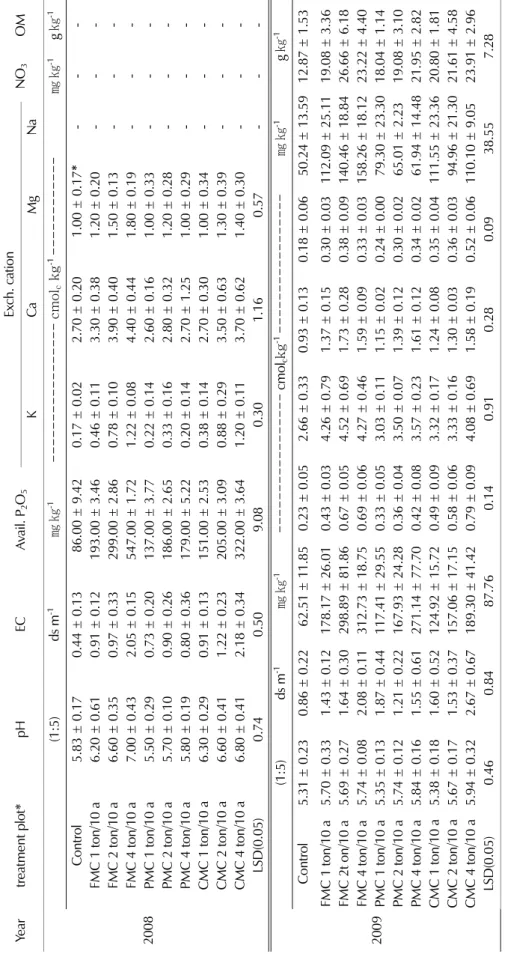
2008년 처리구별 축분퇴비 시용 후 토양의 이화학성을 분석 한 결과, pH를 비롯한 EC 등의 무기염류는 축분퇴비의 시용 량이 증가함에 따라 증가하였으며 증가폭은 돈분퇴비처리구에 비해 계분퇴비처리구와 우분퇴비처리구에서 더 컸다 (Table 3).
이는 시용된 돈분퇴비의 무기화 비율이 계분퇴비와 우분퇴비 보다 적었기 때문으로 판단되었다 (Table 2). 해가 갈수록 대 조구의 pH는 논전환밭의 낙수효과로 낮아졌으나, EC는 예정 지관리 후 수단그라스의 부숙으로 높아졌다 (Dawe et al., 2000; Jung et al., 1998). 축분퇴비처리구의 pH범위는 2009년 이후 4.7 ~ 5.9로 대조구의 pH 변화양상처럼 점차 낮아지는 추 세인데 반해 2008년에만 5.5 ~ 7.0으로 2009년 데이터와 비교 해 지나치게 높은 데는 축분퇴비를 처리한 후 충분히 부숙되 지 않은 상태에서 토양화학성을 측정했기 때문인 것으로 보였 다. 2012년에는 모든 처리구의 EC는 수단그라스나 축분퇴비 와 같은 유기물 부숙의 영향으로 2008년과 비교해 상승하였 는데, 대조구의 EC는 2008년 이후 계속적으로 1 ds/m을 넘지 않는 선에서 처음보다 증가하였지만 축분퇴비처리구의 EC는
종류와 시용량에 상관없이 상승하여 EC가 2012년 기준으로 모두 1.5 ds/m 이상이었다. 시용량이 많을수록 처리구 내 EC 의 2008 ~ 2012년까지의 누적양은 높아지는 추세였으나 돈분 퇴비처리구에선 시용량에 따른 큰 차이가 없었다.
2. 축분퇴비 처리별 인삼의 생육 및 생리장해 발생
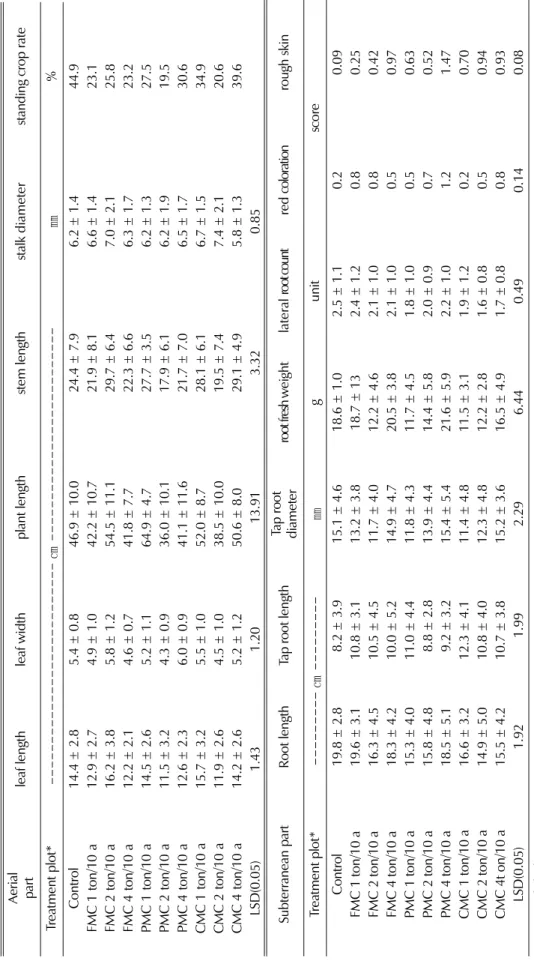
논전환밭 5년근 인삼의 지상부 생육은 전반적으로 FMC 2 ton/10a의 인삼이 가장 좋았으나 무처리구와 차이가 없었다.
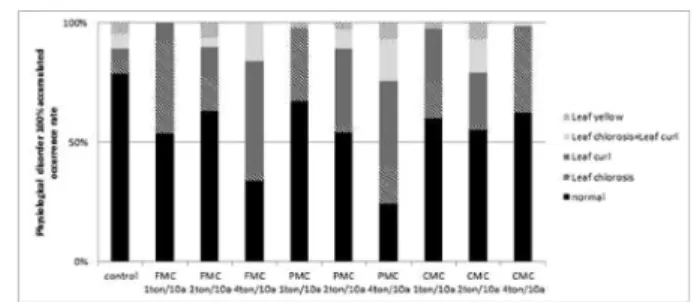
다른 축분퇴비처리구의 인삼 역시 무처리구와 비교하여 차이 가 없었으며 생육 또한 좋지 못했다. 입모율은 무처리구는 (44.9%), 축분퇴비처리구는 CMC 4 ton/10a (39.6%)의 입모율 로 높았을 뿐 축분퇴비의 종류와 양에 상관없이 대부분의 입 모율이 20 ~ 30%로 무처리구의 입모율과 비교하여 낮았다 (Table 4). 엽연형+갈색 반점형 황증이 중복으로 발생한 인삼 의 생리장해를 포함한 100% 누적 생리장해 발생 상대비율을 보면 EC와 P2O5이 과다하기 때문에 발생하는 엽연형의 경우 FMC 4 ton/10a > PMC 4 ton/10a > PMC 2 ton/10a 순이었으 며 환원상태에서 NO3−과다 시 Fe+2 조장으로 발생하는 갈색 반점형 황증의 경우 FMC 1 ton/10a > CMC 4 ton/10a > PMC 1 ton/10a 순 이었다 (Fig. 1).
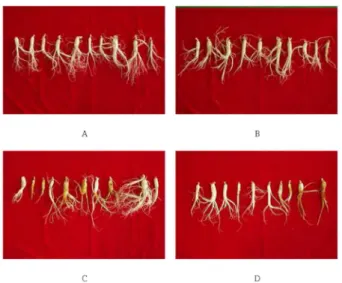
논전환밭 5년근 인삼의 지하부 생육은 무처리구가 축분퇴비 처리구보다 더 좋았다 (Table 4). 하지만 인삼의 개체 당 생근 중은 FMC 4 ton/10a과 PMC 4 ton/10a이 더 무거웠다. 이는 무처리구 인삼의 근장이 상대적으로 긴데 반해 동체장이 짧아 무게가 덜 나갔기 때문이며 체형계수가 높아지는데 영향을 미 친 것으로 판단되었다. 인삼의 지근수는 무처리구 (2.54개) 인 데 반해 CMC 1 ton/10a, CMC 2 ton/10a, CMC 4 ton/10a, PMC 1 ton/10a에서는 1.4개 미만이었었으며 그 외 축분처리구 인삼에서도 무처리구에 비해 지근수가 적었다. 토양 내 염류 농도가 적정범위 이상인 경우는 인삼 고유의 형태가 변형되어 동체장이 길어지고 지근수는 적어져 품위하락에 영향을 미치 는 것으로 판단되었다 (Fig. 2).
인삼의 상품성 판단에 기준이 되는 적변과 은피 발생지수에 Table 2. Chemical properties of livestock manure used for the
study.
Compost* T-N P2O5 K2O CaO MgO Water content --- % ---
FMC 1.76 3.98 2.46 7.74 1.25 40
PMC 0.88 3.22 1.13 2.70 1.13 67
CMC 1.97 2.20 3.13 3.75 1.41 48
*FMC; Fowl(chicken) Manure, PMC; Pig Manure, CMC; Cow Manure.
Fig. 1. Physiological disorder 100% accumulated occurrence rate of Korean ginseng affected by application of manure in paddy-converted field. FMC; Fowl(chicken) Manure, PMC; Pig Manure, CMC; Cow Manure.
축분퇴비 시용 수준에 따른 논전환밭 인삼의 생육특성 및 생리장해 분석
Table 3. The changes of chemical properties of paddy-converted field by application of manure. Yeartreatment plot*pHECAvail. P2O5Exch. cation NO3OM KCaMgNa 2008
(1:5)ds m-1㎎ ㎏-1--- cmolc kg-1 ---㎎ ㎏-1g ㎏-1 Control5.83±0.17 0.44±0.13086.00±9.420.17±0.022.70±0.2001.00±0.17* --- FMC 1ton/10a6.20±0.610.91±0.12 193.00±3.460.46±0.113.30±0.38 1.20±0.20 --- FMC 2ton/10a6.60±0.350.97±0.33 299.00±2.86 0.78±0.103.90±0.40 1.50±0.13 --- FMC 4ton/10a7.00±0.43 2.05±0.15 547.00±1.721.22±0.08 4.40±0.44 1.80±0.19 --- PMC 1ton/10a5.50±0.29 0.73±0.20 137.00±3.77 0.22±0.14 2.60±0.16 1.00±0.33 --- PMC 2ton/10a5.70±0.10 0.90±0.26 186.00±2.65 0.33±0.162.80±0.32 1.20±0.28 --- PMC 4ton/10a5.80±0.190.80±0.36 179.00±5.22 0.20±0.14 2.70±1.25 1.00±0.29 --- CMC 1ton/10a6.30±0.29 0.91±0.13 151.00±2.53 0.38±0.14 2.70±0.30 1.00±0.34 --- CMC 2ton/10a6.60±0.41 1.22±0.23 205.00±3.09 0.88±0.29 3.50±0.63 1.30±0.39 --- CMC 4ton/10a6.80±0.41 2.18±0.34 322.00±3.64 1.20±0.11 3.70±0.62 1.40±0.30 --- LSD(0.05)0.740.509.080.301.160.57--- 2009
(1:5)ds m-1㎎ ㎏-1--- cmolckg-1 ---㎎ ㎏-1g ㎏-1 Control5.31±0.23 0.86±0.22062.51±11.85 0.23±0.05 2.66±0.33 0.93±0.13 0.18±0.06 050.24±13.59 12.87±1.53 FMC 1ton/10a5.70±0.33 1.43±0.12 178.17±26.010.43±0.03 4.26±0.79 1.37±0.15 0.30±0.03 112.09±25.11 19.08±3.36 FMC 2ton/10a5.69±0.27 1.64±0.30 298.89±81.86 0.67±0.05 4.52±0.69 1.73±0.28 0.38±0.09 140.46±18.84 26.66±6.18 FMC 4ton/10a5.74±0.08 2.08±0.11 312.73±18.75 0.69±0.06 4.27±0.46 1.59±0.09 0.33±0.03 158.26±18.12 23.22±4.40 PMC 1ton/10a5.35±0.13 1.87±0.44 117.41±29.55 0.33±0.05 3.03±0.11 1.15±0.02 0.24±0.00 079.30±23.30 18.04±1.14 PMC 2ton/10a5.74±0.121.21±0.22 167.93±24.28 0.36±0.04 3.50±0.07 1.39±0.120.30±0.02 065.01±2.23 19.08±3.10 PMC 4ton/10a5.84±0.16 1.55±0.61 271.14±77.70 0.42±0.08 3.57±0.23 1.61±0.12 0.34±0.02 061.94±14.4821.95±2.82 CMC 1ton/10a5.38±0.18 1.60±0.52 124.92±15.72 0.49±0.09 3.32±0.17 1.24±0.08 0.35±0.04 111.55±23.36 20.80±1.81 CMC 2ton/10a5.67±0.17 1.53±0.37 157.06±17.15 0.58±0.06 3.33±0.16 1.30±0.03 0.36±0.03 094.96±21.30 21.61±4.58 CMC 4ton/10a5.94±0.32 2.67±0.67 189.30±41.42 0.79±0.09 4.08±0.69 1.58±0.19 0.52±0.06 110.10±9.05 23.91±2.96 LSD(0.05)0.460.8487.760.140.910.280.0938.557.28 (continued)
2011
(1:5)ds m-1 ㎎ ㎏-1 --- cmolc ㎏-1 ---㎎ ㎏-1 g ㎏-1 Control5.10±0.240.75±0.35040.57±8.470.20±0.072.70±0.260.91±0.120.18±0.0442.86±28.7311.61±2.15 FMC 1ton/10a5.05±0.171.80±0.61125.48±1.540.44±0.083.95±0.351.34±0.200.29±0.08132.10±61.0115.92±1.73 FMC 2ton/10a5.42±0.401.32±0.37095.38±11.930.57±0.053.73±0.281.36±0.100.25±0.06189.17±34.8516.93±1.11 FMC 4ton/10a5.96±0.292.53±1.52268.73±82.360.74±0.205.10±0.771.68±0.400.29±0.13231.30±78.5622.25±4.22 PMC 1ton/10a4.97±0.191.58±0.63085.74±25.940.36±0.053.16±0.191.13±0.080.22±0.07120.4±73.0515.38±1.94 PMC 2ton/10a5.06±0.071.62±0.39122.67±12.250.39±0.033.50±0.391.42±0.240.33±0.09131.18±63.3416.31±0.23 PMC 4ton/10a5.24±0.101.70±0.20152.22±13.870.41±0.033.60±0.171.42±0.040.31±0.03124.07±31.7214.78±1.80 CMC 1ton/10a4.97±0.041.33±0.40116.01±10.270.46±0.083.01±0.251.06±0.100.20±0.0693.05±40.1417.38±2.38 CMC 2ton/10a5.30±0.272.19±0.54117.89±24.520.66±0.083.93±0.511.50±0.210.45±0.18182.62±48.4117.98±1.86 CMC 4ton/10a5.54±0.351.75±0.44137.57±14.330.66±0.023.93±0.421.45±0.070.37±0.0799.71±32.3718.09±2.02 LSD(0.05)0.501.3562.110.180.820.390.19108.324.41 2012
(1:5)ds m-1 ㎎ ㎏-1 --- cmolc ㎏-1 ---㎎ ㎏-1 g ㎏-1 Control4.78±0.130.91±0.04 103.33±2.89 0.32±0.04 3.05±.02 1.17±0.18 0.22±0.01 37.44±1.27 12.62±1.03 FMC 1ton/10a4.91±0.03 1.96±0.01 158.48±2.86 0.40±0.02 3.68±0.06 1.32±0.01 0.37±0.02 125.94±1.25 16.73±1.07 FMC 2ton/10a5.46±0.02 1.52±0.04 430.28±0.88 0.59±0.02 4.31±0.06 1.63±0.04 0.34±0.03 120.54±2.49 17.16±0.84 FMC 4ton/10a5.61±0.06 2.01±0.08 605.02±0.62 0.70±0.02 4.66±0.12 1.70±0.02 0.35±0.02 140.67±2.46 21.42±0.06 PMC 1ton/10a5.00±0.19 1.90±0.18 60.50±0.36 0.39±0.05 3.36±0.06 1.44±0.05 0.36±0.02145.50±2.38 14.34±0.26 PMC 2ton/10a4.71±0.16 1.87±0.12 176.26±0.39 0.43±0.05 3.46±0.06 1.68±0.09 0.46±0.03 149.53±2.06 15.45±0.46 PMC 4ton/10a5.07±0.141.77±0.08 239.57±0.69 0.46±0.02 3.69±0.09 1.60±0.02 0.40±0.09120.36±2.45 14.60±0.46 CMC 1ton/10a5.01±0.10 1.54±0.06 174.15±0.79 0.58±0.05 3.29±0.15 1.30±0.06 0.30±0.07131.14±3.5617.14±0.60 CMC 2ton/10a4.98±0.132.20±0.08 231.61±0.52 0.67±0.15 4.20±0.06 1.49±0.10 0.46±0.06 177.50±4.34 15.33±0.78 CMC 4ton/10a5.45±0.56 2.17±0.12 359.70±0.60 0.84±0.06 4.05±0.08 1.69±0.07 0.48±0.10 132.40±1.34 21.87±1.40 LSD(0.05)0.440.192.930.120.170.170.115.301.66 *Value are the mean of 3 replicates±SE. FMC; Fowl(chicken) Manure, PMC; Pig Manure, CMC; Cow Manure.
축분퇴비 시용 수준에 따른 논전환밭 인삼의 생육특성 및 생리장해 분석
Table 4. 5 years ginseng growth, physiological disorder and standing crop rate in the presence of manure amendments in paddy-converted field. Aerial partleaf lengthleaf widthplant lengthstem lengthstalk diameterstanding crop rate Treatment plot*--- ㎝ ---㎜% Control14.4±2.85.4±0.846.9±10.024.4±7.96.2±1.444.9 FMC 1ton/10a12.9±2.74.9±1.042.2±10.721.9±8.16.6±1.423.1 FMC 2ton/10a16.2±3.85.8±1.254.5±11.129.7±6.47.0±2.125.8 FMC 4ton/10a12.2±2.14.6±0.741.8±7.722.3±6.66.3±1.723.2 PMC 1ton/10a14.5±2.65.2±1.164.9±4.727.7±3.56.2±1.327.5 PMC 2ton/10a11.5±3.24.3±0.936.0±10.117.9±6.16.2±1.919.5 PMC 4ton/10a12.6±2.36.0±0.941.1±11.621.7±7.06.5±1.730.6 CMC 1ton/10a15.7±3.25.5±1.052.0±8.728.1±6.16.7±1.534.9 CMC 2ton/10a11.9±2.64.5±1.038.5±10.019.5±7.47.4±2.120.6 CMC 4ton/10a14.2±2.65.2±1.250.6±8.029.1±4.95.8±1.339.6 LSD(0.05)1.431.2013.913.320.85 Subterranean partRoot lengthTap root lengthTap root diameterroot fresh weightlateral root countred colorationrough skin Treatment plot*--- ㎝ ---㎜gunitscore Control19.8±2.808.2±3.915.1±4.618.6±1.02.5±1.10.20.09 FMC 1ton/10a19.6±3.110.8±3.113.2±3.818.7±132.4±1.20.80.25 FMC 2ton/10a16.3±4.510.5±4.511.7±4.012.2±4.62.1±1.00.80.42 FMC 4ton/10a18.3±4.210.0±5.214.9±4.720.5±3.82.1±1.00.50.97 PMC 1ton/10a15.3±4.011.0±4.411.8±4.311.7±4.51.8±1.00.50.63 PMC 2ton/10a15.8±4.808.8±2.813.9±4.414.4±5.82.0±0.90.70.52 PMC 4ton/10a18.5±5.109.2±3.215.4±5.421.6±5.92.2±1.01.21.47 CMC 1ton/10a16.6±3.212.3±4.111.4±4.811.5±3.11.9±1.20.20.70 CMC 2ton/10a14.9±5.010.8±4.012.3±4.812.2±2.81.6±0.80.50.94 CMC 4ton/10a15.5±4.210.7±3.815.2±3.616.5±4.91.7±0.80.80.93 LSD(0.05)1.921.992.296.440.490.140.08 *FMC; Fowl(chicken) Manure, PMC; Pig Manure, CMC; Cow Manure.
서는 축분퇴비의 종류에 상관없이 퇴비시용량이 많아질수 록 높아지는 경향을 보였다(Table 4). 이는 축분퇴비의 부 숙도가 낮으면 NH4+장해 및 세균의 밀도가 높아져 적변 율과 은피발생률이 증가하기 때문이라는 선행연구 결과와 유사하였다 (Park et al., 2008).
3. 축분퇴비 처리별 인삼의 조사포닌 함량
축분퇴비 처리에 따른 인삼 조사포닌 함량은 무처리구가 92.84 ㎎/g로 FMC 1 ton/10a, FMC 2 ton/10a, CMC 1 ton/
10a, CMC 2 ton/10a, CMC 4 ton/10a의 축분퇴비를 시용했을 때 인삼 조사포닌 함량과의 유의성은 없었다. CMC 1 ton/10a 처리구 인삼의 조사포닌 함량은 98.1 ㎎/g으로 처리구들 중 가
장 높았으나 CMC 2 ton/10a, CMC 4 ton/10a는 무처리구 인 삼의 조사포닌 함량보다 조금 낮았으며 유의성은 없었다 (Table 5). 이는 인삼의 조사포닌 함량은 토양상태와 논과 밭 간에 큰 차이가 없거나 비슷하다고 한 기존의 연구 결과와 유 사하였다 (Jo et al., 1996). 금후 기온, 투광량 등 재배환경과 뿌리의 성분함량과의 관계 구명이 필요하다고 생각된다.
감사의 글
본 연구는 농촌진흥청에서 주관하는 유기물퇴비 종류별 생 리장해 조사(과제번호 : PJ00860501) 연구비 지원으로 수행된 결과로 이에 감사드립니다.
LITERATURE CITED
Amitai-Zeigersona H, Scolnikb PA and Bar-Zvi D. (1995).
Tomato Asrl mRNA and protein are transiently expressed following salt stress, osmotic stress and treatment with abscisic acid. Plant Science. 110:205-213.
Banzai TG, Hershkovits, Katcoff DJ, Hanagata N, Dubinsky Z and Karube I. (2002). Identification and characterization of mRNA transcripts differentially expressed in response to high salinity by means of differential display in the mangrove, Bruguiera gymnorrhiza. Plant Science. 162:499-505.
Dawe D, Dobermann A, Moya P, Abdulrachman S, Singh B, Lal P, Li SY, Lin B, Panaullah G, Sariam O, Singh Y, Swarup A, Tan PS and Zhen QX. (2000). How widespread are yield declines in long-term rice experiments in Asia. Field Crops Research. 66:175-193.
Eo JN, Park KC and Yeon BR. (2011). Changes in soil biota affected by the application of organic materials in reclaimed upland and paddy-converted soils cultivated with korea ginseng.
Korean Journal of Soil Science. 44: 872-877.
Fagan LL, Didham RK, Winchester NN, Behan-Pelletier V, Clayton M, Lindquist E and Ring RA. (2006). An experimental assessment of biodiversity and species turnover in terrestrial vs canopy leaf litter. Oecologia. 147:335-347.
Ginseng Production Guide for Commercial Growers. (2003).
Physiological disorders of ginseng plants. British Columbia, Canada. p.117-120.
Hyun DY, Yeon BY, Lee SW, Kang SW, Hyun GS, Jin YC, Kim JU and Yang DC. (2009). Effect of nutritional environment in ginseng field on the plant growth of ginseng(Panax ginseng C.
A. Meyer). Journal of Ginseng Research. 33:234-239.
Jo JS, Kim CS and Woo JY. (1996). Crop rotation of the Korean ginseng and the rice in paddy field. Korean Journal of Medicinal Crop Science. 4:19-26.
Jung BG, Jo GH, Yun ES, Yoon JH and Kim YH. (1998).
Monitoring on chemical properties of bench marked paddy soils in Korea. Korean Journal of Soil Science. 31:246-252.
Kang SW, Yeon BY, Hyun GS, Bae YS, Lee SW and Seong NS. (2007). Changes of soil chemical properties and root injury ratio by progress years of post-harvest in continuous cropping Fig. 2. Shape of ginseng by treating manure 4 ton/10a. A;
Control, B; FMC 4 ton/10a, C; PMC 4 ton/10a, D; CMC 4 ton/10a.
Table 5. Contents of crude saponins separated from ginseng affected by application of manure in paddy-converted field.
Compost Saponin
(㎎ g-1) control 92.84± 2.98**ab* FMC 1 ton/10a 91.28± 1.12ab FMC 2 ton/10a 96.11± 3.39ab FMC 4 ton/10a 86.61± 1.17b PMC 1 ton/10a 87.90± 1.61ab PMC 2 ton/10a 88.20± 3.16ab PMC 4 ton/10a 86.51± 2.65b CMC 1 ton/10a 98.10± 2.60a*
CMC 2 ton/10a 89.43± 5.44ab CMC 4 ton/10a 89.02± 5.62ab
*Means values followed by the same letter not significant 5% level.
**Means and standard error are presented (n = 3).
축분퇴비 시용 수준에 따른 논전환밭 인삼의 생육특성 및 생리장해 분석
soils of ginseng. Korean Journal of Medicinal Crop Science.
15:157-161.
Kim KW and Kim SM. (2009). Analysis of occurrence type of physiological disorder to soil chemical components in ginseng cultivated field. Korean Journal of Medicinal Crop Science.
17:439-444.
Kim YS, Lee MS, Yeom JH, Song JG, Lee IK, Yeo WH and Yun BS. (2012). Screening of antagonistic bacteria for biological control of ginseng root rot. Journal of Ginseng Research. 14:36-43.
KT & G. (1997). Annual report of ginseng-culture part. Korea Tobacco and Ginseng. Deajeon, Korea. p.36-38.
Lee IH, Yuk CS and Han KW. (1980). Influence of various soil characteristic in ginseng field on the growth and the yield of ginseng(Panax ginseng C. A. Mayer). Journal of Ginseng Research. 4:175-185.
Lee NR, Han JS, Kim JS and Choi JE. (2011). Effects of extraction temperature and time on ginsenoside content and quality in ginseng(Panax ginseng) flower water extract. Korean Journal of Medicinal Crop Science. 19:271-275.
Lee SW, Yeon BY, Hyun DY, Hyun GS, Park CG, Kim TS, Cha SW. (2007). Effect of compost application level on seedling growth of Panax ginseng C. A. Meyer. Korean Journal of Medicinal Crop Science. 15:138-141.
Ministry for Food, Agriculture, Forestry and Fisheries. (2011).
Statistical sourcebook of Ginseng 2010. Ministry for Food, Agri- culture, Forestry and Fisheries. Gwacheon, Korea. p.2.
Munns R and Tester M. (2008). Mechanisms of salinity tolerance. Annual Review of Plant Biology. 59:651-681.
National Institute of Agricultural Science and Technology(NIAST).
(2000). Methods of soil chemical analysis. National Institute of Agricultural Science and Technology. Rural Development Administration. Suwon, Korea. P.103-130.
Park H, Mok SK and Kim KS. (1982). Relationship between soil moisture, organic matter and plant growth in ginseng plantations. Korean Journal of Soil Science. 15:156-162.
Park JH, Yeo JK, Lee WW, Kim HC and Park CH. (2008).
Effects of slurry composting and biofiltration liquid fertilizer on growth characteristic of poplar clones in a reclaimed land mounding soil. Korean Journal of Soil Science. 41:318-323.
Rahman M and Punja ZK. (2005). Factors influencing development of root rot on ginseng caused by Cylindrocarpon destructans. Phytopathology. 95:1381-1390.
Rural Development Administration(RDA). (2009). Ginseng cultivation standard farming textbook(1st ed.). Rural Development Administration. Suwon, Korea. p.31-37.
Rural Development Administration(RDA). (2009). Good agricultural practice of ginseng(2nd ed.). Rural Development Administration. Suwon, Korea. p.70.
Rural Development Administration(RDA). (2012). Agricultural science technology research & analysis standard(5th ed.). Rural Development Administration. Suwon, Korea. p.759-770.
Woo SY, Lee DS and Kim PG. (2004). Growth and Eco- physiological characteristics of Panax ginseng grown under three different forest type. Journal of Plant Biology. 473:230-235.
Yoo SH, Choi WJ and Han GH. (1999). An investigation of the sources of nitrate contamination in the Kyonggi province groundwater by isotope ratios analysis of nitrogen. Korean Journal of Soil Science and Fertilizer. 32:47-56.