계분퇴비와 천연무기질 자재를 활용한 고랭지배추 비가림 유기재배 시 시용질소의 이용률과 배추의 생육
1)
김기덕*․권영석**․유동림***․이종남***․서종택***
Growth of Korean Kimchi Cabbage and Nitrogen Availability of Fertilizer in Organic Farming with Poultry Manure Compost and
Natural Mineral Materials in Highland Rainshelter Cultivation
Kim, Ki-Deog․Kwon, Yeong-Seok․Yoo, Dong-Lim․
Lee, Jong-Nam․Seo, Jong-Taek
This study was carried out to evaluate nitrogen availability of applied fertilizer and to investigate yield and growth of Korean kimchi cabbage as affected by amount of fertilizer and soil fertility in organic farming applied various fertilizers in rain- shelter. The head weight of Korean kimchi cabbage cultured in infertile soil (sand loam) with no amendments was very low. and that in fertile soil (clay loam) was higher than in infertile soil (sand loam). The head weight of Korean kimchi cabb- age as affected by amount of fertilizer was more variable in infertile soil (sand loam) than in fertile soil (clay loam). Nitrogen availability of applied fertilizer by Korean kimchi cabbage was lower in fertile soil (clay loam) than in infertile soil (sand loam) and the lower that was, the more fertilizer applied. By application of poultry manure compost 20Mg ha-1 and natural mineral materials such as guano, phosphate rock, and potassium magnesium rock equal to amount of fertilizer recommended in conventional farming, the yield of Korean kimchi cabbage in infertile soil (sand loam) with 1% organic matter came up to 90% of the yield in fertile soil (clay loam) with 6% organic matter. Therefore natural mineral materials such as guano for N source, phosphate rock for P source, and potassium magnesium rock for K source may be able to use as environmental-friendly fertilizers in organic Korean kimchi cabbage production in highland.
Key words : chinese cabbage, nitrogen availability, organic farming, rainshelter
* Corresponding author, 국립식량과학원 고령지농업연구센터([email protected])
**국립식량과학원 기획조정과
***국립식량과학원 고령지농업연구센터
연구보문
Ⅰ. 서 론
고랭지배추는 여름철 김치의 주재료로 중요한 채소 중의 하나이다. 고랭지배추는 고온다 습한 여름철에 재배되기 때문에 병해충 발생이 많아 방제 없이는 상품성 있는 배추를 생산 하기가 어려웠다(Kwon and Ryu, 2003). 그런데 최근 웰빙먹거리에 관심이 높아짐에 따라 고 랭지배추의 청정재배의 필요성이 인식되면서 대관령지역의 방충비가림시설에서 고랭지배 추의 무농약 재배에 관한 연구가 시작되었다(Kim et al., 2008). 앞으로 무농약재배에서 한 단계 높여 유기재배가 보편화된다면 고랭지배추의 고부가가치의 창출은 물론 청정이미지를 부각시켜 고랭지에서 새로이 발전 가능한 소득작물로 거듭날 수 있을 것으로 생각된다.
고랭지배추의 유기재배 시 생산성의 감소는 유기재배에 있어서 해결해야 하는 중요한 문제 중의 하나이다. 이러한 측면에서 지금까지의 유기재배에서는 생산성을 높이고자 지나 치게 많은 퇴비를 시용하여 왔다(Poudel et al., 2002; Evanylo et al., 2008). 특히 시설내 유기 재배에서 과다한 연속적 축분퇴비의 시용은 토양 양분의 불균형을 가져왔고, 그 결과 수량 감소의 원인이 되었다(Lee et al., 2006; Ge et al., 2010). 이와 같은 현상은 유기재배를 실천 하면서 그에 걸맞는 균형적 시비관리가 되지 못하고 관행적 수준으로 축분퇴비를 시용하 였기 때문으로 보인다(Sohn et al., 1996). 따라서 유기재배토양의 지속 생산을 위해서는 토 양 양분의 균형적 관리가 필요한데, 고정비율의 양분을 함유하는 유기퇴비시용만으로는 작 물에 알맞는 토양 양분의 합리적 조절이 곤란하다.
이에 고랭지배추 유기재배 시 토양 양분조건과 유기자재 시용량에 따른 배추의 생육 및 수량 특성을 검토하였으며, 아울러 토양의 양분불균형을 해소할 수 있는 방안을 모색하기 위하여 질소, 인산, 칼륨 등 3요소 각각의 양분을 함유하고 있는 천연무기질자재인 구아노, 인광석, 황산가리고토 등의 시용효과를 평가하였다.
Ⅱ. 재료 및 방법
본 연구는 2010년 6월부터 8월까지 대관령지역(해발 800m)의 비옥도가 다른 두 토양 즉, 흑색삼림토의 식양토(차항통)와 석비레 유래 사양토로 조성된 비가림시설에서 실시하였다.
고랭지배추(CR여름맛, 농우바이오)를 200공 플러그 육묘상자에 6월 1일에 파종하여 육묘한 후 60cm × 35cm 간격으로 6월 21일에 정식하였고 8월 24일에 수확하였다. 이랑은 0.03mm 흑백비닐로 멀칭하였으며, 20cm 간격의 점적호스를 이랑 당 2줄을 설치하여 관수하였다.
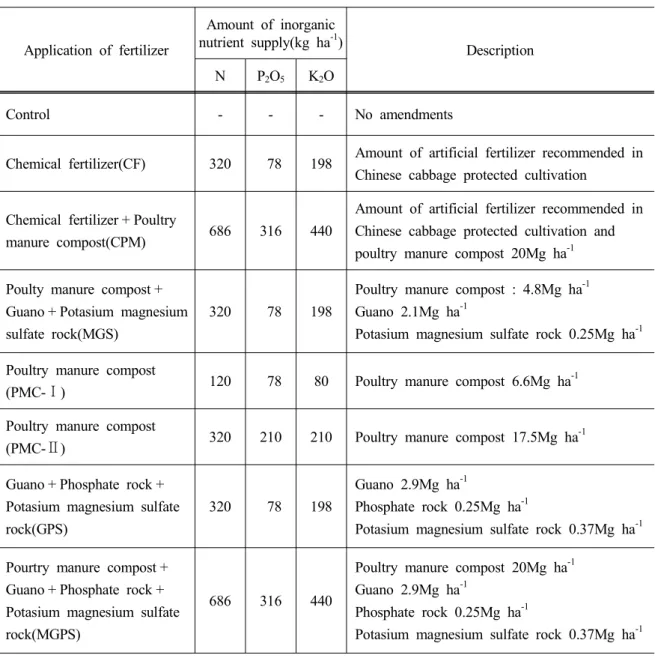
질소의 천연공급량을 알아보기 위해 무비구를 두었으며, 일반 화학비료추천시비량, 퇴비시 용량, 천연자재 투입량 간 생육 및 토양반응을 검토하기 위하여 사용한 처리별 자재와 질 소, 인산, 칼륨 등 3요소 시용량은 Table 1과 같다. 사용 자재의 투입비율을 달리하여 질소,
인산 및 칼리 시용량을 조절하였다. 계분퇴비에 의해 투입되는 3요소성분량과 천연무기질 자재에 의해 투입되는 3요소 성분량을 합산하여 명기하였다(Table 1). 질소의 주 공급원으 로서 구아노(트리플, 누보, N-P2O5-K2O(%) = 11-1-4)를 시용하였으며, 인산질 공급원으로서 인광석 분말을, 그리고 칼리질 비료의 공급원으로서 황산가리고토(썰포마그, 남해화학)를 정식 1주일 전에 시용하였다. 두 토양 간 시용질소의 비료효과는 질소시비량에 대한 수량 구성요소인 구중의 관계로부터 검토하였다. 또한 처리별 배추의 질소 흡수량에서 무비구에 서의 배추에 의한 질소 흡수량을 제외한 흡수량에 대한 시용질소량의 100분율로 시용질소 의 이용률을 조사하였다. 시험에 사용된 계분퇴비의 특성 및 토양의 화학성은 Table 2 및 Table 3과 같다.
Table 1. Description of fertilizer application practices in the experiments Application of fertilizer
Amount of inorganic nutrient supply(kg ha-1)
Description N P2O5 K2O
Control - - - No amendments
Chemical fertilizer(CF) 320 78 198 Amount of artificial fertilizer recommended in Chinese cabbage protected cultivation
Chemical fertilizer + Poultry
manure compost(CPM) 686 316 440
Amount of artificial fertilizer recommended in Chinese cabbage protected cultivation and poultry manure compost 20Mg ha-1 Poulty manure compost +
Guano + Potasium magnesium sulfate rock(MGS)
320 78 198
Poultry manure compost : 4.8Mg ha-1 Guano 2.1Mg ha-1
Potasium magnesium sulfate rock 0.25Mg ha-1 Poultry manure compost
(PMC-Ⅰ) 120 78 80 Poultry manure compost 6.6Mg ha-1
Poultry manure compost
(PMC-Ⅱ) 320 210 210 Poultry manure compost 17.5Mg ha-1
Guano + Phosphate rock + Potasium magnesium sulfate rock(GPS)
320 78 198
Guano 2.9Mg ha-1
Phosphate rock 0.25Mg ha-1
Potasium magnesium sulfate rock 0.37Mg ha-1 Pourtry manure compost +
Guano + Phosphate rock + Potasium magnesium sulfate rock(MGPS)
686 316 440
Poultry manure compost 20Mg ha-1 Guano 2.9Mg ha-1
Phosphate rock 0.25Mg ha-1
Potasium magnesium sulfate rock 0.37Mg ha-1
Table 2. C/N ratio and nutrient contents of poultry manure compost used in the experiment
C/N N(%) P2O5(%) K2O(%) Compositon(%)
14.7 1.83 1.19 1.21 Poultry manure 55,
Sawdust 35, Others 10
Table 3. Chemical properties of soil used in the experiment
Soil pH EC
(dS m-1)
O.M.
(g kg-1)
T-N (g kg-1)
Av. P2O5
(mg kg-1)
Ex. Cations(cmol+ kg-1)
K Ca Mg
Clay loam 5.68 1.07 58.9 3.1 685 1.11 5.7 1.4
Sand loam 6.10 0.35 11.3 1.0 153 0.13 9.6 1.8
천연 무기질 자재 시용에 따른 배추의 수량성과 생육반응을 알아보기 위해 8월 25일에 처리구별로 10주씩 초장, 엽수, 엽폭, 구중 등을 조사하였다. 무기성분 분석으로 탄소 및 총 질소는 CN분석기(Vario-EL, Elementar, Germany)로 분석하였으며, P는 Vanadate방법으로, K 는 ICP(PE2400, Perkim Elmer, USA)로 분석하였다.
시험구배치는 완전임의배치법 3반복으로 하였으며, 통계분석은 SAS(Statistical Analysis System Institute Inc.)를 이용하여 분석하였고, 처리간 유의성은 던칸의 다중검정법으로 검정 하였다.
Ⅲ. 결과 및 고찰
배추의 생육은 시험에 사용된 토양의 비옥도(Table 3)에 따라 현저한 차이를 보였는데, 비옥도가 높았던 식양토의 무비구에서 배추의 주중이 1442g인데 비해 비옥도가 낮았던 사 양토의 무비구에서 358g으로 나타났고, 외엽수는 식양토에 비해 사양토에서 많은 경향보인 반면 내엽수는 식양토에서 많은 경향을 보였다. 특히 식양토에서 무비구를 포함 처리구에 서 내엽수의 차이가 크지 않은 반면 사양토에서는 처리구별로 차이를 보였다(Table 4). 특 히 비옥도가 낮았던 사양토의 무비구에서 배추의 구가 형성되지 않았다(Fig. 1). 사양토의 시험전 토양의 성분함량(Table 3)이 유기물 11.3g ․ kg-1, 인산 153mg ․ kg-1, 칼리 0.13cmol+․ kg-1로 적정범위(RDA, 2010)에 못 미쳤기 때문으로 생각된다.
모든 시비처리구에서 배추의 구중은 토양비옥도가 낮았던 사양토재배구에 비해 비옥도 가 높았던 식양토재배구에서 높았다. 또한 비옥도가 높았던 식양토 재배구에서와는 달리
석비레 유래 사양토에서는 구아노, 인광석 및 황산가리고토를 배추의 3요소 표준시비량 (RDA, 2010)과 동일한 수준으로 시용한다 하더라도 질소 표준시용량(32kg/10a)의 1/3수준을 포함하는 6.6톤/10a의 계분퇴비시용구에서보다 구중이 낮았다(Fig. 2). 한편 시비량에 따른 구중의 변화 폭이 식양토보다 사양토에서 컸다. 이는 비옥도가 높은 식양토보다 비옥
Table 4. Korean kimchi cabbage growth characteristics and nigrogen uptake affected by application of chemical fertilizer, poultry manure compost, and nature ore fertilizers in rainshelter cultivation at Daegwallyeong highland
Soil Fertilizerz Wt. of plant (g)
No. of outer leaves
No. of inner leaves
Leaf width (cm)
Nitrogen uptake (kg/10a)
Clay loam
Control 1442 a-ey 9.9 ef 48.5 abc 25.1 a 12.4 a-ey
CF 1615 a-e 9.5 ef 50.7 abc 25.8 a 13.8 a-e
CPM 1867 a-c 9.5 ef 51.1 abc 25.3 a 16.0 a-c
MGS 1835 a-c 10.7 de 50.0 abc 26.4 a 15.7 a-c
PMC-Ⅰ 1767 a-c 10.6 de 49.9 abc 26.8 a 16.0 a-c
PMC-Ⅱ 1872 a-d 10.3 de 51.7 abc 25.8 a 15.1 a-d
GPS 1785 a-d 10.6 de 52.1 ab 25.7 a 15.3 a-d
MGPS 2026 a 11.3 de 54.7 a 26.4 a 17.4 a
Sand loam
Control 358 f 15.9 bc 27.8 f 18.3 b 3.1 f
CF 1343 b-e 14.7 bc 41.8 de 24.9 a 11.5 b-e
CPM 1651 a-e 13.1 cd 46.7 bcd 27.1 a 14.1 a-e
MGS 1236 de 15.0 bc 44.4 cde 23.7 a 10.6 de
PMC-Ⅰ 1281 a-d 11.8 de 40.6 abc 24.7 a 15.4 a-d
PMC-Ⅱ 1803 c-e 11.4 de 47.9 de 27.2 a 11.0 c-e
GPS 1167 e 17.4 a 38.9 e 23.2 a 10.0 e
MGPS 1903 ab 8.2 f 52.1 ab 27.4 a 16.3 ab
Significance Soil Fertilizer Soil × Fertilizer
***
***
*
**
NS
*
***
***
***
*
**
*
***
***
*
zSee the table 1
yMeans with the same letter within columns are not significantly different by Duncan’s multiple range test at 5% level.
NS, *, **, ***, Nonsignificant or significant at p=0.05, 0.01 or 0.001, respectively.
A B C
Fig. 1. The photographs of Korean kimchi cabbage affected by application of chemical fertilizer, nature ore fertilizers such as guano in rainshelter cultivation. upper:
sand loam soill, lower: clay loam soil, A: no amendment, B: Amount of standard chemical fertilizers recommended in Korean kimchi cabbage cultivation, C: nature ore fertilizers of same amount of standard chemical fertilizers
도가 낮았던 사양토에서 시비량에 대한 비료반응이 컸으므로, 석비레 유래 사양토와 같이 토양 비옥도가 낮은 토양에서도 시비를 잘하면 상품성 있는 배추를 생산할 수 있다고 판단 된다.
질소이용률은 식양토에 비해 사양토에서 높았으며, 질소시비량이 많은 처리에 비해 적은 처리에서 높게 나타났으며, 두 토양 모두 화학비료 인산 표준시비량 수준으로 계분퇴비 6.6 톤/ha을 시용했던 처리구(PMC-Ⅰ)에서 다른 시비처리에 비해 질소이용률이 가장 높게 나타 났다(Fig. 2). 또한 배추의 구중은 질소시비량이 높을수록 높은 결과를 보였다(Fig. 2). Fig.
2에서 보여주는 바와 같이 T-N이 1% 수준으로 비옥도가 낮았던 사양토(Table 3)에서 무비 구의 구중이 현저하게 낮았으나 계분퇴비 2톤/10a에 표준시비량수준의 자재를 시용하면 식 양토 구중의 약 90%수준으로 높아져 비옥도가 낮은 토양에서도 시비량을 잘 조절하면 배 추의 수량을 충분히 확보할 수 있을 것으로 판단된다. 또한 식양토나 사양토 모두 계분퇴 비 2톤/10a에 3요소 화학비료 표준시비량과 동등한 양으로 구아노, 인광석 및 황산가리고토 를 시용하면 화학비료를 사용하는 관행재배에 준하는 수량을 얻을 수 있었다. 구아노는 토 양 중에서 10일이 경과하면 질소의 90%이상이 용출되어(Hadas, 1992) 비효가 빠르기 때문 에 이와 같은 수량을 얻을 수 있었다고 판단된다. 토양의 양분함량에 따른 배추의 구중으 로 나타낸 비효반응은 토양 양분함량이 높은 식양토보다는 토양 양분 함량이 낮았던 석비 레 유래 사양토에서 높았다(Fig. 3). 또한 토양의 EC는 시비량이 많을수록 높게 나타났으며 재배 이 후에는 거의 처음의 수준으로 낮아졌다. EC의 변동폭은 사양토에 비해 식양토에서
컸다(Fig. 4). 모든 처리의 시비량이 계분퇴비 2톤/10a에 표준시비량 수준 이하로 시비하였 기 때문에 재배 후의 EC의 상승은 크게 나타나지 않았으나 매년 시용이 계속된다면 염류 집적으로 인해 EC 상승이 나타날 것으로 판단된다.
Fig. 2. The changes of nitrogen content of soil, nitrogen availability of applied fertilizer, head weight of Korean kimchi cabbage affected by application of chemical fertilizer, poultry manure compost, and nature ore fertilizer in rainshelter cultivation. Vertical bars represent SE of the means (n=3). (upper: clay loam soil, lower: sand loam soil)
Z: See table 1
Fig. 3. Relationship between application rate of nitrogen and head weight of Korean kimchi cabbage cultivated in rainshelter from Jun. 21 to Aug. 26, 2010
z
Fig. 4. The changes of eletric conductivity(EC) of soil affected by application of chemical fertilizer, poultry manure compost, and nature ore fertilizer in rainshelter cultiva- tion. left: clay loam soil, light: sand loam soil
Z: See table 1
앞의 결과에서 보여주는 바와 같이 토양의 비옥도는 생산성을 제한한다. 질소가 배추의 수량에 크게 영향을 미치므로 관행적으로 질소를 기준으로 시비한다. 유기농업에서 흔히 관행적으로 시용하고 있는 퇴비 및 녹비작물 등에만 의존된 토양비옥도 관리에서 유기질퇴 비의 과용이나 연용은 결국 토양양분의 불균형을 초래하게 될 가능성이 높다(Lee et al., 2006; Ge et al., 2010). 특히 용탈이 제한되는 시설재배에서의 특정양분의 축적은 작물의 생 산성에 영향을 미친다. 유기물의 무계획적인 장기연용은 토양유기물의 증가보다 토양의 무
기물 함량을 더욱 증가시키므로(Hong, 1993) 토양의 지력이 낮은 경우 녹비작물, 두과작물, 윤작 이외에 미생물발효퇴비의 시용과 함께 토양진단에 의한 최적 유기질비료를 시용이 필요함을 제시하였지만(Jeong et al., 2000), 유기질비료의 3요소 성분함량비는 원 재료에 의 해 일정한 범위로 한정되어 있어 유기질비료의 투입만으로는 작물의 각각의 양분 흡수비 율에 맞을 가능성은 높지 않다.
본 연구는 유기재배에서도 적정 시비조절이 필요함을 인식하고, 우선 N, P, K 등 단비성 분을 많이 함유하고 있는 구아노 등의 천연무기질자재를 활용하여 시비조절했을 때와 관 행과의 수량성을 비교하여 천연무기질자재의 토양양분 자재로의 이용가능성을 검토하고자 한 것이다. 천연무기질자재 시비로 충분한 수량을 얻을 수 있음을 확인하였고, 구아노, 인 광석, 황산가리고토 등의 천연무기질자재를 잘 활용한다면 작물 맞춤형 시비가 가능하여 특정 성분의 토양집적을 방지하여 양분불균형을 해소하므로써 작물생산성의 감소를 줄이 면서, 토양의 지속 생산성을 유지할 수 있을 것으로 기대되며, 앞으로 이에 대한 구체적인 연구가 더 진행되어야 할 것으로 보인다.
Ⅳ. 적 요
비가림하우스에서 고랭지배추 유기재배 시 시용량 및 토양비옥도에 따른 시용질소의 이 용률과 배추의 수량성을 검토하였다. 무비구에서의 구중은 사양토 토양에서 현저히 낮았으 며, 비옥도가 낮은 사양토에 비해 비옥도가 높은 식양토에서 높았다. 시비량에 따른 구중의 변화는 비옥도가 높은 식양토에 비해 비옥도가 낮은 사양토에서 더 크게 나타났다. 질소이 용률은 토양의 비옥도가 높고, 질소시비량이 많을수록 낮았다. 질소함량 1%의 사양토에서 도 계분퇴비 2톤/10a과 표준시비량 수준의 천연무기질자재의 시용으로 질소함량 6%의 식 양토의 약 90% 수준의 수량을 나타냈다. 질소, 인산, 및 칼리질 천연광물자원인 구아노, 인 광석 및 황산가리고토 등은 친환경 자재로서 균형적 시비를 꾀하는 유기재배에서 널리 활 용될 수 있을 것으로 보인다.
[논문접수일 : 2012. 9. 17. 논문수정일 : 2013. 1. 10. 최종논문접수일 : 2013. 1. 16.]
Reference
1. Hadas, R. Rosenberg. 1992. Guano as a nitrogen source for fertigation in organic farming.
Nutient Cycling in Agroecosystems 31(2): 209-214.
2. Poudel, D. D., W. R. Horwath, W. T. Lanini, S. R. Temple, and A. H. C. van Bruggen.
2002. Comparison of soil N availability and leaching potential, crop yields and weeds in organic, low-input and conventional farming systems in northern California. Agric., Ecosys- tems and Environ. 90: 125-137.
3. Evanylo, G., C. Sherony, J. Spargo, D. Starner, M. Brosius, and K. Haering. 2008. Soil and water environmental effects of fertilizer-, manure-, and compost-based fertility practices in an organic vegetable cropping system. Agric., Ecosystems and Environ. 127: 50-58.
4. Ge, Tida., S. Nie, Y. Hong, J. Wu, H. Xiao, C. Tong, and K. Iwasaki. 2010. Soluble organic nitrogen pools in greenhouse and open field horticultural soils under organic and conventional management: A case study. European J. Soil Biol. 46: 371-374.
5. Hong, J. W. 1993. Status and vision of utilization of organic sources. Proceeding of the symposium on soil management for environment conservation. Kor. Soc. Soil Sci. Fert. pp.
31-37.
6. Jeong, S. J., W. B. Chung, H. T. Kim, K. H. Kang, J. S. Lee, and J. S. Oh. 2000. Effect of the soil physicochemistry property and plant growth and components of Chinese cabbage after application organic farming materials. Kor. J. Org. Agr. 8(6): 131-146.
7. Kim, K. D., J. S. Lim, W. B. Kim, E. H. Lee, C. W. Nam, and S. C. Hong. 2008.
Cultivation technology of highland Korean kimchi cabbage under rainshelter with net. NIHA Research Report. pp. 13-41.
8. Kwon, M. and K. Y. Ryu. 2003. Integrated pest management in highland Korean kimchi cabbage. NHRI Research Report. pp. 173-185.
9. Lee, Y. H., S. G. Lee, S. H. Kim, J. H. Shin, D. H. Choi, Y. J. Lee, and H. M. Kim. 2006.
Investigation of the utilization of organic materials and the chemical properties of soil in the organic farms in Korea. Kor. J. Org. Agr. 14(1): 55-67.
10. RDA. 2010. Standard recommended rate of fertilizer by crops. p.111.
11. Sohn, S. M., D. H. Han, and Y. H. Kim. 1996. Chemical characteristics of soils cultivated by the conventional farming, greenhouse cultivation and organic farming and accumulation of NO3-
in Chinese cabbage and lettuce. Kor. J. Org. Agr. 5(1): 149-165.