개간 및 답전윤환 인삼재배지에서 유기물처리에 따른 토양생물상 변화
어진우·박기춘*·연병열 농촌진흥청 국립원예특작과학원
Changes in Soil Biota Affected by the Application of Organic Materials in Reclaimed Upland and Paddy-converted Soils Cultivated with Korea Ginseng
Jinu Eo, Kee-Choon Park*, and Byung-Ryul Yeon
Department of Herbal Crop Research, Rural Development Administration, 80 Bisanri, Eumseong, Chungbuk 369-873, Korea
Cultivation of Korea ginseng in newly reclaimed and paddy-converted fields has been increasing, and evaluation of organic amendment effectiveness is needed in the two soil types. Soil organisms influence organic matter decomposition, and their responses to applications of organic matter were studied. De-oiled cake and compost were applied at 20 Mg ha
-1and 40 Mg ha
-1in both soil types. Changes in microflora were assessed by analyzing phospholipid fatty acid (PLFA). The abundance of nematodes and microarthropods was measured. Microbial PLFA indicators for microorganisms and microarthropod abundance were greater in reclaimed upland than in paddy-converted soil. There were few differences in the microflora and fauna of reclaimed uplands, regardless of treatment. In paddy-converted soil, the abundance of Oribatida was increased by the application of compost at 20 Mg ha
-1and was correlated with PLFA indicators of fungi. The results suggested a minimal influence of organic amendments in reclaimed upland, because the organic matter content and abundance of soil organisms are low in mineral soils. In paddy-converted soil, the effects of organic amendment differ among different soil organisms, and soil properties are important mediators of the effect.
Key words: Compost, De-oiled cake, Nematode, Oribatida, PLFA
접수 : 2011. 9. 22 수리 : 2011. 10. 14
*연락저자 : Phone: +82438715556 E-mail: [email protected]
서 언
인삼을 연작할 경우 근부병 등으로 인한 연작장해가 나 타날 수 있다. 이를 피하기 위해 인삼을 경작하지 않은 포 지를 이용하려는 사례가 많으며, 초작지의 고갈 및 경제적 손실 등 재배면적 확보 문제가 심화되고 있는 실정이다.
한편, 우리나라는 논재배 면적이 많아, 밭으로 전환할 경 우 인삼재배에 이용할 수 있는 잠재력이 크다. 우리나라 논토양의 74%가 인삼재배에 적합하므로 (Hyun et al., 2009), 논을 전환밭으로 활용한다면 경작지 부족 문제를 경감시 킬 수 있을 것이다. 이에 따라 인삼 재배를 위해서 개간밭 과 논전환밭에 대한 연구의 중요성이 커지고 있다 (Lee et al., 2004).
인삼을 다년간 재배하기 위해서는 양분을 안정적으로 공급해야 하며, 이를 위해서는 유기물의 분해를 통한 지속 적인 양분공급이 필요하다. 인삼재배에서 토양 유기물함
량은 인삼의 근수량과 정의 상관관계 있으며 (Park et al., 1982), 다양한 퇴비의 시용이 인삼의 생육에 미치는 영향 에 대한 연구가 보고되었다 (Kang et al., 2009; Nam et al., 2002). 또한, 묘삼의 생산에 대한 유기물의 효과도 연구되 었으며 (Kim et al., 2010; Lee et al., 2003), 외국에서는 미국삼의 재배에 유기물을 이용한 연구가 보고되었다 (Nadeau et al., 2003). 한편, 심토로 성토한 개간지 토양은 양분이 적으며, 오랫동안 벼재배를 했던 논토양을 전환밭으로 이 용할 경우 일부 양분이 다량으로 축적될 가능성이 있다.
따라서 일반 밭토양과 비교할 때 개간밭과 논전환밭에서 유기물 처리에 의한 토양화학성 변화가 다를 수 있으므로 이에 대한 기초연구가 필요하다.
토양에 존재하는 미생물 및 미소동물은 유기물의 분해 과정 및 양분의 이동에 중요한 역할을 하며, 이들의 밀도 와 다양성에 따라 유기물의 분해가 영향을 받는다 (Fagan et al., 2006). 또한, 토양생물은 토질을 평가하기 위한 환 경지표로도 이용할 수 있으며, 토양의 물리화학적 수치와 마찬가지로 토양생물의 활성이나 다양성도 토양의 변화를 나타내는 정보를 제공할 수 있다 (Schloter et al., 2003).
따라서, 인삼재배지에서 유기물 시용에 대한 토양생물의
Table 1. Chemical composition of applied organic materials.
Organic material Total N P2O5 K2O CaO MgO
--- % ---
De-oiled cake 3.89 2.21 1.35 0.89 1.01
Compost 1.13 0.58 2.04 1.99 0.69
변화를 조사한다면 유기물 분해와 양분공급을 이해하는데 도움이 될 것이다.
최근에 인삼재배지에 대한 기초적인 토양생물 연구가 진행되고 있고 (Eo et al., 2010; Hong et al., 2009), 균 근균과 같은 미생물을 이용한 예정지 관리가 보고되었으 나 (Sohn et al., 2008), 이들 연구는 밭토양에 국한되어 있다. 본 연구는 개간밭과 논전환밭에서 유기물 시용에 따 른 토양화학성의 변화를 알아보고, 두 토양에서 토양생물 의 반응을 비교하는 것을 목표로 하였다.
재료 및 방법
실험포장 및 처리 충청북도 음성군에 위치한 국립 원예특작과학원 인삼특작부 실험포장에서 연구를 수행하 였다. 개간지 밭은 2007년에 마사토로 성토하여 조성하였 고, 논전환밭은 2006년까지 농가에서 벼를 재배하던 논을 밭으로 전환하였다. 유기물은 2008년 11월 11일에서 20일 사이에 상업적으로 판매하는 유박과 볏짚퇴비를 사용하여 각각 20 및 40 Mg ha-1으로 처리하였고, 유기물의 화학적 조성은 Table 1에 나타내었다. 유기물을 투입하지 않은 처 리구를 대조구로 하였고, 실험구 배치는 난괴법 3반복으 로 배치하였다. 자경종 묘삼을 2009년 3월 17일에서 30일 사이에 기계로 이식하였다. 각 처리구의 크기는 0.9 m × 3.6 m로 하였고, 줄 간격은 20 cm로 하여 1줄에 7주씩 1년 생 묘삼을 이식하였다. 해가림은 2009년 3월 23일에서 4월 11일 사이에 설치하였고, 차광망은 4월 13일에서 4월 24일 사이에 설치하였다.
토양채취 및 토양생물조사 토양생물을 조사하기 위 한 토양시료는 2011년 7월 3일에 채취하였다. 각 처리구별 로 오거를 이용하여 0-10 cm 깊이 토양 네다섯 곳에서 시 료를 채취하여 골고루 혼합하였다. 선충은 베르만깔대기법 을 이용하여 20 g의 토양을 48시간 동안 추출 후 TAF용액 에 보관하여 개체수를 조사하였다. 선충의 추출에 사용한 토 양은 건조하여 토양수분함량을 측정하였다. 미소절지동물 은 툴그렌장치를 이용하여 300 mL의 토양을 96시간동안 추출 후 현미경을 이용해 동정하였다.
인지질 지방산 (PLFA) 분석 토양미생물 군락을 분석하
기 위하여, 채취한 토양시료를 냉동건조하여 인지질 지방 산 추출에 이용하였다. 토양 5 g에 chloroform : methanol : buffer solution (1:2:0.8, v/v/v) 의 혼합액을 넣고 지질을 추출한 후 silicic acid column으로 neutral-, glyco- 및 phospho-lipid로 분리하였다. 내부표준물질로는 fatty acid methyl ester 19:0를 사용하여 인지질을 메틸화한 지방산 에 첨가하였다. 지방산의 정성 및 정량은 MIDI Sherlock Microbial Identification System (MIDI Inc., Newark, DE) 을 이용하여 분석하였다. 전체 PLFA 중에서 주요 지표 지방산은 미생물 지방산 지표들을 이용하여 분류하였다 (Frostegard et al., 1993; Li et al., 2006). 단불포화 지방 산은 16:1 ω5c, 17:1 ω8c, 18:1 ω7c, 포화지방산은 14:00, 15:00, 16:00, 17:00, 18:00, 20:00을 지표지방산으로 이용하 였다. 호기성균은 16:1 ω 7t, 혐기성균은 cy19:0을 사용하 였다. 그램 음성균의 지표 지방산은 18:1 ω7c, 19:0cy ω8c, 17:1 ω8c, 그램양성균은 i14:0, i15:0, a15:0, i16:0, i17:0, a17:0, 세균은 그램 음성균과 양성균을 모두 이용하였다. 곰팡이는 18:2 ω6,9c, 방선균은 10Me16:0, 10Me17:0, TBSA10Me18:0 을 지표로 이용하였다.
토양화학성 및 미생물체량 분석 상온 건조 후 보 관된 토양 시료를 이용하여 pH, EC, 유기물, C/N율, 유효 태인산, 질산태질소, 치환성양이온을 분석하였다. pH와 EC 는 초자전극법을 이용하였고, 유효인산함량은 Lancaster법 으로 측정하였다. 총탄소 및 총질소함량은 CN 분석기 (Vario Max CN, Elementar Analysenesysteme, Germany)를 이 용하여 측정하였으며 토양유기물 함량은 측정한 총탄소함 량을 이용하여 환산계수에 의해 계산하였다. 치환성 양이온 함량은 1 N NH4OAc (pH 7.0)으로 침출한 후 그 여과액을 ICP (Integra XL DUAL, GBC Scientific Equipment, USA)를 이용하여 측정하였다.
통계 유기물 시용의 토양생물에 대한 효과는 각 토양 별로 분산분석과 최소유의차 검정법 (LSD)으로 분석하였 고, 개간밭과 논전환밭의 PLFA 수치와 미소동물의 밀도 차이는 t-검정법으로 분석하였다. 또한, 각 지방산 수치와 미소동물의 개체밀도간 상관계수를 계산하였다. 모든 분 석은 SAS v9.1 (SAS Institute Inc., USA)를 이용하여 수 행하였다.
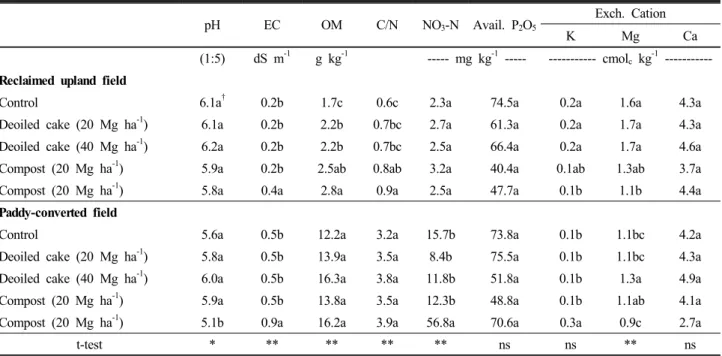
Table 2. Chemical characteristics of soils affected by organic amendments in the reclaimed upland and paddy-converted soils.
pH EC OM C/N NO3-N Avail. P2O5
Exch. Cation
K Mg Ca
(1:5) dS m-1 g kg-1 --- mg kg-1 --- --- cmolc kg-1 ---
Reclaimed upland field
Control 6.1a† 0.2b 1.7c 0.6c 2.3a 74.5a 0.2a 1.6a 4.3a
Deoiled cake (20 Mg ha-1) 6.1a 0.2b 2.2b 0.7bc 2.7a 61.3a 0.2a 1.7a 4.3a Deoiled cake (40 Mg ha-1) 6.2a 0.2b 2.2b 0.7bc 2.5a 66.4a 0.2a 1.7a 4.6a Compost (20 Mg ha-1) 5.9a 0.2b 2.5ab 0.8ab 3.2a 40.4a 0.1ab 1.3ab 3.7a
Compost (20 Mg ha-1) 5.8a 0.4a 2.8a 0.9a 2.5a 47.7a 0.1b 1.1b 4.4a
Paddy-converted field
Control 5.6a 0.5b 12.2a 3.2a 15.7b 73.8a 0.1b 1.1bc 4.2a
Deoiled cake (20 Mg ha-1) 5.8a 0.5b 13.9a 3.5a 8.4b 75.5a 0.1b 1.1bc 4.3a Deoiled cake (40 Mg ha-1) 6.0a 0.5b 16.3a 3.8a 11.8b 51.8a 0.1b 1.3a 4.9a Compost (20 Mg ha-1) 5.9a 0.5b 13.8a 3.5a 12.3b 48.8a 0.1b 1.1ab 4.1a Compost (20 Mg ha-1) 5.1b 0.9a 16.2a 3.9a 56.8a 70.6a 0.3a 0.9c 2.7a
t-test * ** ** ** ** ns ns ** ns
†Values indicated by the same letter within the same field are not significantly different according to LSD test (P>0.05). The significance (t-test) between the 2 types of soils is presented as *(P<0.05) and **(P<0.01).
Fig 1. Principal component analysis based on the microbial PLFA analysis. C and D indicate compost and de-oiled cake, respectively.
결과 및 고찰
유기물 시용과 토양 이화학성 변화 토양 pH는 개 간밭보다 논전환밭에서 유의적으로 낮았으나 (t-test, P <
0.05) 같은 토양에서 처리간 차이가 없었으며, EC는 두 토 양에서 모두 퇴비 20 Mg ha-1 처리구에서 높았다 (Table 2).
질산태질소의 농도는 개간밭에서는 처리간 유의적 차이가 없었으나, 논전환밭에서는 20 Mg ha-1 처리구에서 증가하 였다. 토양에 유기물을 투입하면 토양생물의 분해활동에 의 해 식물이 이용할 수 있는 형태의 양분이 증가하는데, 개간 밭에서 질산태농도가 처리간 차이가 없었던 것은 분해자 의 밀도가 증가하지 않은 것이 하나의 원인으로 추측된다.
농경지에서는 일반적으로 세균에 의한 분해활동이 활발하 게 나타나지만, 유기물 처리에 의해 세균 PLFA의 값이 증 가하지 않았다는 것은 이를 뒷받침해준다.
인삼재배를 위해 투입한 유기물은 장기간에 걸쳐 서서 히 분해되어 양분을 공급한다. 이 과정에서 투입된 유기물 을 기질로 분해하는 분해자인 미생물들이 일차적으로 영향 을 받을 수 있으며 (Bending et al., 2004; Verschoor et al., 2001), 미소동물인 선충이나 미소절지동물의 밀도를 높이 는 효과가 있다 (Mueller et al., 1993; Verhoeven, 2001).
또한, 유기물은 토양의 pH나 EC등의 화학성을 변화시켜 간접적으로 토양생물에 영향을 미칠 수 있으므로 (Lindberg and Persson, 2004), 유기물시용이 토양생물상에 미치는 효과를 고찰할 때 기질공급 효과와 토양화학성 변화를 같 이 살펴야 한다.
인지질지방산 분석에 의한 토양미생물군집 비교 인지질지방산 분석에서 확인된 24종류의 지방산을 이용하 여 주요인 분석을 한 결과, 주성분 1이 97.1%, 주성분 2가 0.9%를 설명하였다 (Fig. 1). 그램 양성균/그램 음성균의 비 율은 토양중의 양분상태를 나타내는데, 개간밭에서 이 비 율이 논전환밭보다 컸기 때문에 이 토양에서 미생물들이 이 용할 수 있는 기질의 양이 적다는 것을 반영한다. PC 1에 의해 개간밭과 논전환밭 토양이 분리되었으며 (Fig. 1), 지 방산은 개간밭과 논전환밭에서 평균 10.1 종류와 19.5 종류 가 각각 검출되었다. 또한, 14:0, 14:0 iso, 15:0, 17:0 iso, 17:0 antesio 등의 지방산은 개간밭에서는 발견되지 않아
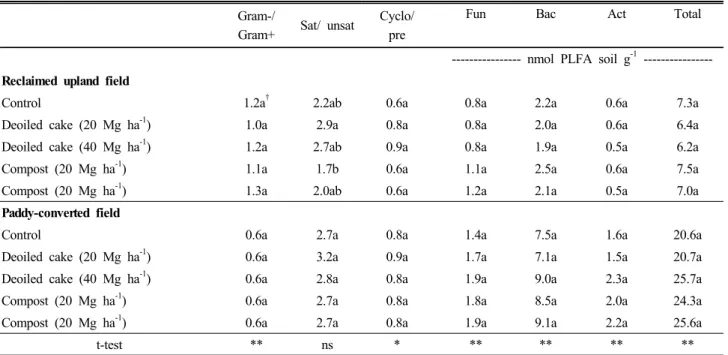
Table 3. Changes in microbial characteristics based on PLFA analysis.
Gram-/
Gram+ Sat/ unsat Cyclo/
pre
Fun Bac Act Total
--- nmol PLFA soil g-1 ---
Reclaimed upland field
Control 1.2a† 2.2ab 0.6a 0.8a 2.2a 0.6a 7.3a
Deoiled cake (20 Mg ha-1) 1.0a 2.9a 0.8a 0.8a 2.0a 0.6a 6.4a
Deoiled cake (40 Mg ha-1) 1.2a 2.7ab 0.9a 0.8a 1.9a 0.5a 6.2a
Compost (20 Mg ha-1) 1.1a 1.7b 0.6a 1.1a 2.5a 0.6a 7.5a
Compost (20 Mg ha-1) 1.3a 2.0ab 0.6a 1.2a 2.1a 0.5a 7.0a
Paddy-converted field
Control 0.6a 2.7a 0.8a 1.4a 7.5a 1.6a 20.6a
Deoiled cake (20 Mg ha-1) 0.6a 3.2a 0.9a 1.7a 7.1a 1.5a 20.7a
Deoiled cake (40 Mg ha-1) 0.6a 2.8a 0.8a 1.9a 9.0a 2.3a 25.7a
Compost (20 Mg ha-1) 0.6a 2.7a 0.8a 1.8a 8.5a 2.0a 24.3a
Compost (20 Mg ha-1) 0.6a 2.7a 0.8a 1.9a 9.1a 2.2a 25.6a
t-test ** ns * ** ** ** **
†Values indicated by the same letter within the same field are not significantly different according to LSD test (P>0.05). The significance (t-test) between the 2 types of soils is presented as *(P<0.05) and **(P<0.01). ‘Gram-’, gram-negative bacteria;
‘Gram+’, gram-positive bacteria; ‘sat’, saturated fatty acids; ‘unsat’, unsaturated fatty acids; ‘cycl’, cyclo fatty acids; ‘pre’, the precursors of cyclo fatty acids; ‘fun’, fungi; ‘bac’, bacteria; ‘act’, actinomycetes.
서 논전환밭 토양의 미생물군집이 개간밭보다 다양한 것 으로 나타났다.
주요인 분석 결과의 산포정도를 비교하면 개간밭에서는 처리에 의한 변이가 적었으나, 논전환밭에서는 유박 또는 퇴비 처리구가 PC1이나 PC2에 의해 분리되었다 (Fig 1).
이것은 개간밭에서는 유기물을 투입하여도 논전환밭에 비 해서는 처리효과가 적다는 것을 반영한다. 세균, 곰팡이 및 방선균의 지방산 지표를 이용하여 처리간 미생물 군집을 비교하였을 때 개간밭에서는 처리간 차이가 적었다 (Table 3). 또한, 논전환밭에서도 처리간 유의적 차이는 없었지만, 세 종류의 미생물과 전체 PLFA 수치가 퇴비 20 Mg ha-1 처리구에서 약 1.3배 증가하였다. 이것은 논전환밭의 미생 물의 종구성뿐만 아니라 밀도변화도 개간밭보다 크다는 점을 시사한다.
개간밭 및 논전환밭의 특징과 토양생물 반응 토양 생물은 일반적으로 표토에서 밀도가 높고 심토에서는 밀 도가 낮으며, 이것은 미생물의 먹이가 되는 유기물 등의 기질 함유량과 밀접한 연관성이 있기 때문이다. 따라서 심 토로 개간을 하면 초기에 토양동물의 밀도가 극히 낮아 이들이 증가하려면 상대적으로 시간이 걸리기 때문에, 논 전환밭보다 개간밭에서 토양동물 밀도 변화가 적었던 하 나의 원인으로 추측된다. 특히, 환경의 변화에 민감한 곰 팡이섭식성 선충이나 날개응애 등은 세대증식 기간이 비 교적 길어 일정한 수준의 밀도를 유지하기까지 시간이 걸
릴 수 있다. 또 하나의 원인으로 토양생물은 유기물을 분 해하기도 하지만 이를 이용하여 증식할 경우 물질을 체내 에 고정시키므로, 양분이 적은 토양에서는 식물과 경합관 계를 형성할 수 있다 (Schmidt et al., 2011).
인삼의 뿌리 생육은 토양수분에 영향을 받으며 (Lee et al. 2009; Park et al. 1982), 논전환밭 토양의 인삼재배에 서 배수가 중요한 문제로 지적되었다 (Hyun et al., 2009).
본 연구에서도 토양수분함량이 개간밭과 논전환밭에서 각 각 6.7% 및 20.7%로 나타났으며, 밭보다 전환밭에서 유의 적으로 높았다 (t-test, P < 0.05). 따라서, 토양수분은 인 삼의 생육뿐만 아니라 토양생물에 영향을 미칠 수 있는 중요한 환경요소라 할 수 있다. 토양의 pH, 수분 등의 스 트레스를 나타내는 cyclopropyl지방산/전구체 지방산의 비 율이 개간밭보다 논전환밭에서 높았기 때문에 환경스트레 스가 높은 것을 반영한다 (Table 3). 논전환밭에서 미생물 의 기질이 되는 유기물의 함량이 높았으나, 기질이 풍족한 상태에서 우점하는 그램 음성균의 비율은 개간밭보다 낮 았다 (Kaur et al., 2005). 이러한 차이가 나타난 것은 미 생물의 먹이가 되는 기질의 양적인 영향뿐만 아니라 토양 수분과 같은 환경적 요소의 차이에 의한 것으로 추측할 수 있다. 중형동물 중에서 선충의 총밀도와 식성별 분류에 의한 개체밀도는 토양수분함량에 따라 영향을 받을 수 있 으나 (Liu et al., 2008; Todd et al., 1999), 본 연구에서 유의적 차이가 없었다. 미소절지동물중에서 톡토기의 개 체밀도는 두 토양간에 유의적 차이가 없었고, 날개응애의
Table 4. Abundance of nematodes and microarthropods in the presence of organic amendments in reclaimed upland and paddy-converted soils.
Bacterivorous nematodes
Fungivorous
nematodes Collembola Oribatida Mesostigmata --- Ind g-1 --- --- Ind 100 mL-1 ---
Reclaimed upland field
Control 0.4a† 0.1a 1.1a 1.3a 0.6a
Deoiled cake (20 Mg ha-1) 0.4a 0.1a 2.9a 0.5a 0.2b
Deoiled cake (40 Mg ha-1) 0.5a 0.3a 2.7a 0.5a 0.0b
Compost (20 Mg ha-1) 0.4a 0.4a 2.5a 0.8a 0.0b
Compost (20 Mg ha-1) 0.3a 0.2a 1.7a 1.9a 0.1b
Paddy-converted field
Control 0.9a 0.3a 2.5a 1.3b 0.2b
Deoiled cake (20 Mg ha-1) 0.4a 0.3a 3.3a 4.3ab 0.1b
Deoiled cake (40 Mg ha-1) 0.4a 0.3a 1.3a 4.4ab 0.0b
Compost (20 Mg ha-1) 0.9a 0.3a 3.9a 1.7b 1.0a
Compost (20 Mg ha-1) 0.6a 0.3a 3.7a 6.5a 0.4b
t-test ns ns ns ** ns
†Values indicated by the same letter within the same field are not significantly different according to LSD test (P>0.05). The significance (t-test) between the 2 types of soils is presented as *(P<0.05) and **(P<0.01).
개체밀도만 개간밭보다 논전환밭에서 유의적으로 높았다 (Table 3). 톡토기는 토양수분이 증가할수록 개체밀도가 감소 하는 경향이 있으나 (Sinka et al., 2007), 날개응애는 비교적 수분함량의 영향을 적게 받기 때문에 (Laiho et al., 2001), 논전환밭에서 날개응애의 밀도차이를 일부 설명할 수 있다.
토양 미생물과 중형동물과의 관계 유기물 분해과 정에서 생성된 물질은 토양생태계의 먹이망을 통하여 전 달되며 (Polis and Strong, 1996), 일차 분해자인 곰팡이 와 세균과 이를 섭식하는 미소동물들이 유기적 관련성을 갖는다. 곰팡이 PLFA와 곰팡이섭식성 선충 밀도와는 유의 적 상관관계가 없었으나, 곰팡이 PLFA와 날개응애밀도는 유의한 양의 상관관계를 나타냈다 (r = 0.63, P < 0.001).
날개응애는 유기물을 분쇄하여 곰팡이를 섭식하는 것으로 알려져 있기 때문에 (Schneider et al., 2004), 유기물처리 로 인한 곰팡이의 증가가 이들의 밀도 증가를 유발했을 것으로 추측된다. 그러나 세균 PLFA는 세균섭식성 선충이 나 톡토기의 밀도와 유의한 상관관계가 없었다. 유기물 처 리에 의해 세균 PLFA가 증가하는 경향이 있었으나 이를 섭식하는 동물들의 밀도에는 변화가 적게 나타난 것은 먹 이량 이외의 환경요인이 작용한 것으로 추측된다.
요 약
인삼재배에서 논전환밭의 이용이 증가하는 추세이며, 개간밭과 더불어 유기물투입의 효과를 조사할 필요가 있
다. 토양생물은 유기물의 분해에 영향을 미치는 중요한 요 소이기 때문에 유기물 시용이 토양생태계에 미치는 영향 을 조사했다. 유박과 퇴비를 개간밭과 논전환밭에 20 Mg ha-1 와 40 Mg ha-1로 투입하였다. 미생물상 변화는 인지 질지방산을 분석하여 검정하였고, 동물상의 변화는 미소 동물의 개체밀도를 측정하였다. 미생물에 대한 PLFA 지수 나 미소동물의 밀도는 개간밭보다 논전환밭에서 높았다.
개간밭에서는 유기물 투입에 의한 처리간 차이가 적었다.
논전환밭에서는 퇴비 40 Mg ha-1 처리구에서 날개응애 밀 도가 증가하였고, 이들의 밀도는 곰팡이 PLFA와 양의 상 관관계가 나타났다. 위의 결과는 개간밭에서 유기물 함량 이나 토양생물의 밀도가 낮은 심토로 개간하면 유기물을 투입하여도 토양생물에 대한 효과가 적을 수 있다는 것을 보여준다. 논전환밭에서는 유기물에 대한 토양생물들의 반응이 다르며 토양의 물리화학성도 토양생태계에 영향을 미칠 수 있다. 논전환밭과 개간밭에서는 유기물에 대한 토 양생물의 반응이 다르므로, 투입된 유기물의 분해나 이에 따른 양분의 순환이 다를 수 있기 때문에 두 토양에서 시 비방법을 다르게 할 필요성이 있다고 생각된다.
인 용 문 헌
Bending, G.D., M.K. Turner, F. Rayns, M. Marx, and M.
Wood. 2004. Microbial and biochemical soil quality indicators and their potential for differentiating areas under contrasting agricultural management regimes. Soil Biol. Biochem.
36:1785-1792.
Eo, J., K.C. Park, S.W. Lee, Y.S. Bae, and B.R. Yeon. 2010.
Effects of Organic Materials on Soil Organisms in a Korean Ginseng Field. Korean J. Soil Sci. Fert. 43:188-193.
Fagan, L.L., R.K. Didham, N.N. Winchester, V. Behan-Pelletier, M. Clayton, E. Lindquist, and R.A. Ring. 2006. An experimental assessment of biodiversity and species turnover in terrestrial vs canopy leaf litter. Oecologia 147:335-347.
Frostegard, A., A. Tunlid, and E. Baath. 1993. Phospholipid fatty acid composition, biomass and activity of microbial communities from two soil types experimentally exposed to different heavy metals. Appl. Environ. Microbiol. 59:
3605-3617.
Hong, Y., N.J. Choi, and I.Y. Choi. 2009. Distributions of soil organisms in the ginseng cultivation fields. Korean J. Environ. Biol. 27:272-278.
Hyun, G.S., S.M. Kim, K.C. Song, B.Y. Yeon, and D.Y.
Hyun. 2009. Establishment of the suitability class in ginseng cultivated lands. Korean J. Soil Sci. Fert. 42:430-438.
Kang S.W., B.Y. Yeon, S.W. Lee, D.Y. Hyun, Y.S. Bae, and G.S. Hyeon. 2009. Studies on the application of byproduct composts as substitute for Yacto in Yang-jik nursery of ginseng. J. Medicinal crop 17:415-420.
Kaur, A., A. Chaudhary, A. Kaur, R. Choudhary, and R.
Kaushik. 2005. Phospholipid fatty acid-A bioindicator of environment monitoring and assessment in soil ecosystem, Curr. Sci. 89:1103-1112.
Kim, D.W., H.J. Kim, J.S. Park, D.H. Kim, S.S. Cheong, and J. Ryu. 2010. Selection of suitable organic matter for To-jik nursery in Panax ginseng C.A. Meyer. Korean J. Medicinal Crop Sci. 18:74-78.
Laiho, R., N. Silvan, H. Carcamo, and H. Vasander. 2001.
Effects of water level and nutrients on spatial distribution of soil mesofauna in peatlands drained for forestry in Finland. 2001. Appl. Soil Ecol. 16:1-9.
Lee, G.S., S.S. Lee, and J.D. Chung. 2003. Effect of several kinds of composts on growth status of aerial parts in ginseng seedling. J. Ginseng Res. 27:24-31.
Lee, S.W., G.S. Kim, B.Y. Yeon, D.Y. Hyun, Y.B. Kim, S.W. Kang, and Y.C. Kim. 2009. Comparison of growth characteristics and ginsenoside contents by drainage classes and varieties in 3-year-old ginseng (Panax ginseng C.A.
Meyer). Korean J. Medicinal Crop Sci. 17:346-351.
Lee, S.W., S.W. Kang, D.Y. Kim, N.S. Deong, and H.W.
Park. 2004. Comparison of growth characteristics and compounds of ginseng cultivated by paddy and upland cultivation. Korean J. Medicinal Crop Sci. 12:10-16.
Li, W.H., C.B. Zhang, H.B. Jiang, G.R. Xin, and Z.Y.
Yang. 2006. Changes in soil microbial community associated with invasion of the exotic weed, Mikania micrantha HBK. Plant Soil 281:309-324.
Lindberg, N. and T. Persson. 2004. Effects of long-term
nutrient fertilisation and irrigation on the microarthropod community in a boreal Norway spruce stand. Forest Ecol.
Manag. 188:125-135.
Liu, M., X. Chen, J. Qin, D. Wang, B. Griffiths, and F.
Hu. 2008. A sequential extraction procedure reveals that water management affects soil nematode communities in paddy field. Appl. Soil Ecol. 40:250-259.
Mueller, B.R., M. Roth, and P. Rittner. 1993. Influence of compost and lime on population structure and element concentrations of forest soil invertebrates. Biol. Fert. Soils 15:165-173.
Nadeau, I., R.R. Simard, and A. Olivier. 2003. The impact of lime and organic fertilization on the growth of wild- simulated American ginseng. Can. J. Plant Sci. 3:603-609.
Nam, Y.K., J.I. Lee, and K.H. Han. 2002. Production of organic compost to exclusive use in a Ginseng. J. KOWREC.
10:139-147.
Park, H., S.K. Mok, and K.S. Kim. 1982. Relationship between soil moisture, organic matter and plant growth in ginseng plantations. J. Korean Soc. Soil Fert. 15:156-161.
Polis, G.A. and D.R. Strong. 1996. Food web complexity and community dynamics. Am. Nat. 147:813-846.
Schloter, M., O. Dilly, and J.C. Munch. 2003. Indicators for evaluating soil quality. Agric. Ecosyst. Environ. 98:255-262.
Schmidt, B.H.M., K. Kalbitz, S. Braun, R. Fuss, W.H.
McDowell, and E. Matzner. 2011. Microbial immobilization and mineralization of dissolved organic nitrogen from forest floors. Soil Biol. Biochem. 43:1742-1745.
Schneider, K., S. Migge, R.A. Norton, S. Scheu, R. Langel, A. Reineking, and M. Maraun. 2004. Trophic niche differentiation in soil microarthropods (Oribatida, Acari):
evidence from stable isotope rations (15N/14N). Soil Biol.
Biochem. 36:1769-1774.
Sinka, M., T.H. Jones, and S.E. Hartley. 2007. The indirect effect of above-ground herbivory on collembolan populations is not mediated by changes in soil water content. Appl.
Soil Ecol. 36:92-99.
Sohn, B.K., S.Y. Jin, H.L. Kim, J.S. Cho, and D.J. Lee.
2008. Improvement of arbuscular mycorrhizal fungi (AMF) propagule at the preplanting field for ginseng cultivation.
Korean J. Soil Sci. 41:170-176.
Todd, T.C., J.M. Blair, and G.A. Milliken. 1999. Effects of latered soil-water availability on a tallgrass prairie nematode community. Appl. Soil Ecol. 13:45-55.
Verhoeven, R. 2001. Response of soil microfauna to organic fertilisation in sandy virgin soils of coastal dunes. Biol.
Fertil. Soils 34:390-396.
Verschoor, B.C., R.G.M. De Goede, F.W. De Vries, and L. Brussaard. 2001. Changes in the composition of the plant-feeding nematode community in grasslands after cessation of fertiliser application. Appl. Soil Ecol. 17:1-17.