논토양에서 해가림 유형 및 품종별 인삼의 생육시기에 따른 생육특성, 건물생산 능력 및 수량성 비교
송범헌*†·장윤기*·이경아*·이성우**·강승원**·차선우**
*충북대학교 농업생명환경대학 식물자원학과, **농촌진흥청 국립원예특작과학원 인삼특작부
Studies on Analysis of Growth Characteristics, Ability of Dry Matter Production, and Yield of Panax ginseng C. A. Meyer at Different Growth Stages with Different
Cultivars and Shading Nets in Paddy Field
Beom Heon Song
*†, Yoon Gi Chang
*, Kyung A Lee
*, Sung Woo Lee
**, Seung Won Kang
**and Sun Woo Cha
***Department of Plant Science, College of Agriculture Life & Environment Science, Chungbuk National University, Cheongju 361-763, Korea.
**Department of Herbal Crop Research, NIHHS, RDA, Eumseong 369-873, Korea.
ABSTRACT: This study was conducted to examine major growth responses, the production and partitioning of dry matter on different growth stages, and yields and to select the optimal shading material in both quality and productivity of ginseng.
Two cultivars of ginseng, Cheonpoong and Geumpoong, were cultivated in the paddy soil with three different shading mate- rials; three-layered blue and one-layered black polyethylene (TBP), blue polyethylene sheet (BPS), and aluminium-coated polyethylene sheet (APS). Plant heights were linearly increased until June 24 and then maintained with showing higher height in Cheonpoong than that in Geumpoong cultivar. Root lengths were gradually increased until October 16. They were longer in Cheonpoong than that in Geumpoong cultivar, showing slightly longer with APS compared to TBP and BPS. The ability of producing dry matter of leaves was much higher from April to June compared to those of other growth periods, whereas its ability of root was concentrated from the end of June to the end of August. Among the shading materials, the abil- ity of producing dry matter of shoot was higher with TBP than those with BPS and APS, while its ability of root was not appeared certain tendency unlike the shoot. The yield of ginseng roots was the highest with TBP among three shading materi- als and it was higher in Cheonpoong than that of Geumpoong cultivar. The shading materials which affect the light intensity and the temperature would be considered as an important factor to get better quality and productivity of Korean ginseng.
Key Words : Ginseng, Cultivar, Shading Material, Yield, Growth Responses, Partitioning
서 언
인삼은 오랜 역사를 통해 동양에서 영약재로 이용되어 오고 있으며 근래에는 건강식품으로 서양에서도 각광을 받게 되면 서 그 수요가 증대되고 있다 . 그러나 인삼은 타작물과 달리 해
가림 시설의 특수환경하에서만 재배가 가능하며 지극히 유한 신육형으로 생육이 극히 완만하여 수확에 이르기까지 4-6 년의 기간이 소요되며 , 내병 , 내비성이 약한 생리적 특성 때문에 비 배관리에 여러 가지 어려움이 따른다 (Lee et al. , 1980). 인삼 은 토양전염병인 뿌리썩음병원균 ( Cylindrocarpon destructans )
의 피해로 인해 연작장해가 심한 작물로 알려져 있으며 (Cho
et al. , 1995), 인삼재배 후 10-15 년이 경과되어야만 비로소 재
경작이 가능하므로 밭 토양에서 뿌리썩음병이 오염되지 않은 인삼재배지를 찾는 일은 점차 어려워지고 있다 . 따라서 뿌리 썩음병원균의 오염이 적은 논토양에 인삼재배를 늘려 나갈 수 밖에 없는 실정이다 (Kang et al. , 2007).
인삼을 재배한 논에 벼를 3-4 년간 재배하면 토양전염성 병 원균의 밀도가 낮아져 인삼을 재경작할 수 있기 때문에 풍기 ,
금산 , 진안 등은 이미 오래전부터 논토양에서 인삼을 재배해 오고 있는데 연작을 회피하는 최선의 경작방법으로 추천되고 있다 (Jo et al. , 1996; Kang et al. , 2010). 국내 논토양의 배수등급별 면적비율은 배수불량지 14.0%, 배수약간불량지
48.6%, 배수약간양호지 35.8%, 배수양호지 1.6% 로 배수약간 불량지 이상의 등급에서는 인삼재배가 가능할 것으로 예상되
†Corresponding author: (Phone) +82-43-261-2511 (E-mail) [email protected]
Received 2011 February 23 / 1st Revised 2011 March 29 / 2nd Revised 2011 April 7 / Accepted 2011 April 11
어 논토양에서의 인삼 재배면적은 점차 늘어 날 전망이다
(Lee et al. , 2007a). 논과 밭토양은 토양 특성이 다르기 때문
에 생산성과 품질적인 면에서 다소 다른 특성을 보이는데 , 인 삼의 수량성은 논토양 재배에서 약간 높게 나타나고 수삼등급 비율도 높게 나타나며 , 사포닌 함량은 논 재배 인삼에서
5.69% 였으며 밭 재배 인삼에서는 5.64% 로 큰 차이가 없는 것 으로 보고된 바 있다 (Lee et al. , 1995, 2004).
해가림 유형 및 농자재 종류에 따라 군락의 미기상과 토양 의 수분함량 등이 차이가 있어 인삼의 생육 및 품질에 영향을 미치는데 , 밭토양에서 인삼재배 시 해가림의 색상 , 해가림 유 형 및 투광율의 차이에 따라 인삼의 생장반응 , 수량 및 사포 닌 함량이 차이가 있으며 (Mok et al. , 1994; Lee et al. , 2007b), 논토양에서도 해가림 유형에 따른 온도 , 토양수분 및 투광율의 차이에 따라 인삼의 생육과 수량 및 사포닌 함량이 다른 것으로 알려 진다 (Lee et al. , 2009b). 우리나라의 인삼
품종은 재래종이 오랫동안 재배되어 오다가 2002 년도에 천풍 ,
연풍 , 2003 년에 고풍 , 선풍 , 금풍을 비롯하여 2009 년까지 9 품 종이 육성되었다 (Kwon et al. , 1998, 2000). 천풍은 체형이 양호하고 증숙시 내공 및 내백이 적어 홍삼제조용으로 적합하 고 , 연풍은 줄기가 2 개 이상으로 엽면적이 크고 수량성이 높 은 특성들이 있으나 (Kwon et al. , 1994, 2000) 아직까지는 재 래종이 대부분의 농가에서 재배되고 있는 실정이다 . 또한 밭
토양에서 주로 재배되어온 인삼은 연작장해로 인한 재배지의 제한과 연작장해의 해소수단으로 논 재배가 시작되면서 인삼 의 논 재배면적은 지속적으로 증가해 왔으며 앞으로 더더욱 늘어날 것으로 예측된다 . 하지만 , 밭토양과는 달리 인삼의 논 재배에 관한 실질적인 연구는 아주 미흡한 실정이다 .
따라서 본 연구는 해가림 자재 종류별로 소엽의 형태가 상 이한 인삼 2 품종을 논토양에서 재배하면서 주요 생육시기별로
인삼의 생장반응 , 건물생산능력 및 수량성 등을 조사하여 안
정적인 논 재배기술 개발을 위한 기초 및 응용자료를 얻고자 수행하였다 .
재료 및 방법
본 시험은 배수가 약간 불량한 사촌통 논토양에서 3 종의 피
복 농자재 차광망 , 차광지 , 은박차광판을 해가림 설치하고 인 삼의 소엽형태와 생육특성이 상이한 천풍과 금풍 2 품종을 공 시하여 2007 년 3 월부터 2009 년까지 음성 소재 국립원예특작 과학원 인삼특작부 시험포장에서 수행되었다 .
묘삼을 정식하기 전에 예정지 관리목적으로 2006 년 5 월 상 순경에 수단그라스를 파종하여 재배하면서 7 월 하순경 출수기 에 달했을 때 예취하고 로타리 경운하여 예정지를 관리하였 다 . 이듬해 2007 년 3 월 하순에 나침반을 놓고 이랑 방향을 설
정하고 두둑 폭 90 ㎝ , 골 사이 90 ㎝의 이랑에 천풍과 금풍
1 년생 묘삼을 7 행 x 9 열의 간격으로 3.3 ㎡당 63 주씩을 정식
하였으며 , 이후 4 월에 3 종류의 피복자재인 4 중직 ( 청색 3 + 흑
색 1) 차광망 , 청색 차광지 및 은박차광판으로 해가림 설치를 하였다 . 기타의 재배관리는 농촌진흥청 인삼 표준경작법에 준 하여 수행하였으며 시험구당 면적은 33 ㎡이었고 난괴법 3 반 복으로 시험구를 배치하여 수행하였다 .
공시된 인삼 품종들의 생육특성 , 건물생산능력 및 수량 등 이 2008 년 월동 후 새싹이 돋아나는 4 월 초순부터 조사되어
졌는데 , 잎이 완전히 전개된 후 4 월 23 일 , 6 월 24 일 , 8 월 25
일 , 그리고 10 월 16 일의 계절성을 대표하는 4 시기에는 인삼 식물체를 채취하여 지상부는 물론 지하부의 생육특성 , 생체중 과 건물중 및 수량성 등을 조사하였다 . 초장은 지표면으로부 터 길이를 측정하였고 , 줄기의 직경은 지표면으로부터 10cm
높이에서 캘리퍼스 (Mitutoyo 사 ) 를 이용에 측정하였으며 , 근장 은 줄기와 뿌리사이의 뿌리 선단으로부터 가장 긴 세근까지의 길이로 측정하였다 . 근 직경은 동체의 직경으로 뿌리 선단에
서 지근이 생성된 부위의 중간 위치에서 캘리퍼스로 측정하였 으며 10 개체 이상을 1 반복으로 하여 3 반복으로 조사하였다 .
생체중은 식물체를 채취 후 곧바로 얼음이 담겨져 있는 아 이스박스에 넣어 실험실로 옮긴 후 잎 , 줄기 , 동체 , 세근으로 분리 후 각각의 무게를 평량하였다 . 건물중은 78 ℃로 유지되 는 열풍건조기에서 48 시간 동안 건조시킨 후 평량되었으며 , 생
체중과 건물중의 차이로 인삼의 식물체 부위별 수분함량을 산 출하였고 , 인삼의 생육기간별 건물생산능력은 주요 생육시기 별로 조사된 건물중의 차이를 계산하여 산출하였으며 , 수량은
10 월 16 일에 수확한 인삼뿌리를 가지고 단보당 수량으로 환산 하였다 .
결과 및 고찰
1. 생육특성
해가림 유형별로 3 년근 인삼의 천풍과 금풍 2 개 품종을 논 토양에서 재배하면서 주요 생육시기별로 조사한 초장의 변이 는 Fig. 1 과 같다 . 인삼 잎의 출아 후 완전히 전개된 4 월 23
일경의 초장은 약 20 ㎝ 정도였으며 , 이후 지속적으로 자라 6
월 24 일에는 약 40~60 ㎝ 정도로 조사되었고 , 이 이후의 초장
은 크게 더 자라지 않으며 비슷한 크기로 유지되는 것으로 나 타났다 . 품종별로 비교해 보면 천풍이 금풍보다 약간 더 큰 초장을 보였으며 , 해가림 유형별로는 잎의 전개가 완료된 4 월 하순에 천풍 품종에서는 차광망보다 차광지와 은박차광판에서 더 큰 초장을 보였으며 그 이후는 뚜렷한 큰 차이를 보이지 않았다 . 금풍 품종은 전 생육기간을 통해서 해가림 유형간에 큰 차이를 보지지 않는 것으로 나타났다 . 이러한 연구 결과는
엽의 길이와 넓이가 해가림 자재별로 큰 차이를 보이지 않았
다는 연구결과 (Lee et al. , 2009b) 와 유사한 경향이며 해가림
유형이 초장에는 크게 영향을 미치지 않는 것으로 판단된다 .
논토양에서 천풍과 금풍 2 개 품종을 해가림 유형별로 재배
하면서 주요 생육시기별로 조사한 절간장의 변이는 Fig. 2 와 같다 . 인삼의 절간장도 주요 생육시기별로 초장과 유사한 경 향을 보였으며 , 역시 금풍보다는 천풍의 절간장이 더 길었고 ,
해가림 유형별로 비교해 보면 천풍의 경우에는 생육초기인 4
월 하순에 차이를 보이며 차광지 , 은박차광판 , 차광망 순으로 절간장이 긴 것으로 조사되었고 , 금풍의 경우에는 생육초기에
는 차이를 보이지 않았지만 6 월과 8 월에는 차이를 보이며 은
박차광판 해가림 자재에서 더 짧은 절간장을 보였다 . 인삼의 절간장은 품종 및 석회보르도액 처리에 의해 차이가 난다는 연구결과 (Lee et al. , 2009a; Lee et al. , 2010) 들과 비교 검
토할 수 있으며 이에 대한 연구는 앞으로 더 이루어져야 한다 고 본다 .
해가림 유형 및 품종별로 논토양에서 재배된 인삼의 주요 생육시기에 따라 조사된 절직경은 Fig. 3 과 같다 . 초장과 절간
장과는 달리 절직경은 생육초기부터 후기까지 비슷하게 유지 되는 것으로 조사되었으며 , 품종별로도 큰차이를 보이지 않았 고 , 해가림 유형별로는 뚜렷하지는 않지만 약간의 차이를 보 였는데 차광지와 은박차광판보다 차광망 해가림 유형에서 절 직경이 더 두꺼운 것으로 조사되었다 . 해가림 유형별로 인삼 의 생육특성을 연구한 결과들이 많지 않아 이에 대한 연구들 이 더 이루어져야 한다고 보며 , 또한 해가림 자재 유형은 광
도 , 온도 등 인삼의 군락내 재배환경여건을 변화시키기 때문
에 품종에 따른 차이보다 더 큰 차이가 있을 수 있다고 본다 .
논토양에서 재배된 3 년생 인삼의 주요 생육시기에 따른 해 가림 유형 및 품종별 근장과 근직경의 변이는 Fig. 4, 5 와 같 다 . 인삼뿌리의 길이는 월동 후 생육초기부터 낙엽기에 이르 기까지 서서히 자라는 것으로 조사되었으며 , 천풍은 18~28 ㎝
금풍은 14~25 ㎝의 뿌리 길이를 보이며 품종간 차이를 나타
냈다 . 건물생산능력이 지상부에서 더 왕성한 생육초기에 있어
해가림 자재별로는 차광망에서 차광지와 은박차광판보다 근소 하게 더 잘 자라는 것으로 나타났다 . 지하부의 건물생산능력 이 왕성한 것으로 조사된 8 월부터 10 월까지의 생육후반기에는 은박차광판에서 뿌리가 더 잘 자란 것으로 조사되었다 . 인삼 의 근직경은 근장이 자라는 양상과는 약간 달리 건물생산능력 이 지상부에서 왕성한 4 월부터 6 월까지의 생육초기에는 아주
적은 비대생장을 보였으며 , 지하부의 건물생산능력이 왕성한
8~10 월의 생육후기에는 근직경의 비대가 더 뚜렷하게 나타났 다 . 근직경의 경우 인삼의 품종간에는 큰 차이를 보이지 않았
Fig. 1.Changes of plant heights of Cheonpoong and Geumpoong
ginseng cultivars cultivated with three different shading nets. The error bars represent the standard deviation.
(TBP : Three-layered blue and one-layered black polyethylene net, BPS : Blue polyethylene sheet, APS : Aluminium-coated polyethylene sheet)
Fig. 2.
Changes of stem lengths of Cheonpoong and Geumpoong ginseng cultivars cultivated with three different shading nets. The error bars represent the standard deviation.
(TBP : Three-layered blue and one-layered black polyethylene net, BPS : Blue polyethylene sheet, APS : Aluminium-coated polyethylene sheet)
Fig. 3.
Changes of stem diameters of Cheonpoong and Geumpoong
ginseng cultivars cultivated with three different growth
stages and shading nets. The error bars represent the
standard deviation. (TBP : Three-layered blue and one-
layered black polyethylene net, BPS : Blue polyethylene
sheet, APS : Aluminium-coated polyethylene sheet)
Fig. 4.
Changes of root lengths of Cheonpoong and Geumpoong ginseng cultivars cultivated with three different growth stages and shading nets. The error bars represent the standard deviation. (TBP : Three-layered blue and one- layered black polyethylene net, BPS : Blue polyethylene sheet, APS : Aluminium-coated polyethylene sheet)
Fig. 5.
Changes of root diameters of Cheonpoong and Geumpoong ginseng cultivars cultivated with three different growth stages and shading nets. The error bars represent the standard deviation. (TBP : Three-layered blue and one- layered black polyethylene net, BPS : Blue polyethylene sheet, APS : Aluminium-coated polyethylene sheet)
Table 1.
Statistical analysis of fresh weights, dry weights and moisture contents of Cheonpoong and Geumpoong cultivars cultivated with three different growth stages and shading nets.
Shading
Net Varieties Growth stage
Fresh weight (g) Dry weight (g) Moisture content (%) Leaf Stem Tap root Lateral roots Leaf Stem Tap root Lateral roots Leaf Stem Tap root Lateral roots
TBP
†Cheonpoong Apr-23 0.54 1.41 3.73 0.20 0.09 0.06 1.30 0.03 83.3 95.7 65.1 85.0 Jun-24 4.32 1.87 7.04 0.44 0.98 0.32 2.35 0.08 77.3 82.9 66.6 81.8 Aug-25 4.71 2.03 14.73 3.04 1.15 0.38 4.23 0.69 75.6 81.3 71.3 77.3
Oct-16 - - 17.53 6.32 - - 4.46 1.34 - - 74.6 78.8
Geumpoong Apr-23 0.64 1.00 2.25 0.33 0.11 0.07 0.90 0.04 82.8 93.0 60.0 87.9 Jun-24 2.84 1.19 4.61 0.31 0.65 0.18 1.57 0.05 77.1 84.9 65.9 83.9 Aug-25 2.48 1.43 8.25 2.25 0.72 0.24 2.41 0.50 71.0 83.2 70.8 77.8
Oct-16 - - 11.95 3.20 - - 3.06 0.62 - - 74.4 80.6
BPS
†Cheonpoong Apr-23 0.99 1.52 3.06 0.38 0.16 0.11 1.10 0.06 83.8 92.8 64.1 84.2 Jun-24 4.39 2.06 6.45 0.61 0.99 0.35 2.05 0.10 77.4 83.0 68.2 83.6 Aug-25 4.53 1.95 15.93 1.89 1.26 0.36 4.16 0.43 72.2 81.5 73.6 77.2
Oct-16 - - 16.06 4.85 - - 4.21 1.05 - - 74.1 78.4
Geumpoong Apr-23 0.90 1.17 2.78 0.23 0.15 0.08 1.00 0.03 83.3 93.2 64.0 87.0 Jun-24 2.08 1.45 5.44 0.34 0.53 0.22 1.91 0.05 74.5 84.8 64.9 85.3 Aug-25 3.19 1.47 8.54 1.02 0.76 0.23 2.61 0.21 76.2 84.4 69.4 79.4
Oct-16 - - 10.28 1.74 - - 2.66 0.33 - - 74.1 81.0
APS
†Cheonpoong Apr-23 0.86 1.52 3.33 0.30 0.14 0.11 1.20 0.04 83.7 92.8 64.0 86.7 Jun-24 3.60 1.53 5.23 0.22 0.76 0.24 1.77 0.05 78.9 84.3 66.2 81.8 Aug-25 4.61 1.89 11.03 1.88 1.10 0.29 3.86 0.37 76.1 84.7 65.0 77.1
Oct-16 - - 11.05 1.88 - - 4.00 0.43 - - 63.8 80.3
Geumpoong Apr-23 0.63 1.03 2.69 0.23 0.11 0.07 0.97 0.04 82.5 93.2 63.9 82.6 Jun-24 2.37 0.98 4.36 0.22 0.55 0.15 1.49 0.05 76.8 84.7 65.8 81.8 Aug-25 2.38 1.32 9.60 0.93 0.64 0.20 2.34 0.22 73.1 84.8 75.6 76.3
Oct-16 - - 9.34 1.91 - - 2.44 0.37 - - 73.9 80.6
T
‡** ** ** ** ** ** ** ** ns ** ns **
V
‡** ** ** ** ** ** ** ns ns ** * **
D
‡** ** ** ** ** ** ** ** ** ** ** **
T
×V ns ** ** ** ns ns ** ** ns ** ** **
T
×D ** ** ns ** ns ** ** ** ns ** ns **
V
×D ** ** ** ** ** ** ** ** ns ** ns **
T
×V
×D ** ** ** ns ns * ** ns ns ** ** **
†TBP : Three-layered blue and one-layered black polyethylene net, BPS : Blue polyethylene sheet, APS : Aluminium-coated polyethylene sheet
‡T : Shading material, V : Variety, D : Growth stage, * ,** : Significant at the 0.05 and 0.01 probability levels, respectively.
으며 해가림자재별로도 뚜렷한 차이는 볼 수 없었다 .
해가림 유형 및 품종별 논에서 재배된 3 년근 인삼의 주요
생육시기별로 지상부와 지하부의 식물체 부위별로 조사된 생 체중 , 건물중 및 수분함량은 Table 1 과 같다 . 인삼의 생체중과 건물중을 비교해 보면 , 잎의 경우 해가림 유형에 따라 차이는 있지만 통계적으로는 차이가 나타나지 않았으나 품종간에는 유의성이 인정되면서 천풍이 금풍보다 생육이 진전되면서 뚜 렷하게 더 많은 생체중과 건물중을 보였다 . 줄기의 경우에도
해가림 자재간에는 유의차는 없었지만 품종간의 차이는 인정 되었으며 생육이 진전되면서 서서히 증가하는 것으로 나타났 다 . 인삼 뿌리의 생체중과 건물중은 해가림 자재간에 유의적 인 차이를 보이며 차광지와 은박차광판에서보다는 차광망 해 가림에서 더 많은 생체중을 보였고 품종간에도 유의성을 보이 며 금풍보다 천풍이 더 무거운 생체와 건물중을 갖는 것으로 나타났다 . 이러한 인삼뿌리 건물중의 결과는 논토양의 배수약
간불량지에서 해가림 차광망에서 인삼의 뿌리 수량이 다른 해 가림 자재들에서보다 더 많았고 , 배수불량지에서는 차광지 자 재에서 가장 높은 수량을 보인 연구결과 (Lee et al. , 2009b)
와 비교해 볼 때 일치하는 점과 불일치하는 점이 있어 앞으로 해가림 자재에 대한 연구는 더 구체적으로 이루어져야 할 것 으로 판단된다 .
인삼의 수분함량은 잎에서 해가림 유형과 품종에 따른 차이 가 없었지만 생육이 진전됨에 따라 유의하게 수분함량이 감소 되었다 . 줄기에서는 해가림 유형과 품종 및 생육시기에 따라 유의성이 인정되어 은박차광판이 차광망과 차광지보다 수분함 량이 높았고 금풍이 천풍보다 수분함량이 높았으며 잎과 동일 하게 생육이 진전됨에 따라 수분함량이 감소되었다 . 동체의 수 분함량은 해가림 유형과 품종에 따른 차이가 거의 없었지만 수확시기인 10 월에 천풍의 은박차광판처리구에서 가장 낮은
수분함량을 보였고 , 생육시기가 진전됨에 따라 현저히 감소하
는 지상부의 잎과 줄기의 수분함량과는 달리 동체의 수분함량 은 유의있게 증가되었다 . 세근의 경우 , 천풍은 은박차광판에 서 , 금풍은 차광망과 차광판에서 수분함량이 높은 경향을 보 이고 , 생육이 진전됨에 따라 수분함량이 감소하다 수확기인 10
월에 다시 증가하는 것으로 나타났다 . 인삼 뿌리 전체의 수분 함량은 논토양 재배에서 75% 로 밭토양 재배 72.4% 보다 높아
토성에 따라 차이를 보이며 , 동체의 조사포닌 함량은 밭토양
재배에서 높았고 , 50% 에탄올 추출 엑스함량도 밭토양 재배
가 논토양 재배보다 많았다는 보고 (Lee et al. , 2004) 와 비교 하여 인삼의 수분함량과 관련하여 주요 약효성분간의 관계에 대한 연구가 필요할 것으로 판단된다 .
2. 건물생산능력 및 수량
인삼의 잎이 완전히 전개하고 난 후 4 월부터 8 월 하순까지
잎의 건물생산능력을 조사한 결과는 Fig. 6 과 같다 . 인삼 지상
부의 주를 이루는 잎의 건물생산능력은 4 월 ~6 월 하순의 생육 초기에 매우 높았으며 , 그 이후 7 월 ~8 월 하순의 생육중반기에 는 현저히 떨어졌다 . 해가림 자재별로도 차광망에서 가장 많 은 건물생산력을 보였고 , 차광지 , 은박차광판 순의 건물생산력 을 나타냈다 . 품종간에도 뚜렷한 차이를 보이며 천풍이 금풍
보다 더 높은 잎의 건물생산능력을 가지는 것으로 나타났다 .
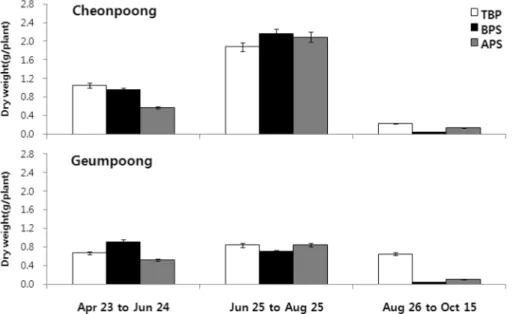
인삼의 지하부 건물생산능력을 조사한 인삼뿌리의 건물축적량 은 Fig. 7 과 같은데 , 지상부와는 정반대로 4 월 ~6 월 하순의 생 육초기에 비교해 7 월 ~8 월 하순의 생육중반기에 현저히 높게 나타났으며 , 그 이후 생육후반기에는 건물축적량이 거의 미미 하였다 . 인삼뿌리의 건물축적량은 품종간에는 현저한 차이를 보였으나 해가림 자재간에는 뚜렷한 경향을 나타내지 않았으 며 , 생육시기에 따라 해가림 자재의 효과가 다르게 나타나 인
삼의 수량 및 품질성과 연결되는 동화산물과 2 차 대사산물들 의 전류 및 생합성 과정 등에 대한 연구들이 앞으로 더 이루 어져야 할 것으로 본다 .
해가림 유형 및 품종별 논에서 재배된 3 년근 인삼의 수량을 조사한 결과는 Fig. 8 과 같다 . 인삼의 수량은 해가림 자재 및 품종별로 뚜렷한 차이를 보였으며 , 해가림 자재간에는 차광망
이 가장 높은 수량을 보였고 은박차광판에서 가장 낮은 수량 을 보였다 . 해가림 유형에 따라서 인삼의 지상부의 생육특성 조사결과들은 큰 차이가 보이지 않았지만 , 인삼의 수량은 해 가림 유형별로 유의적인 차이를 보이며 차광망에서 높게 나온 것은 인삼의 동체뿐만 아니라 세근의 생육 및 동화산물의 전 류가 차광지나 은박차광판에 비하여 왕성하였기 때문으로 판 단된다 . 품종간의 수량은 천풍이 금풍보다 현저하게 높은 단
보당 수량을 보여 해가림과 마찬가지로 품종간에도 생산성의
차이가 크게 나타났다 . 이러한 연구결과는 토양의 배수관리 및
품종에 따라 수량의 차이가 있다 (Lee et al. , 2009a) 는 연구
Fig. 6.Increments of dry weights for certain growth period on
leaves of two ginseng cultivars grown with three different
shading nets. The error bars represent the standard
deviation. (TBP : Three-layered blue and one-layered
black polyethylene net, BPS : Blue polyethylene sheet,
APS : Aluminium-coated polyethylene sheet)
내용과 일치하는 점이 많이 있지만 은박차광판이 차광망에 비 하여 광합성 속도와 기공전도도 및 인삼 잎의 엽록소 함량이 높아서 인삼 생육에 유리할 것으로 사료된다 (Won et al. ,
2008) 는 연구내용과 다르게 차광망에서 높은 수량을 보이는
결과가 나와 앞으로 해가림 유형에 따른 인삼의 광 생리연구 와 관련된 품종간의 생산성과 품질성과 연계되는 연구가 더 이루어져야 한다고 판단된다 .
감사의 글
본 연구는 2009 년도 충북대학교 학술연구지원사업의 연구
지원에 의하여 수행되었으며 이에 감사드린다 .
LITERATURE CITED
Cho DH, Park KJ, Yu YH, Oh SH and Lee HS.
(1995). Root- rot development of 2-year old ginseng(Panax ginseng C.A.Meyer) caused by Cylindrocarpon destructans(Zinssm.) Scholten in the continuous cultivation field. Journal of Ginseng Research.
19:175-180.
Jo JS, Kim CS and Won JY.
(1996). Crop rotation of the Korean ginseng(Panax ginseng C. A. Meyer) and the rice in paddy field. Korean Journal of Medicinal Crop Science. 4:19-26.Kang SW, Yeon BY, Hyeon GS, Bae YS, Lee SW and Seong NS.
(2007). Changes of soil chemical properties and root injury ratio by progress years of post-harvest in continuous cropping soils of ginseng. Korean Journal of Medicinal Crop Science.15:157-161.
Fig. 7.
Increments of dry weights for certain growth period on tap roots of two ginseng cultivars grown with three different shading nets.
The error bars represent the standard deviation. (TBP : Three-layered blue and one-layered black polyethylene net, BPS : Blue polyethylene sheet, APS : Aluminium-coated polyethylene sheet)
Fig. 8.
Yield of Cheonpoong and Geumpoong Ginseng cultivars grown with three different shading net. The error bars represent the
standard deviation. (TBP : Three-layered blue and one-layered black polyethylene net, BPS : blue polyethylene sheet, APS :
aluminium-coated polyethylene sheet)
Kang SW, Lee SW, Hyun DY, Yeon BY, Kim YC and Kim YC.
(2010). Studies on selection of adaptable varieties in paddy-field of ginseng culture. Korean Journal of Medicinal Crop Science. 18:416-420.Kwon WS, Lee JH, Kang JY, Kim YT and Choi KT.
(1994).Red ginseng quality of Jakyungjong and Hwangsookjoong in
Panax ginseng C. A. Meyer. Korean Journal of Breed. 26:400-
Kwon WS, Chung CM, Kim YT, Lee MG and Choi KT.
404.(1998). Breeding process and characteristics of KG101, a superior line of Panax ginseng C. A. Meyer. Journal of Ginseng Research. 22:11-17.
Kwon WS, Lee MG and Choi KT.
(2000). Breeding process and characteristics of Yunpoong, a new variety of Panax ginseng C.A. Meyer. Journal of Ginseng Research. 24:1-7.
Lee CH, Shim SC, Park H and Han KW.
(1980). Distribution and relation of mineral nutrients in various parts of Korea ginseng(Panax ginseng C.A. Meyer). Korean Journal of Medicinal Crop Science. 4:55-64.Lee IH, Kim MS, Park CS, Byen JS and Oh SH.
(1995).Studies on the ginseng cultivated in paddy field. Ginseng Research Annual Report. Korean Ginseng Research Institute Press. Daejeon, Korea. p. 299-317.
Lee SW, Kang SW, Kim DY, Seong NS and Park HW.
(2004).Comparison of growth characteristics and compounds of ginseng cultivated by paddy and upland cultivation. Korean Journal of Medicinal Crop Science. 12:10-16.
Lee SW, Hyun DY, Park CG, Kim TS, Yeon BY, Kim CG and Cha SW.
(2007a). Effects of soil moisture content on photosynthesis and yield of ginseng seedling in Yangjikseedbed cultivation. Korean Journal of Medicinal Crop Science.
15:367-370.
Lee SW, Kim GS, Lee MJ, Hyun DY, Park CG, Park HK and Cha SW.
(2007b). Effect of blue and yellow polyethylene shading net on growth characteristics and ginsenoside contents in Panax ginseng C. A. Meyer. Korean Journal of Medicinal Crop Science. 15:194-198.Lee SW, Kim GS, Yeon BY, Hyun DY, Kim YB, Kang SW and Kim YC.
(2009a). Comparison of growth characteristics and ginsenoside contents by drainage classes and varieties in 3-year- old ginseng(Panax ginseng C. A. Meyer). Korean Journal of Medicinal Crop Science. 17:346-351.Lee SW, Kim GS, Hyun DY, Kim YB, Yeon BY, Kang SW and Kim YC.
(2009b). Comparison of growth characteristics and ginsenoside contents of 3-year-old ginseng(Panax ginseng C. A.Meyer) by drainage class and shade material in paddy soil.
Korean Journal of Crop Science. 54:390-396.
Lee SW, Kim GS, Hyun DY, Kim YB, Kang SW and Cha SW.
(2010). Effects of spraying lime-bordeaux on yield, ginsenoside, and 70% ethanol extract contents of 3-year-old ginseng in
Panax ginseng C. A. Meyer. Korean Journal of Medicinal Crop Science. 18:244-247.
Mok SK, Cheon SK, Lee SS and Lee TS.
(1994). Effect of shading net colors on the growth and saponin content of Korean ginseng(Panax ginseng C. A. Meyer). Journal of Ginseng Research. 18:182-186.Won JY, Lee CY, Oh DJ and Kim SM.
(2008). Changes of chlorophyll fluorescence and photosynthesis under different shade materials in Korea ginseng(Panax ginseng C. A. Meyer).Korean Journal of Medicinal Crop Science. 16:416-420.