Jour. Petrol. Soc. Korea Vol. 21, No. 2, p. 235~247, 2012
우리나라 상부암석권 맨틀: 페리도타이트 포획암으로부터의 고찰
최성희*
충남대학교 자연과학대학 지질환경과학과
Lithospheric Mantle beneath the Korean Peninsula: Implications from Peridotite Xenoliths in Alkali Basalts
Sung Hi Choi*
Department of Geology & Earth Environmental Sciences, Chungnam National University, Daejeon 305-764, Korea
요 약: 우리나라 백령도, 제주도, 보은, 아산, 평택, 간성일대에는 맨틀 페리도타이트들이 알칼리 현무암류에 포획되어 온 형태로 분포하고 있다. K-Ar 전암연대측정 자료에 의하면 이들 화산암류는 약 0.1-18.9 Ma에 분 출하였다. 페리도타이트의 광물조합은 감람석-사방휘석-단사휘석-첨정석이며, 함수광물이나 석류석이 보고된 바 는 없다. 암석의 종류는 레어조라이트에서 하즈버가이트에 걸쳐있다. 감람석은 Fo88.4-92.0이고, 단사휘석은 투휘 석, 사방휘석은 엔스터타이트가 풍부하며, 첨정석은 Cr이 풍부하다(Cr# = 7.8-53.6). 주성분 원소함량에 의하면 이들 페리도타이트는 부화된 중앙해령현무암 근원 맨틀로부터 대략 26%까지의 부분용융을 겪은 후에 남은 잔류물로 추정된다. 그러나 맨틀에서의 이차적인 변성교대작용의 흔적이 미량원소의 함량에 기록되어 있는 경 우도 있다. 양휘석 지온계에 의하면 우리나라 페리도타이트 포획암의 평형온도는 대략 850-1050oC 범위이다.
Sr-Nd 동위원소비는 결핍된 중앙해령현무암의 근원맨틀 성분(DMM)에서부터 지구전암(BSE) 성분 값까지 넓 은 범위에 걸쳐있어, 오랜 시간의 성장과 진화의 역사를 대변하고 있다. Sr-Nd-Pb 동위원소비에 의하면 우리 나라 암석권 맨틀은 대개 맨틀 단성분 중 DMM과 EM2의 혼합으로 설명되며, 상부 대륙지각과 연계될 수 있는 남북 내지는 동서방향으로의 지역성을 기록하고 있지는 않다. 이는 동아시아의 신생대후기 판내부기원 현무암류들이 기록하고 있는 남북간의 이분성과는 매우 대조적인 것으로, 동아시아 연약권 맨틀의 지역성을 시사하고 있다. Os 모델연대에 기초하면 우리나라 암석권 맨틀이 연약권으로부터 분리된 시기는 약 1.8-1.9 Ga 로 추정된다.
핵심어: 암석권 맨틀, 페리도타이트, Sr-Nd-Pb-Os 동위원소
Abstract: Peridotite xenoliths hosted by alkali basalts from South Korea occur in Baengnyeong Island, Jeju Island, Boeun, Asan, Pyeongtaek and Ganseong areas. K-Ar whole-rock ages of the basaltic rocks range from 0.1 to 18.9 Ma. The peridotites are dominantly lherzolites and magnesian harzburgites, and the constituent minerals are Fo-rich olivine (Fo88.4-92.0), En-rich orthopyroxene, Di-rich clinopyroxene, and Cr- rich spinel (Cr# = 7.8-53.6). Hydrous minerals, such as pargasite and phlogopite, or garnet have not been reported yet. The Korean peridotites are residues after variable degree of partial melting (up to 26%) and melt extraction from fertile MORB mantle. However, some samples (usually refractory harzburgites) exhibit metasomatic enrichment of the highly incompatible elements, such as LREE. Equilibration temperatures estimated using two-pyroxene geothermometry range from ca. 850 to 1050oC. Sr and Nd isotopic compositions in clinopyroxene separates from the Korean peridotites show trends between depleted MORB-like mantle (DMM) and bulk silicate earth (BSE), which can be explained by secondary metasomatic overprinting of a precursor time-integrated depleted mantle. The Korean peridotite clinopyroxenes define mixing trends between DMM and EM2 end members on Sr-Pb and Nd-Pb isotopic correlation diagrams, without any corresponding changes in the basement. This is contrary to what we
*Corresponding author Tel: 042-821-6428 E-mail: [email protected]
observe in late Cenozoic intraplate volcanism in East Asia which shows two distinct mantle sources such as a DMM-EM1 array for NE China including Baengnyeong Island and a DMM-EM2 array for Southeast Asia including Jeju Island. This observation suggests the existence of large-scale two distinct mantle domains in the shallow asthenosphere beneath East Asia. The Re-Os model ages on Korean peridotites indicate that they have been isolated from convecting mantle between ca. 1.8 and 1.9 Ga.
Key word: Peridotite xenolith, Lithospheric mantle, Sr-Nd-Pb-Os isotope, Korean peninsula
서 론
암석권 맨틀(lithospheric mantle)은 판(plate)의 일 부로 대류하는 연약권(asthenosphere)으로부터 물리적 으로, 화학적으로 또 열적으로 분리되어 있는 지각의 뿌리를 이루는 공간이다. 물리적으로는 강체이며, 화 학적으로는 연약권의 부분용융으로 생성된 액(분출하 여 지각을 생성)을 분리하고 남은 잔류물(residue)로, 또 열적으로는 맨틀 단열선(adiabat)인 약 1280oC 이 하의 공간으로 간주된다(Nixon, 1987; Takahashi, 1990; Thompson, 1992). 성인적으로 지각에 대응하 는 부분인 만큼, 암석권 맨틀의 구조, 성분 및 진화 과정을 이해하는 것은 지각의 성장과정을 이해하는 것과 밀접한 관련이 있다. 특히, 대륙지각하부의 암석 권 맨틀(sub-continental lithospheric mantle, SCLM) 은 시생대이래로 지각이 생성되고 성장한 역사를 보 완적으로 기록하고 있으며, 오랜 시간동안 대류하는 연약권으로부터 분리되어 있어서 지구화학적으로 고 유한 영역으로 성장해 있는 경우가 많다(e.g., Fei et al., 1999). 판구조운동은 섭입과정을 통하여 해양지각 하부의 암석권 맨틀을 연약권으로 재순환시킨다.
SCLM의 경우도 대륙분열에 의해, 또는 엽렬(delami- nation)에 의해 부분적으로 연약권으로 재순환할 수 있다(e.g., McKenzie and O'Nions, 1983; Gao et al., 2002; O'Reilly et al., 2009). 그러므로 암석권 맨틀의 본성을 이해하는 것은 현재 논란의 대상이 되 고 있는 맨틀의 불균질성(mantle heterogeneity)을 위 시한 맨틀 동력(dynamics)을 이해하는데 있어 결정적 인 정보를 제공할 수 있다.
암석권 맨틀 시료를 확보할 수 있는 방법에는 크게 두 가지가 있다. 하나는 조산대 페리도타이트 암괴 (orogenic peridotite massif)의 형태로 지구조적으로 지표면에 노출되어 있는 경우이며(e.g., Menzies and Dupuy, 1991), 다른 하나는 알칼리현무암류나 킴벌라 이트(kimberlite) 화산암내에 포획되어 온 경우이다 (Nixon, 1987). 페리도타이트 암괴의 경우 노두 규모
는 수 km에 달하기도 한다. 그러므로 큰 규모에서의 암상변화나 구조연구 등이 가능하다는 장점이 있다.
맨틀 포획암은 대개 크기가 수 cm 규모로 비교적 작 다. 그러나 마그마에 의해 매우 빠른 속도로 지표로 이동하기 때문에 저온저압 환경에서의 재평형 정도가 조산대 페리도타이트 암괴에 비해 미약하다는 장점을 가지고 있다.
우리나라의 경우, 초염기성 암괴(ultramafic massif) 가 홍성일대, 안동, 울산 등지에서 소규모 렌즈상(약 1 km 길이)으로 산출되나, 대개 상당한 정도의 사문 암화 작용과 이차 변성작용을 겪은 것으로 보고되었 다(Oh et al., 2010, Kim et al., 2011). 맨틀 포획 암의 경우는 백령도, 간성일대, 아산-평택지역, 보은 및 제주도 등지에서 신생대 후기 알칼리현무암류내에 포획되어 있다(김윤규 외, 1988; 윤성효 외, 1998; 신 홍자 외, 2006; 양경희 외, 2009; Lee, 1996; Arai et al., 2001; Choi et al., 2005; Kil, 2006; Lee and Walker, 2006) (Fig. 1). 암편들은 대개 상당히 신선 하여 맨틀에서의 지질역사를 잘 간직하고 있다. 본 연구에서는 우리나라 페리도타이트 포획암에 대한 광 물성분, 전암 주/부성분 및 Sr-Nd-Pb 동위원소 성분 을 보고한 그 동안의 연구들을 종합하였다. 연구의 목적은 현재까지 밝혀진 우리나라 암석권 맨틀의 생 성과 진화과정을 이해하고, 향후 연구방향을 모색하 는 것이다.
산출양상 및 암석학적 기재
우리나라에서 맨틀 포획암이 산출되는 지역은 백령 도, 간성일대, 아산-평택지역, 보은(조곡리) 및 제주도 (신산리, 산굼부리, 선흘리, 낙천동, 송악산, 지그리오 름) 등지 이다(Fig. 1). 이 중, 제주도와 백령도에서의 산출빈도가 비교적 높은 편이다. 포획해 온 현무암은 알칼리현무암과 바사나이트(basanite)로서, K-Ar 전암 연대측정 자료에 의하면 분출연대는 0.1-18.9 Ma에 걸쳐있다(신홍자 외, 2006; Arai et al., 2001; Choi
우리나라 상부암석권 맨틀: 페리도타이트 포획암으로부터의 고찰 237
et al., 2006). 포획암편의 크기는 대략 수 cm 이지만, 최대 30 cm에 달하는 경우도 있다(e.g., Choi and Kwon, 2005). 모양은 아각형에서 타원형까지 다양하 다. 포획해 온 현무암과의 반응연(reaction rim)은 대 개 포획암의 가장자리로부터 1 mm 이내로 매우 제한 적이다(Choi et al., 2001; Choi and Kwon, 2005).
맨틀 포획암을 구성하는 광물은 감람석, 사방휘석, 단사휘석 및 첨정석이며, 현재까지 함수광물(각섬석, 금운모)이나 석류석이 보고된 바는 없다. IUGS 분류 법에 의하면, 암종은 주로 레어조라이트(lherzolite)에 서 일부 하즈버가이트(harzburgite)에 걸쳐있는 페리도 타이트이다(Fig. 2). 광물 모드비(modal proportion)는 감람석이 40-83%, 사방휘석이 14-32%, 단사휘석이 2- 23%, 첨정석이 0.4-6%이다(김윤규 외, 1988; 길영우와 이석훈, 2005; 신홍자 외, 2006; 양경희 외, 2009;
유재은 외, 2011; Choi et al., 2002; Choi and Kwon, 2005). 레어조라이트에서 하즈버가이트로 갈수록 단사
휘석의 상대적 함량은 감소하고 감람석의 함량은 증 가한다. 제주도와 백령도의 경우, 지역간 암상분포 차 이는 없다(Fig. 2). 그러나 현재까지 아산-평택과 보은 지역에서 하즈버가이트 암편이 보고된 바는 없다. 아 마도 산출규모가 제한적이기 때문일 것으로 사료된다.
광물의 크기는 대략 장경 1-5 mm이며, 감람석과 사방휘석이 단사휘석과 첨정석에 비해서 비교적 큰 편 이다(김윤규 외, 1988; 신홍자 외, 2006; Choi et al., 2001; Choi and Kwon, 2005). Mercier and Nicolas (1974) 분류법에 의하면, 우리나라 페리도타이트 포획 암은 대개 원생입상조직(protogranular)을 보인다(신홍 자 외, 2006; Lee, 1996; Choi et al., 2001; Choi and Kwon, 2005). 그러나 등립상조직(equigranular texture) 이나 잔쇄반상조직(porphyroclastic texture)을 보이는 경우도 있다(김윤규 외, 1988; 길영우와 이석훈, 2005;
양경희 외, 2009; Lee, 1996).
Fig. 1. Simplified geological map of the Korean peninsula with mantle xenolith locations (after Chough et al., 2000;
Kim et al., 2000; Ree et al., 2001). IB = Imjingang Belt; GM = Gyeonggi Massif; OFB = Okcheon Fold Belt; TB = Taebaeksan Basin; YM = Yeongnam Massif; GB = Gyeongsang Basin.
광물화학
페리도타이트를 구성하는 광물조합은 Fo가 많은 감 람석, 엔스터타이트와 투휘석이 풍부한 휘석 및 Cr이 풍부한 첨정석으로 요약할 수 있다.
감람석은 Fo88.4-92.0로 매우 제한적인 성분 범위를 가 진다(그림 3a). 지역적으로 Fo 값은 제주도(88.6-91.9), 백령도(88.4-92.0), 아산-평택(89.2-90.5), 보은(89.1-90.3), 간성(90.0-90.2)으로 큰 차이가 없다(그림 3a).
사방휘석은 엔스터타이트가 풍부하며 Wo1-3En87-
93Fs6-12 성분 범위를 가진다[제주도(Wo1-2En88-93Fs6-9), 백령도(Wo1-2En88-91Fs8-11), 아산-평택(Wo1-3En88-91Fs8-10), 보은(Wo1-3En87-90Fs9-12), 간성(Wo1En89Fs10)] (김윤규 외, 1988; 양경희 외, 2009; 유재은 외, 2011; Lee, 1996; Arai et al., 2001; Choi et al., 2001; Choi and Kwon, 2005; Kil, 2006, 2007). Mg# (=100Mg/
(Mg+Fe)는 대략 88.4-92.2 범위이다[제주도(88.4-92.2), 백령도(89.6-91.7), 아산-평택(89.6-92.0), 보은(88.5-90.7), 간성(90.1-90.4)]. Al2O3의 함량은 1.8-5.4 wt%이다[제 주도(2.1-4.6), 백령도(1.8-4.4), 아산-평택(3.9-5.1), 보은
(3.8-5.4), 간성(4.0-4.1)].
단사휘석은 투휘석이 풍부하며 Wo42-50En46-52Fs1-6성 분 범위를 가진다[제주도(Wo46-50En48-51Fs1-5), 백령도 (Wo45-49En47-51Fs3-5), 아산-평택(Wo42-47En48-52Fs4-6), 보 은(Wo45-48En46-50Fs5-6), 간성(Wo48En47Fs5)] (김윤규 외, 1988; 양경희 외, 2009; 유재은 외, 2011; Lee, 1996;
Arai et al., 2001; Choi et al., 2001; Choi and Kwon, 2005; Kil, 2006, 2007). Mg#는 88.4-94.1 범위이다 [제주도(88.4-92.5), 백령도(90.0-94.1), 아산-평택(89.7- 92.3), 보은(90.8-91.5), 간성(90.1-91.2)]. Al2O3의 함 량은 3.2-7.6 wt%이다[제주도(3.2-6.5), 백령도(2.2- 6.5), 아산-평택(4.0-7.4), 보은(5.4-7.6), 간성(5.2-5.9)].
첨정석의 Cr# (=100Cr/(Cr+Al))는 약 7.8-53.6 범 위이다[제주도(10.2-53.6), 백령도(7.8-50.3), 아산-평택 (8.6-24.7), 보은(8.5-12.5), 간성(10.9-11.2)] (Fig. 3).
감람석의 Fo 함량대 첨정석의 Cr# 상관도에서 우 리나라 페리도타이트는 Arai (1994)가 정의한 맨틀영 역 내에 도시된다(Fig. 3a). 비교를 위해서 중앙해령 에서 준설한 심해저 페리도타이트(abyssal peridotite)와 섭입대 상부판 기원의 페리도타이트(supra-subduction Fig. 2. Modal proportions of peridotites from South Korea. Data sources (Kim et al., 1988; Choi et al., 2002, 2005;
Choi and Kwon, 2005; Kil and Lee, 2005; Kil, 2006, 2007; Shin et al., 2006; Yang et al., 2009; Yu et al., 2011).
OL = olivine; OPX = orthopyroxene; CPX = clinopyroxene.
우리나라 상부암석권 맨틀: 페리도타이트 포획암으로부터의 고찰 239
zone peridotite)의 영역을 그림 3a에 함께 도시하였 다. 우리나라 시료는 심해저 페리도타이트 영역에 도 시된다. 첨정석의 Mg#와 Cr#는 부의 상관관계를 보 이며, 심해저 페리도타이트 기원 첨정석 영역 내에 도시된다(Fig. 3b).
전암화학
우리나라 페리도타이트 전암의 Mg#는 87.8-91.4 범위이다(김윤규 외, 1988; 윤성효 외, 1998; Choi et al., 2002, 2005). 페리도타이트의 전암화학 성분 중 대표적인 MgO, CaO 및 Al2O3 함량의 상관관계 를 Fig. 4에 나타내었다. 비교를 위하여 시원적 맨틀 성분과 대표적인 시생대 Kaapvaal 대륙강괴 기원 및 심해저 페리도타이트의 평균값을 함께 도시하였다. 세 계적인 첨정석 페리도타이트 포획암에 대하여 Maalφe and Aoki (1977)가 집계한 추세선(best-fit line)도 추 가하였다. 우리나라 페리도타이트의 성분은 넓은 범
위에 걸친 변화폭을 가지며, MgO 함량이 증가할수록 CaO와 Al2O3 함량은 감소하는 경향을 보인다. 성분 함량과 변화 경향은 Maalφe and Aoki (1977)의 추세 선을 따라서 분포한다. 그러나 시원적 맨틀에 비해서 MgO의 양은 많고, CaO와 Al2O3의 양은 적다. 페리 도타이트내 MgO의 함량은 현무암질 액을 제거한 정 도, 즉 결핍정도에 대한 지수로 사용된다. 이러한 특 징들에 비추어 우리나라 암석권 맨틀은 시원적 맨틀 로부터 부분용융 액을 제거하고 남은 잔류물인 것으로 해석된다. MgO가 증가할수록 TiO2, MnO 및 N2O는 감소하는 경향을 보여 위의 사실을 뒷받침한다(Choi et al., 2002, 2005). 특히, 레어조라이트에 비해 하즈 버가이트 쪽의 MgO 함량이 높아서 하즈버가이트가 보다 결핍된 맨틀암석임을 지시한다. 그러나 우리나 라 페리도타이트는 심해저나 Kaapvaal 대륙강괴기원 페리도타이트에 비해서는 대체적으로 MgO 함량이 적 고, CaO와 Al2O3 함량이 많다(Fig. 4). 그러므로 평균 적인 해양 암석권 맨틀이나 시생대 암석권 맨틀에 비 Fig. 3. Plots of (a) 100Cr/(Cr+Al) of spinel and Fo content of coexisting olivine, and (b) spinel quad. Ferrous iron in spinel was calculated on the basis of stoichiometry. Olivine-spinel mantle array and melting trend (annotated by partial melting %) are from Arai (1994). Data sources: Korean peridotites (Kim et al., 1988; Lee, 1996; Choi et al., 2001, 2005; Choi and Kwon, 2005; Kil and Lee, 2005; Kil, 2006, 2007; Shin et al., 2006; Kil et al., 2008; Yang et al., 2009; Yu et al., 2011); abyssal peridotites (Dick and Bullen, 1984); supra-subduction zone peridotites (Ishii et al., 1992; Parkinson and Pearce, 1998; Pearce et al., 2000). FMM = fertile mid-ocean ridge basalt mantle.
해서는 결핍정도가 적은 편이다.
첨성석의 Cr# 역시 페리도타이트의 결핍정도에 대 한 지시자의 역할을 한다(Dick and Bullen, 1984;
Arai, 1994). 즉, Cr#가 높을수록 보다 결핍된 맨틀에 해당한다. Fig. 3a에 부분용융의 정도에 따른 Cr#의 변화방향을 나타내었다. Cr#에 기초하면, 우리나라 페 리도타이트는 부화된 중앙해령현무암 근원 맨틀로부 터 대략 26%까지의 부분용융을 겪은 후에 남은 잔류 물의 영역에 점시된다.
미량원소 지구화학
페리도타이트내 Ni (1825-2669 ppm), Cr (1584- 3727 ppm), Co (88-122 ppm), Sc (1-15 ppm) 등은 비교적 함량이 높은 편이다(김윤규 외, 1988; Choi et al., 2002, 2005). 이 중에서 감람석에 대한 분배 계수가 큰 Ni과 Co의 함량은 MgO가 증가할수록 증 가하며, 단사휘석에 대한 상대적 분배계수가 더 큰 Cr과 Sc의 함량은 감소한다(Choi et al., 2002, 2005).
이러한 경향은 맨틀의 부분용융 정도가 증가할수록 잔류물내 단사휘석의 모드비는 감소하며 감람석의 비 는 상대적으로 증가한다는 관찰 사실과도 일치한다.
페리도타이트 내 희토류원소의 함량은 대개 1 ppm 이하이다. 무수(anhydrous) 첨정석 페리도타이트 광물 조합 중에서 희토류원소의 대부분을 가지고 있는 광
물은 단사휘석이다(Rampone et al., 1991; Roden and Shimizu, 1993). 그러므로 대개 단사휘석의 희토 류원소 패턴(rare earth element pattern)이 전암 페리 도타이트의 패턴을 대변한다고 볼 수 있다(e.g., Song and Frey, 1989). 현재까지 보고된 우리나라 페리도타 이트 내 단사휘석의 희토류원소 패턴을 Fig. 5에 정 리하였다. 단사휘석에 대한 분배계수는 경희토류원소 (LREE, light rare earth element)에 비해 중희토류원 소(HREE, heavy rare earth element) 쪽이 높다(Frey et al., 1978). 그러므로 부분용융이 진행될수록 잔류하 는 단사휘석의 희토류원소 함량은 경희토류원소에 결 핍되고 중희토류원소에 농집되는 경향을 띤다. 우리 나라 페리도타이트내 단사휘석들은 대개 LREE에 결 핍된 패턴을 보인다. 그러나 일부의 시료에서는 La이 부화된 숟가락 형태나 또는 완전히 LREE에 부화된 패턴을 보이기도 한다. 특히 부화정도는 HREE 함량 이 적은 단사휘석들(즉, 보다 결핍된 맨틀기원) 일수 록 강하다(Fig. 5). 이런 관찰 사실은 페리도타이트 암석들이 맨틀에서의 부분용융후 잔류물이라는 주장 과 위배된다. 그러나 이는 세계 여러 곳의 페리도타 이트에서 관찰되는 일반적인 경향으로서, Frey and Green (1974)을 위시하여 대개의 연구자들은 이를 이 차적인 변성교대작용의 흔적으로 해석한다(Frey and Prinz, 1978; Shi et al., 1998; Choi et al., 2005, 2008). 즉, 연약권이나 암석권맨틀 하부에서 생성된 Fig. 4. Whole-rock major element concentrations for peridotite xenoliths from South Korea. The broken lines are the best-fit lines for spinel lherzolite xenoliths elsewhere from Maalφe and Aoki (1977). Data sources: Korean peridotites (Kim et al., 1988; Yun et al., 1998; Choi et al., 2002; Yang and Hwang, 2005; Choi et al., 2005);
average abyssal peridotite (Boyd, 1989); average Kaapvaal peridotite (Boyd, 1989); primitive mantle (Palme and Nickel, 1985; McDonough, 1990 and references therein).
우리나라 상부암석권 맨틀: 페리도타이트 포획암으로부터의 고찰 241
소량의 유체가 상부로 이동하는 도중 주변 암석과 반 응한 흔적이라는 것이다. 변성교대작용의 근원물질로 는 알칼리가 풍부한 규산염멜트, CO2± H2O가 풍부 한 유체, 카보나타이트(carbonatite) 또는 섭입판기원 함수멜트(Green and Wallace, 1988; Yaxley et al., 1998; Zhang et al., 2000; Grégoire et al., 2001)등 이 거론된다. Choi et al. (2005)은 우리나라 페리도 타이트내 단사휘석과 평형인 멜트 성분을 계산하여 변성교대작용의 매체로 제주도는 알칼리 현무암질 멜 트, 백령도는 카보나타이트, 보은은 함수규산염 멜트 임을 주장하였다. 변성교대작용의 정도가 증가하면 그 매체의 종류에 따라 각섬석, 금운모, 인회석, 저어콘, 금홍석, 티탄철석 등의 이차광물을 생성하기도 한다 (Menzies and Hawkesworth, 1987). 그러나 우리나 라 페리도타이트에서 이러한 이차광물의 존재를 보고 한 사례는 없다. 변성교대작용의 흔적이 구성광물내 미량원소의 함량에만 일부 남아있는 경우를 Dawson (1984)은 은닉변성교대작용(cryptic metasomatism)이 라고 정의하였다. 결핍된 맨틀암편일수록 액상친화적 인 원소들(예, LREE)의 함량이 적으므로 상대적으로
변성교대작용의 영향을 받기 쉽다.
평형 온도-압력 측정
첨정석 페리도타이트의 광물조합에 적용할 수 있는 지온계는 매우 다양하다. 보편적으로 이용되는 것에는 (1) 양휘석 지온계(Wells, 1977; Bertrand and Mercier, 1985; Brey and Köhler, 1990)와 (2) 사방휘석-첨정석 간의 Cr-Al 분배에 기초한 지온계(Sachtleben and Seck, 1981; Witt-Eickschen and Seck, 1991)를 들 수 있다. 위의 지온계를 활용하여 우리나라 페리도타 이트의 평형온도를 계산하면, 모델간의 편차는 있으 나 대략 ±50oC 범위에서 일치한다(신홍자 외, 2006;
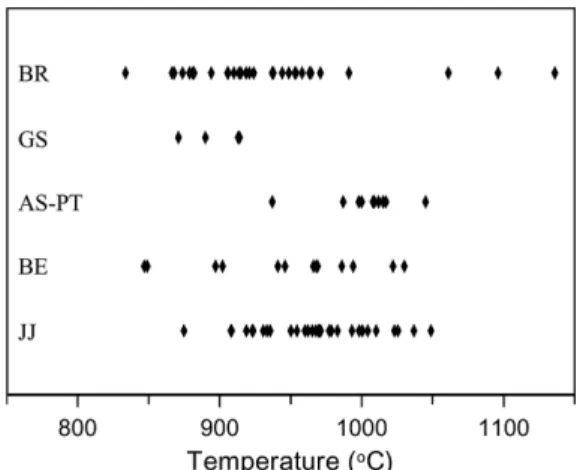
Lee, 1996; Choi et al., 2001; Choi and Kwon, 2005; Kil, 2007). Brey and Köhler (1990)의 모델을 사용하여 측정한 온도결과를 Fig. 6에 정리하였다. 이 모델의 신뢰도는 ±20oC이다. 우리나라 페리도타이트 포획암의 평형온도는 대략 850-1050oC 범위이다. 레 어조라이트와 하즈버가이트 간의 주목할 만한 온도편 차는 발견되지 않는다(Choi et al., 2001; Choi and Fig. 5. Rare earth element patterns, normalized to chondrite values (Sun and McDonough, 1989), for clinopyroxenes separated from peridotite xenoliths. Data sources: Arai et al., 2001; Choi et al., 2002, 2005; Kil, 2006, 2007; Shin et al., 2006.
Kwon, 2005). 지역적으로는 백령도가 제주도 및 아 산-평택 지역에 비해 평균적으로 다소 낮은 온도분포 를 보인다. 중앙값을 비교하면, 아산-평택(1010oC), 제 주도(970oC), 보은(970oC), 백령도(920oC) 순으로 백 령도가 다른 지역에 비해서 대략 50oC 이상 낮다.
간성의 경우는 이용할 수 있는 시료의 개수가 제한적 이므로 통계적 의미는 없다.
지온계의 종류와는 달리 첨정석 페리도타이트에 이 용할 수 있는 지압계는 매우 제한적이다(Lee, 1996).
경험적인 모델인 휘석-지압계(Mercier, 1980)와 감람 석-단사휘석 사이의 Ca 분배를 이용한 지압계(Adams and Bishop, 1982, 1986; Köhler and Brey, 1990)가 있을 뿐이다. Ca 분배를 이용한 지압계의 경우, (1) 감람석내 Ca 함량이 매우 낮아(~0.05 wt%) 측정오차 를 주의해야 한다는 점과, (2) 감람석내 Ca 확산속도 가 휘석에 비해 상당히 빨라서 시료내 평형정도에 민 감하다는 단점이 있다. 첨정석 페리도타이트가 안정 할 수 있는 깊이는 대략 8-25 kb이다(Nickel, 1986;
Webb and Wood, 1986). 첨성석의 Cr#가 높아질수 록 보다 깊은 곳에서 안정할 수 있다(Robinson and Wood, 1998).
양휘석 지온계와 감람석 Ca 지압계를 조합하면, 제 주도의 지온구배는 880oC/13 kb-1040oC/26 kb (Choi et al., 2001)이며, 백령도 쪽은 820oC/7.3 kb-1000oC/
20.6 kb (Choi and Kwon, 2005)이다. 위의 지온구배 를 이용하여 모호면 부근의 온도를 구해보면, 평균적 인 대륙암석권의 전도성 지온구배에 비해 양쪽 모두 상당히 높다. 이러한 결과로부터 적어도 연구시료가 기록하는 범위 내에서는 암석권맨틀 내부에 열적교란 이 있었음을 알 수 있다.
Sr-Nd-Pb 동위원소
단사휘석은 희토류원소 이외에도 무수 첨정석 페리 도타이트 광물조합 중에서 Sr과 Pb의 대부분을 가지 고 있는 광물이다(Choi et al., 2005, and references therein). 결과적으로 단사휘석의 Sr-Nd-Pb 동위원소비 는 전암 페리도타이트의 성분을 대변한다고 볼 수 있 다. 현재까지 보고된 우리나라 페리도타이트내 단사 휘석에 대한 Sr-Nd 및 Pb-Pb 동위원소비의 상관도를 Fig. 7과 8에 나타내었다. 비교를 위해 페리도타이트 를 포획해 온 현무암류, 이론적인 맨틀 단성분들 (DMM, EM1, EM2, HIMU; Zindler and Hart, 1986)의 위치 및 해양현무암류에 기초하여 보고된 맨 틀배열도(mantle array) 등을 함께 도시하였다. 페리도 타이트내 단사휘석의 Sr-Nd 동위원소비는 결핍된 중 Fig. 6. Temperatures estimated using the two-pyroxene
thermometer of Brey and Köhler (1990) for peridotite xenoliths from South Korea. 15 kbar has been used as an input pressure for the temperature estimation.
Data sources: Lee, 1996; Choi et al., 2001; Choi and Kwon, 2005; Kil 2006, 2007; Shin et al., 2006. BR = Baengnyeong Island, GS = Ganseong, AS-PT = Asan- Pyeongtaek, BE = Boeun, JJ = Jeju Island.
Fig. 7. 143Nd/144Nd vs. 87Sr/86Sr isotopic ratios for clinopyroxenes separated from peridotite xenoliths.
For comparison, isotopic compositions of the host basaltic rocks are also shown. Symbols as in Fig. 2.
Error bars are 2σ uncertainties, and are given only where they exceed the size of the symbol in the plot.
Data sources: peridotites (Choi et al., 2005; Kil, 2006, 2007; Shin et al., 2006); host basalts (Choi et al., 2006; Kil, 2006, 2007; Shin et al., 2006). Mantle components and array are from Zindler and Hart (1986) (BSE = bulk silicate Earth, DMM = depleted mantle, EM 1 and 2 = enriched mantle of type 1 and 2, respectively, HIMU = mantle with high U/Pb ratio).
우리나라 상부암석권 맨틀: 페리도타이트 포획암으로부터의 고찰 243
앙해령현무암의 근원맨틀로 추정되는 DMM 단성분 에서부터 지구전암 성분(BSE; bulk silicate earth)에 이르기까지 매우 넓은 범위에 걸쳐있으며, 대체로 맨 틀배열도를 따라 분포한다(Fig. 7). Pb-Pb 동위원소 상관도(Fig. 8)에서도 페리도타이트 단사휘석들은 DMM에서 EM2까지의 단성분 범위에 걸친 변화폭을 가지고 있다. 이와는 대조적으로 페리도타이트를 포 획해 온 현무암류들은 상당히 제한적인 범위의 Sr- Nd-Pb 동위원소비를 가진다(Figs. 7, 8). 특히 현무암 류들이 페리도타이트 단사휘석에 비해 보다 BSE 쪽 으로 치우친 Sr-Nd 동위원소비를 가진다는 사실을 주 목할 만하다(Fig. 7).
토의 및 결언
암석권 맨틀내에 기록된 Sr-Nd-Pb 동위원소비를 결 정하는 인자는 매우 다양하다. 요약하면, 부분용융 정 도에 따른 각 모원소들의 함량(즉, Rb/Sr, Sm/Nd, U/
Pb, Th/Pb비), 연약권으로부터 분리된 시간, 변성교대 작용을 받은 정도, 변성교대작용을 일으킨 인자 및 그 시간 등이 해당된다. Sr-Nd 동위원소비의 경우,
대체로 부분용융 정도가 크고, 연약권으로부터 분리 된 시기가 오래되며, 변성교대작용의 영향이 적을수 록 DMM 단성분 방향의 값을 가진다고 볼 수 있다.
그러므로 넓은 범위에 걸친 변화폭을 가지고 있는 우 리나라 페리도타이트의 동위원소비는 변성교대작용을 포함한 여러 인자들의 복합작용에 의한 것으로 해석 할 수 있다.
우리나라 페리도타이트의 광물성분, 전암성분 및 동 위원소 자료를 검토하면 약간의 지역성은 있는 듯하 다. 우선 이용할 수 있는 시료의 개수가 많은 백령도 와 제주도를 비교하면, 약 50oC 정도의 온도 차이를 볼 수 있다(Fig. 6). 그러나 광물조합, 광물성분 및 전암성분에서는 양자 간의 주목할 만한 차이는 관찰 할 수 없다(Figs. 2-5). 보은, 아산-평택 및 간성의 경 우는 이용할 수 있는 시료의 숫자가 제한적이어서 통 계적인 비교가 어렵기는 하다. 그렇지만 제한적인 자 료를 해석하면, 제주도나 백령도에 비해 보다 낮은 Fo와 Cr#, 전암 MgO 및 단사휘석내 희토류원소의 함량으로 보아 시원적인 맨틀에 보다 가깝다고 볼 수 있다. 그러나 유의미한 해석을 위해서는 향후 더 많 은 시료에 대한 자료확보가 필요하다.
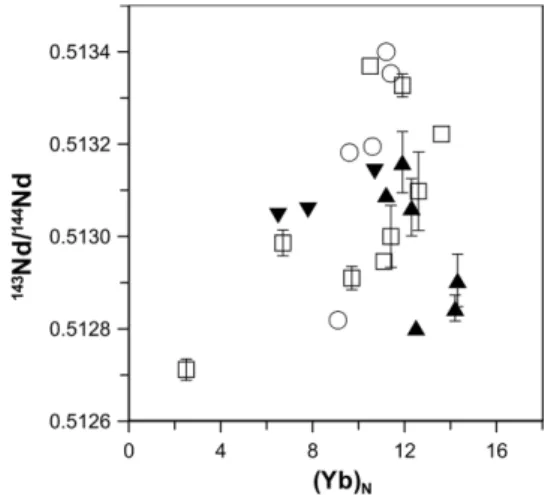
Sr-Nd 동위원소비를 보면, 아산-평택과 보은지역이 백령도나 제주도에 비해 보다 BSE 쪽에 가까운 성분 을 가지고 있어 위의 주장을 뒷받침하는 듯하다(Fig.
7). 그러나 Yb과 143Nd/144Nd비의 상관도(Fig. 9)를 보 Fig. 8. Pb-Pb isotopic compositions for clinopyroxenes
separated from peridotite xenoliths. The fields for host basalts are also shown for comparison. NHRL is the Northern Hemisphere Reference Line of Hart (1984).
Data sources and mantle components as in Fig. 7.
Fig. 9.143Nd/144Nd ratios vs. Yb, normalized to chondrite values (Sun and McDonough, 1989), for clinopyroxenes separated from peridotite xenoliths. Symbols and data sources as in Fig. 7. Error bars are 2σ uncertainties, and are given only where they exceed the size of the symbol in the plot.
면, 대개의 시료들이 양의 상관관계를 보이고 있어 동 위원소성분비가 이차적인 변성교대작용의 영향을 받 았음을 보여준다. 만일 이차적인 영향이 없었다면, Yb 함량이 적은 시료(결핍정도가 큰 시료)가 더 높은
143Nd/144Nd 비를 가질 것으로 기대되기 때문이다. 페 리도타이트내 Os 동위원소는 Sr-Nd-Pb 동위원소와는 달리 변성교대작용과 같은 이차적인 거동에 비교적 안정하다(Shirey and Walker, 1998). Re-Os 모델연 대에 기초하면 우리나라 암석권맨틀이 연약권으로부 터 분리된 시기는 약 1.8-1.9 Ga로 추정된다(Lee and Walker, 2006).
Pb-Pb 동위원소 상관도(Fig. 8)에서, 제주도의 페리 도타이트 단사휘석은 백령도나 보은지역에 비하여 다 소 높은 206Pb/204Pb 동위원소비를 가진다. 그러나 Pb- Sr과 Pb-Nd 동위원소 상관도(Fig. 10)에서 보면, 우 리나라 페리도타이트 단사휘석들은 모두 DMM과 EM2 맨틀 단성분간의 혼합으로 설명할 수 있는 배열 을 보인다. 이러한 경향은 페리도타이트를 포획해 온 현무암들의 특징 즉, 제주도 현무암은 DMM-EM2의 배열을, 백령도는 DMM-EM1의 배열을 보이는 것과 매우 대조적이다(Fig. 10). 비교를 위해서 그림 10에 는 북동중국와 남동중국 현무암류의 동위원소비를 함 께 도시하였다. 비교자료로 사용한 현무암들은 모두 신생대후기에 분출한 것들이며, 대륙지각과의 혼염의
영향을 배제하기 위하여 해양도현무암과 유사한 지 구화학적 특징을 가지거나 또는 맨틀 포획암을 가지 고 있는 시료들을 선정하였다. 흥미롭게도 북동중국 과 남동중국 현무암류는 서로 상반되는 배열 즉, 북 동중국은 DMM-EM1 방향, 남동중국은 DMM-EM2 방향의 배열을 가지고 있다. 백령도 현무암류의 동위 원소 자료는 북동중국 현무암의 영역에 포함되며, 제 주도는 남동중국 현무암의 영역과 겹치면서 보다 EM2 쪽에 치우친 동위원소비를 가진다. 남지나해와 베트남 등지에 분포하는 현무암류 역시 남동중국 현 무암처럼 DMM-EM2의 배열을 보인다(Choi et al., 2006 and references therein). 동아시아 현무암류의 동위원소 성분에서 발견되는 이러한 남북 방향의 지 역성은 매우 흥미로운 주제로서 그 근원맨틀의 기원 은 논쟁의 대상이다(Hoang et al., 1996; Flower et al., 1998; Chung, 1999; Zou et al., 2003; Park et al., 2005; Choi et al., 2006). 요약하자면 부화된 맨 틀의 근원지로 암석권 맨틀(엽렬된 후 재개한 내인성 (endogenous) 암석권 맨틀)을 고려할 것인지, 아니면 연약권 맨틀로 생각할 것인지로 나눌 수 있다. 본 연 구에서 정리한 우리나라 암석권 맨틀에 대한 동위원 소자료로 판단하자면, DMM-EM1 배열을 보이는 백 령도나 북동중국 현무암류가 DMM-EM2 방향의 배 열을 보이는 암석권 맨틀의 부분용융 산물이라고 보 Fig. 10. Sr-Nd-Pb isotopic compositions of clinopyroxenes from peridotite xenoliths. The fields for host basaltic rocks (JJ, Jeju island; BR, Baengnyeong island), late Cenozoic within-plate basaltic rocks from eastern China are also shown for comparison. Data sources for the xenoliths and basalts are from Choi et al. (2005, 2006) and references therein. EM 1 and 2 = enriched mantle of type 1 and 2 (Zindler and Hart, 1986); MORB = mid-ocean ridge basalts.
우리나라 상부암석권 맨틀: 페리도타이트 포획암으로부터의 고찰 245
기는 어렵다. 그러나 현재까지 이용가능한 페리도타 이트 시료는 모두 상부암석권 맨틀 기원이다. 그러므 로 부화된 맨틀의 근원지가 하부 암석권 맨틀일 가능 성은 아직 남아있다. 그러나 연약권과 암석권의 경계 로 갈수록 연약권기원 액에 의한 변성교대작용의 정 도는 증가하고, 결과적으로 양자간의 지구화학적 특 징이 유사해질 것을 감안하면 동아시아 현무암류의 근원맨틀은 대개 연약권에 있다고 보여진다. 따라서 만일 동아시아 상부 연약권이 크게 남북방향의 두 분 역으로 나뉘어져 있다면, 그 성인을 추적하는 일이 향후 연구과제로 남아있다.
사 사
이 연구는 2011년도 충남대학교 학술연구비에 의 해 지원되었습니다. 심사과정에서 건설적인 비평을 해 주신 이한영 박사님과 박준범 박사님께 감사드립니다.
참고문헌
길영우, 신홍자, 윤성효, 고정선, 안웅산, 2008, 제주도 선 흘리 일대에 분포하는 맨틀포획암 내의 광물의 지화학적 특성 연구. 한국광물학회지, 21, 373-382.
길영우, 이석훈, 2005, 백령도와 보은 지역의 상부맨틀암석 내의 단사휘석의 지화학적 특징. 한국광물학회지, 18, 61- 72.
김윤규, 이대성, 송윤구, 김선억, 1988, 보은지역 조곡리 현 무암에 함유된 초염기성 포획암의 암석학. 지질학회지, 24, 57-66.
신홍자, 길영우, 진명식, 이석훈, 2006, 아산, 평택 지역 상 부맨틀 포획암의 암석학적 연구. 지질학회지, 42, 95-113.
양경희, 남복현, 김진섭, Szabó C., 2009, 제주도 현무암에 포획된 세립질 맨틀 페리도타이트 포획암의 조직적 특성.
한국광물학회지, 22, 1-11.
양경희, 황병훈, 2005, 제주도 알칼리 현무암에 산출되는 단사휘석의 기원. 한국광물학회지, 18, 33-43.
유재은, 김선웅, 양경희, 2011, 제주도 맨틀포획암내의 실 리카 부화작용: 모달 교대작용의 증거. 암석학회지, 20, 61-75.
윤성효, 고정선, 안지영, 1998, 제주도 동부 알칼리 현무암 내 스피넬-레졸라이트 포획체의 연구. 자원환경지질, 31, 447-458.
Adams, G.E., Bishop, F.C., 1982, Experimental investigation of Ca-Mg exchange between olivine, orthopyroxene and clinopyroxene: potential for geobarometry. Earth and Planetary Science Letters, 57, 241-250.
Adams, G.E., Bishop, F.C., 1986, The olivine-clinopyroxene geobarometer: experimental results in the CaO-FeO-MgO- SiO2 system. Contributions to Mineralogy and Petrology,
94, 230-237.
Arai, S., 1994, Characterization of spinel peridotites by oli- vine-spinel compositional relationships: review and inter- pretation. Chemical Geology, 113, 191-204.
Arai, S., Kida, M., Abe, N., Yurimoto, H., 2001, Petrology of peridotite xenoliths in alkali basalt (11 Ma) from Boun, Korea: an insight into the upper mantle beneath the East Asian continental margin. Journal of Mineralogical and Petrological Sciences, 96, 89-99.
Bertrand, P., Mercier, J.C., 1985, The mutual solubility of coexisting ortho- and clinopyroxene: toward an absolute geothermometer for the natural system? Earth and Plane- tary Science Letters, 76, 109-122.
Boyd, F.R., 1989, Compositional distinction between oce- anic and cratonic lithosphere. Earth Planetary Science Letters, 96, 15-26.
Brey, G.P., Köhler, T., 1990, Geothermometry in four-phase lherzolite II. New thermometers and practical assessment of existing thermobarometers. Journal of Petrology, 31, 1353-1378.
Choi, S.H., Jwa, Y.-J., Lee, H.Y., 2001, Geothermal gradient of the upper mantle beneath Jeju Island, Korea: Evidence from mantle xenoliths. Island Arc, 10, 175-193.
Choi, S.H., Kwon, S.-T., 2005, Mineral chemistry of spinel peridotite xenoliths from Baengnyeong Island, South Korea, and its implications for the paleogeotherm of the uppermost mantle. Island Arc, 14, 236-253.
Choi, S.H., Kwon, S.-T., Mukasa, S.B., Sagong, H., 2005, Sr-Nd-Pb isotope and trace element systematics of mantle xenoliths from Late Cenozoic alkaline lavas, South Korea.
Chemical Geology, 221, 40-64.
Choi, S.H., Lee, J.I., Park, C.-H., Moutte, J., 2002, Geochem- istry of peridotite xenoliths in alkali basalts from Jeju Island, Korea. Island Arc, 11, 221-235.
Choi, S.H., Muaksa, S.B., Zhou, X.-H., Xian, X.H., Andron- ikov, A.V., 2008, Mantle dynamics beneath East Asia constrained by Sr, Nd, Pb and Hf isotopic systematics of ultramafic xenoliths and their host basalts from Han- nuoba, North China. Chemical Geology, 248, 40-61.
Choi, S.H., Mukasa, S.B., Kwon, S.-T., Andronikov, A.V., 2006, Sr, Nd, Pb and Hf isotopic compositions of late Cenozoic alkali basalts in South Korea: Evidence for mixing between the two dominant asthenospheric mantle domains beneath East Asia. Chemical Geology, 232, 134- 151.
Chough, S.K., Kwon, S.-T., Ree, J.-H., Choi, D.K., 2000, Tectonic and sedimentary evolution of the Korean penin- sula: a review and new view. Earth Science Reviews, 52, 175-235.
Chung, S.-L., 1999, Trace element and isotope characteris- tics of Cenozoic basalts around the Tanlu Fault with implications for the eastern plate boundary between North and South China. Journal of Geology, 107, 301-312.
Dawson, J.B., 1984, Contrasting types of upper-mantle meta- somatism. In: Kornprobst, J. (ed.) Kimberlites II: The man- tle and crust-mantle relationships. Amsterdam: Elsevier, New York, p. 289-294.
Dick, H.H.B, Bullen, T., 1984, Chromian spinel as a petro- genetic indicator in abyssal and alpine-type peridotites and spatially associated lavas. Contributions to Mineral- ogy and Petrology, 86, 54-76.
Fei, Y., Bertka, C.M., Mysen, B.O., 1999, Mantle petrology:
Field observations and high pressure experimentation.
Atribute to Francis R. (Joe) Boyd. The Geochemical Soci- ety Special Publication 6, 322 pp.
Flower, M., Tamaki, K., Hoang, N., 1998, Mantle extrusion:
a model for dispersed volcanism and DUPAL-like asthenosphere in East Asia and the Western Pacific. In:
Flower, M., Chung, S.-L., Lo, C.-H., Lee, T.Y. (eds.), Mantle dynamics and plate interactions in East Asia. Am.
Geophys. Union, Geophys. Monogr., vol. 27, p. 67-88.
Frey, F.A., Green, D.H., 1974, The mineralogy, geochemis- try and origin of lherzolite inclusion in Victorian basani- tes. Geochimica et Cosmocimica Acta, 38, 1023-1059.
Frey, F.A., Green, D.H., Roy, S.D., 1978, Integrated models of basalt petrogenesis: A study of quartz tholeiites to oli- vine melilitites from South Eastern Australia utilizing geochemical and experimental petrological data. Journal of Petrology, 19, 463-513.
Frey, F.A., Prinz, M., 1978, Ultramafic inclusions from San Carlos, Arizona: petrologic and geochemical data bearing on their petrogenesis. Earth and Planetary Science Letters, 38, 129-176.
Gao, S., Rudnick, R.L., Carlson, R.W., McDonough, W.F., Liu, Y.-S., 2002, Re-Os evidence for repalcement of ancient mantle lithosphere beneath the North China cra- ton. Earth and Planetary Science Letters, 198, 307-322.
Green, D.H., Wallace, M.E., 1988, Mantle metasomatism by ephemeral carbonatite melts. Nature, 336, 459-462.
Grégoire, M., McInnes, B.I.A., O’Reilly, S.Y., 2001, Hydrous metasomatism of oceanic sub-arc mantle, Lihir, Papua New Guinea: Part 2. Trace element characteristics of slab-derived fluids. Lithos, 59, 91-108.
Hart, S.R., 1984, A large-scale isotope anomaly in the southern hemisphere mantle. Nature, 309, 753-757.
Hoang, N., Flower, M., Carlson, R.W., 1996, Major, trace, and isotopic compositions of Vietnamese basalts: interac- tion of hydrous EM1-rich asthenosphere with thinned Eurasian lithospere. Geochimica et Cosmochimica Acta, 60, 4329-4351.
Ishii, T., Robinson, P.T., Maekawa, H., Fiske, R., 1992, Pet- rological studies of peridotites from diapiric serpentinite seamounts in the Izu-Ogasawara-Mariana forearc, Leg 125.
In: Proceedings of the ocean drilling program, scientific results 125. Texas A & M University, Ocean Drilling Pro- gram, College Station, pp. 445-485.
Kil, Y.-W., 2006, Characteristics of subcontinental lithos- pheric mantle beneath Baegryeong Island, Korea: Spinel peridotite xenoliths. Island Arc, 15, 269-282.
Kil, Y.-W., 2007, Geochemistry and petrogenesis of spinel lherzolite xenoliths from Boeun, Korea. Journal of Asian Earth Sciences, 29, 29-40.
Kim, J.-N., Ree, J.-H., Kwon, S.-T., Park, Y., Choi, S.-J., Cheong, C.-S., 2000, The Kyeonggi shear zone of the central Korean peninsula: late orogenic imprint of the north and south China collision. Journal of Geology, 108, 469-478.
Kim, S.W., Santosh, M., Park, N., Kwon, S., 2011, Forearc serpentinite mélange from the Hongseong suture, South Korea. Gondwana Research, 20, 852-864.
Köhler, T., Brey, G.P., 1990, Calcium exchange between oli- vine and clinopyroxene calibrated as a geobarometer for natural peridotites from 2 to 60 kb with applications.
Geochimca et Cosmochimica Acta, 54, 2375-2388.
Lee, H.Y., 1996, Petrochemical study of mantle xenoliths in alkali basalts from South Korea: P/T regime of the upper mantle. International Geology Review, 38, 320-335.
Lee, S.R., Walker, R.J., 2006, Re-Os isotope systematics of mantle xenoliths from South Korea: Evidence for com- plex growth and loss of lithospheric mantle beneath East Asia. Chemical Geology, 231, 90-101.
Maalφe, A., Aoki, K., 1977, The major element composition of the upper mantle estimated from the composition of lherzolites. Contributions to Mineralogy and Petrology, 63, 161-173.
McDonough, W.F., 1990, Constraints on the composition of the continental lithospheric mantle. Earth Planetary Sci- ence Letters, 101, 1-18.
McKenzie, D.P., O'Nions, R.K., 1983, Mantle reservoirs and ocean island basalts. Nature, 301, 229-231.
Menzies, M.A., Dupuy, C., 1991, Orogenic massifs: pro- tolith, process and provenance. Journal of Petrology Spe- cial Issue: Orogenic lherzolites and mantle processes, pp.
1-16.
Menzies, M.A., Hawkesworth, C.J., 1987, Mantle metasom- atism. Academic Press Geology Series. 472 pp.
Mercier, J.-C., 1980, Single-pyroxene thermobarometry. Tec- tonophysics, 70, 1-37.
Mercier, J.-C., Nicolas, A., 1974, Textures and fabrics of upper-mantle peridotites as illustrated by xenoliths from basalts. Journal of Petrology, 16, 454-487.
Nickel, K.G., 1986, Phase equilibria in the system SiO2- MgO-Al2O3-CaO-Cr2O3 and their bearing on spinel/garnet lherzolite relationships. N. Jb. Miner. Abh., 155, 259-287.
Nixon, P.H., 1987. Mantle xenoliths. Wiley, UK, 844 pp.
O’Reilly, S.Y., Zhang, M., Griffin, W.L., Begg, G., Hronsky, J., 2009, Ultradeep continental roots and their oceanic remnants: A solution to the geochemical “mantle reser- voir” problem? Lithos, 211S, 1043-1054.
우리나라 상부암석권 맨틀: 페리도타이트 포획암으로부터의 고찰 247
Oh, C.W., Rajesh, V.J., Seo, J., Choi, S.-G., Lee, J.H., 2010, Spinel compositions and tectonic relevance of the Bibong ultramafic bodies in the Hongseong collision belt, South Korea. Lithos, 198-208.
Palme, H., Nickel, K.G., 1985, Ca/Al ratio and compositions of the Earth’s upper mantle. Geochimica et Cosmochim- ica Acta, 49, 2123-2132.
Park, K.-H., Park, J.-B., Cheong, C.-S., Oh, C.W., 2005, Sr, Nd and Pb isotopic systematics of the Cenozoic basalts of the Korean Peninsula and their implications for the Permo-Triassic continental collision boundary. Gondwana Research, 8, 529-538.
Parkinson, I.J., Pearce, J.A., 1998, Peridotites of the Izu- Bonin-Mariana forearc (ODP Leg 125) evidence for man- tle melting and melt-mantle interactions in a suprasubduc- tion zone setting. Journal of Petrology, 39, 1577-1618.
Pearce, J.A., Barker, P.F., Edwards, S.J., Parkinson, I.J., Leat, P.T., 2000, Geochemistry and tectonic significance of peridotites from the South Sandwich arc-basin system, south Atlantic. Contributions to Mineralogy and Petrol- ogy, 139, 36-53.
Rampone, E., Botazzi, P., Ottolini, L., 1991, Complementary Ti and Zr anomalies in orthopyroxene and clinopyroxene from mantle peridotites. Nature, 354, 518-520.
Ree, J.-H., Kwon, S.-T., Park, Y., 2001, Pretectonic and posttectonic emplacements of the granitoids in the south central Okcheon belt, South Korea: implications for the timing of strike-slip shearing and thrusting. Tectonics, 20, 850-867.
Robinson, A.J.C., Wood, B.J., 1998, The depth of spinel to garnet transition at the peridotite solidus. Earth and Plan- etary Science Letters, 164, 277-284.
Roden, M.F., Shimizu, N., 1993, Ion microprobe analyses bearing on the composition of the upper mantle beneath the Basin and Range and Colorado plateau provinces.
Journal of Geophysical Research, 98, 14091-14108.
Sachtleben, T.H., Seck, H.A., 1981, Chemical control on the Al-solubility in orthopyroxene and its implications on pyroxene geothermometry. Contributions to Mineralogy and Petrology, 78, 157-165.
Shi, L., Francis, D., Ludden, J., Frederiksen, A., Bostock, M., 1998, Xenolith evidence for lithospheric melting above anomaly hot mantle under the northern Canadian Cordillera. Contributions to Mineralogy and Petrology, 131, 39-53.
Shirey, S.B., Walker, R.J., 1998, The Re-Os isotope system in cosmochemistry and high temperature geochemistry.
Annual Review of Earth Planetary Sciences, 26, 423-500.
Song, Y., Frey, F.A., 1989, Geochemistry of peridotite xeno- liths in basalt from Hannuoba, Eastern China: Implica- tions for subcontinental mantle heterogeneity. Geochimica et Cosmocimica Acta, 53, 97-113.
Sun, S.-S., McDonough, W.F., 1989, Chemical and isotopic systematics of oceanic basalts: implications for mantle composition and processes. Geological Society of London Special Publications, 42, 313-345.
Takahashi, E., 1990, Speculations on the Archean mantle:
missing link between komatiite and depleted garnet peri- dotite. Journal of Geophysical Research, 95, 15941- 15954.
Thompson, A.B., 1992, Water in the earth’s upper mantle.
Nature, 358, 295-302.
Webb, S.A.C., Wood, B.J., 1986, Spinel-pyroxene-garnet relationships and their dependence on Cr/Al ratio. Contri- butions to Mineralogy and Petrology, 92, 471-480.
Wells, P.R.A., 1977, Pyroxene thermometry in simple and complex systems. Contributions to Mineralogy and Petrol- ogy, 62, 129-139.
Witt-Eickschen, G., Seck, H.A., 1991, Solubility of Ca and Al in orthopyroxene from spinel peridotite: An improved version of an empirical geothermometer. Contributions to Mineralogy and Petrology, 106, 431-439.
Yaxley, G.M., Green, D.H., Kamenetsky, V., 1998, Carbon- atite metasomatism in the southeastern Australian lithos- phere. Journal of Petrology, 39, 1917-1930.
Zhang M., Suddaby, P., O’Reilly, S.Y., Norman, M., Qiu, J., 2000, Nature of the lithospheric mantle beneath the east- ern part of the Central Asian fold belt: mantle xenolith evidence. Tectonophysics, 328, 131-156.
Zindler, A., Hart, S., 1986, Chemical geodynamics. Annual Review of Earth Planetary Sciences, 14, 493-571.
Zou, H., Reid, M.R., Liu, Y., Yao, Y., Xu, X., Fan, Q., 2003, Constraints on the origin of historic potassic basalts from northeast China by U-Th disequilibrium data.
Chemical Geology, 200, 189-201.
2012년 4월 02일 접수 2012년 4월 04일 심사개시 2012년 4월 10일 채택