163
Isolation, Identification, and Characterization of Pichia guilliermondii K123-1 and Candida fermentati SI , Producing Isoflavone β -Glycosidase
to Hydrolyze Isoflavone Glycoside Efficiently, from the Korean Traditional Soybean Paste
Won-Chan Kim1, Jai-Hyun So1, Sang-In Kim1, Jae-Ho Shin1, Kyung-Sik Song1, Choon-Bal Yu2, Yung-Hee Kho3, and In-Koo Rhee1*
1Department of Agricultural Chemistry, Kyungpook National University, Daegu 702-701, Korea
2Department of Food Science and Engineering, Daegu University, Gyeongsan 714-712, Korea
3Korea Research Institute of Bioscience and Biotechnology, Daejeon 305-333, Korea Received October 20, 2009; Accepted November 16, 2009
A total of 155 microbial strains were isolated from the Korean traditional soybean paste based on their morphological features on the growth of agar plate. Among the isolated strains, a total of 28 strains were capable of hydrolyzing isoflavone glycoside to isoflavone aglycone efficiently in the soy- bean paste. Finally, two strains, K123-1 and SI, were selected because of their resistance to 15%
NaCl and ability to convert isoflavone glycoside to isoflavone aglycone efficiently during the fer- mentation of soybean paste. The isolated strains K123-1 and SI were identified to be Pichia guilli- ermondii and Candida fermentati, respectively, using the partial 26S rDNA sequence analysis and phylogenic analysis. Pichia guilliermondii K123-1 and Candida fermentati SI converted daidzin to daidzein up to 96% and 95%, respectively, and genistin to genistein up to 92% when soybean pastes were fermented at 30oC for 20 days with a single isolated strain. Pichia guilliermondii K123- 1 and Candida fermentati SI were able to grow in the presence of 15% NaCl on both liquid medium and agar plate. We think that Pichia guilliermondii K123-1 and Candida fermentati SI might be one of good candidates for making functional soybean paste because they are isolated from the Korean traditional soybean paste and have a good ability to convert isoflavone glycosides to isoflavone aglycones and a high salt tolerance.
Key words: Candida fermentati, β-glycosidase, isoflavone, Pichia guilliermondii, soybean paste
Soybeans and Soy foods have many bioactive components like phenolic compounds [Arai et al., 1966], phytate [Erdman and Forbes, 1981], protease inhibitors [Liener, 1994] lignans [Thompson et al., 1991] and saponinns [Scheline, 1991].
Among the phenolic compounds, isoflavones are responsible for various biological activities in humans. Isoflavones are a kind of phytoestrogens that have estrogen-like structures [Miksicek, 1995]. Also, isoflavones are efficacious on various diseases such as the effect of cancer-preventives [Caragay, 1992], antioxidative [Naim et al., 1976], antiosteoporosis [Lee and Byun, 2001], anticarcinogenics [Hirobumi et al., 2002], and cardiovascular- enhancing agents [Clarkson, 2002]. Isoflavones are composed of genistein, daidzein and glycitein in soybeans and these isoflavones are almost entirely bound to sugars [Lee et al., 2002]. Among these isoflavones, isoflavone aglycones like
genistein and daidzein represent mainly bioactive effect and genistein is absorbed faster than genistin, which is the glycoside form of genistein. The urinary excretion of genistein is more plentiful than that of genistin when genistein and genistin are ingested together [Hutchins et al., 1995]. But the absorption ability of isoflavones is changed by physical constitutions of an individual and distribution of microorganisms in the intestine because the isoflavones are absorbed in the intestine as an aglycone form converted by gastric acid, β-glucosidase from intestinal microorganisms, and lactase phlorizin hydrolase in the mucous membrane of the small intestine of mammals [Day et
al., 2000]. Therefore, the coefficient of biological utilization of isoflavone aglycones is greater than that of isoflavone glycosides. But it was known that 90% of isoflavones exist in a isoflavone glycoside form in the soybean, and 70~80% of isoflavones are converted to isoflavone aglycone in the fermented soy foods like soybean paste, miso, and tempeh [Choi and Sohn, 1998]. Therefore, it is necessary to find microorganisms that hydrolyze isoflavone glycoside to isoflavone aglycone efficiently to increase isoflavone aglycone
*Corresponding author
Phone: +82-53-950-5718; Fax: +82-53-953-7233 E-mail: [email protected]
doi:10.3839/jabc.2009.028
164 Won-Chan Kim et al.
contents in soybean-fermented food. There are three methods in the conversion of isoflavone glycoside to isoflavone aglycone like acid hydrolysis using an acid, enzyme hydrolysis using β- glucosidase and bioconversion using a microorganism. Many microorganisms which are isolated from the fermented soy foods [Lee, 1995] are known to produce β-glucosidase converting isoflavone glycoside to isoflavone aglycone, but they are not investigated the conversion rate of isoflavone glycosides to their aglycones and salt resistance during the soybean fermentation. In this study, microbial strains were isolated from Korean traditional soybean paste, which are osmotolerant to 15% NaCl and able to convert isoflavone glycoside form to its aglycone form, identified, and investigated characteristics of the isolates.
Materials and Methods
Culture media and growth condition. Soy broth and soy broth agar plates were prepared for the culture and isolation of microbial strains. For the making of soy broth and soy broth agar plates, 100 g of soybean was soaked in 300 mL distilled water for 12 h at room temperature and then the remaining water was discarded. One liter of distilled water was added to the soaked soybean and then autoclaved at 121oC for 15 min. The supernatant was collected by the centrifugation at 15,000 rpm for 5 min. The supernatant was autoclaved again and used as the soy broth for the culture. One and half percent of agar was added to the soy broth for making the soy broth agar plates to isolate micro- organisms. For salt tolerant experiments, the isolates were grown with NaCl in various concentrations between 5% and 15%(w/v) with an interval of 5% at 30oC in the soy broth under a shaking condition and the soy broth agar plate.
Isolation of microorganisms from the Korean traditional soybean paste. For the isolation of microorganisms, 9 mL of the sterilized saline (0.85% NaCl) was added to 1 g of a soybean paste sample and homogenized with the vortex mixer for 2 min.
This sample solution was diluted serially ten-fold with the saline (10−1~10−8). One hundred microliters of the diluted sample solution was spread onto soy broth agar plates and incubated for 16 h at 30oC. According to their different morphological characteristics, the single isolated colony from the soy broth agar plates which were incubated for 16 h at 30oC was selected randomly and cultivated again on the soy broth agar plates by triple streaking for the pure colony.
Isolation of strains hydrolyzing isoflavone glycosides to their aglycones efficiently in the soy broth by thin layer chromatography. A loopful from the single colony of an isolate was inoculated to the soy broth for the seed culture and incubated overnight at 30oC on the shaker. The culture broth was inoculated into soy broth up to 1% and incubated for 24 h at
30oC. The culture broth was centrifuged at 12,000 rpm for 10 min and 600 mL ethyl acetate was added to the same volume of the supernatant for extraction of isoflavone glycosides and their aglycone from the culture broth.After that, 500 mL ethyl acetate layer was dried under decompression and dissolved in 50 mL methanol using as the sample of thin layer chromatography (TLC). Silica gel 60F254 (Merck, Darmstadt, Germany) was used for the TLC and the solvent system was chloroform : methanol (10:1, v/v). The isoflavones on TLC plates were detected with a UV-detector at 254 nm.
Isolation of strains hydrolyzing isoflavone glycosides to their aglycones efficiently during the soybean fermentation by high performance liquid chromatography. With the strains isolated by TLC, the fermentation of soybeans which were commercially available in Korea was carried out as follows:
Fifty g of the dry soybean cereals, soaked with 150 mL water for 12 h, was poured into a 500-mL glass bottle with 50 mL tap- water and autoclaved at 121oC for 15 min. A single isolated strain was inoculated to the bottle and incubated at 30oC for 20 days.
After fermentation, the fermented soybean was dried at 80oC for 30 h and then pulverized with a grinder. The isoflavones were extracted from 15 g of the pulverized fermented soybean with 75 mL of methanol at 85oC for 3 h and then 1 mL aliquot of methanol extract was filtrated with membrane filter (0.45
µm). Quantitative analysis of isoflavones was performed on a high-performance liquid chromatography (HPLC) system (Younglin M950, Anyang, Korea) equipped with a chromolith column (Merck, 1.6×10 mm) at 35oC with 10 mL injection of samples. Water containing 1% acetic acid and methanol containing 1% acetic acid were used as the binary gradient with following profile: 0-10 min, 20-80% water, 80-20% methanol.
The flow rate was 1 mL/min. The eluted products were detected at a wavelength of 254 nm.
Identification of the isolated strain using partial 26S rDNA sequencing. Chromosomal DNA was extracted with a genomic DNA prep kit (Solgent Co. Ltd, Daejeon, Korea) according to the manufacturer’s directions. For the amplification of partial 26S rDNA, universal primers (5'-GAGACCGATAGCGAACA AG-3', 5'-GGTCCGTGTTTCAAGACGG-3') were used and PCR was carried out according to the condition described by Yoon et al. [1997]. The amplified PCR products were analyzed by 0.8%(w/v) agarose gel electrophoresis and purified using a PCR purification kit (Bioneer, Korea) according to the manufacturer’s instructions. Sequence analysis of the amplified DNA fragments was performed by the services of Solgent Co., Ltd. (http://www.solgent.co.kr, Korea). The acquired sequence was used for a gene homology search (http://www.ncbi.nlm.
nih.gov/BLAST/, NCBI, Bethesda, MD). Using the CLUSTAL- X Multiple Sequence Alignment Program (Strasburg, France),
the partial 26S rDNA sequence of the isolated strain was aligned with a sequence of organisms obtained from GenBank [Thompson et al., 1997]. Phylogenic analysis was performed with PHYLIP [Felsenstein, 1993] and Phylogenic tree was constructed through the neighbor-joining method using the TreeView program [Saitou and Nei, 1987].
Results and Discussion
Isolation of strains from the Korean traditional soybean pastes. A total of 155 bacterial strains were isolated from 75 samples of the Korean traditional soybean paste, which were collected from individual homes in the Daegu-Gyeongbuk area of Korea, based on their morphological features in the growth of agar plate and used for the selection of isoflavone glycoside hydrolyzing strains.
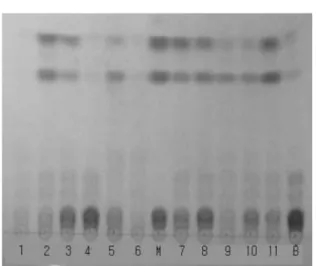
Isolation of strains hydrolyzing isoflavone glycosides to their aglycones efficiently in the soy broth by TLC. For the isolation of isoflavone glycoside hydrolyzing strains, 155 isolates were inoculated into the soy broth media and incubated for 24 h at 30oC. The isoflavones were extracted with ethyl acetate and used as TLC samples. As shown in Fig. 1, isoflavones were separated efficiently with the separation condition as described in Materials and Methods. Using the TLC, a total of 28 strains were selected for the hydrolysis of isoflavone glycoside to isoflavone aglycone efficiently. Among 28 isolates, strain K123-1, K114-1, and SI showed strong intensity in the TLC plate under a UV-detector at 254 nm (Table 1). Isolation of strains hydrolyzing isoflavone glycosides to their aglycones efficiently during the soybean fermentation by HPLC. An individual isolate was inoculated to the autoclaved soybean cereals and fermented at 30oC for 20 days.
The extraction of isoflavones and quantitative analysis of
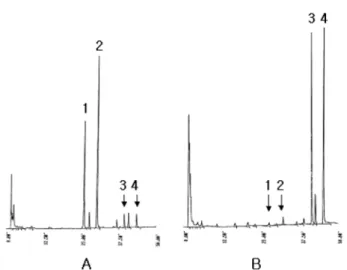
isoflavones were carried out as described in Materials and Methods. The isoflavones were successfully analyzed with our HPLC system (Fig. 2). As shown in Table 2, Strain SI converted from daidzin to daidzein up to 95% and genistin to genistein up to 92%. Also, Strain K123-1 was converted from daidzin to daidzein up to 96% and genistin to genistein up to 92%. But strain K114-1 was converted from daidzin to daidzein up to 84%
and genistin to genistein up to 70%, and all other strains were converted the isoflavone glycosides to isoflavone aglycones between 30 to 85% in the soybean paste fermented at 30oC for 20 days. The strain K123-1, SI, and K114-1 were able to convert the isoflavone glycosides to their aglycones and glucoses by β- glycosidases which were produced during the growth in the soy broth and fermentation of soybean paste. Choi and Sohn [1998]
reported that 20~30% of isoflavones remained in a glycoside form in the fermented soy foods like soybean pastes, miso, and Fig. 1. An example of TLC pattern of isoflavones extracted from the culture filtrates of isolated strains. M, marker for genistein, daidzein and their glucosides(from upper to lower); Number one to eleven, strain number; B, sample without treatment of the isolated strains.
Table 1. TLC analysis of isoflavone glucoside hydrolyzing ability of the isolated strains
Strain Genistein Daidzein Strain Genistein Daidzein
C20-2 +++* +++ K114-1 +++++ +++++
C21-1 ++++ ++++ K123-1 +++++ +++++
C22-4 +++ ++++ K215-4 +++ +++
C25-1 +++++ ++ K221-1 ++++ ++++
C25-5 +++ ++++ K231-1 +++ +++
SSB4 ++++ ++++ K521-1 +++ +++
SSA6 ++++ ++++ Y115-1 ++++ ++++
SM2 ++++ ++++ Y115-2 ++++ ++++
SPC2 ++++ ++++ Y231-1 +++ +++
SPB20-2 ++ ++++ Y331-3 +++ +++
SS20-5 +++ ++++ Y413-2 +++ +++
H2-1 ++++ ++++ Y415-2 ++ +++
SI +++++ +++++ Y422-2 ++++ ++++
K113-1 +++ ++ CC4-2 +++ ++++
*Plus symbols (+) indicate the relative spot intensity of aglycones, which are hydrolyzed, on TLC plate exposed with UV light (254 nm).
166 Won-Chan Kim et al.
tempeh. Therefore, the conversion ability of isoflavone glycosides to isoflavone aglycones by the isolated strain K123-1 and SI was fairly high. The both strains, K123-1 and SI were
determined to be yeasts on the surface of colony, microscopical observation, and resistances to antibiotics. Several yeasts like Saccharomyces rouxii, Saccharomyces acidificans, Pichia membranaefaciens, Pichia sake, Pichia farisona, and Hansenula anomala related to the fermentation of soybean paste were reported and these yeasts were known as film yeast [Cha, 1978]. But it was reported that the growth of these film yeasts was inhibited under the salt concentration of 15% [Cha, 1978].
Any film was not found on the surface of soybean pastes which were fermented at 30oC for 20 days by strain K123-1 and SI.
The taste and smell of the soybean pastes fermented by strain K123-1, SI, and K114-1 were good in the sensory evaluation (data not shown).
Effect of salt on the growth of the isolated strains. The soybean paste is Korean traditional fermented food, which is very salty up to 15% NaCl and stays preserved for a long period.
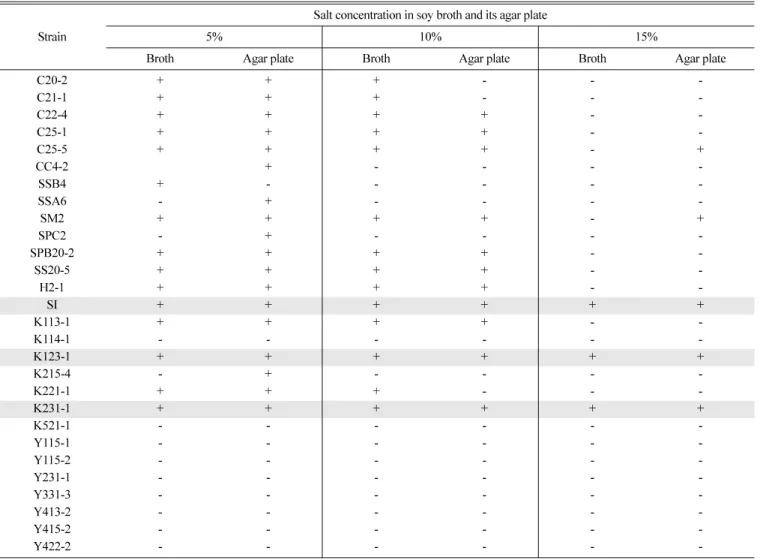
Therefore, the effect of salt on the growth of the isolated strains was investigated. While most of the strains were not grow in the soy broth containing 5% NaCl, strain K123-1, SI, and K231-1 grew in the soy broth and soy broth agar plate media containing Fig. 2. A typical HPLC profile of fermented and non-fermented
soybean. A, non-fermented soybean extract; B, soybean extract fermented by strain K123-1: 1, daidzin; 2, genistin; 3, daidzein; 4, genistein.
Table 2. Changes of isoflavone glucoside and their aglycone contents after fermentation of soybean with the isolated strains
Strain Daidzein Aglycone*Genistein Sum Daidzin Glycoside*Genistin Sum Total sum
C20-2 **207.4** 308.2 515.6 318.3 381.4 699.7 1215.5
C21-1 419.8 150.4 570.1 209.6 578.0 787.6 1357.7
C22-4 178.4 126.8 305.2 391.4 496.0 887.4 1192.6
C25-1 213.1 34.9 248.1 283.2 637.3 920.5 1168.5
C25-5 188.5 131.2 319.7 548.4 463.5 1011.9 1331.6
SSB4 144.3 97.3 241.6 501.5 478.7 980.2 1221.8
SSA6 112.3 101.6 213.9 531.5 493.8 1025.3 1239.2
SM2 271.3 154.0 425.3 305.7 364.4 670.1 1095.4
SPC2 283.4 316.2 599.6 384.3 317.6 701.9 1301.5
SPB20-2 378.4 234.0 612.4 428.6 367.7 796.3 1418.7
SS20-5 401.1 255.1 655.2 208.3 280.1 488.4 1143.6
H2-1 489.9 465.5 955.4 190.4 145.8 336.2 1291.6
SI 739.8 580.2 1320.0 31.9 43.7 75.6 1395.6
K113-1 270.5 203.7 474.2 334.4 222.2 556.6 1030.8
K114-1 646.8 415.5 1062.3 120.2 177.6 297.9 1360.2
K123-1 732.2 676.2 1408.4 28.8 53.8 82.6 1491.0
K215-4 241.3 194.6 435.9 302.3 242.5 544.8 980.7
K221-1 496.7 284.0 780.7 188.4 149.8 338.2 1118.9
K231-1 432.2 278.3 710.5 184.3 106.8 291.1 1001.6
K521-1 180.7 87.4 268.1 388.4 302.2 690.6 958.7
Y115-1 280.7 215.0 495.7 513.3 310.5 823.8 1319.5
Y115-2 266.0 198.8 464.8 404.8 341.8 746.6 1211.4
Y231-1 89.8 102.9 192.7 700.4 394.7 1095.1 1287.8
Y331-3 290.0 134.6 424.6 301.1 257.5 558.6 983.2
Y413-2 237.3 170.5 407.8 518.9 405.6 924.5 1332.3
Y415-2 398.6 272.5 671.1 327.7 219.6 547.3 1218.4
Y422-2 187.4 73.5 260.9 392.5 285.3 677.8 938.7
CC4-2 260.3 179.8 440.1 329.7 369.0 698.7 1138.8
Blank 71.7 55.1 126.8 603.1 488.9 1092.0 1218.8
*Contents were determined by HPLC; **µg/g (dry weight); Blank, no microbial inoculation.
15% of NaCl (Table 3). Byun et al. [1999] isolated Zygosaccharomyces rouxii which can grow in the media containing 2.0 M NaCl. This Zygosaccharomyces rouxii was known as osmophillic yeast [Jermini et al., 1987]. Also, Zygosaccharomyces rouxii is associated with the spoilage of syrups or high sugar food and is important for the development of flavor of soy sauce or soy paste [Onishi, 1963]. Cha [1978]
reported that the film forming yeasts which isolated from soybean pastes were unable to grow in the media containing 15% NaCl.
The isolated strain K231-1 had a high salt tolerance but bad isoflavone hydrolyzing ability, and the isolated strain K114-1 had good isoflavone hydrolyzing ability but low salt tolerance.
The other isolated 25 strains were bad in the isoflavone hydrolyzing ability or low salt tolerance (Table 2, Table 3). It was thought that the strain K123-1 and SI were applicable microbes for making soybean fermentation food because of their good isoflavone hydrolyzing ability and high salt tolerance.
Partial 26S rDNA sequence similarity and phylogenetic analysis. Among these isolated strains, strain SI and K123-1 had
good isoflavone hydrolyzing ability and high osmotolerance.
Therefore an attempt was made to identify strain SI and K123-1 using partial 26S rDNA sequence analysis. Each 570 bp sequence obtained from the strain K123-1 and SI were aligned with presently available 26S rDNA sequences in the GenBank database. The partial 26S rDNA sequence of strain K123-1 and SI had a 100% homology with Pichia guilliermondii and Candida fermentati, respectively (data not shown). A phylogenic tree was constructed using a neighbor-joining method (Fig. 3).
Although it is difficult to distinguish between the Pichia genus and the Candida genus with the present classifying system, sequence similarity and phylogenetic analysis using 26S rDNA indicated that the isolated strains K123-1 and SI were identified to be Pichia guilliermondii and Candida fermentati, respectively (Fig. 3).
As a result, we think that the isolated Pichia guilliermondii K123-1and Candida fermentati SI were one of good candidates for making functional soybean paste because they are isolated from the Korean traditional soybean paste and they have good ability to convert isoflavone glycosides to their aglycones and
Table 3. Effect of salt on the growth of the isolated strains on the soy broth and soy broth agar plate containing 5%, 10% and 15% NaCl Salt concentration in soy broth and its agar plate
Strain 5% 10% 15%
Broth Agar plate Broth Agar plate Broth Agar plate
C20-2 + + + - - -
C21-1 + + + - - -
C22-4 + + + + - -
C25-1 + + + + - -
C25-5 + + + + - +
CC4-2 + - - - -
SSB4 + - - - - -
SSA6 - + - - - -
SM2 + + + + - +
SPC2 - + - - - -
SPB20-2 + + + + - -
SS20-5 + + + + - -
H2-1 + + + + - -
SI + + + + + +
K113-1 + + + + - -
K114-1 - - - - - -
K123-1 + + + + + +
K215-4 - + - - - -
K221-1 + + + - - -
K231-1 + + + + + +
K521-1 - - - - - -
Y115-1 - - - - - -
Y115-2 - - - - - -
Y231-1 - - - - - -
Y331-3 - - - - - -
Y413-2 - - - - - -
Y415-2 - - - - - -
Y422-2 - - - - - -
+, growth; -, not growth.
168 Won-Chan Kim et al.
high salt tolerance.
Even though the soybean pastes fermented by strain K123-1 and SI were good in the tastes and smells, the effect of both strains on the development of taste and flavor in the fermentation of Korean traditional soybean paste will be soon investigated in detail.
It was known that the aflatoxin production of Aspergillus parasiticus was inhibited when it was co-cultivated with Bacillus pumilus [Célestin and Lloyd, 1998]. Even though there are not any reports to produce a toxin from Pichia guilliermondii and Candida fermentati and about the safety of both yeast strains up to now, it was supposed that this riskiness of a toxin production from Pichia guilliermondii and Candida fermentati may be reduced in the presence of salts by co-cultivation with Bacillus subtilis which is the major bacteria for the soybean fermentation. We think that the soybean fermented by co-culture of the yeast strains and Bacillus subtilis might be a good functional soybean paste which contained high level of isoflavone aglycones, genistein and daidzein. Therefore, we are going to apply the yeasts for the preparation of the functional soybean paste by co-culture with Bacillus subtilis.
Acknowledgment. This work was supported (in part) by a grant(Code 20080401034042) from BioGreen 21 Program, Rural Development Administration, Republic of Korea.
References
Arai A, Suzuki H, Fujimaki M, and Sakurai Y (1966) Studies on flavor components in soybean. part. Phenolic acids in defatted soybean flavor. Agric Biol Chem30, 364-371.
Byun MK, Lee SB, Koo BS, Song JK, Ryu JC, and Lee DH (1999) Identification and characterization of osmotolerant yeasts isolated from soy paste. Kor J Mycol27, 181-186.
Caragay AB (1992) Cancer-preventive foods and ingredients. Food Technol46, 65-68.
Céletin M and Lloyd BB (1998) Inhibition of aflatoxin production of Aspergillus parasiticus NRRL 2999 by Bacillus pumilus. Mycopathologia140, 163-169.
Cha WS (1978) Studies on the preservation of soybean paste.
Korean J Appl Microbiol Bioeng6, 81-84
Choi YB and Sohn HS (1998) Isoflavone content in Korean fermented and unfermented soybean foods (in Korean). Korean J Food Sci Technol30, 745-750.
Clarkson TB (2002) Soy, soy phytoestrogens and cardiovascular disease. J Nutr 132, 566S-569S.
Day AJ, Canada FJ, Diaz JC, Kroon PA, Mclauchlan R, Faulds CB, Plumb GW, Morgan MR, and Williamson G (2000) Dietary flavonoid and isoflavone glycosides are hydrolysed by the lactase site of lactase phlorizin hydrolase. FEBS Lett 468, 166-170.
Erdman JW and Forbes RM (1981) Effect of soya protein in mineral availability. J Am Oli Chem Soc 58, 489-495.
Felsenstein J (1993) PHYLIP: Phylogenetic Inference Package, version 3.5. University of Washinton, Seattle, WA, USA.
Hirobumi M, Kanazawa K, Ogura S, Otsuka, and Nagai H (2002) Anticarcinogenic effects of isoflavones may be mediated by genistein in mouse mammary tumor virus-induced breast cancer. Oncology62, 78-84.
Hutchins AM, Slavin JL, and Lampe JW (1995) Urinary isoflavonoid pytoestrogen and lignan excretion after consumption of fermented and unfermented soy products. J Am Diet Assoc95, 545-551.
Jermini MFG, Geiges O, and Schmidt-lorenz W (1987) Detection, isolation and identification of osmotolerant yeasts from high- sugar products. J Food Protection 50, 468-472.
Lee DS and Byun SY (2001) Effects of the dietary mixture of isoflavone on osteoporosis. Korean J Biotechnol Bioeng 16, 420-425.
Lee MA, Park YH, Oh HS, and Kwak TS (2002) Isoflavone content in soybean and its processed products. Korean J Food Fig. 3. Phylogenetic tree based on partial 26S rDNA sequences showing the positions of strains K123-1 and SI and some other related taxa.
Scale bar represents 0.01 substitution per nucleotide position.
Sci Technol 34, 365-369.
Lee SS (1995) Meju fermentation for a raw material of Korean traditional soy products. Kor J Mycol23, 101-175.
Liener IE (1994) Impilcation of antinutrional components in soybean foods. Crit Rev Food Sci Nutr 34, 31-39.
Miksicek RJ (1995) Estrogenic flavonoids: structural requirements for biological activity. Proc Soc Exp Biol Med 208, 44-50.
Naim M, Gestetner B, Bondi A, and Birk Y (1976) Antioxidative and antihemolytic activity of soybean isoflavone. J Agric Food Chem22, 806-811.
Onishi H (1963) Osmophilic yeasts. Adv Food Res12, 53-94.
Saitou N and Nei M (1987) The neighbor-joining method: a new method for reconstructing phylogenic tree. Mol Biol Evol 4, 406-425.
Scheline RR (1991) In CRC handbook of mammalian metabolism of plant compounds, pp. 208. CRC press, Bocaraton, FL, USA.
Thompson LU, Ronn P, Senaion M, and Cheung F (1991) Mammalian lignan production from various foods. Nutr Cancer
16, 43-48.
Thomson JD, Higgins DG, and Gibson TJ (1997) CLUSTAL W:
improving the sensitivity of progressive multiple sequence alignment through sequence weighting, position specific gap penalties and weight matrix choice. Nucleic Acids Res 22, 4673-4680.
Yoon JH, Lee ST, Kim SB, Kim WY, Goodfellow M, and Park YH (1997) Restriction fragment length polymorphisms analysis of PCR-amplified 16S ribosomal DNA for rapid identification of Saccharomonospora strains. Int J Syst Bacteriol47, 111-114.