Ⅰ. 서 론
타이타늄은 우수한 내식성과 생체적합성(Bio- compatibility), 높은 강도와 귀금속 합금에 비해 경제 적이라는 장점 때문에 임플랜트 뿐만 아니라, 최근 에는 단일관이나 계속 가공의치, 금속 알러지가 있 는 가철성 국소의치환자에서도 사용범위가 확대되 어 귀금속의 대체 금속으로 주목받고 있다.1-6)
현재 사용되고 있는 대표적인 타이타늄계 합금은 CP Ti, Ti-6Al-4V 합금 등을 들 수 있다. 순수 타이 타늄은 두개의 동소체로 구성되어 있는데, 조밀 육 방정(HCP : Hexagonal Close-Packed)의 α상과 체심 입방정(BCC : Body Centered Cubic)의 β상으 로 상온에서 883℃까지는 α상이 안정하고, 883℃이 상의 온도에서는 β상이 안정하다. Ti-6Al-4V 합금은 순수 타이타늄에 α상 안정화 원소로써 합금의 강도 는 향상시키고 무게를 감소시키는 알루미늄을 약 6%첨가하고, β상 안정화 원소로써 부식저항 능력을 향상시키는 바나듐을 약 4% 첨가한 α+β상 합금으 로 순수 타이타늄에 비해 높은 인장강도와 파절 강 도를 나타내는 것으로 알려져 있다.7)
그러나 타이타늄은 용융점이 높고 고온에서 산소 와의 화학적 반응성이 크고, 883℃ 이상의 온도에서 는 두꺼운 산화층의 형성으로 도재와의 결합력을 약
화시킨다.1,8-10)이는 도재 소성 온도에서 타이타늄의 산화와 타이타늄 주조 시 표면에 형성되는 α-case 층 이 주요 요인이다. α-case 층은 타이타늄 주조 시 고 온에서 매몰재내의 산소가 타이타늄 격자사이로 확 산되어 타이타늄 표면에 형성되는 산화층으로 연성 과 피로 저항성을 감소시켜 결국 타이타늄-도재 결 합력을 저하시킨다.1-6,11-13) 이러한 문제점을 해결하 기 위해 타이타늄 전용 주조기가 개발되고, 아르곤 이나 헬름등 불활성가스 분위기 하에서 주조하거나, 저온소성이 가능하고 타이타늄의 열팽창계수와 비 슷하거나 약간 낮은 열팽창계수를 갖는 타이타늄 전 용도재가 개발되었다.14)또한 타이타늄 주조시 형성 되는 산화층에 대한 문제점을 해결하기 위한 대안으 로 순수 타이타늄 괴(Ingot)를 직접 가공하는 방법이 Andersson15)등에 의해 고안되었는데 Copy milling spark erosion technique 또는 Procera technique이 라고 불리고 있다.
이 방법은 타이타늄 주조 시 생성되는 α-case 층이 없어 타이타늄-도재 결합이 유리하다는 장점이 있으
나,4,16-18)특수한 장비와 숙련된 기술을 필요로 할 뿐
아니라 단일관 제작에 한정되기 때문에 고정성 국소 의치나 복잡한 보철물 제작에는 어려움이 있다.10,19-20) 도재-금속 보철물의 내구성과 안정성을 위해서 도재 와 금속의 강한 결합력이 중요한 변수로 작용함에 대한치과보철학회지:Vol. 45, No. 2, 2007
타이타늄의 표면개질에 따른 도재 결합 특성
전남대학교 치의학 전문 대학원 보철학교실
*전남대학교 신소재공학부 및 기능성 표면공학연구소,
**타이타늄∙특수합금부품개발지원센터
최택휴∙박상원∙방몽숙∙양홍서∙박하옥∙임현필 오계정∙김현승∙이광민*∙이경구**
※ This study was supported by second stage Brain Korea 21 project for school of dentistry.
따라, 타이타늄과 전용도재의 결합강도에 대한 많은 관심이 모아지고 있다.
이와 관련하여 도재 소성 동안 과다한 타이타늄 산 화를 억제하고, 타이타늄-도재의 결합력을 개선시키 기 위한 방법으로 타이타늄 표면에 다양한 금속이나 세라믹을 코팅하는 연구가 진행되어 왔다.
Wang과 Weltch21)는 타이타늄 표면에 Si3N4코팅을 시행하였으며, Wang과 Fung 등22)은 타이타늄 표면 에 Cr 코팅을 실시하여 타이타늄의 낮은 산화율을 보고하였고, 또 다른 연구에서는 silver 코팅을 시행 하여 타이타늄-도재 결합이 개선되었음을 보여주었
다.23-24)Oshida 등25)은 타이타늄 위에 TiN 코팅을 시
행함으로써 타이타늄 표면의 질화(Nitridation)가 고온에서 타이타늄 산화를 제한하여 도재와의 결합 에 효과적이었다고 보고하였다. 최근에는 Y2O3- ZrO2을 코팅한 타이타늄도 도재와의 결합을 향상시 켰다고 보고되었다.26)
타이타늄 위에 Au 코팅을 시행한 연구들도 시행되
었다.3-6,27)De�rand와 Herψ′는 주조와 가공 타이타늄에
대한 도재와의 결합에 관한 연구에서 Au 결합제가 타이타늄-도재의 결합에 비효과적이었다고 보고하 였다.4)그러나 Lee 등3)의 연구에서는 Au sputter 코 팅을 시행한 경우 타이타늄 표면에 가장 많은 도재 가 부착되었음을 보고하였는데, 이 결과에서 Au 코 팅이 타이타늄 표면과 화학적 결합을 하여 타이타 늄-도재와의 결합에 효과적임을 밝혔다.
이에 본 연구는 주조 타이타늄과 가공 타이타늄을 각각 Au, TiN 코팅과 Al2O3sandblasting으로 표면 처리 후 도재를 축성 소성하여 도재와 타이타늄의 결합형태를 관찰하고, 2축 굴곡 실험 후 SEM/EDS, XRD 방법으로 코팅층에 따른 타이타늄-도재와의 계면 반응 및 결합양상을 알아보고자 한다.
Ⅱ. 연구 재료 및 방법 2.1 연구 재료
2.1.1 금속 시편제작 (1) 주조 타이타늄
주조 타이타늄은 CP-Ti(Grade 2) (Kobe still Co., Japan)를 사용하여, 13×13×1㎜의 아크릴
판을 가공 후, MgO계 매몰재 (Selevest CB�, Selec) 로 매몰하였다. 850℃에서 소환하고 주조 전 350
℃를 유지한 후 원심타이타늄 주조기 (Ticast Super R�, Selec, Osaka, Japan)로 주조하였다. 시편은 bench cooling시키고 250㎛ Al2O3particle (Korox�, Bego, Bremen, Germany)로 sandblasting하여 매 몰재를 제거한 후 deionized water와 acetone에서 각 각 5분간 초음파 세척 후 건조되었다(N=8).
(2) 가공 타이타늄
가공 타이타늄은 CP-Ti(Grade 2)(Kobe still Co., Japan) 판를 13×13×1㎜ 크기로 초정밀와이어가공 기(AP450L, Sodick, Japan)로 가공하였다(N=8).
(3) Au-Pd-In Alloy
Au-Pd-In alloy는 비교군으로 13×13×1㎜의 납형 을 제작한 뒤 인산염계 매몰재(Powercast�; Whipmix, Louisville, Ky)로 매몰하고 Au-Pd-In 합 금 (Alphadent�, Korea)를 gas-oxygen torch로 용융시킨 후 원심주조기로 주조하였다. 시편은 bench cooling시키고 250㎛ Al2O3 입자 (Korox�, Bego, Bremen, Germany)로 sandblasting하여 매 몰재를 제거한 후 deionized water와 acetone에서 각 각 5분간 초음파 세척 후 건조하였다(N=8).
2.1.2 표면처리
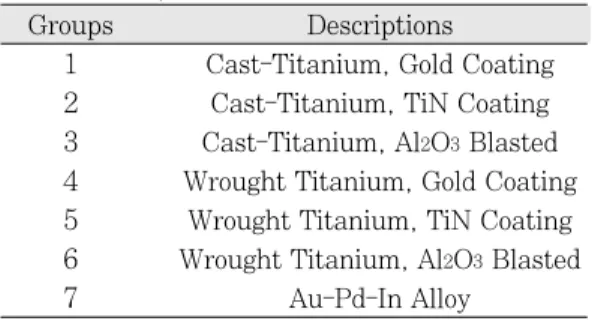
금속 시편의 종류와 표면 처리 방법에 따라 군을 분류하였다(Table I). Au 코팅군은 sputter coater (ParaOne�, Gold Ion Sputter, Model PS-1200)로 40mA, 1000s로 코팅하였다(Fig. 1). TiN 코팅군은
Table I. Experimental groups of specimens used in study
Groups Descriptions
1 Cast-Titanium, Gold Coating 2 Cast-Titanium, TiN Coating 3 Cast-Titanium, Al2O3Blasted 4 Wrought Titanium, Gold Coating 5 Wrought Titanium, TiN Coating 6 Wrought Titanium, Al2O3Blasted
7 Au-Pd-In Alloy
AIP(Arc Ion Plating, 아텍 시스템, Korea) 방법으로 300℃에서 N2 유량 300sccm를 유입하고, 공정압력 7.5mtorr에서 바이어스 -30V, 아크전류 65A로 약 2 시간 동안 증착하였다.
2.1.3 도재 소성
각 시편에서 도재가 소성될 표면은 dental air abrasion unit (Blastmate II�, Ney, Bloomfield, CT) 에서 110㎛ Al2O3particle(Korox�, Bego)로 air abra- sion되었다. Air abrasion을 위한 기압은 0.55 ㎫ (80psi)에서 유지되었고, 표면과 nozzle 사이의 거리 는 약 1㎜를 유지한 채 20초 동안 sandblasting하 였다.
타이타늄 시편의 경우 초저용융도재 (Vita Tita- nkeramik�, Vident, Brea, CA)를 시편의 중심에 6
㎜직경의 원형이 되게 porcelain bonder를 바르고 한 층의 opaue porcealin과 두층의 dentin porcelain을 타이타늄 전용 도재로(TiKROM, OROTIG)에서 제 조회사의 추천 사이클로 소성하였다(Table II). 두번 째 dentin porcelain 소성 후 도재의 높이를 1.1㎜가 되게 SiC abrasive paper로 연마하였다. 초음파 세척 기로 5분간 세척 후 건조시키고 최종 glaze firing을 시행하였다(Fig. 1).
Au-Pd-In 합금시편에서는 일반 도재 (Creation�, KLEMA)를 이용하여 타이타늄 시편에서와 동일하 게 표본의 중심에 6㎜직경의 원형으로 1.1㎜ 높이가 Fig. 1. Dimensions of metal-ceramic specimen. Fig. 2. Specimens after porcelain firing.
Table II. Settings of the porcelain furnace used for fusing of the Ultra-Low-Fusing dental porcelain in the present study
Porcelain Layer Porcelain Furnace Setting
Paste bonder Heat from 400 to 800 ℃ at 60 ℃/min in vacuum, hold at 800 ℃ in vaccum for 1 min Opaque porcelain Heat from 400 to 790 ℃ at 110℃/min in vacuum,
hold at 790 ℃ in vaccum for 1 min First-layer dentin porcelain Heat from 400 to 770℃ at 50 ℃/min in vacuum,
hold at 770℃ in vaccum for 1 min Second-layer dentin porcelain Heat from 400 to 770 ℃ at 50 ℃/min in vacuum,
hold at 770 ℃ in vaccum for 1 min Glaze Heat from 400 to 790 ℃ at 60 ℃/min in vacuum,
hold at 790 ℃ in vaccum for 1 min
13mm
13mm
t = 1.0mm
1.0mm 6mm
Ti Plate
1.1mm Ti
Porcelain
되게 통상 적인 도재로 (HIGH BAKE II�, JAE MYONG)에서 제작하였다(Fig. 2).
2.2 연구방법
2.2.1 2축 굴곡 실험 (Biaxial Flexure Test) 2축 굴곡 실험을 위해 만능시험기(UH-100A�자, Shimazu, Japan)에 자체 제작한 die와 plunger(Fig.
3)을 사용하여 모재에서 도재가 탈락될 때까지 0.25
㎜/min의 cross head speed로 하중을 가하였다.
2.2.2 SEM/EDS 분석
도재 소성후 시편의 단면과 2축 굴곡 시험 후 탈락 한 도재 표면 형상은 주사전자현미경(SEM, Scanning Electron Microscope, JSM 5400, JEOL, JAPAN)으로 관찰하였고, EDS(Energy Dispersive X-ray Spectroscopy, Noran�, USA)로 시편 표면에 존재하는 Si 함량을 도재 부착의 지표로 이용하였 고, Si 성분의 분포를 관찰하였다. SEM operating 조 건은 20kV accelerating voltage, 38㎜ working dis- tance, 64㎂ beam current, 41.3�take-off angle, 100s live time으로, Si 성분의 원자량은 시편의 중심 원내의 3.7㎜ × 2.7㎜ 사각형 내에서 시행되었다(×
50). 시편 표면에 존재하는 각 성분원소의 분포를 관 찰하기 위한 EDS Mapping은 시편의 중앙부를 분석 하였다(×300).
Ⅲ. 연구 성적 3.1 SEM photomicrographs
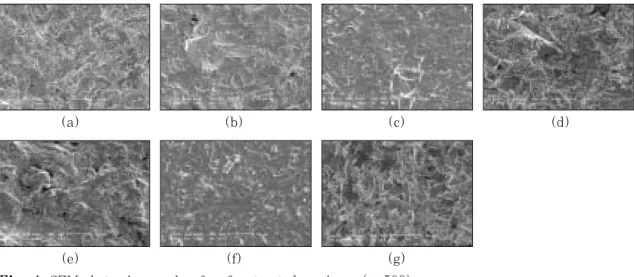
Fig. 4는 타이타늄의 코팅 전과 후 그리고 Au- Pd-In 합금의 SEM사진으로 타이타늄 시편에서 각 코팅은 주조 타이타늄과 가공 타이타늄에서 유사한 코팅 양상을 보였다.
Fig. 3. Schematic diagram of a special die and plunger.
(a) (b) (c) (d)
(e) (f) (g)
Fig. 4. SEM photomicrographs of surface treated specimens(× 500).
(a) cast titanium, (b) gold coated cast titanium, (c) TiN coated cast titanium, (d) wrought titanium, (e) gold coated wrought titanium, (f) TiN coated wrought titanium, (g) Au-Pd-In alloy.
Plunger
Die
Specimen
Fig. 5는 표면 처리 후 주조 타이타늄, 가공 타이타 늄 및 Au-Pd-In alloy에 저온도재소성 후 각 층의 단 면을 관찰한 사진이다. 코팅에 따른 주조 타이타늄 과 가공 타이타늄의 차이는 나타나지 않고 유사한 양상을 보이고 있다.
Fig. 6은 2축 굴곡 실험 후 시편의 표면 양상을 관 찰한 사진이다(×30). 시료의 표면에 도재 축성시 사용되는 dentin porcelain, bonding porcelain 및 opaque porcelain으로 보이는 물질이 존재하는 것을 알 수 있다.
(a) (b) (c) (d)
(e) (f) (g)
Fig. 5. The cross sectional SEM photomicrographs of titanium specimens after porcelain firing(×5000).
(a) cast titanium, (b) gold coated cast titanium, (c) TiN coated cast titanium, (d) wrought titanium, (e) gold coated wrought titanium, (f) TiN coated wrought titanium, (g) Au-Pd-In alloy.
(a) (b) (c) (d)
(e) (f) (g)
Fig. 6. SEM photomicrographs specimens after porcelain debonding(×30).
(a) cast titanium, (b) gold coated cast titanium, (c) TiN coated cast titanium, (d) wrought titanium, (e) gold coated wrought titanium, (f) TiN coated wrought titanium, (g) Au-Pd-In alloy.
3.2 EDS 분석
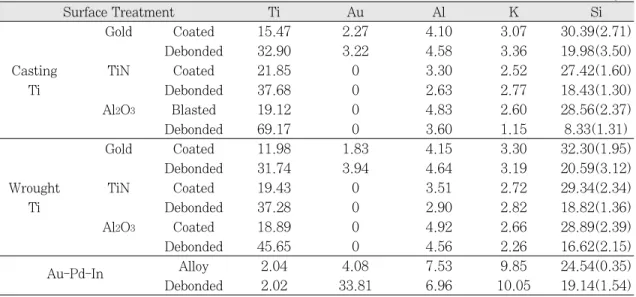
Table III은 2축 굴곡 시험 후 도재가 탈락된 시편 을 50배 확대하여 중심원내(3.7㎜×2.7㎜)에 존재하
는 Si 성분의 원자량을 비교한 표이다. Au와 TiN 코 팅한 실험군과 Au-Pd-In alloy 비교군에서는 Si 원자 량이 비슷한 값을 보이고 있으나, 주조 타이타늄에 Al2O3 sandblasting만을 시행한 실험군에서 가장 Table III. EDS Analyses results (at.%) on titanium surfaces before & after the porcelain debonding
Surface Treatment Ti Au Al K Si
Gold Coated 15.47 2.27 4.10 3.07 30.39(2.71)
Debonded 32.90 3.22 4.58 3.36 19.98(3.50)
Casting TiN Coated 21.85 0 3.30 2.52 27.42(1.60)
Ti Debonded 37.68 0 2.63 2.77 18.43(1.30)
Al2O3 Blasted 19.12 0 4.83 2.60 28.56(2.37)
Debonded 69.17 0 3.60 1.15 8.33(1.31)
Gold Coated 11.98 1.83 4.15 3.30 32.30(1.95)
Debonded 31.74 3.94 4.64 3.19 20.59(3.12)
Wrought TiN Coated 19.43 0 3.51 2.72 29.34(2.34)
Ti Debonded 37.28 0 2.90 2.82 18.82(1.36)
Al2O3 Coated 18.89 0 4.92 2.66 28.89(2.39)
Debonded 45.65 0 4.56 2.26 16.62(2.15)
Au-Pd-In Alloy 2.04 4.08 7.53 9.85 24.54(0.35)
Debonded 2.02 33.81 6.96 10.05 19.14(1.54)
Entries are mean values. Standard deviations are in parentheses.
Data were based on analysis of eight specimens.
(a) (b) (c) (d)
(e) (f) (g)
Fig. 7. EDS mapping photomicrographs specimens after porcelain debonding (×300).
(a) cast titanium, (b) gold coated cast titanium, (c) TiN coated cast titanium, (d) wrought titanium, (e) gold coated wrought titanium, (f) TiN coated wrought titanium, (g) Au-Pd-In alloy.
낮은 수치를 보여주고 있다.
Fig. 7은 도재 탈락후 시편 표면에 존재하는 Si 성 분은 EDS mapping한 사진으로 주조 타이타늄과 가공 타이타늄에 Au와 TiN 표면 처리한 실험군에서 많은 양의 Si 성분이 다소 균일한 분포를 나타내고 있었으며, Al2O3sandblasting한 실험군에서는 적은 양의 Si 성분이 불규칙한 분포를 나타내고 있다.
3.3 XRD 분석
Fig. 8은 2축 굴곡 시험 후 도재가 탈락된 주조 타 이타늄과 가공 타이타늄의 표면을 X-ray 회절 분석 한 결과이다. Au와 TiN 코팅된 실험군에서 각각 Au2Ti 화합물과 TiN 코팅층이 존재하였으며, 모든 실험군에서 타이타늄의 대표적인 산화물인 TiO2가 형성되었음을 알 수 있다.
Ⅳ. 고 찰
도재가 갖는 낮은 전단 및 인장 강도와 충격에 대 한 취약성을 보완하기 위해 도재전장금속관이 사용 되고 있다. 도재와 금속과의 결합 증진을 위한 노력 으로 화학적 결합 방법이나 기계적 결합 방법 등을 이용한 여러 가지 연구들이 시행되어 왔다.28-30)기계 적 결합이 효과적이긴 하지만 범위가 제한되며, 대 부분의 문헌들은 화학적 결합을 금속-도재간의 결합
에서 가장 주요한 요소로 보고하였으며,25)화학적 결 합은 금속 표면에 형성된 산화물이 도재내로 확산되 어 도재내 산화물과 공유결합이나 이온결합을 함으 로써 이루어진다하였다.10,31) 또한 도재와 금속간의 결합에 있어 Lautenschlager 등30)은 다양한 도재전장 금관의 계면 연구에서 전자현미경을 통해 철, 주석, 인듐 등의 미량원소를 발견하였는데, 이들 미량원소 들이 산소와 결합하거나 상호 반응하여 도재와 금속 사이에 결합을 형성한다고 보고하였다. 도재용 금속 계면의 산화막이 너무 두꺼울 경우 얇은 산화막에 비해 접착실패의 가능성이 더 클 것으로 알려져 있 으며,32)비귀금속은 주성분들이 쉽게 산화되어 과도 한 산화막이 형성 될 수 있으므로 산화막 두께 조절 은 결합강도를 확보하는데 중요한 요인이라 할 수 있다.33) 타이타늄은 883℃ 이상의 온도에서 산소, 질소 등과 반응하여 비교적 두껍고 쉽게 분리되는 타이타늄 산화막을 형성하기 때문에 Kimura 등34)은 도재용 합금에서 일반적으로 시행하는 degassing 처리가 타이타늄-도재 수복물에는 적합하지 않을 뿐 아니라, 타이타늄 표면의 산화막 형성을 최소로 하 기 위하여 800℃ 이하에서 도재 소성을 시행해야 한 다고 보고하였다. 타이타늄과 도재의 결합은 일반적 인 니켈-크롬 합금과 도재와의 결합 강도보다 낮다 고 알려져 있다. Adachi 등35)은 타이타늄과 도재간의 낮은 결합강도는 타이타늄에 대한 산화막의 부착이 불안정하기 때문이며, 이러한 불안정한 산화막은 도 재 소성중에 생성되고 결합강도를 저하시킨다고 하 였으며, 온도에 따른 순수 타이타늄의 부착성 산화 막 형성능력을 분석해 본 결과 1,000℃에서는 약 1
㎛의 두꺼운 산화막을 형성하여 부착성 산화막이 전 체 표면의 1% 미만에서 형성되었고, 750℃에서는 약 32㎚의 얇은 산화층으로 가장 많은 부착성 산화 막이 형성되었다고 하였다. Hautaniemi 등36)은 소성 주기와 온도, 진공 등의 상태로 생성된 산화층의 두 께와 결합강도에 있어 진공 소성을 시행하여 0.1�
0.2㎛의 산화층을 얻은 실험군이 가장 강한 결합 강 도를 얻었다고 하였으며, 진공상태가 아니거나 소성 시간이 길어질수록 더 낮은 결합 강도를 나타내었다 고 하였다. 따라서 도재와 타이타늄의 보철물의 내 구성과 안정성을 위해서 타이타늄 표면의 산화막 형 성을 조절하는 것이 결합강도를 증가시킬 수 있는
C-Ti-Au ; Cast-Titanium, Gold Coating C-Ti-TiN ; Cast-Titanium, TiN Coating C-Ti ; Cast-Titanium, Al2O3Blasted W-Ti-Au ; Wrought Titanium, Gold Coating W-Ti-TiN ; Wrought Titanium, TiN Coating W-Ti ; Wrought Titanium, Al2O3Blasted
Intensity
2theta
Fig. 8.
중요한 요인으로 간주된다.
이와 관련해 Atsu¨ 등37)은 타이타늄-도재간의 결합 을 증진시키기 위해서는 주조 타이타늄에서 도재 소 성시 환원성 Ar 대기(Reduced Argon Atmosphere) 하에서 소성해야 한다고 주장하였고, Abdulaziz 등2) 도 Au 스퍼터 코팅을 시행한 타이타늄이 환원성 Ar 대기하에서 도재가 소성되었을 때 가장 높은 타이타 늄-도재 결합강도를 보였다고 보고하였다. Wang 등21)은 타이타늄 표면에 실리콘 질화코팅시 도재와 의 결합력이 증진되었다는 연구결과에서, 타이타늄 표면에 Si3N4coating을 하여 파절 실험 후 양상은 Si3N4코팅층과 도재사이보다는 도재내의 파절이 발 생한 것으로 도재와 Si3N4 코팅사이의 결합력이 향 상되었음을 보여주었는데, 이는 Si3N4층이 타이타늄 과의 계면에서 titanium silicide를 형성하기 때문이 라고 보고하였다.
도재 소성동안 타이타늄 산화를 조절하기 위해 타 이타늄 표면에 질화 코팅을 하였을 경우, 질화하지 않은 타이타늄 보다 약 5배 더 낮은 산화속도를 보 여, 동일한 산화 정도에서 비질화된 타이타늄 보다 약 2.24배 더 긴 산화시간을 필요로 했다고 보고하 였다.25)Cai 등26)은 TiN 코팅층이 금속표면의 산화를 억제함으로써 마모 저항이 강한 표면과 낮은 마찰계 수와 화학적 안정성을 제공해 준다고 보고하였다.
타이타늄 표면의 산화층은 산소가 고온에서 타이 타늄 용매에 쉽게 용해되는 일종의 용질원소로 작용 한다고 알려져 왔으며, 아주 소량의 산소가 용해되 었다 할지라도 타이타늄의 성질을 급격히 변화시켜 파절을 일으킬 수 있다. 열역학적으로 Ellin-Ghams/
Richardson Diagram에 기초한 Ti/Oxygen의 평형 은 400℃�800℃사이에서 10-110�10-90 atmos- pheres의 산소 분압을 요한다. 따라서 기존의 치과 도재로를 사용하여 그러한 낮은 압력에서 과다한 산 화를 막는 것은 거의 불가능하므로 타이타늄 전용 도재와 도재로를 사용해야 한다.3,38)
본 연구에서도 주조 타이타늄에서 Au 코팅한 실험 군, TiN 코팅한 실험군과 가공 타이타늄에서 Au 코 팅한 실험군, TiN 코팅한 실험군이 Al2O3 sand- blasting한 주조 타이타늄 보다 Si 함량(at.%)이 높게 나타났으며, 표면에 존재하는 Si 분포에서 차이를 나타내었다. 이는 타이타늄 표면의 코팅 처리가 타
이타늄의 산화를 제한하여 도재와의 결합력을 증진 시킬수 있다는 가능성을 보여주었다. 또한 타이타늄 표면 코팅 처리가 기계적 처리보다 도재와 결합력을 증진시킴을 보여준다. Al2O3sandblasting한 주조 타 이타늄에서의 낮은 Si 함량과 다소 불규칙한 분포는 표면에 형성된 산화층이 도재와의 결합을 방해하는 것으로 보인다. Al2O3sandblasting 처리 방법과 기 술에 따라 금속과 도재의 결합력이 코팅군과 동일 할 수 있다는 보고도 있으나39), 이에 대한 연구가 더 필요하리라 생각된다.
치과용 도재는 용융온도에 따라 고용융도재(1,201
℃�1,450℃), 중용융도재(1,051℃�1,200℃), 저용 융도재 (870℃�1,050℃), 초저용융도재(870℃이 하)의 4가지로 분류할 수 있다. 일반 금속과 도재용 으로는 저용융도재로 백류석(Leucite)를 첨가하여 열팽창계수를 높이고 강도를 증가시켰다. 타이타늄 과 타이타늄 합금에 사용되는 초저용융도재는 열팽 창계수가 낮고 용융온도가 낮아 제 III, IV형 금합금 과도 사용될 수 있다40). 본 연구에서 Au-Pd-In 합금 에 사용된 도재는 타이타늄에 사용되는 초저용융도 재로 도재 탈락 후 표면에 존재하는 Si 함량의 차이 는 존재한다.
X-ray 회절분석에서 주조 타이타늄과 가공 타이타 늄에 Au 코팅시 형성되는 금속간 화합물 Au2Ti는 Au 코팅된 타이타늄 표면에서 생성된 것에서 기인 한 것으로, 타이타늄 표면위의 Ti(O) 고용체의 형태 와 산화를 변경시킴으로써 도재와 타이타늄 산화층 에 영향을 주어 도재와의 결합을 용이하게 하는 것 으로 보고하였다.3)
이러한 금속-도재간의 결합강도를 개선하고자 하 는 연구는 계속 진행되고 있으나 진정한 결합강도를 측정할 만한 일반적인 방법은 없다.41)따라서 도재의 주성분인 Si을 2축 굴곡 실험 후 남아있는 함량을 정 량화 하여 금속-도재와의 결합을 평가하는 대안으로 개발되었고 연구가 진행되었다.3,39)
본 연구에서 주조 타이타늄과 가공 타이타늄에 표 면 처리 후 도재를 축성하고 소성하였을 때 각 층의 결합양상은 표면처리 방법에 따라 유사하게 나타났 으나, 파절 후 Si 함량과 분포에서는 차이를 나타내 었다. 주조 타이타늄과 가공 타이타늄에서 산화층 조절을 위해 코팅 처리한 경우에 Au 코팅은 도재 소
성시 타이타늄의 산화층과 새로운 화합물인 Au2Ti 를 형성하는 화학반응을 일으켜 도재와의 결합력을 증진시키고, TiN 코팅은 도재 소성시 산소 확산의 방어막으로 작용하여 도재와의 결합력을 증진시킬 것으로 판단되지만, 2축 굴곡 실험후 주조 타이타늄 과 가공 타이타늄 표면의 도재 탈락 현상은 주로 코 팅층과 모재의 결합력 저하로 인한 것으로 부착실패 (adhesive failure)와 응집실패(cohesive failure) 가 동시에 존재하는 것을 알 수 있었다
따라서 도재전장금관 제작시 타이타늄 주조체에 Au나 TiN 표면 코팅한 경우 도재와의 결합력을 향 상 시킬 수 있는 가능성을 보여 주었다. 임상에서 도 재전장금관 제작시 타이타늄을 이용하기 위해서, 선 행되어야 할 과제는 모재와 코팅층간의 결합력을 더 욱 향상시킬 수 있는 코팅 기술 개발이 선행되어야 할 것으로 사료된다.
Ⅴ. 결 론
주조 및 가공 타이타늄 표면처리에 따른 결합양상 을 평가하여 다음과 같은 결론을 얻을 수 있었다.
1. 주조 타이타늄과 가공 타이타늄에 표면처리(Au, TiN, Al2O3sandblasting)후 표면 양상은 유사하 게 나타났으며, 저온소성도재의 축성 후 도재와 타이타늄 단면 관찰에서 주조 타이타늄과 가공 타이타늄 각 군에서 동일한 결합 형상을 나타내 고 있었다.
2. 2축 굴곡 실험 전후 Si 성분의 원자량에 대한 변 화는 Al2O3sandblasting한 주조 타이타늄에서 가 장 큰 차이를 나타났으며(28.6at.%→8.3at.%), Au-Pd-In 합금에서 변화량이 가장 작게 나타났다 (24.5at.%→19.1at.%).
3. 도재 탈락 후 주조 타이타늄과 가공 타이타늄에 Au와 TiN 표면 처리한 실험군에서 많은 양의 Si 성분이 다소 균일한 분포를 나타내고 있었으며, Al2O3 sandblasting한 실험군에서는 적은양의 Si 성분이 불규칙한 분포를 나타내었다.
4. 도재 탈락 후 X-ray 회절분석에서 Au와 TiN 코팅 된 실험군에서 각각 Au2Ti 화합물과 TiN 코팅층 이 존재하였으며, 모든 실험군에서 타이타늄의 대표적인 산화물인 TiO2가 형성되었음을 알 수
있었다.
5. 2축 굴곡 실험후 주조 타이타늄과 가공 타이타늄 표면의 도재 탈락 현상은 주로 코팅층과 모재의 결합력 저하로 인한 것으로 판단되며, 부착실패 (adhesive failure)와 응집실패(cohesive fail- ure)가 동시에 존재하는 것을 알 수 있었다.
참고문헌
1. Cai Z, Bunce N, Nunn ME, Okabe T.
Porcelain adherence to dental cast CP titanium: effects of surface modifications.
Biomaterials 2001;22:979-986.
2. Abdulaziz Sadeq, Zhuo Cai, Ronald D.
Woody, Amp W. Miller. Effects of interfacial variables on ceramic adherence to cast and machined commercially pure titanium. J Prosthet Dent 2003;90:10-17.
3. Lee KM, Cai Z, Griggs JA, Guiatas L, Lee DJ, Okabe T. SEM/EDS Evaluation of Porcelain Adherence to Gold-Coated Cast Titanium. J Biomed Mater Res Part B: Appl Biomater 2004;68B:165-173.
4. De�rand T, Herψ′H. Bond strength of porce- lain on cast vs. wrought titanium. Scand J Dent Res 1992;100:184-188.
5. Saadet A, Semih B. Bond strength of three porcelains to two forms of titanium using two firing atmospheres. J Prosthet Dent 2000;84;567-574.
6. Russell R. Wang, Gerhard E. Welsch, Othon Monteriro. Silicon nitride coating on titanium to enable titanium-ceramic bond- ing. J Biomed Mater Res 1999;46: 262-270.
7. Taira M, Moser JB, Greener EH. Face coats for dental casting of titanium alloys. J Dent Res 1985;64:317.
8. Bagby M, Marshall SJ, Marshall GW.
Metal ceramic compatibility: A review of the literature. J Prosthet Dent 1990;63:21- 25.
9. Dent RJ, Preston JD, Moffa JP. Effect of oxidation on ceramometal bond strength.
J Prosthet Dent 1982;47:59-62.
10. Park SY, Jeon YC, Jeong CM. Comparison of the bond strength of ceramics fused to titanium and Ni-Cr alloy. J Korean Acad Prosthodont 2003;41:89-98.
11. Hruska AR, Borelli P. Quality criteria for pure titanium casting, laboratory sol- dering, intraoral welding, and a device to aid in making uncontaminated castings. J Prosthet Dent 1991;66:561-565.
12. Pang IC, Gilbert JL, Chai J, Lautenschlager EP. Bonding characteristics of low-fusing porcelain bonded to pure titanium and pal- ladium-copper alloy. J Prosthet Dent 1995;73:17-75.
13. Donachie MJ, editor. Titanium: a technical guide. Metals Park, OH: ASM Internati- onal. 1988 p.28,69,71.
14. Kimura H, Horning CJ, Okazaki M, Takahashi J. Thermal compatibiltiy of titanium-porcelain system. J Osaka Uni Dent Sch 1990;30:43-52.
15. Andersson M, Bergman B, Bessing C, et al. Clinical results wity titanium crowns fab- ricated with machine duplication and spark erosion. Acta Odontol Scand 1989;
47:279-286.
16. Gilbert JL, Covey DA, Lautenschlager EP. Bond characteristics of porcelain fused to milled titanium. Dent Mater 1994;10:134-140.
17. Lautenschlager EP, Monaghan P. Titanium and titanium alloys as dental materials. Int Dent J 1993;43:245-253.
18. Andersson M, Bergman B, Bessing C, Ericson G, Lundquist P, Nilson H. Clinical results with titanium crowns fabricated with machine duplication and spark erosion. Acta Odontol Scand 1989;47:279-286.
19. Einar B, Warren CW, Geir D, Edward Rd.
Mechanical properties of laser-welded cast and wrought titanium. J Prosthet Dent 1995;74:250-257.
20. Togaya T, Suzuki M, Tsutsumi A, Ida K. An application of pure titanium to metal porcelain system. J Dent Mater 1983;2:210-219.
21. Wang R, Welsch G, Monterio O. Silicon ni- tride coating on titanium to enable titanium- ceramic bonding. J Biomed Mater Res 1999;46:262-270.
22. Wang RR, Fung KK. Oxidation behavior of surface-modified titanium for titanium-ce- ramic restorations. J Prosthet Dent 1997;77:423-434.
23. Ko¨no¨nen M, Varpaveara P, Kivilahti J.
Bonding of low-fusing dental porcelain to silver-coated titanium. J Dent Res 1999;78:127.
24. Varpaveara P, Kivilahti J, Ko¨no¨nen M.
Comparison of a novel titanium-ceramic sys- tem with the commercial systems. J Dent Res 2000;79:27.
25. Oshida Y, Fung L, Isikbay S. Titanium- porcelain system. Part II: Bond strength of fired porcelain on nitrided pure titani- um. Biomed Mater Eng 1997;7:13-34.
26. Cai Z, Carrasco L, Okabe T. Porcelain adherence to titanium cast in oxide-coat- ed patterns. Trans Soc Biomater 2002;
25:103.
27. Okazaki M, Wang X, Toguchi MS, Taira M, Takahashi J, Matsuo C, Hino Y. Impro- vement of bond strength in metal ceram- ic systems using a gold intermediate lay- er. J Dent Mater 1998;17:163-173.
28. MP Borom, JA Pask. Role of adherence ox- ides in the development of chemical bond- ing at glass-metal interfaces. J Am Ceram Soc 1966;49:1-6.
29. M Szantho von Radnoth, EP Lautenscha- gler. Metal surface changes during porce- lain firing. J Dent Res 1969;48:321-326.
30. EP Lautenschagler, EH Grenner, WE Elingtion. Microprobe analysis of gold- porcelain bonding. J Dent Res 1969; 48:
1206-1209.
31. Shell JS, Nielsen JP. Study of the bond be- tween gold alloys and porcelain. J Dent Res 1962;41:1424-1437.
32. Rosenstiel SF, Land MF, Fujimoto J.
Contemporay fixed prosthodontics, 3rd ed. St. Louis: Mosby, pp.488-512, 2001.
33. Kelly JR, Rose TC. Nonprocious alloys for use in fixed prosthodontics, A Literature review. J Prosthet Dent 1983;49:363.
34. Kimura H, Horning CJ, Okazak Mi.
Oxidation effect on porcelain titanium interface reaction and bond strength. J Dent Mater 1990;9:91-99.
35. Adachi M, Mackert JR Jr, Parry EE, Fairhurst CW. Oxide adherence and porce- lain bonding to titanium and Ti-6Al-4V al- loy. J Dent Res 1990;69:1230-1235.
36. Hautaniemi JA, Hero H, Juhanoja JT. On the bonding of porcelain on titanium. J Mater Sci 1992;3:186-191.
37. Atsu¨ S, Berksun S. Bond strength of three porcelain to two forms of titanium us- ing two firing atmospheres. J Prosthet Dent 2000;84:567-574.
38. Cai Z, Watanabe I, Mitchell JC, Brantley WA, Okabe T. X-ray diffraction investigation of gold casting alloy-ceramic interfaces. J Mater Sci Mater Med 2001;21:215-223.
39. Kim YM. The Effects of Surface Coating of Titanium on Ceramic Adhesion. Chonnam National University, Doctor’s Degree Thesis, 2005.
40. Anusavice K. Meta-Ceramics and dental ceramics for the 21st century, Proceeding of international Symposium on titanium in dentistry. 1995;3: 137-154.
41. Papazoglou E, Brantley WA, Carr AB, Johnston WM. Porcelain adherence to high-palladium alloys, J Prosthet Dent 1993;70:386-394.
Reprint request to:
Sang-Won Park, D.D.S., M.S.D. Ph.D.
Department of Prosthodontics, College of Dentistry, Chonnam National University 8, Hak-Dong, Dong-Gu, Gwangju, 501-757, Korea
Statement of problem: Titanium is well known as a proper metal for the dental restora- tions, because it has an excellent biocompatibility, resistance to corrosion, and mechani- cal property. However, adhesion between titanium and dental porcelains is related to the diffusion of oxygen to the reaction layers formed on cast-titanium surfaces during porcelain firing and those oxidized layers make the adhesion difficult to be formed. Many studies using mechanical, chemical and physical methods to enhance the titanium-ceramic adhesion have been actively performed.
Purpose: This study meant to comparatively analyse the adhesion characteristics depending on different titanium surface coatings after coating the casts and wrought tita- nium surfaces with Au and TiN.
Material and method: In this study, the titanium specimens (CP-Ti, Grade 2, Kobe still Co. Japan) were categorized into cast and wrought titanium. The wrought titanium was cast by using the MgO-based investment(Selevest CB, Selec). The cast and wrought tita- nium were treated with Au coating(ParaOne�, Gold Ion Sputter, Model PS-1200) and TiN coating(ATEC system, Korea) and the ultra low fusing dental porcelain was fused and fired onto the samples. Biaxial flection test was done on the fired samples and the porcelain was separated. The adhesion characteristics of porcelain and titanium after firing and the spec- imen surfaces before and after the porcelain fracture test were observed with SEM. The atom- ic percent of Si on all sample surfaces was comparatively analysed by EDS. In addition, the constituents of specimen surface layers after the porcelain fracture and the formed compound were evaluated by X-ray diffraction diagnosis.
THE BOND CHARACTERISTICS OF PORCELAIN FUSED BY TITANIUM SURFACE MODIFICATION
Taek-Huw Choi, D.D.S,. Ph.D., Sang-Won Park, D.D.S, Ph.D., Mong-Sook Vang, D.D.S., Ph.D., Hong-So Yang, D.D.S., Ph.D., Ha-Ok Park, D.D.S., Ph.D., Hyun-Pil Lim, D.D.S., M.S.D., Gye-Jeong Oh, B.S., Hyun-Seung Kim, M.S., Kwang-Min Lee, Ph.D*, Kyung-Ku Lee, Ph.D.**
Department of Prosthodontics, College of Dentistry, Chonnam National University
*Division of Materials Science and Engineering, Research Institute for Functional Surface, Chonnam National University
** R&D Center for Titanium and Special Alloys ABSTRACT
Result: The results of this study were obtained as follows :
1. The surface characteristics of cast and wrought titanium after surface treatment(Au, TiN, Al2O3sandblasting) were similar and each cast and wrought titanium showed sim- ilar bonding characteristics.
2. Before and after the biaxial flection test, the highest atomic weight change of Si com- ponent was found in Al2O3sandblasted wrought titanium(28.6at.% � 8.3at.%). On the other hand, the least change was seen in Au-Pd-In alloy(24.5at.%� 19.1at.%).
3. Much amount of Si components was uniformly distributed in Au and TiN coated tita- nium, but less amount of Si’s was unevenly dispersed on Al2O3 sandblasting surfaces.
4. In X-ray diffraction diagnosis after porcelain debonding, we could see Au2Ti compound and TiN coating layers on Au and TiN coated surfaces and TiO2, typical oxide of tita- nium, on all titanium surfaces.
5. Debonding of porcelain on cast and wrought titanium surface after the biaxial flection is considered as a result of adhesion deterioration between coating layers and titani- um surfaces. We found that there are both adhesive failure and cohesive failure at the same time.
Conclusion: These results showed that the titanium-ceramic adhesion could be improved by coating cast and wrought titanium surfaces with Au and TiN when making porce- lain fused to metal crowns. In order to use porcelain fused to titanium clinically, it is con- sidered that coating technique to enhance the bonding strength between coating kKlayers and titanium surfaces should be developed first.
Key words : Titanium, Surface treatment(Au, TiN, Al2O3sandblasting), Adhesion