405
비귀금속 합금에 적용한 Au Based Bonding Agent가 금속-도재 결합에 미치는 영향
이정환
†·안재석
1광주보건대학 치기공과, 1고려대학교의료원 안산병원 치과기공실
The Effect of a Au Based Bonding Agent Coating on Non-Precious Metals-Ceramic Bond Strength
Jung-Hwan Lee
†and Jae-Seok Ahn
1Department of Dental Laboratory Technology, Gwang-Ju Health college University, Shin chang-dong 683-3, Gwangsan-gu, Gwangju-City 506-701, Korea
1
Dental Laboratory, Korea University Ansan Hospital, Gojan1-Dong, Danwon-GThe Effect u, Ansan-Si, Gyeonggi-Do 152-703, Korea
Abstract The purpose of this study investigated the effect of Au coating on adhesion between porcelain matrix and metal substructure interface. Titanium, Ni-Cr alloy and Co-Cr alloy are well known as proper metal for the dental restorations. The success of a porcelain fused to metal (PFM) restoration depends upon the quality of the porcelain-metal bond. However, adhesion between dental alloys and porcelain is related to diffusion of oxygen during ceramic firing. The excessive oxidized layers make hard adhesion between dental alloy and ceramic. Ni-Cr and Co-Cr specimens were divided into a test and a control group and Titanium specimens were divided into three test groups and a control group.
Each group had 20 specimens. The adhesion characteristics of porcelain and metal with Au coating layer and without Au coating layer were observed with scanning electron microscopy(SEM). The adhesion was evaluated by a biaxial flexure test and volume fraction of adherent porcelain was determined by SEM/EDS analysis. Result of this study suggest that Au coating layer is effective barrier to diffuse oxide layer completely protect non-precious alloys from oxidation during the porcelain firing. The SEM photomicrographs of cross-section specimens showed a smooth interface between Au coating layer and metals and porcelain which suggested proper chemical bonding, and no gap, porosity were observed.
The mode of failure was mainly adhesive for Ti tested specimens, but mixed failures with adhesive and cohesive were observed in Ni-Cr and Co-Cr specimens. The adhesion between non-precious metals and porcelain would not be improved by Au coating agent. However, It is suggested that the continuous study is required further investigation and development.
Key words Au coating, Titanium, Ni-Cr alloy, Co-Cr alloy, Metal-ceramic bonding
서 론
도재전장금관으로 사용되는치과주조용귀금속합금 의 주조성은매우좋고
,
연성,
전성및 부식 저항성이 높으나 고가인 반면
,
비귀금속 합금은 비교적 낮은 가격과 도재용 합금이 가져야 할 적절한 강도와 경도,
고온에서변형 저항성등 우수한 성질을 가지고있지만
,
생체 적합 성과부식저항성이낮은단점을가지고있다1-4).
그 중
Ti
는우수한 내식성과생체적합성,
도재용합금이가져야할높은강도와미세경도및귀금속합금에비 해경제적이라는장점때문에고정보철물과가철성보철 물
,
그리고 임플란트와 임플란트 상부구조물에까지 사용 되고 있다5-7).
그러나Ti
는 용융점이 높고 고온에서 산소와 화학적반응이크며
,
주조시고온에서표면에형성되 는 α-case
층이금속-
도재결합을약하게 하고,
반복되는도재 소성과정에서 생성되는 두꺼운 산화층또한 도재와 티타늄의 결합력을 저하시키는 원인으로 알려져
,
통상적인금속
-
도재결합보다약하다는문제가있다4,8-11).
이러한문제점을 해결하기 위해서티타늄과 열팽창계수가 비슷 하고
,
저온에서 소성이 가능한 전용의 도재와 과도한산화층의형성을억제하기 위하여전용의
porcelain bond
가개발되었다13,32)
.
†
Corresponding author
Tel: 062-958-7696
Fax: 062-958-7693
E-mail: [email protected]
도재용 합금으로 사용되는 귀금속 합금은 산화막형성 이불충분하여
Sn
이나In
등을함유시켜산화막을형성하 지만,
비귀금속합금의경우는소성되는 과정중에과도한산화막의 발생으로 산화층이 두꺼워지면서 도재와 합금 의결합실패가일어나기쉽다12,13)
.
McLean
과Sced
는 비귀금속 합금의chromium oxide
가도재속에 침투하여 열팽창계수를 낮추므로 비귀금속 합 금이 귀금속합금에 비해결합력이 낮아진다고 주장했다
14,15)
.
통상적인도재의소결온도인950
℃에서형성되는과도한 산화막을 막기위한 방법으로 비귀금속 합금의표면 에 코팅하는 방법들이 연구되어 왔다
. Isil
과Hakan
16)은금속의 표면에
silicon
코팅하여 결합력의 증진시켰다고보고하였고
, Wang
과Russell
등은Si
3N
4와Cr
등의코팅으 로과도한산화막을방지하여금속-
도재간의결합력을증 진 시켰다고 보고하였다17,18).
금속의 표면에Au
코팅을시행한 연구들도 있다
. Masayuki
와Xue
19)는Au
코팅을 하여결합력증진을보고하였고. Lee
등5)의연구와HerØ
와
Austrheim
20)의 연구에서도Au sputter
코팅을 시행한 경우Ti
표면에가장많은도재가부착되었음을보고하였는데
Au
코팅이Ti
의표면과화학적결합을하여결합력 증진에효과적임을밝혔다.
본 연구에서는국내에서 널리 사용되는
Ni-Cr
계 합금과
Co-Cr
계 합금 그리고주조Ti
에Au
코팅을한 실험 군으로Au
코팅이금속과 도재간의 결합력에미치는 영향을 관찰하기 위하여
2
축 굴곡 시험 후SEM(Scanning Electron Microscope)
과EDS (Energy-Dispersive X-ray Spectroscopy)
방법으로분석하여비교하고자한다27-30).
재료 및 방법 1. 금속 시편 제작
금속 시편을 제작하기 위해
13×13×1 mm
의 납형을 제작한뒤
Rematitanplus
®(Dentaurum, Germany)
로매몰하여
, cp-Ti Grade 2(Kobe still Co, Japan)
로 주조하였다.
이때 소환은
furnace
의 온도를 실온에서 시작하여 승온속도
6
oC/min
로850
oC
까지 도달하도록 하였으며,
아크주조기
(Ticast Super R, Selec, Osaka, Japan)
에서 주조하였다
.
Ni-Cr
및Co-Cr
시편은 각각 시판중인Verabond 2V (Aalba Dent. Inc, U,S,A)
와Wirobond
®C(Bego, Germany)
를 인산염계매몰재(Univest
®Plus, Metalor, Swiss)
로매몰하 고,
고주파주조기(Decatron, Ugin-dentaire, France)
에서주조하였다
.
각각의 시편은bench cooling
한 다음,
매몰재 제거를위하여110
µm Al
2O
3입자((Korox
®Bego, Bremen, Germany)
로sand-blasting
하였고,
증류수로초음파세척후 건조시켰다.
2. Au 코팅 및 도재 소성
1) Ni-Cr
계합금군V1
과V2
실험군은 합금 회사의 지시를 근거로982
℃진공에서
degassing
하여산화층을 형성하고, V1
군은대조군으로 장석류 도재
(Noritake Super Porcelain EX-3,
Noritake. Japan)
를 사용하여 제조 회사의 추천 방식으로축성하고
,
소성하였다. V2
시편군은1
차 불투명 도재를소성한후에
, Au
코팅층과불투명도재와상아질도재를축성하였다
. gold
코팅agent(Aurofilm NP, Metalor,
Swiss)
는 제조회사의 추천 방식으로1
차 불투명도재 소성 후에
950
oC
에서2
번도포하여 소성하였고화학적조성은
Table 1
과같다. 2) Co-Cr
계합금군합금회사의 지시를 근거로
980
oC
를 최고 온도로 진공에서
5
분 동안 유지하여degassing
하였으며,
도재 축성 과Au
코팅은Ni-Cr alloy
군과 동일한조건으로시편을Lee
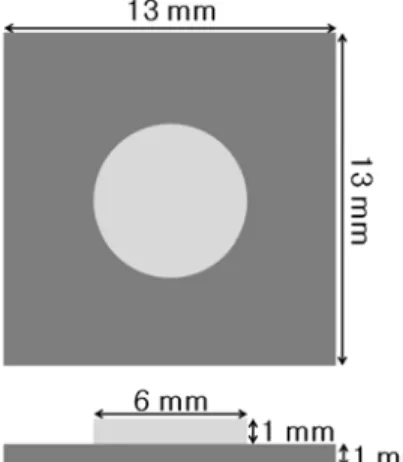
등5) 의 연구를 참조하여Fig. 1
과 같이 제작하였다.
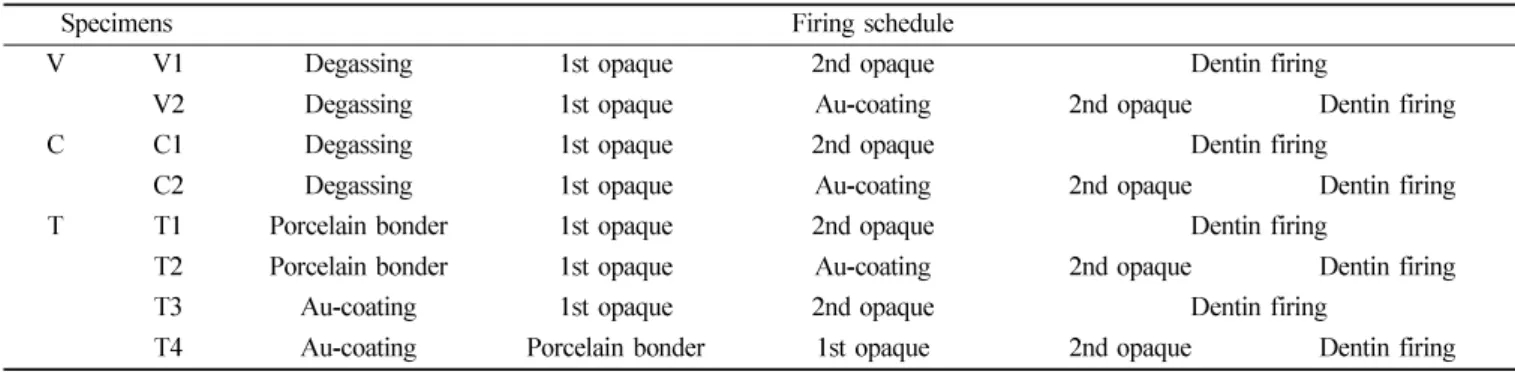
각군의시편제작과정은
Table 2
와같다. 3) cp-Ti
군Ti
시편은 전용의Vita Titankeramik
®(Vident, Brea, CA)
을사용하였다. porcelain bonder
층과Au
코팅층을Ti
시편에각각형성한다음
,
전용의도재를소성했을때금Table 1. Chemical composition in wt%
Composition Specification
(weight %) Note
Paste Au 90.00 Principal
component
Cu 0.18
Terpineol 7.22 Evaporation
after firing
Eucalytol 0.60
Ethylcellulose 2.00
Liquid Terpineol 95.50 Evaporation
after firing
Eucalytol 1.75
Ethylcellulose 2.75 Fig. 1. Dimension of metal-ceramic specimen.
속
-
도재간의결합력의 차이를비교하기위하여, 1
차불투 명 도재와porcelain bonder
그리고Au
코팅 층의 적층순서를달리하였다
(Table 2). gold coating agent
는800
oC
에서
2
번 도포하여소성하였고,
도재는제조회사지시에 의해서소성하였다.
3. 연구방법
1) 2
축굴곡시험시험은 특별한
die
와plunger(Fig 2)
가 장착된screw driven universal testing machine(Model 1125, instron,
Canton, MA)
을 사용하여 금속에서도재가 탈락될 때까지
0.1mm/min
의cross-head speed
로 압축강도를 가하였 다.
시험후시편상의 부착된도재조각들은nylon bristle brush
로제거하였다.
2) SEM/EDS analysis
시편의 표면은
EDS (Energy-dispersive X-ray Spectros- copy, Horiba, Japan)
가 있는SEM(Scanning electron microscope, S-4700, Hitachi, Japan)
으로 관찰하였다.
시 험이 끝난 시편 중심원내의3
곳을 임으로 정해서250
배 확대하여 사각형(420×300
µm)
내에서Si
부착율을 조사하였고
,
절단면시편은line profile
을 하여산화층의확산정도를관찰하였다
. Si Ka X-ray count
는금속표면에남아 부착된도재를측정하는데 매우신뢰할만한방법이고
, Si
함량은금속-
도재결합강도의지표로이용되었다.
결 과
1. SEM line profile
Fig. 3
은V
군과C
군,
그리고T
군의시편에서Au
코팅층과 산화층그리고 도재층간의 결합형태와 산화층확 산을 관찰하기위해 시행한
line profile
이다. Au
코팅층을 형성한
V2, C2
군과Au
코팅 층을형성하지 않은V1
과
C1
시편의line profile
을 비교해 보면Au
코팅 층이산화층확산을효과적으로제어하고있는것으로관찰되 었다
. V2
군과C2
군에서Au
코팅층과도재 층의결합은 잘일어나보였다.
Ti
에Au
코팅층을형성한Fig. 3
의T2, T3, T4
의절단 면시편에서불투명도재, porcelain bonder, Ti,
와Au
코팅층간의결합은잘일어나보였다
. Fig. 3
의T1, T2, T4
시편에도포한
porcelain bonder
는소성후에다공성을구조를형성하는것으로관찰되었는데
,
다공성구조는도재와
Ti,
그리고Au
코팅층과의결합력을저하시킬것으로생각된다
. Au
코팅 층을 형성한Fig. 3
의V2, C2, T2, T3, T4
시편line profile
에서Au
코팅 층을기준으로산 화층확산이잘제어되고있는것으로관찰되었다.
Fig. 4
는2
축 굴곡 시험이끝난 시편표면사진이다.
시 편표면에Au
코팅층과상아질도재와불투명도재,
그리고
porcelain bonder
로보이는물질이 관찰되었다. Fig. 4
의
V1, V2, C1, C2
시편에서금속-
도재간의결합실패형태는
cohesive failure
와adhesive failure
가혼재된양상이 관찰되었고, T1, T2, T3, T4
시편에서는 전형적인adhesive failure
의 양상이 관찰되었다. T1, T2,
시편에서는
porcelain bonder
층과Ti
계면에서의 박리가 되었고, T3
시편에서는Au
코팅층과Ti
계면에서의박리를관찰할 수 있었다
. T4
시편에서는T3
시편과 달리Au
코팅 층과porcelain bonder
층계면에서박리를관찰할수있었는데
porcelain bonder
층의다공성구조가결합력을저 하시킨것으로여겨진다.
Table 2. Firing schedule applied on Non-precious alloy and cp-Ti used in this study
Specimens Firing schedule
V V1 Degassing 1st opaque 2nd opaque Dentin firing
V2 Degassing 1st opaque Au-coating 2nd opaque Dentin firing
C C1 Degassing 1st opaque 2nd opaque Dentin firing
C2 Degassing 1st opaque Au-coating 2nd opaque Dentin firing
T T1 Porcelain bonder 1st opaque 2nd opaque Dentin firing
T2 Porcelain bonder 1st opaque Au-coating 2nd opaque Dentin firing
T3 Au-coating 1st opaque 2nd opaque Dentin firing
T4 Au-coating Porcelain bonder 1st opaque 2nd opaque Dentin firing
V ; Ni-Cr alloy, C ; Co-Cr alloy, T ; cp-Ti
Fig. 2. Schematic diagram of a special die and plunger.
Fig. 5
는도재탈락시험후에금속표면을관찰한사진 이다.
백색의밝은 부분은잔존하는porcelain
이고,
회색과검은부분은산화층과금속의부분이다
. V
군과C
군 에서Au
코팅 층을 형성한Fig. 5
의V2, C2
시편과Au
코팅 층을 형성하지 않은
V1, C1
시편표면에 잔존하는Si
의 부착율은 비슷한정도로 관찰되었다(Table 3). T
군의
T1, T2
시편표면에서는 다공성의porcelain bonder
가 관찰되었고, Fig. 4
의T4
시편에서는Au
코팅층이관찰Fig. 3. EDS line profile on cross section of specimens. (A) V1, (B) V2, (C) C1, (D) C2, (E) T1, (F) T2, (G) T3, (H) T4.
Fig. 4. Specimens surface after biaxial flexure test. (A) V1, (B) V2, (C) C1, (D) C2, (E) T1, (F) T2, (G) T3, (H) T4.
되었는데
,
이것은porcelain bonder
와Au
코팅 층간의cohesive failure
결합실패형태로생각된다.
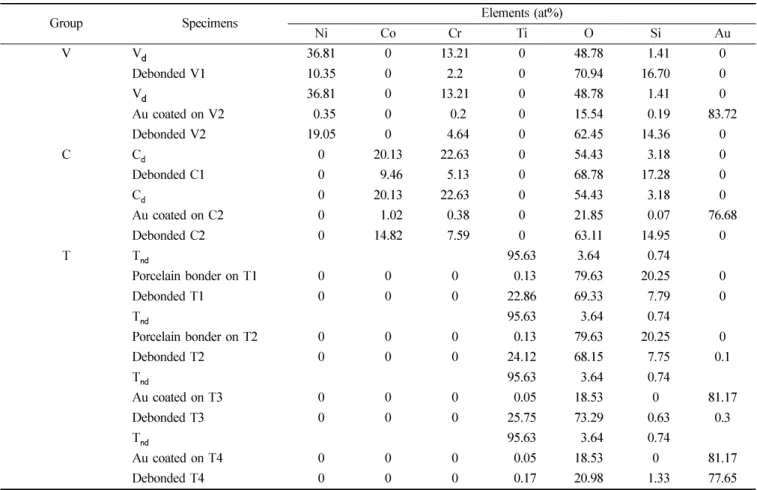
2. EDS analysis
Table 3
는 도재 탈락 시험이끝난 시편의표면의 중심원내를각시편 마다임의의
3
곳을250
배확대하여 사각형
(420×300
µm)
안의 성분을 조사하고,
각 시편에서 검 출되는성분들을나타내었다. Si
함량을비교하기 위하여, V
군과C
군은degassing
과정을 거친 시편표면과, Au
코 팅층을형성한시편을조사하였다. T
군은Au
코팅층과porcelain bonder
층소성전·후에각각조사하였다.
V
군의 시편에서 도재 탈락 후EDS
분석 결과V1
과V2
군의시편표면에 남아있는Si
함량은많은 차이가없는 것으로나타났다
. Au
코팅 층을형성한V2
군에서 도재탈락시험후
Au
가검출되지않았는데,
이것은Au
코팅층이금속보다는도재에더강하게결합되어금속표 면에서부터탈락이된것으로생각된다
. C
군시편의분석결과
C1
과C2
군시편의표면에남아있는Si
함량은V
군 과마찬가지로거의차이가없는것으로나타나, Au
코팅층이금속
-
도재간의결합강도에 미치는효과는미미하다고생각된다
.
Ti
군에서는porcelain bonder
를 적층한T1, T2
군과Au
코팅 층을적층한T3, T4
군 시편의EDS
결과를보 면T1, T2
군에서Si
부착율은porcelain bonder
소성전에 비해서 증가하였고
,
결합실패의 형태는adhesive failure
로 관찰되었다. T3
시편에서는2
축 굴곡 시험 후 조사한Si
부착율은 거의 차이가없었고, Au
가 검출되지 않았다.
이것은Au
코팅층이 도재층에 부착되어탈락이된것으로
, Au
코팅층이Ti
와의결합력보다도재와결합력이 상대적으로 더 높다는것을 나타낸다
. T4
의 시편 에서도Si
부착율차이는거의없었고, adhesive failure
의결합실패 양상이 관찰되었다
. T4
시편표면에서는Au
코 팅 층이 관찰되었는데, T3
시편과는 달리Au
코팅 층과porcelain bonder
층의 결합력이 상대적으로 약하다는 것을 의미한다
. Ti
군에서금속-
도재결합실패의 형태는대체적으로
adhesive failure
가 많이 관찰되었으며Si
의부착율의결과로미루어보면층간에적층된
Au
코팅층은 도재와Ti
간의 결합에거의 영향을 미치지않는다고생Fig. 5. SEM photomicrographs specimens after porcelain debonding. (A) V1, (B) V2, (C) C1, (D) C2, (E) T1, (F) T2, (G) T3, (H) T4.
각된다
.
도재탈락 시험후에도재-
금속간의결합실패양 상은Ni-Cr alloy
군과Co-Cr alloy
군 보다Ti
군에서adhesive failure
양상이두드러지게관찰되었다.
고 찰
도재전장금속관에서 도재와금속의결합력증진을위한
많은연구들이보고되고있다 17-22)
.
기계적결합이효과적이지만제한적이며
,
많은연구들에서화학적결합을가장주요한 요소로 보고하고있다
.
화학적 결합은 금속 표면 에 형성된산화물이 금속과도재로 확산되어 공유결합이 나 이온결합을 하는 것으로 알려져 있고31),
화학적 결합 을 이루게하는 금속계면의 산화층이 너무 과도하게형 성되었을 경우 얇은 산화층에 비해 접착 실패의 경향이 더 큰 것으로보고되고있다3).
특히Ti
경우800
oC
이상의온도에서두껍고분리가쉽게되는산화층을 형성하기
때문에
degassing
과정을거치지않아야한다고보고되고있고
, Ti
와 도재의결합은일반적으로Ni-Cr alloy
와Co- Cr alloy
보다 결합강도가 더 낮다고 알려져 있다24,25).
Adachi
등23)은 온도에 따른순수 티타늄의 부착성산화막형성능력을보고하였는데
, 1000
℃에서는 약1
µm
의두꺼 운 산화막을형성하여부착성 산화막이 전체 표면의1%
미만에서 형성되었고
, 750
oC
에서는 약32 nm
의 얇은 산 화층으로 가장 많은 부착성산화막이 형성되었다고 하였 다. Ti
소성과정에서발생하는과도한TiO
2 산화층을억제 하기 위해사용하는porcelain bonder
는Ti
와porcelain
간의 결합력을증진시키는데목적이있다32)
.
산화막형성에 관한 보고에서Lee
등5)은 금 박막층을sputtering
방식으로 코팅하고
,
금 박막층이 도재 소성 후 새로운 금속간 화합물Au
2Ti
를 형성하여 도재와 티타늄 산화층에 영향을 주어 도재와 결합을 용이하게 한다고 보고하였다
. Yamamoto
11)는합금의표면에gold bonding agent
등을사 용하는 것이심미적으로 우수하고 소성 과정에서 발생하 는 기포를 억제하지만 도재와금속의 결합강도에 미치는 영향은 적다고 하였다. Vickery
26)등은Au
코팅만으로는결합력에 영향을주지는않지만표면요철을만드는고융 점의금속가루나도재입자를포함하는
Au
코팅제는도재와의결합강도를높일수있다고하였다
.
본 연구에서는 도재소부용 비귀금속 합금의 도재 소성 과정 중에 발생하는 과도한 산화층을효과적으로 억제하 고금속표면의색을개선하여심미적으로우수한만족도 를 줄 수 있는
Au
코팅 층을 형성하고도재를 소성하였다
. Au
코팅층이도재와금속의결합강도에미치는영향을 설명하기 위해
SEM/EDS
분석과병행된2
축굴곡강Table 3. EDS analysis results(at%) on specimens surfaces before & after the porcelain debonding (n=5)
Group Specimens Elements (at%)
Ni Co Cr Ti O Si Au
V V
d36.81 0 13.21 0 48.78 01.41 0
Debonded V1 10.35 0 2.2 0 70.94 16.70 0
V
d36.81 0 13.21 0 48.78 01.41 0
Au coated on V2 00.35 0 00.2 0 15.54 00.19 83.72
Debonded V2 19.05 0 04.64 0 62.45 14.36 0
C C
d0 20.13 22.63 0 54.43 03.18 0
Debonded C1 0 09.46 05.13 0 68.78 17.28 0
C
d0 20.13 22.63 0 54.43 03.18 0
Au coated on C2 0 01.02 00.38 0 21.85 00.07 76.68
Debonded C2 0 14.82 07.59 0 63.11 14.95 0
T T
nd95.63 3.64 00.74
Porcelain bonder on T1 0 0 0 00.13 79.63 20.25 0
Debonded T1 0 0 0 22.86 69.33 07.79 0
T
nd95.63 03.64 00.74
Porcelain bonder on T2 0 0 0 00.13 79.63 20.25 0
Debonded T2 0 0 0 24.12 68.15 07.75 0.1
T
nd95.63 03.64 00.74
Au coated on T3 0 0 0 00.05 18.53 0 81.17
Debonded T3 0 0 0 25.75 73.29 00.63 00.30
T
nd95.63 03.64 00.74
Au coated on T4 0 0 0 00.05 18.53 0 81.17
Debonded T4 0 0 0 00.17 20.98 01.33 77.65
V
d: Ni-Cr alloy after degassing
,C
d: Co-Cr alloy after degassing, T
nd: non-degassing Ti
도시험을하였고
,
도재탈락시험 후금속의표면을
EDS
분석하여Si
부착율을 결합력의지표로 삼았다
.
금속과 도재 사이의 결합력을측정하는 여러방법들이제시되고있지만가장이 상적인방법에대한논란은계속되고있다
.
그 중2
축 굴 곡시험전·후Si
원자량에대한변화량을측정하는방법도훌륭한대안이라고여겨진다28-30)
.
연구결과를종합해보면
Ni-Cr alloy
군과Co-Cr alloy
군
,
그리고Ti
군의 절단면 시편 전자현미경 소견으로는Au
코팅 층은 산화층의 확산을 효과적으로 제어하고 있는 것으로 관찰되었다
. Ni-Cr alloy
와Co-Cr alloy
군의 결합 실패 형태는adhesive failure
와cohesive failure
가혼재된양상으로 관찰되었고
, Au
코팅층을 형성한군에서도재탈락시험후
Si
부착율이조금줄어들기는하였 지만,
금속-
도재의 결합력에미치는영향은크지않을 것이라고생각된다
.
이것은Yamamoto
11)의보고와일치하였 다.
Au
코팅층과Ti
전용의porcelain bonder
층을각각형 성한Ti
군에서는금속-
도재의결합실패형태는adhesive
failure
양상이 두드러지게 관찰되었다. Au
코팅 층을 형성한
T3, T4
군에서Si
부착율은 거의 차이가 없었고,
porcelain bonder
층을 형성한T1, T2
군에서는 도재 탈락 시험 후
Si
부착율이약간 증가한것으로 관찰되었는 데이것은porcelain bonder
의주요 성분때문 이라생각된다
. Ti
군에서는Ni-Cr alloy
군과Co-Cr alloy
군에비 해 도재탈락 시험 후Si
부착율이매우 낮은것으로 관찰되었는데
,
이것은porcelain
의반복소성과정중에두껍 고 분리가 쉽게 되는TiO
2 산화층이 과도하게 형성되기때문이라 여겨진다
. Si
부착율로 미루어 보면, Ti
군에Au
코팅층이금속-
도재결합에미치는영향은매우적은것으로나타났고
,
결합실패의 양상은adhesive failure
형태로나타났는데
sputtering
방식으로Au
코팅한Ti
의Si
부착율에 대한
Lee
등5)의 보고와는 일치하지는 않았지만, Vickery
26)등과Dand
와HerØ
7)의보고와는일치하였다.
도재소부용 비귀금속합금의도재소성과정에서발생하 는 과도한산화층의 제어와금속과의결합력을 증진시키 려는많은연구들이 보고되고 있다
.
다른코팅방법에비해
Au base bonding agent
를이용하는Au
코팅은임상에 서쉽게 사용할수 있는방법이지만,
금속과Au
코팅 층 그리고 도재와의 결합력을 증진 시킬 수 있는 지속적인 연구가필요할것으로사료된다.
요 약
본 연구는 도재소부용 비귀금속에
Au
코팅 층을 형성하고
, Au
코팅층이금속-
도재의결합력에미치는영향을알아보고자
2
축 굴곡 시험 후에SEM/EDS
방법으로 조 사하여비교하였다.
1. Ni-Cr alloy
군과Co-Cr alloy
군,
그리고Ti
군의절단면 시편의전자현미경 사진에서
Au
코팅 층은산 화층의확산을제어하는것으로관찰되었다.
2. 2
축 굴곡 시험후에EDS
분석결과Ni-Cr alloy
군 과Co-Cr alloy
군에서Si
함량은Au
코팅 층을형 성한 시편에서 약간감소하였고,
결합실패의 형태는cohesive failure
와adhesive failure
가 혼재된 양상으 로관찰되었다.
3. Ni-Cr alloy
군과Co-Cr alloy
군에서Au
코팅 층은 도재-
금속결합력에미치는영향은미미하였다. 4. Ti
군의 결합실패 형태는Ni-Cr alloy
군과Co-Cr
alloy
군에 비해서adhesive failure
양상이 두드러지게 관찰되었고
, Au
코팅 층은 도재-
금속 결합력에 영향을미치지않았다.
이상의 결과 비귀금속에 적용한
Au
코팅은 산화층의확산을제어 하는것으로 관찰되었으나
,
금속-
도재 간의 결합력증진에 미치는효과는미미하였다. Au
코팅을이용하여 금속