INTRODUCTION
Radical cystectomy is considered the standard treatment for muscle-invasive bladder cancer, and over recent years surgical techniques have improved and urinary diversion has been intro- duced, which have undoubtedly improved quality of life. How- ever, even the construction of a neobladder with continent uri- nary diversion cannot substitute for the original bladder. Resul- tantly, trimodality treatment, including transurethral resec- tion of bladder tumor (TURBT) and chemoradiotherapy (CRT) has been suggested as a bladder-preserving therapy in invasive bladder cancer over the past two decades (1-4). To my knowl- edge, no study has been reported on a prospectively designed trimodality protocol for muscle-invasive bladder cancer in Korean patients. To determine the clinical effectiveness of this trimodality treatment, we designed the present study of concurrent CRT incorporating cisplatin following TURBT for the treatment of muscle-invasive bladder cancer.
MATERIALS AND METHODS Patient selection
Patient with cT2-3 bladder cancer and an eastern cooper-
ative oncology group (ECOG) of <2 were enrolled in this study. Initial evaluations included chest radiography, com- puted tomography (CT) scan of abdomen and pelvis, com- plete blood count (CBC) and serum chemistry, and creati- nine clearance. A white blood cell (WBC) of >4,000/μL, a platelet count of >100,000/μL, bilirubin <1.5 mL/dL, and a creatinine clearance of >60 mL/min were mandatory. Patients were excluded if there was evidence of distant metastases, or prior pelvic irradiation, or if cisplatin chemotherapy was con- traindicated.
A trimodality treatment was recommended as an alterna- tive treatment to radical cystectomy only to patients who un- derwent complete TURBT. On the other hand, radical cys- tectomy was strongly recommended as a standard treatment to patients if complete TURBT was deemed impossible. When patients refused to undergo an operation designed to remove the native bladder, they were considered for the present study.
After giving written informed consent, patients were enrolled for the concurrent CRT protocol, which was initiated 3-4 weeks after TURBT.
Treatment protocol TURBT
TURBT was performed layer by layer, which produced three
598
Jae Young Joung, Kyung Seok Han, Taek Sang Kim, Ho Kyung Seo, Jinsoo Chung, and Kang Hyun Lee
Urologic Oncology Clinic, Institute and Hospital, National Cancer Center, Goyang, Korea
Address for correspondence Kang Hyun Lee, M.D.
Urologic Oncologic Clinic, National Cancer Center, 809 Madu-dong, Ilnsan-gu, Goyang 410-769, Korea Tel : +82.31-920-1676, Fax : +82.31-920-1520 E-mail : [email protected]
*This study was supported by a National Cancer Center Grant, No. 0510200.
DOI: 10.3346/jkms.2008.23.4.598
Single Institutional Experience of Bladder-Preserving Trimodality Treatment for Muscle-Invasive Bladder Cancer
The authors designed this study to determine the clinical effectiveness of trimodality treatment, i.e., transurethral resection of a bladder tumor (TURBT) and concurrent chemoradiotherapy (CRT). Twenty patients with a muscle-invasive bladder cancer were treated by TURBT followed by concurrent cisplatin (75 mg/m2day), adminis- tered on weeks 1 and 4 of radiotherapy. According to residual tumor status after TURBT, patients were classified into patients with a complete TURBT group and incomplete TURBT group. Response to treatment was evaluated by restaging TURBT at 4 weeks after completing CRT (post-CRT). Fifteen patients (75%) achiev- ed complete remission (CR) at restaging; 10 patients (50%) remained continuous- ly free of tumor recurrence. Disease-specific and overall survivals were 51.1% and 38.6% at 5 yr post-CRT, respectively. Of 16 patients in the complete TURBT group, 14 patients (87.5%) achieved CR, which was significantly different from that observed in the incomplete TURBT group, in which only 1 (25%) of 4 patients achieved CR (p=0.032). Five- year disease-specific and overall survivals were 71.6% and 53.5%, respectively. Ten patients (90.9%) maintained their own bladder among the 11 surviving patients. Trimodality treatment was found to be an effective treatment in patients who underwent complete TURBT for a muscle-invasive bladder cancer.
Key Words : Urinary Bladder Neoplasms; Cisplatin; Combined Modality Treatment
Received : 4 September 2007 Accepted : 10 December 2007
separate specimen groups according to depth, i.e., the super- ficial layer from mucosa and submucosa, deep layer from super- ficial muscle, and a bottom layer from deep muscle. Complete- ness of TURBT was assessed according to residual tumor sta- tus. Tumor infiltration in the deep layer with no tumor infil- tration in the bottom layer was defined as microscopic no resid- ual tumor. Scant tumor infiltration (up to 2 foci per high power field, ×400) in the bottom layer and prominent tumor infil- tration in the deep layer was defined as microscopic residual tumor, and gross residual tumor on the resection surface or prominent tumor infiltration even in the bottom layer was defined macroscopic residual tumor. Therefore, complete TURBT was defined as microscopic no residual tumor or mi- croscopic residual tumor, whereas incomplete TURBT was defined as macroscopic residual tumor.
Concurrent chemoradiotherapy
Radiotherapy was initiated 3-4 weeks after TURBT using 6- to 10-MV photons and a four-field box technique with individually shaped portals and daily fractions of 1.8 Gy on 5 consecutive days. Planned target volumes (PTV) consisted of the bladder and tumor with a 2-cm contoured margin. PTV were sometimes modified after administering a dose of 40 or 45 Gy and a cone down boost was given to exclude the unin- volved part of the bladder, provided the tumor was unifocal and well lateralized. The total dose given during the induc- tion period was 45 Gy in 1.8 Gy daily fractions over 5 weeks and 20 Gy in 1.8 Gy daily fractions over 2 weeks during the consolidation period. Therefore, total doses administered to whole bladder and pelvic lymph node ranged from 45 and 65 Gy. As concurrent chemotherapy, cisplatin 75 mg/m2was administered by slow intravenous infusion in conjunction with adequate hydration on weeks 1 and 4 of radiotherapy.
Response evaluation and salvage treatment
Four weeks after completing CRT (post-CRT), initial res- ponse was evaluated by restaging TURBT of the former tumor region, and by urine cytology and CT. Complete remission was diagnosed when no evidence of residual tumor was found on restaging TURBT, no cancer cells were found by urine cytology, and there was no evidence of tumor recurrence by CT. Patients were regarded as having local failure if they had superficial recurrence or persistent invasive cancer by restag- ing TURBT at 4 weeks post-CRT, and were regarded as hav- ing distant failure if they had developed metastasis by CT. In case of persistent invasive cancer at initial evaluation after CRT, salvage cystectomy was preferentially recommended.
Follow-up schedules
In case of complete response at 4 weeks post-CRT, patients were followed up at 3-months intervals by CT, urine cytolo- gy, and by cystoscopic biopsy (the latter was performed when cystoscopic findings were suspicious). Follow-up was performed on a 3 monthly basis for the first 3 yr, 6 monthly for the next
3 yr, and then annually. In addition, acute hematologic and non-hematologic toxicities were assessed weekly during CRT according to the National Cancer Institute Common Toxic- ity Criteria, version 2.0, and late complications were noted during follow-up.
End points and statistical analysis
The major statistical endpoints of this study were; the CR rate at 4 weeks post-CRT, disease-specific survival (DSS) at 5 yr, and overall survival (OS) at 5 yr. Actuarial survival rates were calculated from the end of CRT to the time of the last follow-up visit or death, using the Kaplan-Meier method. The Mann-Whitney U test was used to analyze continuous variable and the chi-square or Fisher’s exact tests were used to analyze categorical variables. Statistical significance was accepted at the p<0.05 (two-sided) level. Statistical analysis was performed entirely using the Statistical Package for the Social Sciences for Windows, version 11 (SPSS Inc, Chicago, IL, U.S.A.).
RESULTS Patient characteristics
From March 2000 to January 2006, 22 patients with mus- cle-invasive cT2-3 bladder cancer were enrolled in this prospec- tive study. Of these, 20 patients completed the CRT protocol and two patients were excluded because they refused to con- tinue with the study protocol during radiotherapy induction in the absence of complications. CRT was actively recommend- ed as an alternative treatment to radical cystectomy in 16 pa-
WHO, World Health Organization; CIS, carcinoma in situ.
Variables No. of patients (%)
Male vs. female 11 (55) vs. 9 (45)
Primary tumor 10 (50)
Recurrent tumor 10 (50)
Tumor size
<5 cm 8 (40)
≥5 cm 12 (60)
Multiplicity
Single 10 (50)
Multiple 10 (50)
Clinical stage
T2N0M0 12 (60)
T3N0M0 8 (40)
Grade (WHO grade)
1-2 4 (20)
3 16 (80)
Associated CIS 1 (5)
Residual tumor status
No microscopic residual tumor 3 (15) Microscopic residual tumor 13 (65)
Macroscopic residual tumor 4 (20)
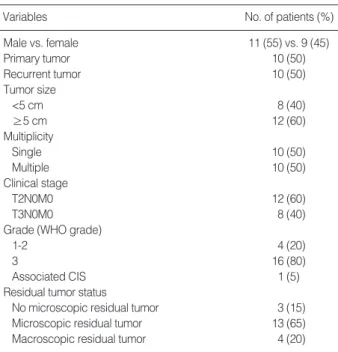
Table 1. Patient characteristics (n=20)
tients with complete TURBT. On the other hand, radical cystectomy was preferentially recommended in 4 patients with incomplete TURBT. However, these 4 patients strongly want to preserve the native bladder and voluntarily enrolled in this study. The characteristics of the 20 patients are outlined in Table 1.
Initial response and salvage treatment
In terms of initial response at 4 weeks post-CRT, 15 patients (75%) achieved CR and 5 patients (25%) had a persistent invasive cancer at 4 weeks post-TURBT. In terms of response to CRT according to the completeness of TURBT, 14 (87.5
%) of 16 patients with complete TURBT achieved CR where- as only 1 (25%) of 4 patients with incomplete TURBT ac- hieved CR, which was significant (p=0.032). Radical cystec- tomy was preferentially recommended as a salvage treatment to 5 patients who failed to achieve CR as an initial response to CRT. However, only one patient accepted our suggestion;
the other 4 chose CMV (cisplatin, methotrexate, and vin- blastine) chemotherapy rather than an operation.
Tumor recurrence after complete remission
Of 15 patients with CR at initial response, tumor recurrence (both local and distant) occurred in 7 patients. Two patients showed invasive tumor recurrence at the preserved bladder 6 months and 52 months post-CRT. The patient with later recurrence developed a recurrent superficial cancer before an
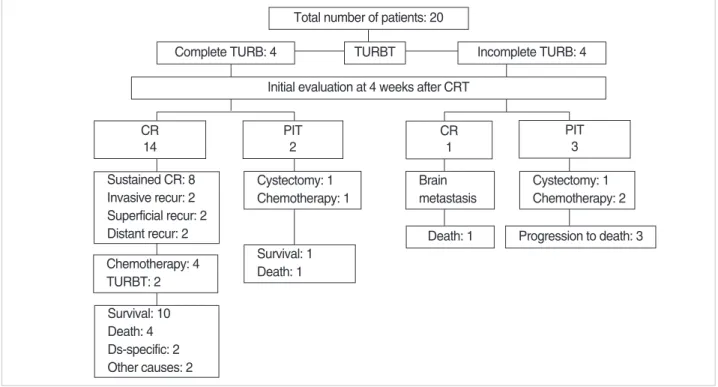
invasive cancer. For salvage treatment of invasive cancer, both patients requested chemotherapy rather than salvage cystec- tomy, and they remained in a locally controlled state with no evidence of distant metastasis by cystoscopy or CT scan at 6 months after chemotherapy using MVAC regimen. On the other hand, isolated superficial recurrences were found in anoth- er 2 patients. Of these, one patient experienced superficial recurrences on three occasions, which were managed by TUR and intravesical chemotherapy. The other patient showed expe- rienced a single recurrence at 48 months post-CRT. In anoth- er 3 patients, isolated distant metastases to brain, lung and liver developed at 6, 10 and 24 months post-CRT, and under- went MVAC (methotrexate, vinblastine, adriamycin, and cis- platin) for the treatment of distant metastasis. Subsequently, they died of progression to bladder cancer. Treatment out- comes are summarized in Fig. 1.
Survival and bladder preservation
After 33 months (range, 8-62 months) of median follow- up period for all study subjects, 9 deaths had occurred. All 4 patients with incomplete TURBT died of bladder cancer progression at a median 12 months (range, 8-43 months) post-CRT. On the other hand, of the 16 patients with com- plete TURBT, 3 patients died of bladder cancer progression and 2 of other causes (lung cancer and a heart attack). DSS and OS rates for all 20 patients were 51.1% and 38.6% at 5 yr, respectively, and those of the 16 patients with complete TURBT were 71.6% and 53.5%, respectively. DSS and OS
Fig. 1. Treatment outcomes. TURBT, transurethral resection of bladder tumor; CR, complete remission, PIT, persistent invasive tumor; recur, recurrence; Ds, disease.
Total number of patients: 20
CR 14
PIT 2 Sustained CR: 8
Invasive recur: 2 Superficial recur: 2 Distant recur: 2 Chemotherapy: 4 TURBT: 2 Survival: 10 Death: 4 Ds-specific: 2 Other causes: 2
Cystectomy: 1 Chemotherapy: 1
Survival: 1 Death: 1
TURBT Incomplete TURB: 4
Complete TURB: 4
Initial evaluation at 4 weeks after CRT
CR 1
PIT 3 Brain
metastasis
Cystectomy: 1 Chemotherapy: 2 Death: 1 Progression to death: 3
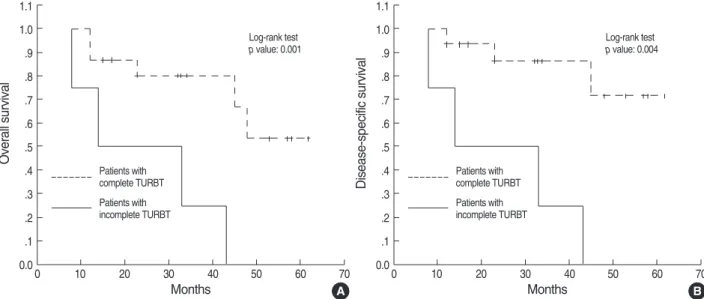
rates showed significant differences according to the com- pleteness of TURBT (DSS, p=0.004; OS, p=0.001) (Fig. 2).
Of the 11 surviving patients, 10 patients (90.9%) retained their own bladders at the time of analysis.
Treatment-related toxicities
Toxicities are briefly presented in Table 2. In terms of hema- tologic toxicities, neutropenia, leukopenia, thrombocytope- nia, and anemia were reported in 1 (5%), 5 (25%), 2 (10%), and 2 (10%) patients, respectively. Only one patient (5%) required a dose reduction due to neutropenia, and recovered within 2 weeks. In terms of non-hematologic toxicities, diar- rhea was most frequently reported and occurred in 7 (35%) patients. No case of grade 3-4 non-hematologic toxicity was encountered. All patients who experienced a non-hematolog- ic toxicity recovered with conservative treatment. In terms of bladder function, mild dysuria, urgency, and nocturia were registered in 20-55% of patients, but these were temporary and improved 3 months post-CRT. No remarkable late com- plication occurred, though one patient complained of noctur-
nal frequency due to a decreased functional bladder capacity.
DISCUSSION
Traditionally, transitional cell carcinoma (TCC) is known to be sensitive to cisplatin-based chemotherapy (5). In addi- tion, radiation therapy has been administered to patients who appear to be unsuitable for radical cystectomy (6). However, in the case of muscle-invasive bladder cancer, adequate can- cer control cannot be achieved by TURBT, chemotherapy, or radiotherapy alone. Over the last two decades, some centers in the United States and Europe adopted a trimodality treat- ment (1-4).
The rationale for combining radiotherapy with chemother- apy after TURBT is twofold. First, certain cytotoxic agents may have the ability to sensitize cancer cells to radiation and to inhibit repopulation during radiotherapy. Second, high rates of occult metastases require that efforts to eradicate occult me- tastases that have already developed in as many as 50% of muscle-invasive cancer (7).
There are two main concerns about CRT. The selection of optimal regimens and ideal candidates are main issues following bladder-preserving therapy, but optimal regimens have not been established. In general, cisplatin and 5-FU (fluorouracil) are still recommended by many investigators, because both agents have been shown to have radiosensitizing activities and acceptable toxicities (8). In addition, to these two drugs, newer chemotherapeutic agents, particularly gemcitabine and tax- anes, have also been shown to be potent radiation sensitizers (9). Furthermore, recent studies have established that gemc- itabine in combination with radiotherapy as a feasible regimen for bladder sparing treatments, and other series have shown that concurrent CRT using platinum and paclitaxel or doc-
Fig. 2. Kaplan-Meier estimates of likelihood of overall survival (A) and disease-specific survival (B) for patients with complete TURBT vs.
incomplete TURBT.
A
Overall survival
1.1 1.0 .9 .8 .7 .6 .5 .4 .3 .2 .1
0.00 10 20 30 40 50 60 70
Log-rank test p value: 0.001
Patients with complete TURBT Patients with incomplete TURBT
Months B
Disease-specific survival
1.1 1.0 .9 .8 .7 .6 .5 .4 .3 .2 .1
0.00 10 20 30 40 50 60 70
Log-rank test p value: 0.004
Patients with complete TURBT Patients with incomplete TURBT
Months
Variables No. of patients (%)
Hematologic
Neutropenia 1 (5)
Leukopenia 5 (25)
Thrombocytopenia 2 (10)
Anemia 2 (10)
Non-hematologic
Diarrhea 7 (35)
Irritative voiding symptoms 11 (55)
Nausea and vomiting 2 (10)
Table 2. Treatment-related acute toxicity according to the Nation- al Cancer Institute Common Toxicity Criteria
etaxel was also an effective regimen (10, 11). Recently, the relation between radiosensitization and the inhibition of onco- gene products, such as, H-ras and c-erbB-1, has been the focus of attention (12, 13).
The selection of ideal candidates for CRT is another impor- tant issue for successful bladder-preserving treatment. Some studies have been undertaken to identify clinical factors that help distinguish candidates for trimodality treatment. Rodel et al. concluded that the completeness of TURBT is one of the most potent factors of survival after CRT for patients with invasive bladder cancer (14). In our patients with complete TURBT, the rate of CR was 87.5% and the 5-yr disease-spe- cific and overall survivals were 71.6% and 53.5%, respective- ly. Our patients with complete TURBT were found to be more likely to respond to CRT and to have a higher survival rate than the 4 patients with incomplete TURBT. These findings are comparable with those of other studies on CRT, which achieved overall survivals of 45-60% (7, 14-16). Other clin- ical factors that have been considered when choosing patients for bladder preserving surgery include; small tumor size (<5 cm), early tumor stage, absence of ureteral obstruction, and no evidence of pelvic lymph node metastases (7). In addition to clinical factors, several promising molecular markers, such as p53, bcl-2, bax, and pRB may help predict response to specific cytotoxic therapies (17-19).
In terms of the timing of evaluating initial response to CRT, there are two strategies, i.e., early and delayed evaluation. In our study, delayed evaluation was performed at 4 weeks post- CRT. In a study by Erlangen and several others, responses were evaluated 4 to 6 weeks post-CRT by restaging TURBT (1-3).
Conversely, according to the Massachusetts General Hospital (MGH) and Radiation Therapeutic Oncology Group (RTOG) protocols, response evaluation should be performed much earlier, i.e., after approximately 40 Gy of induction radiation therapy (20-22). In the literature, salvage cystectomy plays an important role in patients with a persistent tumor after CRT. In this study, we also preferentially recommended cys- tectomy, but the majority of patients with a persistent tumor at initial evaluation after CRT refused a salvage operation.
Thus, we performed cystectomy as a salvage treatment in only 1 of the 5 patients with a persistent tumor at initial evalua- tion after CRT. In the Erlangen series, which used a late- response evaluation at 4 to 6 weeks post-CRT (1-3), the dis- ease-specific survival rate at 5 yr for patients treated by sal- vage cystectomy for invasive relapse was 51%. Similarly, in the Boston series, the 5-yr disease-specific survival rate for patients that ultimately underwent salvage cystectomy, but after early-response evaluation, was approximately 50% (23).
Thus, available findings reveal no difference in survival after salvage cystectomy according to the time of initial evalua- tion after CRT.
In our subjects, 4 of 15 patients that achieved CR at initial evaluations after CRT developed a recurrent tumor at the pre- served bladder. Of these 4 patients, 2 had a superficial cancer
and 2 had an invasive cancer. Two patients with superficial recurrence were easily managed by TURBT and survived with bladder preservation at the time of analysis. Of two patients with superficial recurrence, one patient showed experienced a single recurrence at 48 months post-CRT. Moreover, 3 of 15 patients that achieved CR at initial evaluations after CRT devel- oped isolated distant metastasis. Thus, close follow-up of pati- ents after organ-preserving treatment is mandatory in patients who achieve CR at initial evaluations after CRT for a long time.
Generally, 30% of patients who achieved initial CR after CRT developed a recurrent tumor in the preserved bladder, and about a half of these recurrent cancer were superficial (7).
We found that the common acute side effects by CRT are transient diarrhea and voiding symptoms (frequency and urgen- cy), which were common but easily managed with support- ive treatment. Moreover, these symptoms usually resolved within 2 or 3 weeks of completing treatment. In this study, 55% and 35% of patients experienced voiding symptoms and diarrhea, respectively. At the time of analysis, no patient required cystectomy for bladder contraction by radiation, but in the largest series conducted to date by Erlangen, 2% of patients required cystectomy for bladder shrinkage, 10% re- ported some degree of incontinence or increased micturition frequency, and 1.5% of patients experienced a late gastroin- testinal toxicity (bowel obstruction) requiring surgical inter- vention (14).
The present study is limited by the small number of patients recruited, which is why we could not analyze results with res- pect to clinical factors, especially the completeness of TURBT.
A study with a greater number of patients is required to iden- tify factors that distinguish candidates for bladder-preserving treatment. In our study, we could not perform salvage cystec- tomy on patients with a persistent tumor after CRT, and num- ber of patients with incomplete TURBT was too small to reach the conclusion of survival differences with respect to the com- pleteness of TURBT. However, considering that salvage cys- tectomy was performed in only 2 patients, 5-yr disease-spe- cific and overall survivals for the 16 patients with complete TURBT were better than those reported by large studies in the US and Europe (1-4). Furthermore, the 5-yr overall sur- vival rate was comparable to the results of radical cystectomy from large surgical series, which showed 48% from the Uni- versity of Southern California and 45% from Memorial Sloan- Kettering Cancer Center (24).
The trimodality treatment was found to be an effective treatment option for patients with a muscle-invasive blad- der cancer who underwent complete TURBT. Close follow- up of patients after CRT is mandatory even in those patients who achieved CR at initial response evaluations.
REFERENCES
1. Shipley WU, Prout GR JR, Einstein AB, Coombs LJ, Wajsman Z,
Soloway MS, Englander L, Barton BA, Hafermann MD. Treatment of invasive bladder cancer by cisplatin and radiation in patients unsuit- ed for surgery. JAMA 1987; 258: 931-5.
2. Housset M, Maulard C, Chretien Y, Dufour B, Delanian S, Huart J, Colardelle F, Brunel P, Baillet F. Combined radiation and chemother- apy for invasive transitional-cell carcinoma of the bladder; a prospec- tive study. J Clin Oncol 1993; 11: 2150-7.
3. Sauer R, Dunst J, Altendorf-Hofmann A, Fischer H, Bornhof C, Schrott KM. Radiotherapy with and without cisplatin in bladder cancer. Int J Radiat Oncol Biol Phys 1990; 19: 687-91.
4. Kachnic LA, Kaufman DS, Heney NM, Althausen AF, Griffin PP, Zietman AL, Shipley WU. Bladder preservation by combined modal- ity therapy for invasive bladder cancer. J Clin Oncol 1997; 15: 1022-9.
5. Bajorin DF, Dodd PM, Mazumdar M, Fazzari M, McCaffrey JA, Scher HI, Herr H, Higgins G, Boyle MG. Long term survival in metastatic transitional cell carcinoma and prognostic factors predicting outcome of therapy. J Clin Oncol 1999; 17: 3173-81.
6. Gospodarowicz MK, Warde P. The role of radiation therapy in the management of transitional cell carcinoma of the bladder. Hematol Oncol Clin North Am 1992; 6: 147-68.
7. Rodel C, Weiss C, Sauer R. Trimodality treatment and selective organ preservation for bladder cancer. J Clin Oncol 2006; 24: 5536-44.
8. Weiss C, Engehausen DG, Krause FS, Papadopoulos T, Dunst J, Sauer R, Rodel C. Radiochemotherapy with cisplatin and 5-fluorouracil after transurethral surgery in patients with bladder cancer. Int J Radi- at Oncol Biol Phys 2007; 68: 1072-80.
9. Sangar VK, McBain CA, Lyons J, Ramani VA, Logue JP, Wylie JP, Clarke NW, Cowan RA. Phase I study of conformal radiotherapy with concurrent gemcitabine in locally advanced bladder cancer. Int J Radi- at Oncol Biol Phys 2005; 61: 420-5.
10. Varveris H, Delakas D, Anezinis P, Haldeopoulos D, Mazonakis M, Damilakis J, Metaxaris G, Chondros N, Mavromanolakis E, Daskal- opoulos G, Dimitrakopoulos A, Kranidis A. Concurrent platinum and docetaxel chemotherapy and external radical radiotherapy in patients with invasive transitional cell carcinoma: a preliminary report of tolerance and local control. Anticancer Res 1997; 17: 4771-80.
11. Nichols RC Jr, Sweetser MG, Mahmood SK, Malamud FC, Dunn NP, Adams JP, Kyker JS, Lydick K. Radiation therapy and concomi- tant palcitaxel/carboplatin chemotherapy for muscle invasive tran- sitional cell carcinoma of the bladder: a well tolerated condition. Int J Cancer 2000; 90: 281-6.
12. Cohen-Jonathan E, Muschel RJ, Gillies McKenna W, Evans SM, Cerniglia G, Mick R, Kusewitt D, Sebti SM, Hamilton AD, Oliff A, Kohl N, Gibbs JB, Bernhard EJ. Farnesyltransferase inhibitors poten- tiate the antitumor effect of radiation on a human tumor xenograft expressing activated HRAS. Radiat Res 2000; 154: 125-32.
13. Chakravarti A, Winter K, Wu CL, Kaufman D, Hammond E, Par- liament M, Tester W, Hagan M, Grignon D, Heney N, Pollack A, San- dler H, Shipley W. Expression of the epidermal growth factor recep- tor and Her-2 are predictors of favorable outcome and reduced com- plete response rates, respectively, in patients with muscle-invading bladder cancers treated by concurrent radiation and cisplatin-based
chemotherapy: a report from the Radiation Therapy Oncology Group.
Int J Radiat Oncol Biol Phys 2005; 62: 309-17.
14. Rodel C, Grabenbauer GG, Kuhn R, Papadopoulos T, Dunst J, Meyer M, Schrott KM, Sauer R. Combined-modality treatment and selec- tive organ preservation in invasive bladder cancer: Long-term results.
J Clin Oncol 2002; 20: 3061-71.
15. Dunst J, Diestelhorst A, Kuhn R, Muller AC, Scholz HJ, Fornara P.
Organ-sparing treatment in muscle-invasive bladder cancer. Strahlen- ther Onkol 2005; 181: 632-7.
16. Danesi DT, Arcangeli G, Cruciani E, Altavista P, Mecozzi A, Sara- cino B, Orefici F. Conservative treatment of invasive bladder carci- noma by transurethral resection, protracted intravenous infusion ch- emotherapy, and hyperfractionated radiotherapy: long term results.
Cancer 2004; 101: 2540-8.
17. Osen I, Fossa SD, Majak B, Rotterud R, Berner A. Prognostic factors in muscle-invasive bladder cancer treated with radiotherapy: an im- munohistochemical study. Br J Urol 1998; 81: 862-9.
18. Rodel C, Grabenbauer GG, Rodel F, Birkenhake S, Kuhn R, Martus P, Zorcher T, Fursich D, Papadopoulos T, Dunst J, Schrott KM, Sauer R. Apoptosis, p53, bcl-2, and Ki-67 in invasive bladder carcinoma:
possible predictors for response to radiochemotherapy and success- ful bladder preservation. Int J Radiat Oncol Biol Phys 2000; 46: 1213- 21.
19. Pollack A, Wu CS, Czerniak B, Zagars GK, Benedict WF, McDon- nell TJ. Abnormal bcl-2 and pRb expression are independent corre- lates of radiation response in muscle-invasive bladder cancer. Clin Cancer Res 1997; 3: 1823-9.
20. Zietman AL, Shipley WU, Kaufman DS, Zehr EM, Heney NM, Al- thausen AF, McGovern FJ. A phase I/II trial of transurethral surgery combined with concurrent cisplatin, 5-fluorouracil and twice daily radiation followed by selective bladder preservation in operable patients with muscle invading bladder cancer. J Urol 1998; 150: 1673-7.
21. Kaufman DS, Winter KA, Shipley WU, Heney NM, Chetner MP, Souhami L, Zlotecki RA, Sause WT, True LD. The initial results in muscle-invading bladder cancer of RTOG 95-06: phase I/II trial of transurethral surgery plus radiation therapy with concurrent cis- platin and 5-fluorouracil followed by selective bladder preservation or cystectomy depending on the initial response. Oncologist 2000; 5:
471-6.
22. Hagan MP, Winter KA, Kaufman DS, Wajsman Z, Zietman AL, Heney NM, Toonkel LM, Jones CU, Roberts JD, Shipley WU. RTOG 97-06:
Initial report of a phase I-II trial of selective bladder conservation using TURBT, twice daily accelerated irradiation sensitized with cis- platin, and adjuvant MCV combination chemotherapy. Int J Radiat Oncol Biol Phys 2003; 57: 665-72.
23. Shipley WU, Kaufman DS, Zehr E, Heney NM, Lane SC, Thakral HK, Althausen AF, Zietman AL. Selective bladder preservation by combined modality protocol treatment: Long-term outcomes of 190 patients with invasive bladder cancer. Urology 2002; 60: 62-8.
24. Dalbagni G, Genega E, Hashibe M, Zhang ZF, Russo P, Herr H, Reuter V. Cystectomy for bladder cancer: a contemporary series. J Urol 2001;
165: 1111-6.