• 검색 결과가 없습니다.

Treatment of Large Arteriovenous Malformation in Right Lower Limb

N/A
N/A
Protected

Academic year: 2021

Share "Treatment of Large Arteriovenous Malformation in Right Lower Limb"

Copied!
5
0
0

로드 중.... (전체 텍스트 보기)

전체 글

(1)

http://dx.doi.org/10.5090/kjtcs.2014.47.1.66 ISSN: 2233-601X (Print) ISSN: 2093-6516 (Online)

Departments of

1

Thoracic and Cardiovascular Surgery and

2

Anesthesiology and Pain Medicine, Kyungpook National University School of Medicine

Received: June 19, 2013, Revised: September 16, 2013, Accepted: October 24, 2013

Corresponding author: Seong Wook Hong, Department of Anesthesiology and Pain Medicine, Kyungpook National University School of Medicine, 680 Gukchaebosang-ro, Jung-gu, Daegu 700-842, Korea

(Tel) 82-53-200-5872 (Fax) 82-53-426-2760 (E-mail) [email protected]

C

The Korean Society for Thoracic and Cardiovascular Surgery. 2014. All right reserved.

CC
This is an open access article distributed under the terms of the Creative Commons Attribution Non-Commercial License (http://creative- commons.org/licenses/by-nc/3.0) which permits unrestricted non-commercial use, distribution, and reproduction in any medium, provided the original work is properly cited.

Treatment of Large Arteriovenous Malformation in Right Lower Limb

Young Ok Lee, M.D.

1

, Seong Wook Hong, M.D.

2

A 10-year-old boy with arteriovenous malformation (AVM) of the right lower limb was scheduled for an amputation of the affected limb. Limb amputation was necessary because of the ineffectiveness of previous sclerotherapy and the rapid progression of AVM causing pain and heart failure. Right hip disarticulation was considered the best op- tion to improve his quality of life. To prevent congestive heart failure and uncontrollable hemorrhage during surgery, the disarticulation was done under a partial cardiopulmonary bypass. The patient underwent surgery successfully without complications.

Key words: 1. Arteriovenous malformations 2. Cardiopulmonary bypass 3. Heart failure

CASE REPORT

A 10-year-old boy (height, 120 cm; weight, 20 kg) pre- sented with an 8-year history of arteriovenous malformation (AVM) involving the right lower limb. He had been started on sclerotherapy 4 years earlier because of leg length discrep- ancy causing gait disturbance. However, this treatment was stopped because there was no remarkable improvement. A year before presentation, the AVM had undergone rapid ex- pansion causing significant pain and high-output cardiac failure. Therefore, an amputation of the affected lower limb was recommended at the other hospital.

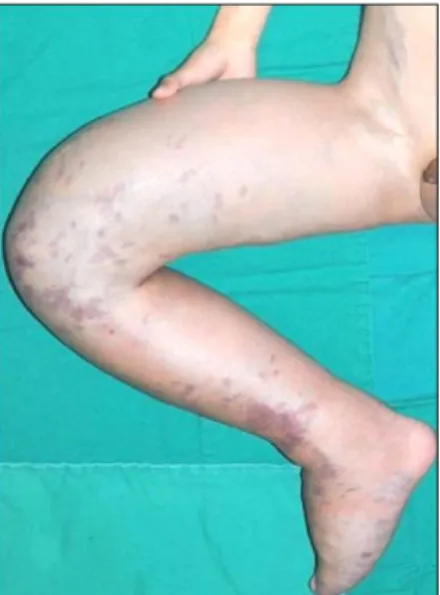
On admission to Kyungpook National University Hospital, an examination revealed that AVM with soft tissue hyper- trophy had spread all over the right leg (Fig. 1). A chest X-ray showed marked cardiomegaly with increased pulmonary

vascularities (Fig. 2A). Electrocardiography showed normal sinus rhythm with right ventricular hypertrophy. Two-dimen- sional echocardiography showed an enlarged right atrium, right ventricle, and left ventricle, but relatively good left ven- tricular contractility. The pulmonary artery was also enlarged, but there was no pulmonary edema. Computed tomographic (CT) angiography of the right lower extremity revealed ex- tensive AVM with feeding arteries from the branches of the right profunda femoris and superficial femoral arteries. The venous drainage was through the superficial femoral and deep femoral veins, and there was a marked dilatation of the pel- vic vein and inferior vena cava (Fig. 3A). The blood inves- tigations were found to be normal.

One week before surgery, the patient was scheduled to re-

ceive preoperative selective embolization to reduce the size of

the AVM and minimize the risk of uncontrolled intra-

(2)

Fig. 1. Photo of arteriovenous malformation of right lower limb.

operative bleeding. For embolization, the radiologist per- formed catheterization through the left common femoral ar- tery and installed a tourniquet over the right proximal thigh.

Soon after, remarkable bradycardia developed due to a baror- eceptor reflex-induced abrupt increase in the systemic vas- cular resistance (SVR), and this procedure was cancelled.

After a thorough discussion with the plastic surgeons, ortho- pedic surgeons, and vascular surgeons, right hip dis- articulation was considered to be the best option for improv- ing the patient’s quality of life. It was anticipated that the large feeding vessel branches of the right profunda femoris artery, superficial femoral artery, and the large veins draining the limb would be difficult to control during a hip disarticulation. To minimize the chances of torrential hemor- rhage, a disarticulation was planned under cardiopulmonary bypass.

After anesthetic induction, an intra-arterial catheter 22G was inserted into the left radial artery to check the invasive arterial pressure and cardiac output by using an arterial pres- sure waveform-derived cardiac index sensor (FloTrac; Edward Lifesciences LLC, Irvine, CA, USA) and monitor (Vigileo, Edward Lifesciences LLC). Further, a central venous catheter was positioned into the left subclavian vein.

After induction, the mean arterial pressure was maintained between 60 and 80 mmHg. The cardiac index (CI) and the central venous pressure (CVP) were recorded at 10 and 18,

respectively, which were considered to be high.

After heparinization, the right iliac artery was cannulated using an 18 French (Fr) cannula, and a 24 Fr venous cannula was placed through the right iliac vein. Partial cardiopulmo- nary bypass (CPB) was commenced at a flow rate of 1,200 mL/m²/min. The patient’s body was maintained at a normal temperature, and the activated clotting time was greater than 400 seconds throughout the CPB. During a partial CPB, a continuous intravenous infusion of milrinone 0.5 μg/kg/min was used to improve the right ventricle function by decreas- ing the pulmonary vascular resistance. After the initiation of CPB, the CI and CVP were lowered to 2.5 and 3, respectively. The amputation was performed at the level of the proximal one-third of the right femur. The CPB time was 180 minutes. After heparin neutralization using protamine, the patient was weaned off of the bypass with 0.1 μg/kg/min of norepinephrine and 0.5 μg/kg/min of milrinone. Despite the use of CPB, the blood loss was extensive, and a transfusion of 8 units of packed red cells, 6 units of fresh frozen plasma, and 5 units of cryoprecipitate was required.

He was extubated on the following day. The postoperative period was uneventful, and he recovered fully with no neuro- logic deficit. A two-dimensional echocardiography, which was performed a week after surgery, showed a significantly small- er cardiac chamber. Two months after surgery, no residual le- sion was observed in a CT angiography (Fig. 3B), and a chest X-ray was unremarkable without cardiomegaly (Fig.

2B).

DISCUSSION

AVM, an abnormal connection between an artery and a vein with a bypass of the capillary bed [1], can occur any- where in the body. However, certain anatomical sites, such as the pelvis, extremities, lungs, and brain, seem to be com- monly affected [2]. Many AVMs regress spontaneously.

Although smaller AVMs are usually asymptomatic, larger

AVMs may cause cosmetic disfiguration, functional impair-

ment, distal ischemia, and even hemorrhage due to ulceration

in the limb [3,4]. Finally, AVM may lead to cardiac decom-

pensation and death, if not treated. A large AVM with a sig-

nificant shunt between the artery and the vein causes a

(3)

Fig. 2. A preoperative chest X-ray shows (A) marked cardiomegaly with increased pulmonary vascularities. (B) A postoperative chest X-ray shows unremarkable finding without cardio- megaly.

Fig. 3. A preoperative computed to- mographic (CT) angiography of the right lower extremity (A) revealed ex- tensive arteriovenous malformation with feeding arteries from branches of right profunda femoris artery and superficial femoral artery. (B) A post- operative CT angiography.

chronic volume overload of the heart, which leads to remod- eling, ventricular dilatation, and heart failure [4]. Our patient was presented with extensive AVM involving the right lower limb, which induced limb length inequality, significant pain of the affected lesion, and moderate cardiomegaly. Since he

had suffered from recurrences of AVM in spite of previous sclerotherapy and his AVM was thought to be life-threat- ening, an amputation of the affected limb was recommended.

Management of AVM varies, with a conservative approach

adopted for patients who are asymptomatic or have minor

(4)

symptoms. Symptomatic AVMs may be treated using techni- ques such as percutaneous sclerotherapy, endovascular embo- lization, or surgery [3,4]. Complete eradication of the nidus of AVM has been known to be the only option for a poten- tial cure. However, surgical treatment alone can result in massive bleeding during the surgery and can be life-threate- ning. In addition, surgical trauma and incomplete resection with a remnant nidus can result in the explosive growth of AVM due to a high blood flow between the arteries and the veins. Therefore, to minimize the complications related with surgery, a multidisciplinary approach should be considered [3]. Embolization has been commonly used for reducing the vascularity of extensive AVM before surgery. Anoop et al.

[4] reported a case of huge subclavian AVM causing heart failure, which was treated using embolization followed by surgical resection. In our patient, preoperative embolization was also attempted, but it failed due to a decompensated car- diac function that was unable to withstand an abrupt increase in the SVR at the moment of pressure application to the right proximal thigh using a tourniquet for catheter embolization.

As an alternative method for reducing the risk of massive bleeding during surgery, CPB was considered. CPB has been used for managing massive vascular lesions when vascular control cannot be achieved by conventional methods. There was one case of vascular malformation of the lower limb un- dergoing hip disarticulation under CPB; this case has been re- ported in the literature [5]. CPB enables the resection to pro- ceed in a bloodless field and the surgeon to identify the ad- jacent structures, thereby minimizing the risk of damage to these structures and enabling a more complete resection. In patients with significant right-side heart failure, surgical re- section with CPB is relatively beneficial because it provides a more prompt resolution of heart failure than multiple emboli- zation [6]. The effects of CPB and heparin may result in sig- nificant postoperative bleeding. Fortunately, no bleeding ten- dency was observed and no other complications occurred postoperatively.

Milrinone is an inotropic drug with vasodilator activity that has been shown to be useful in increasing cardiac output and decreasing wedge pressure. As a phosphodiesterase III in- hibitor, it prevents degradation of cyclic adenosine mono- phosphate in cardiac myocytes in order to increase the con-

tractile force of the heart muscle, and it relaxes the vascular smooth muscle to reduce systemic vascular resistance, as well as pulmonary vascular resistance [7]. Studies on patients with low right ventricular function have shown that milrinone in- creases the cardiac index while reducing systemic vascular re- sistance, thereby playing a beneficial role in improving the right ventricular function [8]. In our patient, intravenous in- fusion of milrinone was administered at 0.5 μg/kg/min in or- der to prevent the worsening of the existing heart failure, thereby improving cardiac function and maintaining hemody- namic stability. Although milrinone can induce hypotension and arrhythmia, these complications did not develop.

In conclusion, to manage AVMs successfully, a careful as- sessment of the treatment strategy before the treatment is im- portant and there must be a positive balance between sub- sequent morbidity and treatment gains from a plan. This case of AVM implies the need for a multidisciplinary approach that must be tailored to each patient. Based on this concept, CPB may be considered an efficient adjunctive method for the treatment of extensive AVM in which surgical resection is necessary.

CONFLICT OF INTEREST

No potential conflict of interest relevant to this article was reported.

REFERENCES

1. Duncan JM, Cooley DA, Vargo TA, Gutgesell HP.

Successful surgical management of congenital arteriovenous fistula of the subclavian artery: case report. Cardiovasc Dis 1978;5:139-43.

2. Ching AS, Chan PN, Cheung H, Chan YL, Metreweli C. CT and DSA appearances of a ruptured congenital arteriovenous malformation of the posterior mediastinal aorta. Br J Radiol 2000;73:1320-2.

3. Lee BB, Do YS, Yakes W, Kim DI, Mattassi R, Hyon WS.

Management of arteriovenous malformations: a multi- disciplinary approach. J Vasc Surg 2004;39:590-600.

4. Anoop TM, Sreejith P, Thomas JK, et al. Congenital sub- clavian arteriovenous malformation causing cardiac failure in an adult. J Am Soc Echocardiogr 2009;22:864.e5-6.

5. Ismail MS, Sharaf I, Thambidorai CR, et al. Cardiopulmon-

ary bypass in surgery for complex-combined vascular mal-

(5)

formation of the lower limb: case report. Pediatr Surg Int 2005;21:392-5.

6. McCready RA, Fehrenbacher JW, Divelbiss JL, Bryant A, Savader S. Surgical resection of a large recurrent pelvic ar- teriovenous malformation using deep hypothermic circulatory arrest. J Vasc Surg 2004;39:1348-50.

7. Borow KM, Come PC, Neumann A, Baim DS, Braunwald E, Grossman W. Physiologic assessment of the inotropic,

vasodilator and afterload reducing effects of milrinone in subjects without cardiac disease. Am J Cardiol 1985;55:

1204-9.

8. Lee JH, Oh YJ, Shim YH, Hong YW, Yi G, Kwak YL. The

effect of milrinone on the right ventricular function in pa-

tients with reduced right ventricular function undergoing

off-pump coronary artery bypass graft surgery. J Korean

Med Sci 2006;21:854-8.

수치

Fig. 1. Photo of arteriovenous malformation of right lower limb.
Fig. 2. A preoperative chest X-ray  shows (A) marked cardiomegaly with  increased pulmonary vascularities

참조

관련 문서

– Head rotation to the left causes extension of left arm and leg and flexion of right arm and leg; head rotation to the right causes extension of right arm and leg and

성공적인 모금을 위해 모금단체 의 구성원 중 가장 적합한(Right) 요청자가 적합한(Right) 잠재기부자에게 적절한 (Right) 기부액과 프로젝트를 적절한(Right)

정밀농업의 기본개념은 적절성, 적시성, 위치적합성(Doing the right treatment, at the right times, in the right places)을 기본 개념으로 하며 비 료, 농약, 물

Unique members represent the cumulative number of members that have borrowed on the SoFi platform or opened a financial services account through SoFi Money, SoFi Invest, SoFi

1 John Owen, Justification by Faith Alone, in The Works of John Owen, ed. John Bolt, trans. Scott Clark, "Do This and Live: Christ's Active Obedience as the

Starting the Jungyun, the Jungsayou(正思惟, right thinking), the Jungeo(正語, right speech), the Jungup(正業, right conduct), the Jungmyung(正命, right

Preoperative evaluation of pelvic lateral lymph node of patients with lower rectal cancer: comparison study of MR imaging and CT in 53 patients?.

Select: Skin surface (Target of intersection, white border on upper figure) Click: [GO] (in the lower right side of modeling window). Select: original and duplicated curves