www.cmj.ac.kr
Identification of Risk Factors Influencing In-Stent Restenosis with Acute Coronary Syndrome Presentation
Jae Young Cho*
Department of Cardiovascular Medicine, Regional Cardiocerebrovascular Center, Wonkang University Hospital, Iksan, Korea
Although the angiographic rates of in-stent restenosis (ISR) at later months have re- duced dramatically with the introduction of drug-eluting stents (DESs), some patients with ISR after implantation of DES present with acute coronary syndrome (ACS). Here, we sought to identify parameters influencing the likelihood of restenosis with ACS pre- sentation after DES implantation. Stented patients (n=3,817) with DESs in the Korea University Anam Hospital percutaneous coronary intervention registry were reviewed retrospectively for inclusion. In this database, 247 age- and sex-matched patients (6.5%) with ISR were allocated to either the Stable ISR group (n=78) or the ACS ISR group (n=73). Predictors of in-stent restenosis were identified with Cox regression analyses. Age (hazard ratio [HR], 1.14; 95% confidence interval [CI], 1.02 to 1.27;
p=0.026), diabetes (HR, 8.40; 95% CI, 1.30 to 54.1; p=0.025), use of aspirin (HR, 0.003;
95% CI, 0.0001 to 0.63; p=0.03), clopidogrel (HR, 0.005; 95% CI, 0.001 to 0.121; p=0.001), renin-angiotensin system (RAS) blocker (HR, 0.02; 95% CI, 0.003 to 0.14; p<0.001), use of first -generation DES (HR, 0.07; 95% CI, 0.009 to 0.59; p=0.014), and matrix met- alloproteinase 2 (MMP-2) levels (HR, 1.120; 95% CI, 1.001 to 1.190; p=0.004) during follow-up angiograms were significant predictors of ISR with ACS presentation during the 3 year follow-up. Age, diabetes, the use of first generation DES, and increased MMP-2 levels were significant predictors of ISR with ACS presentation; moreover, the use of aspirin, clopidogrel, RAS blocker, and the use of second generation DESs pre- vented ISR with ACS presentation.
Key Words: Acute Coronary Syndrome; Coronary Restenosis; Drug-Eluting Stents;
Matrix Metalloproteinase 2
This is an Open Access article distributed under the terms of the Creative Commons Attribution Non-Commercial License (http://creativecommons.org/licenses/by-nc/4.0) which permits unrestricted non-commercial use, distribution, and reproduction in any medium, provided the original work is properly cited.
Article History:
Received June 22, 2017 Revised July 22, 2017 Accepted August 2, 2017
Corresponding Author:
Jae Young Cho
Department of Cardiovascular Medicine, Regional Cardiocerebrovascular Center, Wonkang University Hospital, 895 Muwang-ro, Iksan 54538, Korea Tel: +82-63-859-2528
Fax: +82-63-852-8480 E-mail: [email protected]
INTRODUCTION
In-stent restenosis (ISR) remains a significant clinical problem especially in patients with multiple risk factors.1,2 With the introduction of drug-eluting stents (DESs), there has been a considerable reduction in the in-stent restenosis rates and target lesion revascularization. Nevertheless, patients with multiple risk factors continue to show in- creased rates of restenosis and late lumen loss.3 Systemic treatments with antiplatelet drugs, statins, angioten- sin-converting enzyme inhibitors, or calcium-channel blockers have not shown to be effective in reducing neo- intimal proliferation.4-6
Although mortality from acute coronary syndrome (ACS)
has declined substantially, the mortality risk is still esti- mated to be 5 to 6 times higher in patients who suffer a re- current coronary event.7 Moreover, prevalence of ACS in ISR was reported to be high as 60 to 70% and myocardial infarction 5 to 10%.8 According to a previous study—the Prevention of Restenosis with Tranilast and Its Outcomes (PRESTO) trial—patients with ISR who presented with ACS were older and less often men, had a higher incidences of diabetes, hypertension, tobacco use, previous coronary artery bypass graft surgery, and congestive heart failure.9 However, the stent type used in this trial was a bare-metal stent (BMS), and none of the lesions were revascularized with a DES. The purpose of this retrospective, age and sex-matched study was to demonstrate predictors of ISR
FIG. 1. Study design.
with ACS presentation in the era of DESs.
MATERIALS AND METHODS 1. Study patients
A total of 247 patients with ISR were retrospectively screened for inclusion in the study at Korea University Anam Hospital Cardiovascular Center from June 2004 through December 2012. All participating patients re- ceived DESs according to the study protocol. Patients who did not fulfill the inclusion criteria (n=39) or who had any of the exclusion criteria (n=102) were excluded. Eligible pa- tients (n=151, 62 women and 99 men) were allocated to ei- ther the ISR with ACS group (73 patients) or ISR without ACS group (78 patients) after age and sex-matching (Fig. 1).
Standard definitions of ACS including ST-segment ele- vation myocardial infarction (STEMI), non-ST segment el- evation myocardial infarction (NSTEMI), and unstable an- gina (UA) were used.10,11 We excluded left main coronary lesions, heart failure (ejection fraction <45%), hepatic dys- function (AST or ALT>twice the upper limit), cerebro- vascular disease, or expected life expectancy of <1 year.
Statin intensity was defined as follows: low intensity; sim- vastatin 10 mg, pravastatin 10-20 mg, pitavastatin 1 mg, fluvastatin 20-40 mg, moderate intensity; atorvastatin 10-20 mg, rosuvastatin 5-10 mg, pravastatin 40-80 mg, simvastatin 20-40 mg, pitavastatin 2-4 mg, high intensity;
atorvastatin 40-80 mg, rosuvastatin 20 mg. A renin-angio- tensin system (RAS) blocker was defined as any use of an- giotensin converting enzyme inhibitors (ACE-I) or angio- tensin II receptor blockers (ARB).
The primary end point of the study was to compare vari- ous risk factors between the patients with ISR who pre-
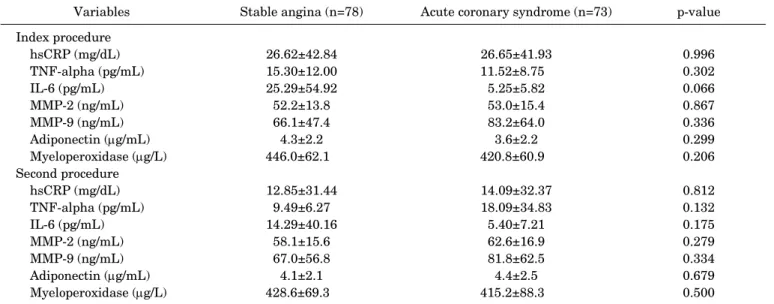
sented with ACS or stable angina. Moreover, biomarkers known to predict ACS such as matrix metalloproteinase-2 (MMP-2), MMP-9,12,13 myeloperoxidase (MPO),14,15 inter- leukin-6 (IL-6),16,17 adiponectin,18,19 tumour necrosis fac- tor- (TNF-)17,20 and high-sensitivity C-reactive protein (hsCRP) 19 were compared between the two groups. Our study only tried to find the statistical significance among the biomarkers because the reference range of biomarkers were not confidentially determined and the pathological range varied with studies researching the same biomarkers.
2. Angiographic analysis
Procedural success was defined as residual stenosis of
<15% in the absence of closure during the first 48 hours after the procedure. Two identical orthogonal views were obtained after intracoronary administration of nitrates and stored on digital CD-ROM. All angiographic and clin- ical data were analyzed by people blinded to the treatment.
End-diastolic frames were chosen for quantitative analysis.
This was performed using a computer-based TCS system, Version 2.02 (Medcon Inc., Tel-Aviv, Israel). The reference diameter, minimal luminal diameter, percentage of steno- sis, and lesion length were calculated as the average value of the two orthogonal views. The same views and calibra- tions were used at follow-up angiography. The average di- ameter of normal segments proximal and distal to the treated lesion was used as the reference diameter. The Gensini score was calculated based on a previous report.21 Lesions were characterized according to the modified Ame- rican College of Cardiology/American Heart Association classification.22 Restenosis was defined as a stenosis of > 50% of the luminal diameter, and Mehran classification was used for description of in-stent restenosis patterns.23
TABLE 1. Patients characteristics of study subjects
Variable Stable angina (n=78) Acute coronary syndrome (n=73) p-value
Age (years) 61.3±8.4 61.1±10.3 0.921
Male, n (%) 51 (64.6) 48 (66.7) 0.785
Smoking, n (%)
Ex-smoker 20 (25.6) 16 (22.2) 0.579
Current smoker 18 (23.1) 22 (30.6)
Hypertension, n (%) 39 (50.0) 43 (59.7) 0.232
Diabetes mellitus, n (%) 27 (35.5) 29 (42.0) 0.694
Medications, n (%)
Aspirin 76 (97.4) 70 (96.0) 0.673
Clopidogrel 67 (85.9) 58 (79.5) 0.389
DAPT 67 (85.9) 58 (79.5) 0.389
RAS blocker 59 (75.6) 53 (72.6) 0.712
Stain 73 (93.6) 65 (89.0) 0.391
High statin intensity 0 4 (5.7) 0.798
Generation of previously implanted DES, n (%)
First generation 35 (44.9) 57 (78.1) <0.001
Second generation 43 (55.1) 16 (21.9)
Laboratory data
Hemoglobin (g/dL) 13.2±1.83 14.5±10.2 0.262
Creatinine (mg/dL) 0.95±0.20 0.97±0.29 0.631
HbA1c (%) 7.49±18.71 10.85±24.30 0.346
ESR (mm/hr) 36.19±41.52 34.49±41.73 0.802
Total cholesterol (mg/dL) 136.50±49.03 140.49±61.12 0.643
Triglyceride (mg/dL) 110.79±81.92 109.79±67.60 0.936
HDL cholesterol (mg/dL) 40.97±15.03 40.78±15.76 0.934
LDL cholesterol (mg/dL) 72.87±29.80 85.64±42.15 0.035
Diagnosis, n (%)
Unstable angina 63 (86.4)
NSTEMI 6 (8.0)
STEMI 4 (5.7)
Stent thrombosis 7 (9.6)
DAPT: dual antiplatelet therapy, RAS: renin-angiotensin system, DES: drug-eluting stent, HbA1c: glycated hemoglobin, ESR: eryth- rocyte sedimentation rate, LDL: low-density lipoprotein, HDL: high-density lipoprotein, NSTEMI: non-ST segment elevation my- ocardial infarction, STEMI: ST segment elevation myocardial infarction.
Balloon angioplasty and stent implantation were per- formed according to standard clinical practice.
The first-generation DES group included patients whose initial procedure treatment consisted of either sirolimus- (Cypher, Cordis; Johnson and Johnson, Miami Lakes, FL, USA) or paclitaxel-eluting stents (Taxus Express or Liberté; Boston Scientific Corp, Natick, MA, USA). The sec- ond-generation DES included patients treated with ever- olimus- (Xience V; Abbott, Santa Clara, CA, USA) or zotar- olimus-eluting stents (Endeavor; Medtronic Inc, Minnea- polis, MN, USA).
3. Laboratory analysis and inflammatory markers Venous blood samples were drawn from each patient af- ter overnight fasting at the beginning of the study.
Biomarkers predicting ACS were obtained at both index PCI and ISR PCI. Blood samples were centrifuged to obtain serum, and the serum was stored at −80oC. TNF- was measured using a sandwich enzyme-linked immuno-
sorbent assay (ELISA) with a sensitivity of 0.13 pg/mL (ALPCO Diagnostics, Salem, NH, USA). Undetectable TNF- values in 2 patients were recorded as 0.13 pg/mL.
High-sensitivity IL-6 was also measured using a sandwich ELISA with a sensitivity of 0.16 pg/mL (ALPCO Diagno- stics, Salem, NH, USA). The hsCRP levels were quantified using a latex nephelometer II (Dade Behring Inc., Newark, DE, USA). The serum adiponectin level was assessed by ra- dioimmunoassay (Linco Research, Inc. St. Charles, MO, USA) with a sensitivity of 0.78 ng/mL. The intra- and in- ter-assay coefficients of variation for the radioimmuno- assay were 9.3% and 15.3%, respectively.
Cytokine protein levels such as MMP2 and MMP-9 were quantified using Luminex’s xMAP Technology with the Milliplex kits (Millipore, Billerica, MA, USA) similar to the sandwich ELISA procedure according to the manu- facturer’s instructions. In brief, 5 g of total protein per sample was mixed with the capture antibody conjugated beads before adding the phycoerythrin/streptavidin-con-
TABLE 2. Angiographic characteristics of study subjects
Variable Stable Angina (n=78) Acute coronary syndrome (n=73) p-value
Interval between index and second procedure (months) 16.8±15.9 18.9±16.3 0.41
Before index procedure
Gensini score 30.9±21.0 38.6±22.3 0.032
Number of target vessel, n (%) 0.028
One vessel 50 (65.8) 32 (44.4)
Two vessel 22 (28.9) 35 (48.6)
Three vessel 3 (5.3) 5 (6.9)
Reference diameter (mm) 2.67±0.44 2.55±0.62 0.181
Minimal lumen diameter (mm) 0.68±0.53 0.69±0.48 0.932
Percentage of stenosis (%) 74.0±0.21 70.0±0.25 0.263
Mean lesion length (mm) 27.7±16.0 32.8±19.6 0.084
Immediately after index procedure
Minimal lumen diameter (mm) 2.87±0.46 2.89±0.35 0.275
Percentage of stenosis (%) 3.5±2.9 9.3±13.3 0.126
Second procedure
Number of target vessel, n (%) 0.927
One vessel 71 (93.4) 67 (93.1)
Two vessel 5 (6.6) 5 (6.9)
Three vessel 0 (0) 0 (0)
Location of ISR, n (%)
Left anterior descending artery 50 (61.0) 50 (64.1) 0.688
Left circumflex artery 18 (22.0) 18 (23.1) 0.869
Right coronary artery 14 (17.1) 14 (17.9) 0.880
Reference diameter (mm) 2.65±0.62 2.49±0.60 0.111
Minimal lumen diameter (mm) 0.76±0.51 0.65±0.51 0.172
Percentage of stenosis (%) 71.1±21.1 72.2±0.24 0.783
ISR lesion length (mm) 17.3±8.16 22.2±13.2 0.023
Restenosis pattern, n (%) 0.884
Ia 3 (3.8) 1 (1.4)
Ib 24 (30.4) 25 (35.2)
Ic 22 (27.8) 11 (15.5)
Id 5 (6.3) 10 (14.1)
II 7 (8.9) 11 (15.5)
III 11 (13.9) 4 (5.6)
IV 7 (8.9) 9 (12.7)
ISR: in-stent restenosis.
jugated reporter antibody. The double-labeled beads were separated and quantitated in a Luminex xMAP flow cytometer. The MPO serum levels were measured with ELISA according to manufacturer’s suggestions (Calbio- chem, Millipore, Billerica, MA, USA). This assay provides a detection limit of 1.5 g/L.
4. Statistical analysis
Data are expressed as mean±SD for continuous varia- bles, and data for the categorical variables are expressed as the number and the percentage of patients. A Chi-square test was used for categorical variables. The results between the two groups were compared via an unpaired Student’s t test, and the comparisons before and after treatment were analyzed with a paired t test. Angiographic analyses were performed according to the number of patients available for each analysis. A Cox regression analysis of hazard ratios
(HRs) was applied to verify the independent predictors for ACS. Adjusted factors for the Cox regression analysis were age, smoking history, diabetes mellitus, RAS blocker, first generation DES, and LDL cholesterol level. These are com- mon risk factors of ACS development. A P-value of less than 0.05 was considered statistically significant. SPSS soft- ware (version 18.0) was used for analyses (SPSS Inc., Chicago, Illinois, USA).
RESULTS 1. Study patients
Baseline characteristics of the 151 patients included in this study are presented in Table 1. The baseline level of low-density lipoprotein (LDL) cholesterol was higher in ACS group compared to that of SA (90.8±35.7 mg/dL in SA group vs 75.3±35.6 mg/dL in ACS group, p=0.005).
TABLE 3. Biomarkers in index and second procedure according to clinical presentation
Variables Stable angina (n=78) Acute coronary syndrome (n=73) p-value
Index procedure
hsCRP (mg/dL) 26.62±42.84 26.65±41.93 0.996
TNF-alpha (pg/mL) 15.30±12.00 11.52±8.75 0.302
IL-6 (pg/mL) 25.29±54.92 5.25±5.82 0.066
MMP-2 (ng/mL) 52.2±13.8 53.0±15.4 0.867
MMP-9 (ng/mL) 66.1±47.4 83.2±64.0 0.336
Adiponectin (g/mL) 4.3±2.2 3.6±2.2 0.299
Myeloperoxidase (g/L) 446.0±62.1 420.8±60.9 0.206
Second procedure
hsCRP (mg/dL) 12.85±31.44 14.09±32.37 0.812
TNF-alpha (pg/mL) 9.49±6.27 18.09±34.83 0.132
IL-6 (pg/mL) 14.29±40.16 5.40±7.21 0.175
MMP-2 (ng/mL) 58.1±15.6 62.6±16.9 0.279
MMP-9 (ng/mL) 67.0±56.8 81.8±62.5 0.334
Adiponectin (g/mL) 4.1±2.1 4.4±2.5 0.679
Myeloperoxidase (g/L) 428.6±69.3 415.2±88.3 0.500
hsCRP: high-sensitivity C-reactive protein, TNF: tumor necrosis factor, IL: interleukin, MMP: matrix metalloproteinase.
Compared to second generation DESs, a first generation DES implanted at an index procedure was more closely re- lated to ACS presentation in the following procedure in the ACS group (78.1% in first generation DES vs 21.9% in sec- ond generation DES, p<0.001). In the index procedure, 151 patients underwent percutaneous coronary inter- vention with first generation DESs (n=92) or second gen- eration DESs (n=59) (Fig. 1). Sirolimus eluting stents (n=75) and everlorimus eluting stents (n=37) were most common in implanted stents in the first and the second gen- eration DESs, respectively.
Within the ACS group, patients’ characteristics of UA versus myocardial infarction (MI) in the acute coronary syndrome group were also analyzed (Supplement Table 1).
Compared to UA, MI, which contains STEMI and NSTEMI, had significantly higher incidence with first generation DESs in index procedures (55.3% in UA group vs 91.7% in MI group, p=0.017). Patients’ baseline characteristics were also compared between stent generations (Supplement Table 2). On medication, use of clopidogrel (76.1% in first vs 93.2% in second generation DES, p=0.007) and dual anti- platelet therapy (76.1% in first vs 89.8% in second gen- eration DES, p=0.034) was higher in the second generation DES group. Although the use of statin or statin intensity was similar between two groups, LDL cholesterol levels were significantly lower in the second generation DES group (90.2±34.8 mg/dL in first vs 72.8±25.6 mg/dL in sec- ond generation DES, p=0.001).
2. Angiographic characteristics
Table 2 lists the results of quantitative coronary angio- graphy. The baseline Gensini score was significantly high- er in the ACS group than in the SA group (38.5±22.3 vs.
30.9±21.0, p=0.03). More patients in the ACS group had two-vessel disease (48.6% vs. 28.9%, p=0.028). There were
no significant differences in reference diameter, minimal lumen diameter, percentage of stenosis, and mean lesion length during the index and follow-up procedure except that the ISR lesion length was longer in ACS group (22.2±13.2 mm vs. 17.3±8.16 mm, p=0.023). However, there was no significant difference between the two groups in terms of restenosis pattern.
3. Comparison of Inflammatory Biomarkers
None of the biomarkers showed a significant difference between the two groups (Table 3). However, IL-6 level tend- ed to be lower in the ACS group compared to the SA group at the index procedure (25.29±54.92 pg/mL vs. 5.25±5.82 pg/mL, p=0.066). We also studied the impact of procedure timing on biomarker levels, but there was no significant dif- ference between the index and the follow-up procedure.
Within the ACS group, biomarkers of UA versus MI in the acute coronary syndrome group were compared (Supplement Table 3). None of biomarkers except adipo- nectin in the index procedure (3.3±2.0 in UA group vs 6.6±1.6 in MI group, p=0.041) showed significant differ- ences between the UA and MI group. Regarding stent gen- eration, MMP-9 showed significant differences in both in- dex (96.1±50.7 ng/mL in first vs 51.7±47.6 ng/mL in second generation DES, p=0.006) and second (96.5±68.5 ng/mL in first vs 49.1±35.5 ng/mL in second generation DES, p=0.001) procedures (Supplement Table 4).
4. Predictors for ISR with ACS presentation
The result of risk factor using Cox-regression analysis is shown in Table 4. Of the medications, aspirin (HR: 0.003, 95% CI: 0.0001 to 0.63, p=0.034) as well as clopidogrel (HR:
0.005, 95% CI: 0.0001 to 0.121, p=0.001) and RAS blocker (HR: 0.02, 95% CI: 0.003 to 0.14, p=0.0001) lowered the risk of ISR with ACS presentation. With respect to stent type
FIG. 2. Cumulative rate of occurrence analyzed by Cox regression analysis. (A) shows the difference of cumulative occurrence rates in acute coronary syndrome between first and second generation stents. (B) shows differences between the Cypher and Xience prime stent.
TABLE 4. Cox regression analysis of risk factors for occurrence of acute coronary syndrome
Variables HR 95% CI p-value
Age 1.14 1.02-1.27 0.026
Male 0.45 0.05-4.37 0.491
Smoking 1.30 0.15-11.4 0.812
Hypertension 0.28 0.05-1.61 0.163
Diabetes mellitus 8.40 1.30-54.1 0.025 Medications
Aspirin 0.003 0.0001-0.63 0.034
Clopidogrel 0.005 0.001-0.121 0.001
Statin 0.19 0.01-2.63 0.225
Relative doses of statin 0.99 0.96-1.02 0.916
RAS blocker 0.02 0.003-0.14 0.0001
Stent
Gensini score 1.03 0.98-1.09 0.217 Total length of stents 0.99 0.97-1.01 0.358 Second generation stent 0.07 0.009-0.59 0.014 Laboratory data
LDL 1.03 0.998-1.06 0.064
MMP-2 during second procedure
1.12 1.001-1.19 0.004
HR: hazard ratio, CI: confidence intervals, RAS: renin-angiotension system, LDL: low-density lipoprotein, MMP: matrix metallopro- teinase.
at the index procedure, the second generation of DESs had lower risks for ISR. The ACS presentation was compared to the first generation DESs (HR: 0.07, 95% CI: 0.009 to 0.59, p=0.014) (Fig. 2A). We conducted a subgroup analysis for patients who had SES and EES. In subgroup analysis, EES at the index procedure lowered the risk of ISR with ACS presentation (HR: 0.41, 95% CI: 0.19 to 0.89, p=0.026) (Fig. 2B). High levels of MMP-2 during the second proce- dure could predict the ISR with ACS presentation (HR:
1.12, 95% CI: 1.001 to 1.19, p=0.004).
DISCUSSION
To the best of our knowledge, this is the first study to in- vestigate multiple predictors of ISR with ACS presentation after DES implantation. Our study demonstrated that pa- tients who had second generation DESs in index PCI, pre- scription of aspirin, clopidogrel, and RAS blocker were as- sociated with a lower risk of ISR upon ACS presentation.
Older age and diabetes mellitus had predictive power for ISR with ACS presentation. Of the biomarkers, only in- creased MMP-2 in the ISR period was associated with ISR in the ACS presentation.
Although DES is known to be superior to BMS in sup- pressing neointimal proliferation, recent studies have shown that there were differences among different types of DESs in the rate of ISR development.24,25 According to previous studies, second generation DESs (zotarolimus and everolimus-eluting stents) showed a low restenosis rate compared to the first generation DESs (sirolimus and paclitaxel-eluting stents). However, in a study of 12-month follow up after stent implantation, cardiac death and MI did not show any significant difference between patients who were implanted with zotarolimus-eluting stents (ZES) and paclitaxel-eluting stents (PES); TLR did show a difference.25
In our study, patients who developed ISR after the sec- ond generation DESs demonstrated significantly fewer ACS presentations than the first generation DESs (22.2%
vs 54.4%, p=0.0001) (HR 0.07, CI 0.009-0.59, p=0.014). This is the first result of superior clinical outcome of second gen- eration DES in clinical presentation after ISR, which im- proves the safety and efficacy of early generation devices.26 Several studies have shown that pharmacologic therapy with ACE-I or ARB reduced neointima proliferation and restenosis after stent implantation.27,28 We speculated that the tissue renin-angiotensin system inside the stent might play a role in neointima formation. Although each drug
showed specific effects, the plaque-stabilizing effects of ACE-I and ARB were equivalent and increased the thick- ness of the fibrous cap and collagen content in the plaque.
This decreased the number of plaque macrophages.29 These facts may explain why our patients who used RAS blockers in ISR had a lower risk of ACS (HR 0.02, CI 0.003-0.14, p=0.0001). On the other hand, statin use was not a significant predictor of ISR with ACS presentation.
It is known that statins have a significant reduction in coro- nary heart disease events including mechanisms of low-density lipoprotein (LDL) reduction or a variety of LDL-independent mechanisms—these are the so-called pleiotropic effects.30 Considering the difference of LDL lev- els between 2 groups, which was higher in ACS group, it seems that statins may not have been administered suffi- ciently enough to lower LDL levels. As a result, statin use did not play a major role in lowering the risk of ACS pre- sentation in ISR.
MMP-2 and MMP-9 are increased in vascular smooth muscle and inflammatory cells and contribute to the devel- opment and complications of atherosclerosis. Moreover, patients with ACS had significantly greater levels of MMP-9 and MMP-2 than both SA patients and healthy con- trol subjects.12,13 In our study, only MMP-2 had a higher risk of ACS development (HR 1.12, CI 1.001-1.19, p=0.004).
There are several reasons why only MMP-2 was elevated. A period of ACS presentation to admission may have been delayed. A previous study showed that both MMP-2 and MMP-9 were elevated in early ACS pre- sentation, but only MMP-2 elevation was sustained until day 7. MMP-9 gradually decreased by day 7.12 Also, consid- ering the strong relationship between MMP-9 and hs-CRP, the hs-CRP level was similar between the 2 groups; there- fore, MMP-9 did not show significant differences. Finally, the mechanisms could play a role between MMP-2 and ISR with ACS presentation so that only MMP-2 elevation con- tributes to the development of ISR with ACS presentation.
Although previous studies showed the mechanism of ele- vated MMP for de novo atherosclerosis, this was not seen in ISR. It can be assumed that elevated MMP can represent plaque rupture or instability in ISR—ACS presentation in ISR is also a consequence of plaque rupture in neo-athe- rosclerosis.
There are several limitations to this study. First, this is a retrospective analysis and is therefore subject to the limi- tations pertinent to this type of clinical investigation.
Second, this had a small sample size, a nonrandomized de- sign, and a lack of strict entry criteria. Due to the limited prevalence of ISR, patient data was collected over 9 years of the database, which caused heterogeneity with first and second generation. Furthermore, several different DESs were included in the analysis. The differences among DESs could not be assessed because of the small sample size.
CONCLUSION
This study demonstrates that age, diabetes, the use of
first generation DESs, and increased MMP-2 levels were significant predictors of ISR with ACS presentation. The use of aspirin, clopidogrel, RAS blocker, and the use of sec- ond generation DES prevented ISR with ACS presentation.
CONFLICT OF INTEREST STATEMENT None declared.
REFERENCES
1. Kastrati A, Dibra A, Mehilli J, Mayer S, Pinieck S, Pache J, et al.
Predictive factors of restenosis after coronary implantation of si- rolimus- or paclitaxel-eluting stents. Circulation 2006;113:
2293-300.
2. Kastrati A, Schömig A, Elezi S, Schühlen H, Dirschinger J, Hadamitzky M, et al. Predictive factors of restenosis after coro- nary stent placement. J Am Coll Cardiol 1997;30:1428-36.
3. Mishkel GJ, Moore AL, Markwell S, Shelton MC, Shelton ME.
Long-term outcomes after management of restenosis or thrombo- sis of drug-eluting stents. J Am Coll Cardiol 2007;49:181-4.
4. Jørgensen B, Simonsen S, Endresen K, Forfang K, Vatne K, Hansen J, et al. Restenosis and clinical outcome in patients treat- ed with amlodipine after angioplasty: results from the Coronary AngioPlasty Amlodipine REStenosis Study (CAPARES). J Am Coll Cardiol 2000;35:592-9.
5. Ribichini F, Wijns W, Ferrero V, Matullo G, Camilla T, Feola M, et al. Effect of angiotensin-converting enzyme inhibition on reste- nosis after coronary stenting. Am J Cardiol 2003;91:154-8.
6. Serruys PW, Foley DP, Jackson G, Bonnier H, Macaya C, Vrolix M, et al. A randomized placebo-controlled trial of fluvastatin for prevention of restenosis after successful coronary balloon angio- plasty; final results of the fluvastatin angiographic restenosis (FLARE) trial. Eur Heart J 1999;20:58-69.
7. Rogers WJ, Canto JG, Lambrew CT, Tiefenbrunn AJ, Kinkaid B, Shoultz DA, et al. Temporal trends in the treatment of over 1.5 million patients with myocardial infarction in the US from 1990 through 1999: the National Registry of Myocardial Infarction 1, 2 and 3. J Am Coll Cardiol 2000;36:2056-63.
8. Magalhaes MA, Minha S, Chen F, Torguson R, Omar AF, Loh JP, et al. Clinical presentation and outcomes of coronary in-stent restenosis across 3-stent generations. Circ Cardiovasc Interv 2014;7:768-76.
9. Assali AR, Moustapha A, Sdringola S, Denktas AE, Willerson JT, Holmes DR Jr, et al. Acute coronary syndrome may occur with in-stent restenosis and is associated with adverse outcomes (the PRESTO trial). Am J Cardiol 2006;98:729-33.
10. Anderson JL, Adams CD, Antman EM, Bridges CR, Califf RM, Casey DE Jr, et al. 2012 ACCF/AHA focused update incorporated into the ACCF/AHA 2007 guidelines for the management of pa- tients with unstable angina/non-ST-elevation myocardial in- farction: a report of the American College of Cardiology Foundation/American Heart Association Task Force on Practice Guidelines. Circulation 2013;127:e663-828.
11. O'Gara PT, Kushner FG, Ascheim DD, Casey DE Jr, Chung MK, de Lemos JA, et al. 2013 ACCF/AHA guideline for the manage- ment of ST-elevation myocardial infarction: executive summary:
a report of the American College of Cardiology Foundation/
American Heart Association Task Force on Practice Guidelines.
Circulation 2013;127:529-55.
12. Kai H, Ikeda H, Yasukawa H, Kai M, Seki Y, Kuwahara F, et al.
Peripheral blood levels of matrix metalloproteases-2 and -9 are elevated in patients with acute coronary syndromes. J Am Coll Cardiol 1998;32:368-72.
13. Zeng B, Prasan A, Fung KC, Solanki V, Bruce D, Freedman SB, et al. Elevated circulating levels of matrix metalloproteinase-9 and -2 in patients with symptomatic coronary artery disease.
Intern Med J 2005;35:331-5.
14. Baldus S, Heeschen C, Meinertz T, Zeiher AM, Eiserich JP, Münzel T, et al. Myeloperoxidase serum levels predict risk in pa- tients with acute coronary syndromes. Circulation 2003;108:
1440-5.
15. Zhang R, Brennan ML, Fu X, Aviles RJ, Pearce GL, Penn MS, et al. Association between myeloperoxidase levels and risk of coro- nary artery disease. JAMA 2001;286:2136-42.
16. Ikeda U, Ito T, Shimada K. Interleukin-6 and acute coronary syndrome. Clin Cardiol 2001;24:701-4.
17. Wang YN, Che SM, Ma AQ. Clinical significance of serum cyto- kines IL-1beta, sIL-2R, IL-6, TNF-alpha, and IFN-v in acute coro- nary syndrome. Chin Med Sci J 2004;19:120-4.
18. Nakamura Y, Shimada K, Fukuda D, Shimada Y, Ehara S, Hirose M, et al. Implications of plasma concentrations of adiponectin in patients with coronary artery disease. Heart 2004;90:528-33.
19. Otake H, Shite J, Shinke T, Watanabe S, Tanino Y, Ogasawara D, et al. Relation between plasma adiponectin, high-sensitivity C-reactive protein, and coronary plaque components in patients with acute coronary syndrome. Am J Cardiol 2008;101:1-7.
20. Mizia-Stec K, Gasior Z, Zahorska-Markiewicz B, Janowska J, Szulc A, Jastrzebska-Maj E, et al. Serum tumour necrosis fac- tor-alpha, interleukin-2 and interleukin-10 activation in stable angina and acute coronary syndromes. Coron Artery Dis 2003;14:431-8.
21. Gensini GG. A more meaningful scoring system for determining the severity of coronary heart disease. Am J Cardiol 1983;51:606.
22. Ellis SG, Vandormael MG, Cowley MJ, DiSciascio G, Deligonul
U, Topol EJ, et al. Coronary morphologic and clinical determi- nants of procedural outcome with angioplasty for multivessel cor- onary disease. Implications for patient selection. Multivessel Angioplasty Prognosis Study Group. Circulation 1990;82:
1193-202.
23. Mehran R, Dangas G, Abizaid AS, Mintz GS, Lansky AJ, Satler LF, et al. Angiographic patterns of in-stent restenosis: classi- fication and implications for long-term outcome. Circulation 1999;100:1872-8.
24. Song HG, Kang SJ, Ahn JM, Kim WJ, Lee JY, Park DW, et al.
Intravascular ultrasound assessment of optimal stent area to pre- vent in-stent restenosis after zotarolimus-, everolimus-, and siro- limus-eluting stent implantation. Catheter Cardiovasc Interv 2014;83:873-8.
25. Xu B, Yang Y, Yuan Z, Du Z, Wong SC, Généreux P, et al. Zotaroli- mus- and paclitaxel-eluting stents in an all-comer population in China: the RESOLUTE China randomized controlled trial. JACC Cardiovasc Interv 2013;6:664-70.
26. Kedhi E, Joesoef KS, McFadden E, Wassing J, van Mieghem C, Goedhart D, et al. Second-generation everolimus-eluting and pa- clitaxel-eluting stents in real-life practice (COMPARE): a rando- mised trial. Lancet 2010;375:201-9.
27. Hong SJ, Shim WJ, Choi JI, Joo HJ, Shin SY, Park SM, et al.
Comparison of effects of telmisartan and valsartan on late lumen loss and inflammatory markers after sirolimus-eluting stent im- plantation in hypertensive patients. Am J Cardiol 2007;100:1625-9.
28. Yoshida O, Hirayama H, Nanasato M, Watanabe T, Murohara T.
The angiotensin II receptor blocker candesartan cilexetil reduces neointima proliferation after coronary stent implantation: a pro- spective randomized study under intravascular ultrasound gui- dance. Am Heart J 2005;149:e2.
29. Hotchi J, Hoshiga M, Takeda Y, Yuki T, Fujisaka T, Ishihara T, et al. Plaque-stabilizing effect of angiotensin-converting enzyme inhibitor and/or angiotensin receptor blocker in a rabbit plaque model. J Atheroscler Thromb 2013;20:257-66.
30. Morrissey RP, Diamond GA, Kaul S. Statins in acute coronary syndromes: do the guideline recommendations match the evi- dence? J Am Coll Cardiol 2009;54:1425-33.
coronary syndrome group
Variable
Unstable angina (N=63)
Myocardial infarction (N=10)
P value
Age (years) 60.8 11.1 62.3 10.5 0.682
Male, n (%) 43 (68.4) 7 (66.7) 0.904
Smoking, n (%)
Ex-smoker 18 (29.0) 3 (33.3) 0.433
Current smoker 18 (29.0) 2 (16.7)
Hypertension, n (%) 32 (51.3) 6 (58.3) 0.651
Diabetes mellitus, n (%) 26 (40.8) 6 (58.3) 0.254
Medications, n (%)
Aspirin 59 (93.4) 10 (100) 0.360
Clopidogrel 52 (82.9) 7 (66.7) 0.186
DAPT 51 (80.26) 7 (66.7) 0.287
RAS blocker 48 (76.3) 9 (91.7) 0.230
Stain 57 (90.8) 8 (83.3) 0.428
High statin intensity 3 (4.0) 2 (16.7) 0.671
Generation of previously implanted DES, n (%)
First generation 35 (55.3) 9 (91.7) 0.017
Second generation 28 (44.7) 1 (8.3)
Laboratory data
Hemoglobin (g/dL) 13.1 1.5 14.1 2.0 0.059
Creatinine (mg/dL) 0.94 0.25 2.07 3.40 0.276
HbA1c (%) 7.2 15.5 12.5 27.5 0.531
ESR (mm/hr) 10.8 10.3 14.6 20.0 0.611
Total cholesterol (mg/dL) 148.7 40.8 168.5 60.5 0.199
Triglyceride (mg/dL) 123.9 75.3 118.7 71.1 0.843
HDL cholesterol (mg/dL) 42.6 10.7 46.9 11.2 0.260
LDL cholesterol (mg/dL) 82.3 33.7 99.1 44.6 0.178
hemoglobin; ESR: erythrocyte sedimentation rate; LDL: low-density lipoprotein; HDL: high-density lipoprotein
Variable
1st generation (N=92)
2nd generation (N=59)
P value
Age (years)
61.8 ± 9.1 60.3 ± 9.7 0.347
Male, n (%) 59 (64.1) 40 (67.8) 0.644
Smoking, n (%)
Ex-smoker 16 (17.4) 20 (33.9)
0.233
Current smoker 31 (33.7) 10 (17)
Hypertension, n (%) 52 (56.5) 30 (50.9) 0.495
Diabetes mellitus, n (%) 41 (44.6) 21 (35.6) 0.274
Medications, n (%)
Aspirin 91 (98.9) 55 (93.2) 0.057
Clopidogrel 70 (76.1) 55 (93.2) 0.007
DAPT 70 (76.1) 53 (89.8) 0.034
RAS blocker 69 (75) 43 (72.9) 0.772
Stain 85 (92.4) 55 (93.2) 0.848
High statin intensity 3 (3.3) 2 (3.4) 0.859
Laboratory data
Hemoglobin (g/dL) 13.1 ± 1.6 13.4 ± 2 0.283
Creatinine (mg/dL) 1.22 ± 1.77 0.98 ± 0.24 0.219
HbA1c (%) 10.4 ± 23.8 7.1 ± 17.7 0.332
ESR (mm/hr) 11.7 ± 10.8 11.2 ± 11.2 0.845
Total cholesterol (mg/dL) 154.2 ± 43.7 140.3 ± 38.2 0.057
Triglyceride (mg/dL) 116.9 ± 74.5 116.2 ± 69.9 0.953
HDL cholesterol (mg/dL)
42.5 ± 10.4 44 ± 11.3 0.416
LDL cholesterol (mg/dL) 90.2 ± 34.8 72.8 ± 25.6 0.001
Diagnosis, n (%)
Stable angina 39 (42.4) 24 (40.7)
0.238
Unstable angina 42 (45.7) 34 (57.6)
STEMI 5 (5.4) 0 (0)
Stent thrombosis 6 (6.5) 2 (3.4)
DAPT: dual antiplatelet therapy; RAS: renin-angiotensin system; HbA1c: glycated hemoglobin; ESR:
erythrocyte sedimentation rate; LDL: low-density lipoprotein; HDL: high-density lipoprotein; NSTEMI: non- ST segment elevation myocardial infarction; STEMI: ST segment elevation myocardial infarction
Variables
Unstable Angina (n=63)
Myocardial infarction (n=10)
P value
Index procedure
hsCRP (mg/dL) 2.29 ± 4.8 1.36 ± 3.67 0.527
TNF-alpha (pg/mL) 11.48 ± 9.21 8.77 ± 2.43 0.691
IL-6 (pg/mL) 8.62 ± 12.32 4.49 ± 2.98 0.65
MMP-2 (ng/mL) 50.7 ± 16.3 58.1 ± 20.9 0.56
MMP-9 (ng/mL) 73.4 ± 57.2 75.0 ± 80.7 0.97
Adiponectin (μg/mL) 3.3 ± 2 6.6 ± 1.6 0.041
Myeloperoxidase (μg/L) 437.5 ± 57.9 349.3 ± 11.9 0.051
Second procedure
hsCRP (mg/dL) 2.85 ± 5.92 14.92 ± 26.46 0.143
TNF-alpha (pg/mL) 14.34 ± 31.63 7.43 ± 3.25 0.255
IL-6 (pg/mL) 7.05 ± 16.89 3.92 ± 1.87 0.335
MMP-2 (ng/mL) 57.7 ± 16.9 64.8 ± 8.8 0.367
MMP-9 (ng/mL) 63.1 ± 55.3 107.7 ± 56.2 0.105
Adiponectin (μg/mL) 3.8 ± 2.1 4.2 ± 2.5 0.722
Myeloperoxidase (μg/L) 420.4 ± 85.3 379.3 ± 93.2 0.331
hsCRP: high-sensitivity C-reactive protein; TNF: tumor necrosis factor; IL:interleukin; MMP: matrix metalloproteinase
Variables
1st generation DES (n=92)
2nd generation DES (N=59)
P value
Index procedure
hsCRP (mg/dL) 2.28 ± 4.65 0.86 ± 1.42 0.007
TNF-alpha (pg/mL) 11.93 ± 7.7 15.79 ± 13.12 0.244
IL-6 (pg/mL) 15.21 ± 36.2 21.42 ± 52.93 0.667
MMP-2 (ng/mL) 53.9 ± 14.4 51.4 ± 14.2 0.569
MMP-9 (ng/mL) 96.1 ± 50.7 51.7 ± 47.6 0.006
Adiponectin (μg/mL) 3.5 ± 1.8 4.6 ± 2.4 0.125
Myeloperoxidase (μg/L) 441.7 ± 55.8 433.8 ± 68.2 0.687
Second procedure
hsCRP (mg/dL) 4.03 ± 11.23 2.27 ± 5.77 0.267
TNF-alpha (pg/mL) 14.39 ± 30.68 10.71 ± 6.34 0.511
IL-6 (pg/mL) 9.58 ± 24.76 12.39 ± 38.64 0.728
MMP-2 (ng/mL) 60.3 ± 17.7 59.3 ± 14.7 0.816
MMP-9 (ng/mL) 96.5 ± 68.5 49.1 ± 35.5 0.001
Adiponectin (μg/mL) 4.4 ± 2.2 4.1 ± 2.3 0.664
Myeloperoxidase (μg/L) 421.8 ± 73.8 425.6 ± 80.1 0.842
DES: drug-eluting stent; hsCRP: high-sensitivity C-reactive protein; TNF: tumor necrosis factor;
IL:interleukin; MMP: matrix metalloproteinase