Therapeutic Science for Rehabilitation Vol. 9. No. 4. 2020. 107
재활치료과학 제 9 권 제 4 호Therapeutic Science for Rehabilitation Vol. 9. No. 4. 2020.
https://doi.org/10.22683/tsnr.2020.9.4.107
척수 손상 환자의 라이프 스타일 개선을 위한 재활 중재 효과:
무작위 대조군 연구의 체계적 고찰 및 메타분석
하성규*, 박혜연**
*연세대학교 일반대학원 작업치료학과 박사과정 학생
**연세대학교 보건과학대학 작업치료학과 교수
국문초록
목적
:
척수손상환자를 대상으로 한 무작위 대조군 연구의 체계적 고찰과 메타분석을 통해 척수손상환자의 재활 중재의 효과성과 근거를 알아보고자 한다.
연구방법
:
국외 논문데이터베이스에서 검색어를 사용하여 학술지에 게재된 연구를2
명의 연구자가 독립적 으로 검색하여 선정하였다.
선정기준에 부합한 연구는 총21
편이었고, PEDro Scale
을 사용하여 연구의 질적 평가를 실시하였다.
메타분석은Comprehensive Meta-Analysis 3.0
프로그램을 사용하였다.
결과:
분석된 연구에 참여한 연구대상자는 총713
명이었고,
메타분석을 실시한 결과 신체활동을 이용한중재는
0.406(95.0%
신뢰구간: 0.221~0.591),
전기 자극 치료중재는0.505(95.0%
신뢰구간: 0.449~1.528)
로 중간크기(Medium)
의 효과를 보이는 것으로 나타났고 교육적 방법 중재는0.248(95.0%
신뢰구간: 0.033~0.464),
복합 중재는0.280(95.0%
신뢰구간: 0.122~0.438)
로 작은 크기(Small)
의 효과를 보이는 것으로 나타났다.
통계적 이질성 검정에서 유의미한 이질성이 있어 연구결과 통합 시 랜덤효과 모형을 선택하여 분석하였고,
출판편견은 유의미하지 않아 신뢰할만한 연구결과였다.
결론
:
분석된 결과 척수손상환자를 대상으로한 재활 중재는 효과적임을 알 수 있었다.
척수손상환자를 대상으로한 재활분야에서 임상가들이 대상자의 라이프 스타일을 개선하기 위한 프로그램을 구성할 때 기여할 것으로 사료된다.
주제어
:
라이프 스타일,
메타분석,
재활 중재,
척수손상,
체계적 고찰교신저자 : 박혜연([email protected]) || 접수일: 2020.01.28 || 심사일: 2020.01.29
|| 게재승인일: 2020.02.25
108 Therapeutic Science for Rehabilitation Vol. 9. No. 4. 2020.
Ⅰ. 서 론
라이프 스타일은 그 사람의 가치관, 태도, 생활양식,
개인의 문화 등 다양한 요소가 포함되어 있는 것으로 과거 생활양식에 대한 경험과 문제 해결 방법, 미래를 위해 노력하는 태도에서 보이는 일관성을 라이프 스타일 이라고 하였고(Kim, 2016), Christiansen과 Baum(1997)은 인간의 시간 사용 패턴이 시간에 대한 작업 수행 패턴이 고 이것이 곧 라이프 스타일이라고 정의하였다. 인간의 건강상태와 삶의 질에 영향을 미칠 수 있는 건강 관련 라이프 스타일에는 작업균형, 시간사용, 신체활동수준 등이 있다(Shin, 2019).
손상 수준 이하의 감각 및 운동 또는 자율신경계 기능저 하로 인해 척수손상을 가진 사람들은 손상직후부터 평생 동안 신체활동이 극도로 저하된다(van den Berg-Emons et al., 2004). 신체활동의 저하는 체력, 사회적 참여 및 삶의 질에 부정적인 영향을 미칠 수 있고(Manns & Chad, 1999; Noreau & Shephard, 1995), 심혈관 질환, 비만, 당뇨 병과 같은 이차 건강 문제가 발생할 위험을 증가시킬 수 있다(Manley, 1996; Warburton, Nicol, & Bredin, 2006).
척수손상환자의 낮은 신체활동 수준은 비활동적인 라 이프 스타일을 만들면서 다양한 문제를 야기할 수 있다고 보고하였다(van den Berg-Emons et al., 2004; Vissers et
al., 2008). 비활동적인 라이프 스타일은 척수손상환자의
합병증 증가, 컨디션 저하와 관련이 있으며(Lannem, Sørensen, Frøslie, & Hjeltnes, 2009; Tasiemski, Kennedy, Gardner, & Taylor, 2005; Tawashy, Eng, Lin, Tang, & Hung,
2009), 활동 수준이 높을수록 합병증 감소 및 예방, 기타
생리적, 심리적 상태에 긍정적인 영향을 미쳤다(Fernhall, Heffernan, Jae, & Hedrick, 2008; Tasiemski et al., 2005;
Tawashy et al., 2009). 신체활동 수준을 높이는 것은 척수 손상환자가 효과적으로 자기관리를 하면서 향상될 수 있으며 이는 증상, 치료, 신체적, 정신적, 사회적 및 만성 적 상태에서의 라이프 스타일 변화를 통해 이루어질 수 있다(Cramp, Berry, Gardiner, Smith, & Stephens, 2013;
Ferrier, Blanchard, Vallis, & Giacomantonio, 2011).
척수손상환자의 신체 활동 수준을 높이거나 유지하기 위한 여러 가지 선행연구들이 있다. 척수손상환자들의 건강지표, 활동수준, 일상생활활동 참여를 증진하기 위 한 중재 방법으로 Jones 등(2014)은 활동기반 중재를 하여 일생 생활 활동 참여의 개선을 보였으며, Kooijmans 등
(2017)은 능동적인 라이프 스타일 변화를 교육해 신체활
동수준과 우울감 개선에 효과를 보고했다. Kapadia 등
(2014)은 기능적 전기 자극 치료를 통해 보행능력의 개선
을 보였고, Kim, Lee, Lee, Kim과 Jeon(2015)은 실내핸드바 이크 운동을 통해 최대 산소 소비 지수, 체질량지수에서 개선을 보였다.
이처럼 척수손상환자를 대상으로 한 중재 연구는 활발 히 이루어지고 있으나 그 효과성을 체계적이고 종합적으 로 분석한 연구가 부족하고 증거-기반 구축을 위한 메타 분석을 시행한 연구는 없었다. 따라서 본 연구의 목적은 척수손상환자를 대상으로 한 재활 중재의 근거를 마련하 기 위해 국외에서 연구된 무작위 대조군 연구를 체계적 고찰과 메타분석 방법을 이용하여 재활 중재 효과성을 알아보고자 한다.
Ⅱ. 연구 방법
1. 연구대상 및 자료 수집
본 연구에서는 척수손상환자의 라이프 스타일을 개선 하기 위한 재활 중재 중에서 수술과 약물 같은 침습적인 방법을 제외한 재활중심의 중재 효과를 확인하기 위해 국외에서 연구된 논문들을 대상으로 하였다. Pubmed, CINAHL, Google, Medline의 데이터베이스에서 최근 10년 동안(2010~2019) 게재된 논문을 검색하였다. 사용한 주제어 는 “spinal cord injury” or “SCI” or “paraplegia” or “tetraplegia”
or “incomplete” and “interventions” or “strategies” or “best practices” or “treatment” or “therapy” or “program” or
“management” or “exercise” and “RCT” or “randomized control trial” or “randomized controlled trial” or “randomized clinical
trial”이었다. 선정된 연구들은 신체활동을 이용한 연구,
Therapeutic Science for Rehabilitation Vol. 9. No. 4. 2020. 109 Figure 1. Flow Diagram of Search Strategy
전기 자극을이용한 연구, 복합중재 연구, 교육적 방법 연구들이었다.
2. 논문의 선정기준
본 연구의 메타분석을 위한 논문의 선정기준은 다음과 같다. 두 명의 연구자가 독립적으로 논문을 검색하여 선 정하였고, 선정결과에서 차이가 있을 경우 논의하여 의견 을 일치시켰다. 1차 주제어 검색을 통해 총 367편의 논문 이 검색되었고, 최종적으로 21편을 메타분석에 사용하였 다(Figure 1).
1) 포함기준
(1) 영어로 작성된 논문
(2) 척수손상환자를 대상으로 한 무작위 실험 연구 논문
(3) 최근 10년간 작성된 논문
(4) 독립변수로 중재를 포함한 논문
(5) 전문을 획득할 수 있는 논문
2) 배제기준
(1) 영어 이외의 언어로 작성된 논문
(2) 질적 연구 논문
(3) 사례보고 혹은 개별실험연구 논문
(4) 대조군이 없는 연구 논문
(5) 체계적 고찰 논문
(6) 학위논문
3. 분석방법
1) 질적 메타분석방법
최종적으로 선정된 연구는 2명의 연구자가 PEDro
Scale을 사용하여 각각 문헌의 질을 평가하고 차이가 나
는 경우 회의를 통해 의견을 일치시켰다. PEDro Scale은 무작위 대조군연구에 대하여 총 10개 문항에 대하여 ‘예’
또는 ‘아니요’로 평가하고, 1점 또는 0점으로 점수화한다.
총점은 0~10점으로 점수가 높을수록 문헌의 질이 높은 것으로 평가한다(Yu, Lee, Kim, & Hong, 2012).
2) 계량적 메타분석방법
본 연구에서는 Comprehensive Meta-Analysis 3.0(Biostat, Englewood, NJ, USA)을 이용하여 메타분석을 실시하였다.
이를 통해 이질성 검정, 효과크기산정, 및 출판 편의를 분석
110 Therapeutic Science for Rehabilitation Vol. 9. No. 4. 2020.
하였다.
(1) 이질성 검정
이질성 검정은 메타분석에 포함된 연구들 안에서의 이질성을 알아보고자 할 때 사용된다. 즉, 메타분석에서 분석한 연구들의 서로 다름의 정도를 이질성 검정
(Heterogeneity test)을 통해 분석하게 되는데 이런 이질성 정도는 Q-statistic와 I-squared value로 알 수 있다. Q값이 유의미한 결과를 나타낼 경우 이질성이 있다고 해석할 수 있으며(Rosenthal & Rubin, 1982), 이질성의 정도는
I-squared value로 볼 수 있는데 0, 25, 50과 75는 없음,
낮음, 중간, 높음으로 해석할 수 있다(Huedo-Medina, Sánchez-Meca, Marín-Martínez, & Botella, 2006). 만일 이 질성 정도가 유의미하다고 분석될 경우 효과크기 검정 시 랜덤효과모형(Random effect model)을 사용하고, 반대 의 경우 고정효과모형을 사용하게 된다(Borenstein, Hedges, Higgins, & Rothstein, 2011).
(2) 효과크기산정
연구의 효과크기를 확인하기 위해 추정된 통합효과크 기에 대한 누적 효과크기(Cumulative effect size)를 분석 했다. 즉, 신체활동치료, 전기 자극치료, 복합자극치료,
교육적 치료의 표준화된 평균차(Standardized mean difference)로 효과크기를 비교해 그 결과를 제시했다. 또 한 결과 변수는 신체활동치료, 전기 자극, 복합자극치료,
교육적 치료를 하위그룹으로 묶어서 효과크기를 계산하 고, 효과크기는 실험군이 대조군보다 양(+)의 결과가 나 오면 좋은 실험효과를 보인 것으로 음(-)의 결과가 나오면 대조군이 실험군보다 좋은 실험결과를 보인 것으로 해석 하였다. 효과크기는 0.2 이하의 값은 작은 효과크기
(Small), 0.5 이상은 보통의 효과크기(Medium), 0.8이상은 큰 효과크기(Large)로 해석하였다(Cohen, 1988). 효과크 기는 숫자뿐 아니라 숲그림(Forest plot)을 사용하여 처리 효과의 추정치들과 해당 신뢰구간, 메타분석 결과인 결합 추정치와 신뢰구간을 제시하였다.
(3) 출판편의
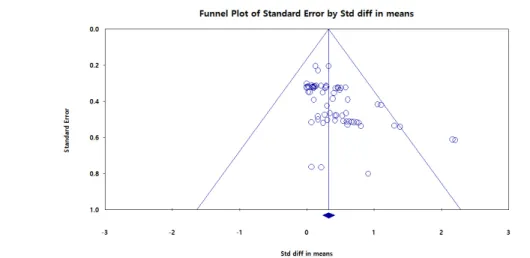
연구들이 통계적으로 유의미한 결과들만 제시되는 경 향을 출판편의라고 볼 수 있다. 본 연구에서는 출판편의 를 보기 위해 깔대기 점도표법(Funnel plots)과 에거분석
(Egger’s regression intercept analysis)을 하였다. 깔대기 점도표법은 깔대기 모양에 중심선을 기준으로 왼쪽과 오른쪽에서 한쪽으로 쏠려 비대칭적인 모습이 관찰될 때 출판편의가 있음을 시각적으로 판단할 수 있다. 그리 고 에거분석은 선형회귀분석을 통해 출판편의 여부를 확인할 수 있는데, 이때 p값이 0.05보다 작을 경우 출판 편의가 유의하다고 해석할 수 있다.
Ⅲ. 연구 결과
1. 질적 메타분석의 결과
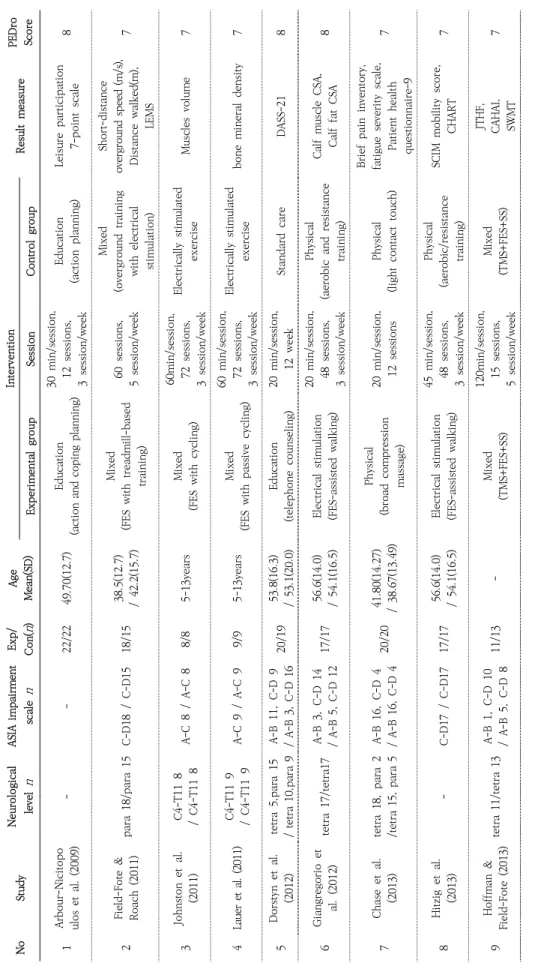
본 연구의 분석을 위하여 최종적으로 선정된 논문은 총 21편이었다. 분석된 연구에 참여한 연구대상자는 총
713명이었고, 대부분 성인 대상자였으며, 대상자의 진단 은 완전 손상과 불완전 손상으로 혼합되어 있었다. 재활 중재 유형으로 분류해보면 신체활동을 이용한 중재가
9편, 전기 자극 중재가 3편, 신체활동을 이용한 중재와 전기 자극 치료 중재를 함께 적용한 복합 중재가 5편,
교육적 치료 중재가 4편이었다.
출판 년도는 2009년부터 2019년까지이고, 치료회기는 연구별로 편차가 컸는데 짧게는 5회기에서 길게는 72회 기까지 치료를 제공하였고, 치료시간은 20-120분 사이 였다. 효과크기 산출을 위한 결과측정도구는 신체기능,
건강지표, 활동수준을 평가하는 도구들이었다. 분석된 모든 연구는 대조군이 있는 무작위 실험설계연구였고,
연구의 질적 수준에 대한 PEDro Score는 9점연구 1편, 8점연구 4편, 7점연구 9편, 6점연구 6편, 5점연구 1편이 었다(Table 1).
T her apeut ic S ci ence fo r Rehabi lit at io n Vol . 9 . No . 4. 2 0 2 0 . 111
NoStudyNeurological level n ASIA impairment scalen
Exp/ Con(n)
Age Mean(SD) Intervention ResultmeasurePEDro ScoreExperimental groupSessionControlgroup 1Arbour-Nicitopo ulos et al. (2009)--22/2249.70(12.7)Education (action and coping planning)
30min/session, 12sessions, 3session/week
Education (action planning)Leisureparticipation 7-point scale8 2Field-Fote& Roach(2011)para 18/para 15C-D18 / C-D1518/1538.5(12.7) / 42.2(15.7)
Mixed (FES withtreadmill-based training) 60sessions, 5session/week Mixed (overgroundtraining withelectrical stimulation) Short-distance overground speed (m/s), Distancewalked(m), LEMS
7 3Johnston etal. (2011)C4-T11 8 / C4-T11 8A-C8 / A-C88/85-13yearsMixed (FES withcycling)
60min/session, 72sessions, 3session/week Electricallystimulated exerciseMuscles volume7 4Lauer et al. (2011)C4-T11 9 / C4-T11 9A-C9 / A-C99/95-13yearsMixed (FES withpassive cycling)
60min/session, 72sessions, 3session/week
Electricallystimulated exercisebone mineral density7 5Dorstynet al. (2012)tetra5,para15 / tetra 10,para 9A-B11, C-D 9 / A-B 3, C-D 1620/1953.8(16.3) / 53.1(20.0)Education (telephonecounseling)20min/session, 12 weekStandardcareDASS-218 6Giangregorioet al. (2012)tetra17/tetra17A-B3, C-D 14 / A-B 5, C-D 1217/1756.6(14.0) / 54.1(16.5)Electrical stimulation (FES-assistedwalking)
20min/session, 48sessions, 3session/week Physical (aerobic and resistance training)
CalfmuscleCSA, Calf fat CSA8 7Chaseet al. (2013)tetra 18,para 2 /tetra 15, para 5A-B16, C-D 4 / A-B 16, C-D 420/2041.80(14.27) / 38.67(13.49)
Physical (broadcompression massage) 20min/session, 12sessionsPhysical (lightcontacttouch) Brief paininventory, fatigue severityscale, Patient health questionnaire-9
7 8Hitziget al. (2013)-C-D17 / C-D1717/1756.6(14.0) / 54.1(16.5)Electrical stimulation (FES-assistedwalking)
45min/session, 48sessions, 3session/week Physical (aerobic/resistance training)
SCIMmobility score, CHART7 9Hoffman& Field-Fote (2013)tetra 11/tetra 13A-B1, C-D 10 / A-B5, C-D 811/13-Mixed (TMS+FES+SS)
120min/session, 15sessions, 5session/week Mixed (TMS+FES+SS)
JTHF, CAHAI, SWMT7
Tabl e 1. Charact eristics of Inc lud ed St udi es
11 2 Ther apeut ic S ci ence fo r Rehabi lit at io n V ol . 9 . N o. 4 . 20 2 0 .
NoStudyNeurological level n ASIA impairment scalen
Exp/ Con(n)
Age Mean(SD)
Intervention ResultmeasurePEDro ScoreExperimental groupSessionControlgroup 10Kressler etal. (2013)para 18 /para 22C-D18/ C-D2218 / 22-Mixed (treadmill-basedtraining withelectrical stimulation) 30min/session, 60sessions, 5session/week Mixed (overgroundtraining withElectrical stimulation) Slowgait oxygen consumption, Moderategait oxygen consumption, Fastgait oxygen consumption
6 11Ordonez etal. (2013)para9/ para8A-B9 / A-B89/829.6(3.6) / 30.2(3.8)Physical (armcrankingexercise)
35-55min/sessi on 36sessions, 3session/week
Not interventionTAS,GPX, MDA, Carbonyls7 12Jones et al. (2014)tetra 15,para 5 / tetra16, para 5C-D20 / C-D2120/2142.2(13.03) / 34.14(12.03)
Physical (resistance training; repetitive, patternedmotor activity; and task-specific locomotor training) 60min/session, 72sessions, 3session/week Physical (resistancetraining; repetitive, patterned motor activity; andtask-specific locomotor training)
ISNCSCI motor score, 10 MWTspeed, SCIM-III, BMI6 13Kapadia etal. (2014)tetra 14,para 3 /tetra 12, para 5C-D17 / C-D1717/1756.59(14.00) / 54.06(16.45)Electrical stimulation (FES-assistedwalking)
30min/session, 10sessions, 2session/week Physical (aerobic and resistance training)
FIMlocomotor score, 2-minwalkdistance, 10-mwalktime,TUG6 14Kim et al. (2015)tetra6,para2 / tetra7A-B 8 / A-B78/731.5(5.5) / 35.0(5.1)
Physical (6-weekindoorhand-bike exerciseprogram) 60min/session, 18sessions, 3session/weekUsual activities BMI, HOMA-IR, Peakoxygen consumption
7 15Pelletier et al. (2015)C3–T10 12 / C1–T11 11A-B4, C-D 8 / A-B5, C-D 612/1140.0(12.3) / 45.9(11.5)
Physical progressiveexercise program 20min/session, 48sessions, 3session/week Community exercise program
Aerobic endurance test, Musclestrength(1RM), Vertical bench press7 16Kirby et al. (2016)para 4,tetra 49 / para 9,tetra 44-53/5348.1(13.6) / 47.1(12.6)
Physical (wheelchair skills training program) 40min/session, 5sessions Education (generalwellnessafter SCI)
Wheelchair skill test, CHART6 17Nooijen etal. (2016)para13,tetra7 /para 13,tetra6A-B13, C-D 7 / A-B 11, C-D 820/1944(15) / 44(15)
Education (behaviouralintervention promotingphysical activity withstructuredhandcycle trainingprogramme) 60min/session, 13sessions, Onlystructuredhand cycle training programme Fatigue severityscale, Pain intensity score , Depressionscale5
T her apeut ic S ci ence fo r Rehabi lit at io n Vol . 9 . No . 4. 2 0 2 0 . 113
NoStudyNeurological level n ASIA impairment scalen
Exp/ Con(n)
Age Mean(SD) Intervention ResultmeasurePEDro ScoreExperimental groupSessionControlgroup 18Arbour-Nicitopo ulos et al. (2017)tetra25,para 17 /tetra18, para 17-42/3548.79(10.59) / 47.11(10.23)Physical (PAG-SCI)
20min/session, 8sessions, 2session/week
Physical (SCI Get Fit Toolkit)Guidlineseven-point Likert scale8 19Kooijmanset al. (2017)tetra 11,para22 /tetra 10,para 21A-B24, C-D 9 / A-B 26, C-D 533/3148(10) / 49(11)Education (client-centered counseling+ information book)16 weekEducation (only informationbook)
Physical activityscale, Objectively measured physical activity6 20Chang etal. (2018)tetra 2,para 2 / tetra 1, para 2C-D4 / C-D34/356(17)/ 60(2)Physical (exoskeleton-assistedgait training)
60min/session, 15sessions, 5session/week Physical (stretching, strengthening, balance training, standing, sit to stand, stair, andgait training)
10 MWT, 6 MWT, TUG6 21Cheunget al. (2019)tetra 8 / tetra 8-8/855.6(4.98) / 53.0(12.94)Physical (RABWSTT)
60min/session, 24sessions, 3session/week Physical (passive lower limbs mobilizationexercise) Walking index for spinal cord injury versionII, Maximal oxygen consumption
9 BMI=Body Mass Index; CAHAI=Chedoke Arm and Hand Activity Inventory; CHART=Craig Handicap and Assessment Reporting Technique; CSA=Cross-Sectional Area; DASS=Depression Anxiety StressScale;FES=FunctionalElectricalStimulation;FIM=FunctionalIndependence Measure;GPX=Glutathione Peroxidase;HOMA-IR=HomeostasisModelAssessment of Insulin Resistance; ISNCSCI=International Standards for Neurological Classificationof SpinalCordInjury; JTHF=Jebsen TaylorHand FunctionTest;LEMS=LowerExtremity MotorScore; MDA=malondialdehyde; MDA=malondialdehyde; MWT=Meter Walk Test; PAG-SCI=Physical Activity Guidelines for adults with SCI; RABWSTT=Robotic-Assisted Body Weight Supported Treadmill Training; SCI=Spinal Cord Injury; SCIM=Spinal Cord Independence Measure; SS=Somatosensory Stimulation; SWMT=Semmes-Weinstein; TUG=Timed Up and Go; TAS=Total Antioxidant Status; TMS=Transcranial Magnetic Stimulation
114 Therapeutic Science for Rehabilitation Vol. 9. No. 4. 2020.
Category Number of
studies
Effect size Heterogeneity
d Z p Q value df(Q) p I2
Fixed effect analysis
Physical 24 0.352 4.741 0.000 32.348 23 0.093 28.898
Education 9 0.248 2.264 0.024 4.070 8 0.851 0.000
Electrical stimulation 8 0.505 3.344 0.001 6.312 7 0.504 0.000
Mixed 23 0.280 3.463 0.001 7.522 22 0.998 0.000
Overall 64 0.324 6.960 0.000 52.597 63 0.822 0.000
Random effect analysis
Physical 24 0.406 4.306 0.000
Education 9 0.248 2.264 0.024
Electrical stimulation 8 0.505 3.344 0.001
Mixed 23 0.280 3.463 0.001
Overall 64 0.335 6.628 0.000
p<.05
Table 2. Effects of Rehabilitation Intervention on Spinal Cord Injury
2. 계량적 메타분석의 결과1) 통계적 이질성 검정
이질성의 정도는 overall I2 값이 0으로 이질적이지 않 았으나 Q값의 유의수준이 0.05보다 크므로 유의미하지 않다고 해석하였다. 이에 본 연구에서는 각 논문 별 연구 결과의 통합 시 랜덤효과 모형을 선택하여 분석하였다.
2) 효과크기
(1) 척수손상환자의 재활 중재별
척수손상환자를 대상으로 적용한 재활 중재 중 신체활 동을 이용한 중재는 0.406(95% 신뢰구간: 0.221~0.591),
전기 자극 치료 중재는 0.505(95% 신뢰구간: 0.449~1.528)
로 중간크기(Medium)의 효과를 보이는 것으로 나타났고 교육적 방법 중재는 0.248(95% 신뢰구간: 0.033~0.464),
복합 중재는 0.280(95% 신뢰구간: 0.122~0.438)로 작은 크기(Small)의 효과를 보이는 것으로 나타났다. 신체활동,
전기 자극, 복합 중재, 교육적 방법을 적용한 중재들은 모두 양(+)의 효과크기로 실험군이 대조군에 비하여 결과 값이 좋은 것으로 해석할 수 있고 모두다 p값이 통계적으
로 유의하였다(p<.05)(Table 2).
(2) 라이프 스타일 개선효과별
척수손상환자를 대상으로 적용한 재활 중재의 라이프 스타일 개선효과별로 메타분석을 한 결과 Health and fitness는 0.538(95% 신뢰구간: 0.271~0.806), Participation
은 0.381(95% 신뢰구간: -0.038~0.800)로 중간크기(Medium)
의 효과를 보이는 것으로 나타났고, Physical은 0.294(95%
3) 출판편의 검정
본 연구의 깔대기 점도표 분석 결과 대부분에 중앙에 위치를 하였고 시각적으로 대칭적인 편이었다. 또한 에거 분석 결과 출판 편의는 유의미하였으므로(p<.05) 출판 편 의는 없는 것으로 해석할 수 있다(Table 4, Figure 2).
신뢰구간: 0.174~0.414)로 작은 효과크기(Small)를 보이는 것으로 나타났다. Mental을 제외한 요인들은 모두p값이 통계적으로 유의하였다(p<.05)(Table 3).
Therapeutic Science for Rehabilitation Vol. 9. No. 4. 2020. 115
Category Number of
studies
Effect size Heterogeneity
d Z p Q value df(Q) p I2
Fixed effect analysis
Health and fitness 17 0.461 4.592 0.000 27.510 16 0.036 41.839
Mental 4 0.235 1.458 0.145 1.946 3 0.584 0.000
Participation 5 0.287 2.156 0.031 9.119 4 0.058 56.134
Physical 38 0.294 4.804 0.000 11.523 37 1.000 0.000
Overall 64 0.324 6.960 0.000 52.597 63 0.822 0.000
Random effect analysis
Health and fitness 17 0.538 3.948 0.000
Mental 4 0.235 1.458 0.145
Participation 5 0.381 1.783 0.031
Physical 38 0.294 4.804 0.000
Overall 64 0.327 6.393 0.000
p<.05
Table 3. Effects of Lifestyle Improvement on Spinal Cord Injury
Intercept 1.71977
Standard error 0.34820
95% lower limit (2-tailed) 1.02374
95% upper limit (2-tailed) 2.41581
t-value 4.93906
df 62
p-value (1-tailed) 0.00000
p-value (2-tailed) 0.00001
df: degree of freedom; p<.05
Table 4. Egger’s Regression Intercept Test
Figure2. Funnel Plot
116 Therapeutic Science for Rehabilitation Vol. 9. No. 4. 2020.
Ⅳ. 고 찰
본 연구는 척수손상환자의 재활 중재 효과를 확인하고 근거를 제시하기 위해 국외에서 연구된 무작위 실험설계 연구 21편을 체계적 고찰 및 메타분석 하였다. 중재 방법 은 신체활동치료 8편, 전기 자극 3편, 신체활동과 전기 자극을 함께 하는 복합자극치료 5편, 교육적 치료 4편으 로 신체활동치료가 가장 많았다. 평가 지표는 보행거리,
보행속도, 일상생활 능력 등 기능적 지표와 근력, 근육의 볼륨, 최대산소소비량, 활성산소수치, 항산화 상태, 체질 량 지수 등 건강지표, 통증, 우울감, 스트레스, 분노 등의 정신지표, 일상생활활동, 레져 참여 등의 사회참여 지표 등으로 다양하였다. PEDro Scale에서 한편을 제외한 모든 연구는 6점 이상의 높은 질적 수준을 가진 연구들이었다.
연구결과 신체활동치료, 전기 자극은 중간 효과크기,
복합 중재 치료, 교육적 치료방법은 작은 효과크기를 보 여 4가지 중재 모두 긍정적인 효과가 있음을 확인할 수 있었고 라이프 스타일 개선효과별로는 건강지표와 사회 참여 지표가 중간크기의 효과를 보이고 신체기능지표는 작은 효과크기를 보이는 것으로 나타났다. 반면 정신지표 는 유의한 효과를 나타내지 않았지만 2편의 연구에 그쳐 추가적인 연구를 통해 효과를 확인할 필요가 있다. 분석 된 연구의 대상자들은 모두 척수손상환자들로 경수, 흉 수, 요수 손상, 완전마비, 불완전마비 환자들을 모두 포함 하였기 때문에 다양한 임상환경에 적용할 수 있을 것으로 사료된다.
가장 많은 중재 방법으로는 신체활동을 촉진하는 중 재 방법이었다. 그중 우리가 주목할 점은 일반적으로 신 체활동을 촉진하기 위해 보행훈련을 포함한 기능훈련
(Cheung et al., 2019; Jones et al., 2014; Zeilig et al., 2012)과 근력운동(Ordonez et al., 2013)같은 잠재력을 증 진시키는 방법의 치료가 아닌 라이프 스타일의 개선을 촉진하기 위한 방법들이다. 라이스 스타일의 개선을 촉진 하기 위한 방법들은 주로 신체활동량을 증가시키는 것으 로 현재 신체활동수준에서 활동을 방해하는 요인에 대한 대처방안을 찾고 앞으로의 목표를 위협하거나 영향을
줄 수 있는 상황을 예측하고 대응하는 행동 중재 방법들 이었다(Arbour-Nicitopoulos, Ginis, & Latimer, 2009;
Nooijen et al., 2016). 이는 인간의 작업수행을 강조하는 작업 치료적 접근방법으로 척수손상환자의 잠재력을 높 이는 직접적인 중재뿐만 아니라 작업수행의 방해요인과 대처방안, 예상문제 등을 관리하면서 라이프 스타일 개선 을 기대할 수 있을 것으로 보이며 아급성기 척수손상환자 의 행동관련 중재 결과와도 일치한다(Kooijmans et al.,
2017). 하지만 활동적인 라이프 스타일 개선을 위한 카운
슬링을 포함한 교육적인 방법연구들(Dorstyn, Mathias, Denson, & Robertson, 2012; Kooijmans et al., 2017)은 그 효과가 혼재되어 있어 더 많은 연구가 필요할 것으로 사료된다. 현재 대부분의 재활치료기관에서는 척수손상 환자의 일상적인 신체활동 수준에 대한 관심 보다는 잠재 력을 높이는 기능개선부분에 초점을 맞추고 있으며 일상 적인 신체활동 수준이 높을수록 건강관련 이점이 있다는 선행연구를 고려할 때 재활치료기관에서 퇴원 후 활동적 인 라이프 스타일을 증진시키기 위해 재활기간동안 환자 의 일상적인 활동수준 개선에 보다 적극적인 주의를 기울 여야 한다고 제언한다. 그리고 신체활동 수준을 개선하기 위한 방법으로 행동 지향적인 개입을 통해 촉진 될 수 있다는 연구가 있지만(Nooijen et al., 2012), 대상이 한정 적이고 결과가 혼재되어 있어 더 많은 연구가 필요한 것으로 사료된다.
최근 국내 임상에서도 도입되고 있는 로봇 시스템은 다양한 효과에도 불구하고 비싼 비용 때문에 종합병원이 나 규모가 있는 기관 중심으로 이루어지고 있는 실정이 다. 상지 및 하지 로봇 시스템은 관절의 고유수용성 감각 을 촉진하는 신경가소성의 개념과 일치한다(Cheung et al., 2019). 또한 척수손상환자에게 보행의 안전성이나 장, 방광 기능 개선 및 경련 감소와 같은 다양한 건강상의 이점을 얻을 수 있고(Zeilig et al., 2012) 반복적인 움직임 을 통해 신경자극효과를 높이고 치료사의 근골격계 부담 을 감소시킨다(Cheung et al., 2019). 따라서 보다 많은 척수손상환자에게 로봇시스템을 적용하기 위한 법과 제 도적인 지원이 필요할 것으로 사료된다.
Therapeutic Science for Rehabilitation Vol. 9. No. 4. 2020. 117
본 연구의 제한점은 첫째 본 연구 대상 논문을 무작위실험연구로 제한하면서 임상에서 실제 사용하고 있거나 그 효과성에 의문이 있으나 엄격한 연구방법으로 선정되 지 못해 배제된 연구가 있을 수 있다. 두 번째로 연구대상 자를 경수, 흉수, 요수 또는 완전마비, 불완전마비 모두 포함시켰으나 이를 분리하여 효과를 확인하지 못했다.
세 번째로 국외 연구만을 대상으로 하여 국내 임상상황이 나 연구 동향을 반영하지 못했을 수 있다. 하지만 본 연구에서는 미국심리협회에서 제시한 메타논문 기준에 따라 논문의 배재기준과 선정기준을 명확히 하여 연구의 타당도를 높이고자 하였다. 추후 연구에서는 국내 연구를 포함하고 다양한 설계 연구들과 척수손상 분류별로 연구 를 취합하여 효과성을 파악하는 것이 필요할 것이다
Ⅴ. 결 론
본 연구는 총 21편의 척수손상환자를 대상으로 한 재 활 중재 연구를 체계적 고찰하고 메타 분석하였으며 신체 활동치료, 전기 자극 치료는 보통 효과크기, 복합 중재 치료, 교육적 치료는 작은 효과크기가 나타남을 파악하였 다. 이 결과는 통계적 이질성에 따라 랜덤모형으로 분석 하였고, 출판편의가 없어 척수손상환자를 대상으로한 다 양한 재활 중재가 긍정적으로 영향을 미치고 있으며 임상 적용에 있어 유용함을 시사하고 있다. 이러한 결과는 척 수손상환자를 대상으로한 재활분야에서 임상가들이 대 상자의 라이프 스타일을 개선하기 위한 프로그램을 구성 할 때 기여할 것으로 사료된다.
References
Arbour-Nicitopoulos, K. P., Ginis, K. A. M., & Latimer, A. (2009). Planning, leisure-time physical activity, and coping self-efficacy in persons with spinal cord injury:
A randomized controlled trial. Archives of Physical Medicine and Rehabilitation, 90(12), 2003-2011.
doi:10.1016/j.apmr.2009.06.019
Arbour-Nicitopoulos, K. P., Sweet, S. N., Lamontagne,
M.-E., Ginis, K. A. M., Jeske, S., Routhier, F., &
Latimer-Cheung, A. E. (2017). A randomized controlled trial to test the efficacy of the SCI Get Fit Toolkit on leisure-time physical activity behaviour and social-cognitive processes in adults with spinal cord injury.
Spinal Cord Series and Cases, 3, 1-8. doi:10.1038/
scsandc.2017.44
Borenstein, M., Hedges, L. V., Higgins, J. P., & Rothstein, H. R. (2011). Power analysis for meta-analysis. In M.
Borenstein, L. V. Hedges, J. P. Higgins, & H. R. Rothstein (Eds.), Introduction to meta-analysis(1st ed., pp. 257-276).
Hobeken, NJ: John Wiley & Sons Inc. doi:10.1002/9780470 743386.ch29
Chang, S. H., Afzal, T., Berliner, J., & Francisco, G. E.
(2018). Exoskeleton-assisted gait training to improve gait in individuals with spinal cord injury: A pilot randomized study. Pilot and Feasibility Studies, 4(1), 1-10.
doi:10.1186/s40814-018-0247-y
Chase, T., Jha, A., Brooks, C., & Allshouse, A. (2013).
A pilot feasibility study of massage to reduce pain in people with spinal cord injury during acute rehabilitation. Spinal Cord, 51(11), 847-851. doi:10.1038 /sc.2013.104
Cheung, E. Y. Y., Yu, K. K. K., Kwan, R. L. C., Ng, C.
K. M., Chau, R. M. W., & Cheing, G. L. Y. (2019). Effect of EMG-biofeedback robotic-assisted body weight supported treadmill training on walking ability and cardiopulmonary function on people with subacute spinal cord injuries
–
A randomized controlled trial. BMC Neurology, 19(1), 1-9. doi:10.1186/s12883-019-1361-z Christiansen, C., & Baum, C. (1997). Occupational therapy: Enabling function and well-being. British Journal of Occupational Therapy, 61(8), 383. doi:10.1177/030802269806100812
Cohen, M. A. (1988). Some new evidence on the seriousness of crime. Criminology, 26(2), 343-353. doi:10.1111/
j.1745-9125.1988.tb00845.x
Cramp, F., Berry, J., Gardiner, M., Smith, F., & Stephens, D. (2013). Health behaviour change interventions for the promotion of physical activity in rheumatoid arthritis: A systematic review. Musculoskeletal Care, 11(4), 238-247. doi:10.1002/msc.1049
Dorstyn, D., Mathias, J., Denson, L., & Robertson, M.
(2012). Effectiveness of telephone counseling in managing psychological outcomes after spinal cord
118 Therapeutic Science for Rehabilitation Vol. 9. No. 4. 2020.
injury: A preliminary study. Archives of Physical Medicine and Rehabilitation, 93(11), 2100-2108. doi:10.3410/f.
718172940.793488135
Fernhall, B., Heffernan, K., Jae, S. Y., & Hedrick, B. (2008).
Health implications of physical activity in individuals with spinal cord injury: A literature review. Journal of Health and Human Services Administration, 30(4), 468-502. doi:10.1123/jpah.2018-0034
Ferrier, S., Blanchard, C. M., Vallis, M., & Giacomantonio, N. (2011). Behavioural interventions to increase the physical activity of cardiac patients: A review. European Journal of Cardiovascular Prevention & Rehabilitation, 18(1), 15-32. doi:10.1097/01.hcr.0000361198.10773.01 Field-Fote, E. C., & Roach, K. E. (2011). Influence of a locomotor training approach on walking speed and distance in people with chronic spinal cord injury: A randomized clinical trial. Physical Therapy, 91(1), 48-60.
doi:10.2522/ptj.20090359
Giangregorio, L., Catharine, C., Richards, K., Kapadia, N., Hitzig, S. L., Masani, K., & Popovic, M. R. (2012).
A randomized trial of functional electrical stimulation for walking in incomplete spinal cord injury: Effects on body composition. The Journal of Spinal Cord Medicine, 35(5), 351-360. doi:10.1179/2045772312y.
0000000041
Hitzig, S., Craven, B., Panjwani, A., Kapadia, N., Giangregorio, L., Richards, K., ... Popovic, M. (2013).
Randomized trial of functional electrical stimulation therapy for walking in incomplete spinal cord injury:
Effects on quality of life and community participation.
Topics in Spinal Cord Injury Rehabilitation, 19(4), 245-258. doi:10.1310/sci1904-245
Hoffman, L., & Field-Fote, E. (2013). Effects of practice combined with somatosensory or motor stimulation on hand function in persons with spinal cord injury. Topics in Spinal Cord Injury Rehabilitation, 19(4), 288-299.
doi:10.1310/sci1904-288
Huedo-Medina, T. B., Sanchez-Meca, J., Marin-Martinez, F., & Botella, J. (2006). Assessing heterogeneity in meta-analysis: Q statistic or I²index? Psychological Methods, 11(2), 193-206. doi:10.1037/1082-989x.11.2.
193
Johnston, T. E., Modlesky, C. M., Betz, R. R., & Lauer, R. T. (2011). Muscle changes following cycling and/or electrical stimulation in pediatric spinal cord injury.
Archives of Physical Medicine and Rehabilitation, 92(12), 1937-1943. doi:10.1038/sj.sc.3100792
Jones, M. L., Evans, N., Tefertiller, C., Backus, D., Sweatman, M., Tansey, K., & Morrison, S. (2014).
Activity-based therapy for recovery of walking in individuals with chronic spinal cord injury: Results from a randomized clinical trial. Archives of Physical Medicine and Rehabilitation, 95(12), 2239-2246. doi:10.1016/j.rehab.2014.03. 843 Kapadia, N., Masani, K., Craven, B. C., Giangregorio,
L. M., Hitzig, S. L., Richards, K., & Popovic, M. R. (2014).
A randomized trial of functional electrical stimulation for walking in incomplete spinal cord injury: Effects on walking competency. The Journal of Spinal Cord Medicine, 37(5), 511-524. doi:10.1179/2045772314y.
0000000263
Kim, D. I., Lee, H., Lee, B. S., Kim, J., & Jeon, J. Y.
(2015). Effects of a 6-week indoor hand-bike exercise program on health and fitness levels in people with spinal cord injury: A randomized controlled trial study.
Archives of Physical Medicine and Rehabilitation, 96(11), 2033-2040. doi:10.1016/j.apmr.2015.07.010
Kim, S. M. (2016). Lifestyle and retirement preparation for a single household (Doctoral dissertation). Chonnam National University, Gwangju.
Kirby, R. L., Mitchell, D., Sabharwal, S., McCranie, M.,
& Nelson, A. L. (2016). Manual wheelchair skills training for community-dwelling veterans with spinal cord injury:
A randomized controlled trial. Plos One, 11(12), e0168330. doi:10.1371/journal.pone.0168330 Kooijmans, H., Post, M. W., Stam, H. J., Van der Woude,
L. H., Spijkerman, D. C., Snoek, G. J., ... Group, A.
(2017). Effectiveness of a self-management intervention to promote an active lifestyle in persons with long-term spinal cord injury: The HABITS randomized clinical trial.
Neurorehabilitation and Neural Repair, 31(12), 991-1004.
doi:10.1186/isrctn11233847
Kressler, J., Nash, M. S., Burns, P. A., & Field-Fote, E.
C. (2013). Metabolic responses to 4 different body weight-supported locomotor training approaches in persons with incomplete spinal cord injury. Archives of Physical Medicine and Rehabilitation, 94(8), 1436-1442.
doi:10.1016/j.apmr.2013.02.018
Lannem, A. M., Sørensen, M., Frøslie, K. F., & Hjeltnes, N. (2009). Incomplete spinal cord injury, exercise and life satisfaction. Spinal Cord, 47(4), 295-300.
Therapeutic Science for Rehabilitation Vol. 9. No. 4. 2020. 119
Lauer, R., Smith, B., Mulcahey, M., Betz, R., & Johnston,T. (2011). Effects of cycling and/or electrical stimulation on bone mineral density in children with spinal cord injury. Spinal Cord, 49(8), 917-923. doi:10.1038/sc.
2011.19
Manns, P. J., & Chad, K. E. (1999). Determining the relation between quality of life, handicap, fitness, and physical activity for persons with spinal cord injury. Archives of Physical Medicine and Rehabilitation, 80(12), 1566-1571. doi:10.1016/S0003-9993(99)90331-3 Manley, A. F. (1996). Physical activity and health: A report
of the surgeon general. U. S. Department of Health and Human Services: Diane Publishing. doi:10.1037/e525 162010-001
Nooijen, C. F., de Groot, S., Postma, K., Bergen, M. P., Stam, H. J., Bussmann, J., & Van den Berg-Emons, R.
(2012). A more active lifestyle in persons with a recent spinal cord injury benefits physical fitness and health.
Spinal Cord, 50(4), 320-323. doi:10.1038/sc.2011.152 Nooijen, C. F., Stam, H. J., Schoenmakers, I., Sluis, T., Post, M., Twisk, J., & Van Den Berg-Emons, R. J. (2016).
Working mechanisms of a behavioural intervention promoting physical activity in persons with subacute spinal cord injury. Journal of Rehabilitation Medicine, 48(7), 583-588. doi:10.2340/16501977-2110
Noreau, L., & Shephard, R. J. (1995). Spinal cord injury, exercise and quality of life. Sports Medicine, 20(4), 226-250. doi:10.1007/springerreference_73549 Ordonez, F. J., Rosety, M. A., Camacho, A., Rosety, I.,
Diaz, A. J., Fornieles, G., ... Rosety-Rodriguez, M. (2013).
Arm-cranking exercise reduced oxidative damage in adults with chronic spinal cord injury. Archives of Physical Medicine and Rehabilitation, 94(12), 2336-2341. doi:
10.1016/j.apmr.2013.05.029
Pelletier, C., De Zepetnek, J. T., MacDonald, M., & Hicks, A. (2015). A 16-week randomized controlled trial evaluating the physical activity guidelines for adults with spinal cord injury. Spinal Cord, 53(5), 363-367.
doi:10.1038/sc.2014.167
Rosenthal, R., & Rubin, D. B. (1982). Comparing effect sizes of independent studies. Psychological Bulletin, 92(2), 500-504. doi:10.1037/0033-2909.92.2.500 Shin, Y. C. (2019). Effectiveness of occupation based
lifestyle intervention program for health management of community dwelling elderly (Master’s Thesis). Yonsei
University, Seoul.
Tasiemski, T., Kennedy, P., Gardner, B. P., & Taylor, N.
(2005). The association of sports and physical recreation with life satisfaction in a community sample of people with spinal cord injuries. NeuroRehabilitation, 20(4), 253-265. doi:10.3233/nre-2005-20403
Tawashy, A., Eng, J., Lin, K., Tang, P., & Hung, C. (2009).
Physical activity is related to lower levels of pain, fatigue and depression in individuals with spinal-cord injury:
A correlational study. Spinal Cord, 47(4), 301-306.
doi:10.1038/sc.2008.120
van den Berg-Emons, H., Bussmann, J., Sluis, T., van Bergen, M., Van der Woude, L., & Stam, H. (2004).
Restoration of the level of everyday physical activity during spinal cord injury rehabilitation: Preliminary results. Journal of Rehabilitation Research and Development, 41, S22.
Vissers, M., Van den Berg-Emons, R., Sluis, T., Bergen, M., Stam, H., & Bussmann, H. (2008). Barriers to and facilitators of everyday physical activity in persons with a spinal cord injury after discharge from the rehabilitation centre. Journal of Rehabilitation Medicine, 40(6), 461-467. doi:10.2340/16501977-0191
Warburton, D. E., Nicol, C. W., & Bredin, S. S. (2006).
Health benefits of physical activity: The evidence. Journal of Canadian Medical Association, 174(6), 801-809.
doi:10.1503/cmaj.051351
Yu, D. H., Lee, J. S., Kim, H. M., & Hong, D. K. (2012).
Systematic review and meta-analysis on the mediating effects of FES in stroke patients. Korean Journal of Occupational Therapy, 20(1), 111-126.
Zeilig, G., Weingarden, H., Zwecker, M., Dudkiewicz, I., Bloch, A., & Esquenazi, A. (2012). Safety and tolerance of the ReWalk
™
exoskeleton suit for ambulation by people with complete spinal cord injury: A pilot study.The Journal of Spinal Cord Medicine, 35(2), 96-101.
doi:10.1179/2045772312Y.0000000003
120 Therapeutic Science for Rehabilitation Vol. 9. No. 4. 2020.
Abstract
Ha, Sung Kyu*, M.P.H., O.T., Park, Hae Yean**, Ph.D., O.T.
*
Dept. of Occupational Therapy, Graduate School, Yonsei University, Student
**