Vol.18, No.1, (2016), pp.28~32 http://dx.doi.org/10.9714/psac.2016.18.1.028
```
1. INTRODUCTION
Mine industry is one of the most important base fields for modern society since the industry supplies most of the raw materials. However, the mine industry induce several environmental problems such as destroy of forest, release of mine waste and acid mine drainage (AMD), subsidence of ground, noise and vibration pollution.
There are thousands of closed and abandoned mines in South Korea and most of the mines have been closed due to economic or environmental reasons during the past two decades. AMD is one of the most harmful problem among the mine’s adverse effects and a common type of pollution in mining areas. AMD is extremely acidic below pH of 3 and enriched in iron, aluminum, sulfate and heavy metals such as lead, mercury, cadmium and arsenic. AMD is produced when sulfide minerals are exposed to oxygen and water. Although this AMD production reaction occurs naturally, mining can promote the AMD generation through increasing the quantity of sulfide exposed to air and water. The summarized AMD production reactions are below equations (1-3).
FeS2 + 7/2O2 + H2O → Fe2++ 2SO42- + 2H+ (1) Fe2++1/4 O2+H+ → Fe3++1/2H2O (2) Fe3++ 3H2O → Fe(OH)3 solid + 3H+ (3)
AMD contains heavy metals and other ions since the acidity dissolve metals from minerals around mine area.
AMD also works as a highway to deliver the toxic contaminants to surface water and soil environment.
There are many researches and technologies to treat the harmful AMD [1-5]. AMD treatment techniques are usually dividend into active and passive processes. Active treatment use alkaline materials (lime, limestone, hydrated lime, soda ash, etc.) or aeration to neutralize acidity and to induce precipitation of metals [6-8], while passive treatments employ chemical and biological processes to take place naturally [9, 10].
Most of the current remediation technologies consider AMD as waste material, however AMD contains several metals species including value metals [8-11]. There are just a few approaches to use the inorganic ions as natural resources. Both of the passive and active processes resulted in the formation of iron oxides such as ferrihydrite (Fe5HO8·4H2O), goethite (α-FeOOH), lepidocrocite (γ-FeOOH), schwertmannite [Fe16O16(OH)y(SO4)z·nH2O]
and jarosite [KFe3(OH)6(SO4)2]. These secondary Fe-based oxides play important roles in reducing the adverse effect of acidic drainage by their coprecipitation of heavy metals [8-10].
The main factors controlling the formation of secondary minerals in AMD systems are water chemistry such as pH, ionic strength, concentration of dissolved oxygen, and available surface. By controlling the water chemistry, magnetic iron oxides can be formed. Iron oxide is expected to precipitate with other toxic heavy metals such as Pb, Cd, Cu, and As. In current study, iron oxide formation and magnetic separation was tested in a real AMD from Ilkwang mine located in south east area of Korea.
Formation of iron oxides from acid mine drainage and magnetic separation of the heavy metals adsorbed iron oxides
Hee-won Kwona, JeongJin Kimb, Dong-Woo Hac, and Young-Hun Kim*, a
a Department of Environmental Engineering, Andong National University, Andong, Korea
b Department of Earth and Environmental Sciences, Andong National University, Andong, Korea
cKorea Electrotechnology Research Institute, Changwon, Korea
(Received 1 March 2016; revised or reviewed 20 March 2016; accepted 21 March 2016)
Abstract
There are a few thousand abandoned metal mines in South Korea. The abandoned mines cause several environmental problems including releasing acid mine drainage (AMD), which contain a very high acidity and heavy metal ions such as Fe, Cu, Cd, Pb, and As. Iron oxides can be formed from the AMD by increasing the solution pH and inducing precipitation. Current study focused on the formation of iron oxide in an AMD and used the oxide for adsorption of heavy metals. The heavy metal adsorbed iron oxide was separated with a superconducting magnet. The duration of iron oxide formation affected on the type of mineral and the degree of magnetization. The removal rate of heavy metal by the adsorption process with the formed iron oxide was highly dependent on the type of iron oxide and the solution pH. A high gradient magnetic separation (HGMS) system successfully separated the iron oxide and harmful heavy metals.
Keywords : High-gradient magnetic separation, adsorption, environmental application, superconducting magnet, AMD, Heavy metal
* Corresponding author: [email protected]
The synthesized iron oxide from AMD was tested for the removal of As, Cu, and Pb from synthetic wastewater through sorption processes. The recovery rate of synthesized iron oxide was measured in varied magnetic field. Cryo-cooled Nb-Ti superconducting magnet with 100 mm room temperature bore and 600 mm of height was used as the magnetic separator [11].
2. FORMATION OF IRON OXIDES FROM A SYNTHETIC AMD AND A REAL AMD MINE AREA 2.1. Chemicals
Arsenic (standard solution, Kanto, Japan), lead (II) nitrate (97%, Extra Pure, Samchun, Korea), and copper (I) chloride (93%, Extra Pure, Samchun, Korea) were used for adsorbate. Magnetite (94%, Chemical Pure, Junsei, Japan) was used as control group of iron oxide for heavy metal adsorption. All reagents were used without further purification.
2.2. Synthesis of iron oxide from AMD from an abandoned metal mine
AMD was collected from the abandoned Ilkwang Mine located in Gijang, Pusan, Korea. Ilkwang Mine has been known as one of the largest copper mine in Korea and it had been closed in 1994.
Iron oxide recovery system from AMD was configured as shown in Fig. 1, and the key step is a pH adjustment at Neutralization Tank. Iron oxide is collected at precipitation tank where the solution pH was kept as 3.4 to reduce the precipitation of impurities (e.g. Al. Zn, Cu, etc.). The iron oxides were classified to precipitation time as 1 to 24 hours.
The collected precipitates were dried at 40 ℃ for 24 hour after centrifugation.
2.3. Magnetic separation
A superconducting high gradient magnetic separation (HGMS) system was used in the separation of iron oxides.
The superconducting magnetic separation system was equipped with a 6-Tesla cryo-cooled Nb-Ti superconducting magnet and stainless steel wire mesh disk filters for wet magnetic separation and corrosion resistance.
The bore size of the magnet was 100 mm in diameter. The magnetic filter was made from a stainless steel 430 mesh and acrylic case which hold the steel mesh. The diameter
Fig. 1. Schematic diagram for the collection of iron oxides from acid mine drainage.
and thickness of the filter assembly are 65 mm and 10 mm respectively. The magnetic filter size and interval were 10 mesh (0.254 mm) and 10 mm. Iron oxide slurry was introduced into the separation system at varied magnetic field and a fixed flow rate. The magnetic fields were 0.5, 1.0, 3.0, and 5.0 T and the flow rate was 0.1 m/sec. The iron oxide was fed in suspended state in deionized water. Two iron oxides collected from the abandoned mine, Iron oxide (1hr) and iron oxide (24hr) was tested and a control, commercial available magnetite was tested.
2.4.Sorption capacity of the formed iron oxide for Heavy metals
The sorption capacity of the iron oxides was measured in a batch reactor for heavy metals (As, Pb, and Cu). The concentration of each metal was 1 mmol/L. The adsorbent to liquid ratio was 10 g/L. The adsorbent and heavy metal ion was mixed on an orbital shaker at 200 rpm for 4 hours at room temperature. After sorption equilibrium the mixture was filtered with 0.45 μm filter and analyzed for the remained metal concentration.
2.5. Analysis
Analyses of water samples were made using an inductively coupled plasma emission spectrometry (Spectro Flame Modula S) for As, Pb, and Cu. The accuracy and precision of the analytical methods were verified against reference samples. Mineral identification of precipitates was analyzed by an X-ray powder diffractometer (XRD) using Ultima IV equipped with CuKα radiation. Samples analyzed by XRD were continuous-scanned 0.02° and 2 therta from 5 to 60° 2θ.
The morphological features of precipitates were studied using a JEOL-JSM-6300 scanning electron microscope after gold coating. The particle size distribution was analyzed by a particle size analyzer (Mastersizer 2000, Malvern).
TABLEI
CHEMICAL CHARACTERISTICS OF SUPERNATANT AND PRECIPITATE FROM THE PRECIPITATION TANK.
Supernatant (mg/L)
pH EC
(μg/L) SO4 Al Cd Fe
3.43 1366 1106.53 24.25 0.18 6.95
Mn Zn Cu Pb As
9.70 16.75 12.05 ND* ND
Precipitate (%)
Fe Al Cu Zn As Mn
83.14 3.90 0.39 0.08 0.37 ND
Ca Si S Na Mg Cl
0.39 1.38 9.38 0.83 0.05 0.07
P K Cr Total
0.02 ND ND 100.00
* ND = Not Detected
3. RESULT AND DISCUSSION
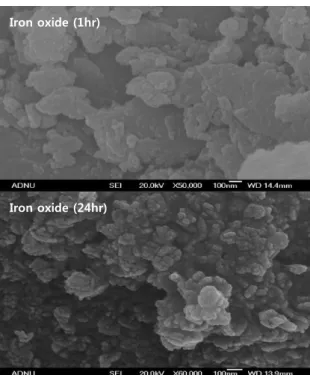
The supernatant and the precipitate were analyzed and the results were summarized in Table 1. The precipitate contained Fe, Al, Cu, Zn, Mn, Ca, Si, and S and the major content was iron (83.14 %) showing the solid is mainly iron oxide as expected. The supernatant also contained some metals but the concentration was relatively very low. The SEM image of precipitates was shown in Fig. 2. Spherical forms of approximately 0.05–0.2 μm in diameter were observed from the precipitates under SEM.
The particle size distribution of the iron oxide is shown in Fig. 3. The particle size ranged from 0.5 to 110 µ m. The mode of iron oxide samples at 1 and 24 hours are 50 and 70 µ m respectively. The two iron oxides have similar
Fig. 2. Scanning electron microscopy (SEM) images of iron oxide precipitated from AMD.
Particle size ( m)
0.1 1 10 100 1000
Volume (%)
0.0 0.5 1.0 1.5 2.0 2.5 3.0
Iron oxide (1hr) Iron oxide (24hr)
Fig. 3. Analysis result of particle size distribution.
distribution patterns and iron oxide samples at 24 hours is relatively bigger size.
The XRD results of iron oxides are shown in Fig. 4. Both of the iron oxides sampled at 1 and 24 hours after precipitation looks broad and round, indicating that they are poor crystallized but certainly not X-ray amorphous.
The sample of 1 hour consists mainly of ferrihydrite.
However, the iron oxide samples at 24 hour composed of ferrihydrite and small amount of goethite.
Iron oxide (1hr)
Intensity
0 50 100 150 200 250 300
Iron oxide (24hr)
Two-Theta (deg)
0 10 20 30 40 50 60 70
Intensity
0 50 100 150 200 250 300
Fig. 4. X-ray diffraction patterns of iron oxide precipitated from AMD.
(A) Arsenic (As)
Iron oxide (1hr) Iron oxide (24hr) Magnetite 0
5 10 15 20 25 30
pH 5 pH 7 pH 9
(B) Lead (Pb)
Iron oxide (1hr) Iron oxide (24hr) Magnetite
Adsorbate/adsorbent (mmol/g)
0 5 10 15 20
25 pH 5
pH 7 pH 9
(C) Copper (Cu)
Iron oxide (1hr) Iron oxide (24hr) Magnetite 0
10 20 30 40
50 pH 5
pH 7 pH 9
Fig. 5. Sorption properties of iron oxide from AMD and magnetite in varied solution pH.
Iron oxide (1hr)
Iron oxide (24hr)
Flow rate = 0.1 m/sec
Magnetic field
0.5 T 1.0 T 3.0 T 5.0 T
Captured (%)
0 20 40 60 80 100
Iron oxide (1hr) Iron oxide (24hr) Magnetite
Fig. 6. Recovery rates of iron oxides and magnetite by HGMS in a variable magnetic field.
The sorption capacity of two iron oxides from AMD and magnetite was calculated from the sorption experiment (Fig.
5). The sorption characteristic is dependent on the solution pH and the type of iron oxdes. Iron oxide (1hr) has higher sorption capacity for Pb and Cu than iron oxide (24hr) but magnetite has relatively low sorption capacity. However, iron oxide (24hrs) has higher sorption capacity for As than iron oxide (1hr).
Fig. 6 showed the separation ratio of two types of iron oxide and magnetite particles as the magnetic field increase.
The recovery rate of the iron oxide (1hr) and magnetite were about 90.5 % and 98.2 % respectively at 1.0 T of magnetic field and the recovery rate was gradually increased up to 99.4 and 99.9 % as the magnetic field increase to 5 T. However, separation ratio of the iron oxide (24 hr) was relatively low (about 16.2 %) at 5 T showing iron oxide aged longer than 24 hours have lower magnetic separation properties. The types of oxide are dependent on the time of formation and the different types of iron oxide have different magnetism. Current results shows that the newly formed (1 hr) iron oxide has relatively higher magnetism compared with that of a longer formation time allowed (24 hr). The XRD pattern was somewhat different as explained above. Current results indicate that iron oxide formed from AMD can be magnetically separated and the condition of iron oxide formation is very important for magnetization of the iron oxides. The superconducting magnetic separation system collects the iron oxide adsorbing heavy metals from wastewater and the collected adsorbent can be regenerated. The captured rate is a function of flow rate of the water through the magnetic field.
Current measurement was conducted at about 0.1 m/sec of flow rate.
Magnetic hysteresis loop of iron oxides (1 and 24 hr) were obtained as shown in Fig. 6. The hysteresis loop showed that the precipitated iron oxides (1 and 24 hr) have a different magnetic moment. The iron oxide (1 hr) has 1.84 emu/g and 149.8 G of magnetization and coercive force, and the iron oxide (24 hr) has 0.08 emu/g and 109.7 G, respectively.
Magnetic Field (G)
-15000 -10000 -5000 0 5000 10000 15000
Moment/mass (emu/g)
-9 -6 -3 0 3 6 9
Iron oxide (1hr)
Iron oxide (24hr)
Fig. 7. Magnetic hysteresis loop of the iron oxides.
4. CONCLUSION
AMD is an express way to deliver the contaminants to surrounding environments. AMD usually contains a high concentration of iron. The iron oxide was successfully synthesized from an AMD by controlling solution pH. The synthesized iron oxide was a good adsorbent for heavy metals such as As, Cu and Pb. The sorption characteristics were highly dependent on the type of iron oxide and solution pH. Heavy metal adsorbed iron oxide was tested by the superconducting HGMS. The recovery rate of iron oxide was proportional to the magnetic field and the type of iron oxide affected on the recovery rate. Current results proved that the iron oxide formed from AMD could remove heavy metals from wastewater and can be magnetically separated with a superconducting HGMS. This implicates that magnetic separation system with iron oxide formed from mine wastewater could be an alternative technology for heavy metal removal from wastewater.
ACKNOWLEDGMENT
This work was supported by GAIA project from Korea Environmental Industry & Technology Institute (KEITI 2013000550008).
REFERENCES
[1] Mingcan Cui, Min Jang, Sang-Hyun Cho, Jeehyeong Khim, Fred S.
Cannond, “A continuous pilot-scale system using coal-mine drainage sludge to treat acid mine drainage contaminated with high concentrations of Pb, Zn, and other heavy metals,” Journal of Hazardous Materials, vol. 215–216, pp. 122–128, 2012.
[2] Jianbo Liao, Zewei Wen, Xuan Ru, Jundong Chen, Haizhen Wu, Chaohai Wei, “Distribution and migration of heavy metals in soil and crops affected by acid mine drainage: Public health implications in Guangdong Province, China,” Ecotoxicology and Environmental Safety, vol. 124, pp. 460–469, 2016.
[3] Kebede K. Kefeni, Titus M. Msagati, Bhekie B. Mamba, “Synthesis and characterization of magnetic nanoparticles and study their
removal capacity of metals from acid mine drainage,” Chemical Engineering Journal, vol. 276, pp. 222–231, 2015.
[4] C.A. R´ıos, C.D. Williams, C.L. Roberts, “Removal of heavy metals from acid mine drainage (AMD) using coal fly ash, natural clinker and synthetic zeolites,” Journal of Hazardous Materials, vol. 156, pp. 23–35, 2008.
[5] Andrada Ma˘ica˘neanu, Horea Bedelean, Marius Ardelean, Silvia Burca, Maria Stanca, “Hanes and Valea Vinului (Romania) closed mines Acid Mine Drainages (AMDs) – Actual condition and passive treatment remediation proposal,” Chemosphere, vol. 93, pp.
1400–1405, 2013.
[6] Hongkyun Lee, Dohyeong Kim, Jongsik Kim, Min-Kyu Ji, Young-Soo Han, Young-Tae Park, Hyun-Shik Yun, Jaeyoung Choi,
“As(III) and As(V) removal from the aqueous phase via adsorption onto acid mine drainage sludge (AMDS) alginate beads and goethite alginate beads,” Journal of Hazardous Materials, vol. 292, pp. 146–154, 2015.
[7] C. Carbone, E. Dinelli, P. Marescotti, G. Gasparotto, G. Lucchetti,
“The role of AMD secondary minerals in controlling environmental pollution: Indications from bulk leaching tests,” Journal of Geochemical Exploration, vol. 132, pp. 188–200, 2013.
[8] Lee G, Bigham JM, Faure G. Removal of trace metals by coprecipitation with Fe, Al and Mn from natural waters contaminated with acid mine drainage in the Ducktown Mining District, Tennessee. Applied Geochemistry, vol. 17, pp. 569–581, 2002.
[9] G.S. Plumlee, K.S. Smith, M.R. Montour, W.S. Ficklin, E.L.
Mosier, “Geologic controls on the composition of natural waters and mine waters diverse mineral deposit types,” Reviews in Economic Geology, The Environmental Geochemistry of Mineral Deposits: Case Studies and Research Topics, pp 373–432, 2002.
[10] J.G. Webster, P.J. Swedlund, K.S. Webster, “Trace metal adsorption onto and acid mine drainage iron (III) oxyhydroxysulfate”
Environmental Science & Technology, vol. 32, pp. 1361–1368, 1998.
[11] Jee-Eun Kim, Dong-Woo Ha, and Young-Hun Kim, “Separation of Steel Slag From Landfill Waste for the Purpose of Decontamination Using a Superconducting Magnetic Separation System,” IEEE Trans. Appl. Supercond., vol. 25, no. 3, pp. xxx, 2015.