Superconductivity and Cryogenics
Vol.14, No.4, (2012), pp.16~19 http://dx.doi.org/10.9714/sac.2012.14.4.016
``
Abstract— In power cables as one of the important power applications adopting HTS tapes, a good insulation should be kept at its optimum performance.
As an insulation material for superconducting device applications, polypropylene laminated paper (PPLP) is now widely used instead of the conventional Kraft paper. In addition to its dielectric property, the insulation material should also possess superior mechanical property at cryogenic temperatures and operability that is necessary for the insulation winding process. This study aims to evaluate the mechanical property of the PPLP material at ambient and cryogenic temperatures. At cryogenic temperature, the failure stress of PPLP increased significantly as compared with that at ambient temperature. The failure stress at both temperatures depended upon the sample orientation to the load application.
Keywords: polypropylene laminated paper (PPLP), mechanical properties, cryogenic temperature, displacement rate.
1. INTRODUCTION
Recently, HTS tapes have been achieving significant improvement in its current transport properties and gained more demands in the field of power application. One of which is the need for the electrical power transmission.
Large power cables including long distance DC submarine cables and land based power cables are now constructed and improved to its optimum potential in carrying large amount of electrical power [1, 2]. The improvement of such systems is believed to be made possible by using an appropriate insulation material in order to minimize the current loss during transmission of electrical current [3].
Due to its well known dielectric property such as breakdown strength, low loss, etc., a polypropylene laminated paper (PPLP) material is now widely used on long HTS power cables as substitute insulation instead of the conventional Kraft paper. Recent studies reported that PPLP materials maximized the full potential of the power cables in power transmission due to its superior insulation properties compared with the conventional Kraft paper [4].
Also, problems such as cracking of PPLP impregnated with liquid nitrogen and anisotropic property along directions were reported elsewhere [5].
Data regarding the insulating properties of the PPLP material at RT and at cryogenic temperatures are already reported [6]. On the other hand, the mechanical properties of the PPLP material as a layered composite at cryogenic temperature are also important. Furthermore, the influences of parameters like the anisotropy and the displacement rate during test on the mechanical properties of the PPLP material at cryogenic temperature should be understood for design purposes. In this study, the evaluation of mechanical properties of the PPLP material at ambient and at cryogenic temperatures was performed. The influences of the displacement rate and orientation dependency (anisotropy) on the mechanical properties were investigated.
2. EXPERIMENTALPROCEDURE 2.1 Sample
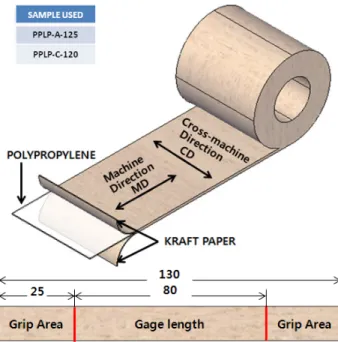
The polypropylene laminated paper (PPLP) is an insulator composed of polypropylene (PP) sandwiched between Kraft papers. Two PPLP samples with different thickness were tested in this study as can be seen in Fig. 1.
PPLP-A-125 and PPLP-C-120 are the sample code given by the manufacturer where the three digit numbers denotes
Fig. 1. PPLP samples and specimen dimensions.
Mechanical Properties of PPLP Material at Cryogenic Temperature
Alking B. Gorospe and Hyung-Seop Shin*
Department of Mechanical Design Engineering, Andong National University, Andong 760-749, Korea Received 3 October 2012; accepted 12 November 2012
* Corresponding author: [email protected]
17
Alking B. Gorospe and Hyung-Seop Shin
the thickness of each sample as 0.125 mm and 0.120 mm, respectively. The samples were cut from a commercialized PPLP roll into the specimen with dimensions of 15 mm x 130 mm for the width and length using a sharp razor cutter.
The samples were prepared with two different orientations;
the one with a length parallel to machine- direction (MD) and the other parallel to cross-machine direction (CD) [5].
The actual thicknesses of the samples were measured using a high precision flat-tipped digital micrometer.
2.2 Tensile test equipment
Fig. 2 shows the setup for tensile test of PPLP samples at RT and 77 K. The sample was held at both ends by grips and sand paper (# 1000) was inserted on both sides to protect the sample from damage and to prevent it from slipping during the test. The sample was gripped with an 80 mm gage length and 25 mm grip part length on both sides as shown in Fig.1. Tensile load was applied by using a universal testing machine (Shimadzu AG-IS) with a 5 kN load cell until failure of the sample [7]. A Nyilas-type double extensometer with a 15 mm gage length was placed at the middle part of the sample to measure the strain experienced by the PPLP sample during the test [8]. For the test at cryogenic temperature, the PPLP sample was submerged on a dewar containing liquid nitrogen (LN2) and held for 10 min before applying the tensile load. The tensile test was carried out at different displacement rates from 0.5 to 10 mm/min.
In this study, the strain obtained by the double extensometers was just used to derive the Young’s modulus (E) and the yield strength (σy) of each sample. On the other hand, the strain was derived from the displacement between the grips. Properties like the percent strain (εf) and the stress at break (σf) were determined using equations (1) and (2), respectively.
Fig. 2. Schematics of PPLP specimen gripping setup.
( 100 %) GL
f f
ε = δ
(1)
w t
P
ff
= ⋅
σ
(2) Where: δf, GL, Pf, t and w represent the displacement at break, the gage length, the failure load, the thickness and the width of the specimen, respectively.3. RESULTSANDDISCUSSION
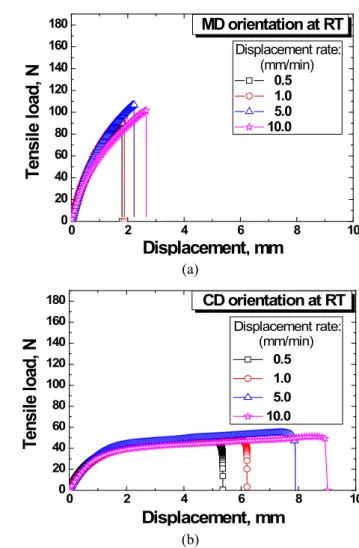
Fig. 3. (a) and (b) show the load-displacement curves along MD and CD orientation of PPLP specimens at each displacement rate at RT. Similarly with other paper materials, PPLP’s load-displacement curves along MD orientation behaved nearly as an elastic material but the CD behaved differently as a perfect plastic material. At ambient temperature, the MD oriented samples (Fig. 3(a)) exhibits a higher load but a smaller displacement value at break point when compared with the CD oriented samples which exhibits quite larger displacement (plastic behavior) as shown in Fig. 3(b). This behavior is due to the dominant anisotropic property of the Kraft papers which has a higher tensile strength of 57.3 MPa along its fiber direction
0 2 4 6 8 10
0 20 40 60 80 100 120 140 160
180
MD orientation at RT
Te ns ile lo ad , N
Displacement, mm
Displacement rate:
(mm/min) 0.5 1.0 5.0 10.0
(a)
0 2 4 6 8 10
0 20 40 60 80 100 120 140 160
180 CD orientation at RT
Te ns ile lo ad , N
Displacement, mm
Displacement rate:
(mm/min) 0.5 1.0 5.0 10.0
(b)
Fig. 3. Load-displacement curves obtained along (a) MD and (b) CD orientations at RT (PPLP-C-120 samples).
18 Mechanical Properties of PPLP Material at Cryogenic Temperature
TABLE I
MECHANICAL PROPERTIES OF PPLP MATERIALS AT RT AND 77K (at 5 mm/min.).
compared with its cross-fiber direction which has only 33.1 MPa [9]. Since most of the fibers in Kraft papers are aligned on MD, this explains why its mechanical properties are superior in the MD orientation as compared with the CD one.
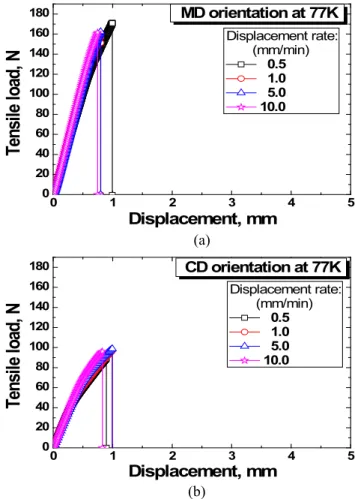
At cryogenic temperature, the mechanical properties of PPLP, especially the tensile load at break, were significantly enhanced as compared with its value at RT for both samples along MD (Fig. 4(a)) and CD (Fig. 4(b)) [6].
However, the displacement at break significantly decreased for both orientations, and it was especially significant on the CD sample. The drastic reduction of the elongation
0 1 2 3 4 5
0 20 40 60 80 100 120 140 160
180 MD orientation at 77K
Te ns ile lo ad , N
Displacement, mm
Displacement rate:
(mm/min) 0.5 1.0 5.0 10.0
(a)
0 1 2 3 4 5
0 20 40 60 80 100 120 140 160
180 CD orientation at 77K
Te ns ile lo ad , N
Displacement, mm
Displacement rate:
(mm/min) 0.5 1.0 5.0 10.0
(b)
Fig. 4. Load-displacement curves obtained along (a) MD and (b) CD orientations at 77 K (PPLP-C-120 samples).
value of CD sample from room temperature to cryogenic temperature can be addressed to the behavior of polypropylene (PP) which is the dominant material in this direction. At cryogenic temperature, the PP changes from
“rubbery” to “glassy” state exhibiting a higher tensile load and a smaller elongation [10].
Mechanical properties such as the Young’s modulus, yield strength and elongation at 5 mm/min were measured, averaged and listed in Table I. It can be found from the table that the influence of the thickness on the properties of the PPLP materials at each temperature and respective orientation did not exist. At cryogenic temperature, the determination of the yield strength for MD samples was difficult because of the quite small elongation due to the hardening effect at low temperature. At 77 K, it can be found that both the stress at break and the Young’s modulus increased significantly as compared with the cases at RT.
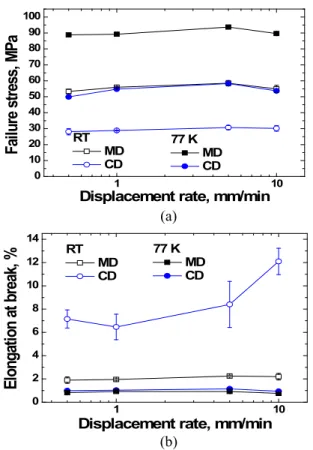
Moreover, the effects of the displacement rate on the failure stress, which is corresponding to tensile strength of PPLP samples, and the elongation at break were shown in Fig. 5 (a) and (b), respectively. Results of two tests for each condition were averaged and depicted by the figures.
In Fig. 5(a), both orientation samples (MD and CD) represented almost similar response at ambient and cryogenic temperatures. As the displacement rate increased, the failure stress of the PPLP material tended to increase slightly until 5 mm/min. However, beyond 5 mm/min, the failure stress decreased a little. As a result, in the mechanical property test of insulating materials at cryogenic temperature, it is necessary that the displacement rate adopted should be considered in determining the failure stress of the PPLP material in both orientations provided. It can be thought that this low rate dependency might be the result of the viscoelastic property of PPLP material at RT.
A similar behavior can also be seen on the elongation at break as shown in Fig. 5(b). At RT, however, the response of the PPLP material oriented along CD was different, as the displacement rate increased the elongation at break was somewhat enhanced showing a significant scattering until 10 mm/min. This might be due to the effect of high strain deformation characteristic of polypropylene material on the whole PPLP structure at RT.
Material orientation Failure load
(N)
Failure stress (MPa)
Elongation at break
(mm)
Elongation at break
(%)
Young’s modulus (GPa)
Yield strength
(MPa) Room temperature (RT)
PPLP-C-120 MD 103.0 58.4 2.2 2.7 4.5 32.4
CD 53.0 30.7 6.7 8.4 2.4 17.8
PPLP-A-125 MD 108.0 59.0 2.0 2.5 5.4 39.3
CD 69.0 37.9 5.6 7.0 3.1 21.8
Cryogenic temperature (77 K)
PPLP-C-120 MD 163.0 93.7 0.8 1.0 12.2 -
CD 100.5 58.3 1.0 1.3 7.6 50.9
PPLP-A-125 MD 169.0 95.1 0.8 0.9 13.0 -
CD 114.0 71.5 0.9 1.1 9.3 55.9
19
Alking B. Gorospe and Hyung-Seop Shin
1 10
0 10 20 30 40 50 60 70 80 90 100
RT MD CD
77 K MD CD Displacement rate, mm/min
Fai lur e st ress, M Pa
(a)
1 10
0 2 4 6 8 10 12
14 77 K
MD CD RT MD
CD
El on ga tio n a t b re ak , %
Displacement rate, mm/min (b)
Fig. 5. Effect of displacement rate on (a) the failure stress and (b) the elongation at break (PPLP - C-120).
Figs. 6 and 7 show the morphologies of fractured specimen at RT and 77 K, respectively. The result of the high strain deformation characteristic of polypropylene at RT as compared with thecase at 77 K can be shown by the longer CD oriented sample in Fig. 7(a).
(a)
(b)
Fig. 6. Morphologies of fractured samples along MD orientation at (a) RT and (b) 77 K (5 mm/min).
(a)
(b)
Fig. 7. Morphologies of fractured samples along CD orientation at (a) RT and (b) 77 K (5 mm/min).
4. CONCLUSIONS
Mechanical properties of the PPLP material with different thickness and orientations (CD and MD) at cryogenic temperature were evaluated. It was found that the mechanical properties of the PPLP material varied and greatly depended on the test temperature and the orientation against the applied load. The failure stress (tensile strength) of the PPLP material along MD was larger than that along CD, but its elongation was significantly smaller in both ambient and cryogenic temperatures due mainly to its fiber orientation.
Compared with the cases at RT, the failure stress and Young’s modulus of the material at 77 K increased almost twice. However the elongation of the material was significantly decreased at cryogenic temperature especially in the case of CD. Furthermore, small displacement rate sensitivity appeared on the failure stress of PPLP up to 5 mm/min on both sample orientations.
ACKNOWLEDGMENT
This work was supported by the National Research Foundation of Korea (NRF) funded by the Korean Government (MEST) (2011-0015369).
REFERENCESS
[1] T. Masuda, Y. Ashibe, M. Watanabe, C. Suzawa, K. Ohkura, M.
Hirose, S. Isojima et. al, “Development of a 100 m, 3 core 114 MVA HTSC cable sytem,” Physica C 372-376, pp. 1580-1584, 2002.
[2] R. Hata, “Solid DC Submarine Cable Insulated with Polypropylene Laminated Paper (PPLP),” SEI technical review: Number 62, pp.
3-9,June 2006.
[3] P. Caracino, M. Lakner, H. Okubo, O Tonnesan and B. Wacker,
“Superconducting and insulating materials for HTS power applications,”15 – 405 CIGRE Session - 2002.
[4] E. Tuncer, G. Polizob, I. Sauers and D. R. James, “Electrical insulation paper and its physical properties at Cryogenic Temperatures,” IEEE Trans. Appl. Supercond, vol. 21, pp. 1438 – 1440, 2011.
[5] H.J. Kim, D.S. Wang, Y.S. Kim and S.H. Kim, “Electrical characteristics of high – Tc superconducting mini-model cable under mechanical stresses in liquid nitrogen,” Cryogenics 45, pp.
45-50, 2005.
[6] J.W. Choi, H.G. Cheon, J.H Choi, H.J Kim, J.W. Cho and S.H. Kim.
“A study on insulation characteristics of laminated Polypropylene Paper for an HTS Cable,” IEEE Trans. Appl. Supercond., vol. 20, no.3, pp. 1280-1283, 2010.
[7] S.H. Shin, M.J. Dedicatoria and S.S. Oh., “Critical current degradation behavior in lap-jointed coated conductor tapes with IBAD substrate under uniaxial tension,” IEEE Trans. Appl.
Supercond., vol. 20, no. 3, pp. 1447-1450, 2010.
[8] A. Nyilas, “Strain sensing systems tailored for tensile measurement of fragile wires,” Supercond. Sci. Technol., vol. 18, pp. 409 – 415, 2005.
[9] J. Tryding “In Plane Fracture of Paper,” University dissertation from Structural Mechanics, Lund University, 1996.
[10] J. Chen, G.A. Bell, H. Dong, J.F. Smith and B. D. Beake, “A study of low temperature mechanical properties and creep behavior of polypropylene using a new sub-ambient temperature nano- indentation test platform”, J. Phys. D: Appl. Phys. vol. 43, no. 42, 425404, 2010.