Vol. 19, No. 12 pp. 931-937, 2018
The Mechanical Characteristics of the PLLA and PCL Sutures According to the Temperature
Yuying Xie, Soon-Kook Kang
*Dept of Environmental and Bio-chemical Engineering., Sunmoon University
온도에 따른 PLLA 및 PCL 봉합사의 기계적 특성
시에위잉, 강순국*
선문대학교 환경생명화학공학과
Abstract Sutures are used not only for wound closure but also for oriental medicine field, beauty and even for plastic surgery. Especially, it is popular in the field of cosmetic surgery. In this paper, we produced sutures using PCL and PLLA with better strength than PDO sutures, which was widely used in the past. To learn about the mechanical characteristics of the PCL and PLLA sutures, the contraction change, tensile strength, and elongation were measured. And SEM was also analyzed for diameter and surface. The contraction change Ratio of sutures are stabilized after a certain period of time regardless of temperature. Also, it can be seen that the higher the temperature, the higher the contraction increase rate. And the rate change of mechanical properties is different according to the temperature before and after the glass temperature. Also the higher the temperature, the faster the molecular motion and the lower the tensile strength. The diameter of the PLLA and PCL sutures is opposite to the contraction change ratio. And it is considered that the sterilization temperature of PLLA sutures is best to set at 45 °C and the sterilization temperature of PCL sutures is best to set at 35 °C.
요 약 봉합사는 단순한 접합용로 뿐만 아니라 한방, 미용 심지어 성형 분야에도 사용하고 있다. 특히 미용 성형 분야에 인기를 끌고 있다. 본 논문에서는 기존에 많이 사용했던 PDO 봉합사보다 강도 더 좋은 PCL 및 PLLA 봉합사를 제조하였다.
이들의 수축 특성을 알기 위해 PCL 및 PLLA 봉합사의 수축률, 인장강도 및 연신율을 측정하였다. 또한 직경 및 표면을 보기 위해 SEM을 분석하였다. 수축률은 온도 상관없이 일정기간 지나면 안정화 되다. 또한 온도 높을수록 수축 증가율이 높아진 다는 것을 확인할 수 있다. 그리고 유리온도의 전후 온도에 따른 기계적 특성의 변화율이 다르게 나타나는 것을 확인할 수 있다. 또한 온도 높을수록 분자운동 더 빨라지고 인장강도 낮아진다. PCL 및 PLLA 봉합사의 직경은 봉합사의 수축률과 상반 관계로 나타나는 것을 확인할 수 있다. 그리고 PLLA 봉합사의 멸균온도는 45 ℃로 설정하고 PCL 봉합사의 멸균온도는 35
℃로 설정하는 것이 가장 적절하다고 사료된다.
Keywords : Contraction change ratio, Elongation rate, PLLA, PCL, Sutures, Tensile strength
*Corresponding Author : Soon Kook Kang(Sunmoon Univ.) Tel: +82-41-530-2382 email: [email protected]
Received October 8, 2018 Revised (1st November 16, 2018, 2nd December 5, 2018) Accepted December 7, 2018 Published December 31, 2018
1. Introduction
Sutures are an essential part of surgery which are with human history. Sutures are disinfected fibers that are applied within the human body while the tissue is
sutured after the surgical site[1]. In general, sutures can be divided into absorbable sutures and non-absorbable sutures depending on the bio-absorbability of the sutures. The non-absorbable sutures are not decomposed in the human body and are present in the
tissue as a foreign substances during the wound healing process. The absorbable sutures can be divided into a natural polymer system and a synthetic polymer system depending on the materials[2,3]. Although natural polymeric materials are used widely, such as catgut, cellulose, and collagen, they have been widely used but have lower tissue reactivity and infection rate than synthetic polymeric suture materials, but have poor degradation rate, breaking strength, knot tensile strength and strength retention rate in vivo. So the synthetic polymeric sutures are expected to be used more[4,5]. The most commonly used materials are Polydioxanone (PDO), Ployglycolide (PGA), Polylactide (PLA), and their copolyesters, such as Poly (lactide-co-glycolide) (PLGA). They have been noticed as sutures because of their biocompatibility, stability and biodegradability as well as proper mechanical properties[6-8].
According to the development of modern social technologies and industries, human life is seeking happiness. So sutures are now not only used for simple bonding, but also for oriental medicine, beauty and even plastic surgery. Especially diet and pain relief needle in the oriental medicine field and lifting in the cosmetic surgery area are popular. PDO sutures which are widely used in the past is developed for skin closure, and also have a high strength at the beginning, but they are not suited for improvement of wrinkles or lifting due to rapid degradation in the body. Recently, Poly (L-lactic acid) (PLLA) and Polycaprolactone (PCL) sutures have been developed to overcome this problem[9,10].
PLLA is a biocompatible material that is widely used because of its biological properties such as biocompatibility and biodegradability. It is known that PLLA has low mechanical strength, low flexibility and long degradation period and is not used as a suture.
However, clinical effects on the formation of collagen-type treatments based on PLLA have been known recently[10,11].
Polycaprolactone (PCL) is a biomaterial that is
approved by FDA and has low melting point, low strength, but it has a high flexibility, non-toxic to living body and high tissue-friendly, and it is widely used in the field of tissue regeneration.[12,13]. PCL structure also allows for blending with other high-polymer as hydrophobic and hydrophilic units exist together. Therefore, PCL is useful as a lifting suture, stapler and drug carrier[14,15].
PLLA sutures and PCL sutures are popular, but they are sensitive to water and temperature, so they are very demanding in storage conditions. Storage conditions are difficult because poor storage can cause distortion and hydrolysis. Therefore, in this study, we measured the contraction change, tensile strength, and elongation rate of the sutures according to the sterilization temperature to observe the mechanical characteristics of the PLLA and PCL sutures. And SEM analysis was performed to examine the surface characteristics of the PLLA and PCL sutures.
2. Materials and Methods
Poly (L-Lactic acid) (PLLA) were purchased from Purac and were manufactured by an extruder. The suture was prepared with a diameter of 0.5 to 1mm, an input speed of 25 mm/min, the temperature of extruder is set at 170 °C, and a take-up speed is set at 70 M/min. Then kept them for 10 minutes in the nitrogen atmosphere and finally PLLA sutures were obtained.
Polycaprolactone(PCL) were purchased from Purac and were manufactured from a self-made extruder. The sutures were prepared with a diameter of 0.5 to 1mm, an input speed of 25 mm/min, an extruder temperature of 80 °C, and a take-up speed of 70 M/min. Then kept them for 10 minutes in the nitrogen atmosphere and finally PLLA sutures were obtained.
The obtained sutures were dried for 12 hours in a dryer. The sutures were cut to 1000mm and the specimens were prepared. Five specimens of PLLA sutures were taken out after a certain period of time at
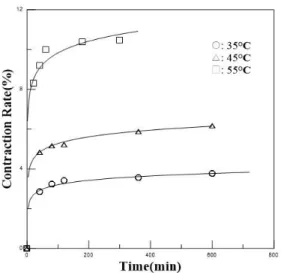
Fig. 1. The Contraction change ratio of PCL sutures at 35 °C, 45 °C and 55 °C.
45 °C, 60 °C, 80 °C and 100 °C. Respectively, the contraction change, tensile strength, and elongation rate of sutures were measured. The specimens of PCL sutures were taken out after a certain period of time at 35 °C, 45 °C and 55 °C. Respectively, the contraction change, tensile strength, and elongation rate of sutures were measured.
3. Results
3.1 The contraction change of sutures 3.1.1 The contraction change of PCL sutures Fig. 1 shows that the contraction change of PCL sutures at 35 °C, 45 °C and 55 °C. As shown in the figure, the contraction change of PCL sutures at 35
°C, 45 °C and 55 °C rapidly increases from the beginning, and the contraction change does not increase any more after a certain period of time. It was seen that the contraction change was stabilized at 35
°C for 180 minutes, 45 °C for 150 minutes, and 55 °C for 120 minutes. The contraction change of the sutures are stabilized after a certain period of time regardless of temperature. Also, it can be confirmed that the higher temperature, the higher the contraction change ratio and the shorter the stabilization time.
Fig. 2. The Contraction change ratio of PLLA sutures at 45 °C, 60 °C, 80 °C and 100 °C.
3.1.2 The contraction change of PLLA sutures Fig. 2 shows that the contraction change of PLLA sutures at 45 °C, 60 °C, 80 °C and 100 °C. As shown in the figure, the contraction change at 45 °C and 60
°C, was stabilized at 120 minutes and 60 minutes respectively, thereafter, there is almost no change in the contraction change. The contraction change was greatly increased to 20 minutes at 80 °C and to 10 minutes at 100 °C, and then stabilized. It can also be seen that the rate of change at 80 °C and 100 °C more than at 45 °C and 60 °C.
As seen in fig. 1 and fig. 2, the higher the temperature, the faster the contraction change ratio, the higher the contraction increase rate. This confirmed that the setting temperature as low as possible when sterilize the sutures . And when the sterilization temperature was setting at 45 °C, the contraction change ratio of the sutures can be found to be in the 3% to 5%. The data from the experimental results published by Ahn Seon-eun showed that the injection temperature also appears within 20% in the injection-type process[16]. It can be confirmed that although the processes are ditterent, the higher the temperature, the higher the contraction change ratio.
Fig. 3. The Contraction change ratio of PCL and PLLA sutures at 45 °C.
Fig. 4. The tensile strength of PCL sutures at 35 °C, 45 °C and 55 °C.
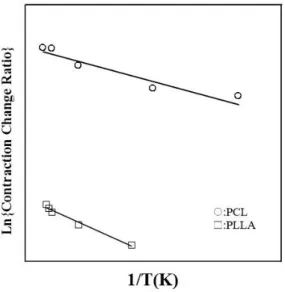
3.1.3 The contraction change of sutures at 45 ℃ Fig. 3 shows that the curves of contraction characteristics of PLLA and PCL sutures at 45 °C. As shown in the figure, the contraction strength of PLLA and PCL sutures as a function of sterilization time at 45 °C. The contraction strength of PLLA was 24.39 N and the contraction strength of PCL was 14.62 N.
Fig. 5. The tensile strength of PLLA sutures at 45 °C, 60 °C and 100 °C.
k=A*exp(-F/RT), (1) lnk=lnA-F/RT, (2) Where A is a constant and R is a universal constant.
And T is the sterilization temperature, F is the contraction strength.
3.2 The tensile strength of sutures 3.2.1 The tensile strength of PCL sutures Fig. 4 is the change of tensile strength of PCL sutures according to the sterilization temperature. As shown in Fig. 4, it can be seen that the tensile strength greatly increases at 35 °C, 45 °C and 55 °C within 2 hours, and after 2 hours the tensile strength almost have no change. The tensile strength at 35 °C is maintained at approximately 36 kgf/mm², and the tensile strength at 45 °C is maintained at 32 kgf/mm² and at 55 °C is 29 kgf/mm². Unlike Fig. 1 and Fig. 2, tensile strength is found to be lower at higher temperatures. It is considered that the higher the temperature, the faster the molecular motion and the lower the tensile strength[17].
3.2.2 The tensile strength of PLLA sutures Fig. 5 is the change of tensile strength of PLLA sutures according to the sterilization temperature. As
Fig. 6. The Elongation Ratio of PCL sutures at 35°C, 45°C and 55°C.
Fig. 7. The Elongation Ratio of PLLA sutures at 45
°C, 60 °C, 80 °C and 100 °C.
shown in the figure, the tensile strength decreases at 45
°C, 60 °C and 100 °C at first and then increases. It is considered that the tensile strength is influenced by the degree of orientation of the PLLA. And the result same as the data from the experimental results published by W. B. Qin showed that when the degree of orientation and the crystallinity is increased after a certain period of time, the change of tensile strength of PLLA sutures also is on the increase[17].
3.3 The elongation ratio of sutures 3.3.1 The elongation ratio of PCL sutures Fig. 6 is the change of elongation ratio of PCL sutures with the sterilization temperature. It stabilizes at 35 °C for 6 hours, at 45 °C for 4 hours, and at 55 °C for 2 hours as shown in Fig. 2. It can be seen that the higher the temperature, the greater the elongation ratio and the faster the stabilization. The rate of change with temperature did not show much like Fig. 1. It can be confirmed that the elongation stays stable at about 67%
to 69%.
3.3.2 The elongation ratio of PLLA sutures Fig. 7 is the change of elongation ratio of PLLA sutures according to the sterilization temperature. As shown in the figure, the elongation ratio of PLLA sutures at 45 °C and 60 °C is decreased first and then increased. On the other hand, the elongation ratio at 80
°C and 100 °C is increased, stabilized, and then increased again. These results show that the mechanical characteristics of the PLLA sutures will change while the sterilization temperature over the glass transition temperature. So the sterilization temperature of sutures is best to set blow the glass transition temperature.
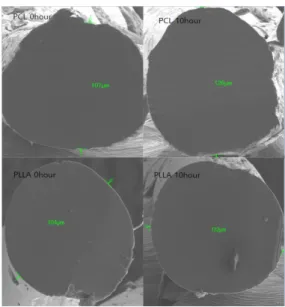
Fig. 8. The SEM image of PCL and PLLA sutures at 45 °C.
3.4 The section characteristics of sutures Fig. 8 is an SEM analysis image of PLLA and PCL sutures at 45 °C with raw data and after 10 hours. As shown in the figure, the diameter increases after 10 hours of PLLA sutures and PCL suture. It can be seen that the diameter of the sutures is opposite to the contraction change ratio of the sutures.
4. Conclusion
The following conclusions can be obtained from experiments on the characteristics of PCL and PLLA sutures according to the sterilization temperature.
(1) The contraction change ratio of PLLA and PCL sutures stabilizes after a certain period of time regardless of temperature. Also, it can be seen that the higher the temperature, the higher the contraction change ratio and the shorter the stabilization time. However, the contraction change rate of PLLA suture is faster When the sterilization temperature is higher than the glass transition temperature.
(2) The tensile strength of PCL sutures is decreases with increasing temperature, which is considered to be due to the low PCL glass transition temperature. On the other hand, the tensile strength of the PLLA sutures is decreased and then increased. It is considered that the tensile strength is influenced by the degree of orientation and thermal motion of the sutures.
(3) It can be confirmed that the elongation ratio of the PCL and PLLA sutures is opposite to the contraction change ratio. However, the tensile strength results are different.
(4) The diameter of the PLLA and PCL sutures is opposite to the contraction change ratio.
(5) According to all the analysis results, it is considered that the sterilization temperature of PLLA sutures is best to set at 45 °C and the sterilization temperature of PCL sutures is best
to set at 35 °C. After sterilization, the suture contraction change ratio is going to be in 3 ~ 5%.
References
[1] S. Bhat and A. Kumar. Biomaterials and bioengineering tomorrow’s healthcare. Biomatter. 3(3): e24717, Jul 1 2013.
[2] G. Joseph Parell, MD; Gary D. Becker, MD, Comparison of Absorbable With Nonabsorbable Sutures in Closure of Facial Skin Wounds, Arch Facial Plast Surg. 5(6):488-490, 2003;
[3] C. S. Yoon, D. S. Ji, Preparation of PLA/PEG Block copolymer via melt blend, Textile Science and Engineering Vol. 43, No.5, 2006.
[4] H. J. Cho, D. J. Chung, J. H. An, Poly(D, L-lactide-ran- ε-caprolactone)-poly(ethylene glycol)- poly(D, L-lactide-ran-ε-caprolactone) as parenteral drug-delivery systems, J Biomaterials, 25, 3733-3742, 2004.
[5] H. Tsuji, A. Mizuno, Y. Ikada, Properties and morphology of poly(L-lactide). iii. Effects of initial crystallinity on long‐term in vitro hydrolysis of high molecular weight poly(L‐lactide) film in phosphate‐ buffered solution, Journal of Applied Polymer Science,Volume77, Issue7, 2000.
[6] Y. Y. Xie, J. S. Park, S. K. Kang, Studies on the effect of molecular weight on the degradation rate of biodegradable polymer membrane, Advanced Science and Technology Letters. Vol.120, pp. 390-394 (GST 2015).
[7] L. S. Nair, Cato T. Laurencin. Biodegradable polymers as biomaterials. Prog. Polym. Sci. 32 762-798, 2007.
[8] Y. Y. Xie, J. S. Park, S. K. Kang, Study on the degradation rate and pH change of PLGA membrane with a biodegradation. Journal of Korea Academia-Industrial cooperation Society Vol.16, No. 9.
pp. 6403-6410, 2015.
[9] So-i Lee, J. S. Park, M. K. Park, J. G. Ku, Mechanical properties of the in vitro degradation test of Poly(L-lactic acid)(PLLA) suture and Polydioxanone(PDO), Korea Academia-Industrial cooperation Society(2015). From:
http://insight.dbpia.co.kr/article/related.do?nodeId=NODE 07217811
[10] S. H. Kim, S. H. Kim, Biofunctional biodegradable polymers, Polymer Science and Technology Vol. 18, No.
5, October 2007.
[11] T. K Dash, V. B Konkimalla, Poly-є-caprolactone based formulations for drug delivery and tissue engineering: A review, Journal of Controlled Release 158 (1), 15-33, 2012.
[12] S. A. Park, B. Lee, Y. E. Kim, J. E. Kim, I. K. Kwon, J. H. Lee, W. D. Kim, H. K. Kim, M. E. Kim, J. S. Lee, Effect of sodium hydroxide treatment on scaffold by solid freeform fabrication, Polymer(Korea), Vol. 38, No.
6, pp. 815-819, 2014
[13] J. M. Willams, A. Adewunmi, R. M. Schck, C. I.
Flanagan, P. H. Krebsbach, S. E. Feinberg, S. E.
Feinberg, S. J. Hollister, and S. Das, Bone tissue engineering using polycaprolactone scaffolds fabricated via selective laser sintering.. Biomaterials, 26, 4817, 2005.
[14] P. Makela, T. Pohjonen, P. Tormala, T. Waris, N.
Ashammakhi, Strength retention properties of self-reinforced poly L-lactide(SR-PLLA) sutures compared with polyglyconste(Maxon) and polydioxanone(PDS) sutures.
An in vitro study, ELSEVIER Biomaterials 23 2587-2592, 2002.
[15] J. M. Seitz, M. Durisin, J. Goldman, J. W. Drelich, Recent Advances in Biodegradable Metals for Medical Sutures: A Critical Review. Advanced Healthcare materials. Volume 4, Issue 13, 2015.
[16] G. S. Ahn, G. B. Han, S. H. Oh, J. W. Park and C. W.
Kim. Evaluation of Anastomotic Strength and in-vitro degradability with microvascular anastomosis coupler based on injection molding condition made by biodegradable polycaprolactone(PCL). Trans. Korean Soc. Mech. Eng. C, Vol. 1, No. 2, pp. 167~177, 2013.
[17] W. B. Qin, A mechanical property study of corn polylactic acid fiber under different temperature status.
Shanghai Textile Science & Technology, Vol. 34 No.
12, 2006.
Yuying Xie [Regular member]
•Feb. 2016 : Sunmoon Univ., environment Eng., MS
•Feb. 2017~ current : Sunmoon Univ., Enviormental & bio-chemical Eng., PhD
•Sep. 2017 ∼ current : Sunmoon Univ., Dept. of Enviormental &
bio-chemical Eng., Lecturer
<Research Interests>
Biodegradation polymer, Membrane, Suture
Soon-Kook Kang [Regular member]
•Feb. 1988 : KAIST Univ., chemical Engineering, MS
•Feb. 1992 : KAIST Univ., chemical Engineering, PhD
•Feb. 2003 ∼ Feb. 2006 : Korean Research Institute, PI
•Mar. 1993 ∼ current : Sunmoon Univ., Dept. of Enviormental &
bio-chemical Eng., Professor
<Research Interests>
Air pollution control, Nano materials