변성전분과 폴리에틸렌 혼합물의 물성 및 분해성 평가
장시훈1·유영선2·서종철1·박수일1,†
1연세대학교패키징학과, 2(주)홍지
Mechanical Properties and Degradability of Modified Starch and Polyethylene Blends
Si-hoon Jang1, Young-Sun You2, Jong Chul Seo1, and Su-il Park1,†
1Department of Packaging, Yonsei University, Wonju, Kangwon 220-710, Korea
2Hongjee Inc. Ltd, Seoul 121-805, Korea
Abstract Starch was modified with epichlorohydrin(ECH) to improve the miscibility with LDPE and LLDPE. Native starch or epichlorohydrin treated starch was mixed with grycerol and LDPE/LLDPE resin using a kneader and extruded using a single screw extruder to make pallets. The pallets were compression-molded at 145 into composite boards to eval- uate their color, oxygen permeation, mechanical and thermal properties, and degradability under UV irradiation. Sheets with epichlorohydrin treated starch generally showed higher L-value than that of native starch blend sheets. The hunter b-values in both native starch blends and epichlorohydrin treated starch blends increased with Increasing starch contents.
Tensile strength and percent elongation of sheets decreased with increasing starch contents. Tensile strength and percent elongation of sheets decreased with increasing starch contents. The degradability of blends under UV radiation increased with increasing starch contents in both blend types. The results represents that crosslinking of starch with epichlorohydrin may be a good method to improve miscibility of starch with petroleum-based materials.
Keywords Starch, Epichlorohydrin(ECH), LDPE, Packaging, Degradable polymer
서 론
난분해성플라스틱으로 인하여 전 세계적으로 환경문제 가대두됨에따라서환경부하를최소화할수있는소재의 개발이중요시 되고있다. 범용플라스틱을대체하기위한
방법으로바이오플라스틱이대두되고있으며이는자연환 경에서가수분해, 산화등의반응을거쳐수분, 이산화탄소,
저분자량단편등으로 분해되며 환경중에존재하는미생 물에의해 최종적으로무기질화되는 것을의미한다1,2). 이
는자연환경에서의오염원을제거하는것이아니라폐기물 로부터 비롯되는원천적인오염원 배출을 미연에 줄일수 있는방법이라고할수있다3,4).
전분(starch)은 세계적으로 전체 바이오플라스틱 시장의
50% 이상을차지하고있는것으로알려져있는바이오플
라스틱의주요소재이다. 전분과 LDPE 복합소재에산화제
를첨가한형태및가소화된전분과 LDPE 혼합물에혼화
성(compatibility) 증진을 위해 EAA, PVOH 혹은 VA와 같은친수성 코폴리머를 혼합한 형태의 바이오플라스틱이 상용화되어 이용되어져왔다5). 또한전분의자체적인 점
착성과열 또는물에의해발포되는발포성을이용하여 다 양한 포장용기 및 완충재의 개발이 이루어 졌다. 이러한 전분은자체적으로물성 확보가어렵고수분이나열에 대 한 안정성을 가지지못해 단독으로 사용되기에는 무리가 따른다6,7).따라서 전분에열가소성을부여하기 위해 생전
분을가소제등과함께 압출기(extruder)를 사용하여 고온
고압 조건에서 화학적 변성을 유발하여 열가소성 전분
(TPS:thermoplastic starches) 혹은 plastarch material을 제 조하는 방법이 상업적으로 주로 사용되고 있다. 또한
epichlorohydrin, citric acid 등의가교결합제를혼합하여변 성전분을제조하거나 다양한 생분해성수지와의 복합체를 제조한 연구가 진행되어져 왔다7-11).에피클로로하이드린
(epichlorohydrin)은일반적으로에폭시(epoxy) 레진생산에
†Corresponding Author : Su-il Park
Department of Packaging, Yonsei University, 234, Maeji, Heungup, Wonju, Kangwon-do, 220-710, Korea
E-mail : <[email protected]>
이용되는 소재로 전분의 포장소재로 이용시 범용수지와의 혼화성을 증진시킬 수 있는 소재이다. Epichlorohydrin을 사용하여전분을변성시킬경우일반적으로가교결합형성 에의해전분및복합체의기계적강도가증가하는경향이 보고되었다12,13).
현재 PLA(Poly lactic acid), PCL(Poly caprolactone), PHB (Poly-hydrolybutyrate) 등다양한종류의생분해성플라스틱
포장소재가상용화되었거나개발단계에있으나아직은범 용 플라스틱에 비해 물성 대비비용이 높고 플라스틱 자
체의 분해도 조절에서 문제점이 있음이 알려져 있다9,10).
생분해성고분자의 원료로싼 가격과가공성확보가용이 한전분은사용량에따라분해도조절이 가능한소재이다.
전분의 취약한 특성을보완하고 컴파운딩 기술이나 블렌 딩 기술 개발을통하여 필름 및 시트로서의 물성이확보 될수 있는 소재에대한연구가지속적으로 필요하다. 따 라서 본 연구에서는 전분의 가교결합제로 이용 가능한
epichlorohydrin을 전분과 반응시켜 변성전분을 제조하였
다. 또한전분및 가교결합전분과 LDPE, LLDPE의혼합 비를조절하고압출기(extruder)를사용하여 LDPE, LLDPE
와전분을 혼합한 후혼합물을시트형태로 제조한 후제 조된시트의기계적물성, 수분및산소투과도, 열적특성을
분석하였으며, Epichlorohydrin의 첨가에 의한쉬트의 UV
조사하에서의분해특성을비교하였다. 재료 및 방법
1. 재료
전분은 수분 함유율 약 12% 정도의 옥수수 전분(corn
starch)으로서콘프로덕츠 코리아(Seoul, Korea)에서구입하 여 사용하였다. 가교결합제는 99.9%의 epichlorohydrin을
Samchun Chemical(Seoul, Korea)에서구입하여사용하였으
며가소제로 Samchun Chemical(Seoul, Korea)에서구입한
99.0%의 glycerol을사용하였다. 가교결합조건조절제로서
sordium hydroxide solution(1N)과 acetic acid(99.7%)를 Samchun Chemical(Seoul, Korea)에서 구입하여 사용하였 다. LDPE (5320-LDPE 레진, 용융지수: 2.0 g/10 min, 용융 점: 110oC)과 LLDPE(UF315-LLDPE, 용융지수: 1.0 g/
10 min, 용융점: 130oC)는 (주)호남석유화학(Seoul, Korea)의
레진를사용하였다.
2. 가교결합전분 제조
가교결합전분의제조는 Kim 등12)의실험방법의일부를
변형하여 이용하였다. 전분(g)과 증류수(mL) 비율을 100 :
166 설정하고증류수에전분을현탁시켜상온에서 2시간동
안교반시켰다. 그후에가교결합제로서 epichlorohydrin을
전분무게의 1% 비율로 혼합하고 1 N NaOH을첨가하여
pH 10.5의 알칼리조건에서 24시간동안상온에서교반하
였다. 초산(acetic acid)을 사용하여 현탁액을 pH 5.5로 조
절한후여과지(Whatman No.2)를사용하여가교결합전분
을얻었다. 분리된 전분은동량의 증류수로 2번, 에탄올로
1번수세를 하고여과시킨후 40oC에서 48시간건조한 후 상온에보관하였다.
3. 가교결합전분 및 LDPE/LLDPE 혼합물의 제조
제조된 가교결합 전분과 LDPE, LLDPE 그리고 전분의
가소제로서 글리세롤(glycerol, 전분함량대비 20%)을 각각 의혼합비별로약 1 kg으로혼합한 후혼련기 (Kneader, 1 L, Fine machinery, Korea)에 투입하여 압력과 열을 가하 여 혼합하였다. 혼합시 가공조건은 chamber 온도 175oC,
내부의 스크류 속도는 25 rpm, 가공시간은 1000 ± 100 sec
으로고정하였는데가공시간은시료별혼합상태를확인하 는작업이더해져오차범위가증가하였다. Kneader에서혼 합된시료는일축압출기 (single extruder, Fine machinery,
Korea)에옮겨져다시혼합되고건조과정을거친후에핫
커팅작업을거쳐지름 2~3 mm를갖는팰릿으로제조되었
다. 사용된 extruder의 각 구간의 온도는 slot 120oC, cylinder 1 165oC, cylinder 2 165oC, die lip 170oC로 설정
을하였고압출속도는 25 rpm이었다.
4. 시편제조
펠릿 형태로 제조된 8 g의 각 혼합물은가열시편제작기
(Heating press, COAD.1006, Ocean Science, Korea)를 이용하여 100 × 100 × 0.85 mm 시트로 제작되었다. 수분에
취약한 전분의 특성으로인해 시트제조 전에 60 ± 3oC에
서약 48시간동안건조하였다. 가열시편제작기의가공조 건은 145oC 그리고약 40 MPa의압력조건이었다. 조성비
별로제조된 시트의종류는 Table 1에나타내었다.
5. 색도 측정
전분 함량및 epichlorohydrin 함량에 따른혼합물의 색
도 변화를 측정하기 위해서 시편의 일정 부위를 색차계 Table 1. Composition of Crosslinked Starch and LDPE/LLDPE Blends(weight ratio)
Type of starch Sample No. Starch LDPE LLDPE Glycerol Native
starch
S5-E0 5 85.5 9.5 1
S10-E0 10 81 9 2
S15-E0 15 76.5 8.5 3
S20-E0 20 72 8 4
Epichlorohydrin (1%) treated
starch
S5-E1 5 85.5 9.5 1
S10-E1 10 81 9 2
S15-E1 15 76.5 8.5 3
S20-E1 20 72 8 4
(Model CR-100, Minolta Co., Japan)를 사용하여 색차계
광조사 부분에시료를 밀착시켜 Hunter L, b 값을측정하
여비교분석하였다.
6. 기계적 강도
인장강도와신장율 분석은 시험편의두께 및크기등은 일반적인인장강도 표준규격인 ASTM D 3826 방법에 따
라서 25 × 102 mm로 시료를 재단하여 Texture Analyzer (TA.XT, Stable Micro System Ltd., UK)를 이용하여 측 정을하였다. Load cell은 50 kgf이였으며 인장속도는 100 mm/min으로설정하여측정하였다. 샘플수는각시료별 5개 이상채취하여실험하였다.
7. 산소투과도 측정
가교결합전분이 함유된 제조된 혼합물을산소투과도기 기(8001 Oxygen Permeation Analyzer, Illinois Instruments, USA)를 사용하여각샘플별 산소투과도를측정하였다. 산
소투과도측정을 위한샘플규격은 기기의 사이즈에맞게
100 mm diameter로재단하여사용하였다. 시료별 3회이상 의시험이진행되었다.
8. 열적 특성 분석
혼합비별로제조된시트의열적특성을관찰하기위해서 시차 주사열량계(Differential Scanning Calorimeter, DSC Q10, TA Instrument, UK)를 사용하여 S10-E0와 S10-E1
시료를측정하였다. 가공조건에서발생될수있는오차를 줄이고 정확한분석을 위해서 시료별로열 이력을 동일하 게해주었다. 그리고 저온조건에서의열적 특성을관찰하 기위해서 액체 질소조건하에서 사용하였으며온도범위 는 −50oC에서 200oC로 설정하였고승온속도는 20oC/min.
으로설정한후측정하였다.
9. 분해성 측정
시료의분해성비교는 ASTM D 3826를이용하였으며, 분
해가속성을부여하기위해 UV 노출온도를 58oC로상승시 켜 실시하였다. 분해성 측정 장치는 UV-A Lamp(352 nm, 20 W, SANKYO DENKI CO., LTD, Japan) 8개를 항온 쳄버내부에 장착하여 제작하였다. 25 × 102 mm로 재단된
시트를 14일동안 UV 조사에노출시키며 분해에의한인 장강도와신장율의변화를관측하였다. 시트샘플과 UV-A
Lamp 사이의거리는약 10 cm이었으며생분해성을평가하
는실험방법의조건과유사하게측정장치내부의온도는
58 ± 2oC로유지하여고온가속조건에서실험을진행하였다.
10. 통계 분석
각 실험별 측정치의 결과는 SAS program(SAS 9.1,
SAS Institute Inc., Cary, NC, USA)을 사용하여분석하였 으며, 각 처리구간의 유의성 검정은 Duncan's multiple range test를이용하여분석하였다(p < 0.05).
결과 및 고찰
1. 색도
전분함량에따른혼합물의색도변화를관찰하기위하여 명도를나타내는 L값과황색도를나타내는 b값을측정하여 전분함량에대한변화를측정하였다. 시료의 L 값은생전 분이 혼합된 시료에 비해서 epichlorohydrin 처리된 전분 혼합물이 더 높은 측정 결과를 나타낸 반면, b값은
epichlorohydrin 처리유무에 차이는없는것으로나타났다
(Table 2). 생전분 혼합물의 L값을제외하고혼합물 중 전
분함량이증가할수록 L값과 b값이동시에증가하는경향
을보이는데 이러한 결과는 Kim 등15)의 연구에서도 유사
하게관측되었다. 전분고유의백색도가 epichlorohydrin 처
리에의해증가하며 Hunter b-value (황색도)는 가공조건 에서전분의 열 변성에 의해 전분 함량의 증가함에 따라 증가하는경향을 보이는것으로사료된다.
2. 기계적 물성
생전분 및 epichlorohydrin 처리전분의 함량 증가에 따 른시료들의인장강도와신장율을 Figure 1에나타내었다.
인장강도및 신장율은전분함량증가에 따라서 감소하는 경향을보였다. Epichlorhydrin 처리를 하지않은생전분이
5% 혼합된 시료(S5-E0)의 인장강도는 10.94 ± 0.43 MPa인
반면에생전분이 20%가혼합된 시료(S20-E0)에서는 8.6 ±
0.5 MPa가측정되어분명한대비를이루고있다. 이러한결
과는신장율측정결과에서도관찰되었는데전분이 5% 함 유된시료에서는 40.0 ± 7.3%가측정되었고전분이 20% 함
유된시료에서는 15.5 ± 2.2%가측정되어전분이시료의기 Table 2. Color Properties of Starch and LDPE/LLDPE Blends
Sample No. Hunter Value
L b
S5-E0 60.5±0.35 10.2±0.15a S10-E0 60.4±0.68 10.8±0.21a S15-E0 60.1±0.55 11.9±0.46b S20-E0 60.4±0.15 13±0.31c S5-E1 61.8±0.29 9.6±0.30a S10-E1 62.3±0.10 10.2±0.17b S15-E1 63.3±.012 12.1±0.21c S20-E1 64.3±0.15 14.3±0.06d
a-d Means with different letters(a-d) within the same column at same epichlorohydrin contents are significantly different by Duncan's multiple range test(p < 0.05)
계적 물성에 중요한 영향을 미치는 것을 알 수 있다.
Epichlorohydrin으로처리한 전분이 혼합된 시료의 경우에
도전분함량증가에 따라서 물성감소경향을보이는 것 으로측정되었으나, Epichlorhydrin 처리전분혼합물(E1)이
생전분혼합물 (E0)에비해신장율이우수함을알수있었
다. 또한 epichlorhydrin으로처리된전분혼합물은전분함
량이 15%에이르기까지인장강도를유지하는것으로판단 된다. 이러한결과는 Garg 등13)의연구와 유사한결과이며 가교결합된 전분만 사용할경우에도 더높은 물성을가질 수 있다는 Hammerstrand 등16) 및 Hollinger 등17)의 연구
와유사성을비교할수있다. 이는가교결합된전분이전분 의분자사슬을가교시켜전분입자의망상구조형성과전 분입자의팽윤을방지하여전분분자의안정성을증가시켜 전분자체의특성을변화시킨결과라고볼수있다18). 전분 의 하이드록실기와 epichlorohydrin 사이에 반응이 일어나
epoxide가중간생성물로서형성되어전분과반응하여전분
의하이드록실기가소모되어결과적으로늘어난사슬길이 와소수성 증가에 의해고분자와의상용성도 증가되는것 으로알려져있다19). 이러한경향은본연구결과에서이용 된 epichlorohydrin 처리전분이 생전분에 비해일부기계
적물성증가의이유로판단된다. 전체적으로전분함량증 가가기계적 물성의 악화를가져오는 이러한 결과는친수
성을가진전분과베이스레진으로사용된 LDPE의소수성
특성간의차이와이로인한계면접착문제로인한것으로 사료된다.
3. 산소투과도
전분함량증가에따라시편의산소투과도는감소하는경 향을 보였다(Table 3). Epichlorohydrin 처리 샘플군이
epichlorohydrin 무처리샘플군에비해산소투과율이상대
적으로낮게측정되었는데이는 epichlorohydrin 처리가가 교결합제의 특성인전분과 LDPE 및 LLDPE와의계면사
이의접착성을증가시킨결과로사료된다.
4. 열적 특성
전분함량이 10%인 시료의 DSC 측정결과를 Figure 2
에 나타내었다. 각 시료의 용융온도(Tm, oC)는 S10-E0가
110.49oC 그리고 S10-E1이 112.04oC로측정되었다. 유리전 이온도(Tg,oC)는 S10-E0이 40.19oC, S10-E1이 40.33oC에
서 관측되었다. 측정된 시료의 결과에서 용융온도는크게
차이가 나지않고있는 것을알 수 있으며 LDPE의 용융
온도와거의 차이가나지 않는온도범위에서용융이 이루 어짐을 알 수 있다. 이러한 결과를 통해 epichlorohydrin
처리가가교결합전분/LDPE 혼합물의열적특성에는큰영 향을주지않는것으로사료된다.
5. 분해성
생전분 및 가교결합 전분과 LDPE/LLDPE의 구성비별
Fig. 1. Tensile strength(left) and percent elongation at break(right) of starch and LDPE/LLDPE blends. (A) blends with native starch (B) blends with 1% epichlorohydrin treated starch
Table 3. Oxygen Transmission Rate of Starch and LDPE/
LLDPE Blends
Sample No. Oxygen Transmission Rate (OTR, cc/m2/day)
S5-E0 184.3±19.5a
S10-E0 .0158±6ab
S15-E0 152.3±5.5b
S20-E0 .0147±8.5b
S5-E1 162.3±19.5a
S10-E1 124.3±2.5ab
S15-E1 158.3±21.5ab
S20-E1 .0123±4b
a-d Means with different letters(a-d) within the same column at same epichlorohydrin contents are significantly different by Duncan's multiple range test(p < 0.05)
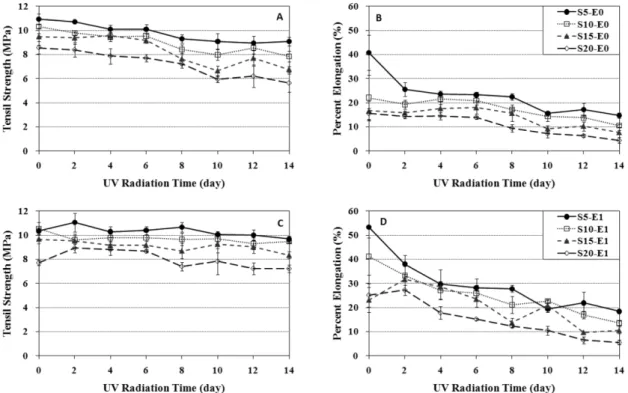
혼합을통한시료의분해성은전분함량및가교결합제처 리유무에 따른시편의 UV 조사에 의한분해성을기계적
물성변화로측정하였다 (Figure 3). 생전분이혼합된시료에 서는전분함량이증가할수록인장강도와신장율의감소가 더빠르게나타나는것으로측정되었다. 초기 S5-E0의인장
강도는 10.94 ± 0.43 MPa이었고 S20-E0는 8.57 ± 0.52 MPa
로 측정되었다. 14일 간 UV 조사 후에는 9.09 ± 0.35와
5.65 ± 0.75 MPa로 측정되었다. 이는전분 함량이 시료 간 의분해성에 중요한요소로 작용되고 있다는것을 의미한 다. 신장율에서도유사한 경향을 보이고 있는데 UV 조사 기간최종시점인 14일에는모든시편에서사용될수있는 물성을 상실하였으며 S5-E0을 제외한 모든시편에서 UV
조사 8일째까지서서히감소한후물성이더빠르게악화
되는경향을 보이고있다. ASTM D3826 규정에서광분해
에의한분해종료점을신장율이 5% 이하에도달한기점으 로명시한 것을기준으로 14일정도에 시트가붕괴되었음 을의미한다.
UV 조사기간이 2일째가되었을때물성이증가하는현
상을보이는경우가있는데시편이노출된분해성측정장 치의고온조건(58 ± 2oC)에의해서결정화가일어난결과로
추측된다. 일반적으로고분자가분해되는 원리는산화반응 에 의해 시작되고 개시 반응으로 폴리머 내에
Hydroperoxide (HPO)가생성되는데이러한반응이 지속적
으로발생하여 HPO의양이증가되고이에따라서 라디칼 의생성이이루어지며산화반응은반복적으로일어나게된
다. HPO는 폴리머내의 주쇄를절단하는 역할을하며 이
에따라서고분자는분자량이감소되어분해반응을일으킨
Fig. 3. Change in tensile strength and elongation at break of starch and LDPE/LLDPE blendswith UV radiation at 58oC. (A and B) blends with native starch, (C and D) blends with 1% epichlorohydrin treated starch
a,b,c,d Means with different letters(a-d) within the same UV radiation time are significantly different by Duncan's multiple range test(p < 0.05)
Fig. 2. DSC curve of S10-E0 and S10-E1 measured from −50 to 200oC at heating rate of 20 min-1.
다. 이러한 분해반응은 주로 다당류(Polysaccharides)가 첨 가된고분자에서주로발생하며기계적 강도, 신장율이저 하되면서분해가진행된다고보고되고있다20).전분에포함 되어있는다당류의양이증가할수록, 즉전분이양이증가 할수록기계적물성의저하를가져오는것으로사료된다. 전 체적인인장강도와신장율의감소를통한평가된시료들의 분해성정도를살펴보면전분함량증가는 Hong 등21)의연
구에서와같이혼합물의 분해를가져오는촉매로서역할을 하고있다고할수있지만전분의가교결합을위해서 사용 된 epichlorohydrin의 함량은 분해성과는 무관하다고 사료 된다.
결 론
가교제인 epichlorohydrin으로처리한전분이생전분에비 해일부기계적물성증가에기여하였으며전분함량증가 는혼합물의 기계적 물성을저하시키는가장 큰원인으로 작용하였다. Epichlorhydrin으로처리한전분혼합물이생전 분혼합물에비해 UV 조사에 의한신장율감소가 적었으 며전분함량이 15%에이르기까지인장강도를유지함을알 수 있었다. 이는 epichlorohydrin에 의해 전분의 분자사슬
간의가교가일어나고망상구조를형성하였기때문이라고 판단된다. 전체적으로전분함량증가가기계적 물성의악 화를가져왔는데 이러한 결과는 친수성을가진전분과 베
이스 레진으로사용된 LDPE의 소수성 특성 간의 차이와
이로 인한 계면접착 문제로 인한 것으로 사료된다. 또한
epichlorhydrin 처리가 전분과 LDPE 및 LLDPE와의상용
성을증가시켜산소투과도를감소시킴을알수있었다. 혼 합물의 용융온도는 약 110oC 정도에서 측정되었고 이는
LDPE 용융온도와차이가 나지않는범위였으며 UV 조사
에 따른 분해성 평가 결과, UV 조사에 의해 인장강도와
신장율이 모든 시편에서 관측되었다. 이러한 결과는 1%
epichlorohydrin 처리가열적특성및전분혼합물에영향을 미치지 않고있는 것으로 볼 수 있다. 가교결합된 전분은
생전분에 비해범용레진과의 상용성이 우수하며충진재로 서의가능성을확인하였지만 향후전분이 포함된 시트및 필름류의개발을위해서는소재에대한연구가지속적으로 진행될 필요가있으며 전분의 분해성에대한 추가적인연 구가필요하다.
감사의 글
본 연구는 농림수산식품기술기획평가원의 농림기술개발 사업지원(과제번호 : 308014-03)에 의하여이루어진연구
의일부임.
참고문헌
1. Averous, L., Fringant, C. and Moro, L. 2001. Starch-based biodegradable materials suitable for thermoforming packaging.
Starch/Starke. 53: 268-371.
2. Halley, P., Rutgers, R., Coombs, S., Kettels, J., Gralton, John., Christie, G., Jenkins, M., Beh, H., Griffin, K., Jayasekara, R.
and Lonergan, G. 2001. Development biodegradable mulch films from starch-based polymers. Starch/Starke,. 53: 362- 3. Nayak, P. and Swain, S. 2002. Plastics and pollution:367.
biodegradable polymers. Popular Plast. Packaging. 47(10):
66-78.
4. Davis, G. and Song, J.H. 2006. Biodegradable packaging based on raw materials from crops and their impact on waste management. Industrial Crops and Products. 23: 147- 5. Anon. 1997. Thermoforming. In The Wiley Encyclopedia of161.
Packaging Technology. 2nd Ed. Brody, A.L. and Marsh, K.S.
(eds.), Wiley, New York, USA, pp. 914-921
6. Zullo, R. and Iannace, S. 2009. The effects of different starch sources and plasticizer on film blowing of thermoplastic starch: Correlation among progress, elongational properties and macromolecular structure. Carbohydrate Polymers. 77:
376-383.
7. Reddy, N. and Yang, Y. 2010. Citric acid cross-lingking of starch films. Food chemistry,. 118: 702-711.
8. Koenig, M.F. and Huang, S,J. 1995. Biodegradable blends and composites of polycapolactone and starch derivatives.
Polymer. 36: 1877-1882.
9. Danjaji, I.D., Nawang, R., Ishiaku, U.S., Ismail, H. and Mohd Ishak, Z.A.M. 2002. Degradation studies and moisture uptake of sago-starch-filled linear low-density polyethylene composites. Polymer Testing. 21: 75-81.
10. Wang, N., Yu, J., Ma, X. and Wu, Y. 2007. The influence of citric acid on the properties of thermoplastic starch/linear low-density polyethylene blends. Carbohydrate Polymers. 67:
446-453.
11. Chandra, R. and Rustgi, R. 1998. Biodegradable polymers.
Prog. Polym. Sci. 1(23): 1273-1335.
12. Kim, M.R. and Lee, S.J. 2000. Mechanical properties and degradability of degradable polyethylene films containing crosslinked potato starch. Korean J. Food Sci. Technol.
32(6): 1298-1305.
13. Garg, S. and Jana, A.K. 2007. Studies on the properties and characteristics of starch-LDPE blend films using cross- linked, glycerol modified, cross-linked and glycerol modified starch. European Polymer Journal. 43: 3976-3987.
14. ASTM Standards, 2002. D 3826-98 Standard practice for determining degradation end point in degradable polyethylene and polypropylene using a tensile test. in Annual Book of ASTM Standards, PA, US.
15. Kim, M.R. and Lee, S.J. 2002. Characteristics of crosslinked potato starch and starch-filled linear low-density polyethylene
films. Carbohydrate Polymers. 50: 331-337.
16. Hammerstrand, G.E., Hofretter, B.T. and Mehltretter, C.L.
1960. Determination of the extent of reaction between epichlorohydrin and starch. Cereal Chemistry. 37: 519-524.
17. Hollinger, G. and Marchessaut, R.H. 1975. Ultrastructure of acid- and enzyme-modified cross-linked potato starch. Biopolymers.
14: 265-276.
18. Kim, H.S. and Lee, Y.E. 1996. Physicochemical Properties of Crosslinked Potato Starch. Korean J. Food Sci. Technol.
28(3): 573-579.
19. Nair, L.S., and Laurencin, C.T. 2007. Biodegradable polymers as biomaterial. Pregress In Polymers Science. 32:762-798.
20. Chung, M.S., Kim, H.Y. and You, Y.S. 2003. Multi-Degradable Food Packaging Plastics and the Future Prospect of Their Practical Use. Food Engineering Progress. 7(3): 134-140.
21. Hong, K.M., Shin, Y.S., Jung, S.H., Jang, S.H., Han, D.H., Lee, T.J., Kim, B.S. and Shin, B.Y. 2004. Biodegradability and Properties of Modified Thermoplastics Starch and LLDPE blend. J. Korean Ind. Eng. Chem. 15(8): 890-895.