대한감각통합치료학회지 제17권 2호
The Journal of Korean Academy of Sensory Integration 2019 Vol. 17. No. 2
http://dx.doi.org/10.18064/JKASI.2019.17.2.056
국내 발달장애 아동‧청소년의 작업치료 목표에 대한 체계적 고찰:
ICF-CY 모델의 활동과 참여를 중심으로
박지훈*, 최정실**, 홍은경***
*어울림아동발달연구소 작업치료사, **충북보건과학대학교 작업치료과 교수,
***신성대학교 작업치료과 조교수
국문초록
목적 : 본 연구는 발달장애 아동과 청소년을 대상으로 한 국내 작업치료의 중재 목표를 International Classification of Functioning, Disability and Health-Children and Youth version(ICF-CY)의 용어를 사용하여 체계적으로 분석하고자 하였다.
연구방법 : Riss, KISS, DBpia를 통하여 2008년 1월부터 2018년 9월까지의 국내 논문을 검색하였다. 검색어는
“아동<and>작업치료”, “아동<and>감각통합”, “청소년<and>작업치료”, “청소년<and>감각통합”, “발달장애
<and>작업치료”, “발달장애<and>감각통합”을 사용하였다. 2차 분류를 통해 최종 7편의 연구를 분석하였다.
연구결과 : 분석 대상 연구의 근거 수준은 개별 실험연구가 가장 많았으며, 중재 대상은 자폐스펙트럼 장애가 가장 많았고, 중재 방법은 감각통합 중재를 가장 많이 적용하였다. ICF-CY의 활동과 참여에 대한 작업치료 목표는 자기관리(33%)와 주요 생활영역(33%), 학습과 지식 적용(11%), 의사소통(11%), 이동(11%) 에서 진행되었다.
결론 : 발달장애 아동과 청소년을 대상으로 한 국내 작업치료 목표는 활동과 참여 영역의 많은 부분에서 진행됨을 확인할 수 있었다. 이를 기반으로 ICF-CY의 활동과 참여 영역에 대한 전문가 중 하나로써 작업치료사의 전문성을 설명할 수 있는 근거가 될 것으로 보인다.
주제어 : 작업치료, 체계적 고찰, 활동과 참여, ICF-CY
교신저자: 홍은경([email protected])
Ⅰ. 서 론
건강은 더 이상 질병이나 장애의 유무로 설명할 수 없 다. 세계보건기구에서는 건강을 ‘단순히 질병이 없거나 허약하지 않은 상태뿐만 아니라 신체적, 정신적, 사회적 으로 안녕(well-being)한 상태’라고 정의하였다(WHO, 1984). 이는 인간의 건강을 설명할 때 개인의 신체 건강
과 정신 건강, 관계와 참여를 통한 사회적 안녕의 개념을 포괄한다는 것이며, 의학적 진단만으로는 개인의 건강 상태에 대한 정보를 완전하게 제공할 수 없다는 것이다 (Byeon et al., 2015; KAOT., 2018). 건강에 대한 개념을 반영하여 세계보건기구는 International Classification of Functioning, Disability and Health(ICF)를 발표하 였다. ICF에서는 건강한 상태를 신체 기능과 구조, 활동 과 참여의 3가지 영역으로 고려하고, 이 때 개인요인과
환경요인이 영향을 주고받고 있다고 제시하였다(Lee &
Song, 2014; Hwang, 2004).
미국작업치료사협회는 ICF의 건강에 대한 개념을 반 영하여 작업치료실행체계(Occupational Therapy Practice Framework: Domain and Process; OTPF)를 발표하였 다(AOTA, 2002). OTPF에서는 작업(occupation)에 참여 (engage)함으로서 건강을 성취하고, 안녕하며, 삶의 참 여가 이뤄진다고 하였다. 또한 작업은 클라이언트의 개 인적인 요소와 환경 사이에서 영향을 주고받는다고 정의 하였다. OTPF에서 제시한 ‘작업에 참여함으로써 건강을 성취’한다는 개념은 ICF에서 ‘기능 수행(활동과 참여, 신 체 기능과 구조)을 통해 건강을 바라보는 것’과 유사한 관점을 가진다. OTPF와 ICF 모두 삶에서 일어나는 다양 한 활동에 참여하는 것이 건강의 중요한 요소라고 제시 하였다. 이를 뒷받침 하듯 AOTA는 2008년 ICF가 제시 하는 건강증진의 개념이 작업치료의 목적과 같으며, OTPF와 ICF가 밀접하게 관련이 있음을 확인하였다 (Stamm, Cieza, Machold, Smolen, & Stucki, 2006).
OTPF와 ICF의 유사성을 세부항목으로 비교해보면 다 음과 같다. OTPF의 ‘작업’ 구성요소 중 하나인 ‘일상생활 활동(Activities of Daily Living; ADL)’과 ICF의 ‘활동 과 참여’의 구성요소 중 하나인 ‘자기관리(Self-care)’를 비교해보면, ADL은 ‘자신의 몸을 돌보는 것에 중점을 둔 활동’으로 목욕하기, 화장실 사용, 옷 입기, 먹기, 개인위 생 및 몸단장 등이 포함된다. ICF의 ‘자기관리’는 스스로 씻고 닦기, 자기 관리, 옷 입고 벗기, 먹고 마시기 및 건 강 돌보기와 같이 자신의 몸을 돌보는 활동들로 구성되 어 있다. 각각의 세부항목을 대칭해보면 그 유사성을 자 세히 확인할 수 있는데, 먼저 ‘ADL’의 목욕하기(Bathing, Showering)는 ‘자기관리’의 씻기(Washing oneself)와 그 내용이 유사하다. 이과 같은 방식으로 유사한 구성요 소를 ‘ADL-자기관리’의 형태로 대칭해보면, ‘옷 입기 (ADL) - 옷 입고 벗기(자기관리)’, ‘먹기 – 먹고 마시기’,
‘개인위생 및 몸단장 – 건강 돌보기’로 매칭이 가능하다.
이와 같이 OTPF와 ICF의 유사성이 밝혀지면서 ICF를 작업치료 임상에 적용하기 위한 연구가 지속적으로 일어 나고 있다(Hagnund & Henricksson, 2003; Maritz et al., 2018; Pettersson, Pettersson, & Frisk, 2012;
Stamm, Cieza, Machold, Smolen, & Stucki, 2006).
국내에서도 Song 등(2016)이 ‘한국형 의료기관 중심 작
업치료기록 표준 용어 개발’을 하는데 ICF와 OTPF를 근 거로 사용하였다.
작업치료에서 ICF를 적용하려는 시도들이 이뤄지고 있지만, 국내에서 ICF를 이용한 작업치료 연구는 극히 일부로 제한된다(An, Park, & Lee, 2009; Bang &
Kim, 2010; Jung, Kim, & Chang, 2009; Kim & Min, 2016; Kim, Kim, Lee, & Park, 2016; Ko, Oh, Baek,
& Lee, 2012; Kwak, Chang, Ahn, & Woo, 2012). 또한 이 연구들은 뇌졸중, 척수손상, 노인을 대상으로 실시하 였다. 발달장애 아동과 청소년을 대상으로 작업치료 중 재를 적용하여 ICF 용어를 사용한 연구는 찾아보기 어려 웠다. 발달장애 아동과 청소년을 대상으로 작업치료 중 재의 효과로써 작업 영역을 살펴본 논문이 다수 발표되 고 있지만(Choi & Kim, 2018; Han, Chang, Kim, &
Han, 2009; Kim, 2017; Park & Kim, 2011; Park &
Kim, 2012; Shin, Yoo, Lee, & Jung, 2017), 이들은 모두 작업치료의 용어를 사용하여 보고 하였다. 앞에서 언급한 것처럼 ‘작업’은 ICF의 ‘활동과 참여’와 유사한 개 념을 포함하고 있지만, 작업치료의 용어만 사용했을 때 는 타 직역의 전문가들이 작업치료의 전문성을 이해하는 데 어려움이 있다. 이를 뒷받침하듯 Bang과 Kim(2010) 은 연구에서 ‘작업치료’의 용어로만 기술할 경우 다른 분 야의 전문가와 의사소통할 때 어려움이 발생할 수 있으 니 공통의 용어인 ICF의 사용이 필요하다고 보고하였다.
이렇게 공통의 용어로써 ICF의 사용이 필요하지만, ICF 는 발달 시기에 있는 아동과 청소년의 변화를 반영하지 못하고 있다. 따라서 아동과 청소년의 특성을 설명할 수 있는 새로운 코드를 추가한 International Classification of Functioning, Disability and Health-Children and Youth version(ICF-CY)가 개발되었고, 아동과 청소년 분야에서는 ICF-CY의 사용이 권장되고 있다(Statistics Korea, 2008).
따라서 본 연구에서는 국내 발달장애 아동과 청소년을 대상으로 작업치료를 적용한 연구의 중재 목표를 ICF-CY의 활동과 참여 용어로 분류하여 체계적으로 고 찰하고자 한다. 이를 통해 ICF에서 작업치료사의 전문적 인 영역을 마련하는 데 근거를 만들고, 다른 전문가들과 의 협업에서 작업치료의 전문성을 설명할 수 있는 기반 을 마련하고자 한다.
Ⅱ. 연구 방법
1. 논문 검색 및 자료수집
자료 수집은 2008년 1월부터 2018년 9월까지 국내 학 회지에 개제된 연구를 대상으로 하였다. 문헌검색을 위 해 1차로 Riss를 사용하였으며, 검색에서 배제된 논문을 확인하기 위하여 2차로 KISS와 DBpia를 통해 논문을 재 검토하였다. 본 연구는 작업치료 중재 효과를 측정한 논 문을 대상 논문으로 선정하였고, 중재방법 중 발달장애 아동과 청소년을 대상으로 많이 사용하는 감각통합 (Leong, Carter, & Stephenson, 2013)을 검색어에 포함 하였다. 최종 선정된 검색 용어는 “아동<and>작업치료”,
“아동<and>감각통합”, “청소년<and>작업치료”, “청소년
<and>감각통합”, “발달장애<and>작업치료”, “발달장애
<and>감각통합”을 사용하였다. ‘발달장애’는 연구자들 마다 다양하게 정의하므로, ‘발달장애인 권리 보장 및 지 원에 관한 법률’에서 제시한 근거에 따라 지적장애와 자 폐성 장애로 진단받은 대상자와 발달장애, 전반적 발달 장애로 진단받은 대상자로 한정하여 논문을 수집하였다.
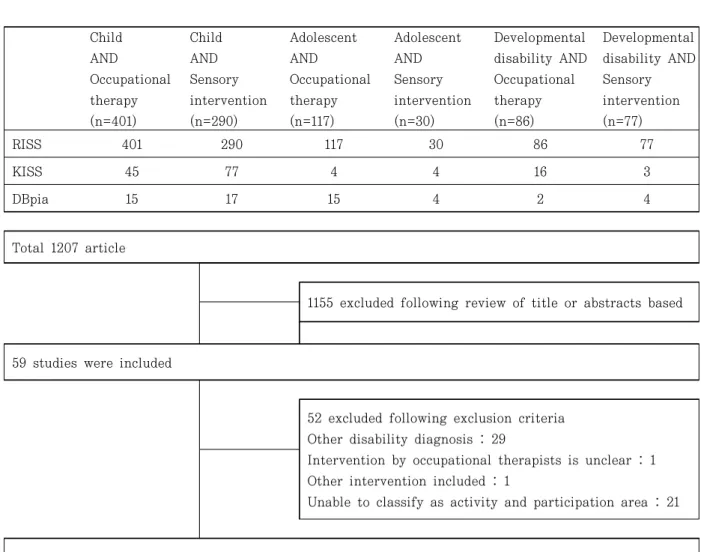
검색용어를 통해 검색한 결과 총 1207개의 논문이 검 색되었다. 검색된 논문은 제목과 초록을 검토하여 1차로 분석을 하였다. 1차 분석에서는 ‘발달장애’, ‘자폐성 장 애’, ‘지적장애’ 중 하나 이상의 진단을 가진 대상자로 실 험한 연구와 ‘작업치료’, ‘감각통합’ 중재를 적용한 논문 을 선정하였다. 대상자가 명확하게 기술되지 않은 논문 은 원문을 확인하기 위하여 2차 분석에 포함시켰다. 1차 분석 결과 총 59편의 논문이 선정되었으며, 선정된 논문 은 원문을 살펴보며 아래의 포함 기준과 배제 기준에 따 라 2차 분석을 실시하였다.
1) 포함 기준
(1) 18세 미만 발달장애(지적장애, 자폐성 장애, 발달 장애) 아동을 대상으로 한 논문
(2) 중재 효과(목적)를 측정한 논문
(3) 종속변수를 ICF-CY의 ‘활동과 참여’ 영역으로 분 류할 수 있는 논문
(4) 작업치료사에 의한 중재가 확인된 논문
2) 배제 기준
(1) 18세 이상 성인을 대상으로 한 논문
(2) 발달장애(지적장애, 자폐성 장애, 발달장애)가 아닌 다른 진단군이 포함된 논문
(3) 중재의 효과(목적)를 측정하지 않는 논문 (systematic review, meta-analysis 등) (4) 종속변수를 ICF-CY의 ‘활동과 참여’ 영역으로 분
류할 수 없는 논문(예: 평가 도구만을 사용 해서 결과 제시, 문제 행동 측정 등)
(5) 작업치료사에 의한 중재가 불분명한 논문
59편의 논문을 분석한 결과 발달장애가 아닌 다른 진 단군이 포함된 논문 29편, 작업치료사에 의해 중재가 제 공된 것이 불분명한 논문 1편, 작업치료 중재와 다른 중 재가 함께 제공된 논문 1편, 활동과 참여 영역으로 분류 할 수 없는 논문 21편을 배제하여 총 7편의 논문이 선정 되었다. 자료 추출 시 신뢰성 확보를 위하여 1저자가 추 출을 진행하고, 임상과 연구경력 7년 차인 작업치료사 2 명이 추출 내역 확인 과정을 거쳐 최종 논문을 선택하였 다(Figure 1).
2. 대상 연구의 질적 분석
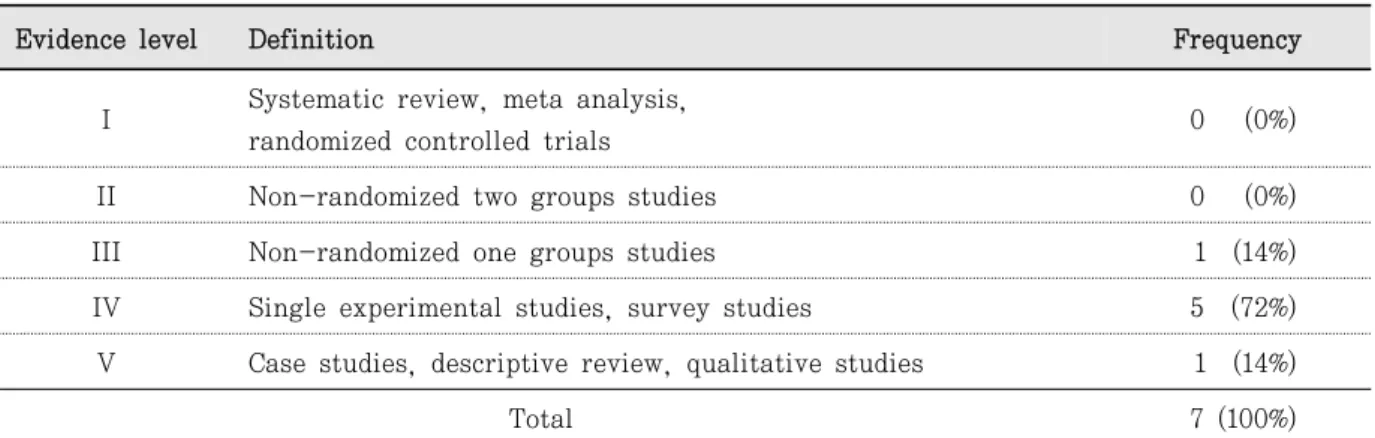
분석 대상 논문의 질적 수준을 평가하기 위해 근거를 기반으로 한 연구의 질적 수준(hierarchy of levels of evidence for evidence-based practice)분석 모델을 사 용하였다. 이 분류 기준은 Arbesman, Scheer와 Lieberman, (2008)에 이해 개발된 모델로써, 체계적 고 찰, 메타분석, 무작위 대조 연구를 Level 1에 두었으며, 두 집단 비 무작위 연구를 Level 2, 단일 집단 비 무작위 연구는 Level 3, 개별 실험연구와 조사연구는 Level 4, 사례연구를 Level 5로 분류하였으며 단위가 낮을수록 근 거 수준이 높다.
3. 자료 제시 방법
본 연구에서는 최종 추출된 7편의 논문을 연구 참여자 의 특성, 중재 방법, 활동과 참여 영역으로 분석하여 제 시하였다. 중재 방법은 논문에 사용된 용어 그대로를 사 용하여 분석하였으며, 각 논문에 사용된 종속변수를
Child AND
Occupational therapy (n=401)
Child AND Sensory intervention (n=290)
Adolescent AND
Occupational therapy (n=117)
Adolescent AND Sensory intervention (n=30)
Developmental disability AND Occupational therapy (n=86)
Developmental disability AND Sensory intervention (n=77)
RISS 401 290 117 30 86 77
KISS 45 77 4 4 16 3
DBpia 15 17 15 4 2 4
Total 1207 article
1155 excluded following review of title or abstracts based
59 studies were included
52 excluded following exclusion criteria Other disability diagnosis : 29
Intervention by occupational therapists is unclear : 1 Other intervention included : 1
Unable to classify as activity and participation area : 21
7 studies were included in the final review
Figure 1. Search process
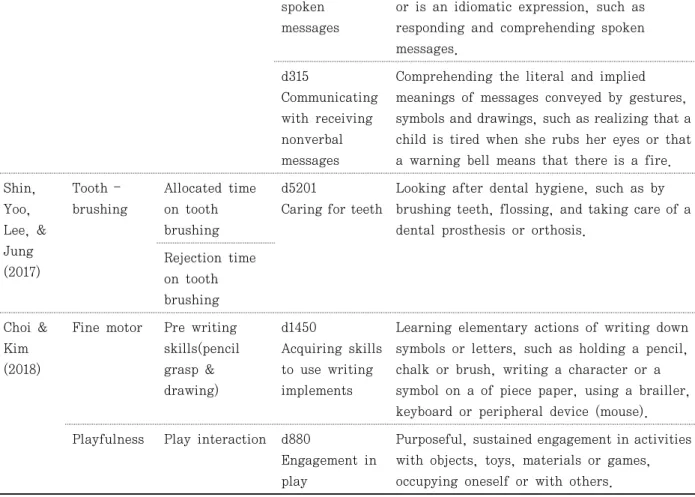
ICF-CY의 활동과 참여 영역으로 비교 분석하였다. 비교 분석 과정은 각 연구에 제시된 종속변수를 OTPF의 용어 로 1차 분류한 뒤, 분류된 용어를 ICF-CY의 카테고리와 비교분석하였다. 이 과정에서 작업치료 개념과 ICF 개념 을 비교한 기존 연구들을 근거로 사용하였다(Park, 2015; Song et al., 2016; Stamm, Cieza, Machold, Smolen, & Stucki, 2006). 분석 시 단어는 다르나 그 의미가 유사하면 동일한 의미로 비교 분석하였으며, 신 뢰성 확보를 위하여 연구자와 7년차 경력의 작업치료사 가 논의하여 분석하였다.
최종적으로 사용된 연구들의 구체적인 정보를 제공하 기 위하여 저자와 연도, 질적 수준, 연구 대상, 중재, 종
속변인 순으로 제시하였으며, 이름순으로 나열하였다.
대상자의 진단명은 자폐성 장애, 지적장애, 발달장애, 전반적 발달장애로 각 논문에 기술된 문장 그대로를 인 용하여 분류하였다(Table 1).
Ⅲ. 연구 결과
1. 분석 대상 연구의 질적 수준
연구 방법에서 제시한 포함 기준과 배제 기준에 따라 선택된 7편의 연구를 질적으로 분석하였다. 1단계와 2단
No Author Level Participants Intervention Dependent variable 1 Kim (2017) IV ID : 1 Sensory integration Social behaviors
Feeding 2 Kim, Son, & Kim (2018) IV DD : 1 Sensory integration Eating
3 Park, Park, Yoo, & Lee
(2012) IV ASD : 3 Therapy ball setting in classroom
Behavior problem Attention
Seating behavior 4 Park & Kim (2011) V DD : 1 Sensory integration Adaptive response 5 Park & Kim (2012) IV PDD : 2 Sensory integration Social interaction
6 Shin, Yoo, Lee, & Jung
(2017) IV ASD : 3
Oral sensory stimulation home program
Tooth-brushing
7 Choi & Kim (2018) III ID : 4 Group sensory integration
Fine motor Social interaction Playfulness
ASD: Autism Spectrum Disorder, DD: Developmental Disorder, ID: Intellectual Disability, PDD: Pervasive Developmental Disorder
Table 1. Summary of review studies
Table 2. Hierarchy of levels of evidence for evidence-based practice Unit: N (%)
Evidence level Definition Frequency
I Systematic review, meta analysis,
randomized controlled trials 0 (0%)
II Non-randomized two groups studies 0 (0%)
III Non-randomized one groups studies 1 (14%)
IV Single experimental studies, survey studies 5 (72%) V Case studies, descriptive review, qualitative studies 1 (14%)
Total 7 (100%)
계 수준의 연구는 없었고, 3단계가 1편으로 약 14%를 차 지하였다. 4단계 수준의 연구는 5편으로 72%, 5단계 수 준은 1편으로 14%를 차지하였다(Table 2).
2. 연구 참여자의 특성
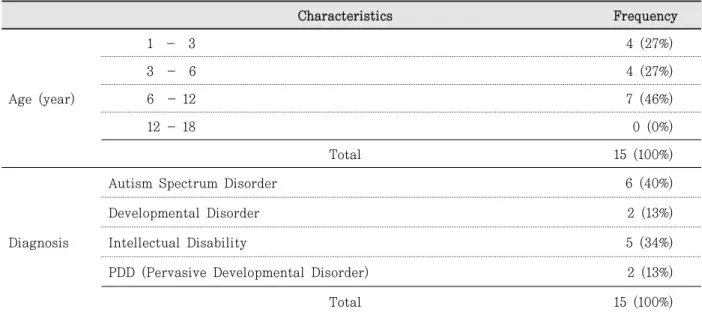
연구 참여자의 특성은 참여한 대상자 모두를 포함하여 연령, 장애유형으로 나누어 분석하였다. 참여자의 연령 을 살펴보면 영유아기(1-3세) 아동은 4명으로 27%,
학령전기(3-6세) 아동 역시 4명으로 27%를 차지하였다.
학령기(6-12세) 아동은 7명(46%)으로 가장 많았으며, 청소년을 대상으로 한 연구는 0편이었다. 장애 유형은 포함 기준에 따라 자폐성 장애와 지적장애, 발달장애, 전 반적 발달장애로 분류하였다. 자폐성 장애 아동은 6명으 로 40%, 지적장애 아동은 2명으로 13%, 발달장애 아동 은 5명으로 34%, 전반적 발달장애는 2명을 13%를 차지 하였다(Table 3).
Table 3. Participant characteristics Unit: N (%)
Characteristics Frequency
Age (year)
1 - 3 4 (27%)
3 - 6 4 (27%)
6 - 12 7 (46%)
12 - 18 0 (0%)
Total 15 (100%)
Diagnosis
Autism Spectrum Disorder 6 (40%)
Developmental Disorder 2 (13%)
Intellectual Disability 5 (34%)
PDD (Pervasive Developmental Disorder) 2 (13%)
Total 15 (100%)
Table 4. Type of therapy Unit: N (%)
Types Frequency
Sensory integration 4 (57%)
Group sensory integration 1 (14%)
Therapy ball 1 (14%)
Home program 1 (14%)
Total 7 (100%)
3. 중재 방법
발달장애 아동을 대상으로 한 작업치료 중재 방법을 논문에서 제시한 용어를 사용하여 분류하였다. 분석 결 과 ‘감각통합’, ‘그룹 감각통합’, ‘공 의자 적용’, ‘가정 프 로그램’의 4가지 분류로 나뉘었으며, ‘감각통합’은 4편 (57%), 그룹 감각통합은 1편(14%), 공 의자 적용 1편 (14%), 가정 프로그램 1편(14%)으로 나타났다(Table 4).
4. 활동과 참여에 대한 중재
각 논문에서 제시한 종속변수를 ICF-CY 활동과 참여 영역의 2, 3 단계 분류로 비교 분석하여 Table 5에 기술 하였다. 한 연구에 종속변수가 여러 개일 때는 중복하여 분류하였으며, 활동과 참여 영역으로 명확하게 분류할
수 없는 변수는 분류에서 제외하였다. 제시된 종속변수 를 활동과 참여의 1단계 분류 분석했을 때 학습과 지식 적용에 1편(11%), 의사소통에 1편(11%), 이동에 1편 (11%), 자기관리에 3편(33%), 주요 생활영역에 3편 (33%)을 차지하였다. 일반적 과제 요구와 가정생활, 대 인 상호작용과 대인 관계와 지역사회생활, 사회생활 및 시민 생활에 해당하는 연구는 없었다(Table 6).
IV. 고 찰
재활의 가장 중요한 목표는 장애 당사자가 사회의 구 성원으로 참여할 수 있게 하는 것이며, OTPF와 ICF는 삶에서 일어나는 다양한 활동에 참여하는 것이 건강의
Author (year)
Dependent variables described in
the title
Dependent variables defined in the
thesis
ICF Sentence defined in ICF
Kim (2017)
Social behavior
Search behavior d8801 Onlooker play
Occupying oneself by purposeful observation of the activities of others with objects, toys, materials or games, but not joining in their activities.
Feeding Enable them to eat
d550 Eating
Indicating need for, and carrying out the coordinated tasks and actions of eating food that has been served, bringing it to the mouth and consuming it in culturally acceptable ways, cutting or breaking food into pieces, opening bottles and cans, using eating implements, having meals, feasting or dining.
Kim, Son, &
Kim (2018)
Eating Voluntary eating of favorite foods
d550 Eating
Indicating need for, and carrying out the coordinated tasks and actions of eating food that has been served, bringing it to the mouth and consuming it in culturally acceptable ways, cutting or breaking food into pieces, opening bottles and cans, using eating implements, having meals, feasting or dining.
Voluntary eating of disliking foods Park,
Park, Yoo, &
Lee (2012)
Seating behavior
In-seat behavior
d4153
Maintaining a sitting position
Staying in a seated position, on a seat or the floor, for some time as required, such as when sitting at a desk or table.
Park &
Kim (2011)
Adaptive response
Quality
improvement of play
d880
Engagement in play
Purposeful, sustained engagement in activities with objects, toys, materials or games, occupying oneself or with others.
Park &
Kim (2012)
Social Interaction
Social initiation behavior
d330 Speaking
Producing words, phrases and longer passages in spoken messages with literal and implied meaning, such as expressing a fact or telling a story in oral language.
d335 Producing nonverbal messages
Using gestures, symbols and drawings to convey messages, such as shaking one's head to indicate disagreement or drawing a picture or diagram to convey a fact or complex idea.
Social reaction behavior
d310
Communicating with receiving
Comprehending literal and implied meanings of messages in spoken language, such as understanding that a statement asserts a fact Table 5. Comparative Analysis of activity and participation
spoken messages
or is an idiomatic expression, such as responding and comprehending spoken messages.
d315
Communicating with receiving nonverbal messages
Comprehending the literal and implied meanings of messages conveyed by gestures, symbols and drawings, such as realizing that a child is tired when she rubs her eyes or that a warning bell means that there is a fire.
Shin, Yoo, Lee, &
Jung (2017)
Tooth – brushing
Allocated time on tooth brushing
d5201
Caring for teeth
Looking after dental hygiene, such as by brushing teeth, flossing, and taking care of a dental prosthesis or orthosis.
Rejection time on tooth brushing Choi &
Kim (2018)
Fine motor Pre writing skills(pencil grasp &
drawing)
d1450
Acquiring skills to use writing implements
Learning elementary actions of writing down symbols or letters, such as holding a pencil, chalk or brush, writing a character or a symbol on a of piece paper, using a brailler, keyboard or peripheral device (mouse).
Playfulness Play interaction d880
Engagement in play
Purposeful, sustained engagement in activities with objects, toys, materials or games, occupying oneself or with others.
ICF: International Classification of Functioning, Disability and Health
Table 6. Classify as activity and participation Unit: N (%)
Activity & Participation Frequency
Learning and Applying Knowledge 1 (11%)
General task and Demands 0 (0%)
Communication 1 (11%)
Mobility 1 (11%)
Self Care 3 (33%)
Domestic Life 0 (0%)
Interpersonal Interactions and Relationships 0 (0%)
Major Life Areas 3 (33%)
Community, Social and Civic Life 0 (0%)
Total 9 (100%)
중요한 요인이라는 관점을 공유하고 있다(Hoogsteen &
Woodgate, 2010; Stamm, Cieza, Marchold, Smolen,
& Stucki, 2006). 따라서 본 연구에서는 건강의 중요한 요소인 활동과 참여에 대한 작업치료 연구를 ICF-CY의 용어로 체계적으로 고찰함으로써, 작업치료 서비스의 근 거와 협업의 기반을 마련하고자 하였다.
최종 포함된 논문의 중재목표를 ICF-CY의 ‘활동과 참 여’ 1단계 분류로 살펴봤을 때, 작업치료사는 5장 자기관 리에서 3편(33%), 8장 주요 생활영역에서 3편(33%), 2 장 학습과 지식 적용 1편(11%), 3장 의사소통에서 1편 (11%), 4장 이동에 1편(11%) 영역에서 중재를 제공하는 것으로 나타났다. 세부적으로 작업치료사는 d1450 쓰기 도구 사용 기술 습득, d310 음성 메시지로 의사소통하기 -수용, d315 비언어적 메시지로 의사소통하기-수용, d330 말하기, d335 비언어적 메시지로 표현하기, d4153 앉은 자세 유지하기, d520 신체 일부 관리하기, d5201 치아 관리하기, d550 먹기, d880 놀이 참여, d8801 방관 자 놀이 영역에서 중재를 제공하는 것으로 나타났다. 결 과적으로 작업치료사는 ICF-CY의 활동과 참여 9개의 장(chapter) 중에서 절반 이상인 5개의 장에 중재를 제 공하였다. 이와 같은 결과는 작업치료의 개념 모델이 ICF와 매우 높은 연관성을 가진다는 Stamm, Cieza, Marchold, Smolen과 Stucki(2006)의 연구에서도 확인 할 수 있으며, ICF는 작업치료사에게 필수적인 이론의 틀로 OTPF와 ICF의 강한 연관성을 인정한 AOTA를 통 해서도 확인할 수 있다(Case-Smith & O’Brien, 2015).
또한 OTPF의 이전 모델인 Uniform Terminology for Occupational Therapy(UTOT)-I, II,I II와 ICF 카테고 리의 2단계를 비교 분석하였을 때, UTOT의 각 항목은 ICF의 활동과 참여 영역과 가장 일치도가 높다고 보고한 Park(2015)의 연구도 이를 뒷받침한다. 이와 같이 활동 과 참여는 작업과 유사한 개념을 가지며, 작업치료사들 은 활동과 참여 영역에 대한 중재를 지속적으로 제공하 고 있다. 이를 종합해 볼 때 작업치료사는 장애인 혹은 비장애인의 참여를 증진시키는데 특화된 직업군으로써 (Law, 2002), ICF의 활동과 참여 영역의 전문가임을 확 인할 수 있었다.
본 연구는 ICF-CY의 활동과 참여 1, 2, 3단계의 분류 를 사용하여 작업치료 연구를 분석하였다. 기존 Kim과 Min(2016)의 연구에서 국내 연구를 ICF-CY의 구성 요
소(신체 구조와 기능, 활동과 참여)로 분류한 것보다 더 많은 분류체계를 사용함으로써, ICF-CY의 각 세부 영역 에서 작업치료사가 제공하는 중재 목표를 구체적으로 확 인할 수 있었다. 또한 본 연구는 대상 군을 발달장애 아 동·청소년으로 제한하였으며, 이를 통해 발달장애인을 대상으로 중재를 제공하는 작업치료사의 임상과 연구 경 향을 ICF-CY의 용어로 확인할 수 있었다. 그러나 본 연 구는 7편이라는 적은 연구를 분석함으로써 연구 결과를 일반화하는데 어려움이 있다.
최종 논문이 7편으로 적은 이유는 다음과 같다. 먼저 본 연구는 대상 군을 발달장애로 제한하였는데, 많은 연 구들이 장애 진단이 없거나 발달지연 의심 소견을 보이 는 아동을 대상으로 연구를 진행하였다(29편). 또한 아 동의 ‘운동 능력’이나 ‘전정감각 처리 향상’과 같은 신체 기능과 구조에 초점을 둔 연구와 ‘문제 행동’에 초점을 둔 연구(21편)가 주를 이뤘기 때문에 최종 선택된 논문이 7편으로 제한되었다. 발달장애 아동과 청소년에게 ‘신체 기능과 구조’, ‘문제 행동’은 중요한 염려일 수 있으나, 작업치료 중재의 목표는 클라이언트가 살아가는 시간과 환경 안에서 본인이 원하거나 해야 하는 작업에 참여할 수 있도록 하는 것이다. 이때 신체 기능과 구조는 작업에 참여하기 위한 하나의 요소일 뿐 작업치료사의 초점은
‘작업의 참여’에 있어야 한다(Fisher & Materella, 2019). 그러나 최종 포함된 연구는 활동과 참여에 초점 을 둔 것보다 신체 구조와 기능 등에 초점을 맞춘 연구가 3배 이상 많았다. 이는 Kim과 Min(2016)에 의해 보고된 한국 아동작업치료 연구 동향 분석에서 신체 기능과 구 조에 관한 연구는 전체 51.2%를 차지하지만, 활동과 참 여에 관한 연구는 28.3%에 그쳤다는 연구 결과와 일치한 다. 또한, Yoo, Lee, Kim과 Han(2016)의 연구에서 2011-2015년의 작업치료 학회지 연구 동향을 분석했을 때 상지기능과 심리 사회적 요인이 가장 많이 측정된 종 속변수라는 연구 결과와도 일치한다. 앞으로의 연구에서 는 ‘작업’의 전문가로서 ‘작업’에 초점을 맞춘 연구가 지 속되어야 할 것으로 보인다.
본 연구는 7편의 적은 연구를 분석한 한계를 갖지만, 기존의 작업치료 용어로 정리되어 있던 연구를 ICF-CY 의 용어로 비교 분석함으로써 공통의 용어를 사용하여 작업치료의 전문성을 확보하고자 한 점에서 의의가 있 다. Haglund와 Henriksson(2003)은 작업치료의 개념
을 다른 분야의 전문가들에게 설명할 때 ICF를 통하여 전달하는 것이 유용하며, 정확하게 전달할 수 있다고 하 였다. 따라서 작업치료의 전문성을 확보하고, 협업에서 정확한 의사소통을 할 수 있도록 ICF를 사용하여 작업에 초점을 맞춘 연구가 꾸준히 지속되어야 할 것이다.
V. 결 론
본 연구는 발달장애 아동·청소년을 대상으로 활동과 참여 영역에 대한 중재를 제공한 7편의 연구를 체계적으 로 고찰하였다. 발달장애 아동과 청소년을 대상으로 한 국내 작업치료 중재는 활동과 참여 영역의 많은 부분에 서 진행됨을 확인할 수 있었으며, 작업치료사는 중재 방 법으로 감각통합중재를 가장 많이 사용하였다. 본 연구 결과는 작업치료사가 ICF의 활동과 참여 영역의 전문가 로서 근거를 마련하는데 도움이 될 것이다.
참 고 문 헌
American Occupational Therapy Association. (2002).
Occupational Therapy practice framework domain & process. American Journal of Occupational Therapy, 56(6), 609-639.
American Occupational Therapy Association.
(2008). Occupational therapy practice framework domain & process (2nd ed.). American Journal of Occupational Therapy, 62(6), 625-683.
An, S. H., Park, D. S., & Lee, S. M. (2009). The clinical application of ICF (International Classification of Functioning, Disability and Health) for functional ability analysis of stroke patients. Journal of Korean Society of Occupational Therapy, 17(4), 37-44.
Arbesman, M., Scheer, J., & Lieberman, D. (2008).
Using AOTA’s Critically Appraised Topic (CAT) and Critically Appraised Paper (CAP) series to link evidence to practice. OT Practice, 13(5),
18-22.
Bang, Y. S., & Kim, H. Y. (2010). Clinical application of the International Classification of Functioning, Disability, and Health tools in occupational therapy. Journal of Korean Society of Occupational Therapy, 18(4), 39-50.
Byeon, K. H., Shin, H. I., Lim, J. G., Lee, M. J., Lee, J. E., & Lee, M. G. (2015). A study on utilization of International Functional Disability Health.
Seoul: Ministry of Health and Welfare.
Case-Smith, J., & O’Brien, J. C. (2015). Occupational therapy for children and adolescents (7th ed.).
St Louis, MO: Mosby.
Choi, J. H., & Kim. H. (2018). Effect of sensory integration group therapy on fine motor, social interaction and playfulness of preschool children with intellectual disabilities. Journal of Korean Academy of Sensory Integration, 16(1), 25-34. http://dx.doi.org/10.18064/JKASI.
2018.16.1.025
Fisher, A. G., & Materella, A. (2019). Powerful practice. Fort colins, Colorado: CIOTS
Hagnund, L., & Henricksson, C. (2003). Conceptional in occupational therapy in relation to the ICF.
Occupational Therapy International, 10(4), 253-268.
Han, M. Y., Chang, K. Y., Kim, J. Y., & Han, S. Y.
(2009). The effect of group sensory integration therapy on motor skill and social function of children with developmental disorder. Journal of Korean Academy of Sensory Integration, 7(2), 25-35.
Hoogsteen, L., & Woodgate, R. L. (2010). Can i play?
a concept analysis of participation in children with disabilities. Physical & occupational therapy in pediatrics, 30(4), 325-339.
Hwang, S. K. (2004). Understanding the new international classification of disability and introduction of the concept of functional disability. Quarterly Journal of Labor Policy,
4(2), 128-149.
Jung, H. Y., Kim, K. M., & Chang, M. Y. (2009).
Measurement tools for occupational therapy for stroke patients: A systematic review.
Journal of Korean Society of Occupational Therapy, 17(3), 79-95.
Kim, K. S. (2017). The effect of sensory integration therapy on social behaviors and feeding of children with intellectual disorder. Journal of the Korea Academia Industrial, 18(10), 634- 641. http://dx.doi.org/10.5762/KAIS.2017.18.10.634 Kim, S. Y., & Min, Y. S. (2016). Literature review
of Korean occupational therapy research for children and youth regarding the international classification of functioning: Focusing on the Korean society of occupational therapy.
Journal of Korean Society of Occupational Therapy, 24(4), 161-174. http://dx.doi.org/
10.14519/jksot.2016.24.4.12
Kim, Y. J., Kim, M. Y., Lee, J. H., & Park, H. Y. (2016).
Effectiveness of occupational therapy for improving participation: A systematic review.
Journal of Korean Society of Occupational Therapy, 24(1), 89-108. https://doi.org/10.12965/
jer.1836636.318
Kim, Y. S., Son, C. R., & Kim, K. M. (2018). The effect of oral activity with sensory integration intervention on eating of child with oral defensiveness: A single subject research design.
Journal of Korean Academy of Sensory Integration, 16(1), 1-13. http://dx.doi.org/10.18064/
JKASI.2018.16.1.001
Ko, H. E., Oh, M. H., Baek, J. Y., & Lee, J. S.
(2012). The relationship between body functions and activities and the participation of community-dwelling elderly persons: Based on ICF. Journal of Korean Society of Occupational Therapy, 20(4), 15-28.
Korean Association of Occupational Therapists.
(2018). It deals with all the concepts that ICF
health includes. Retrieved 15 July, 2019, from http://www.cowalk news .co.kr/news/articleView.
html?idxno=16186
Korea Institute for Health and Social Affairs.
(2008). A study on improving welfare infra- structure for the disabled (1), (2). South Korea, Seoul: Ministry of Health and Welfare.
Kwak, N. H., Chang, K. Y., Ahn, K. H., & Woo, H. S. (2012). Study on the application of wCF- Based SPG case-management frame with a focus on SCI. Journal of Korean Society of Occupational Therapy, 20(4), 95-110.
Law, M. (2002). Participation in the occupations of everyday life. American Journal of Occupational Therapy, 56, 640-649.
Lee, H, J,. & Song, J, M. (2014). Development of revised Korean version of ICF. Journal of Korean Society of Physical Therapy, 26(5), 344-350.
Leong, H. M., Carter, M., & Stephenson, J. (2013).
Sensory integration therapy in Malaysia and Singapore: Sources of information and reasons for use in early intervention. Education and Training in Autism and Developmental Disabilities, 48(3), 421-435.
Maritz, R., Baptiste, S., Darzins, S, W., Magasi, S., Weleschuk, C., & Prodinger, B. (2018).
Linking occupational therapy models and assessments to the ICF to enable standardized documentation of functioning. Canadian Journal of Occupational Therapy, 85(4), 330-341. http://dx.doi.org/10.1177/0008417418 797146
Park, H, J. (2015). Comparison and analysis study about the concept and value of occupational therapy and ICF. Master's thesis, Woosong University, Deajeon.
Park, J. H., & Kim, I. S. (2011). The effect of sensory integration intervention focused on proprioceptive-vestibular stimuli on adaptive
response of children with sensory defensiveness:
Case study. Journal of Korean Academy of Sensory Integration, 9(2), 29-38.
Park, J. H., & Kim, S. K. (2012). Effect of the brotherhood group sensory integration intervention to social interaction of the children with pervasive developmental disorder.
Journal of Korean Academy of Sensory Integration, 10(1), 21-31.
Park, Y. Y., Park, S. H., Yoo, E. Y., & Lee, J. Y.
(2012). Effectiveness of therapy ball on behavior in children with Autism Spectrum Disorder in a classroom setting. Journal of Korean Society of Occupational Therapy, 20(1), 43-56.
Pettersson, I., Pettersson, V., & Frisk, M. (2012).
ICF from an occupational therapy perspective in adult care: An integrative literature review.
Scandiavian Journal of Occupational Therapy, 19(3), 260-73.
Shin, M. K., Yoo, E. Y., Lee, J. Y., & Jung, M. Y.
(2017). The effect of an oral sensory stimulation home program on children with Autism Spectrum Disorder with oral defensiveness: A single subjects design.
Journal of Korean Society of Occupational Therapy, 25(2), 1-13.
Song, Y, J,. Woo, H, S,. Lee, H, S,. Lee, M, Y,.
Kwon, Y, Y,. & Cha, Y, J. (2016). A study on standard terminology for occupational therapy documentations focusing on Korean-type medical. Journal of Korean Society of Occupational Therapy, 24(2), 112-124.
http://dx. doi.org/10.14519/jksot.2016.24.2.09 Stamm, T. A., Cieza, A., Machold, K., Smolen, J.
S., & Stucki, G. (2006). An exploration of the link of conceptual occupational therapy models to the International Classification of Functioning, Disability and Health (ICF).
Australian Occupational Therapy Journal, 53(1), 9-17.
Statistics Korea. (2008). 2008 WHO-FIC meeting business trip report. Retrieved September 16, 2019, from http://Lib1.lostat.go.kr/
World Health Organization. (1984). Glossary of terms used in the “Health for All” Series No.8.
World Health Organization, Geneva.
Yoo, E. Y., Lee, M. J., Kim, S. Y., & Han, S.
(2016). The research trends of the journal of Korean society of occupational therapy: From 2011 to 2015. Journal of Korean Society of Occupational Therapy, 24(4), 149-160.
http://dx.doi.org/10.14519/jksot.2016.24.4.11
Abstract
Occupational Therapy for Activity and Participation of Children and Adolescents With Developmental Disability: A Systematic Review
Park, Jihoon*, D.S., O.T., Choi, Jeong-sil**, Ph.D., O.T., Hong, Eunkyoung***, Ph.D., O.T.
*Oullim Children's Development Institute
**Dept. of Occupational Therapy, Chungbuk Health & Science University
***Dept. of Occupational Therapy, Shinsung University
Objective : The purpose of this study is to provide evidence for a systematic analysis of occupational therapy interventions for the activity and participation of children and adolescents with developmental disabilities.
Methods : The articles used in this study were collected from the RISS, KISS, and DBpia databases.
The key words used were “children and occupational therapy” “children and sensory integration,”
“adolescent and occupational therapy,” “adolescent and sensory integration,” “developmental disorder and occupational therapy,” and “developmental disorder and sensory integration.” The research period was limited to January 2008 to August 2018. Seven articles in total were selected for systematic analysis.
Results : Most of the included works were single-case studies, and most subjects dealt with the autism spectrum disorder. The majority of the interventions used involved sensory integration.
Occupational therapy interventions were self-care (33%), major life area (33%), learning and application (11%), communication (11%), and mobility (11%).
Conclusion : This study will help with understanding the current state of occupational therapy interventions for the activity and participation. On the basis of this understanding, various studies on this subject are expected to be conducted in the future.
Key words : activity, occupational therapy, participation, systematic reviews