Vol. 17 No. 1, 12-27, April, 2020 https://doi.org/10.16952/pns.2020.17.1.12
국내 학령기 아동 ․ 청소년 대상 집단따돌림 중재에 관한 체계적 문헌고찰
황 지 혜 · 석 윤 희 · 박 효 경 · 이 지 연
서울대학교 간호대학 대학원생
A Systematic Review of School-bullying Interventions for Children and Adolescents in Korea
Hwang, Ji-Hye · Seok, Yoonhee · Park, Hyo Gyeong · Lee, Ji Yeon
Graduate Student, College of Nursing, Seoul National University, Seoul, Korea
Purpose: Bullying is a global problem, and various programs are under way to prevent it. The purpose of this study
was to review school bullying interventions for Korean school-age children and adolescents. Methods: Online databases such as RISS, KISS, DBpia, NDSL and KMBASE were searched, identifying 32 intervention studies published from January 2009 to November 2018. Results: Thirty-two intervention studies were identified: 23 included school bullying prevention and 9 included school bullying treatment for victims or youth at high risk for bullying. The main purpose of preventive intervention was to decrease the bystander's attitude toward group bullying and treatment program was to improve the psychosocial adaptation of bullying victims. The school bullying interventions varied from group counseling, social skills training, art therapy, bibliotherapy using role-play, game
& activities. Classroom environment variables and self-esteem, peer-related variables improved significantly after the school bullying prevention programs and school bullying treatment programs, respectively. Conclusion: There is potential for enhancing the outcomes of the behavioral, interpersonal psychological variable. Integrated interventions considering the individuality, gender and physical health of children and adolescents will also be needed. However, a rigorous study design is required to compensate for the methodological limitations.
Key Words: Schools; Bullying; Child; Adolescent; Review
주요어: 학교, 집단따돌림, 아동, 청소년, 체계적 문헌고찰 Corresponding author: Hwang, Ji-Hye
College of Nursing, Seoul National University, 103 Daehak-ro, Jongno-gu, Seoul 03080, Korea.
Tel: +82-2-740-8851, Fax: +82-2-766-1852, E-mail: [email protected] Received: Mar 26, 2020 / Revised: Apr 6, 2020 / Accepted: Apr 9, 2020
서 론
1. 연구의 필요성
2019년 초중고 학생을 대상으로 시행된 학교폭력실태 전수 조사에서 약 6만 명의 학생이 학교폭력 피해 경험이 있다고 응 답하였으며, 학교폭력 피해 유형은 언어폭력(35.6%)과 집단 따돌림(23.2%)이 가장 많은 것으로 보고되었다.1) 물리적 폭력
은 2017년부터 하락세인 반면, 정서적 폭력은 매년 지속해서 증가하는 추세로, 이에 교육부는 학교폭력 예방 및 대응을 위 해 학교폭력 예방교육을 확산하고 학생안전 및 상담 ․ 지원 기 반을 확충하여 피해 학생 보호 ․ 치유 확대와 가해 학생의 재발 방지를 위해 교육 프로그램을 강화하는 등 지속적인 노력을 하 고 있다.2) 그럼에도 집단따돌림으로 인한 청소년 폭행 및 사망 사건은 지속해서 발생하고 있고, 이러한 청소년 강력범죄가 발 생할 때마다 처벌 강화 및 소년법 폐지에 관한 이슈들이 재점
화 되고 있다.
집단따돌림은 폭력적이고 공격적인 행동으로, 같은 집단 내 에서 한 명 혹은 그 이상의 집단이 한 개인에게 심리적, 언어적, 신체적인 고통을 가하는 행위이다. 집단따돌림은 힘의 불균형 이 존재하는 관계에서 발생하므로 동등한 힘을 가진 개인 간의 싸움과는 구별되고, 지속적이고 반복적으로 발생하여 피해자 에게 큰 고통을 준다는 점에서 우발적으로 일어나는 일반적인 공격 형태보다 더욱 심각하다고 보고되었다.3,4)
또래 집단은 사회적 행동에 대한 기준, 개인적 관계의 추구, 소속감 제공, 자아통합 등 자아정체감의 원천이자 아동의 사 회적 위치를 확보하는 데 도움을 주며,5) 인격 형성이나 사회성 습득에 있어서 그 영향력은 매우 크다. 또한, 또래 집단은 아동
․ 청소년의 사고 및 가치체계, 행동 규범의 중요한 준거로 작용 한다. 이에 아동 ․ 청소년은 또래 집단 내 문화를 통해 자아정체 감 형성 및 올바른 사회화 등의 긍정적인 영향을 받기도 하지 만 집단에 소속되지 못하고 또래에 의해 괴롭힘을 받는 경우 자아존중감 발달 저해와 같은 부정적인 영향을 받을 수 있다.6) 선행연구에서는 또래 관계에서 집단따돌림의 경험은 자신에 대한 부정적인 자아개념을 형성하고 장기적으로 심리적 발달 및 사회적 적응에 부정적인 영향을 미치며,7) 아동 ․ 청소년기에 겪었던 집단따돌림의 경험은 성인기의 정신 병리적 증상과 관 련이 있는 것으로 보고되었다.8)
사람은 태어남과 동시에 사회적인 구성원으로서 타인과 끊 임없이 상호작용하며 연결된 상태에서 살아간다. 인간은 본인 이 소속되어 있는 집단에서 인정받기를 원하며, 기본적으로 생리적인 욕구가 충족되면 안전을 추구하고, 사회 집단에서의 소속감과 애정을 갈구하게 된다. 이렇듯 자신이 속한 집단에 강하게 소속되고자 하는 욕구는 인간의 기본적인 욕구이며, 아동은 가족 내에서 가족원으로서 존재가치를 느끼고 성장하 여 또래 집단 속에 포함되는데, 아동 ․ 청소년이 또래 집단에서 소속 및 애정 욕구가 충족되면 또래 집단에서 편안함을 얻어 자아성장을 위한 다음 단계로 성공적으로 도약할 수 있다고 하 였다.9)
우리나라 학교현장에서 일어나는 집단따돌림 현상은 매우 강한 집요함을 보이고, 점점 잔인화되고 있으며 방법도 다양 화되고 있다. 가해 학생뿐만 아니라 다수의 학생이 집단따돌 림을 방관하고 죄의식 없이 따돌림에 동조하는 것으로 나타났 다. 또한, 집단따돌림이 학생들 사이에서 은밀히 이루어지므 로 교사들이 알아차리기 어렵고 예방 및 개입이 늦어지는 문제 점이 있다.10) 교육부에서 발표한 ‘2019 전국 학교폭력 실태조 사 보고’에 따르면 목격 후 아무것도 하지 못한 방관 비율이
30.1%로 2017년 대비 9.8% 증가하였다.1) 방관자집단은 집단 따돌림 피해자를 지지함으로써 발생할 수 있는 보복이나 피해 가 두려워 쉽게 나서지 못하는 심리적인 부담이 있다고 보고되 었는데, 이는 가정, 학교 및 지역사회에서 일반 학생을 위한 집 단따돌림 예방 ․ 행동 교육을 강화할 필요가 있음을 시사하고 있다.1,11)
집단따돌림을 예방하고 대응하기 위해 시행되는 프로그램 은 이론적 토대와 구성요소가 프로그램마다 다르기 때문에 변 인에 따라 중재 효과가 다르게 나타날 수 있다. 집단따돌림은 단순히 가해자, 피해자로 이루어져 있는 것이 아니라 소수의 가해자와 피해자, 다수의 방관자로 구성되어 있고, 다수의 방 관자는 언제든지 가해자나 피해자가 될 가능성이 있다.12) 따라 서 가해자와 피해자, 방관자 또는 일반 학생을 포함하는 집단 따돌림 예방 및 대응 프로그램을 개발하는 것이 필요하다. 또 한, 집단따돌림은 서로 따돌리고 따돌림을 당하는 상황에 이 르게 된, 서로가 가지고 있는 사회 ․ 문화적 배경의 충돌에서 비 롯된다. 집단따돌림은 그 자체가 문화 현상이며, 문화 현상으 로서 집단따돌림은 그것에 선행하는 또 다른 문화 현상과 유기 적 관계 속에서 발생한다.13) 따라서 집단따돌림을 예방하고 대 응하기 위해 시행되는 프로그램은 한 영역에서는 효과적일 수 있지만, 다른 영역에서는 효과적이지 않을 수 있으므로 집단 따돌림 관계자들을 둘러싼 가정, 사회, 국가 등 사회 ․ 문화적 요소를 파악하고 중재를 제공해야 한다. 학령기 아동 ․ 청소년 을 대상으로 한 집단따돌림 예방 프로그램에 관한 국내외의 선 행연구를 살펴보면, 국외에는 학령기 아동 ․ 청소년 대상으로 집단따돌림에 대한 체계적 문헌고찰 연구가14,15) 있으나, 국내 에는 집단따돌림 중재연구를 체계적으로 고찰하여 중재연구 의 특성 및 효과를 확인한 연구는 미비한 실정이다.
따라서 본 연구에서는 국내 학령기 아동 ․ 청소년의 집단따 돌림 중재연구를 연구대상자 및 중재 목적에 따라서 분류하고 체계적으로 검토하고자 한다. 이를 통해 집단따돌림으로 인해 발생할 수 있는 학령기 아동 ․ 청소년의 정신건강 문제를 예방 하고, 건강한 학교생활을 돕기 위한 집단따돌림 중재 개발에 기초자료가 되고자 한다.
연 구 방 법 1. 연구설계
본 연구는 2009년부터 2018년 11월 30일까지 학령기 아동 ․ 청소년을 대상으로 국내에서 시행된 집단따돌림 중재연구의
특성과 효과를 확인하기 위한 체계적 문헌고찰연구이다.
2. 연구대상 논문
연구는 핵심질문인 대상자(Participants), 중재(Interventions), 비교중재(Comparisons), 결과(Outcomes)를 의미하는 ‘PICO’
에 따라 문헌 검색을 진행하였다. 본 연구의 대상(P)은 학령기 아 동 ․ 청소년이며, 중재(I)는 학령기 아동 ․ 청소년을 위해 이루어 진 집단따돌림 중재, 비교중재(C)는 제한하지 않았고, 중재결 과(O)는 학령기 아동 ․ 청소년 대상 집단따돌림 중재의 효과로 정하였다.
문헌의 선정과 배제기준은 다음과 같다. 선정기준은 첫째, 2009년부터 2018년까지 국내에서 발표된 영어와 한국어로 된 학술논문이다. 둘째, 연구대상은 학령기 아동 ․ 청소년이다. 셋 째, 국내 학위논문, 단일군 사전사후 연구, 대조군 사전사후 연 구, 무작위 대조군 연구, 예비조사도 포함하였다. 넷째, 집단따 돌림 관련 변수를 결과변수로 제시된 경우를 포함하였다. 배 제기준은 첫째, 건강한 초중고 학생이 아닌 유아대상이나 정 서행동장애, 가출 청소년, 미혼모와 같은 위기 학생 또는 부적 응 학생을 연구대상으로 선정한 경우는 배제하였다. 둘째, 연 구설계가 질적연구, 문헌고찰 연구, 사례연구인 경우 배제하 였다. 단, 피해자 대상 중재 프로그램은 더 많은 문헌을 살펴보 기 위해 사례연구를 포함하였다. 셋째, 사이버 괴롭힘, 일반적 인 학교폭력(school violence) 중재는 배제하였다.
3. 자료수집
본 연구는 국내 학술연구정보서비스(RISS), 한국학술정보 (KISS), DBpia, 국가과학기술정보센터(NDSL), 한국의학논문 데이터베이스(KMBASE)를 통해 검색을 시행하였으며, PICO 에서 검색과정에서 선정 대상 논문이 배제되는 것을 막기 위해 중재용어로 검색어를 구성하였으며, 나머지 선정기준은 검색 된 논문의 세부 검토를 통해 선별을 진행하였다. 2009년 1월 1 일부터 2018년 11월 30일까지 발간된 학술지 논문과 학위논 문을 모두 포함하고, 검색기간은 2018년 11월 28일부터 11월 30일까지 3일간 이루어졌으며, 집단따돌림 중재의 최신경향 을 살펴보기 위해 검색일 기준으로 최신 10년 논문으로 제한 하였다.
검색어에 사용된 주제어는 “집단따돌림 AND 중재”였다.
문헌검색에 사용된 검색어는 아래와 같다.
Bullying, 집단따돌림, 집단괴롭힘(in abstract or full
text)
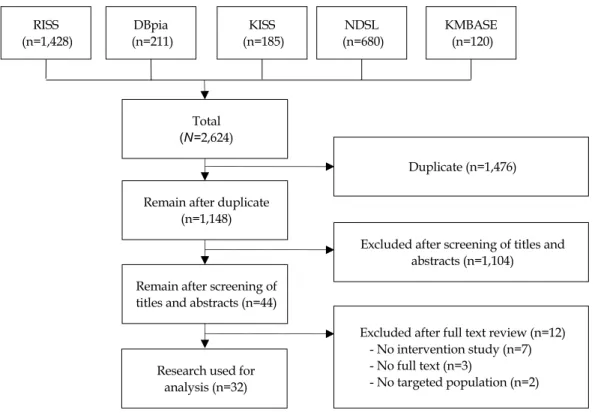
프로그램, 중재, 예방. 검색식에 따라 학술 데이터베이스 에서 검색된 논문은 모두 2,624건으로 검색된 논문 중 중 복검사를 통해 1,476건이 제외되고, 1,148건의 논문들이 1차로 선별되었다. 이후 제목과 초록을 통해 선정, 배제기 준에 따라 44건의 논문이 2차 선별되었다. 최종적으로 전 문(full-text) 확인 가능성, 선정기준에 따라 1차 전문 검토 를 통해 주요 주제와 관련되지 않은 대상 논문을 제외하는 3차 선별 과정을 거쳐 최종적으로 총 32편이 선정되었다.
대상 논문 선별 과정은 Fig. 1에 제시하였다.
선정문헌에 대한 기본 정보를 체계적으로 추출하여 집단따 돌림과 관련하여 예방 중재와 피해자 및 고위험군 대상자에게 제공된 프로그램으로 그 구성과 특성에 따라 분류하였다.
연 구 결 과
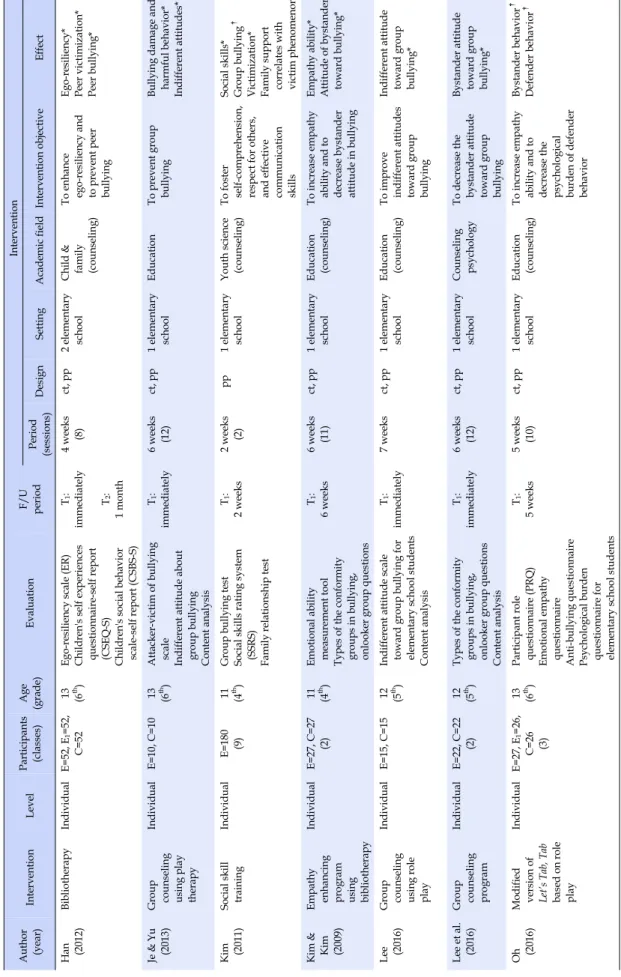
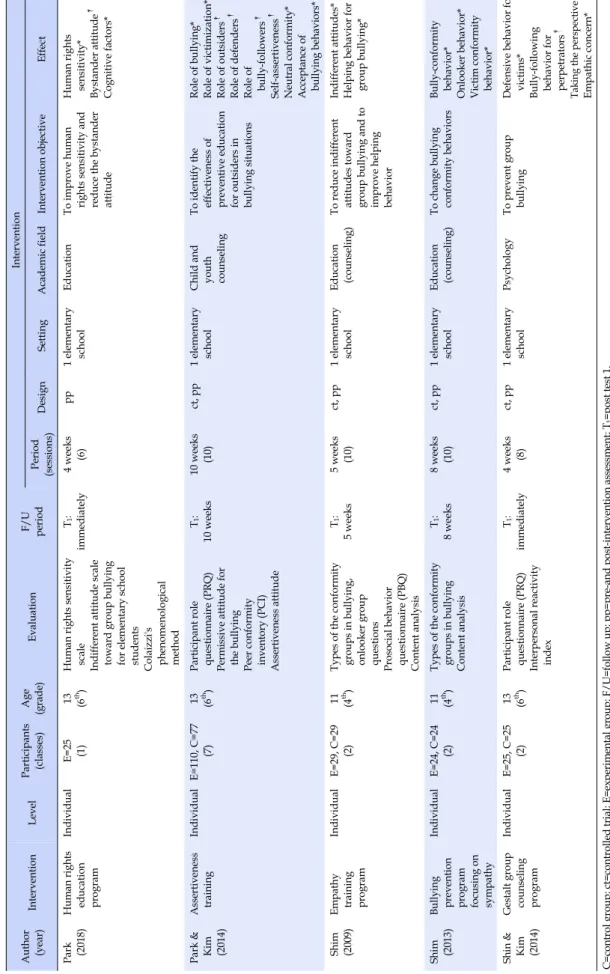
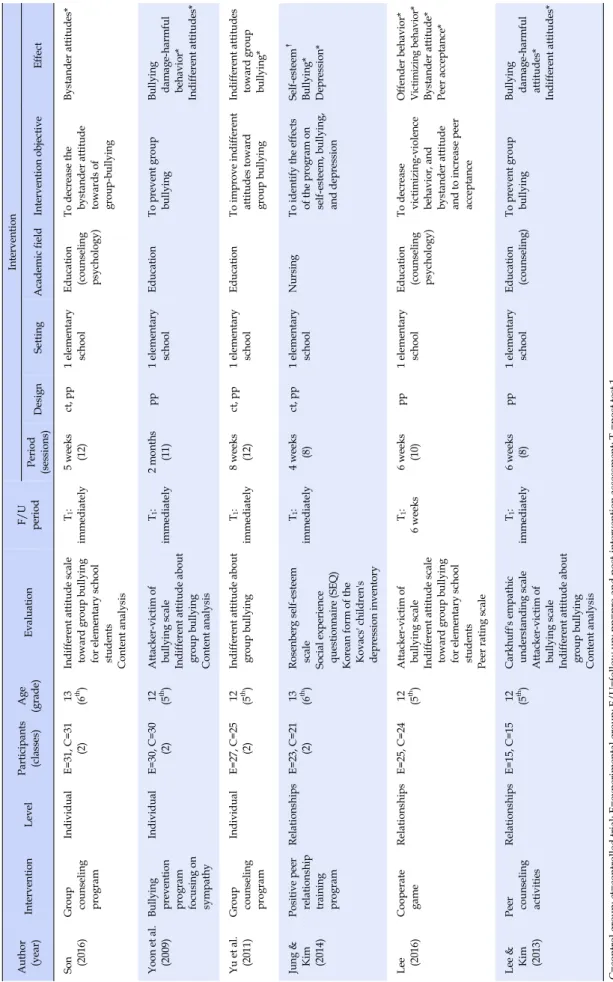
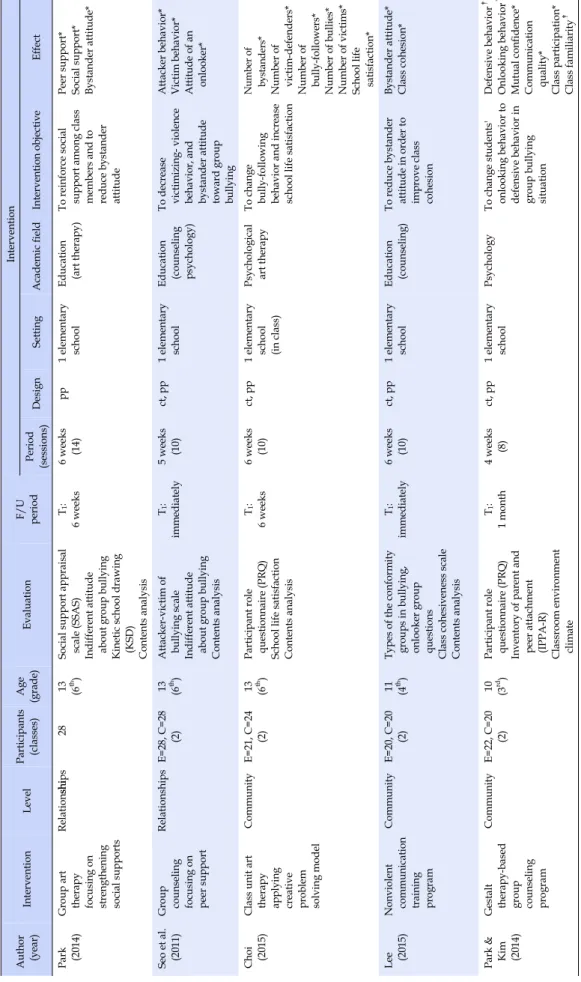
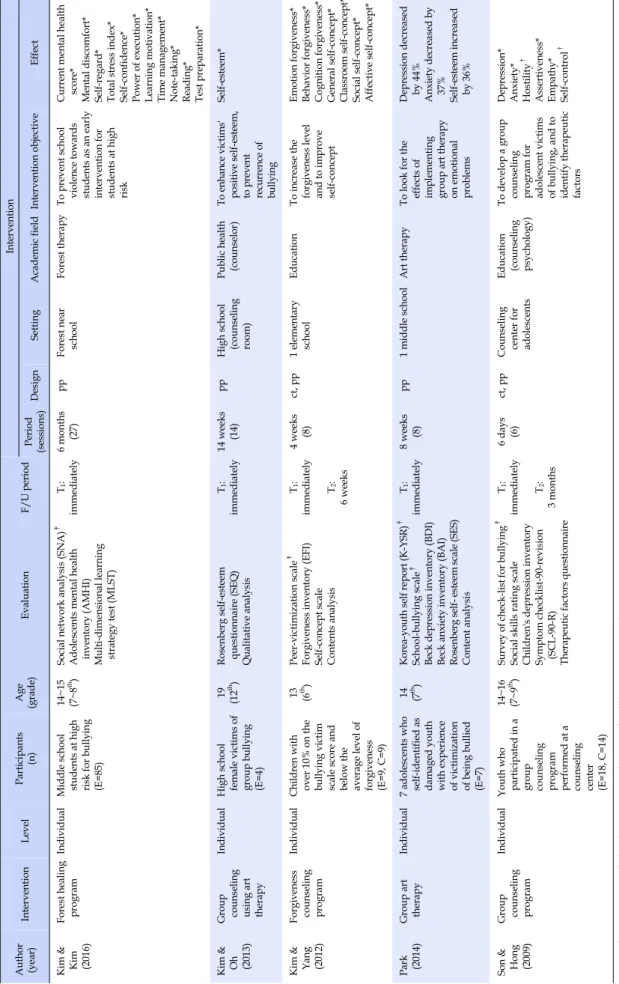
32편의 연구(학술지 15편, 학위논문 17편)가 포함기준을 충 족하였다. 연구대상자에 따라 집단따돌림 예방 프로그램 23편 Table 1과 고위험군 및 피해자 대상 프로그램 9편 Table 2로 분류하여 살펴보았고, 선정된 연구의 주요 특성은 Tables 1, 2 에 제시하였다.
1. 대상 논문의 일반적 특성
본 연구에서 선정된 연구들은 2009~2018년 사이에 출판되 었고, 32편 모두 국내출판 연구이다. 연구설계는 단일군 사전- 사후 연구가 9편(1~9), 비동등성 대조군 전후 연구가 23편이었 고, 무작위 대조군 연구는 없었다. 예방 프로그램 연구의 대상 자 수는 25~187명이며, 연령은 초등학교 3~6학년이었다. 피 해자 대상 프로그램 연구의 대상자 수는 4~85명이며, 예방 프 로그램 연구의 대상이 초등학생인 것과 다르게 주로 중학생(6 편)과 고등학생(1편)을 대상으로 진행되었다. 집단따돌림 예 방 프로그램은 주로 학급 전체학생을 대상으로 수업시간 등을 활용하여 교실에서 시행되었으며, 피해자 및 고위험군 대상 연구는 해당 학생을 선별하여 학교 내 상담실, Wee클래스, 청 소년 상담기관에서 진행되었다.
2. 대상 논문의 중재 목표
한 연구에서 여러 가지 내용을 다루고 있거나 중복되는 변 수가 있다면 중복으로 중재 목표에 기술하였다. 예방 프로그
RISS (n=1,428)
KISS (n=185)
KMBASE (n=120) DBpia
(n=211)
NDSL (n=680)
Excluded after full text review (n=12) - No intervention study (n=7) - No full text (n=3)
- No targeted population (n=2) Remain after screening of
titles and abstracts (n=44)
Research used for analysis (n=32) Remain after duplicate
(n=1,148) Total (N=2,624)
Duplicate (n=1,476)
Excluded after screening of titles and abstracts (n=1,104)
Fig. 1. Flow of studies included from database search.
램에서는 학급구성원의 또래괴롭힘 참여 역할행동 변화가 18 편(78.3%)으로 주를 이루었다(4, 6, 8, 9, 12-25). 이외에 학급구 성원들의 관계성 증진 및 응집력향상이 5편(4, 21, 24-26), 사 회적 기술 증진이 7편이었으며(1, 6, 7, 12, 17-19), 자아존중감, 자아탄력성 증진 및 우울 감소가 2편(24, 27)있었다. 다음으로 집단따돌림 고위험군 및 피해자 대상 프로그램의 목적은 9편 모두 집단따돌림 피해학생의 심리사회적 적응 증진이었으며, 자아존중감 및 자기개념 향상 6편(2, 3, 5, 28-30), 우울, 불안 등 정서 향상이 3편(5, 10, 29), 또래관계 향상이 3편(29-31)이었다.
3. 대상 논문의 중재방법
예방 프로그램은 주로 학급전체 학생을 대상으로 중재가 이루어진 반면, 피해자 및 고위험군 대상연구는 피해학생 및 고위험군을 선별(3, 5, 28-31) 또는 학교 및 지역사회 상담 프로 그램에 참가했었던 학생을 대상으로 진행되었다(2, 10, 32). 집 단따돌림 피해자를 선별하기 위한 측정도구는 다요인 인성검 사, 집단따돌림 피해학생 판별척도, 교우관계분석 등 다양한 선별도구들이 사용되었다.
중재제공 형태를 보면 또래상담 중재 1편(8)은 개별 및 소 그룹으로 진행되었고, 나머지 31편 연구는 그룹 및 집단을 대 상으로 제공되었다. 프로그램 진행 기간은 2주~6개월이었으
며, 4~6주가 22편으로 가장 많았다. 집단따돌림 중재 프로그 램을 시행한 학문분야는 교육학, 심리학, 상담학, 미술치료 등 다양하였으며 교육학 심리상담 전공자에 의한 연구가 21편으 로 주를 이루었다.
4. 대상 논문의 중재 내용
학령기 아동 ․ 청소년 대상 집단따돌림 중재 프로그램은 자기 이해, 감정표출, 사회적 기술 증진 등 다방면의 내용을 복합적으 로 다루는 프로그램이 주를 이루었다. 집단따돌림 중재는 사회 생태학적 예방 모델(social-ecological model of prevention)16) 에 따라 개인수준, 대인관계수준, 공동체수준으로 분류하여 살펴보았다. 예방 프로그램 23편 중 개인수준 중재는 15편이 었고, 독서, 놀이치료, 게임, 역할극 등을 통해 집단따돌림을 막을 수 있는 개인의 행동 및 기술을 강화를 위한 집단상담, 자 기주장 및 공감훈련 등이 이루어졌다. 대인관계수준 중재는 5 편이었고, 긍정적인 또래관계 및 사회적 지지를 강화하기 위 한 집단 및 또래 상담, 미술치료 등이 이루어졌다(4, 8, 9, 15, 24). 공동체수준 중재는 3편이었고, 학급응집력 등을 강화하기 위한 게슈탈트 치료, 비폭력 대화 훈련, 학급미술치료 등이 이 루어졌다(13, 21, 25).
피해자 및 고위험군 대상 프로그램 9편 중 개인수준 중재는
Table 1. Results of Interventions Targeting School Bullying Prevention Author (year)InterventionLevel Participants (classes)Age (grade)EvaluationF/U period
Intervention Period (sessions)DesignSettingAcademic fieldIntervention objectiveEffect Han (2012)BibliotherapyIndividualE=52, E1=52, C=5213 (6th)Ego-resiliency scale(ER) Children's self experiences questionnaire-self report (CSEQ-S) Children's social behavior scale-self report(CSBS-S)
T1: immediately T2: 1 month
4 weeks (8)ct, pp2 elementary schoolChild & family (counseling) To enhance ego-resiliency and to prevent peer bullying
Ego-resiliency* Peer victimization* Peer bullying* Je & Yu (2013)Group counseling using play therapy
IndividualE=10, C=1013 (6th )Attacker-victim of bullying scale Indifferent attitude about group bullying Content analysis
T1: immediately6 weeks (12)ct, pp1 elementary schoolEducationTo prevent group bullyingBullying damage and harmful behavior* Indifferent attitudes* Kim (2011)Social skill trainingIndividualE=180 (9)11 (4th )Group bullying test Social skills rating system (SSRS) Family relationship test T1: 2 weeks2 weeks (2)pp1 elementary schoolYouth science (counseling)To foster self-comprehension, respect for others, and effective communication skills Social skills* Group bullying† Victimization* Family support correlates with victim phenomenon* Kim & Kim (2009)
Empathy enhancing program using bibliotherapy IndividualE=27, C=27 (2)11 (4th)Emotional ability measurement tool Types of the conformity groups in bullying, onlooker group questions T1: 6 weeks6 weeks (11)ct, pp1 elementary schoolEducation (counseling)To increase empathy ability and to decrease bystander attitude in bullying
Empathy ability* Attitude of bystanders toward bullying* Lee (2016)Group counseling using role play
IndividualE=15, C=1512 (5th)Indifferent attitude scale toward group bullying for elementary school students Content analysis T1: immediately7 weeksct, pp1 elementary schoolEducation (counseling)To improve indifferent attitudes toward group bullying
Indifferent attitude toward group bullying* Lee et al. (2016)Group counseling program
IndividualE=22, C=22 (2)12 (5th)Types of the conformity groups in bullying, onlooker group questions Content analysis T1: immediately6 weeks (12)ct, pp1 elementary schoolCounseling psychologyTo decrease the bystander attitude toward group bullying
Bystander attitude toward group bullying* Oh (2016)Modified version of Let’s Tab, Tab based on role play
IndividualE=27, E1=26, C=26 (3)
13 (6th )Participant role questionnaire (PRQ) Emotional empathy questionnaire Anti-bullying questionnaire Psychological burden questionnaire for elementary school students T1: 5 weeks5 weeks (10)ct, pp1 elementary schoolEducation (counseling)To increase empathy ability and to decrease the psychological burden of defender behavior
Bystander behavior† Defender behavior† C=control group; ct=controlled trial; E=experimental group; E1=comparison group; F/U=follow up; pp=pre-and post-intervention assessment; T1=post test 1; T2=post test 2. *Significant improvement in the desired direction compared with control/pre-assessment; †No significant difference between intervention and control group or no significant change from pre-to post-assessment.
Table 1. Results of Interventions Targeting School Bullying Prevention (Continued) Author (year)InterventionLevelParticipants (classes)Age (grade)EvaluationF/U periodPeriod (sessions)DesignSetting Intervention Academic fieldIntervention objectiveEffect Park (2018)Human rights education program
IndividualE=25 (1)13 (6th)Human rights sensitivity scale Indifferent attitude scale toward group bullying for elementary school students Colaizzi's phenomenological method T1: immediately4 weeks (6)pp1 elementary schoolEducationTo improve human rights sensitivity and reduce the bystander attitude
Human rights sensitivity* Bystander attitude† Cognitive factors* Park & Kim (2014)
Assertiveness trainingIndividualE=110, C=77 (7)13 (6th)Participant role questionnaire (PRQ) Permissive attitude for the bullying Peer conformity inventory(PCI) Assertiveness attitude T1: 10 weeks10 weeks (10) ct, pp1 elementary schoolChild and youth counseling
To identify the effectiveness of preventive education for outsiders in bullying situations
Role of bullying* Role of victimization* Role of outsiders† Role of defenders† Role of bully-followers† Self-assertiveness† Neutral conformity* Acceptance of bullying behaviors* Shim (2009)Empathy training program
IndividualE=29, C=29 (2)11 (4th )Types of the conformity groups in bullying, onlooker group questions Prosocial behavior questionnaire(PBQ) Content analysis T1: 5 weeks5 weeks (10)ct, pp1 elementary schoolEducation (counseling)To reduce indifferent attitudes toward group bullying and to improve helping behavior
Indifferent attitudes* Helping behavior for group bullying* Shim (2013)Bullying prevention program focusing on sympathy
IndividualE=24, C=24 (2)11 (4th )Types of the conformity groups in bullying Content analysis
T1: 8 weeks8 weeks (10)ct, pp1 elementary schoolEducation (counseling)To change bullying conformity behaviorsBully-conformity behavior* Onlooker behavior* Victim conformity behavior* Shin & Kim (2014)
Gestalt group counseling program IndividualE=25, C=25 (2)13 (6th )Participant role questionnaire(PRQ) Interpersonal reactivity index
T1: immediately4 weeks (8)ct, pp1 elementary schoolPsychologyTo prevent group bullyingDefensive behavior for victims* Bully-following behavior for perpetrators† Taking the perspective† Empathic concern* C=control group; ct=controlled trial; E=experimental group; F/U=follow up; pp=pre-and post-intervention assessment; T1=post test 1. *Significant improvement in the desired direction compared with control/pre-assessment; † No significant difference between intervention and control group or no significant change from pre-to post-assessment.
Table 1. Results of Interventions Targeting School Bullying Prevention (Continued) (year)Participants (classes)Age (grade)Author InterventionLevelEvaluationF/U period
Intervention Period (sessions)DesignSettingAcademic fieldIntervention objective Son (2016)Group counseling program
IndividualE=31, C=31 (2)13 (6th)Indifferent attitude scale toward group bullying for elementary school students Content analysis T1: immediately5 weeks (12)ct, pp1 elementary schoolEducation (counseling psychology) To decrease the bystander attitude towards of group-bullying
Effect Bystander attitudes* Yoon et al. (2009)Bullying prevention program focusing on sympathy
IndividualE=30, C=30 (2)12 (5th)Attacker-victim of bullying scale Indifferent attitude about group bullying Content analysis
T1: immediately2 months (11)pp1 elementary schoolEducationTo prevent group bullyingBullying damage-harmful behavior* Indifferent attitudes* Yu et al. (2011)Group counseling program
IndividualE=27, C=25 (2)12 (5th )Indifferent attitude about group bullyingT1: immediately8 weeks (12)ct, pp1 elementary schoolEducationTo improve indifferent attitudes toward group bullying
Indifferent attitudes toward group bullying* Jung & Kim (2014)
Positive peer relationship training program Relationships E=23, C=21 (2)13 (6th)Rosenberg self-esteem scale Social experience questionnaire(SEQ) Korean form of the Kovacs' children's depression inventory T1: immediately4 weeks (8)ct, pp1 elementary schoolNursingTo identify the effects of the program on self-esteem, bullying, and depression
Self-esteem† Bullying* Depression* Lee (2016)Cooperate gameRelationships E=25, C=2412 (5th )Attacker-victim of bullying scale Indifferent attitude scale toward group bullying for elementary school students Peer rating scale
T1: 6 weeks6 weeks (10)pp1 elementary schoolEducation (counseling psychology) To decrease victimizing-violence behavior, and bystander attitude and to increase peer acceptance
Offender behavior* Victimizing behavior* Bystander attitude* Peer acceptance* Lee & Kim (2013)
Peer counseling activities
Relationships E=15, C=1512 (5th)Carkhuff's empathic understanding scale Attacker-victim of bullying scale Indifferent attitude about group bullying Content analysis T1: immediately6 weeks (8)pp1 elementary schoolEducation (counseling)To prevent group bullyingBullying damage-harmful attitudes* Indifferent attitudes* C=control group; ct=controlled trial; E=experimental group; F/U=follow up; pp=pre-and post-intervention assessment; T1=post test 1. *Significant improvement in the desired direction compared with control/pre-assessment; †No significant difference between intervention and control group or no significant change from pre-to post-assessment.